
IFS International Food Standard Thursday 23 rd October
IFS (International Food Standard) Thursday 23 rd October 2008 Stéphanie Monnet, IFS Project Manager FCD (Fédération des entreprises du Commerce et de la Distribution, French retail federation)
Legal situation in Europe EU General Product Safety (GPS) Directive 2001/95 ðPurpose : ensure that products placed on the market are safe ðDefinitions : safe product, dangerous product, (serious) risk, recall, withdrawal ðEuropean Commission and 27 member States : exchanges of information and rapid intervention situations ðGeneral safety requirement: producers (manufacturers, importers, others) shall be obliged to place safe products on the market General Food Law Regulation (Reg 178/2002), Hygiene Regulations (Reg 852/2004 and Reg 853/2004) General Labelling Directive (Dir 2001/13), Allergens Labelling Directive (Dir 2003/89) Labelling and Traceability GMO Regulations (Reg 1829/2003 and Reg 1830/2003) 2
Legal situation in Europe §Retailer (wholesaler) branded products - “Private” labels/brands = brands owned by the retail (or wholesale) company - Often also concerned : first price labels/brands §Consequences for retailers (wholesalers) - Retailer (wholesaler) is legally the “producer” together with the manufacturer (cf. GPS directive) - Increase of legal responsibilities for retailers (wholesalers) : obligation to control manufacturers (cf. hygiene regulations, general food law, lalelling directives) Consequence for IFS : main goal = trust in IFS certificates and reports 3
Legal situation in Europe Retailer (wholesaler) labeled products Before each retailer (wholesaler) did specific supplier food safety audits (second part audits) One supplier had several similar audits from several retailers (wholesalers) Goal of IFS : one food safety audit (= product/process third part certification) for all IFS retailers (wholesalers) ðFor one supplier : with IFS, decrease of number of retailer (wholesaler) audits 4
History of the IFS ü 2002: ØGerman retailers from the HDE developed a common food safety standard called IFS ü 2003: ØThe first IFS version was launched in May and the first audits were performed by approved IFS auditors from authorized and accredited certification bodies ØFrench retailers and wholesalers from the FCD joined the IFS Working Group and contributed to the development of IFS version 4 ü 2004: ØThe version 4 of the IFS was published in March 5
History of the IFS ü 2005: Ø In June, the new IFS for Logistic and Transport was launched Ø In November, the review process of the IFS version 4 started – all concerned parties (retailers, food suppliers, certification bodies and accreditation bodies) were strongly involved ü 2006: ØItalian retailers joined the IFS and participated at the review process ü 2007: ØThe review process of IFS version 4 was finalized ØIn Summer, the IFS Food version 5 was published 6
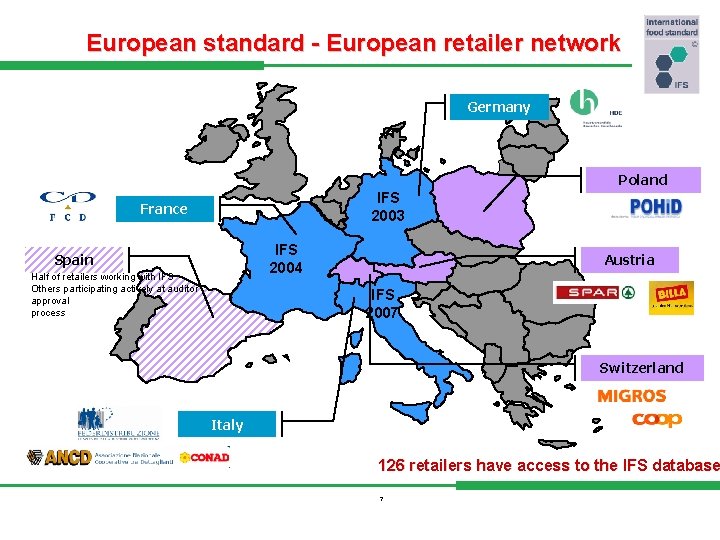
European standard - European retailer network Germany Poland IFS 2003 France IFS 2004 Spain Half of retailers working with IFS Others participating actively at auditor approval process Austria IFS 2007 Switzerland Italy 126 retailers have access to the IFS database 7
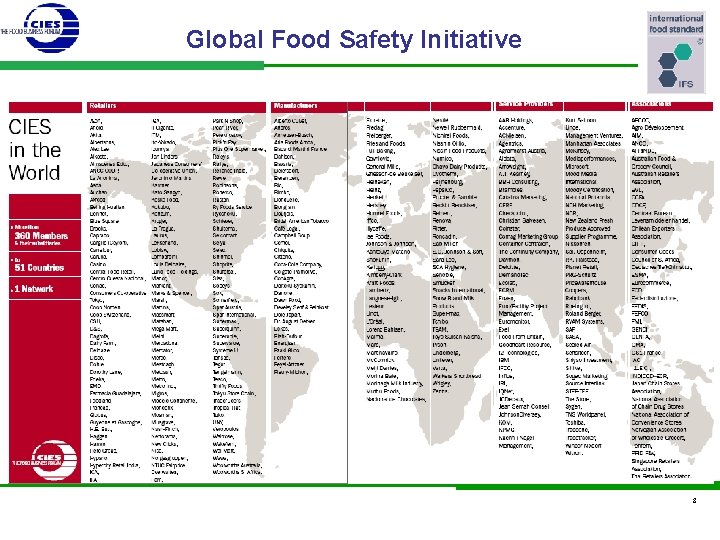
Global Food Safety Initiative 8
Global Food Safety Initiative Objectives of the GFSI are: • Convergence between food safety standards through maintaining a benchmarking process for food safety management schemes • Improve cost efficiency throughout the food supply chain through the common acceptance of GFSI recognised standards by retailers around the world • Provide a unique international stakeholder platform for networking, knowledge exchange and sharing of best food safety practice and information 9
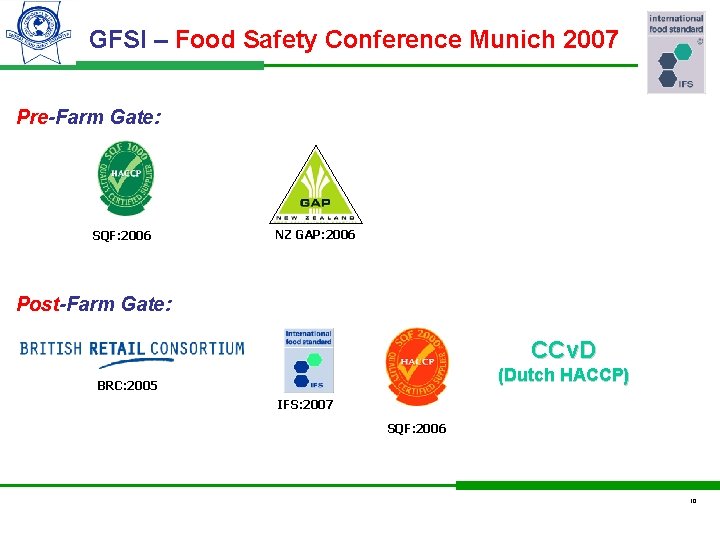
GFSI – Food Safety Conference Munich 2007 Pre-Farm Gate: SQF: 2006 NZ GAP: 2006 Post-Farm Gate: CCv. D (Dutch HACCP) BRC: 2005 IFS: 2007 SQF: 2006 10
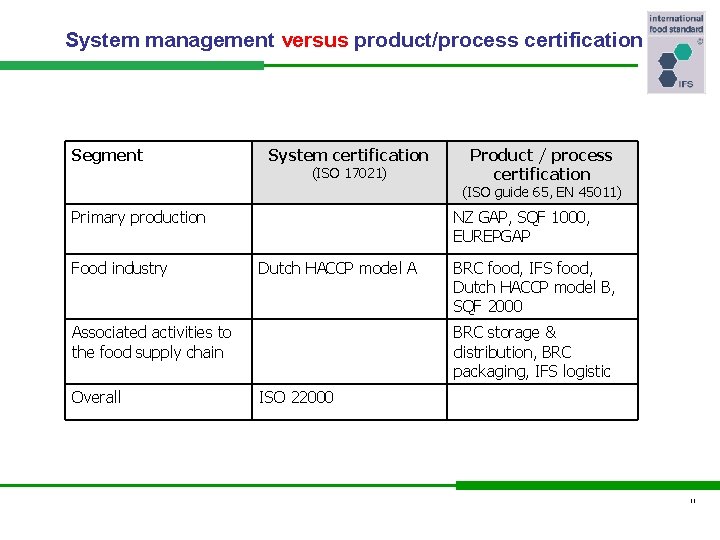
System management versus product/process certification Segment System certification (ISO 17021) Product / process certification (ISO guide 65, EN 45011) Primary production Food industry NZ GAP, SQF 1000, EUREPGAP Dutch HACCP model A Associated activities to the food supply chain Overall BRC food, IFS food, Dutch HACCP model B, SQF 2000 BRC storage & distribution, BRC packaging, IFS logistic ISO 22000 11
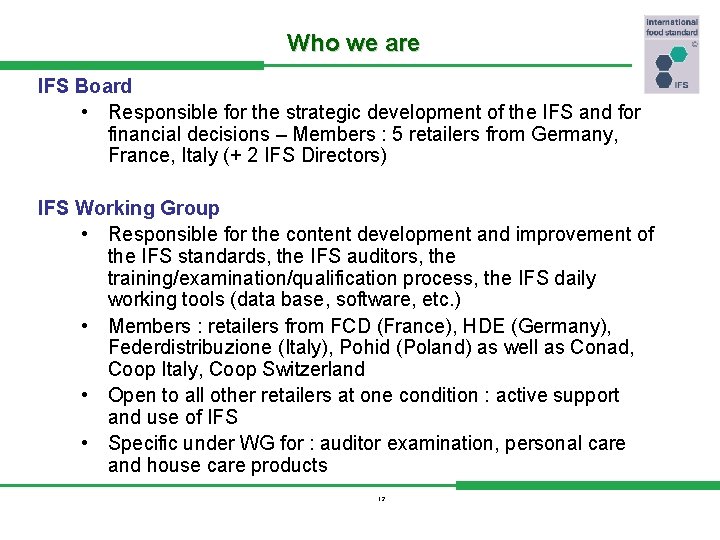
Who we are IFS Board • Responsible for the strategic development of the IFS and for financial decisions – Members : 5 retailers from Germany, France, Italy (+ 2 IFS Directors) IFS Working Group • Responsible for the content development and improvement of the IFS standards, the IFS auditors, the training/examination/qualification process, the IFS daily working tools (data base, software, etc. ) • Members : retailers from FCD (France), HDE (Germany), Federdistribuzione (Italy), Pohid (Poland) as well as Conad, Coop Italy, Coop Switzerland • Open to all other retailers at one condition : active support and use of IFS • Specific under WG for : auditor examination, personal care and house care products 12
Who we are IFS Management • Responsible for the continuous development/improvement and the international recognition • Representation of IFS, financial management • = two directors : Stephan Tromp / HDE + Alexander Rogge / FCD IFS Offices • 3 offices in Berlin, Milano and Paris, 3 IFS project managers • Responsible for the administration and the organisation of the IFS is a non profit structure – Goal of IFS is entire satisfaction of members (retailers) = their complete trust is IFS certificates and reports 13
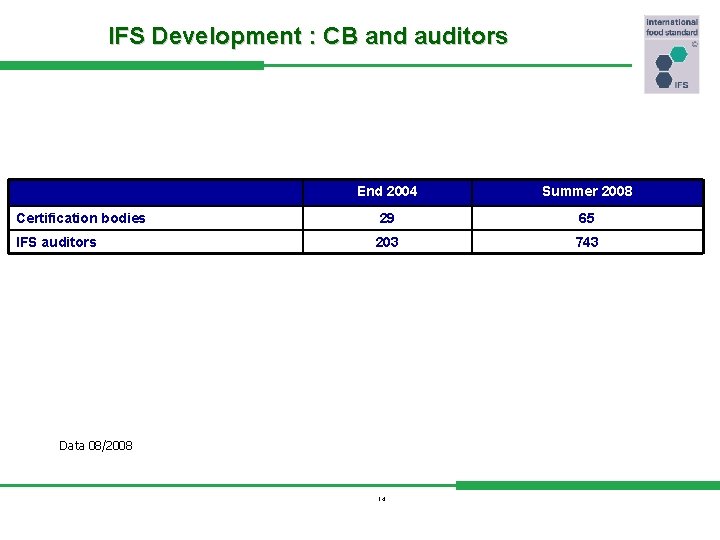
IFS Development : CB and auditors End 2004 Summer 2008 Certification bodies 29 65 IFS auditors 203 743 Data 08/2008 14
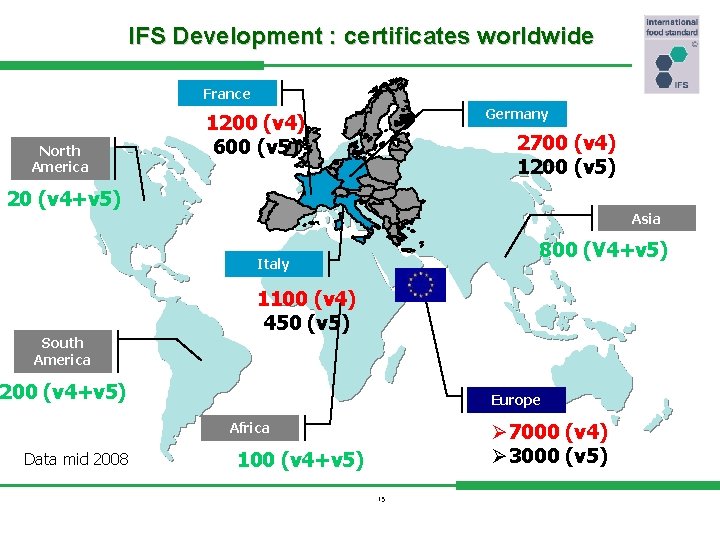
IFS Development : certificates worldwide France North America Germany 1200 (v 4) 600 (v 5) 2700 (v 4) 1200 (v 5) 20 (v 4+v 5) Asia 800 (V 4+v 5) Italy 1100 (v 4) 450 (v 5) South America 200 (v 4+v 5) Europe Ø 7000 (v 4) Ø 3000 (v 5) Africa Data mid 2008 100 (v 4+v 5) 15
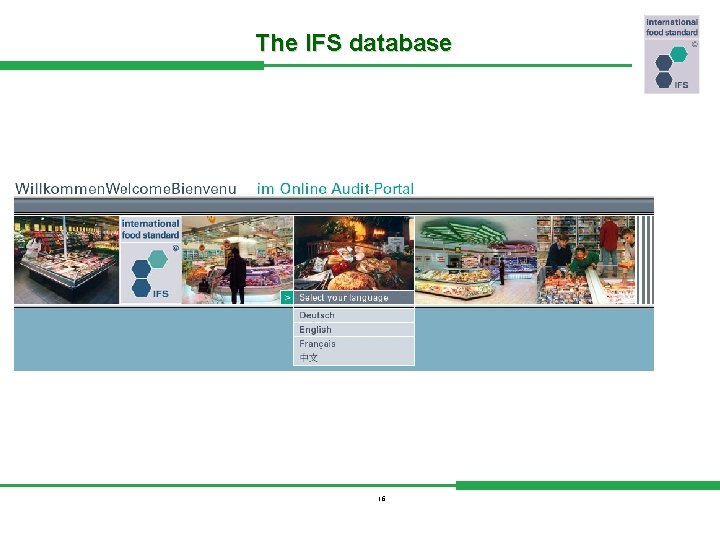
The IFS database 16
Global daily working tool for quality managers / buyers • Database – www. food-care. info or www. ifs-online. eu - gives current status, access to all certificates, to all audit reports (uniform presentation), numerous queries possible In English, German, French, Italian (2009) and Spanish (2009), (as well as Chinese for general information) – for retailers (contact IFS offices for inscription – free – no fees) • Possibility to check status of their suppliers and all audit reports (with comprehensive summary of each chapter) • Numerous statistics online available • Daily supplier management tool online for quality managers/buyers (e. g. automatic information of retailer in case of status modification of one of his pre-selected suppliers) 17
Global daily working tool for quality managers / buyers • Database – www. food-care. info or www. ifs-online. eu – for certification bodies • Administration tool to upload the audit report and action plan of their customers (= suppliers) – Certification bodies have to upload report and action plan for all performed IFS audits • Management of the master data of their customers (= suppliers) – for suppliers • Verification of their own certification status • Give access to retailer clients to own data • Own management tool to check the certification status / audit report of their subcontractors • Direct link with other standards and their data 18
Strong and controlled requirements for CBs and auditors • IFS contract with each certification body CB shall : Ø respect product/process certification = be accredited ISO Guide 65 Ø train on IFS the certification committee/the person responsible for the recommendation of the certification decision Ø have at least one IFS trainer (requirements for IFS trainers and IFS mandatory train the trainer sessions organized by IFS) Ø make sure that none of its auditors has performed consulting activities in the company where he/she performs the IFS audit during the previous 2 years Ø make sure that each auditor works only for one certification body 19
Strong and controlled requirements for CBs and auditors • IFS contract with each certification body CB shall : Ø make sure that the auditor is competent for the scope of the audit and its execution Ø guarantee that one auditor will not perform more than 3 consecutive IFS audits in the same company Ø before the application of an auditor at the IFS examinations, train the auditor (conditions for the organisation of IFS in-house training courses) and perform an on-site observation of the auditor under 45011 -related standards (to ensure the auditor‘s competence before he/she has applied for the IFS examinations) 20
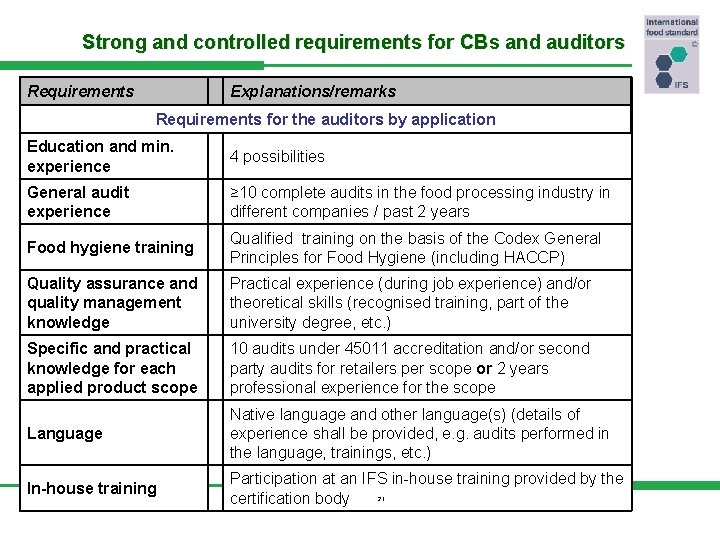
Strong and controlled requirements for CBs and auditors Requirements Explanations/remarks Requirements for the auditors by application Education and min. experience 4 possibilities General audit experience ≥ 10 complete audits in the food processing industry in different companies / past 2 years Food hygiene training Qualified training on the basis of the Codex General Principles for Food Hygiene (including HACCP) Quality assurance and quality management knowledge Practical experience (during job experience) and/or theoretical skills (recognised training, part of the university degree, etc. ) Specific and practical knowledge for each applied product scope 10 audits under 45011 accreditation and/or second party audits for retailers per scope or 2 years professional experience for the scope Language Native language and other language(s) (details of experience shall be provided, e. g. audits performed in the language, trainings, etc. ) In-house training Participation at an IFS in-house training provided by the 21 certification body
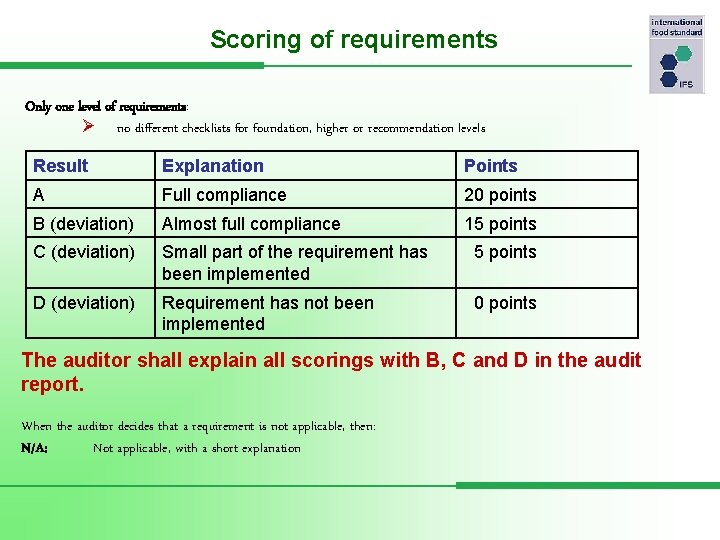
Scoring of requirements Only one level of requirements: Ø no different checklists for foundation, higher or recommendation levels Result Explanation Points A Full compliance 20 points B (deviation) Almost full compliance 15 points C (deviation) Small part of the requirement has been implemented 5 points D (deviation) Requirement has not been implemented 0 points The auditor shall explain all scorings with B, C and D in the audit report. When the auditor decides that a requirement is not applicable, then: N/A: Not applicable, with a short explanation
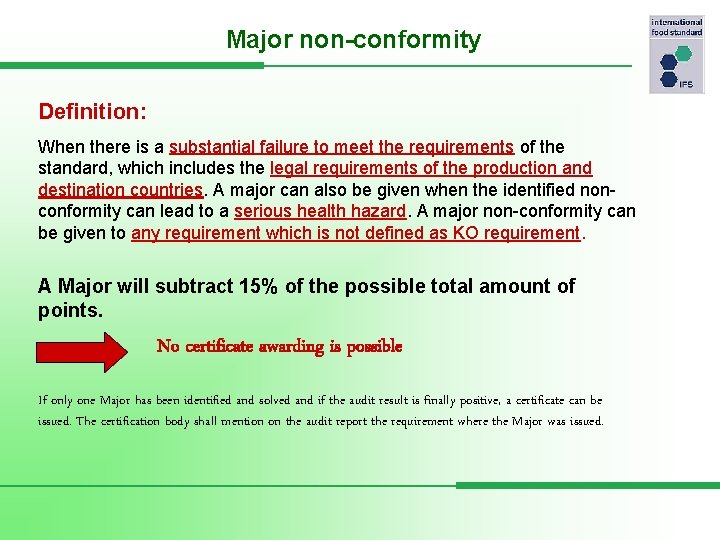
Major non-conformity Definition: When there is a substantial failure to meet the requirements of the standard, which includes the legal requirements of the production and destination countries. A major can also be given when the identified nonconformity can lead to a serious health hazard. A major non-conformity can be given to any requirement which is not defined as KO requirement. A Major will subtract 15% of the possible total amount of points. No certificate awarding is possible If only one Major has been identified and solved and if the audit result is finally positive, a certificate can be issued. The certification body shall mention on the audit report the requirement where the Major was issued.
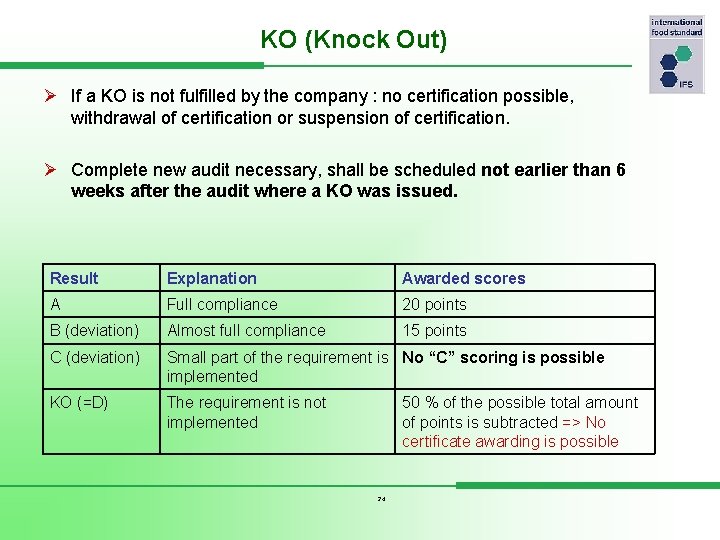
KO (Knock Out) Ø If a KO is not fulfilled by the company : no certification possible, withdrawal of certification or suspension of certification. Ø Complete new audit necessary, shall be scheduled not earlier than 6 weeks after the audit where a KO was issued. Result Explanation Awarded scores A Full compliance 20 points B (deviation) Almost full compliance 15 points C (deviation) Small part of the requirement is No “C” scoring is possible implemented KO (=D) The requirement is not implemented 50 % of the possible total amount of points is subtracted => No certificate awarding is possible 24
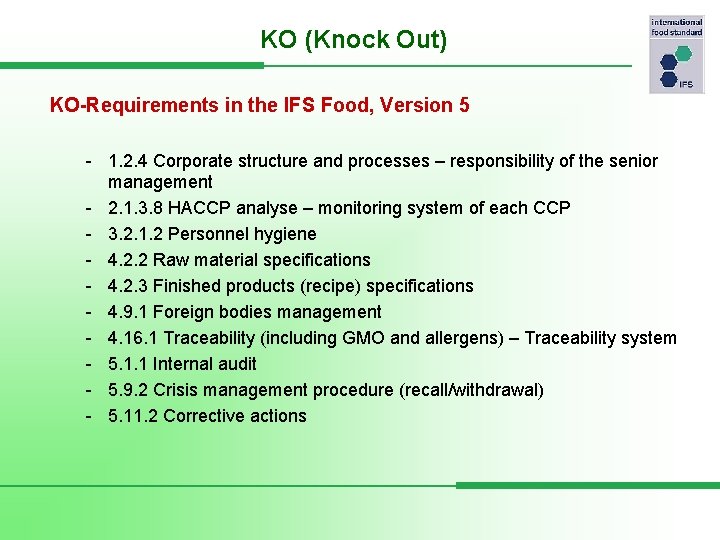
KO (Knock Out) KO-Requirements in the IFS Food, Version 5 - 1. 2. 4 Corporate structure and processes – responsibility of the senior management - 2. 1. 3. 8 HACCP analyse – monitoring system of each CCP - 3. 2. 1. 2 Personnel hygiene - 4. 2. 2 Raw material specifications - 4. 2. 3 Finished products (recipe) specifications - 4. 9. 1 Foreign bodies management - 4. 16. 1 Traceability (including GMO and allergens) – Traceability system - 5. 1. 1 Internal audit - 5. 9. 2 Crisis management procedure (recall/withdrawal) - 5. 11. 2 Corrective actions
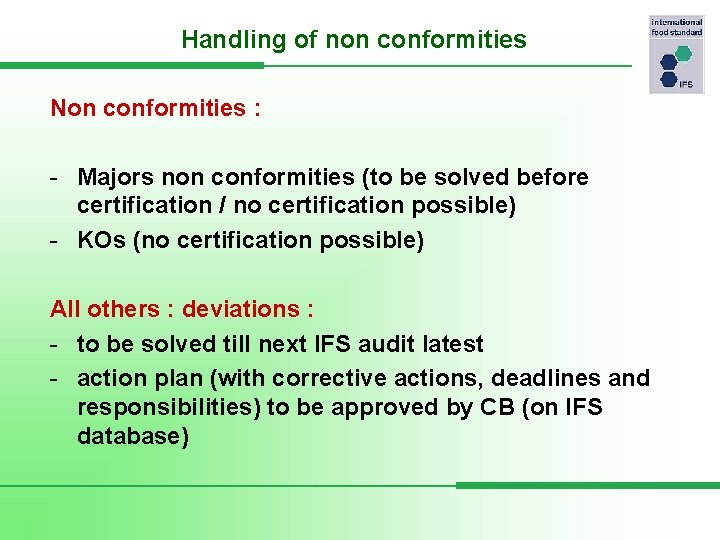
Handling of non conformities Non conformities : - Majors non conformities (to be solved before certification / no certification possible) - KOs (no certification possible) All others : deviations : - to be solved till next IFS audit latest - action plan (with corrective actions, deadlines and responsibilities) to be approved by CB (on IFS database)
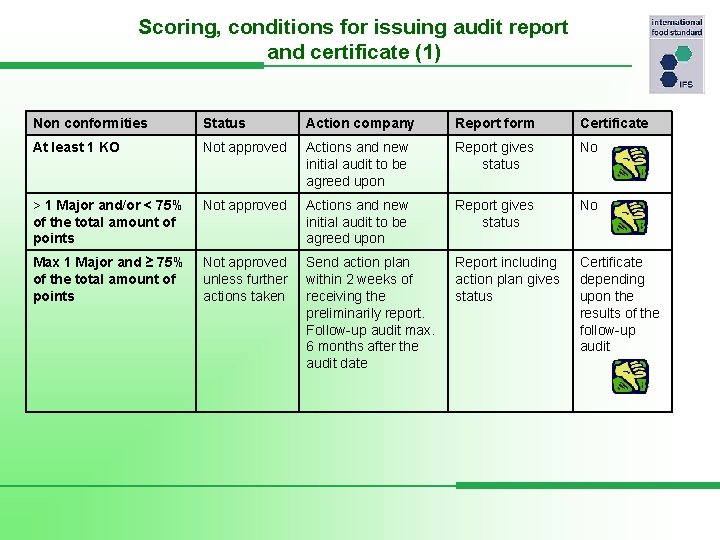
Scoring, conditions for issuing audit report and certificate (1) Non conformities Status Action company Report form Certificate At least 1 KO Not approved Actions and new initial audit to be agreed upon Report gives status No > 1 Major and/or < 75% of the total amount of points Not approved Actions and new initial audit to be agreed upon Report gives status No Max 1 Major and ≥ 75% of the total amount of points Not approved unless further actions taken Send action plan within 2 weeks of receiving the preliminarily report. Follow-up audit max. 6 months after the audit date Report including action plan gives status Certificate depending upon the results of the follow-up audit
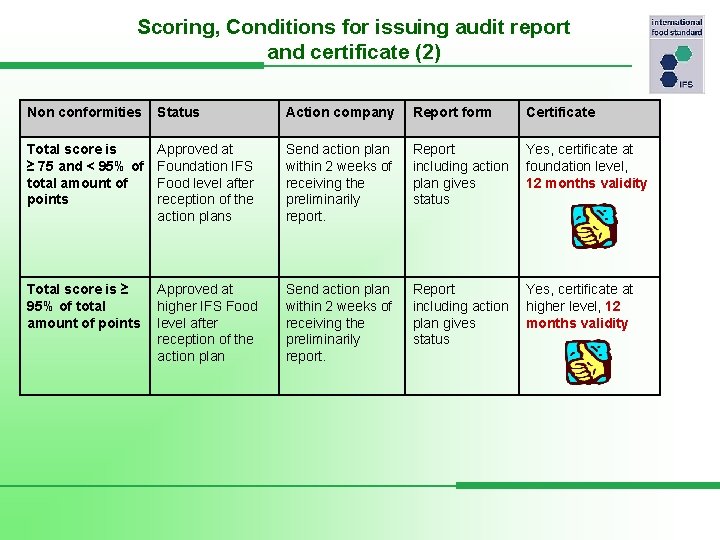
Scoring, Conditions for issuing audit report and certificate (2) Non conformities Status Action company Report form Certificate Total score is ≥ 75 and < 95% of total amount of points Approved at Foundation IFS Food level after reception of the action plans Send action plan within 2 weeks of receiving the preliminarily report. Report including action plan gives status Yes, certificate at foundation level, 12 months validity Total score is ≥ 95% of total amount of points Approved at higher IFS Food level after reception of the action plan Send action plan within 2 weeks of receiving the preliminarily report. Report including action plan gives status Yes, certificate at higher level, 12 months validity
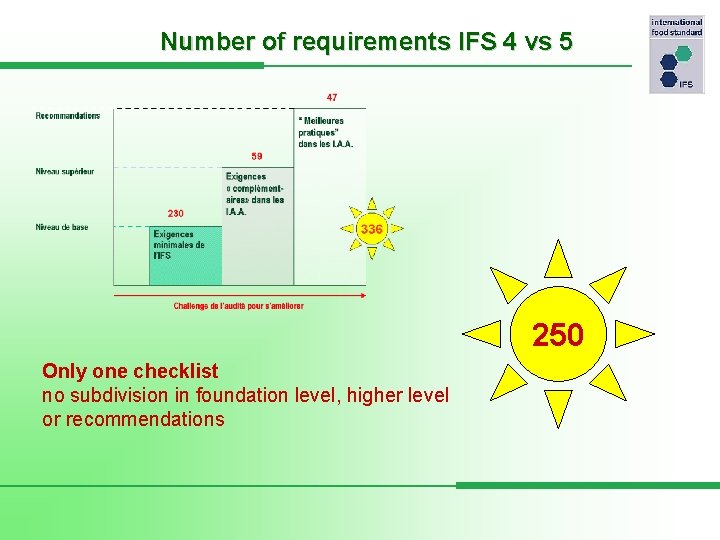
Number of requirements IFS 4 vs 5 250 Only one checklist no subdivision in foundation level, higher level or recommendations
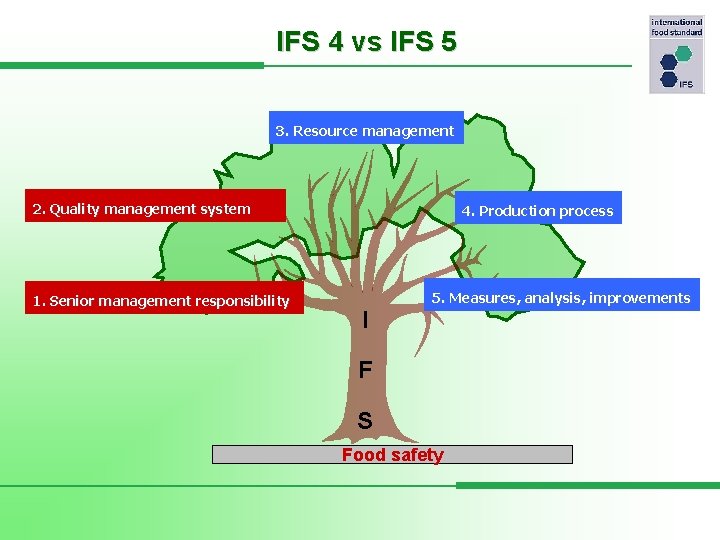
IFS 4 vs IFS 5 3. Resource management 2. Quality management system 1. Senior management responsibility 4. Production process 5. Measures, analysis, improvements I F S Food safety
IFS = fully managed system Ø Contract with each IFS certification body Ø Complete check up of the qualification of each auditor every two years Ø Database gives access to current status, all audit reports, all certificates Ø Uniform audit report saves time and money Ø Quick adaptation to new regulation and new customer requirements Ø World wide audits performed in native language of the supplier Ø Developed by retailers with strong input from manufacturers, CBs/auditors, ABs and national authorities 31
2008/2009 Ø Ø IFS Food version 5 guidelines for wholesalers (cash&carry) Separate guidelines/standard for brokers Review of the IFS Logistic IFS E-learning for suppliers, IFS internal audit software for suppliers Ø Further expansion of the IFS network (e. g. Spain, Poland, Austria, Switzerland) Ø Cooperation with the European Egg Consortium (EEC) Ø Development of IFS “House and personal care products”
Thank you for your attention! For any information, please contact us: • • IFS Paris Stéphanie Monnet-Lemaître Phone: 0033. (0)1. 444. 399. 16 E - Mail: lemaitre@fecd. eu IFS Berlin Steffi Becker Phone: 0049. (0)30. 726. 250. 74 E - Mail: becker@hde. de
- Slides: 33