
IFRS and Global Tax Planning Heather Jurek Deloitte

IFRS and Global Tax Planning Heather Jurek, Deloitte Tax LLP TEI/IFA IFRS Seminar March 25, 2009
Keep in Mind • The views expressed do not necessarily represent Deloitte & Touche LLP or Deloitte Tax LLP policy • The outcome of any specific matter depends upon the specific facts and circumstances in which the matter arises • The views expressed cannot be relied upon as accounting or tax advice • Check with a qualified advisor before taking any action Copyright © 2009 Deloitte Development LLC. All rights reserved.
Agenda Overview of International Tax Implications of IFRS Impact of IFRS on Local Jurisdiction Taxes Effective Tax Rate: Global Tax Planning – Finance supply chain considerations – Product supply chain considerations Copyright © 2009 Deloitte Development LLC. All rights reserved.
International Tax Implications of IFRS
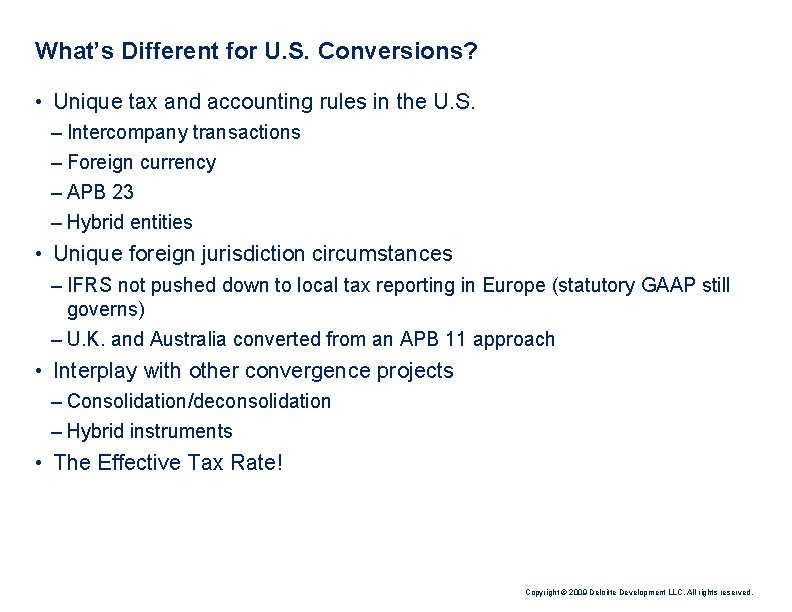
What’s Different for U. S. Conversions? • Unique tax and accounting rules in the U. S. ‒ Intercompany transactions ‒ Foreign currency ‒ APB 23 ‒ Hybrid entities • Unique foreign jurisdiction circumstances ‒ IFRS not pushed down to local tax reporting in Europe (statutory GAAP still governs) ‒ U. K. and Australia converted from an APB 11 approach • Interplay with other convergence projects ‒ Consolidation/deconsolidation ‒ Hybrid instruments • The Effective Tax Rate! Copyright © 2009 Deloitte Development LLC. All rights reserved.

Tax Aspects of IFRS Finance Supply Chain Global Tax Planning • Accounting Method Changes — Some jurisdictions require approval to change an accounting method used to calculate taxes • Transfer pricing — IFRS conversion of comparables and impact of IFRS conversion on individual margins • Transition rules — Dealing with tax forms and systems based on local GAAP • Tax audit defense – Maintaining legacy data Operations, Systems and Talent • Local interest deductibility — Standardize accounting for income tax policies that are not necessarily based on U. S. GAAP • Characterization of financial instruments • Foreign currency • Earnings & profits – Repatriation considerations • Global provision process – Opportunity to revise/improve global provision process • Global provision software — Software needs to accommodate foreign currency implications • Training — Training on changes between IAS 12 and local GAAP tax accounting. Countries with limited book/tax differences under local GAAP may need training to identify new deferred taxes under IFRS • Chart of accounts — Update to enable tracking of legacy data, intercompany transactions, currency translation • Legal entity rationalization — Opportunity to revise structure • Shared service centers Operations Product Supply Chain • Cross-border asset transfers — Consider planning opportunities • Amortization and depreciation - • Leasing — Potential loss of tax benefits as a result of changes to financial reporting accounting methods • R&D – Consider opportunities to improve information to support R&D claims • Local country income/deductions — Consider book/tax conformity e. g. , LIFO in U. S. , intangible amortization in UK • Transition rules – Local country tax treatment of adjustments to retained earnings Compliance Non Tax. Accounting • Share-based compensation — Deferred tax asset based on expected future tax benefit as measured at the end of each reporting period. • Foreign currency — Differences between statutory and consolidated reporting requirements • Deferred tax impact – Many pre-tax changes may impact deferred taxes, with related systems and training issues Cash Taxes • Intercompany transactions — Potential impact on ETR from recording taxes on transactions eliminated for book purposes • Functional currency — ETR impact from recording deferred taxes on non-monetary assets remeasured at historic rate for book purposes • Uncertain tax benefits — Measurement and recognition • Note: Proposed amendments to IAS 12 Cash Taxes and Compliance Global Tax Provision IAS 12 vs. FAS 109 Tax Accounting and Disclosures Copyright © 2009 Deloitte Development LLC. All rights reserved.
Impact of IFRS on Local Jurisdiction Taxes
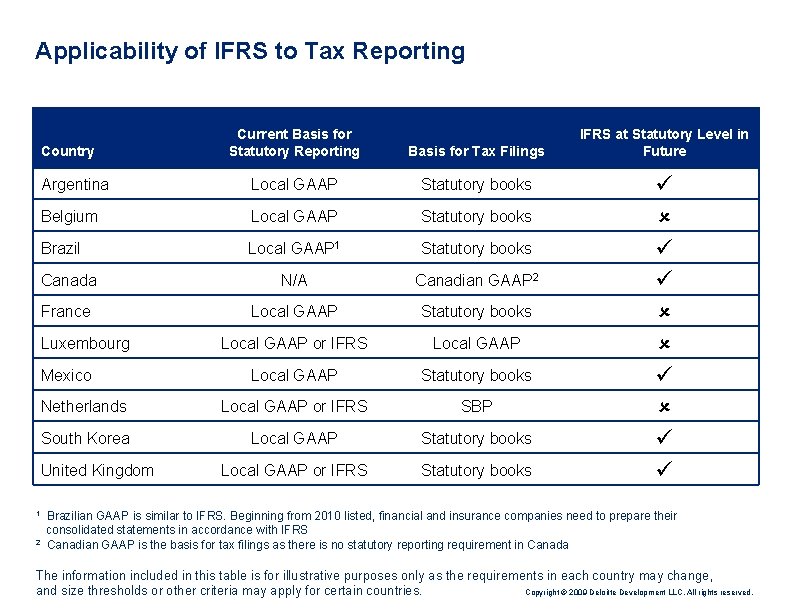
Applicability of IFRS to Tax Reporting Current Basis for Statutory Reporting Basis for Tax Filings Argentina Local GAAP Statutory books Belgium Local GAAP Statutory books Brazil Local GAAP 1 Statutory books Canada N/A Canadian GAAP 2 France Local GAAP Statutory books Local GAAP or IFRS Local GAAP Statutory books Netherlands Local GAAP or IFRS SBP South Korea Local GAAP Statutory books Local GAAP or IFRS Statutory books Country Luxembourg Mexico United Kingdom IFRS at Statutory Level in Future 1 Brazilian GAAP is similar to IFRS. Beginning from 2010 listed, financial and insurance companies need to prepare their consolidated statements in accordance with IFRS 2 Canadian GAAP is the basis for tax filings as there is no statutory reporting requirement in Canada The information included in this table is for illustrative purposes only as the requirements in each country may change, Copyright © 2009 Deloitte Development LLC. All rights reserved. and size thresholds or other criteria may apply for certain countries.
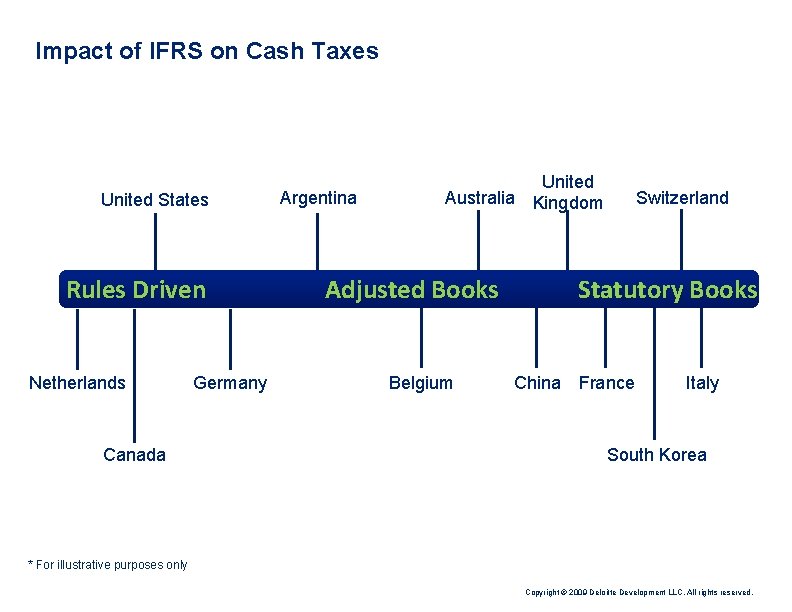
Impact of IFRS on Cash Taxes United States Rules Driven Netherlands Canada Germany Argentina United Australia Kingdom Adjusted Books Belgium Switzerland Statutory Books China France Italy South Korea * For illustrative purposes only Copyright © 2009 Deloitte Development LLC. All rights reserved.

Effective Tax Rate: Global Tax Planning
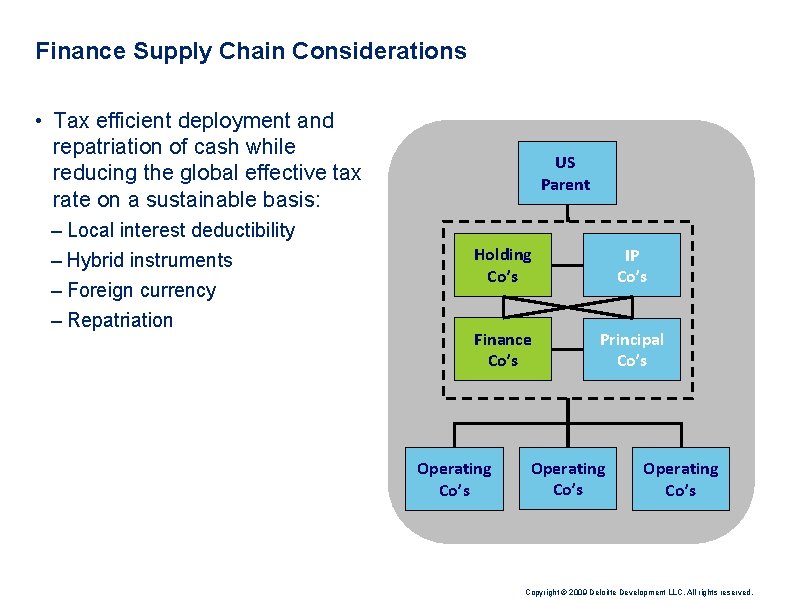
Finance Supply Chain Considerations • Tax efficient deployment and repatriation of cash while reducing the global effective tax rate on a sustainable basis: ‒ Local interest deductibility ‒ Hybrid instruments ‒ Foreign currency ‒ Repatriation US Parent Holding Co’s IP Co’s Finance Co’s Principal Co’s Operating Co’s Copyright © 2009 Deloitte Development LLC. All rights reserved.
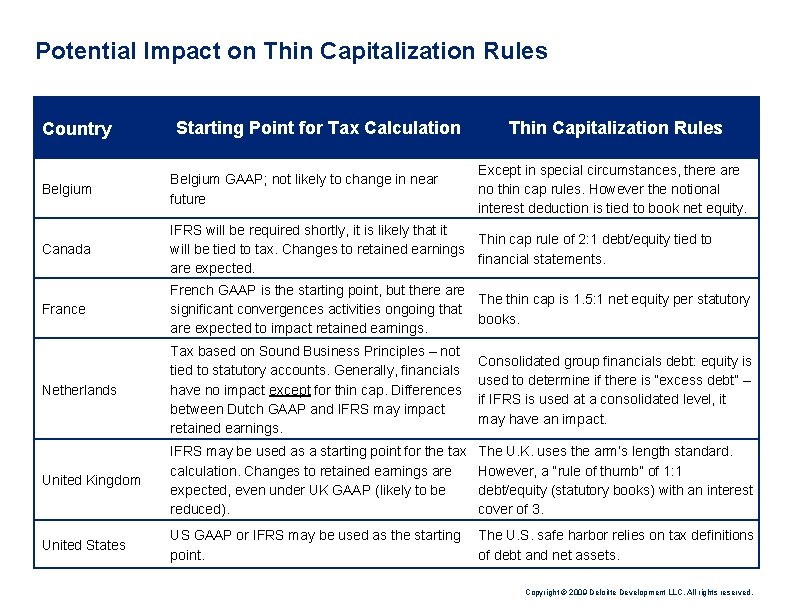
Potential Impact on Thin Capitalization Rules Country Starting Point for Tax Calculation Thin Capitalization Rules Except in special circumstances, there are no thin cap rules. However the notional interest deduction is tied to book net equity. Belgium GAAP; not likely to change in near future Canada IFRS will be required shortly, it is likely that it Thin cap rule of 2: 1 debt/equity tied to will be tied to tax. Changes to retained earnings financial statements. are expected. France French GAAP is the starting point, but there are The thin cap is 1. 5: 1 net equity per statutory significant convergences activities ongoing that books. are expected to impact retained earnings. Netherlands Tax based on Sound Business Principles – not tied to statutory accounts. Generally, financials have no impact except for thin cap. Differences between Dutch GAAP and IFRS may impact retained earnings. Consolidated group financials debt: equity is used to determine if there is “excess debt” – if IFRS is used at a consolidated level, it may have an impact. United Kingdom IFRS may be used as a starting point for the tax calculation. Changes to retained earnings are expected, even under UK GAAP (likely to be reduced). The U. K. uses the arm’s length standard. However, a “rule of thumb” of 1: 1 debt/equity (statutory books) with an interest cover of 3. United States US GAAP or IFRS may be used as the starting The U. S. safe harbor relies on tax definitions point. of debt and net assets. Copyright © 2009 Deloitte Development LLC. All rights reserved.
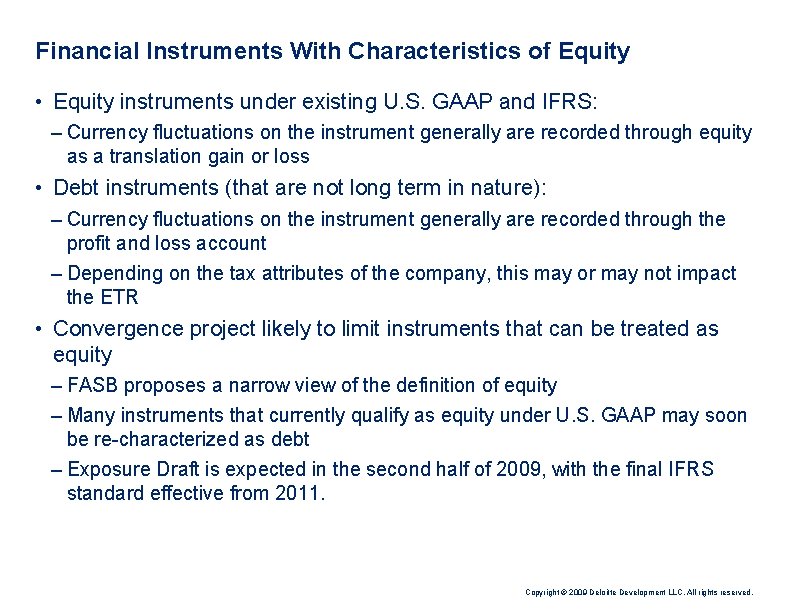
Financial Instruments With Characteristics of Equity • Equity instruments under existing U. S. GAAP and IFRS: ‒ Currency fluctuations on the instrument generally are recorded through equity as a translation gain or loss • Debt instruments (that are not long term in nature): ‒ Currency fluctuations on the instrument generally are recorded through the profit and loss account ‒ Depending on the tax attributes of the company, this may or may not impact the ETR • Convergence project likely to limit instruments that can be treated as equity ‒ FASB proposes a narrow view of the definition of equity ‒ Many instruments that currently qualify as equity under U. S. GAAP may soon be re-characterized as debt ‒ Exposure Draft is expected in the second half of 2009, with the final IFRS standard effective from 2011. Copyright © 2009 Deloitte Development LLC. All rights reserved.
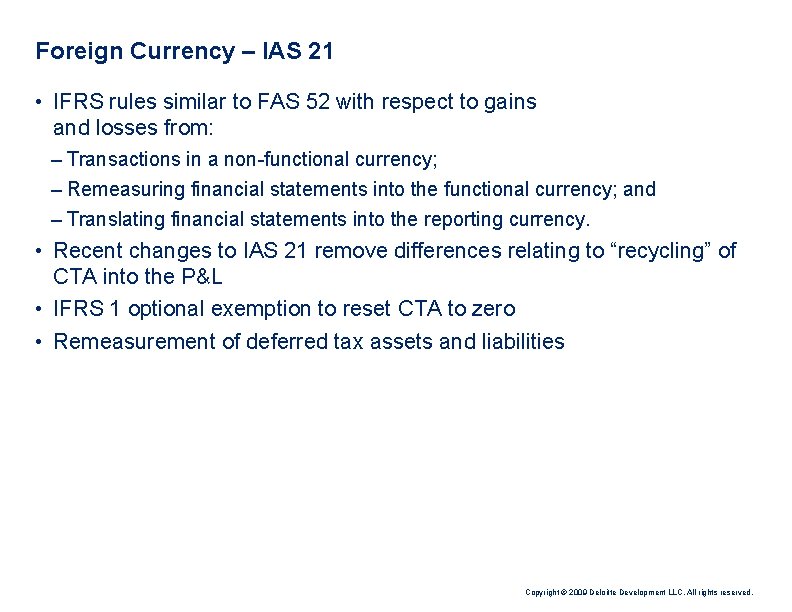
Foreign Currency – IAS 21 • IFRS rules similar to FAS 52 with respect to gains and losses from: ‒ Transactions in a non-functional currency; ‒ Remeasuring financial statements into the functional currency; and ‒ Translating financial statements into the reporting currency. • Recent changes to IAS 21 remove differences relating to “recycling” of CTA into the P&L • IFRS 1 optional exemption to reset CTA to zero • Remeasurement of deferred tax assets and liabilities Copyright © 2009 Deloitte Development LLC. All rights reserved.
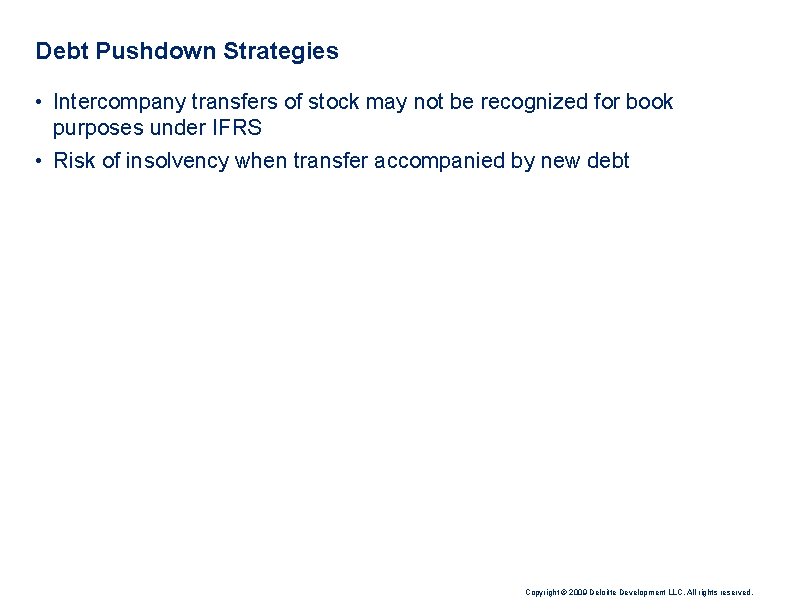
Debt Pushdown Strategies • Intercompany transfers of stock may not be recognized for book purposes under IFRS • Risk of insolvency when transfer accompanied by new debt Copyright © 2009 Deloitte Development LLC. All rights reserved.
Repatriation Planning • Drivers of repatriation planning ‒ Retained earnings per statutory books ‒ U. S. tax “earnings & profits” • Change in local accounting standards impacts first driver, but not second ‒ Evaluate countries where limiting factor is retained earnings Copyright © 2009 Deloitte Development LLC. All rights reserved.
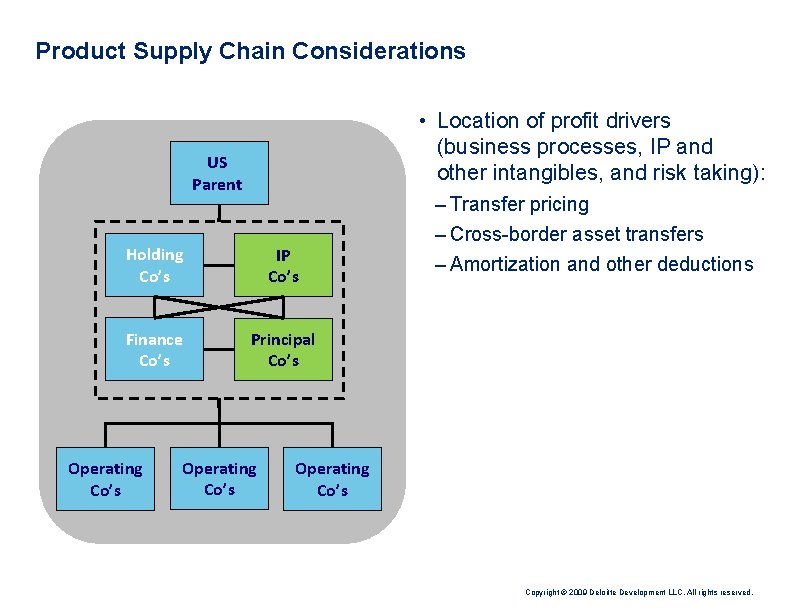
Product Supply Chain Considerations • Location of profit drivers (business processes, IP and other intangibles, and risk taking): US Parent Holding Co’s IP Co’s Finance Co’s Principal Co’s Operating Co’s ‒ Transfer pricing ‒ Cross-border asset transfers ‒ Amortization and other deductions Operating Co’s Copyright © 2009 Deloitte Development LLC. All rights reserved.
IFRS and Transfer Pricing • Principle-Based Standards ‒ Subjective ‒ Differences in interpretation by jurisdictions ‒ May require increased reliance on footnote disclosures to assess comparability • Transition ‒ Global and U. S. timelines ‒ Private companies ‒ Consider number of years of comparative data available under IFRS • Certain US transfer pricing methods generally require 3 years of data Copyright © 2009 Deloitte Development LLC. All rights reserved.
IFRS and Transfer Pricing (cont. ) • Comparability ‒ Different classification of expenses • by nature (e. g. , according to type) or • by function (e. g. , as part of cost of sales or general and administrative expenses) ‒ Differences in accounting treatment of inventory, PP&E, employee benefits, intangible assets, etc. ‒ Revenue acceleration/deferral • Impact on APAs and cost sharing buy-in payments Copyright © 2009 Deloitte Development LLC. All rights reserved.
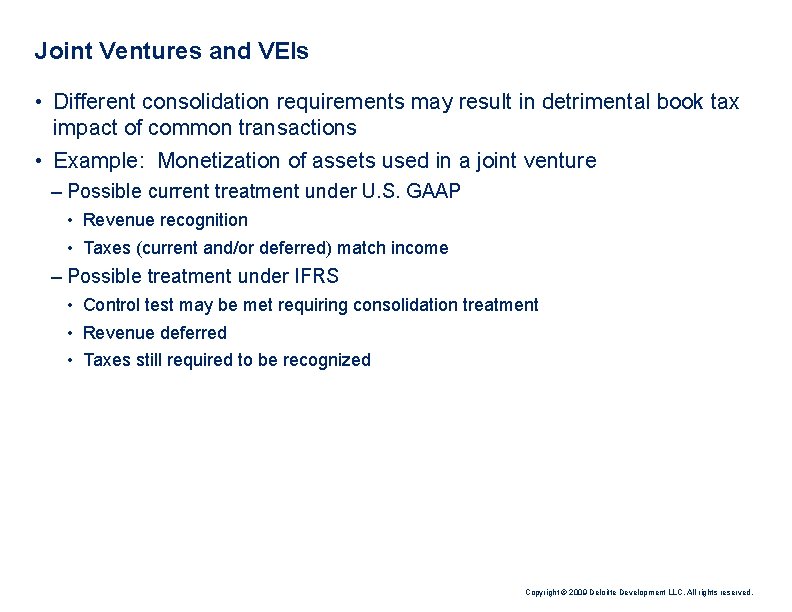
Joint Ventures and VEIs • Different consolidation requirements may result in detrimental book tax impact of common transactions • Example: Monetization of assets used in a joint venture ‒ Possible current treatment under U. S. GAAP • Revenue recognition • Taxes (current and/or deferred) match income ‒ Possible treatment under IFRS • Control test may be met requiring consolidation treatment • Revenue deferred • Taxes still required to be recognized Copyright © 2009 Deloitte Development LLC. All rights reserved.
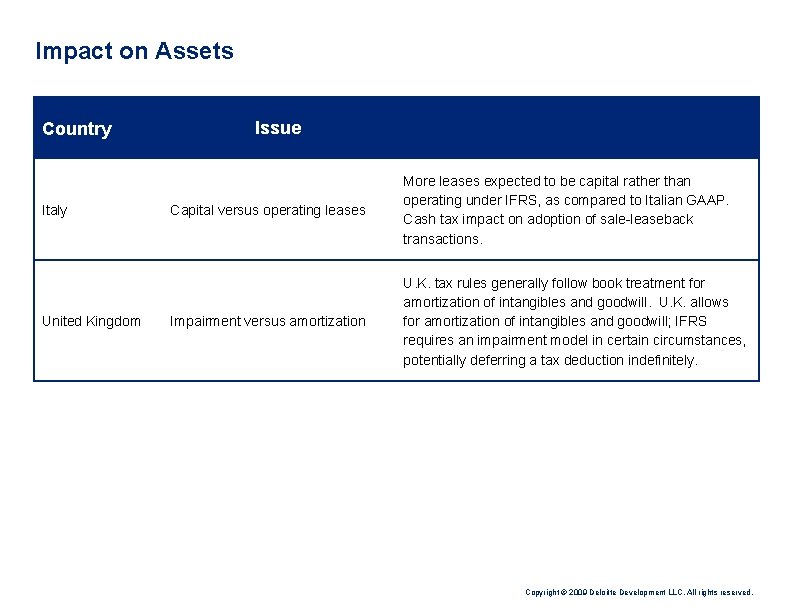
Impact on Assets Country Italy United Kingdom Issue Capital versus operating leases More leases expected to be capital rather than operating under IFRS, as compared to Italian GAAP. Cash tax impact on adoption of sale-leaseback transactions. Impairment versus amortization U. K. tax rules generally follow book treatment for amortization of intangibles and goodwill. U. K. allows for amortization of intangibles and goodwill; IFRS requires an impairment model in certain circumstances, potentially deferring a tax deduction indefinitely. Copyright © 2009 Deloitte Development LLC. All rights reserved.
Speaker Bio Heather J. Jurek is a Director in Deloitte Tax LLP’s Washington National Tax international tax practice specializing in income tax accounting for international transactions and structures. Now based in Atlanta, Heather has 15 years of experience working for Deloitte in Australia, Slovakia, Romania and the United States. Heather leads the international tax service line’s accounting for income taxes group and has a leadership role in the U. S. firm’s initiatives around the tax implications of International Financial Reporting Standards. Heather is a frequent speaker on Accounting for Income Taxes (FAS 109 and IAS 12) – International Tax and Sarbanes-Oxley Section 404. Heather received a Bachelor of Laws and a Bachelor of Commerce from Australian National University. She is a member of Australian Institute of Chartered Accountants Phone: +1 404 220 1510 Email: hjurek@deloitte. com Copyright © 2009 Deloitte Development LLC. All rights reserved.

About Deloitte refers to one or more of Deloitte Touche Tohmatsu, a Swiss Verein, its member firms and their respective subsidiaries and affiliates. Deloitte Touche Tohmatsu is an organization of member firms around the world devoted to excellence in providing professional services and advice, focused on client service through a global strategy executed locally in nearly 140 countries. With access to the deep intellectual capital of 150, 000 people worldwide, Deloitte delivers services in four professional areas, audit, tax, consulting and financial advisory services, and serves more than one-half of the world’s largest companies, as well as large national enterprises, public institutions, locally important clients, and successful, fast-growing global growth companies. Services are not provided by the Deloitte Touche Tohmatsu Verein and, for regulatory and other reasons, certain member firms do not provide services in all four professional areas. As a Swiss Verein (association), neither Deloitte Touche Tohmatsu nor any of its member firms has any liability for each other’s acts or omissions. Each of the member firms is a separate and independent legal entity operating under the names “Deloitte, ” “Deloitte & Touche, ” “Deloitte Touche Tohmatsu, ” or other related names. In the US, Deloitte & Touche USA LLP is the US member firm of Deloitte Touche Tohmatsu and services are provided by the subsidiaries of Deloitte & Touche USA LLP (Deloitte & Touche LLP, Deloitte Consulting LLP, Deloitte Financial Advisory Services LLP, Deloitte Tax LLP and their subsidiaries), and not by Deloitte & Touche USA LLP. The subsidiaries of the US member firm are among the nation's leading professional services firms, providing audit, tax, consulting and financial advisory services through nearly 30, 000 people in more than 80 cities. Known as employers of choice for innovative human resources programs, they are dedicated to helping their clients and their people excel. For more information, please visit the US member firm’s web site at www. deloitte. com/us. Copyright © 2009 Deloitte Development LLC. All rights reserved.
- Slides: 23