
IFMIF Power Coupler for HWR Superconducting cavities SRF

- Slides: 14
IFMIF Power Coupler for HWR Superconducting cavities SRF LINAC GROUP H. Jenhani 1, N. Bazin 1, P. Bosland 1, B. Branas 2, P. Brédy 1, P. Carbonnier 1, G. Disset 1, N. Grouas 1, P. Hardy 1, V. Hennion 1, E. Jacques 1, P. Mendez 2, J. Migne 1, F. Orsini 1, Y. Pénichot 1, J. Plouin 1, I. Podadera 2, D. Regidor 2, J. Relland 1, B. Renard 1, D. Roudier 1, S. Sanz 2, F. Toral 2, E. Zaplatin 3 1 CEA-Saclay France, 2 CIEMAT-Madrid Spain, 3 FZ-Julich Germany H. JENHANI, TTC Meeting, December 2011, Beijing
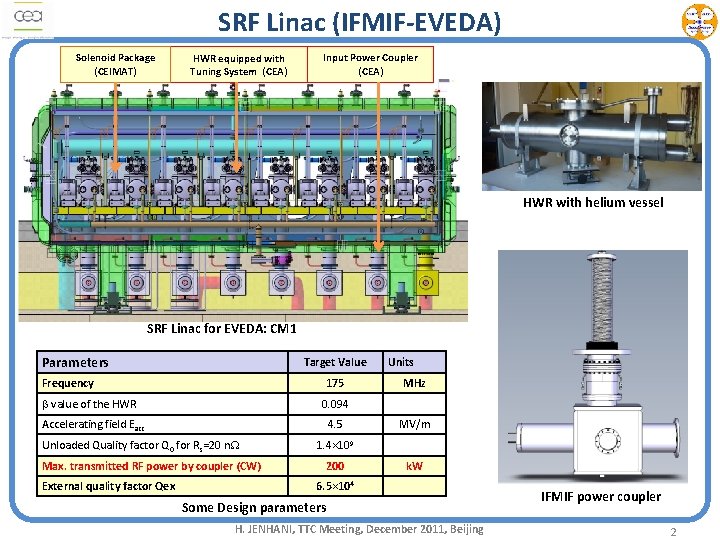
SRF Linac (IFMIF-EVEDA) Solenoid Package (CEIMAT) HWR equipped with Tuning System (CEA) Input Power Coupler (CEA) HWR with helium vessel SRF Linac for EVEDA: CM 1 Parameters Target Value Frequency 175 value of the HWR 0. 094 Accelerating field Eacc 4. 5 Unloaded Quality factor Q 0 for Rs=20 n Max. transmitted RF power by coupler (CW) External quality factor Qex Units MHz MV/m 1. 4× 10⁹ 200 k. W 6. 5× 10⁴ Some Design parameters H. JENHANI, TTC Meeting, December 2011, Beijing IFMIF power coupler 2
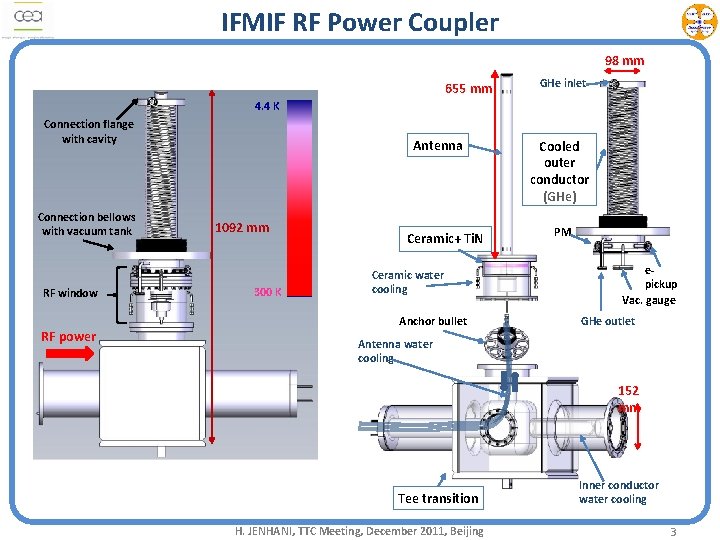
IFMIF RF Power Coupler 98 mm 655 mm GHe inlet 4. 4 K Connection flange with cavity Connection bellows with vacuum tank RF window RF power Antenna 1092 mm 300 K Ceramic+ Ti. N Ceramic water cooling Anchor bullet Cooled outer conductor (GHe) PM epickup Vac. gauge GHe outlet Antenna water cooling 152 mm Tee transition H. JENHANI, TTC Meeting, December 2011, Beijing Inner conductor water cooling 3
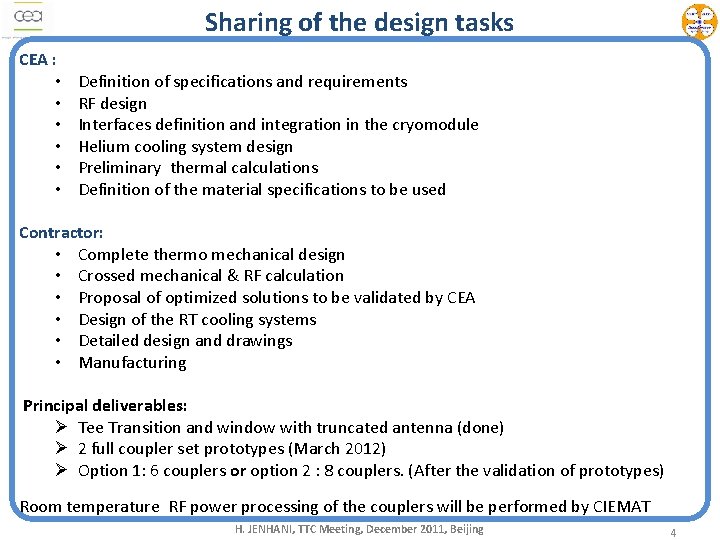
Sharing of the design tasks CEA : • • • Definition of specifications and requirements RF design Interfaces definition and integration in the cryomodule Helium cooling system design Preliminary thermal calculations Definition of the material specifications to be used Contractor: • Complete thermo mechanical design • Crossed mechanical & RF calculation • Proposal of optimized solutions to be validated by CEA • Design of the RT cooling systems • Detailed design and drawings • Manufacturing Principal deliverables: Ø Tee Transition and window with truncated antenna (done) Ø 2 full coupler set prototypes (March 2012) Ø Option 1: 6 couplers or option 2 : 8 couplers. (After the validation of prototypes) Room temperature RF power processing of the couplers will be performed by CIEMAT H. JENHANI, TTC Meeting, December 2011, Beijing 4
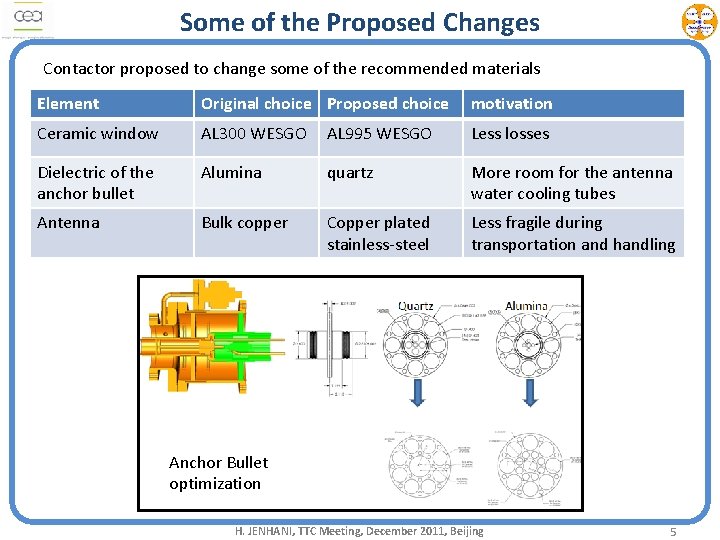
Some of the Proposed Changes Contactor proposed to change some of the recommended materials Element Original choice Proposed choice motivation Ceramic window AL 300 WESGO AL 995 WESGO Less losses Dielectric of the anchor bullet Alumina quartz More room for the antenna water cooling tubes Antenna Bulk copper Copper plated stainless-steel Less fragile during transportation and handling Anchor Bullet optimization H. JENHANI, TTC Meeting, December 2011, Beijing 5
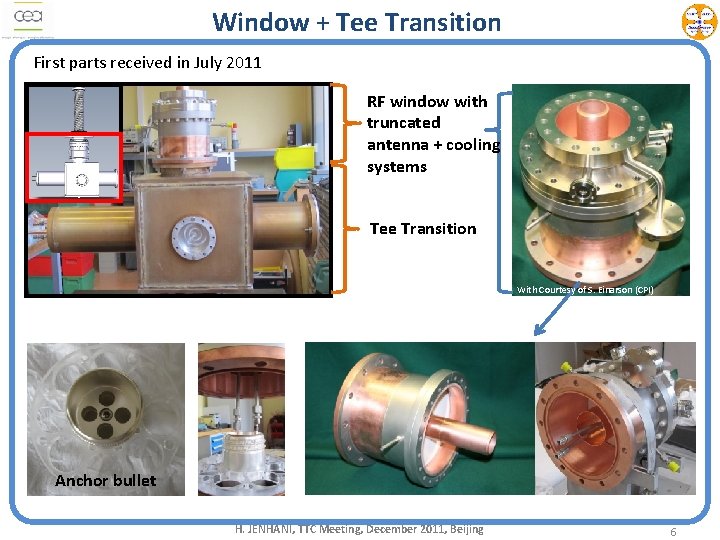
Window + Tee Transition First parts received in July 2011 RF window with truncated antenna + cooling systems Tee Transition With Courtesy of S. Einarson (CPI) Anchor bullet H. JENHANI, TTC Meeting, December 2011, Beijing 6
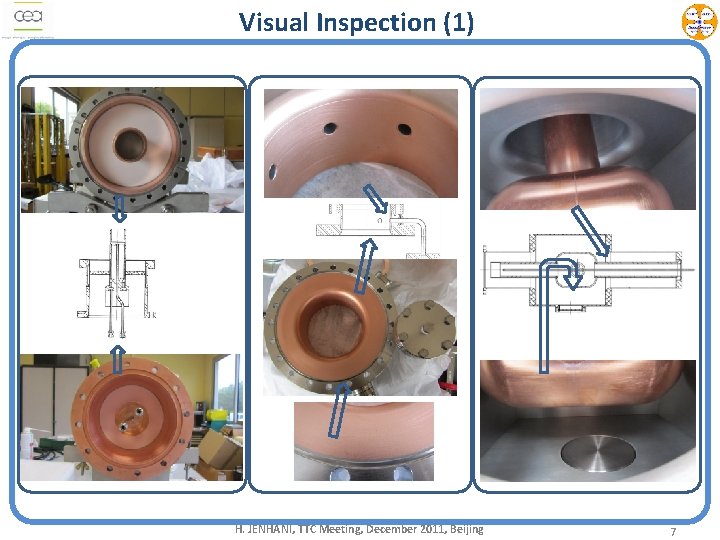
Visual Inspection (1) H. JENHANI, TTC Meeting, December 2011, Beijing 7
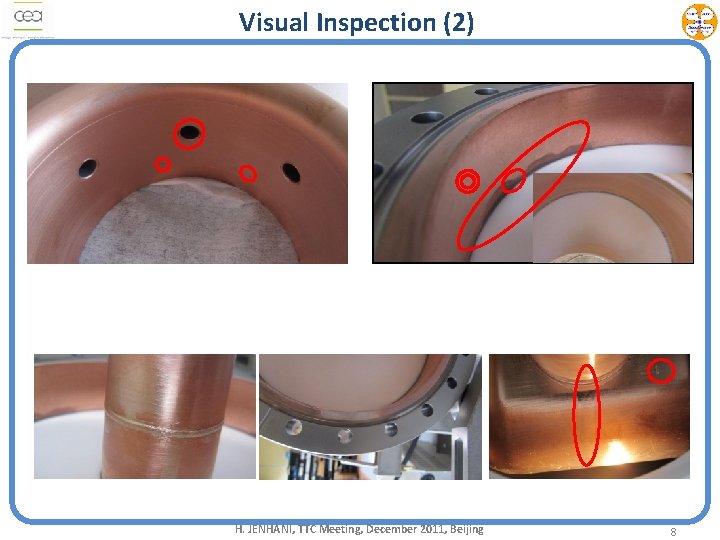
Visual Inspection (2) H. JENHANI, TTC Meeting, December 2011, Beijing 8
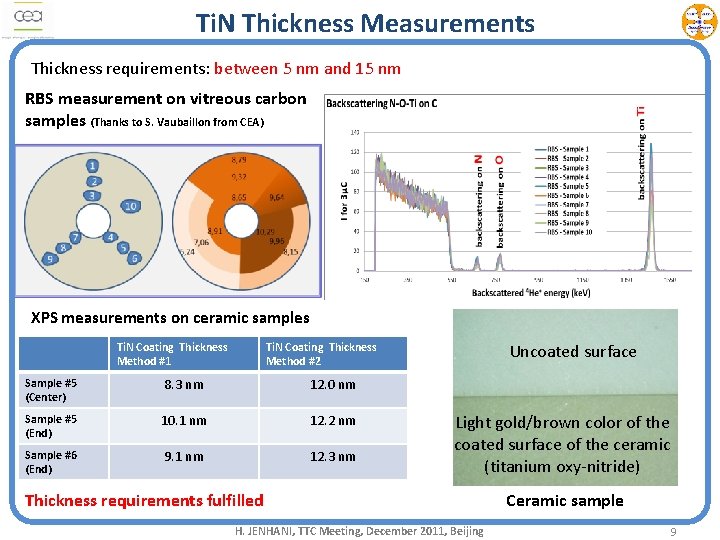
Ti. N Thickness Measurements Thickness requirements: between 5 nm and 15 nm RBS measurement on vitreous carbon samples (Thanks to S. Vaubaillon from CEA) XPS measurements on ceramic samples Ti. N Coating Thickness Method #1 Ti. N Coating Thickness Method #2 Sample #5 (Center) 8. 3 nm 12. 0 nm Sample #5 (End) 10. 1 nm 12. 2 nm Sample #6 (End) 9. 1 nm 12. 3 nm Uncoated surface Light gold/brown color of the coated surface of the ceramic (titanium oxy-nitride) Thickness requirements fulfilled H. JENHANI, TTC Meeting, December 2011, Beijing Ceramic sample 9
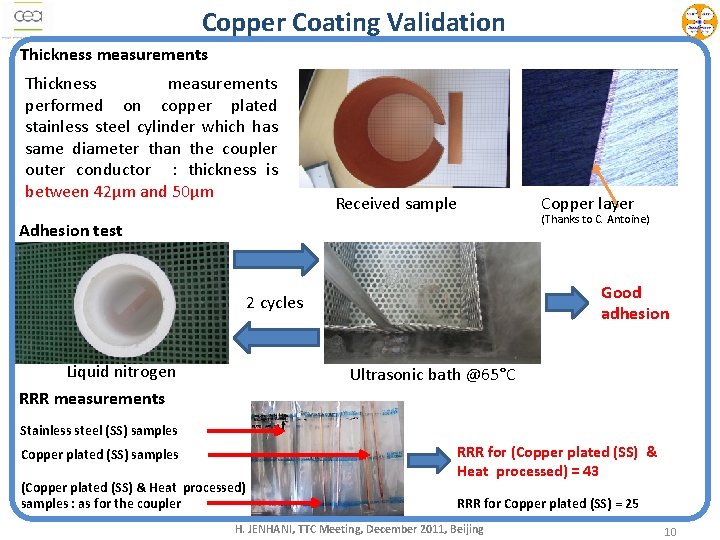
Copper Coating Validation Thickness measurements performed on copper plated stainless steel cylinder which has same diameter than the coupler outer conductor : thickness is between 42µm and 50µm Received sample Copper layer (Thanks to C. Antoine) Adhesion test Good adhesion 2 cycles Liquid nitrogen Ultrasonic bath @65°C RRR measurements Stainless steel (SS) samples Copper plated (SS) samples (Copper plated (SS) & Heat processed) samples : as for the coupler RRR for (Copper plated (SS) & Heat processed) = 43 RRR for Copper plated (SS) = 25 H. JENHANI, TTC Meeting, December 2011, Beijing 10
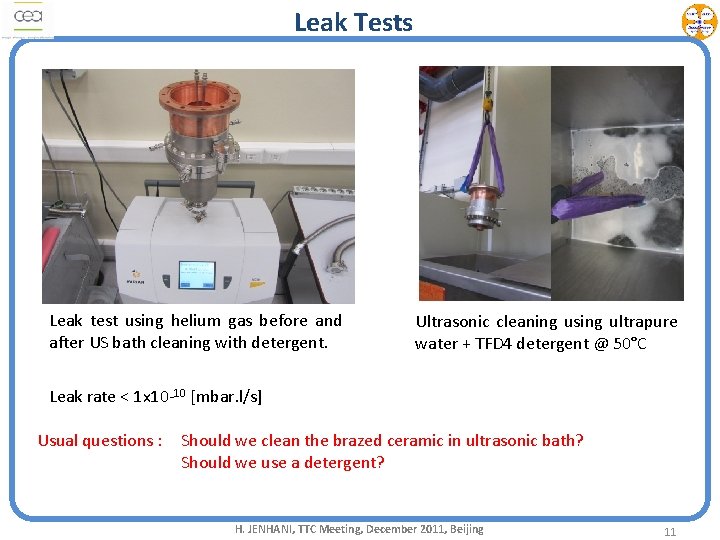
Leak Tests Leak test using helium gas before and after US bath cleaning with detergent. Ultrasonic cleaning using ultrapure water + TFD 4 detergent @ 50°C Leak rate < 1 x 10 -10 [mbar. l/s] Usual questions : Should we clean the brazed ceramic in ultrasonic bath? Should we use a detergent? H. JENHANI, TTC Meeting, December 2011, Beijing 11
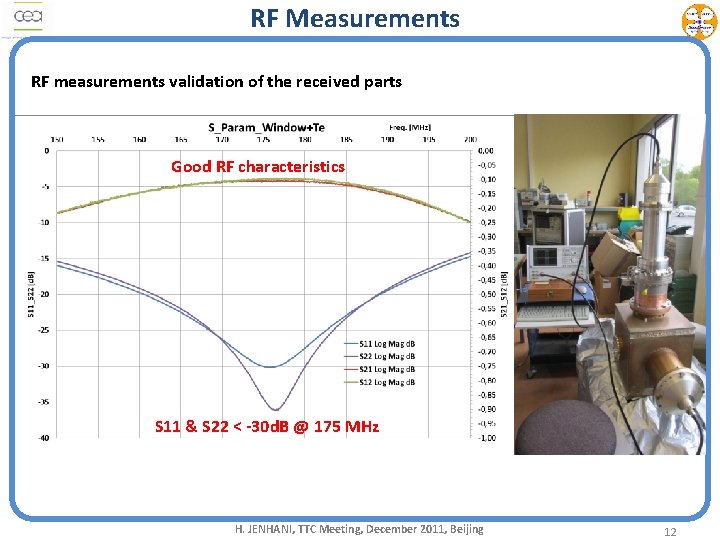
RF Measurements RF measurements validation of the received parts Good RF characteristics S 11 & S 22 < -30 d. B @ 175 MHz H. JENHANI, TTC Meeting, December 2011, Beijing 12
Summary q The design of the IFMIF coupler was performed in two stages: • First stage was performed by CEA: RF design + preliminary global design. • Second stage was performed by a Contractor: thermo mechanical design. q Some manufacturing processes as copper and Ti. N coatings were validated using samples. q A Window and a Tee Transition prototypes were already manufactured and received. q Globally, the manufactured parts were satisfactory. However, some anomalies were noticed and discussed with the contractor. q The manufacturing of two full coupler set prototypes is lunched. Reception is expected for March 2012. 13
Thank you for your attention 14