
IFIEC EUROPE International Federation of Industrial Energy Consumers
- Slides: 16
IFIEC EUROPE – International Federation of Industrial Energy Consumers on behalf of Alliance of Energy Intensive Industries / CEFIC / IFIEC Improving Allocation Performance Based Allocation and Activity Rate: What is the Choice? Annette Loske, IFIEC Europe A. Loske@vik. de ECCP Meeting, EU ETS Review, 21 th May 2007 1
IFIEC EUROPE – International Federation of Industrial Energy Consumers on behalf of Alliance of Energy Intensive Industries / CEFIC / IFIEC The current experience: EU ETS in its current form has raised fundamental challenges Industry strives for a way Ø To solve these fundamentally Ø To improve the emissions trading scheme Ø To safeguard competitiveness for energy intensive manufacturing industries in the EU To create a win-situation for both climate change and economic interests 2
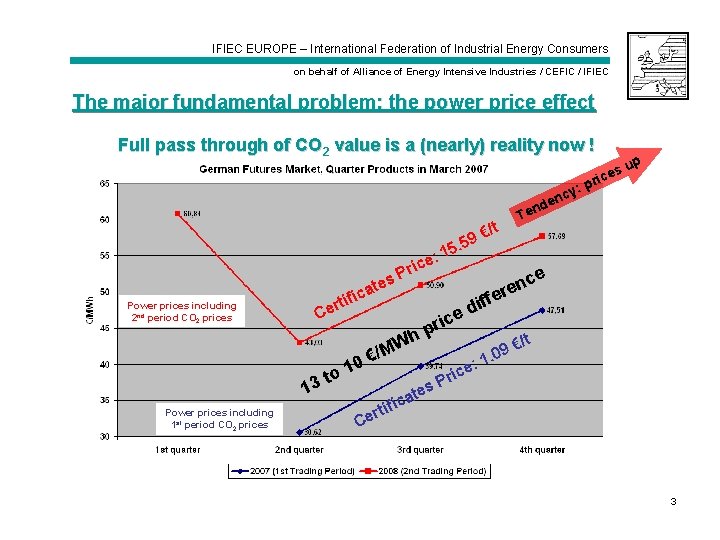
IFIEC EUROPE – International Federation of Industrial Energy Consumers on behalf of Alliance of Energy Intensive Industries / CEFIC / IFIEC The major fundamental problem: the power price effect Full pass through of CO 2 value is a (nearly) reality now ! r s ice y: p c n de /t e: s c Pri te ica if rt Ce Power prices including 2 nd period CO 2 prices 0 o 1 t 3 h W /M Power prices including 1 st period CO 2 prices ce ce pri es cat Ten 9€ 5. 15 € 1 up d en r e iff e: ric /t €. 09 1 P ifi rt Ce 3
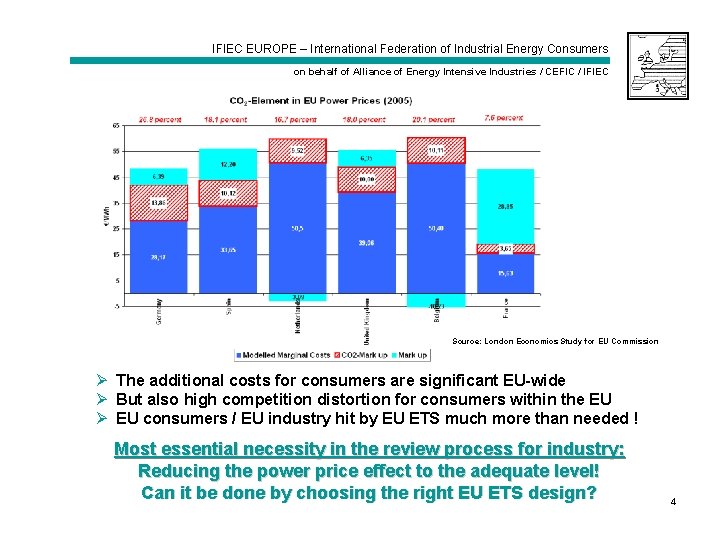
IFIEC EUROPE – International Federation of Industrial Energy Consumers on behalf of Alliance of Energy Intensive Industries / CEFIC / IFIEC Source: London Economics Study for EU Commission Ø The additional costs for consumers are significant EU-wide Ø But also high competition distortion for consumers within the EU Ø EU consumers / EU industry hit by EU ETS much more than needed ! Most essential necessity in the review process for industry: Reducing the power price effect to the adequate level! Can it be done by choosing the right EU ETS design? 4
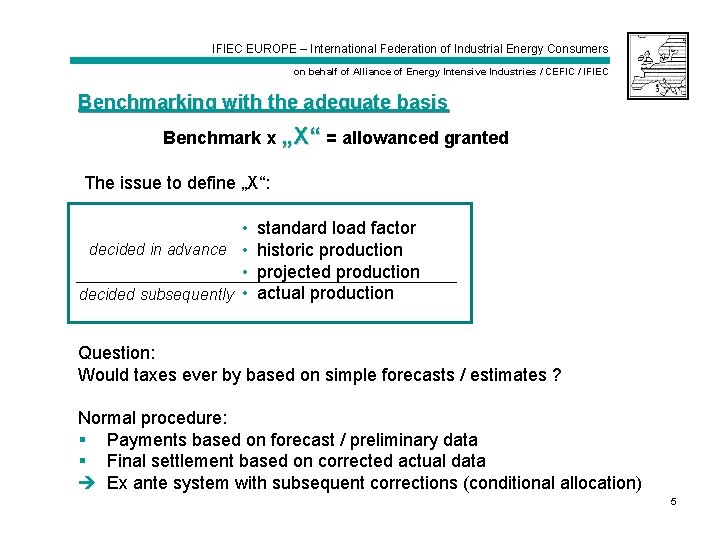
IFIEC EUROPE – International Federation of Industrial Energy Consumers on behalf of Alliance of Energy Intensive Industries / CEFIC / IFIEC Benchmarking with the adequate basis Benchmark x „X“ = allowanced granted The issue to define „X“: • decided in advance • • decided subsequently • standard load factor historic production projected production actual production Question: Would taxes ever by based on simple forecasts / estimates ? Normal procedure: § Payments based on forecast / preliminary data § Final settlement based on corrected actual data Ex ante system with subsequent corrections (conditional allocation) 5
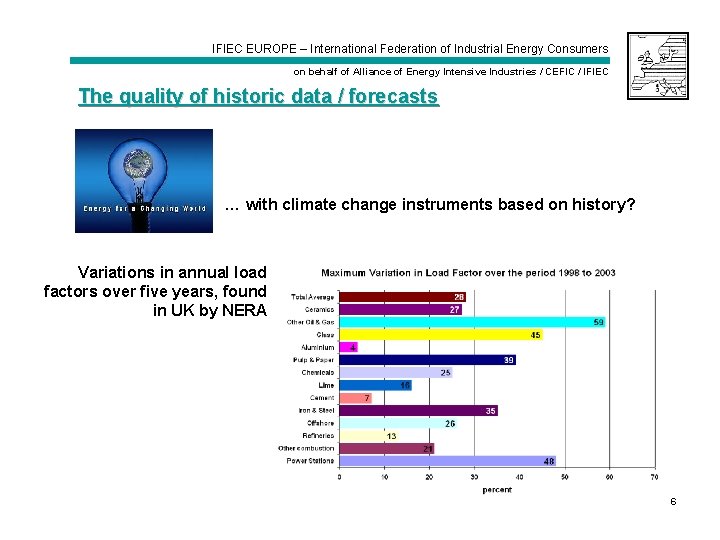
IFIEC EUROPE – International Federation of Industrial Energy Consumers on behalf of Alliance of Energy Intensive Industries / CEFIC / IFIEC The quality of historic data / forecasts … with climate change instruments based on history? Variations in annual load factors over five years, found in UK by NERA 6
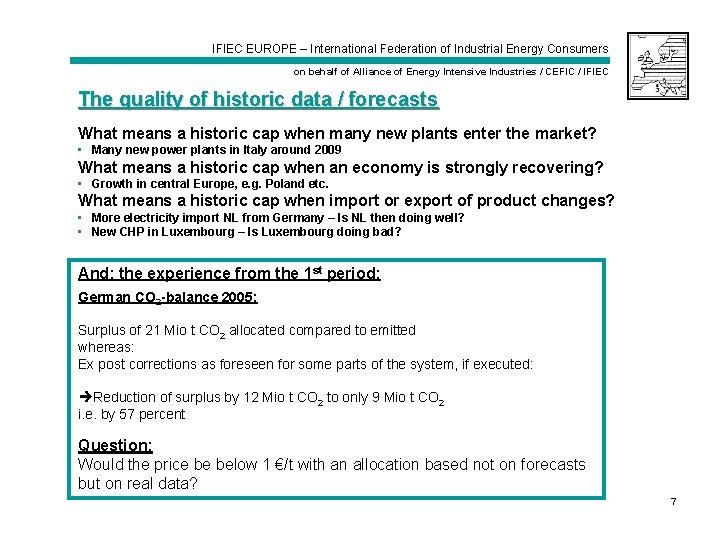
IFIEC EUROPE – International Federation of Industrial Energy Consumers on behalf of Alliance of Energy Intensive Industries / CEFIC / IFIEC The quality of historic data / forecasts What means a historic cap when many new plants enter the market? • Many new power plants in Italy around 2009 What means a historic cap when an economy is strongly recovering? • Growth in central Europe, e. g. Poland etc. What means a historic cap when import or export of product changes? • More electricity import NL from Germany – Is NL then doing well? • New CHP in Luxembourg – Is Luxembourg doing bad? And: the experience from the 1 st period: German CO 2 -balance 2005: Surplus of 21 Mio t CO 2 allocated compared to emitted whereas: Ex post corrections as foreseen for some parts of the system, if executed: Reduction of surplus by 12 Mio t CO 2 to only 9 Mio t CO 2 i. e. by 57 percent Question: Would the price be below 1 €/t with an allocation based not on forecasts but on real data? 7
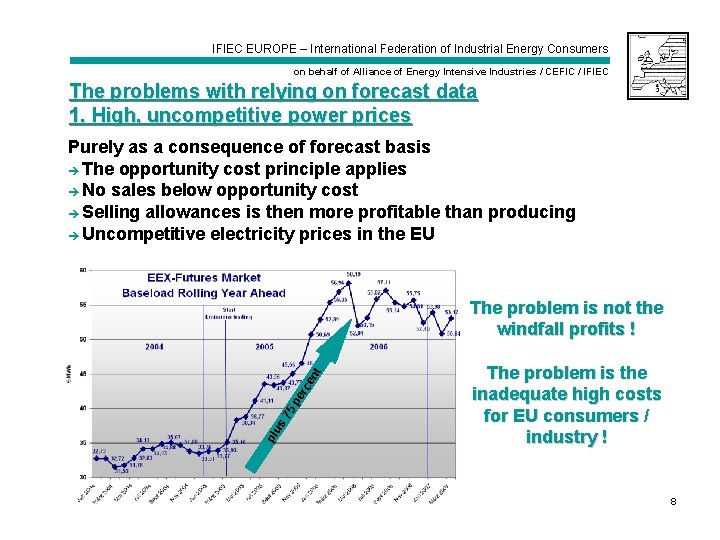
IFIEC EUROPE – International Federation of Industrial Energy Consumers on behalf of Alliance of Energy Intensive Industries / CEFIC / IFIEC The problems with relying on forecast data 1. High, uncompetitive power prices Purely as a consequence of forecast basis The opportunity cost principle applies No sales below opportunity cost Selling allowances is then more profitable than producing Uncompetitive electricity prices in the EU plu s 7 5 p er ce nt The problem is not the windfall profits ! The problem is the inadequate high costs for EU consumers / industry ! 8
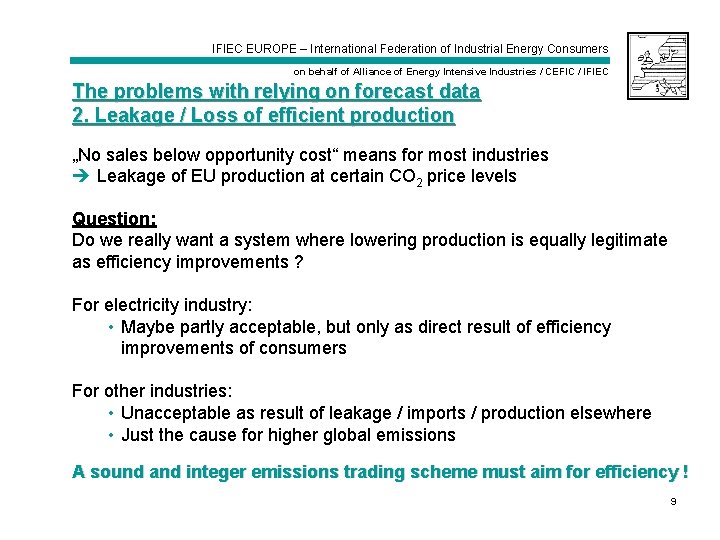
IFIEC EUROPE – International Federation of Industrial Energy Consumers on behalf of Alliance of Energy Intensive Industries / CEFIC / IFIEC The problems with relying on forecast data 2. Leakage / Loss of efficient production „No sales below opportunity cost“ means for most industries Leakage of EU production at certain CO 2 price levels Question: Do we really want a system where lowering production is equally legitimate as efficiency improvements ? For electricity industry: • Maybe partly acceptable, but only as direct result of efficiency improvements of consumers For other industries: • Unacceptable as result of leakage / imports / production elsewhere • Just the cause for higher global emissions A sound and integer emissions trading scheme must aim for efficiency ! 9
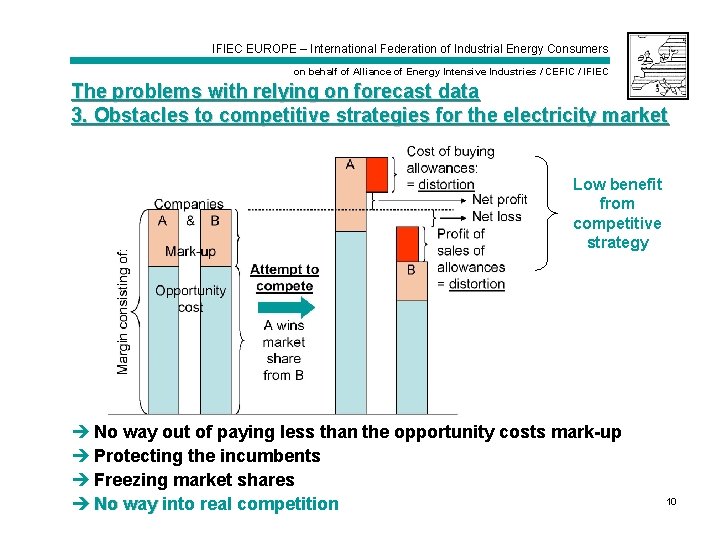
IFIEC EUROPE – International Federation of Industrial Energy Consumers on behalf of Alliance of Energy Intensive Industries / CEFIC / IFIEC The problems with relying on forecast data 3. Obstacles to competitive strategies for the electricity market Low benefit from competitive strategy No way out of paying less than the opportunity costs mark-up Protecting the incumbents Freezing market shares No way into real competition 10
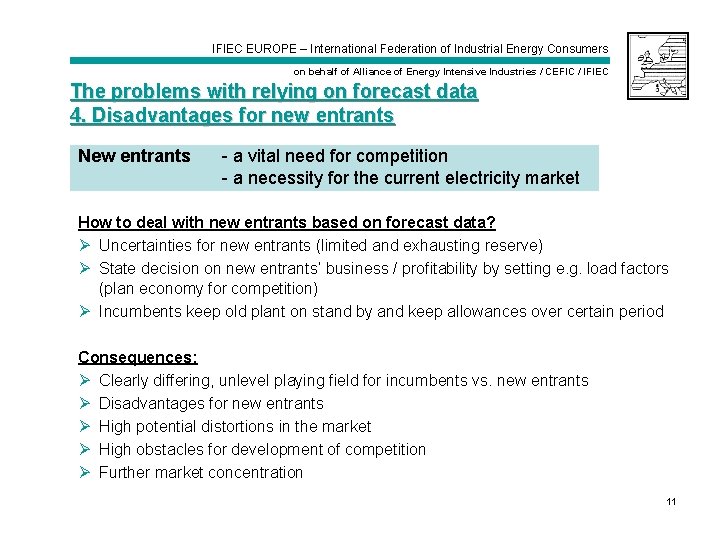
IFIEC EUROPE – International Federation of Industrial Energy Consumers on behalf of Alliance of Energy Intensive Industries / CEFIC / IFIEC The problems with relying on forecast data 4. Disadvantages for new entrants New entrants - a vital need for competition - a necessity for the current electricity market How to deal with new entrants based on forecast data? Ø Uncertainties for new entrants (limited and exhausting reserve) Ø State decision on new entrants‘ business / profitability by setting e. g. load factors (plan economy for competition) Ø Incumbents keep old plant on stand by and keep allowances over certain period Consequences: Ø Clearly differing, unlevel playing field for incumbents vs. new entrants Ø Disadvantages for new entrants Ø High potential distortions in the market Ø High obstacles for development of competition Ø Further market concentration 11
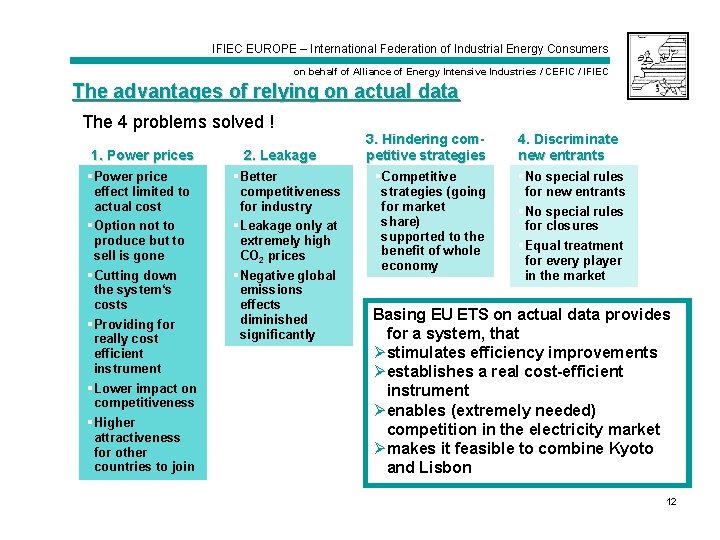
IFIEC EUROPE – International Federation of Industrial Energy Consumers on behalf of Alliance of Energy Intensive Industries / CEFIC / IFIEC The advantages of relying on actual data The 4 problems solved ! 1. Power prices § Power price effect limited to actual cost § Option not to produce but to sell is gone § Cutting down the system‘s costs § Providing for really cost efficient instrument § Lower impact on competitiveness § Higher attractiveness for other countries to join 2. Leakage § Better competitiveness for industry § Leakage only at extremely high CO 2 prices § Negative global emissions effects diminished significantly 3. Hindering competitive strategies § Competitive 4. Discriminate new entrants § No special rules strategies (going for market share) supported to the benefit of whole economy for new entrants § No special rules for closures § Equal treatment for every player in the market Basing EU ETS on actual data provides for a system, that Ø stimulates efficiency improvements Ø establishes a real cost-efficient instrument Ø enables (extremely needed) competition in the electricity market Ø makes it feasible to combine Kyoto and Lisbon 12
IFIEC EUROPE – International Federation of Industrial Energy Consumers on behalf of Alliance of Energy Intensive Industries / CEFIC / IFIEC Refute criticism against actual output basis 1. Illiquidity and uncertainty of the market A performance based system provides for: Ø In-built shortages (red) and oversupply (green) of the system for installations of different efficiency Ø Good and sound basis for trading and for high market liquidity Installations‘ good knowledge on own efficiency and own production rate Certainty of the players on own allowance status / ability to trade 13
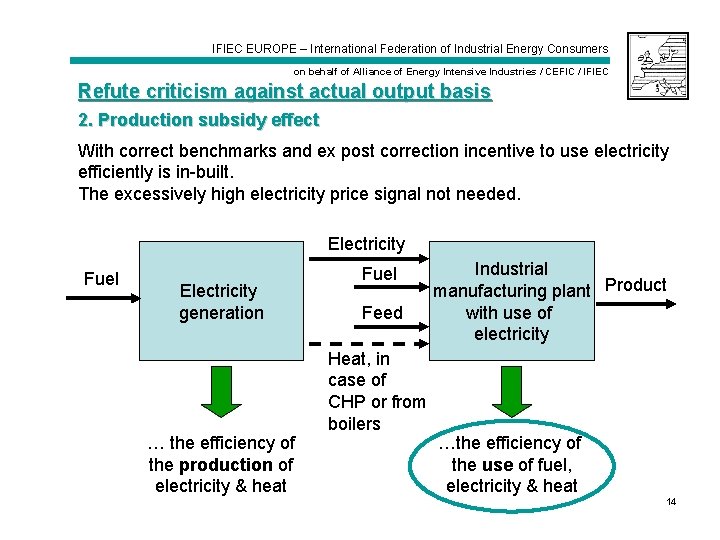
IFIEC EUROPE – International Federation of Industrial Energy Consumers on behalf of Alliance of Energy Intensive Industries / CEFIC / IFIEC Refute criticism against actual output basis 2. Production subsidy effect With correct benchmarks and ex post correction incentive to use electricity efficiently is in-built. The excessively high electricity price signal not needed. Electricity Fuel Electricity generation … the efficiency of the production of electricity & heat Fuel Feed Heat, in case of CHP or from boilers Industrial manufacturing plant Product with use of electricity …the efficiency of the use of fuel, electricity & heat 14
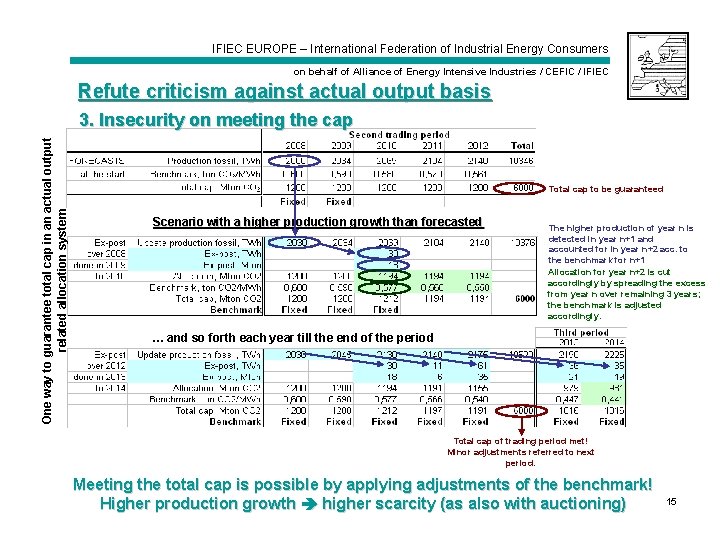
IFIEC EUROPE – International Federation of Industrial Energy Consumers on behalf of Alliance of Energy Intensive Industries / CEFIC / IFIEC Refute criticism against actual output basis One way to guarantee total cap in an actual output related allocation system 3. Insecurity on meeting the cap Total cap to be guaranteed Scenario with a higher production growth than forecasted The higher production of year n is detected in year n+1 and accounted for in year n+2 acc. to the benchmark for n+1 Allocation for year n+2 is cut accordingly by spreading the excess from year n over remaining 3 years; the benchmark is adjusted accordingly. … and so forth each year till the end of the period Total cap of trading period met! Minor adjustments referred to next period. Meeting the total cap is possible by applying adjustments of the benchmark! Higher production growth higher scarcity (as also with auctioning) 15
IFIEC EUROPE – International Federation of Industrial Energy Consumers on behalf of Alliance of Energy Intensive Industries / CEFIC / IFIEC Conclusions The proposed design solves the major problems: Eliminating the disadvantages of present rules § § Uncompetitive high electricity prices Exporting and increasing emissions (leakage) Hindering competitive strategies Discriminating new entrants Realizing the advantages of a market based instrument § Providing for cost efficiency § Setting the right incentives for efficiency improvements § Guarantee of total cap If not solving ETS‘ huge power price effect there is the need to save EU energy intensive industry by additional mechanisms, which would bring discredit on EU ETS 16