
If you did not pick up homework yesterday


- Slides: 39
If you did not pick up homework yesterday do so today!! Due FRIDAY Get out ISN we are taking notes over Scientific Method/Lab Write up Tutorials tomorrow morning for lab make-up and homework help 8 am
Scientific Method/Lab Write up An orderly and systematic way of solving a problem
1. PROBLEM §QUESTION YOU ARE SEEKING AN ANSWER FOR
ALWAYS IN THE FORM OF A QUESTION. § Does the amount of liquid affect the growth of plants? § Does the type of liquid affect the growth of plants? § Does the amount of light affect the growth of plants? § Does the type of soil affect the growth of plants? MUST BE ABLE TO ANSWER THROUGH EXPERIMENTATION
-RESEARCH § COLLECT KNOWN INFORMATION § EXAMPLE: RESEARCH READ OBSERVE
-PREDICTION § A LOGICAL GUESS OF AN OUTCOME BASED ON DATA AND PRIOR KNOWLEDGE. IF YOU HEAR THUNDER, YOU COULD PREDICT THAT IT WILL RAIN.
2. HYPOTHESIS §EDUCATED GUESS TO ANSWER THE QUESTION § The more research, the better our hypothesis
Should be written in an “if- then” statement § I think if the amount of light is changed, then the plant growth will be affected. § I think if the type of liquid is varied, then the plant growth will change. § I think the type of fertilizer affects plant growth.
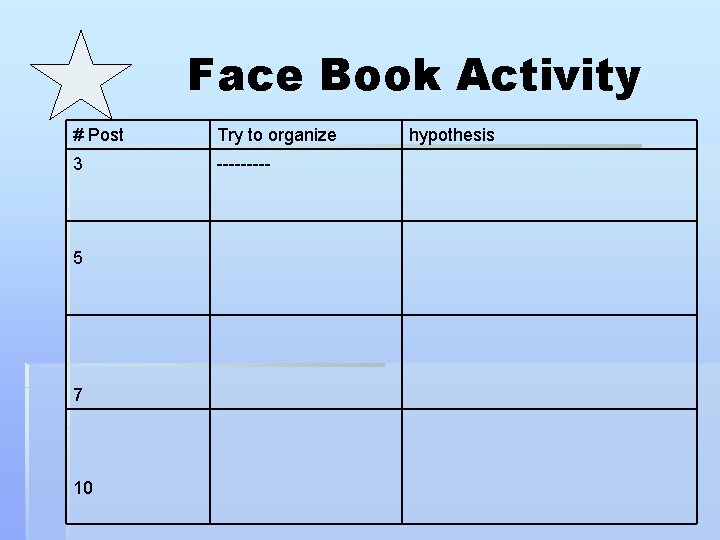
Face Book Activity # Post Try to organize 3 ----- 5 7 10 hypothesis
3. EXPERIMENT § PLANNED WAY OF SOLVING A PROBLEM § WRITTEN AS STEPS § KNOWN AS PROCEDURE.
GIVING INSTRUCTIONS LAB § Tell me how to make Peanut butter and Jelly Sandwich
GIVING INSTRUCTIONS § Quick Write- Using 5 complete sentences, describe what happened and write what you learned
VARIABLE §FACTORS IN AN EXPERIMENT THAT CHANGE
1. Independent Variable § M- Manipulated § I- Independent § X- X axis § This is the variable that you are purposefully changing. § YOU MAY ONLY HAVE 1 INDEPENDENT VARIABLE
2. Dependent Variable § D- Dependent § R- Responding § Y- Y axis § This is the variable you are measuring it will be recorded in your data!
CONSTANT §FACTORS IN AN EXPERIMENT THAT A SCIENTIST PURPOSELY KEEPS THE SAME.
CONTROL § group that serves as the standard of comparison. § Treated as the same as the samples, but not exposed to the independent variable
Peanut Butter Jelly Time! Write the procedure to make a peanut butter jelly sandwich. Be sure to write them in steps and be specific!
4. DATA/ OBSERVATIONS §COMPILE DATA §INFORMATION COLLECTED FROM EXPERIMENTS
-OBSERVATION § DATA THAT YOU COLLECT THAT YOU CAN PHYSICALLY OBTAIN USING YOUR 5 SENSES.
-INFERENCE § LOGICAL INTERPRETATION BASED ON PRIOR KNOWLEDGE AND EXPERIENCE. IF SOMEONE IS WET, YOU COULD INFER IT IS RAINING OUTSIDE.
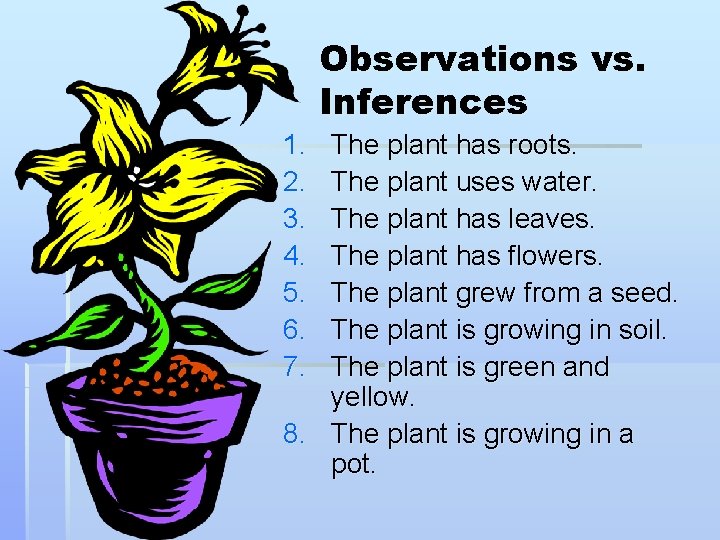
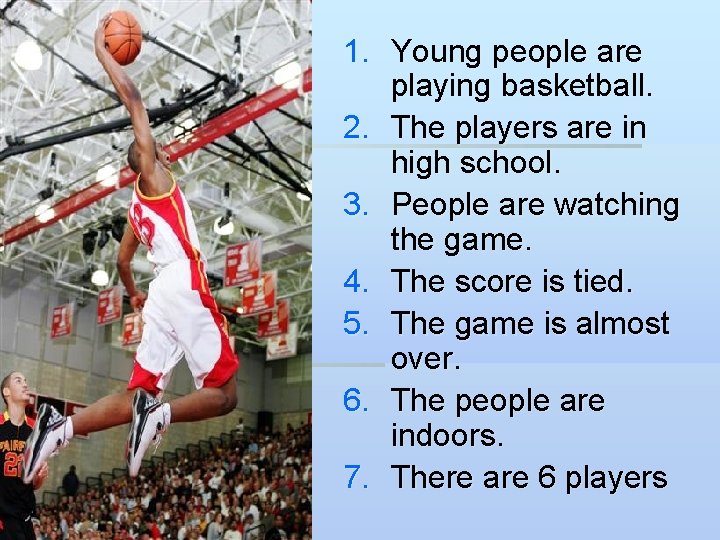
Observations vs. Inferences 1. 2. 3. 4. 5. 6. 7. The plant has roots. The plant uses water. The plant has leaves. The plant has flowers. The plant grew from a seed. The plant is growing in soil. The plant is green and yellow. 8. The plant is growing in a pot.
1. Young people are playing basketball. 2. The players are in high school. 3. People are watching the game. 4. The score is tied. 5. The game is almost over. 6. The people are indoors. 7. There are 6 players
MYSTERY Diapers § List 5 observations § (I see, I feel, I smell, etc) § List 5 inferences
PRECISION § MEASURING WITH ACCURACY AND EXACTNESS. A MEASUREMENT OF 5. 5 CM IS MORE PRECISE THAN 5 CM.
AVERAGING NUMBERS § MANY TIMES SCIENTISTS WILL HAVE SEVERAL ANSWERS FOR A PART OF AN EXPERIMENT. The best method of dealing with this situation, is to average.
EXAMPLE OF AVERAGING § ADD THE DIFFERENT ANSWERS TO REACH A TOTAL. THEN DIVIDE THE TOTAL BY THE NUMBER OF DIFFERENT ANSWERS.
GRAPH § A PICTURE OF DATANUMERICAL DATA
KINDS OF GRAPHS § 1. CIRCLE GRAPH A. DIVIDED CIRCLE B. SHOWS HOW A PART OF SOMETHING RELATES TO THE WHOLE VALUE.
BAR GRAPH § HELPS YOU COMPARE THINGS SUCH AS – AMOUNTS or QUANTITIES
LINE GRAPH § A. LETS YOU PLOT SEVERAL DIFFERENT FORMS OF DATA. § B. HELPS YOU SEE PATTERNS OR TRENDS.
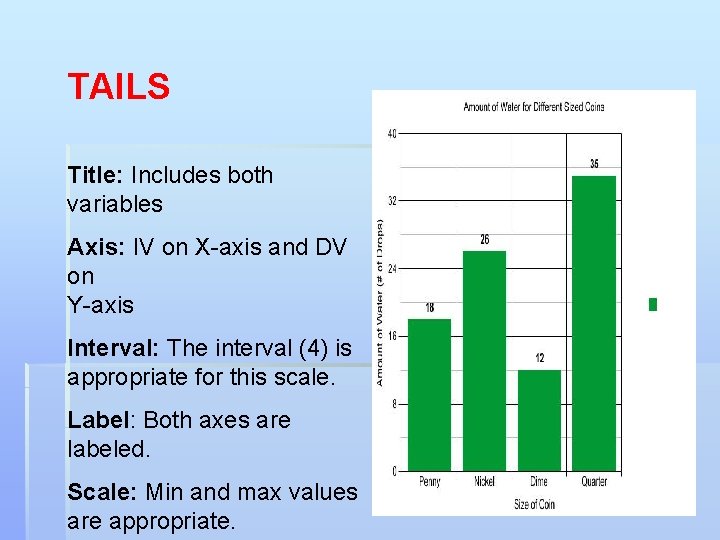
TAILS Title: Includes both variables Axis: IV on X-axis and DV on Y-axis Interval: The interval (4) is appropriate for this scale. Label: Both axes are labeled. Scale: Min and max values are appropriate.
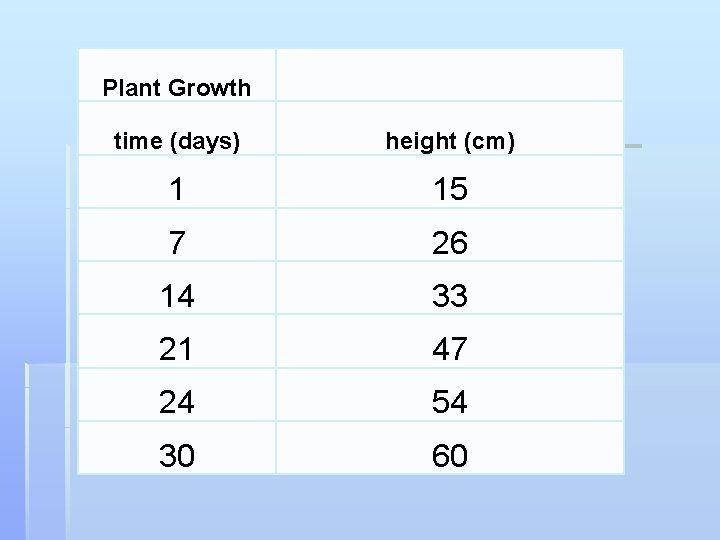
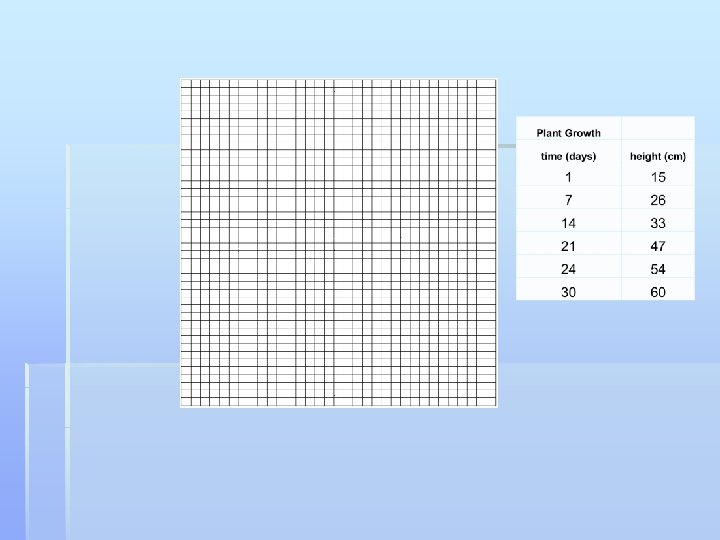
Plant Growth time (days) height (cm) 1 15 7 26 14 33 21 47 24 54 30 60
GRAPHING DEDUCTIONS § § § § § Title (5) X & Y title (5) X label/ scale (5) Y Label/ scale (5) Start at zero (5) Straight lines (5) # increments (5) IV/ DV (20) Plot (20)
5. CONCLUSION §ANSWER TO THE PROBLEM
THEORY §MOST LOGICAL EXPLANATION FOR EVENTS THAT HAPPENED
LAW § A THEORY THAT HAS BEEN TESTED MANY TIMES AND IS GENERALLY ACCEPTED AS TRUE.
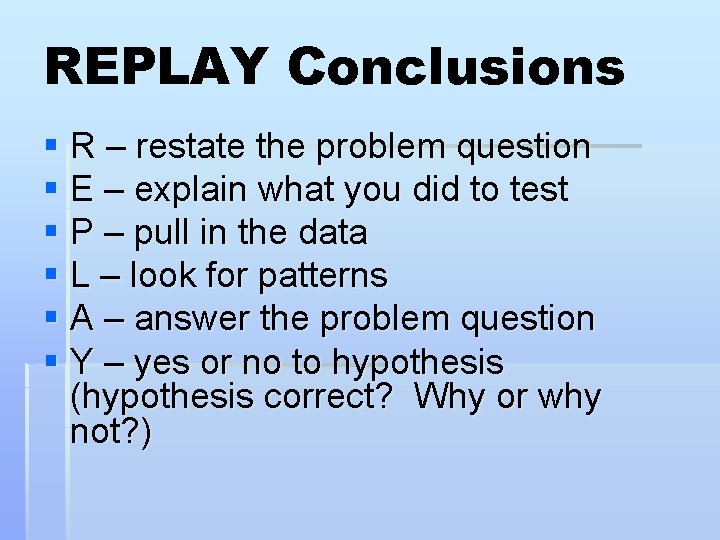
REPLAY Conclusions § R – restate the problem question § E – explain what you did to test § P – pull in the data § L – look for patterns § A – answer the problem question § Y – yes or no to hypothesis (hypothesis correct? Why or why not? )