
If parallel lines lie in two distinct planes







- Slides: 38
If parallel lines lie in two distinct planes, the planes must be parallel.
FALSE
Three planes can intersect at a point.
TRUE (ex: corner of classroom)
Three planes can intersect at a line.
TRUE
If two lines in space are not parallel, then they must intersect.
FALSE (Skew lines)
If lines are perpendicular to the same plane, they are parallel.
TRUE
If a line is perpendicular to a line in a plane, then it is perpendicular to the plane.
FALSE (Mailbox problem… must be perp. to two lines in plane passing through foot)
If a line is perpendicular to one of two parallel planes, then it is perpendicular to the other.
TRUE
If a line is perpendicular to a plane, then it is perpendicular to all lines in the plane.
FALSE (Not perp. to lines not passing through its foot)
If separate planes contain skew lines, the planes are parallel.
FALSE
Two planes can intersect at a point.
FALSE (planes continue infinitely)
Two planes can intersect at a line.
TRUE (crack at top of classroom)
The union of two planes is an angle.
FALSE (an angle is formed by lines – this is called a dihedral angle)
Two intersecting lines can lie in more than one plane.
FALSE (intersecting lines determine a plane)
Two parallel lines determine a plane.
TRUE
Two skew lines determine a plane.
FALSE (by definition, skew lines lie in different planes)
Three points determine a plane.
FALSE (must be noncollinear)
If three lines are parallel, then they must be coplanar.
FALSE
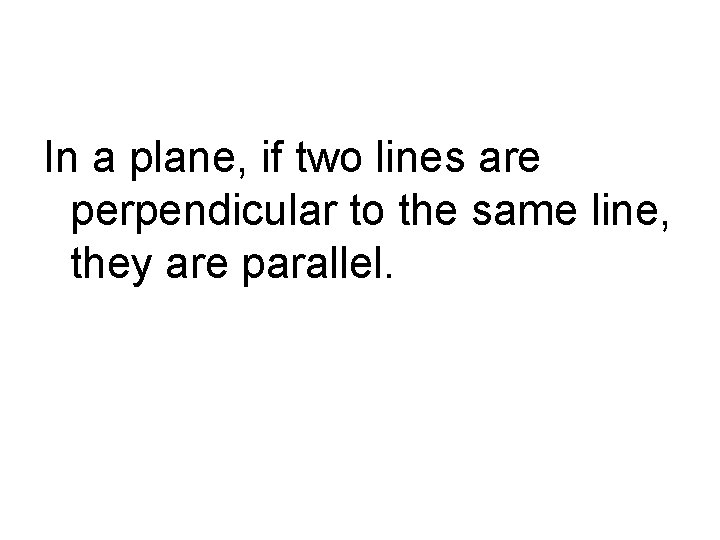
In a plane, if two lines are perpendicular to the same line, they are parallel.
TRUE
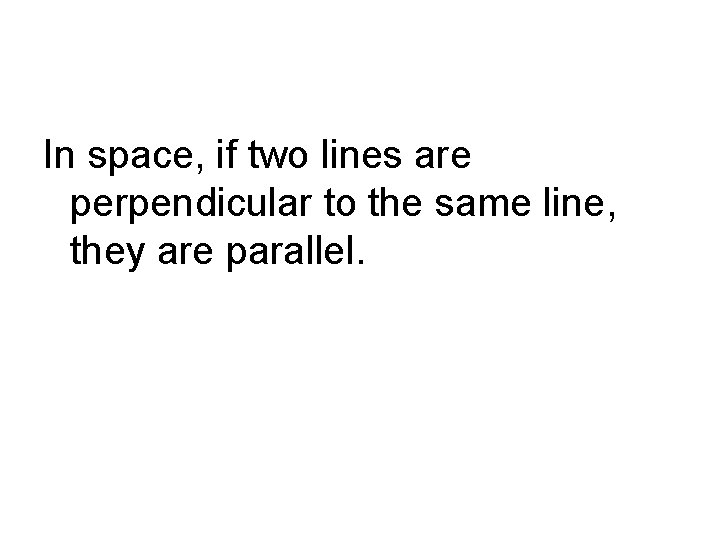
In space, if two lines are perpendicular to the same line, they are parallel.
FALSE