
If one can abide in perfect composure in
If one can abide in perfect composure in the midst of chaos. . . you will find yourself in Nirvana. -Suzuki Roshi
Composure in the Midst of Chaos: Intervention Strategies for Difficult Persons Turi Honegger, Ph. D. Financial Aid Staff Training University of California, Santa Barbara Spring 2019
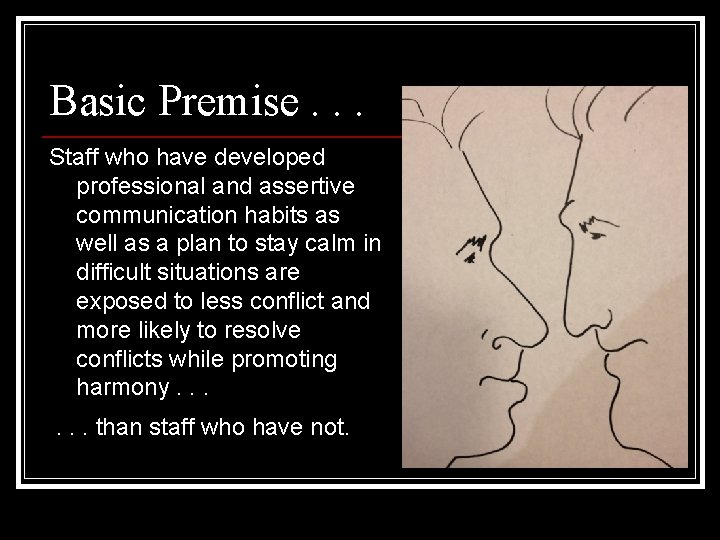
Basic Premise. . . Staff who have developed professional and assertive communication habits as well as a plan to stay calm in difficult situations are exposed to less conflict and more likely to resolve conflicts while promoting harmony. . . than staff who have not.
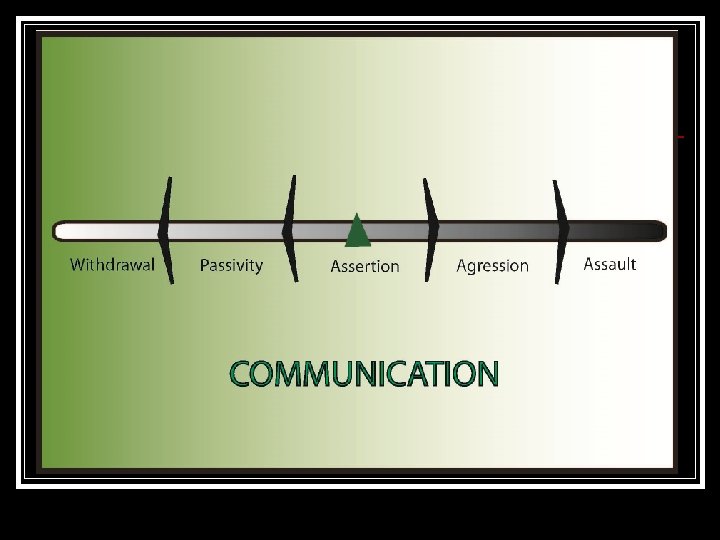
What are your patterns of communication like? Assertiveness n Can you set limits? n Firmness? Specific? Direct? n Making eye contact n Checking in with other staff when something seems odd n
Attenuate Negative Emotions - i. e. Sympathetic Comments n n n You are not agreeing with their statement of facts and perception, you are simply acknowledging that they are upset about something that is important to them Speak to the emotions first so that your message is heard Empathy vs. sympathy vs. validation Deal with emotions first Meet people where they are Sympathy de-escalates • Only after, move on to questions and solutions.
Sympathy “Dear Mrs. Lin, I’m very sorry to hear about your predicament and it sounds like you’re very angry about what happened. ” Did she say the word “angry”? Does everyone need sympathy? n Don’t make assumptions n n n Putting words in people’s mouths Portraying people as more emotional than they are
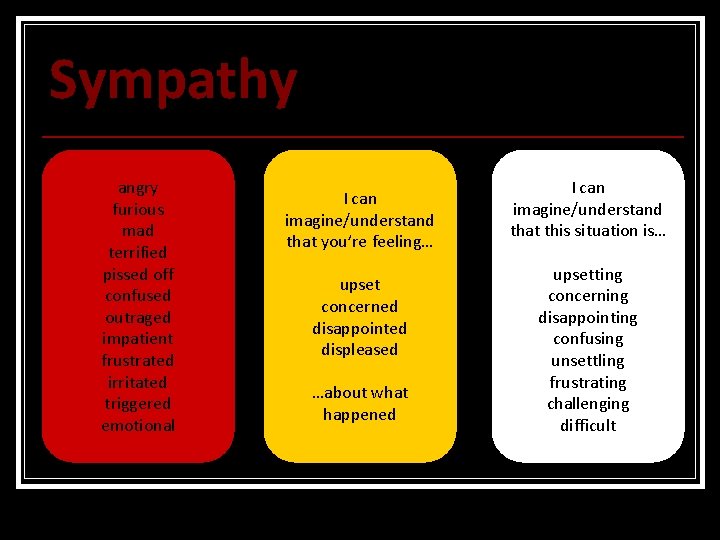
Sympathy angry furious mad terrified pissed off confused outraged impatient frustrated irritated triggered emotional I can imagine/understand that you’re feeling… upset concerned disappointed displeased …about what happened I can imagine/understand that this situation is… upsetting concerning disappointing confusing unsettling frustrating challenging difficult
Clarification n Also known as “active listening” and “mirroring” Again use their words wherever possible Use when email is unclear or you need more context n n Do not say “Your email was unclear/confusing. ” Do say “I would like to make sure I understand your request correctly. ” n Often this can help steer an emotional complaint into the solution focused realm n Does this situation warrant a phone or in-person conversation?
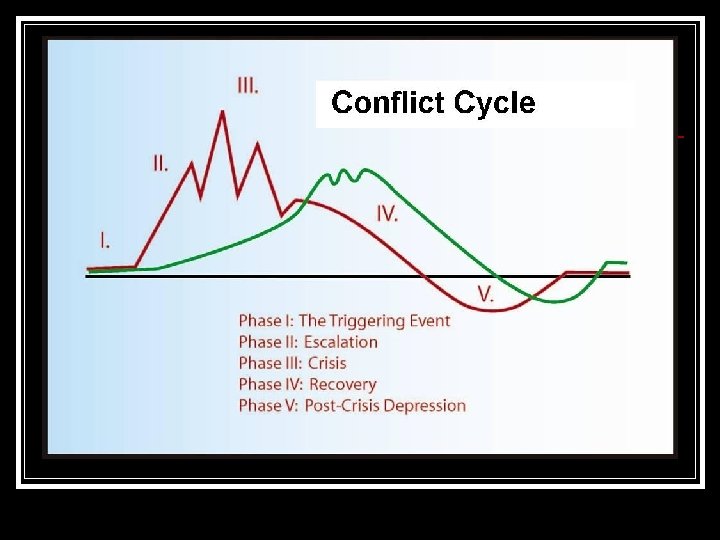
Moving from Professional Dialogue to De-Escalation Communication Clear and calm professional exchanges will often de-escalate tensions n Often the person is already upset or triggered when you meet them n How do you know when you are needing to de-escalate a situation?
Self Control Plan Key ingredients: n Knowing what you don’t want to do n Step that counteracts Fight or Flight n Rehearse language that works for you n Awareness of basic options like getting assistance or inviting them to leave
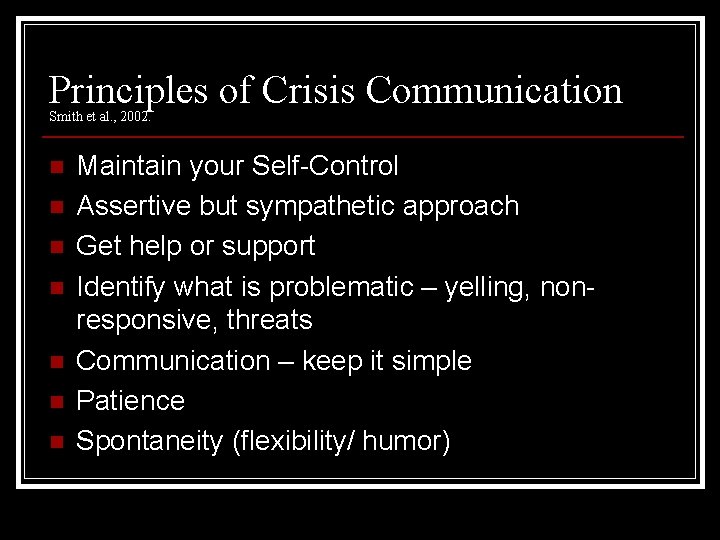
Principles of Crisis Communication Smith et al. , 2002. n n n n Maintain your Self-Control Assertive but sympathetic approach Get help or support Identify what is problematic – yelling, nonresponsive, threats Communication – keep it simple Patience Spontaneity (flexibility/ humor)
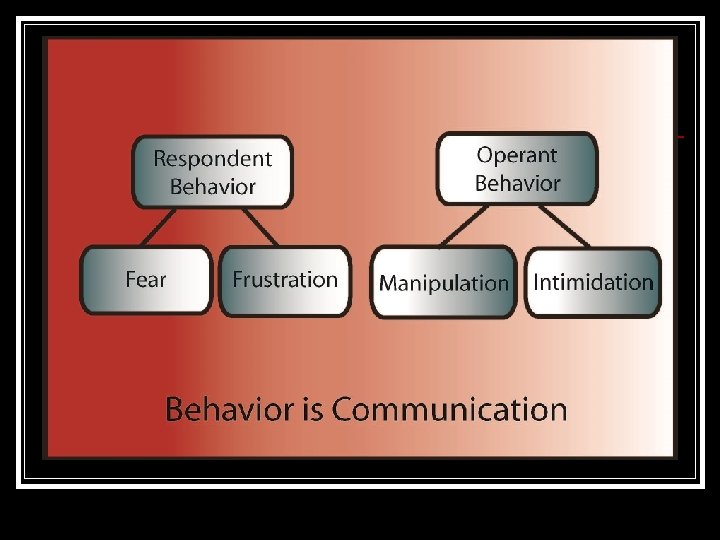
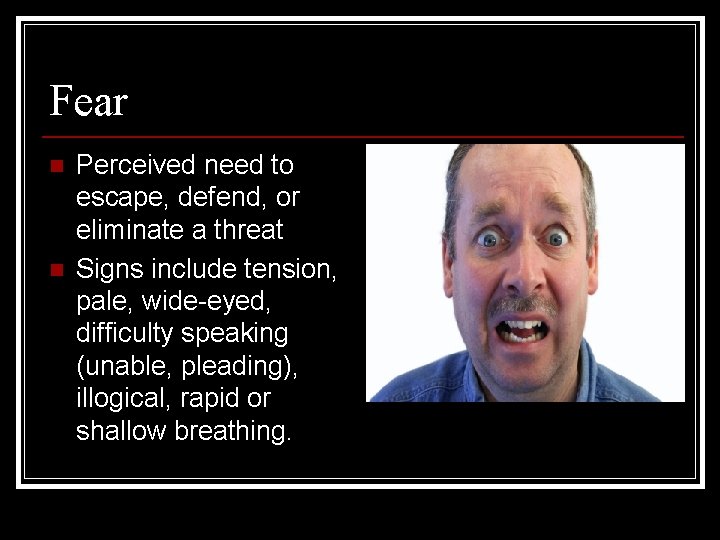
Fear n n Perceived need to escape, defend, or eliminate a threat Signs include tension, pale, wide-eyed, difficulty speaking (unable, pleading), illogical, rapid or shallow breathing.
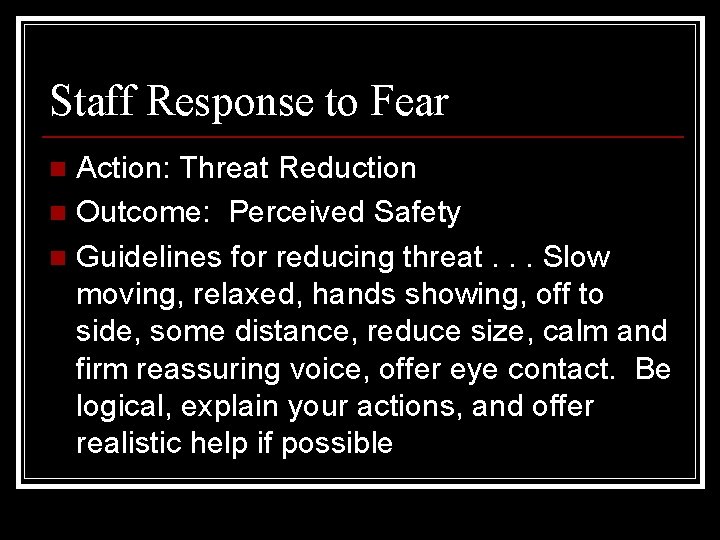
Staff Response to Fear Action: Threat Reduction n Outcome: Perceived Safety n Guidelines for reducing threat. . . Slow moving, relaxed, hands showing, off to side, some distance, reduce size, calm and firm reassuring voice, offer eye contact. Be logical, explain your actions, and offer realistic help if possible n
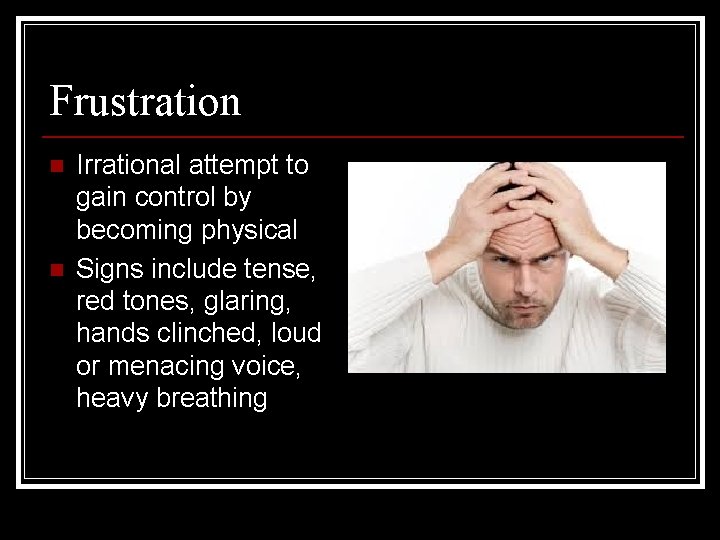
Frustration n n Irrational attempt to gain control by becoming physical Signs include tense, red tones, glaring, hands clinched, loud or menacing voice, heavy breathing
Staff Response to Frustration Action: Lending Control n Outcome: Self-Control n Guidelines for lending control. . . Confident, directive, firm, stand directly in front of the person or sit up straight, positioned just outside of reach, quiet but firm voice quality, direct eye contact. Speech is repetitive with specific directives n
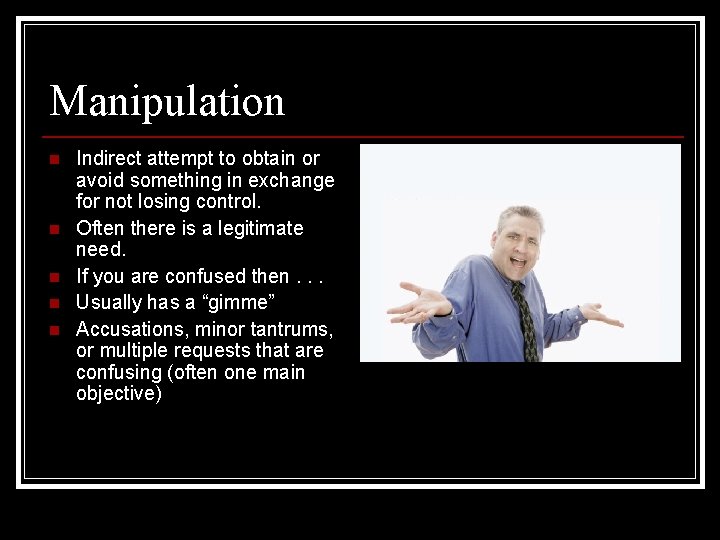
Manipulation n n Indirect attempt to obtain or avoid something in exchange for not losing control. Often there is a legitimate need. If you are confused then. . . Usually has a “gimme” Accusations, minor tantrums, or multiple requests that are confusing (often one main objective)
Staff Response to Manipulation Action: Benign Neglect n Outcome: Healthy Re-engagement n Guidelines. . . Assumption is that nothing will be gained, posture is relaxed, relaxed posture but poised to intervene as necessary, detached voice quality, repetitive content, minimal eye contact. n Beware: may switch to frustration n
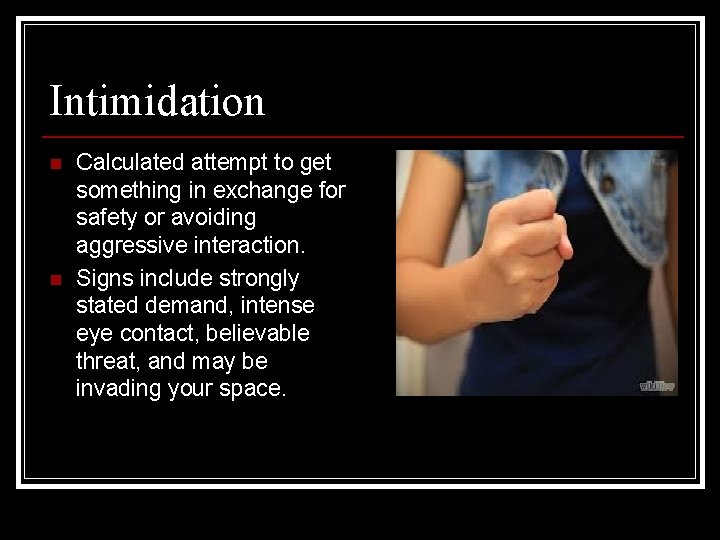
Intimidation n n Calculated attempt to get something in exchange for safety or avoiding aggressive interaction. Signs include strongly stated demand, intense eye contact, believable threat, and may be invading your space.
Staff Response to Intimidation Action: Identifying Consequences n Outcome: Safe Choices n Guidelines. . . poised and ready to move but not anxious, minimal hand movement, flat tone, firm and clear statements about consequences but not threatening. Keep eyes on hands and make eye-contact only to add emphasis to statements. n
Four Approaches Fearful – threat reduction and perceived safety n Frustrated – lending control and self control n Manipulative – benign neglect and healthy reengagement n Aggressive – identifying consequences and safe choices No matter what they do, your goals are self-control and assertive communication n
Supporting a Colleague More than additional information, you are likely there to help de-escalate the situation or maintain a calm atmosphere n You can “lend” them your self-control by modeling it n Be clear and use simple communication between staff and with the difficult person n
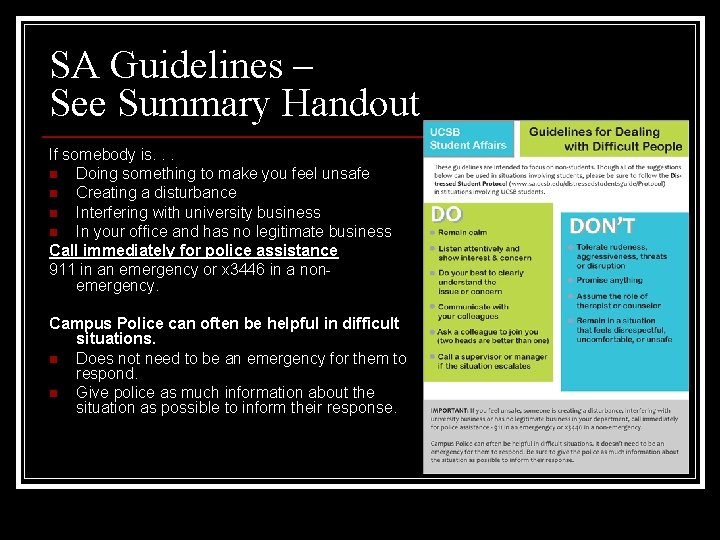
SA Guidelines – See Summary Handout If somebody is. . . n Doing something to make you feel unsafe n Creating a disturbance n Interfering with university business n In your office and has no legitimate business Call immediately for police assistance 911 in an emergency or x 3446 in a nonemergency. Campus Police can often be helpful in difficult situations. n Does not need to be an emergency for them to respond. n Give police as much information about the situation as possible to inform their response.
- Slides: 25