
If needed briefly review the Eight Parts of
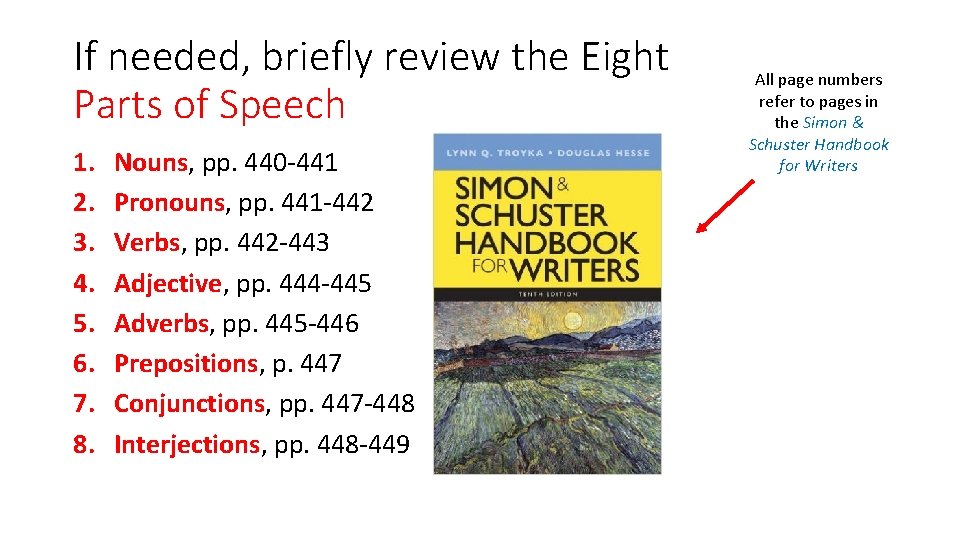
If needed, briefly review the Eight Parts of Speech 1. 2. 3. 4. 5. 6. 7. 8. Nouns, pp. 440 -441 Pronouns, pp. 441 -442 Verbs, pp. 442 -443 Adjective, pp. 444 -445 Adverbs, pp. 445 -446 Prepositions, p. 447 Conjunctions, pp. 447 -448 Interjections, pp. 448 -449 All page numbers refer to pages in the Simon & Schuster Handbook for Writers
What is a sentence? (I know this sounds too simple, but it’s important to review so we can catch run-ons and fragments in our writing) • A sentence starts with a capital letter and finishes with a period, question mark, or exclamation point. • A sentence contains at least one independent clause and makes complete sense on its own. • A sentence must contain both a subject and a predicate (contains the verb), and may also contain objects, complements, modifiers, appositives and phrases. See pages 449 -457

What is a clause? See pages 457 -461 • A clause is a group of words with both a subject and a predicate. Clauses are either independent (main) clauses, or dependent (subordinate) clauses. • An independent clause contains a subject and a predicate and can stand alone as a sentence. • E. g. I overslept this morning. • A dependent clause contains a subject and a predicate but cannot stand alone as a sentence. • E. g. Because I overslept this morning.
Sentence Types See pages 461 -436 There are four sentence types: 1. Simple sentences: Comprised of one main clause (independent clause) that contains at least one subject and at least one verb. • • 2. • • 3. • • 4. • Tip: This is really important to know for the quiz! Example: I went to the library on Tuesday. Example: Sam and Tia went to the library and studied. Compound sentences: Comprised of two independent clauses connected with a comma and a coordinating conjunction or a semicolon. Example: I went to the library, but I forgot my library card. Example: I went to the library; however, the librarian could not help me. Complex sentences: Comprised of one independent clause and one dependent clause (note, dependent clauses usually begin with subordinating conjunctions—a. k. a. “dependent words”) Example: I went to the library because I needed a quiet place to study. Example: Since my house was so noisy, I went to the library to study. Compound-complex sentences: Comprised of two independent clauses and at least one dependent clause. Example: Because my paper is due in two days, I am going to the library to work on it, and I am not coming home until it’s finished.
Coordinating Conjunctions (a. k. a. FANBOYS) • For • And • Nor • But • Or • Yet • So Use a comma before these conjunctions only when the conjunction separates two independent clauses. • Example: Rose is only a child, but she is really intelligent. • Example: John hit a homerun, so the team went out for pizza to celebrate. • Example: I like peanut butter and jelly. (no comma needed in this sentence)
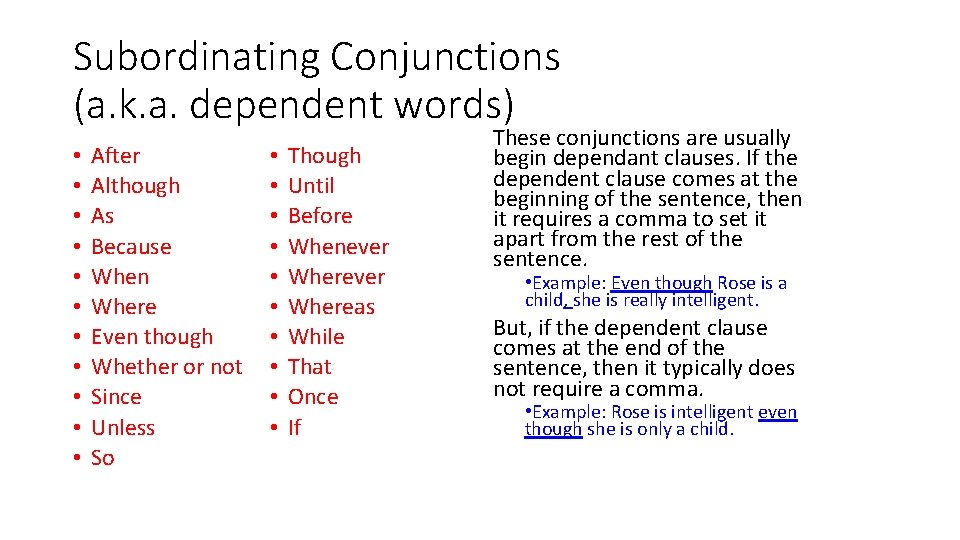
Subordinating Conjunctions (a. k. a. dependent words) • • • After Although As Because When Where Even though Whether or not Since Unless So • • • Though Until Before Whenever Whereas While That Once If These conjunctions are usually begin dependant clauses. If the dependent clause comes at the beginning of the sentence, then it requires a comma to set it apart from the rest of the sentence. • Example: Even though Rose is a child, she is really intelligent. But, if the dependent clause comes at the end of the sentence, then it typically does not require a comma. • Example: Rose is intelligent even though she is only a child.
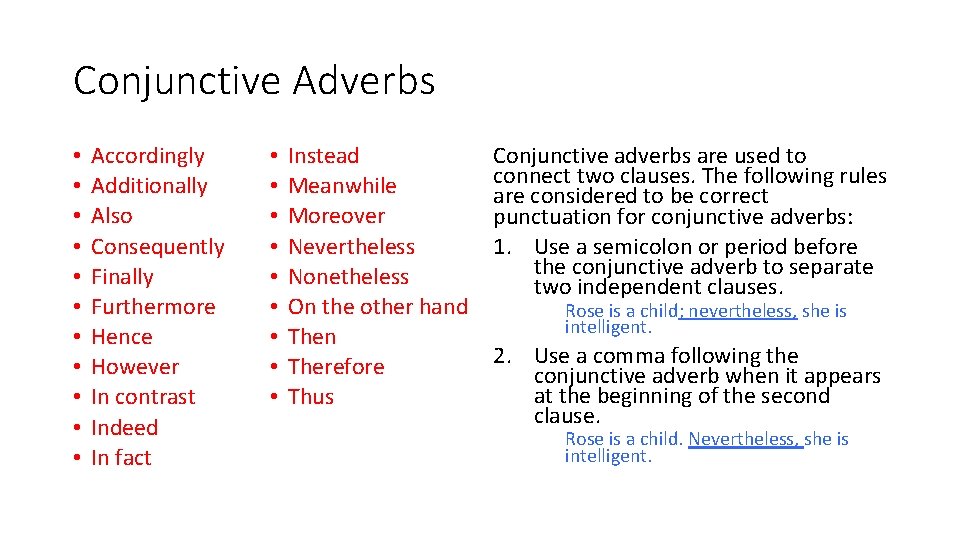
Conjunctive Adverbs • • • Accordingly Additionally Also Consequently Finally Furthermore Hence However In contrast Indeed In fact • • • Instead Meanwhile Moreover Nevertheless Nonetheless On the other hand Then Therefore Thus Conjunctive adverbs are used to connect two clauses. The following rules are considered to be correct punctuation for conjunctive adverbs: 1. Use a semicolon or period before the conjunctive adverb to separate two independent clauses. Rose is a child; nevertheless, she is intelligent. 2. Use a comma following the conjunctive adverb when it appears at the beginning of the second clause. Rose is a child. Nevertheless, she is intelligent.
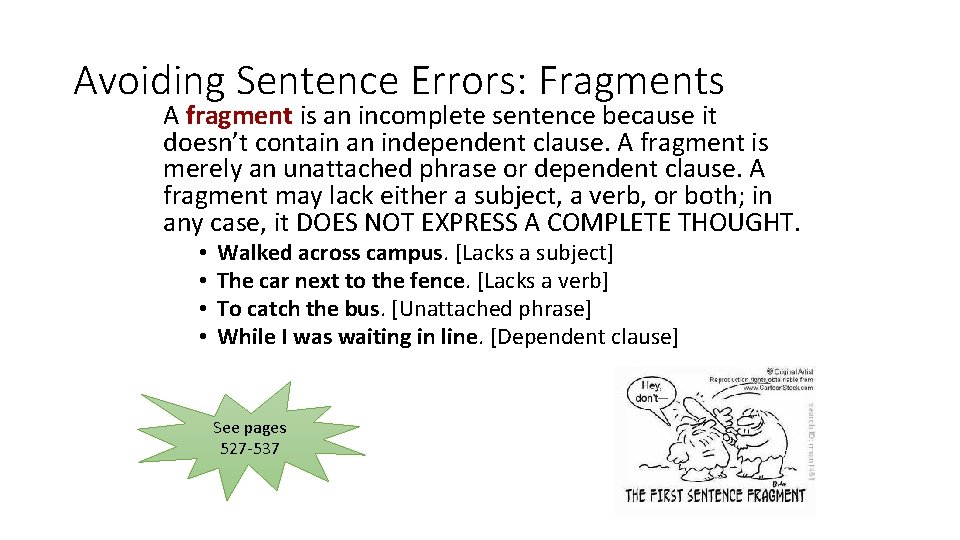
Avoiding Sentence Errors: Fragments A fragment is an incomplete sentence because it doesn’t contain an independent clause. A fragment is merely an unattached phrase or dependent clause. A fragment may lack either a subject, a verb, or both; in any case, it DOES NOT EXPRESS A COMPLETE THOUGHT. • • Walked across campus. [Lacks a subject] The car next to the fence. [Lacks a verb] To catch the bus. [Unattached phrase] While I was waiting in line. [Dependent clause] See pages 527 -537

Correcting Fragments There are several ways to correct a fragment: 1. Attach the fragment to an independent clause. Often, this means attaching it to a sentence that comes either before or after the fragment. • I did not finish the book. Because I found it boring. • I did not finish the book because I found it boring. 2. Remove the subordinating conjunction or relative pronoun and let it stand alone as its own complete sentence: • I did not finish the book. I found it boring. 3. Add the missing subject or verb or both: • Started complaining loudly. [Who? Missing subject] • The angry patient started complaining loudly.
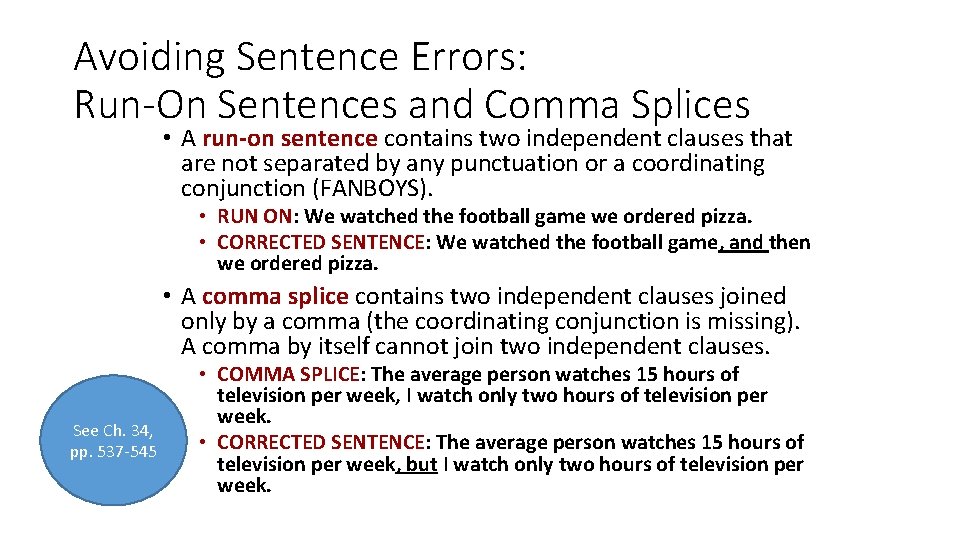
Avoiding Sentence Errors: Run-On Sentences and Comma Splices • A run-on sentence contains two independent clauses that are not separated by any punctuation or a coordinating conjunction (FANBOYS). • RUN ON: We watched the football game we ordered pizza. • CORRECTED SENTENCE: We watched the football game, and then we ordered pizza. • A comma splice contains two independent clauses joined only by a comma (the coordinating conjunction is missing). A comma by itself cannot join two independent clauses. See Ch. 34, pp. 537 -545 • COMMA SPLICE: The average person watches 15 hours of television per week, I watch only two hours of television per week. • CORRECTED SENTENCE: The average person watches 15 hours of television per week, but I watch only two hours of television per week.
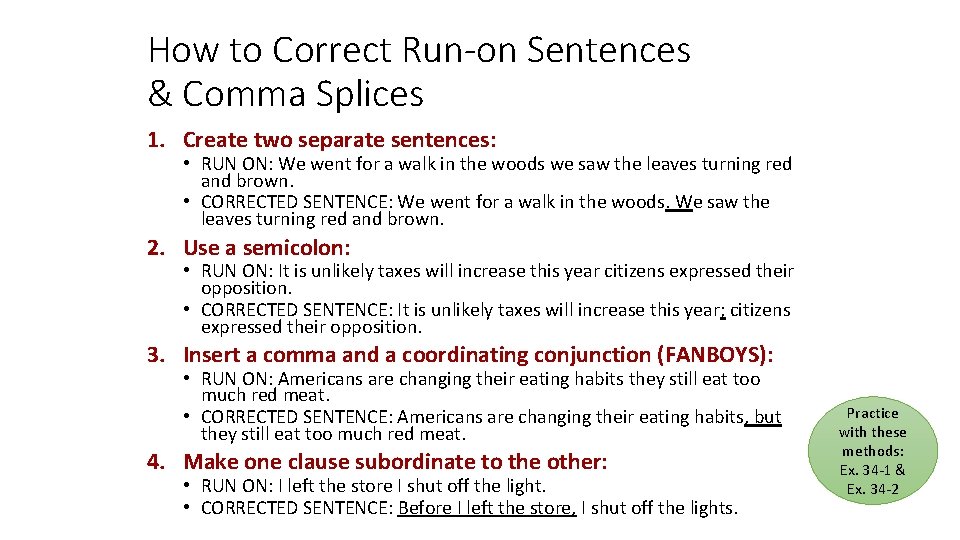
How to Correct Run-on Sentences & Comma Splices 1. Create two separate sentences: • RUN ON: We went for a walk in the woods we saw the leaves turning red and brown. • CORRECTED SENTENCE: We went for a walk in the woods. We saw the leaves turning red and brown. 2. Use a semicolon: • RUN ON: It is unlikely taxes will increase this year citizens expressed their opposition. • CORRECTED SENTENCE: It is unlikely taxes will increase this year; citizens expressed their opposition. 3. Insert a comma and a coordinating conjunction (FANBOYS): • RUN ON: Americans are changing their eating habits they still eat too much red meat. • CORRECTED SENTENCE: Americans are changing their eating habits, but they still eat too much red meat. 4. Make one clause subordinate to the other: • RUN ON: I left the store I shut off the light. • CORRECTED SENTENCE: Before I left the store, I shut off the lights. Practice with these methods: Ex. 34 -1 & Ex. 34 -2
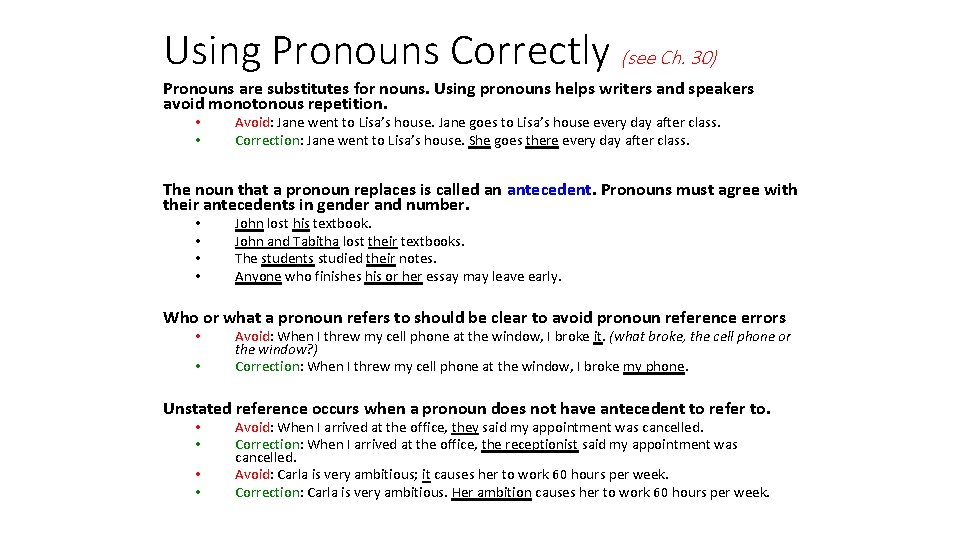
Using Pronouns Correctly (see Ch. 30) Pronouns are substitutes for nouns. Using pronouns helps writers and speakers avoid monotonous repetition. • • Avoid: Jane went to Lisa’s house. Jane goes to Lisa’s house every day after class. Correction: Jane went to Lisa’s house. She goes there every day after class. The noun that a pronoun replaces is called an antecedent. Pronouns must agree with their antecedents in gender and number. • • John lost his textbook. John and Tabitha lost their textbooks. The students studied their notes. Anyone who finishes his or her essay may leave early. Who or what a pronoun refers to should be clear to avoid pronoun reference errors • • Avoid: When I threw my cell phone at the window, I broke it. (what broke, the cell phone or the window? ) Correction: When I threw my cell phone at the window, I broke my phone. Unstated reference occurs when a pronoun does not have antecedent to refer to. • • Avoid: When I arrived at the office, they said my appointment was cancelled. Correction: When I arrived at the office, the receptionist said my appointment was cancelled. Avoid: Carla is very ambitious; it causes her to work 60 hours per week. Correction: Carla is very ambitious. Her ambition causes her to work 60 hours per week.
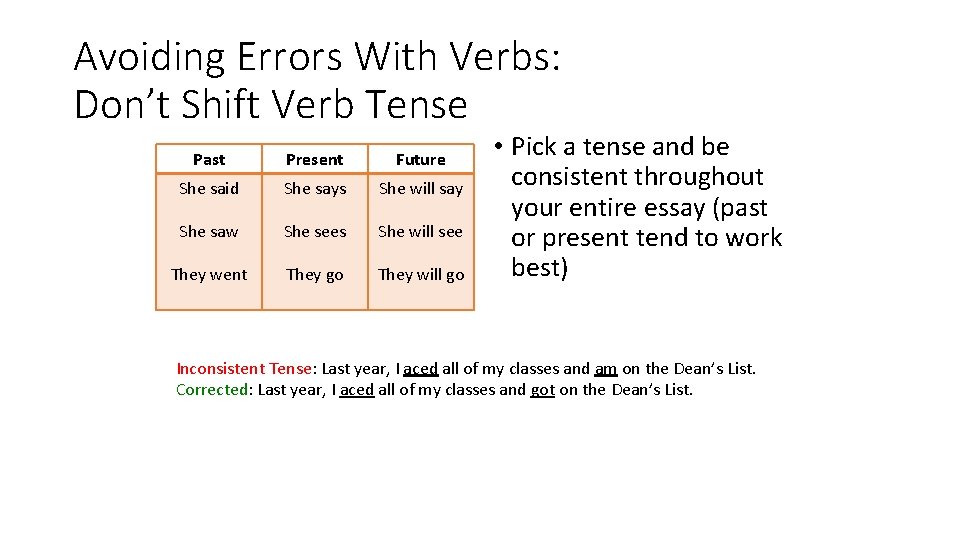
Avoiding Errors With Verbs: Don’t Shift Verb Tense Past Present Future She said She says She will say She saw She sees She will see They went They go They will go • Pick a tense and be consistent throughout your entire essay (past or present tend to work best) Inconsistent Tense: Last year, I aced all of my classes and am on the Dean’s List. Corrected: Last year, I aced all of my classes and got on the Dean’s List.
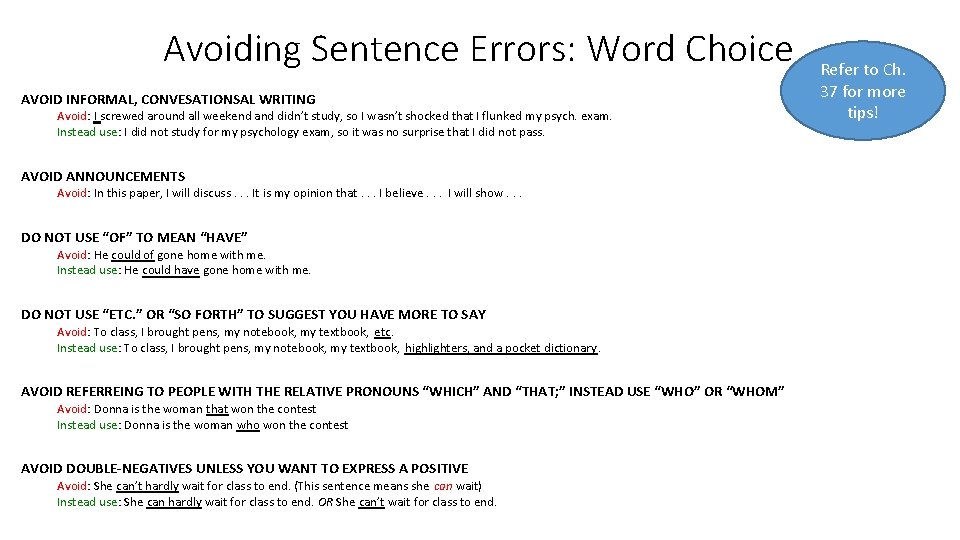
Avoiding Sentence Errors: Word Choice AVOID INFORMAL, CONVESATIONSAL WRITING Avoid: I screwed around all weekend and didn’t study, so I wasn’t shocked that I flunked my psych. exam. Instead use: I did not study for my psychology exam, so it was no surprise that I did not pass. AVOID ANNOUNCEMENTS Avoid: In this paper, I will discuss. . . It is my opinion that. . . I believe. . . I will show. . . DO NOT USE “OF” TO MEAN “HAVE” Avoid: He could of gone home with me. Instead use: He could have gone home with me. DO NOT USE “ETC. ” OR “SO FORTH” TO SUGGEST YOU HAVE MORE TO SAY Avoid: To class, I brought pens, my notebook, my textbook, etc. Instead use: To class, I brought pens, my notebook, my textbook, highlighters, and a pocket dictionary. AVOID REFERREING TO PEOPLE WITH THE RELATIVE PRONOUNS “WHICH” AND “THAT; ” INSTEAD USE “WHO” OR “WHOM” Avoid: Donna is the woman that won the contest Instead use: Donna is the woman who won the contest AVOID DOUBLE-NEGATIVES UNLESS YOU WANT TO EXPRESS A POSITIVE Avoid: She can’t hardly wait for class to end. (This sentence means she can wait) Instead use: She can hardly wait for class to end. OR She can’t wait for class to end. Refer to Ch. 37 for more tips!
Commonly Confused Words it’s, its • It’s is the contraction of it is or it has: It’s unfair to accuse Lee of lying without proof. • Its is a possessive pronoun: The dog buried its bone. than, then • Than is used for comparisons: The car I bought is more fuel efficient than yours. • Then is a time reference; it also means “next”: I went to class, and then I went to the library. there, their, they’re • There indicates place: I thought my car was parked there. • There is also a sentence opener: There are 12 people going on the ski trip. • Their is a possessive pronoun: Children rarely appreciate what their parents do for them. • They’re is a contraction of they are: Lyla and Jim said they’re coming. to, too, two • To means “toward, ” and it is also used with a verb to form the infinitive: Kathleen saved enough money to go to Italy. • Too means “also”: The children wanted to go too. • Too also means “overly”: When the curtain went up, I was too frightened to say my lines. • Two is the number: Lenny gets along with his two roommates. whose, who’s • Whose is the possessive form of who: Whose books are on the kitchen table? • Who’s is the contraction of who is and who has: Who’s been in the cookie jar? your, you’re • Your is the possessive form of you: Your car is parked in a tow-away zone. • You’re is the contraction of you are: Let me know when you’re coming. Spell check doesn’t always catch homonym mistakes!
- Slides: 15