
IF I FORGET THEE OH EARTH BY ARTHUR
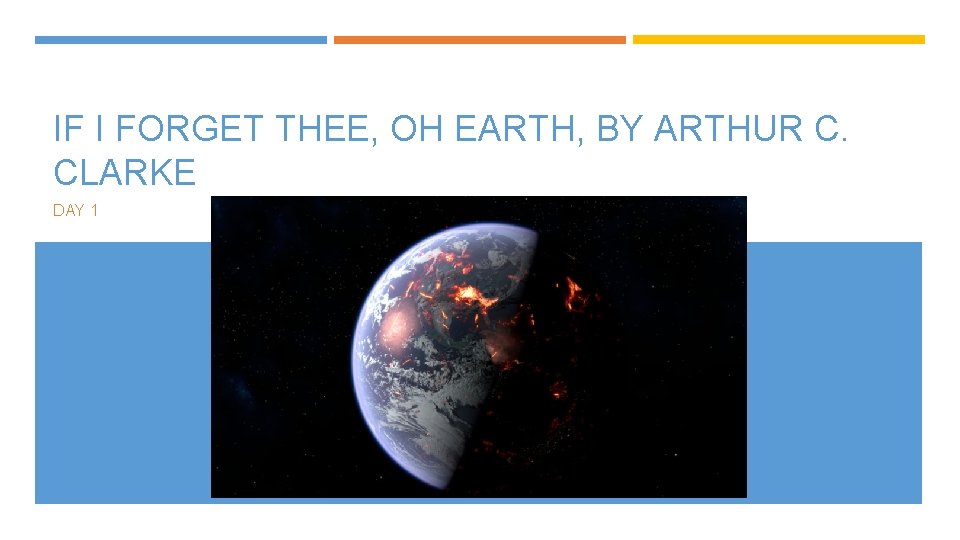
IF I FORGET THEE, OH EARTH, BY ARTHUR C. CLARKE DAY 1
NOTES ON STYLE Theme is the central message of insight about life that is conveyed in a short story, an essay, or another literary work. Sometimes it is explicit, or stated directly. More often, it is implicit – or expressed indirectly – through words and actions of the characters or the events of a story. The way theme is developed depends on the genre, or form, or the work. Nonfiction: In non fiction literature, such as essays or articles, theme is usually stated explicitly, as a main idea or thesis. The thesis statements frequently appears at the beginning of the work. Fiction and poetry: In fiction and poetry, theme is often implicit. Readers can figure out the implied theme by looking at story events, the words and actions of characters, and patters of related images and ideas called motifs.
NOTES ON STYLE The context, or time and place, in which the author is writing, can also affect the expression of a theme. For example, an author living in a culture that values technology might express a theme differently from an author who culture is not technologically advanced. The topic for today’s work is the environment. “If I Forget Thee, Oh Earth” is a short story (fiction).
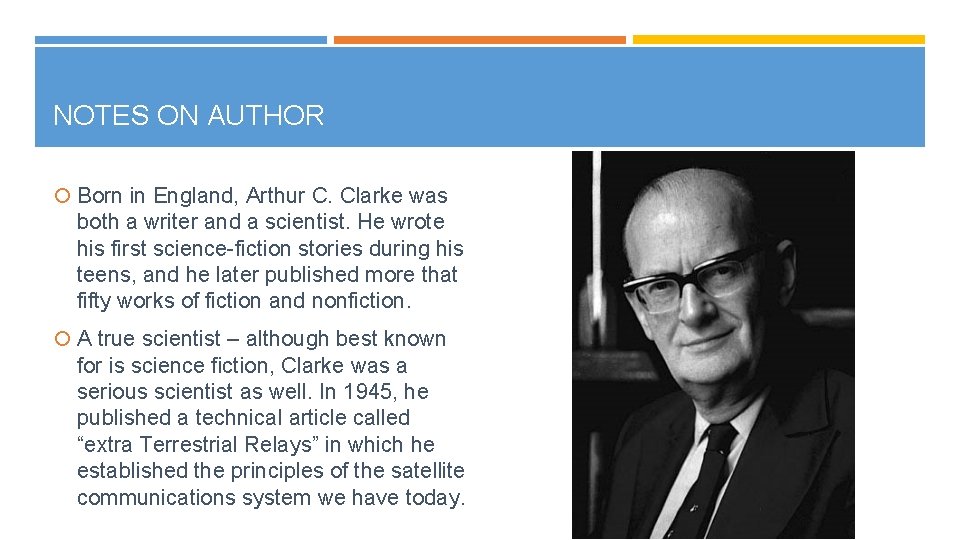
NOTES ON AUTHOR Born in England, Arthur C. Clarke was both a writer and a scientist. He wrote his first science-fiction stories during his teens, and he later published more that fifty works of fiction and nonfiction. A true scientist – although best known for is science fiction, Clarke was a serious scientist as well. In 1945, he published a technical article called “extra Terrestrial Relays” in which he established the principles of the satellite communications system we have today.
VOCABULARY DEFINITIONS Word List A Harmony [HAHR muh nee] n. cooperation; agreement Hostile [HAHS tuhl] adj. unfriendly; difficult to deal with Landscape [LAND skayp] n. view of one’s natural surroundings Misfortunes [mis FOR chunz] unlucky happenings Reminder [fi MYN der] n. something that makes you notice or remember Stark [STAHRK] adj. grim; impossible to avoid Unnoticed [un NOH tist] adj. not seen Word List B Abundance [uh NUN duhns] n. very large quantity Agony [AG uh nee] n. severe pain or suffereing Isolation [eye soh LAY shuhn] n. state of being separated form other Prosperous [PRAHS per us] adj. successful and wealthy Radiance [RAY dee ens] n. soft, shining light Residential [rez i DEN chuhl] adj. having to do with where people live Scour [SKOW uhr] v. to clean by scrubbing Substantial [sub STAN chuhl] adj. Large in amount
VOCABULARY EXERCISE A – FILL IN EACH BLANK IN THE PARAGRAPH BELOW WITH THE APPROPRIATE WORD FROM WORD LIST A – THE WORDS MAY NOT REPEAT! When people have troubles and [1] _____, many find it helpful to escape to nature. Some go to the mountains, where the rugged [2] _____ of tall rocks as far as the eye can see is a [3] _____ that many things are bigger than our problems. Others choose a quiet place, such as a lake, where there is a soothing [4] _____ of water and sky. Still others head for a setting as difficult as their dilemmas, such as a desert, where the [5] _____ surroundings are a challenge. The harshly [6] _____ understanding that they need to keep their wits to survive force them to focus on something other than their troubles. Life is filled with a [7] _____ of problems. Some solutions are [8] _____ until we discover them in the wild.
VOCABULARY EXERCISE B– WRITE WHETHER EACH STATEMENT BELOW IS TRUE OR FALSE. THEN, EXPLAIN YOUR ANSWER. 1. A small party would have a substantial guest list. 2. A prosperous business might make plans to expand. 3. You might describe a pitch-black room as full of radiance. 4. A woman who just painted her nails might not want to scour a pan. 5. A person in agony is blissfully happy. 6. Someone who enjoys other people would prefer to be in isolation 7. The dorms at a college are the residential part of that education community. 8. You might be disappointed to receive an abundance of gifts on your birthday.
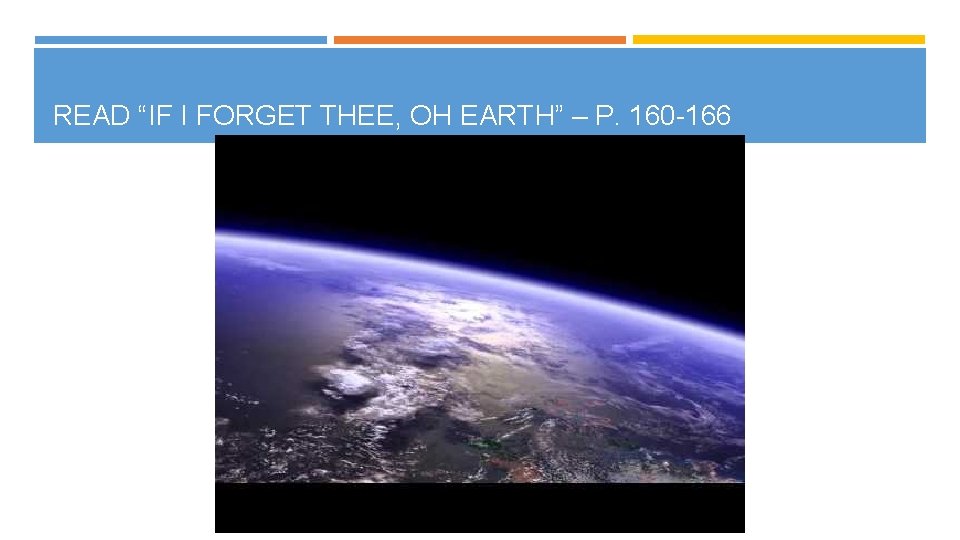
READ “IF I FORGET THEE, OH EARTH” – P. 160 -166
CONNECTING WITH FACTS Nuclear Impact Current estimates put the number of nuclear weapons held by world powers between 15, 000 and 23, 000. Many experts agree that it would take hundreds of years for nuclear atoms to decay to safe levels after a major nuclear weapon detonation. Those who are not killed in the initial blast from a nuclear weapon will be exposed to radiation fallout, which damages the DNA of cells. This can cause internal bleeding, hair loss, ulcers, and cancers such as leukemia. The long-term effects of nuclear fallout include birth defects and deformities.
RESEARCH Research nuclear disasters such as Chernobyl and Fukushima. Also, examine recent studies on thyroid dysfunction in infants and children after Fukushima. Write a two to three page essay answering the following essential questions while making connections to your research findings. Remember to skip lines! What are the dangers of nuclear warfare? Why is it important to have goals and a purpose? Is survival a choice?
TODAY’S GRADE CHECKLIST – COPY THIS ONTO A SHEET OF PAPER AND STAPLE EVERYTHING TOGETHER! I. Author/Style notes ___/15 pts. Vocabulary Definitions ___/15 pts. Vocabulary Exercise A ___/15 pts. II. “If I Forget Thee, Oh Earth” online test ___/100 pts. Total: 100 pts. Vocabulary Exercise B ___15 pts. Oral Reading ___/10 pts. Connecting with the Facts ___/15 pts Research Essay ___/15 pts. Total: 100 pts. III. Video Questions ___/100 pts. Total: 100 pts.
FILM Watch film in class about the dangers of pollution and human destruction of their only planet and answer video guide questions.
- Slides: 12