
IETF Structure and Internet Standards Process Scott Bradner
IETF Structure and Internet Standards Process Scott Bradner 85 th IETF Atlanta, Georgia, USA Guest Day
Agenda IETF history & overview IETF role & scope IETF structure & associated groups IETF management & selection IETF process & procedure a working group session intellectual property rights (IPR)
The IETF Internet Engineering Task Force formed in 1986 evolved out of US ARPANET-related government activities Internet Configuration Control Board (ICCB) (1979) and Internet Activities Board (1983) was not considered important for a long time - good!! not “government approved” (US or other) - great!! although funding support from U. S. Government until 1997 people not companies “We reject kings, presidents and voting. We believe in rough consensus and running code” Dave Clark (1992)
IETF Overview Internet Standards R Us most Internet-related standards were developed or are maintained by the IETF not including physical network or page display standards does not exist (in a legal sense), no members, no voting The IETF is “an organized activity of the Internet Society” 1 K to 1. 5 K people at 3/year meetings many more on mail lists
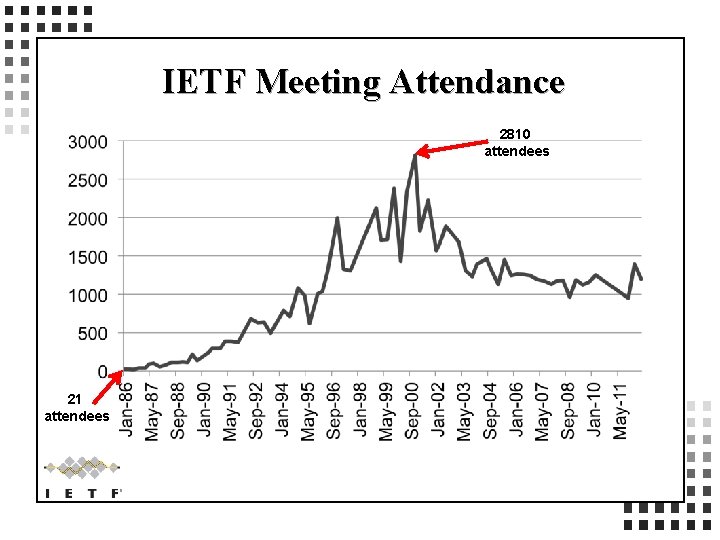
IETF Meeting Attendance 2810 attendees 21 attendees
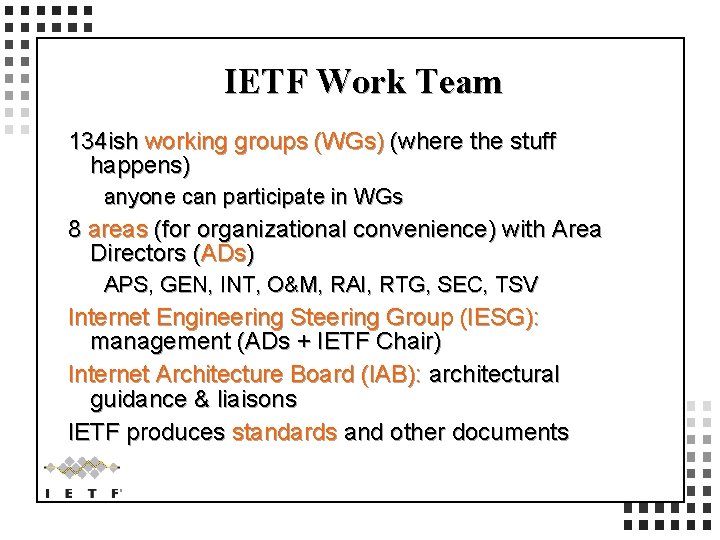
IETF Work Team 134 ish working groups (WGs) (where the stuff happens) anyone can participate in WGs 8 areas (for organizational convenience) with Area Directors (ADs) APS, GEN, INT, O&M, RAI, RTG, SEC, TSV Internet Engineering Steering Group (IESG): management (ADs + IETF Chair) Internet Architecture Board (IAB): architectural guidance & liaisons IETF produces standards and other documents
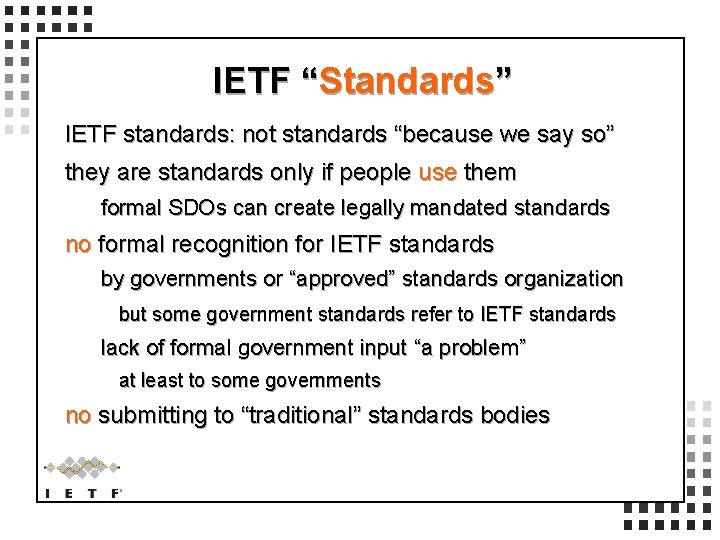
IETF “Standards” IETF standards: not standards “because we say so” they are standards only if people use them formal SDOs can create legally mandated standards no formal recognition for IETF standards by governments or “approved” standards organization but some government standards refer to IETF standards lack of formal government input “a problem” at least to some governments no submitting to “traditional” standards bodies
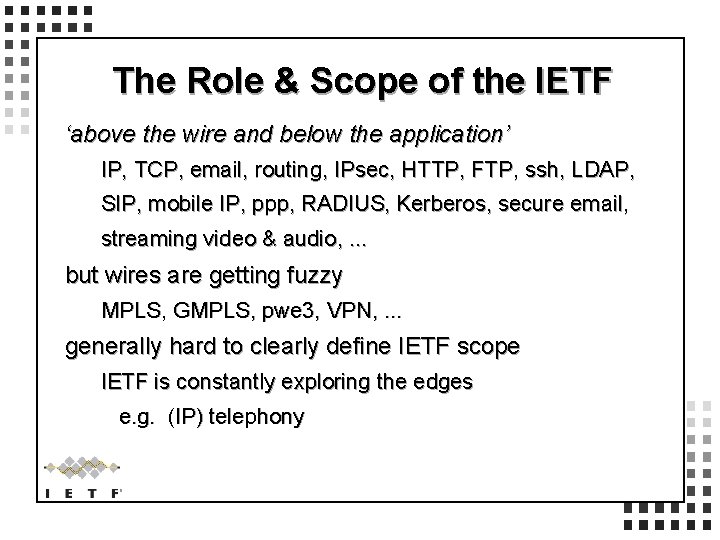
The Role & Scope of the IETF ‘above the wire and below the application’ IP, TCP, email, routing, IPsec, HTTP, FTP, ssh, LDAP, SIP, mobile IP, ppp, RADIUS, Kerberos, secure email, streaming video & audio, . . . but wires are getting fuzzy MPLS, GMPLS, pwe 3, VPN, . . . generally hard to clearly define IETF scope IETF is constantly exploring the edges e. g. (IP) telephony
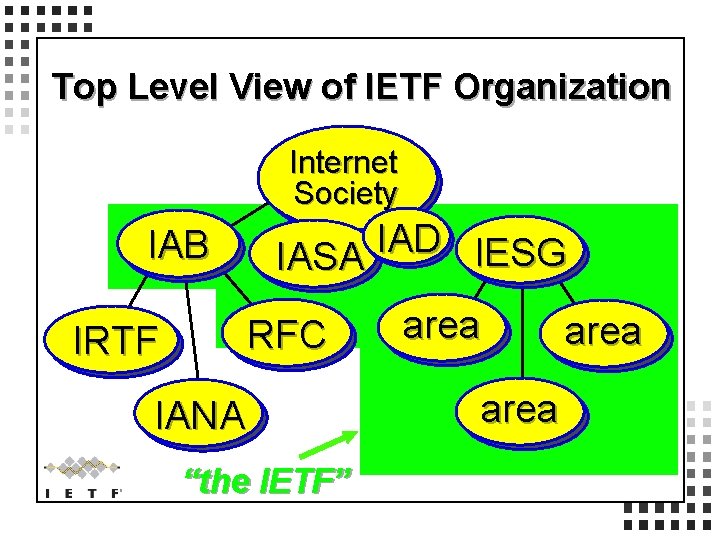
Top Level View of IETF Organization Internet Society IAD IESG IASA IAB IRTF RFC IANA “the IETF” area
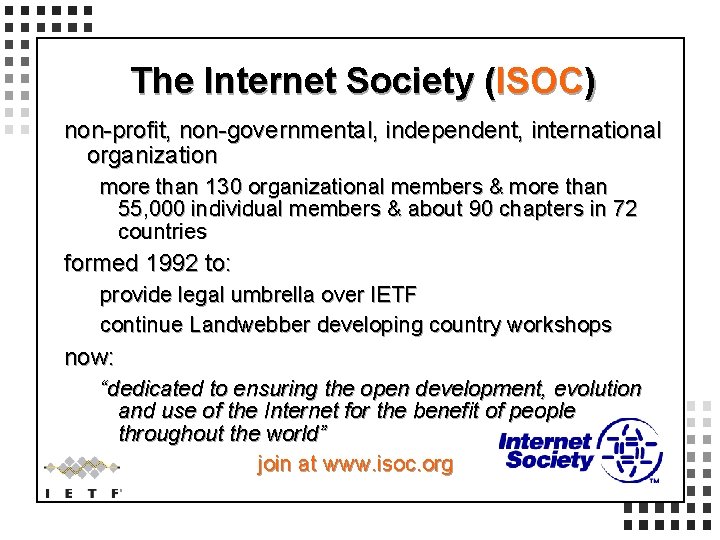
The Internet Society (ISOC) non-profit, non-governmental, independent, international organization more than 130 organizational members & more than 55, 000 individual members & about 90 chapters in 72 countries formed 1992 to: provide legal umbrella over IETF continue Landwebber developing country workshops now: “dedicated to ensuring the open development, evolution and use of the Internet for the benefit of people throughout the world” join at www. isoc. org

Internet Research Task Force (IRTF) focused on long term problems in Internet Anti-Spam Research Group (ASRG) Crypto Forum Research Group (CFRG) Delay-Tolerant Networking Research Group (DTNRG) Host Identity Protocol (HIP) Research Group (HIPRG) Internet Congestion Control Research Group (ICCRG) Information Centric Networking Research Group (ICNRG) Network Complexity Research Group (NCRG) Network Management Research Group (NMRG)
IRTF, contd. Peer-to-Peer Research Group (P 2 PRG) Routing Research Group (RRG) Scalable Adaptive Multicast Research Group (SAMRG) IRTF chair appointed by IAB for more information see http: //www. irtf. org IRTF Chair: Lars Eggert

Internet Architecture Board (IAB) provides overall architectural advice & oversight to IESG, IETF & ISOC approves IESG slate from nomcom provides “oversight” of IETF standards process deals with IETF external liaisons appoints IRTF chair selects IETF-IANA appoints & oversees RFC Editor members appointed by the nomcom
Internet Assigned Number Authority (IANA) assigns numbers and keeps them from colliding assigns protocol numbers (ports, MIME types, etc) IP addresses assigns address blocks to 5 regional IP Address registries which assign addresses to ISPs and end sites domain names defines top level domains (TLDs) - e. g. , . com, . ca, . us, . . . maintains root server database of TLD server addresses the IANA predates the IETF now a function of ICANN
IETF Management IETF Chair AD for General Area, chief spokesperson Area Directors (ADs) manage individual areas (two per regular area) Internet Engineering Steering Group (IESG) ADs + IETF Chair sitting as a body Internet Architecture Board IETF chair is part of IAB IETF management selected by nomcom two year terms
IETF Management, contd. IETF management are all volunteers AD job: half to 3/4 time IAB job: 1/3 time IETF Chair job: full time IETF does not pay ADs, IAB members, IAOC members, WG chairs or IETF Chair a salary or expenses people are company or self-supported secretariat, RFC publication support & IAD are paid
IETF Chair Russ Housley <chair@ietf. org> also chair of the IESG also AD of the General Area also ex officio member of the IAB nominated by IETF community selected by the nomcom IETF’s “CTO” - “Chief Talking (& Traveling) Officer” no particular authority over standards discusisons
Area Directors (ADs) Areas have 2 ADs except General Area responsible for setting direction in Area responsible for managing process in Area approve BOFs & propose working groups review working group documents prior to IESG review selected by the nomcom
IESG Internet Engineering Steering Group ADs + IETF Chair process management and RFC approval body approves WG creation (with IAB advice) provides cross-area technical review & approves publication of IETF documents reviews and comments on non-IETF RFC submissions multi-disciplinary technical review group
Selecting IETF Management picked by a nominations committee (nomcom) nomcom chair appointed by ISOC president process described in RFC 3777 members selected randomly from list of volunteers requirement: present at 3 of last 5 IETF meetings very random process to select from volunteers: RFC 3797 gets list of jobs to fill can include IETF Chair, IESG, IAB & IAOC members nominate one person for each job IAOC selections approved by IESG, IESG & IETF Chair selections approved by IAB, IAB selections approved by ISOC Bo. T
IETF Areas General Area (gen) - 0 WGs (as of 2/13/2012) Applications (app) - 17 WGs Internet (int) - 25 WGs Operations & Management (ops) - 16 WGs Real-time Applications and Infrastructure (rai) - 29 WGs Routing (rtg) - 18 WGs Security (sec) – 12 WGs Transport Services (tsv) - 16 WGs
IETF Administrative Support Activity (IASA) provides the administrative structure required to support the IETF standards process: see RFCs 4071 & 4371 has no authority over the standards process housed within the Internet Society creates budget for IETF money from meeting fees & from ISOC responsible for IETF finances contracts for IETF support functions Secretariat functions, RFC evaluation and publication & IETF-IANA deals with IETF IPR
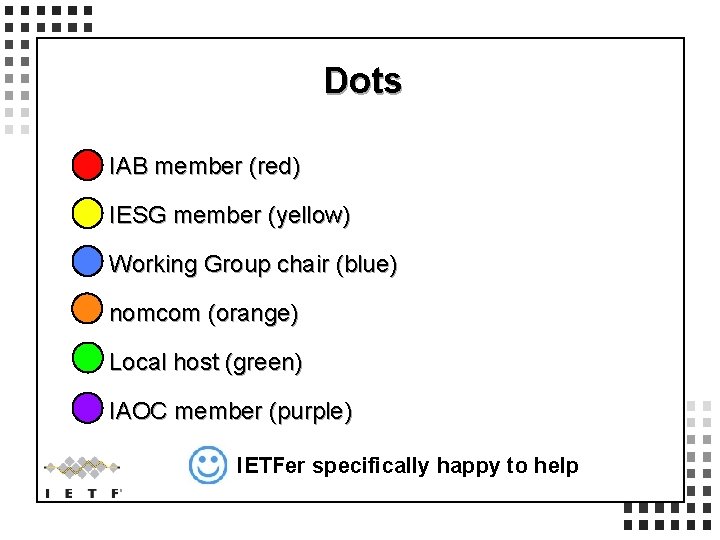
Dots IAB member (red) IESG member (yellow) Working Group chair (blue) nomcom (orange) Local host (green) IAOC member (purple) IETFer specifically happy to help
Birds of a Feather Sessions (BOF) often precedes the formation of a Working Group group of people interested in a topic convince an AD that they have a good idea - one worth exploring & there are enough interested people to do the work need description and agenda before a BOF can be scheduled and sometimes a draft charter for a working group BOFs generally only meet once can lead to a WG or can be a one time thing
Working Groups this is where the IETF primarily get its work done most discussions on a WG mailing list face-to-face meetings focused on key issues (ideally) note: face-to-face meetings generally quite short “bottoms up” i. e. , generally proposed by IETF participants, not ADs sometimes preceded by a BOF
Working Groups, contd. Working Groups are focused by charters agreed between WG chair(s) and area director restrictive charters with milestones charter approved by IESG with IAB advice after public announcement for comments announcement goes to other SDOs to check for overlaps IESG has final say on charter working groups are closed when their work is done at least in theory
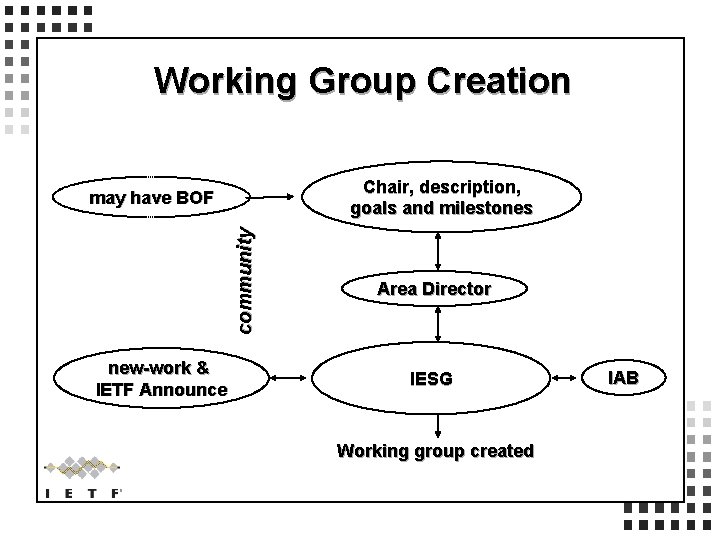
Working Group Creation Chair, description, goals and milestones community may have BOF new-work & IETF Announce Area Director IESG Working group created IAB
Working Groups. contd. no defined membership just participants “Rough consensus and running code. . . ” no formal voting (can not define the constituency) can do show of hands or hum - but no count does not require unanimity chair determines if there is consensus disputes resolved by discussion mailing list and face-to-face meetings final decisions must be verified on mailing list to ensure those not present at face-to-face are included but taking into account face-to-face discussion
IETF Document Format English is the official language of the IETF but blanket permission is given to translate any IETF document (in total) into any language for any reason ASCII is the mailing list and document format constant discussion of alternate formats IETF seen as “behind the times” - e. g. , (almost) no drawings - but no consensus on alternative format note that the current format is still readable after 42 years (see RFC 20 for an example) how many other SDOs can claim that?
Standards Process technical proposals published as Internet Drafts (ID) worked on in a Working Group WG sends IESG request to publish an ID ‘when ready’ proposal reviewed by AD responsible for WG can be sent back to working group for more work 2 -week IETF-wide Last-Call 4 -week Last Call if individual standards track submission IESG review last call comments + own technical review can be sent back to Working Group for more work publication as RFC
IETF Documents all IETF documents are open i. e. , anyone can download and make copies (in full) Internet Draft IETF working documents some I-Ds are working group documents RFC archival publications (never changed once published) update or correction gets new RFC number many different types of RFCs
IETF Working Documents Internet-Draft random or non-random thoughts input to the process no admissions control other than boilerplate (see IPR) might be individual submissions or working group documents can tell by name draft-wgname- is working group draft-person_name- is individual
What is a RFC? RFC used to stand for “Request for Comments” now just a (brand) name now tend to be more formal documents than early RFCs IETF document publication series RFC 1 Host Software - Apr 7 1969 now over 6000 RFCs not all RFCs are standards! see RFC 1796 though some vendors sometimes imply otherwise many types of RFCs
RFC Repository Contains: standards track OSPF, IPv 6, IPsec. . . obsolete Standards RIPv 1 requirements Host Requirements policies poetry ‘Twas the night before startup white papers On packet switches with infinite storage corporate documentation Ascend multilink protocol Classless Inter. Domain experimental history Netblt Routing april fool’s day jokes IP on Avian Carriers. . . updated for Qo. S process documents IETF Standards Process
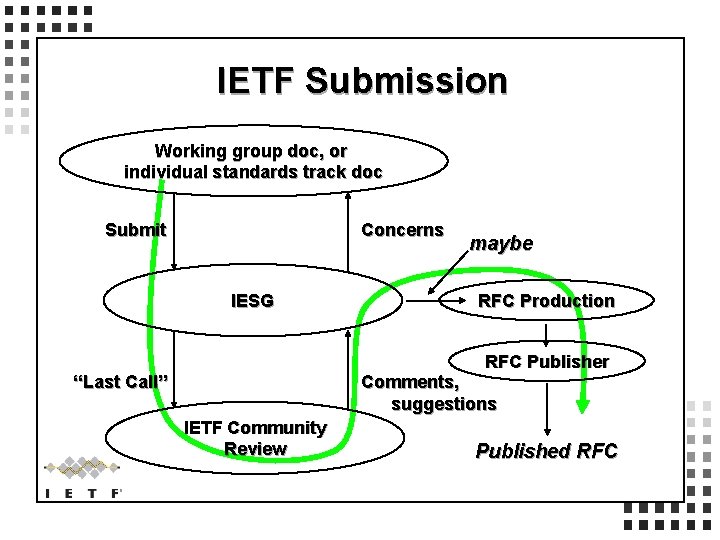
IETF Submission Working group doc, or individual standards track doc Submit Concerns IESG maybe RFC Production RFC Publisher “Last Call” Comments, suggestions IETF Community Review Published RFC
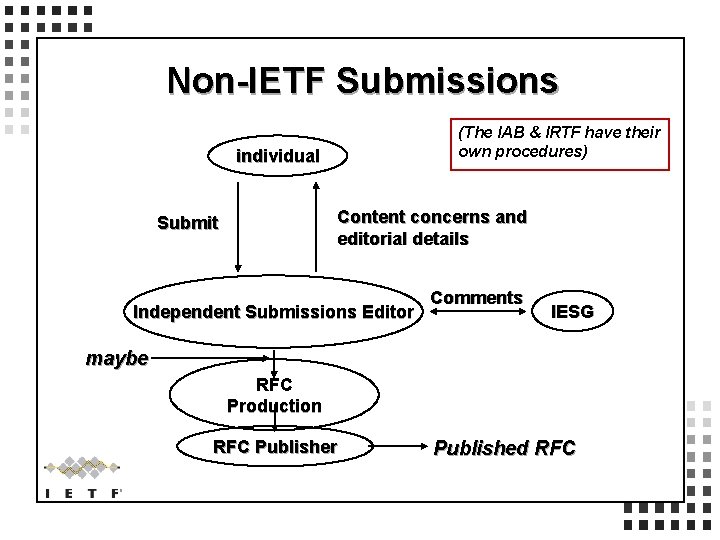
Non-IETF Submissions (The IAB & IRTF have their own procedures) individual Content concerns and editorial details Submit Independent Submissions Editor Comments IESG maybe RFC Production RFC Publisher Published RFC
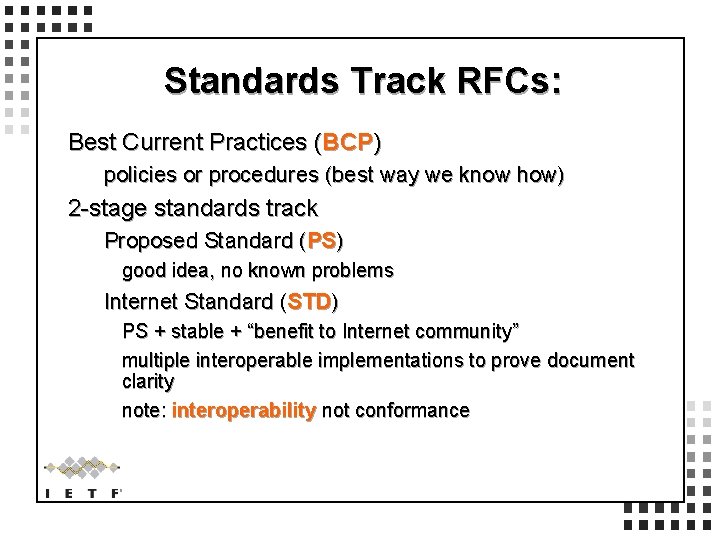
Standards Track RFCs: Best Current Practices (BCP) policies or procedures (best way we know how) 2 -stage standards track Proposed Standard (PS) good idea, no known problems Internet Standard (STD) PS + stable + “benefit to Internet community” multiple interoperable implementations to prove document clarity note: interoperability not conformance
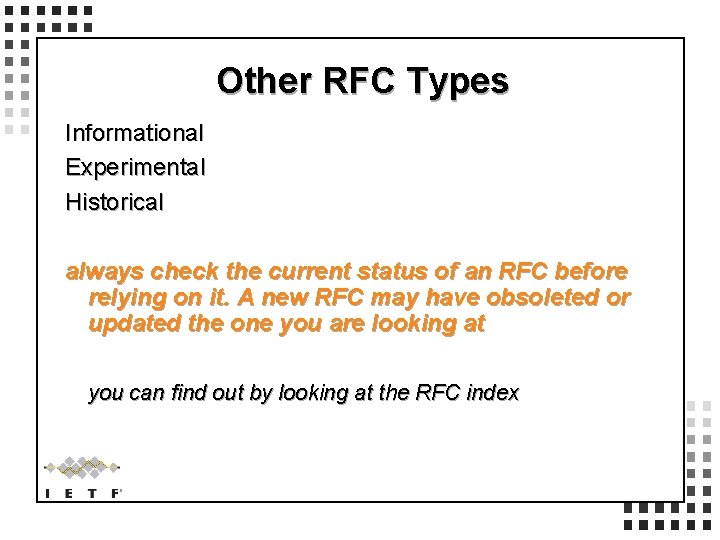
Other RFC Types Informational Experimental Historical always check the current status of an RFC before relying on it. A new RFC may have obsoleted or updated the one you are looking at you can find out by looking at the RFC index
A Working Group Session WGs only meet for a few hours at an IETF meeting most working group work is done on the WG mailing list often only specific unresolved issues are discussed at meetings so read the IDs and mailing list before the session advice: listen (and read) before speaking sessions are being streamed & recorded so speak directly into the mike (don’t look at the questioner) say your name - every time you get to the mike for the people in audio-land & for the scribe(s) sign the blue sheets record of who is in the room - required for openness published but not retained
Intellectual Property Rights IPR is a very big issue in standards bodies what to do if there is a patent on the technology what about just a patent application? what if you do not know until it’s already a standard when you find out about a patent? patent questions: should you demand free rights to implement? require “fair & non-discriminatory” licensing? what if IPR claim is false? e. g. , an attempt to block the standard should the standards body evaluate validity of patents?
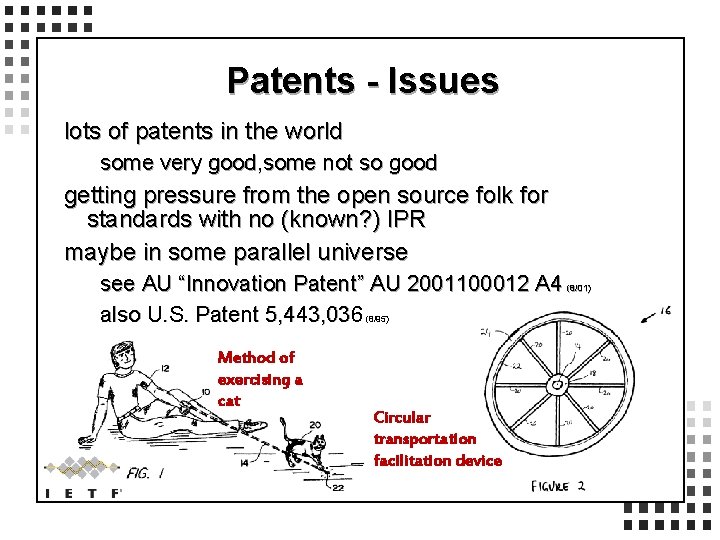
Patents - Issues lots of patents in the world some very good, some not so good getting pressure from the open source folk for standards with no (known? ) IPR maybe in some parallel universe see AU “Innovation Patent” AU 2001100012 A 4 (8/01) also U. S. Patent 5, 443, 036 (8/95) Method of exercising a cat Circular transportation facilitation device
IPR (Patents) IETF IPR (patent) rules require timely disclosure of your own IPR in your own submissions & submissions of others disclosures published on IETF web site “reasonably and personally” known to the WG participant i. e. , no patent search required WG may take IPR into account when choosing solution RFC 3669 gives background and guidance push from open source people for RF-only process consensus to not change to mandatory RF-only but many WGs tend to want RF or IPR-free (or at least assumed to be IPR-free)
IPR (Copyright) author(s) need to give non-exclusive publication rights to IETF Trust if to be published at all also (normally) the right to make derivative works this right required for standards track documents author(s) retain all other rights updated by RFC 5378 expanded rights granted to IETF Trust issue with text copied from older IDs and RFCs IETF Trust released a FAQ on IETF copyright see http: //trustee. ietf. org/faqs. html
Note Well (1) The “Note Well” statement shows up a lot at the IETF. Mailing lists, registration, meeting openings, etc. defines “contribution” and requires obeying IETF rules “Any submission to the IETF intended by the Contributor for publication as all or part of an IETF Internet-Draft or RFC and any statement made within the context of an IETF activity is considered an "IETF Contribution". continued. . .
Note Well (2) Such statements include oral statements in IETF sessions, as well as written and electronic communications made at any time or place, which are addressed to: * The IETF plenary session * The IESG, or any member thereof on behalf of the IESG * Any IETF mailing list, including the IETF list itself, any working group or design team list, or any other list functioning under IETF auspices * Any IETF working group or portion thereof * The IAB or any member thereof on behalf of the IAB * The RFC Editor or the Internet-Drafts function continued. . .
Note Well (3) All IETF Contributions are subject to the rules of RFC 5378 and RFC 3979 (updated by RFC 4879). Statements made outside of an IETF session, mailing list or other function, that are clearly not intended to be input to an IETF activity, group or function, are not IETF Contributions in the context of this notice. Please consult RFC 5378 and RFC 3979 for details. continued. . .
Note Well (4) A participant in any IETF activity is deemed to accept all IETF rules of process, as documented in Best Current Practices RFCs and IESG Statements. A participant in any IETF activity acknowledges that written, audio and video records of meetings may be made and may be available to the public. ”
Today at the IETF 22 2 2 3 Working Group meetings Open Area Meetings IRTF Research Group Meetings BOFs
Today At the IETF: 9 to 11: 30 AM Peer to Peer Streaming Protocol MBONE Deployment Applications Area Open Meeting Network Complexity Research Group – IRTF Contro. Lling m. Ultiple streams for t. Elepresence IPv 6 Maintenance Common Control and Measurement Plane Keying and Authentication for Routing Protocols
Today At the IETF: 1 to 3 PM Audio/Video Transport Core Maintenance Hypertext Transfer Protocol Bis Internet Area Working Group Routing Area Working Group Protocol Independent Multicast Internet Congestion Control Research Group - IRTF Application Bridging for Federated Access Beyond web Diameter Maintenance and Extensions
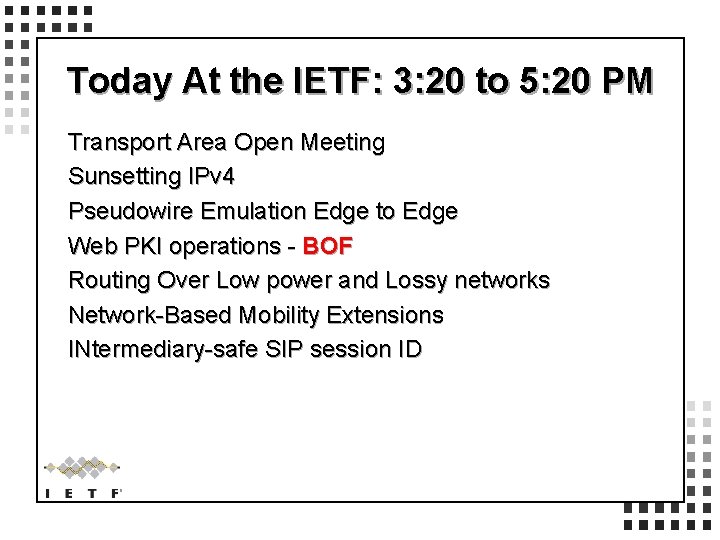
Today At the IETF: 3: 20 to 5: 20 PM Transport Area Open Meeting Sunsetting IPv 4 Pseudowire Emulation Edge to Edge Web PKI operations - BOF Routing Over Low power and Lossy networks Network-Based Mobility Extensions INtermediary-safe SIP session ID
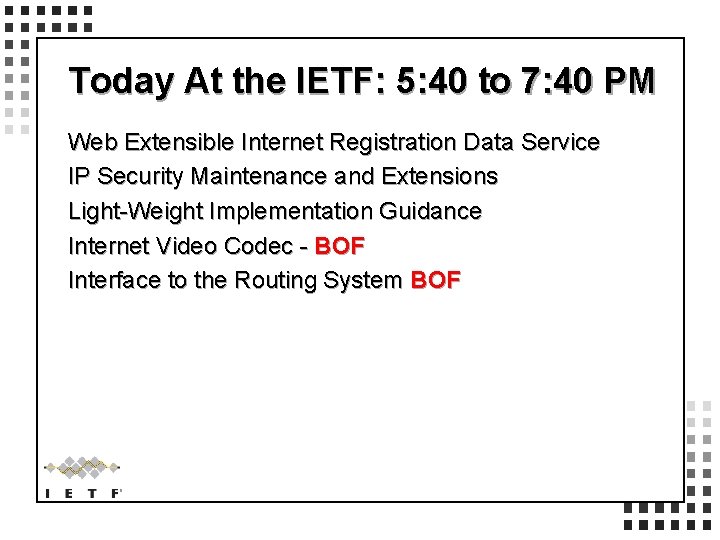
Today At the IETF: 5: 40 to 7: 40 PM Web Extensible Internet Registration Data Service IP Security Maintenance and Extensions Light-Weight Implementation Guidance Internet Video Codec - BOF Interface to the Routing System BOF
What next? join mailing lists this is where the work happens but read (and understand) before writing read the drafts & contribute don’t be shy (but do not come on too strong) talk with (not just to) people look for common ground don’t settle for second-rate discussion or technology
Questions?
- Slides: 54