IETF 92 nd Provisioning AutoDiscovery and Signaling in
- Slides: 5
IETF 92 nd Provisioning, Auto-Discovery, and Signaling in L 2 VPNs for IPv 6 Remote PE draft-abhattacharya-bess-l 2 vpn-ipv 6 -remotepe IETF 92 -Dallas, March 2015 ABhattacharya@ixiacom. com amukherjee@ixiacom. com Presenter: mohamed. boucadair@orange. com 1
IETF 92 nd Problem • Excerpt form RFC 7439 (Gap analysis for MPLS in IPv 6 networks) – “[RFC 6074] is the only RFC that appears to have a gap for IPv 6 -only operation. ” – “In its discovery procedures (Sections 3. 2. 2 and 6 of RFC 6074 [RFC 6074]), it suggests encoding PE IP addresses in the Virtual Switching Instance ID (VSI-ID) …. ” – “means that a PE IP address cannot be an IPv 6 address. ” – “Also, in its signaling procedures it suggests encoding PE_addr in the Source Attachment Individual Identifier (SAII) and the Target Attachment Individual Identifier (TAII), which are limited to 32 bits (AII Type=1) at the moment. ” • This I-D fills this void 2
IETF 92 nd Update#1 to RFC 6074 • Update the BGP NLRI encoding defined in Section 3. 2. 2. 1 to carry an IPv 4 address or an IPv 6 address – OLD: PE_addr (4 octets) – NEW: PE_addr (4 or 16 octets) 3
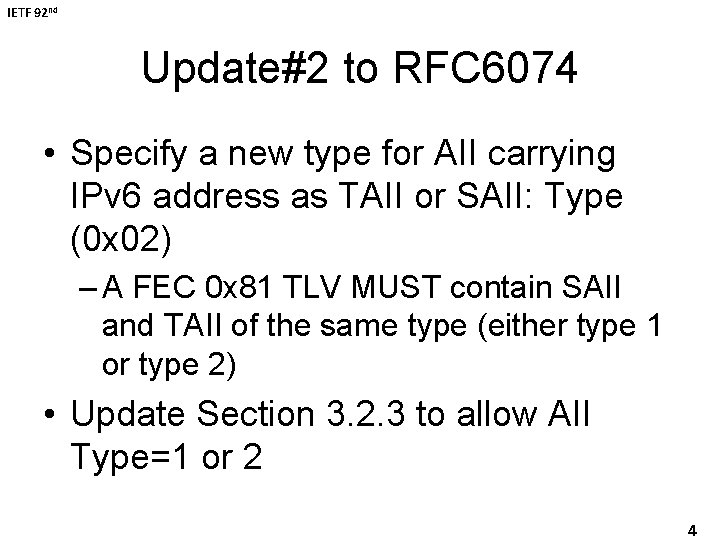
IETF 92 nd Update#2 to RFC 6074 • Specify a new type for AII carrying IPv 6 address as TAII or SAII: Type (0 x 02) – A FEC 0 x 81 TLV MUST contain SAII and TAII of the same type (either type 1 or type 2) • Update Section 3. 2. 3 to allow AII Type=1 or 2 4
IETF 92 nd What’s Next? • This is a missing “piece” as per the RFC 7439 analysis • The proposed fixes are straightforward • Suggestions for the next step? 5