
IES Application Seminar Roadway Lighting Authored by The
IES Application Seminar Roadway Lighting Authored by The IES Roadway Lighting Committee Edited by Matthew Hartley Copyright © 2015 – Illuminating Engineering Society of North America
. . . About your presenter • Doug Paulin Member Emeritus-IES • IES Technical Committee Member – Roadway – Environmental Outdoor – Security Lighting – Industrial Lighting • Past Chair of Technical Committees – Industrial Committee ( RP 7) – Roadway Subcommittee “Off-Roadway Facilities” (RP 20) – Security Lighting (G 1) • Other – Vice President Design & Application – Technical Review Council Copyright © 2015 – Illuminating Engineering Society of North America 2 IES SEM Roadway

Roadway Lighting Learning Outcomes • This seminar is based on ANSI/IES RP-8 -14 American National Standard for Roadway Lighting After this seminar the participants will be able to: § Identify changes to ANSI/IES RP-8 -14 Roadway Lighting § Understand Roadway Lighting Design Techniques § Identify additional design factors involving LED luminaires and special characteristics § Compare various roadway conditions, sites and lighting solutions Participants may receive (2) IES CEUs or (2) AIA LUs. Copyright © 2015 – Illuminating Engineering Society of North America 3 IES SEM Roadway
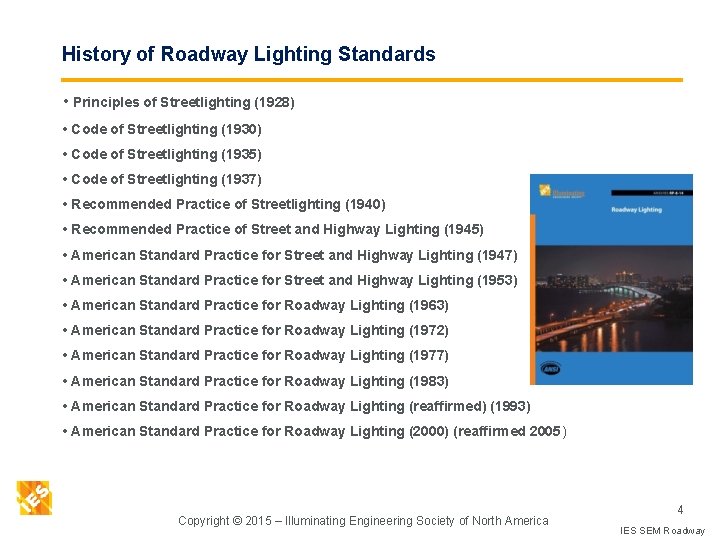
History of Roadway Lighting Standards • Principles of Streetlighting (1928) • Code of Streetlighting (1930) • Code of Streetlighting (1935) • Code of Streetlighting (1937) • Recommended Practice of Streetlighting (1940) • Recommended Practice of Street and Highway Lighting (1945) • American Standard Practice for Street and Highway Lighting (1947) • American Standard Practice for Street and Highway Lighting (1953) • American Standard Practice for Roadway Lighting (1963) • American Standard Practice for Roadway Lighting (1972) • American Standard Practice for Roadway Lighting (1977) • American Standard Practice for Roadway Lighting (1983) • American Standard Practice for Roadway Lighting (reaffirmed) (1993) • American Standard Practice for Roadway Lighting (2000) (reaffirmed 2005) Copyright © 2015 – Illuminating Engineering Society of North America 4 IES SEM Roadway
Purpose of Standard Practice RP-8 -14 • The primary purpose of this standard practice is to serve as the basis for design of fixed lighting for roadways, streets, adjacent bikeways, and pedestrian ways. • The standard practice deals entirely with lighting design and does not give advice on construction. • Its primary purpose is to provide recommended practices for designing new continuous lighting systems for roadways and streets. • It is not intended to be applied to existing lighting systems until such systems are redesigned. • Roadway and street lighting includes pedestrian and bikeway lighting when it is associated with the public right-of- way. Copyright © 2015 – Illuminating Engineering Society of North America 5 IES SEM Roadway

Changes to RP-8 -14 ANSI/IES RP-8 -14 Standard: • Uses only Luminance recommendations for long straight Streets and Roadways – Street is considered straight if radius ≥ 600 m • Provides new Luminance Table 2 (Roadways) and Table 3 (Streets) • Roadways are defined as freeways and expressways with limited access and where pedestrians are not normally present • Streets are defined as major, collector and local roads where pedestrians are expected to be present • Illuminance table (Table 9) is provided for Partial Lighting only 6 Copyright © 2015 – Illuminating Engineering Society of North America IES SEM Roadway
New Definitions: Roadway vs Street ANSI/IES RP-8 -14 Standard: • Roadways are defined as freeways and expressways with limited access and where pedestrians are not normally present • Streets are defined as major, collector and local roads where pedestrians, bicycles and parked cars are expected to be present • Residential Streetlighting is covered in more detail in IES Design Guide: -21 -15 IES SEM Roadway Copyright © 2015 – Illuminating Engineering Society of North America DG 7 IES SEM Roadway
Changes to RP-8 -14 • Cut-off Classifications are included in more detail in Annex E • References TM-15 and the Model Outdoor Lighting Ordinance (MLO) BUG Ratings for Uplight control • Relies on Veiling Luminance Ratio (Lv) criteria for Glare Control • Describes Limited Use of Mesopic Multipliers based on TM-12 -12 (Spectral Effects of Lighting on Visual Performance at Mesopic Light Levels) IES SEM Roadway Copyright © 2015 – Illuminating Engineering Society of North America 8 IES SEM Roadway
Changes to RP-8 -14 IES RP-8 -14 Document contains: • New Tables 4, 5 and 6 with both horizontal and vertical illuminance recommendations for pedestrian walkways in high, medium and low pedestrian conflict areas respectively • New Table 7 with illuminance recommendations for Pedestrian/Vehicular underpasses • New Table 8 with illuminance recommendations for Intersections Copyright © 2015 – Illuminating Engineering Society of North America 9 IES SEM Roadway
Changes to RP-8 -14 IES RP-8 -14 Document also contains: • An expanded section on High Mast Lighting • A new section on lighting of Crosswalks • A new section on Adaptive Lighting • A new section for Lighting of Roundabouts • A new section for Lighting of Toll Plazas THIS presentation includes additional information for designing with LED Luminaires, and other “Tips” Copyright © 2015 – Illuminating Engineering Society of North America 10 IES SEM Roadway
Changes to RP-8 -14 Some recommendations that were in the Annex section of RP-8 -00 have been moved to the main body of the document and expanded. • Lighting for curves and steep grades • Lighting for isolated Intersections and Interchanges • Lighting for underpasses and overpasses • Lighting for railroad grade crossings • Accommodating for trees (note that Centerpoint Energy does not trim trees unless a municipality specifically asks for it. . . And pays for it. Copyright © 2015 – Illuminating Engineering Society of North America 11 IES SEM Roadway
Changes to RP-8 -14 Luminance (Tables 2 and 3) • Specifies the minimum amount and uniformity of light reflected towards the driver from the pavement • Specifies maximum Veiling Luminance Illuminance (Table 9 for Isolated Intersections) • Simple design approach • Specifies minimum amount and uniformity of light incident on roadway surface • Specifies maximum Veiling Luminance Copyright © 2015 – Illuminating Engineering Society of North America 12 IES SEM Roadway
Purpose of Roadway and Street Lighting • To allow accurate and comfortable visibility at night of possible hazards in sufficient time to allow appropriate action. • For a pedestrian, this may mean better visibility of the surrounds and the sidewalk, while for the driver of a motor vehicle, it will mean time to stop or to maneuver around an obstacle. • Good lighting has been shown to significantly reduce the night proportion of accidents; especially on urban freeways and on major streets. Copyright © 2015 – Illuminating Engineering Society of North America 13 IES SEM Roadway
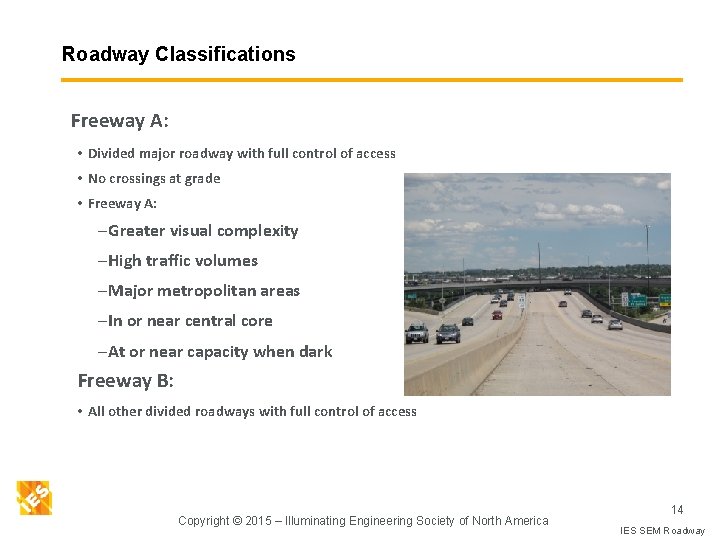
Roadway Classifications Freeway A: • Divided major roadway with full control of access • No crossings at grade • Freeway A: – Greater visual complexity – High traffic volumes – Major metropolitan areas – In or near central core – At or near capacity when dark Freeway B: • All other divided roadways with full control of access Copyright © 2015 – Illuminating Engineering Society of North America 14 IES SEM Roadway
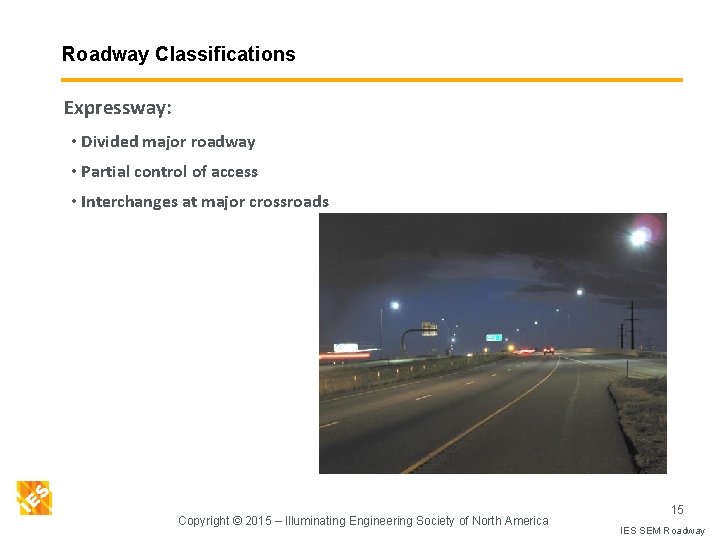
Roadway Classifications Expressway: • Divided major roadway • Partial control of access • Interchanges at major crossroads Copyright © 2015 – Illuminating Engineering Society of North America 15 IES SEM Roadway
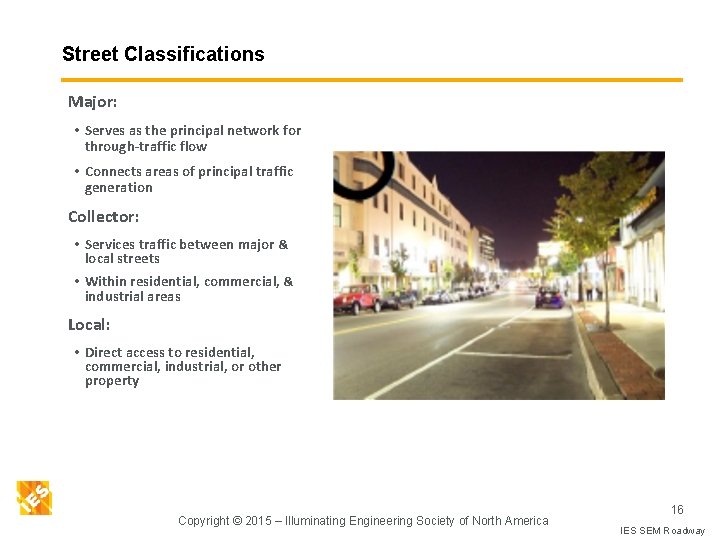
Street Classifications Major: • Serves as the principal network for through-traffic flow • Connects areas of principal traffic generation Collector: • Services traffic between major & local streets • Within residential, commercial, & industrial areas Local: • Direct access to residential, commercial, industrial, or other property Copyright © 2015 – Illuminating Engineering Society of North America 16 IES SEM Roadway
Pedestrian Conflict Areas • High - Areas with significant numbers of pedestrians expected to be on the sidewalks or crossing the streets during darkness. Examples are downtown retail areas, near theaters, concert halls, stadiums, and transit terminals. • Medium - Areas where lesser numbers of pedestrians utilize the streets at night. Typical are downtown office areas, blocks with libraries, apartments, neighborhood shopping, industrial, parks, and streets with transit lines. • Low - Areas with very low volumes of night pedestrian usage. These can occur in any of the cited roadway classifications but may be typified by suburban streets with single family dwellings, very low density residential developments, and rural or semi-rural areas. Copyright © 2015 – Illuminating Engineering Society of North America 17 IES SEM Roadway

Road Surface Classifications Copyright © 2015 – Illuminating Engineering Society of North America 18 IES SEM Roadway
Luminaire Classification System • The IES classification of luminaires is provided in IES TM-15 -11, Luminaire Classification System for Outdoor Luminaires • The LCS system defines the distribution of light from the luminaire within three primary solid angles; including uplight, backlight, and forward light • The primary areas are further divided into 10 secondary solid angles • This method of luminaire classification has replaced the previous classification system of vertical light control-cutoff, semi-cutoff, and noncutoff Copyright © 2015 – Illuminating Engineering Society of North America 19 IES SEM Roadway

The Luminaire Classification System (LCS) Model Forward Light Back Light Uplight Copyright © 2015 – Illuminating Engineering Society of North America 20 IES SEM Roadway

Secondary Solid Angles Describes the light distributed in front of the luminaire • Quantifies light in solid angles for light distributed near the pole and at a further distance from the pole • Provides the ability to evaluate the potential for excessive high angle brightness Copyright © 2015 – Illuminating Engineering Society of North America 21 IES SEM Roadway

Back Light Describes the light distributed behind the luminaire • Quantifies light in solid angles for light distributed near the pole and at a further distance from the pole • Provides the ability to evaluate the potential for light trespass when luminaires are located on or near the property line Copyright © 2015 – Illuminating Engineering Society of North America 22 IES SEM Roadway
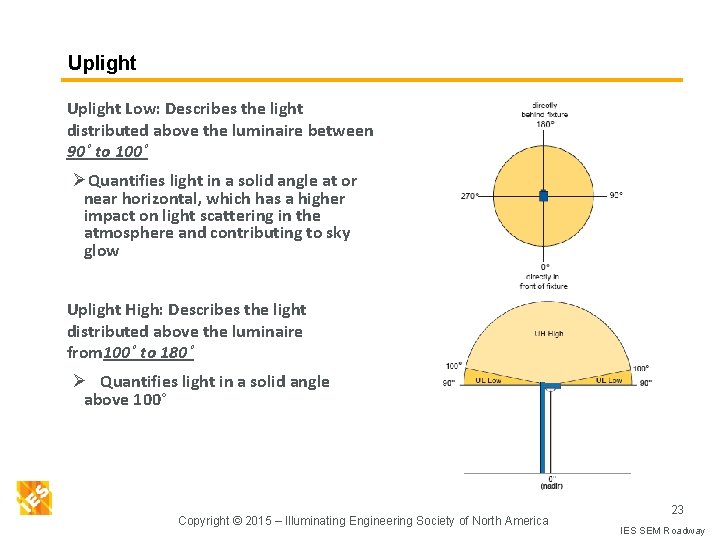
Uplight Low: Describes the light distributed above the luminaire between 90˚ to 100˚ ØQuantifies light in a solid angle at or near horizontal, which has a higher impact on light scattering in the atmosphere and contributing to sky glow Uplight High: Describes the light distributed above the luminaire from 100˚ to 180˚ Ø Quantifies light in a solid angle above 100° Copyright © 2015 – Illuminating Engineering Society of North America 23 IES SEM Roadway
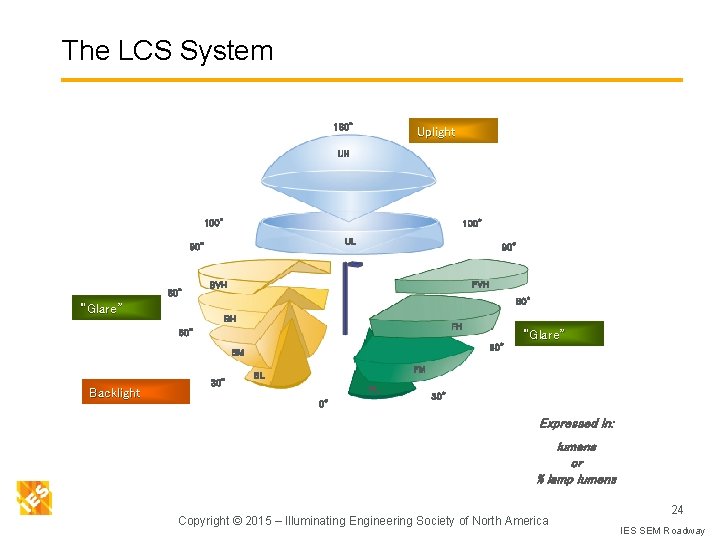
The LCS System 180° Uplight UH 100° UL 90° 80° “Glare” 90° FVH BVH 80° BH FH 60° BM Backlight 30° “Glare” 60° FM BL FL 0° 30° Expressed in: lumens or % lamp lumens Copyright © 2015 – Illuminating Engineering Society of North America 24 IES SEM Roadway
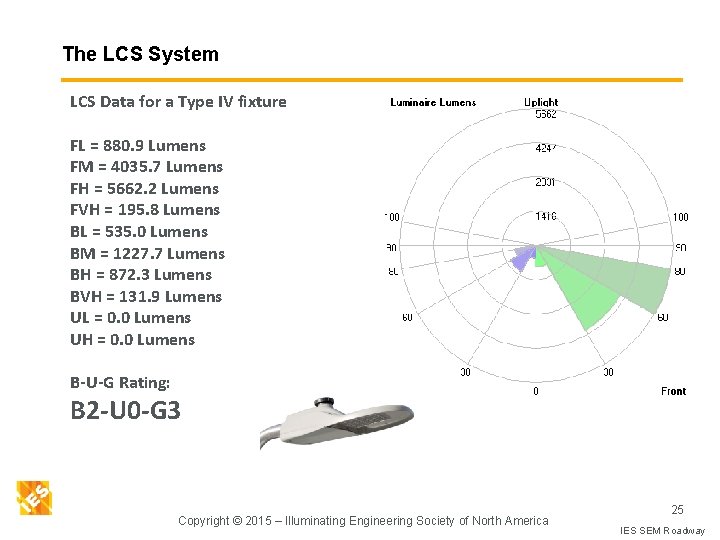
The LCS System LCS Data for a Type IV fixture FL = 880. 9 Lumens FM = 4035. 7 Lumens FH = 5662. 2 Lumens FVH = 195. 8 Lumens BL = 535. 0 Lumens BM = 1227. 7 Lumens BH = 872. 3 Lumens BVH = 131. 9 Lumens UL = 0. 0 Lumens UH = 0. 0 Lumens B-U-G Rating: B 2 -U 0 -G 3 Copyright © 2015 – Illuminating Engineering Society of North America 25 IES SEM Roadway

The LCS System LCS Data for a Type IV fixture FL = 48. 5 Lumens FM = 437. 8 Lumens FH = 920. 0 Lumens FVH = 409. 7 Lumens BL = 50. 2 Lumens BM = 304. 0 Lumens BH = 286. 0 Lumens BVH = 136. 3 Lumens UL = 159. 8 Lumens UH = 148. 4 Lumens B-U-G Rating: B 1 -U 3 -G 3 Copyright © 2015 – Illuminating Engineering Society of North America 26 IES SEM Roadway
LCS system things to consider • Measurements between 30° and 60° count “against” luminaires producing light in these vertical angles – This area yields spacing-to-mounting heights of 1. 15 S/MH to 3. 5 S/MH • LCS system also encourages low light output between 60° and 80° – These angles yield S/MH from 3. 5 to 6. 5 • In order to apply LCS acceptable numbers, you may have a “forest of poles” Copyright © 2015 – Illuminating Engineering Society of North America 27 IES SEM Roadway
Design Considerations There are several major issues that affect driver visibility These include: • Differences in speed • Levels of background luminance • Frequency of intersections and driveways • Presence of curb parking, and • The number of pedestrians present. Copyright © 2015 – Illuminating Engineering Society of North America 28 IES SEM Roadway
Visual Task • Seeing pedestrians • Dropping off passengers • Viewing elements within the streetscape • Dealing with traffic tie- ups • Reading signs, or other driving tasks related to urban areas • Other users of the urban street right of way, such as pedestrians and bicyclists, will also require adequate lighting for their tasks. Copyright © 2015 – Illuminating Engineering Society of North America 29 IES SEM Roadway
Glare • Disability glare is the glare that results in reduced visual performance and visibility. • Discomfort glare is the glare producing a sense of annoyance or pain. It does not necessarily reduce the ability to see an object, but produces a sensation of discomfort due to high contrast of a non- uniform distribution in the field of view. • The criterion used for roadway lighting to address disability glare is limiting the veiling luminance ratio of a lighting system. Copyright © 2015 – Illuminating Engineering Society of North America 30 IES SEM Roadway
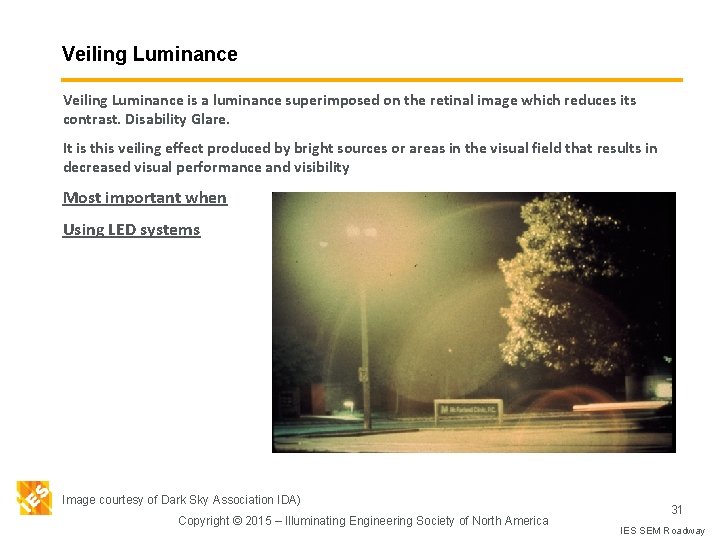
Veiling Luminance is a luminance superimposed on the retinal image which reduces its contrast. Disability Glare. It is this veiling effect produced by bright sources or areas in the visual field that results in decreased visual performance and visibility Most important when Using LED systems Image courtesy of Dark Sky Association IDA) Copyright © 2015 – Illuminating Engineering Society of North America 31 IES SEM Roadway
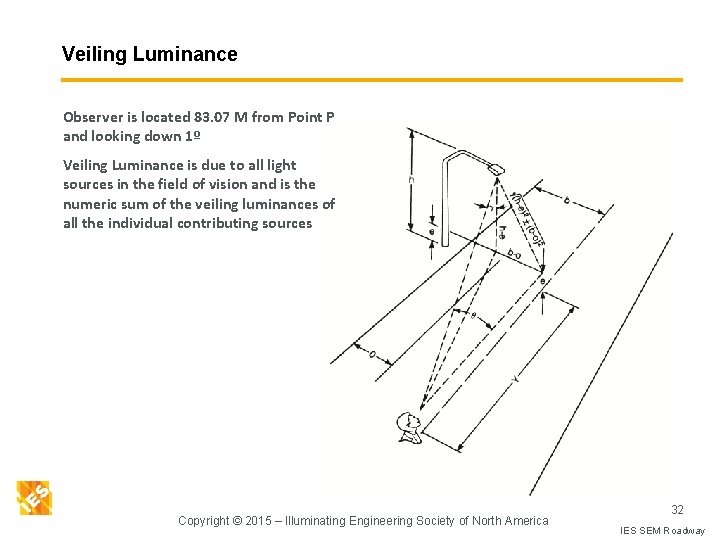
Veiling Luminance Observer is located 83. 07 M from Point P and looking down 1º Veiling Luminance is due to all light sources in the field of vision and is the numeric sum of the veiling luminances of all the individual contributing sources Copyright © 2015 – Illuminating Engineering Society of North America 32 IES SEM Roadway

Light Trespass • Light trespass is the amount of light that leaves a specific site and enters another site. • While many roadway lighting systems cannot effectively limit or contain light to just the roadway or pedestrian areas, designs must be performed to limit the amount of that light. • IES TM-11 -00/(R 06) Light Trespass: Research, Results, and Recommendations, provides guidelines on limitations for light trespass. Copyright © 2015 – Illuminating Engineering Society of North America 33 IES SEM Roadway
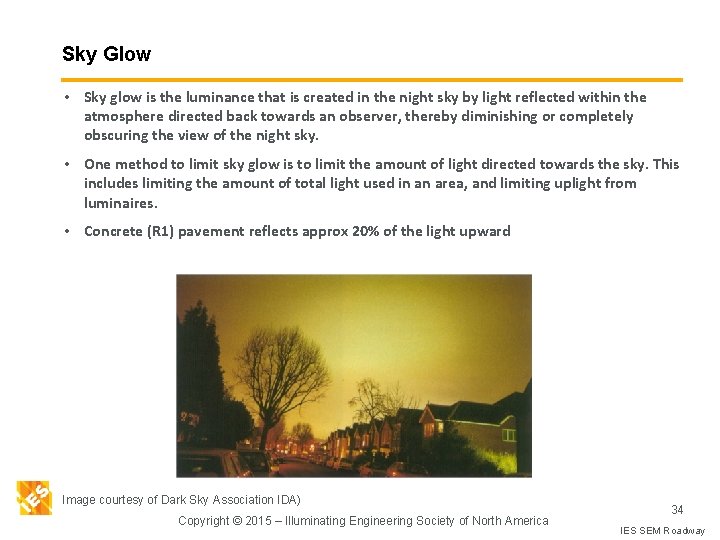
Sky Glow • Sky glow is the luminance that is created in the night sky by light reflected within the atmosphere directed back towards an observer, thereby diminishing or completely obscuring the view of the night sky. • One method to limit sky glow is to limit the amount of light directed towards the sky. This includes limiting the amount of total light used in an area, and limiting uplight from luminaires. • Concrete (R 1) pavement reflects approx 20% of the light upward Image courtesy of Dark Sky Association IDA) Copyright © 2015 – Illuminating Engineering Society of North America 34 IES SEM Roadway
Lighting Zones Corresponds with new IES RP-33 -14 definitions • LZ 0: No ambient lighting • LZ 1: Low ambient lighting • LZ 2: Moderate ambient lighting • LZ 3: Moderately high ambient lighting • LZ 4: High ambient lighting Definitions include use of curfews Copyright © 2015 – Illuminating Engineering Society of North America 35 IES SEM Roadway
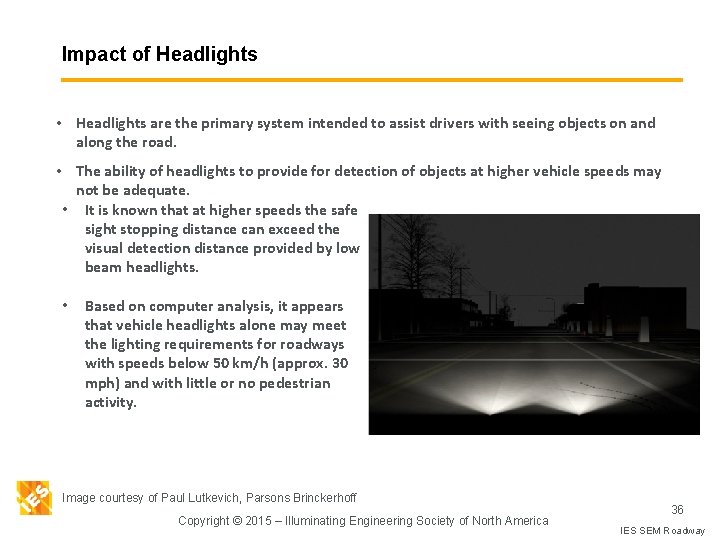
Impact of Headlights • Headlights are the primary system intended to assist drivers with seeing objects on and along the road. • The ability of headlights to provide for detection of objects at higher vehicle speeds may not be adequate. • It is known that at higher speeds the safe sight stopping distance can exceed the visual detection distance provided by low beam headlights. • Based on computer analysis, it appears that vehicle headlights alone may meet the lighting requirements for roadways with speeds below 50 km/h (approx. 30 mph) and with little or no pedestrian activity. Image courtesy of Paul Lutkevich, Parsons Brinckerhoff Copyright © 2015 – Illuminating Engineering Society of North America 36 IES SEM Roadway
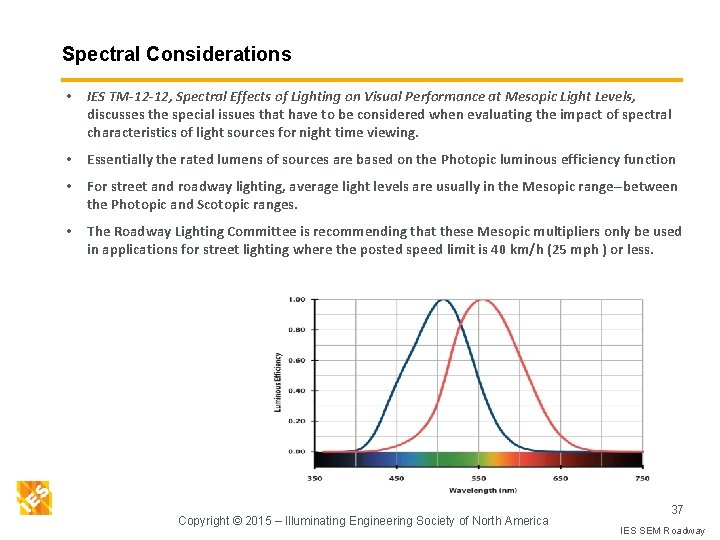
Spectral Considerations • IES TM-12 -12, Spectral Effects of Lighting on Visual Performance at Mesopic Light Levels, discusses the special issues that have to be considered when evaluating the impact of spectral characteristics of light sources for night time viewing. • Essentially the rated lumens of sources are based on the Photopic luminous efficiency function • For street and roadway lighting, average light levels are usually in the Mesopic range--between the Photopic and Scotopic ranges. • The Roadway Lighting Committee is recommending that these Mesopic multipliers only be used in applications for street lighting where the posted speed limit is 40 km/h (25 mph ) or less. Copyright © 2015 – Illuminating Engineering Society of North America 37 IES SEM Roadway
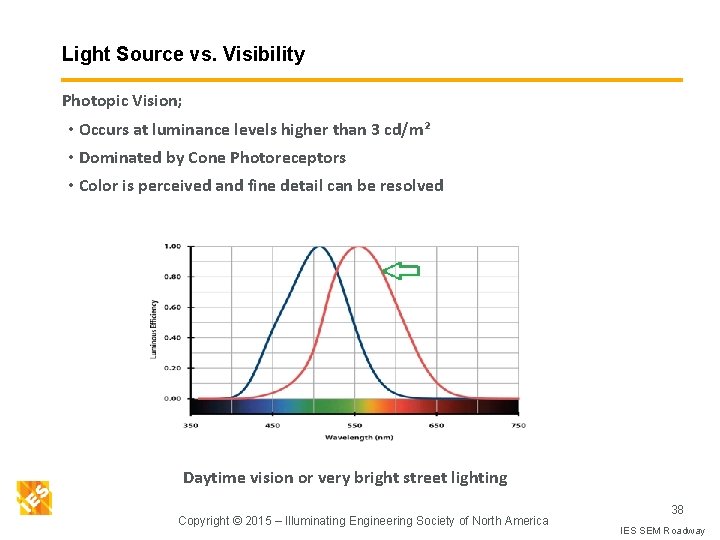
Light Source vs. Visibility Photopic Vision; • Occurs at luminance levels higher than 3 cd/m² • Dominated by Cone Photoreceptors • Color is perceived and fine detail can be resolved Daytime vision or very bright street lighting Copyright © 2015 – Illuminating Engineering Society of North America 38 IES SEM Roadway
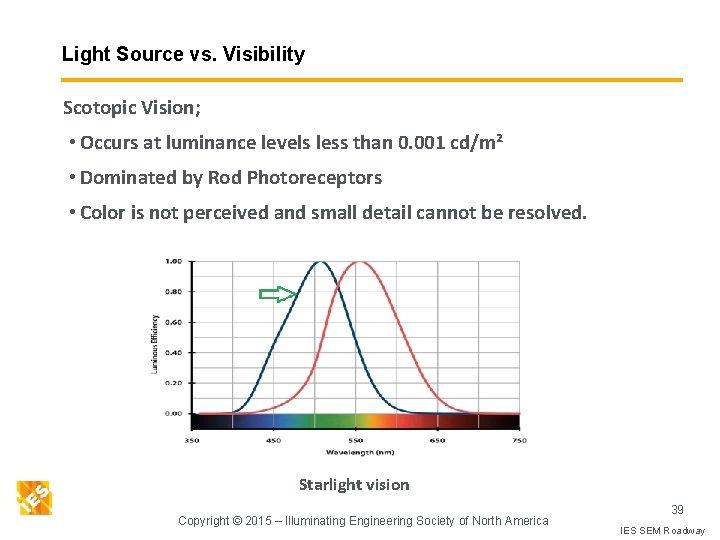
Light Source vs. Visibility Scotopic Vision; • Occurs at luminance levels less than 0. 001 cd/m² • Dominated by Rod Photoreceptors • Color is not perceived and small detail cannot be resolved. Starlight vision Copyright © 2015 – Illuminating Engineering Society of North America 39 IES SEM Roadway
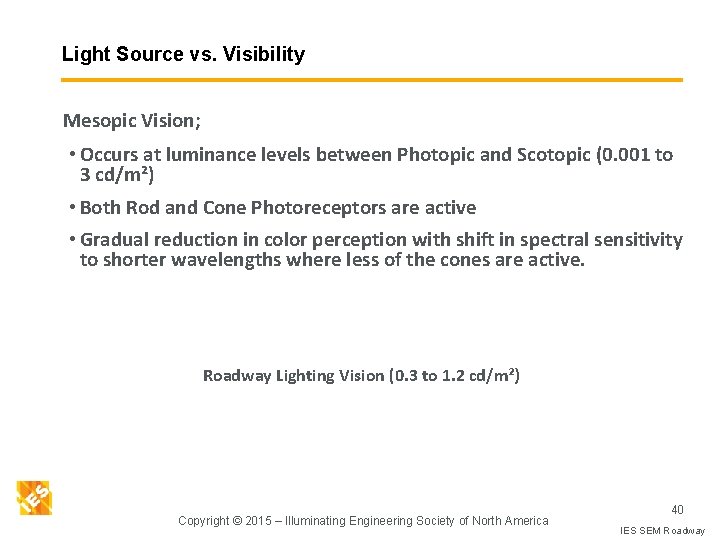
Light Source vs. Visibility Mesopic Vision; • Occurs at luminance levels between Photopic and Scotopic (0. 001 to 3 cd/m²) • Both Rod and Cone Photoreceptors are active • Gradual reduction in color perception with shift in spectral sensitivity to shorter wavelengths where less of the cones are active. Roadway Lighting Vision (0. 3 to 1. 2 cd/m²) Copyright © 2015 – Illuminating Engineering Society of North America 40 IES SEM Roadway
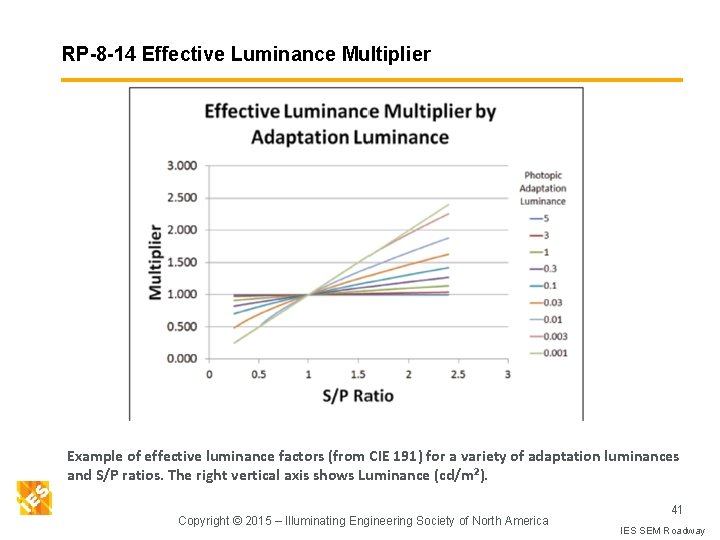
RP-8 -14 Effective Luminance Multiplier 0. 3 cd/m² Example of effective luminance factors (from CIE 191) for a variety of adaptation luminances and S/P ratios. The right vertical axis shows Luminance (cd/m²). Copyright © 2015 – Illuminating Engineering Society of North America 41 IES SEM Roadway
Lighting Recommendations • ANSI/IES RP-8 -14 Standard Practice includes three different methods for use in evaluating different aspects of continuous roadway and street lighting design. • Luminance, • Illuminance, and • Small Target Visibility (STV) Copyright © 2015 – Illuminating Engineering Society of North America 42 IES SEM Roadway
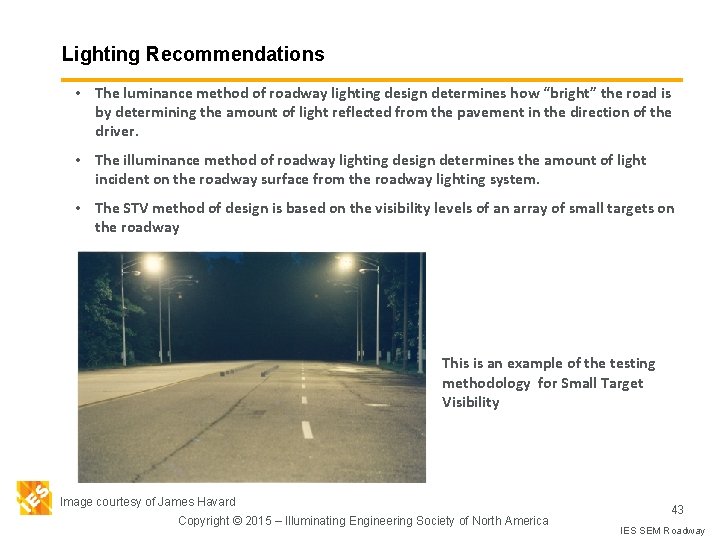
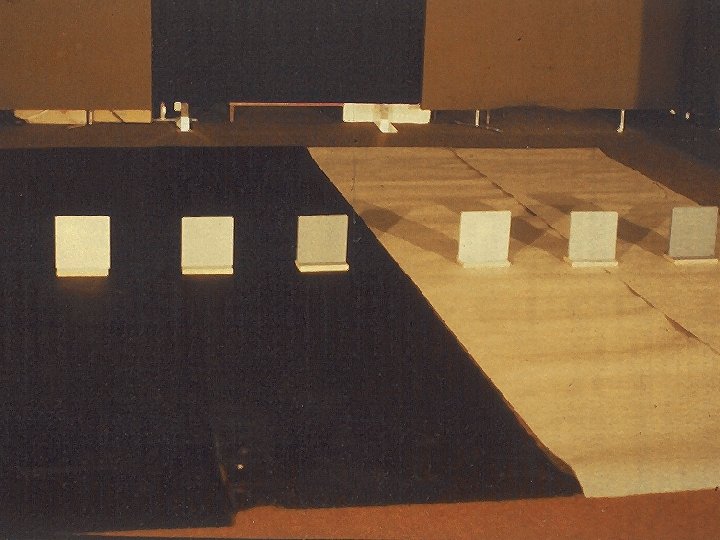
Lighting Recommendations • The luminance method of roadway lighting design determines how “bright” the road is by determining the amount of light reflected from the pavement in the direction of the driver. • The illuminance method of roadway lighting design determines the amount of light incident on the roadway surface from the roadway lighting system. • The STV method of design is based on the visibility levels of an array of small targets on the roadway This is an example of the testing methodology for Small Target Visibility Image courtesy of James Havard Copyright © 2015 – Illuminating Engineering Society of North America 43 IES SEM Roadway
Lighting Recommendations For this recommended practice, • Luminance is the selected design method for straight roadways and streets (with a radius of ≥ 600 m). • Horizontal and vertical illuminance is the selected method for pedestrian areas • Horizontal illuminance is used for intersections and interchanges. • Horizontal illuminance may also be used for the design along curved sections of roads and streets where luminance can be difficult to calculate. Copyright © 2015 – Illuminating Engineering Society of North America 44 IES SEM Roadway
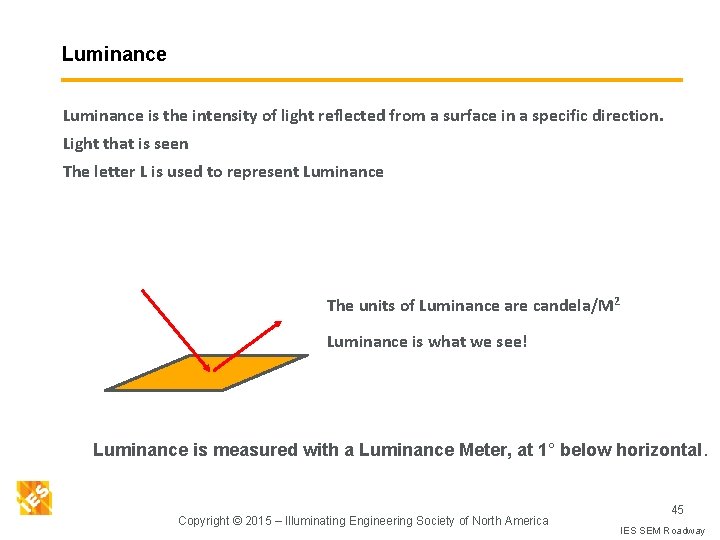
Luminance is the intensity of light reflected from a surface in a specific direction. Light that is seen The letter L is used to represent Luminance The units of Luminance are candela/M 2 Luminance is what we see! Luminance is measured with a Luminance Meter, at 1° below horizontal. Copyright © 2015 – Illuminating Engineering Society of North America 45 IES SEM Roadway
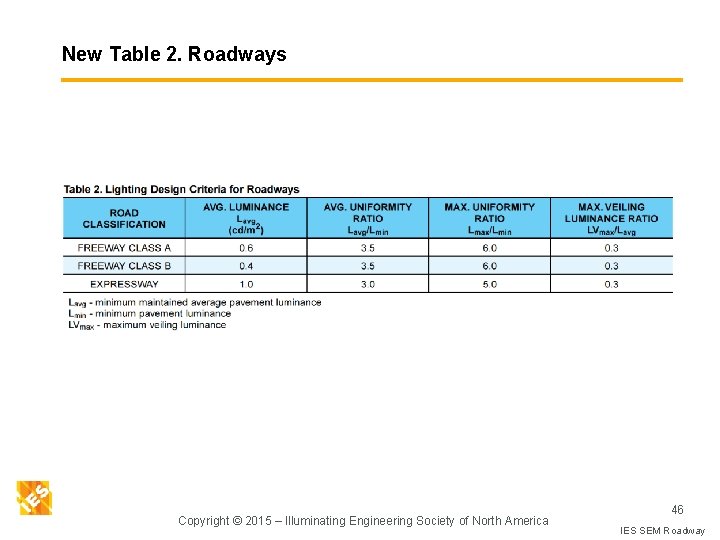
New Table 2. Roadways Copyright © 2015 – Illuminating Engineering Society of North America 46 IES SEM Roadway
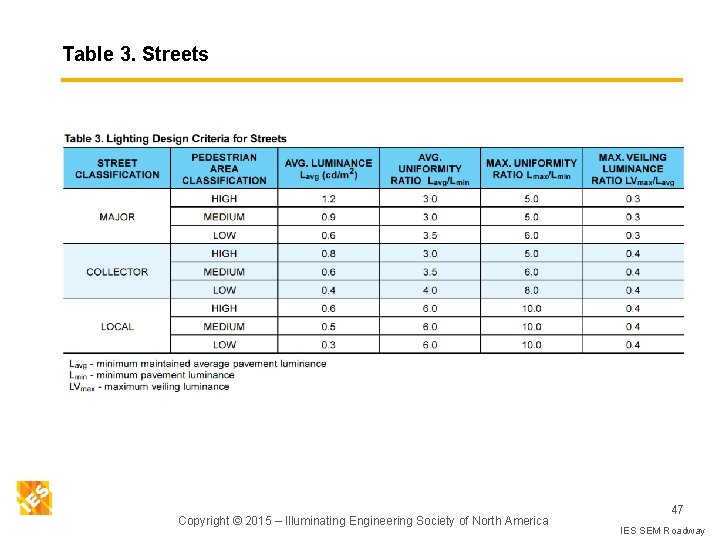
Table 3. Streets Copyright © 2015 – Illuminating Engineering Society of North America 47 IES SEM Roadway
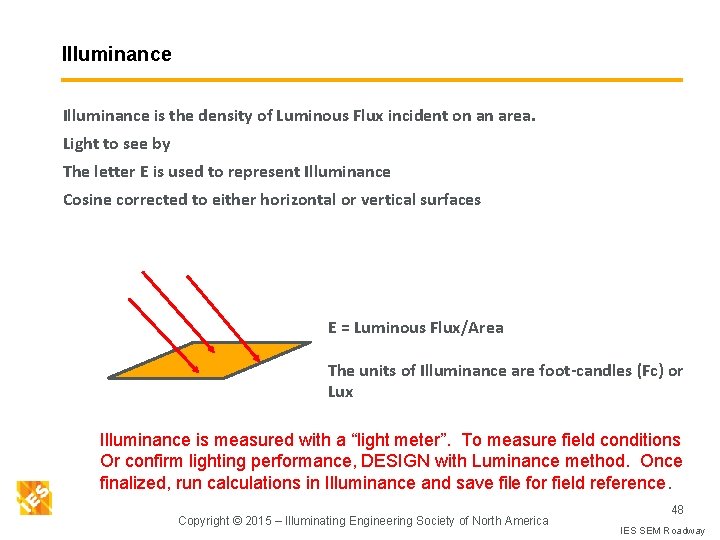
Illuminance is the density of Luminous Flux incident on an area. Light to see by The letter E is used to represent Illuminance Cosine corrected to either horizontal or vertical surfaces E = Luminous Flux/Area The units of Illuminance are foot-candles (Fc) or Lux Illuminance is measured with a “light meter”. To measure field conditions Or confirm lighting performance, DESIGN with Luminance method. Once finalized, run calculations in Illuminance and save file for field reference. Copyright © 2015 – Illuminating Engineering Society of North America 48 IES SEM Roadway
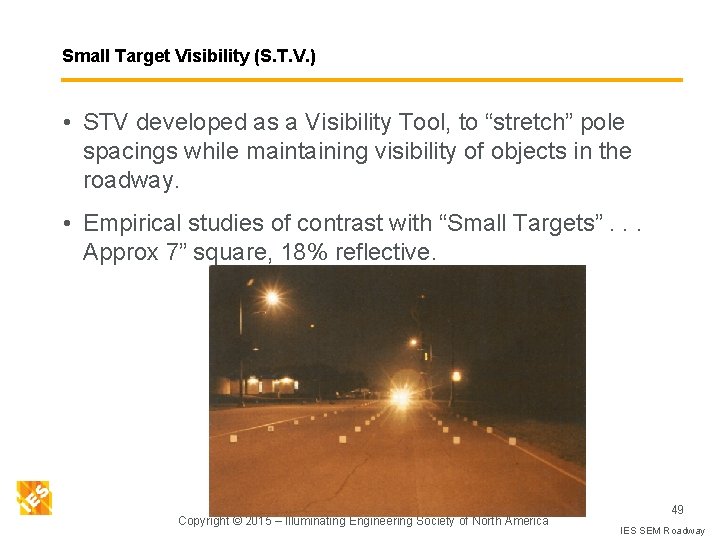
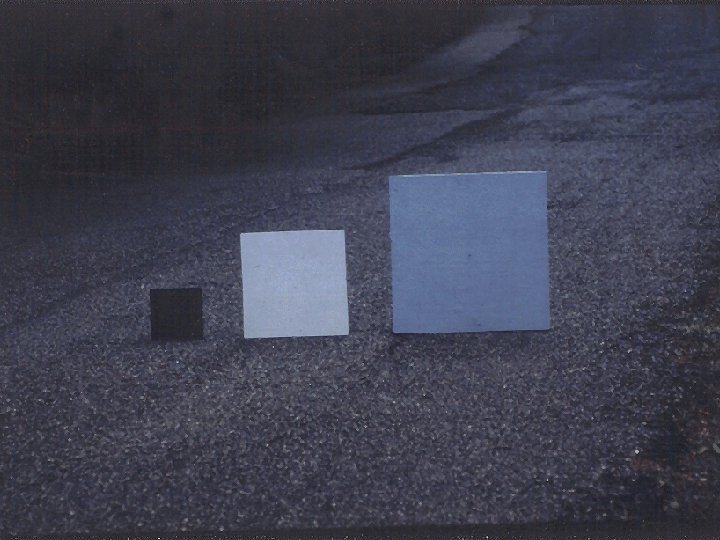
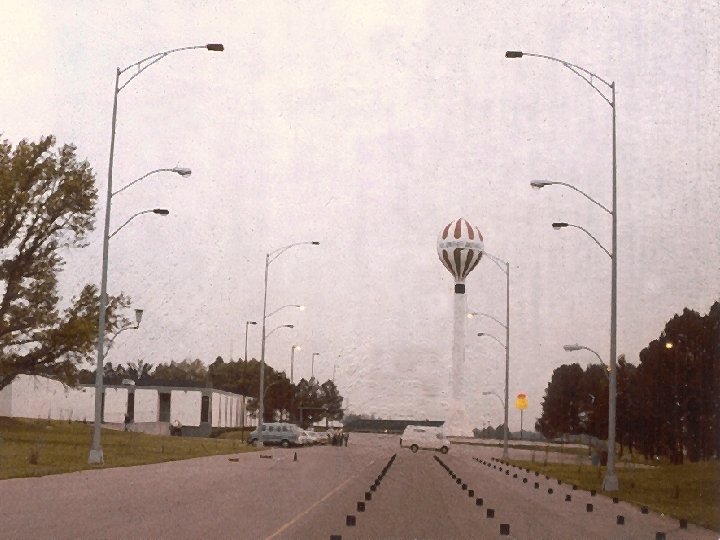
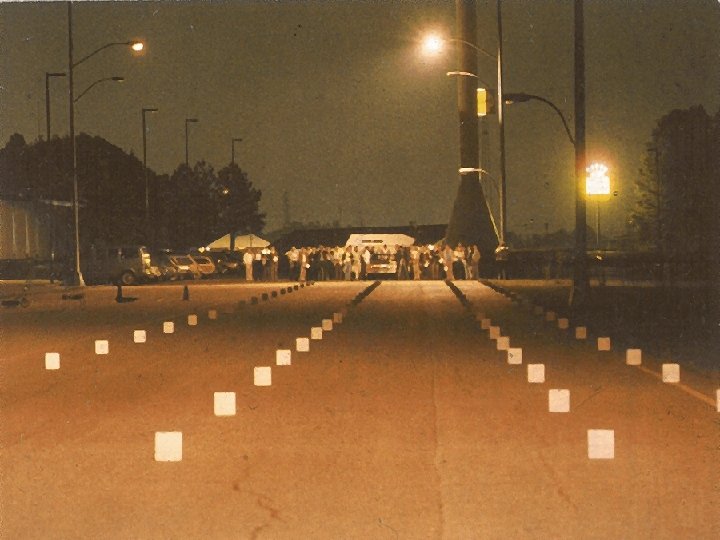
Small Target Visibility (S. T. V. ) • STV developed as a Visibility Tool, to “stretch” pole spacings while maintaining visibility of objects in the roadway. • Empirical studies of contrast with “Small Targets”. . . Approx 7” square, 18% reflective. Copyright © 2015 – Illuminating Engineering Society of North America 49 IES SEM Roadway
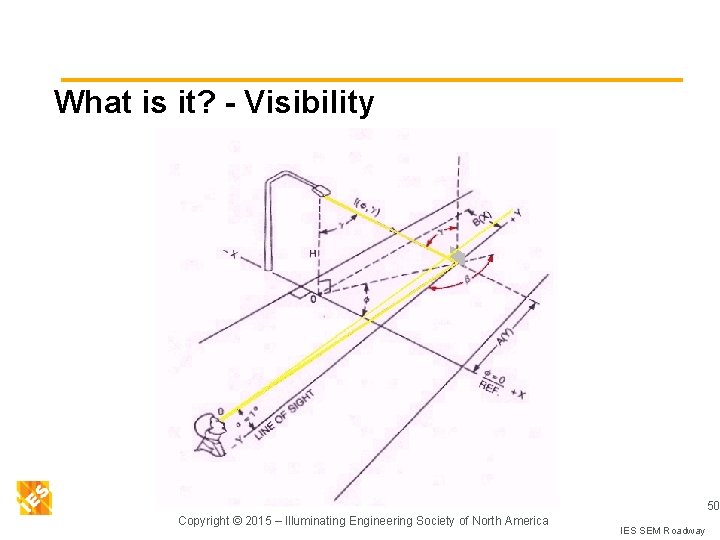
What is it? - Visibility 50 Copyright © 2015 – Illuminating Engineering Society of North America IES SEM Roadway
51 Copyright © 2015 – Illuminating Engineering Society of North America IES SEM Roadway
52 Copyright © 2015 – Illuminating Engineering Society of North America IES SEM Roadway
53 Copyright © 2015 – Illuminating Engineering Society of North America IES SEM Roadway
54 Copyright © 2015 – Illuminating Engineering Society of North America IES SEM Roadway
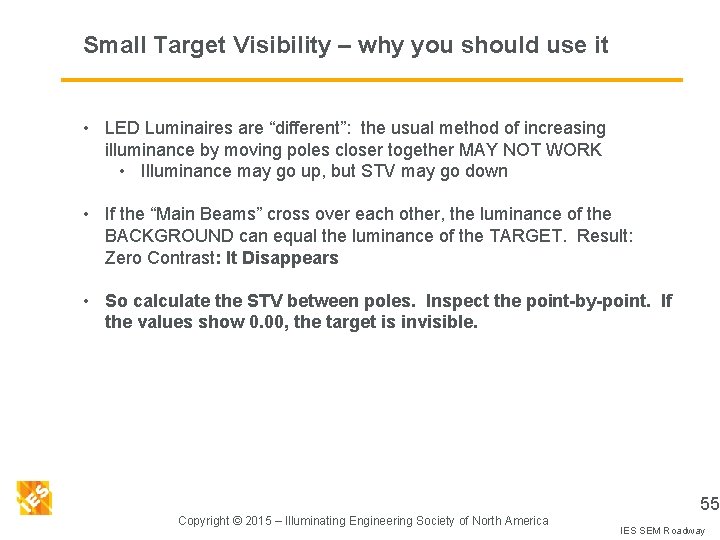
Small Target Visibility – why you should use it • LED Luminaires are “different”: the usual method of increasing illuminance by moving poles closer together MAY NOT WORK • Illuminance may go up, but STV may go down • If the “Main Beams” cross over each other, the luminance of the BACKGROUND can equal the luminance of the TARGET. Result: Zero Contrast: It Disappears • So calculate the STV between poles. Inspect the point-by-point. If the values show 0. 00, the target is invisible. 55 Copyright © 2015 – Illuminating Engineering Society of North America IES SEM Roadway
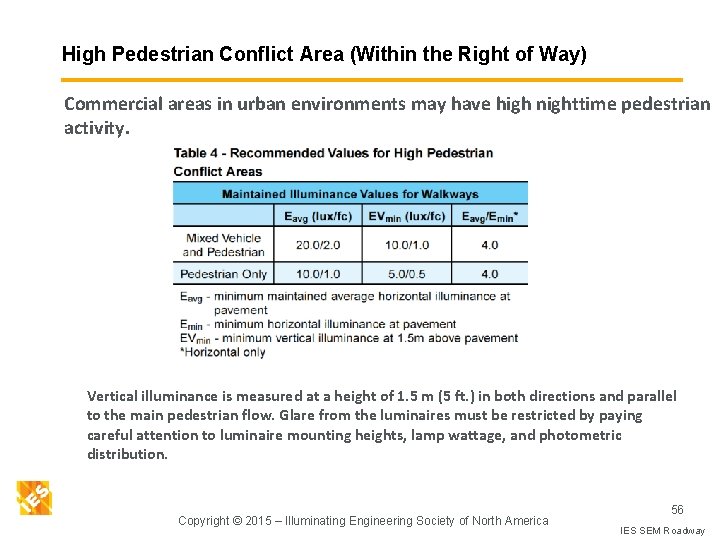
High Pedestrian Conflict Area (Within the Right of Way) Commercial areas in urban environments may have high nighttime pedestrian activity. Vertical illuminance is measured at a height of 1. 5 m (5 ft. ) in both directions and parallel to the main pedestrian flow. Glare from the luminaires must be restricted by paying careful attention to luminaire mounting heights, lamp wattage, and photometric distribution. Copyright © 2015 – Illuminating Engineering Society of North America 56 IES SEM Roadway
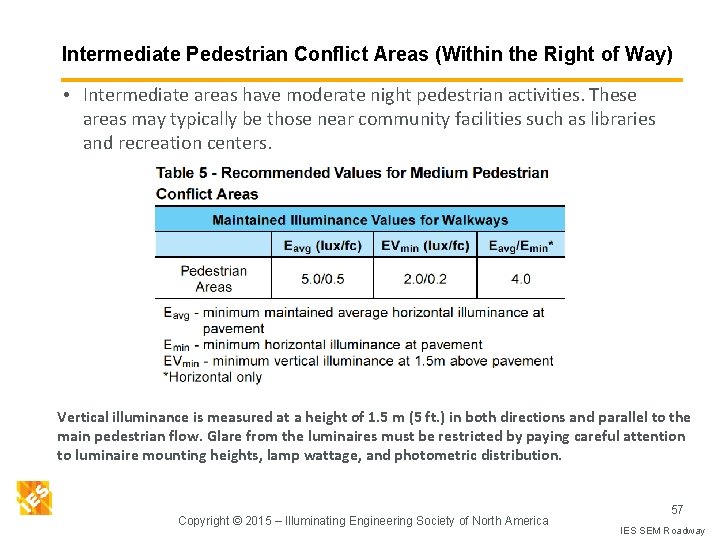
Intermediate Pedestrian Conflict Areas (Within the Right of Way) • Intermediate areas have moderate night pedestrian activities. These areas may typically be those near community facilities such as libraries and recreation centers. Vertical illuminance is measured at a height of 1. 5 m (5 ft. ) in both directions and parallel to the main pedestrian flow. Glare from the luminaires must be restricted by paying careful attention to luminaire mounting heights, lamp wattage, and photometric distribution. Copyright © 2015 – Illuminating Engineering Society of North America 57 IES SEM Roadway
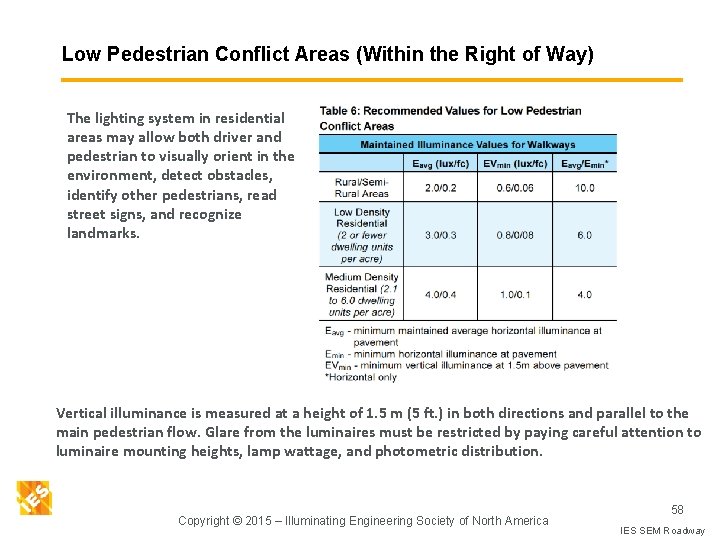
Low Pedestrian Conflict Areas (Within the Right of Way) The lighting system in residential areas may allow both driver and pedestrian to visually orient in the environment, detect obstacles, identify other pedestrians, read street signs, and recognize landmarks. Vertical illuminance is measured at a height of 1. 5 m (5 ft. ) in both directions and parallel to the main pedestrian flow. Glare from the luminaires must be restricted by paying careful attention to luminaire mounting heights, lamp wattage, and photometric distribution. Copyright © 2015 – Illuminating Engineering Society of North America 58 IES SEM Roadway
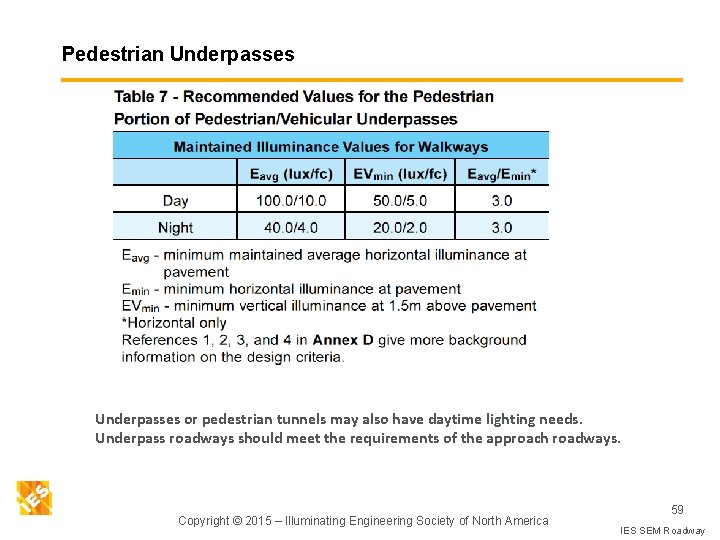
Pedestrian Underpasses or pedestrian tunnels may also have daytime lighting needs. Underpass roadways should meet the requirements of the approach roadways. Copyright © 2015 – Illuminating Engineering Society of North America 59 IES SEM Roadway
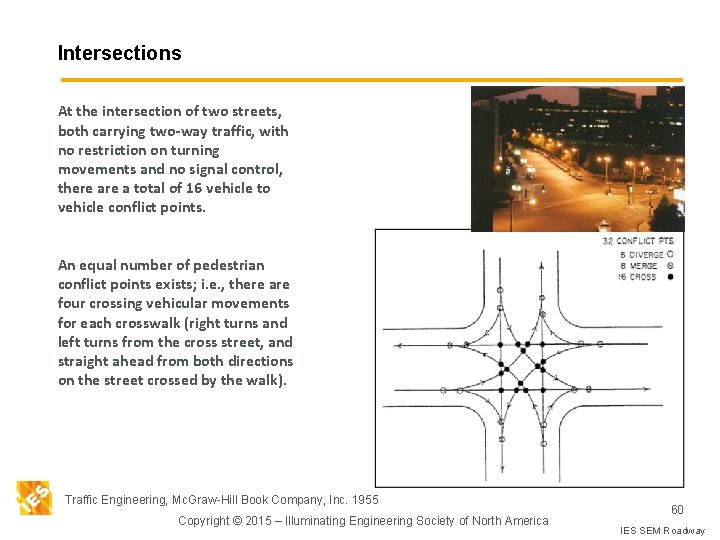
Intersections At the intersection of two streets, both carrying two-way traffic, with no restriction on turning movements and no signal control, there a total of 16 vehicle to vehicle conflict points. An equal number of pedestrian conflict points exists; i. e. , there are four crossing vehicular movements for each crosswalk (right turns and left turns from the cross street, and straight ahead from both directions on the street crossed by the walk). Traffic Engineering, Mc. Graw-Hill Book Company, Inc. 1955 Copyright © 2015 – Illuminating Engineering Society of North America 60 IES SEM Roadway
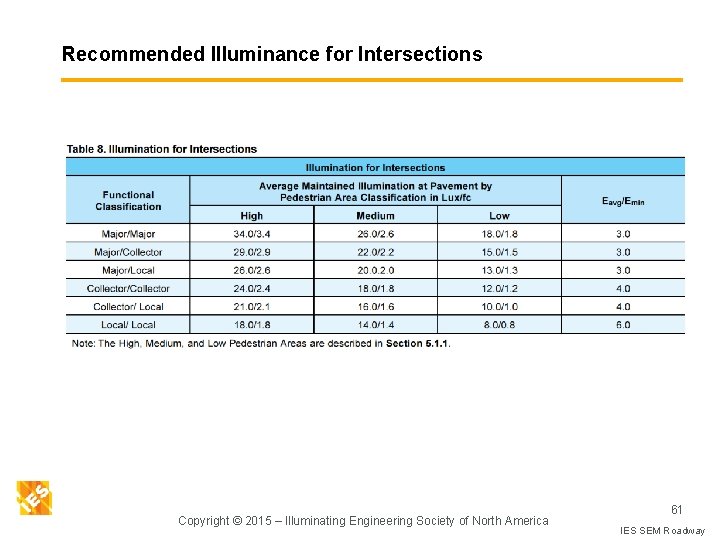
Recommended Illuminance for Intersections Copyright © 2015 – Illuminating Engineering Society of North America 61 IES SEM Roadway
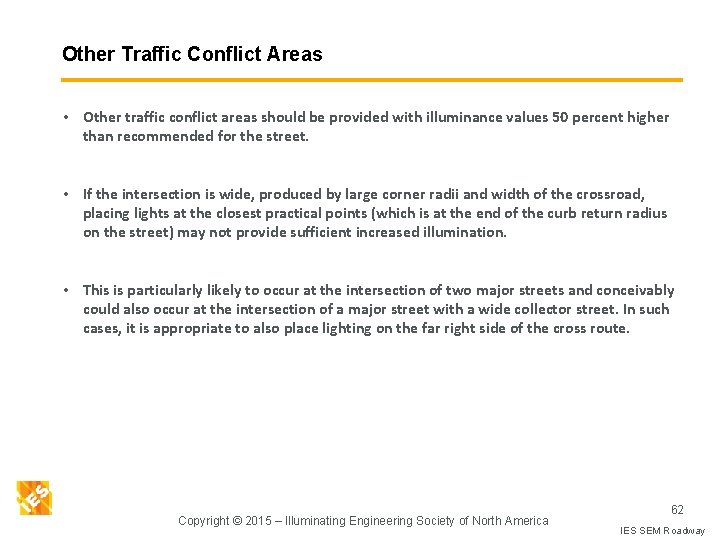
Other Traffic Conflict Areas • Other traffic conflict areas should be provided with illuminance values 50 percent higher than recommended for the street. • If the intersection is wide, produced by large corner radii and width of the crossroad, placing lights at the closest practical points (which is at the end of the curb return radius on the street) may not provide sufficient increased illumination. • This is particularly likely to occur at the intersection of two major streets and conceivably could also occur at the intersection of a major street with a wide collector street. In such cases, it is appropriate to also place lighting on the far right side of the cross route. Copyright © 2015 – Illuminating Engineering Society of North America 62 IES SEM Roadway
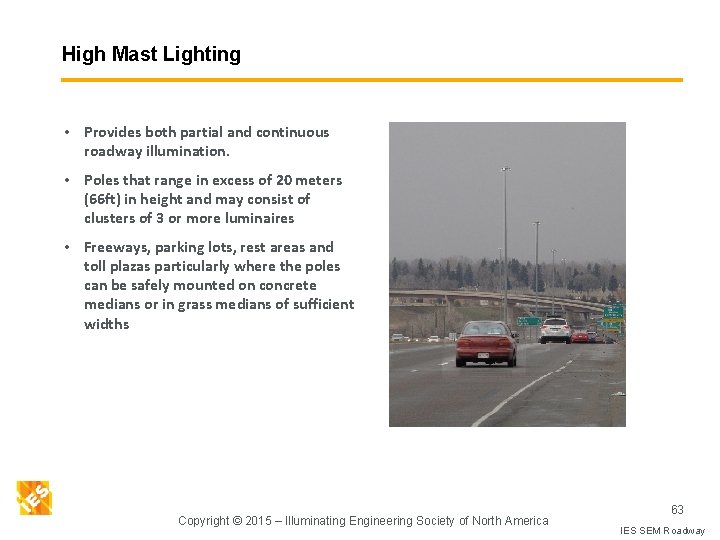
High Mast Lighting • Provides both partial and continuous roadway illumination. • Poles that range in excess of 20 meters (66 ft) in height and may consist of clusters of 3 or more luminaires • Freeways, parking lots, rest areas and toll plazas particularly where the poles can be safely mounted on concrete medians or in grass medians of sufficient widths Copyright © 2015 – Illuminating Engineering Society of North America 63 IES SEM Roadway
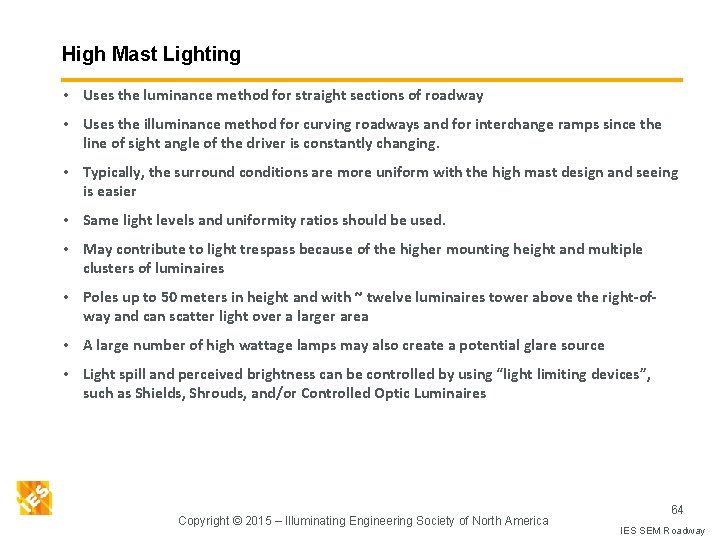
High Mast Lighting • Uses the luminance method for straight sections of roadway • Uses the illuminance method for curving roadways and for interchange ramps since the line of sight angle of the driver is constantly changing. • Typically, the surround conditions are more uniform with the high mast design and seeing is easier • Same light levels and uniformity ratios should be used. • May contribute to light trespass because of the higher mounting height and multiple clusters of luminaires • Poles up to 50 meters in height and with ~ twelve luminaires tower above the right-ofway and can scatter light over a larger area • A large number of high wattage lamps may also create a potential glare source • Light spill and perceived brightness can be controlled by using “light limiting devices”, such as Shields, Shrouds, and/or Controlled Optic Luminaires Copyright © 2015 – Illuminating Engineering Society of North America 64 IES SEM Roadway
Light Trespass Studies • Run point-by-point grid out beyond property line. . . Until it reads 0. 00 • Check Vertical Illumination (at 1. 5 m) at property line, facing interior of parking lot. • Use light “judicially”. . . Downward light reflects upward Copyright © 2015 – Illuminating Engineering Society of North America 65 IES SEM Roadway
Crosswalk Recommendations Based on Research • A vertical illuminance level of 20 lx measured at 1. 5 m (5 ft. ) from the road surface allowed drivers to detect pedestrians in midblock crosswalks at adequate stopping distances under rural conditions. • A higher level of vertical illuminance may be required for crosswalks when: 1. There is a possibility of glare from opposing vehicles. 2. The crosswalk is located in an area with high ambient light levels. 3. The crosswalk is located at a lighted intersection. Copyright © 2015 – Illuminating Engineering Society of North America 66 IES SEM Roadway
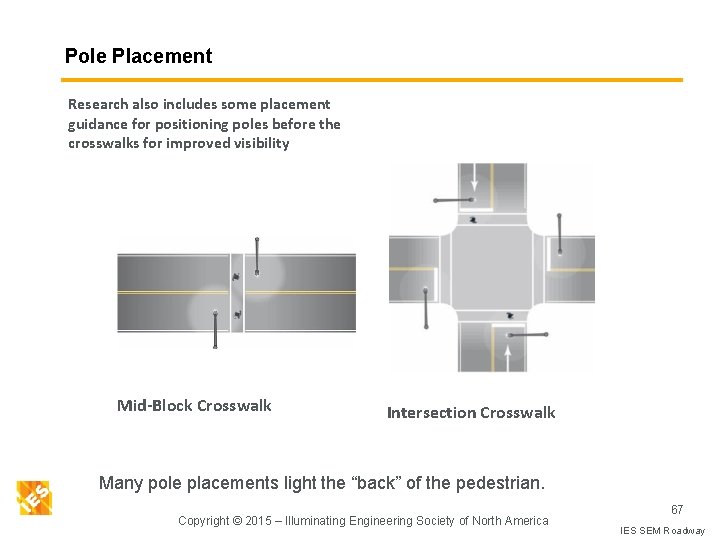
Pole Placement Research also includes some placement guidance for positioning poles before the crosswalks for improved visibility Mid-Block Crosswalk Intersection Crosswalk Many pole placements light the “back” of the pedestrian. Copyright © 2015 – Illuminating Engineering Society of North America 67 IES SEM Roadway
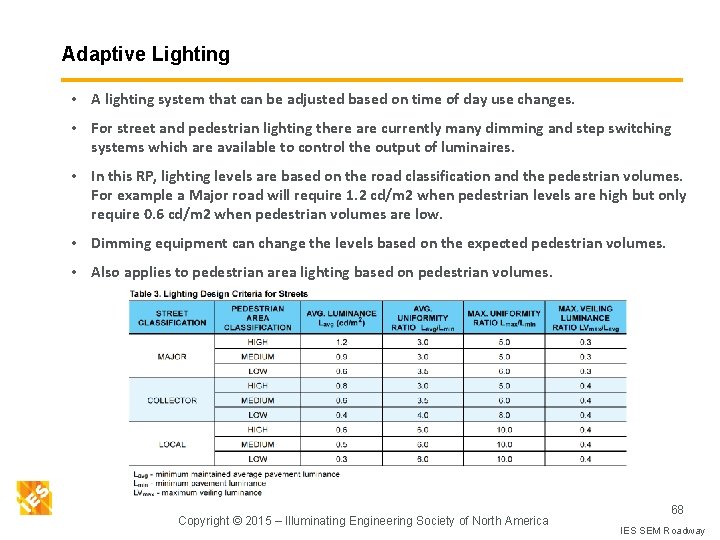
Adaptive Lighting • A lighting system that can be adjusted based on time of day use changes. • For street and pedestrian lighting there are currently many dimming and step switching systems which are available to control the output of luminaires. • In this RP, lighting levels are based on the road classification and the pedestrian volumes. For example a Major road will require 1. 2 cd/m 2 when pedestrian levels are high but only require 0. 6 cd/m 2 when pedestrian volumes are low. • Dimming equipment can change the levels based on the expected pedestrian volumes. • Also applies to pedestrian area lighting based on pedestrian volumes. Copyright © 2015 – Illuminating Engineering Society of North America 68 IES SEM Roadway
Adaptive Lighting • Lighting levels also vary based on roadway or street classification • If vehicle traffic volumes vary during the night, the local jurisdiction may vary the street classification and thereby allow for additional dimming • If adaptive lighting is used in an installation, all of the lighting criteria must be met for the operating conditions at that time. • If a lighting system is dimmed to meet the low pedestrian volume values, the installation must continue to meet the uniformity ratio and veiling luminance ratio given in this recommended practice Copyright © 2015 – Illuminating Engineering Society of North America 69 IES SEM Roadway
Transition Lighting • From a lighted roadway to an un-lighted section • Lighting should be reduced to one half of the fully lighted section for a distance equivalent to 15 seconds of travel time at the posted speed limit. • Maintained by keeping the pole configuration of the lit roadway section and reducing the lumen output of the luminaires in the transition area. • Roadways with luminances equal to or less than 0. 6 cd/m² do not require transition lighting. Copyright © 2015 – Illuminating Engineering Society of North America 70 IES SEM Roadway
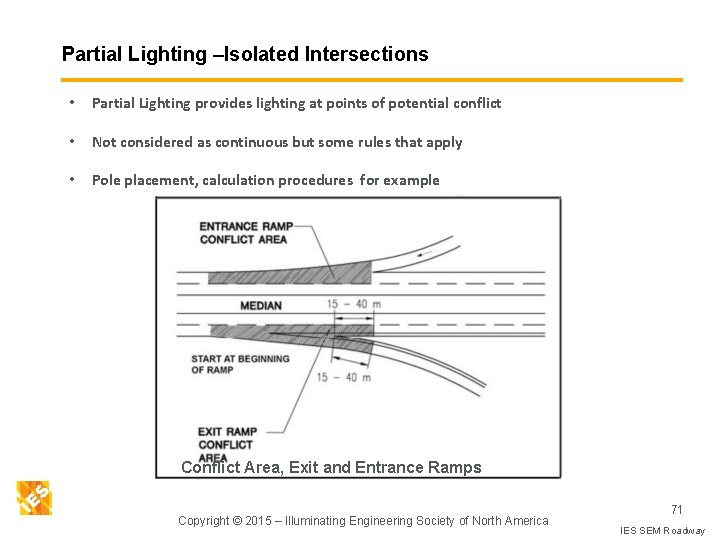
Partial Lighting –Isolated Intersections • Partial Lighting provides lighting at points of potential conflict • Not considered as continuous but some rules that apply • Pole placement, calculation procedures for example Conflict Area, Exit and Entrance Ramps Copyright © 2015 – Illuminating Engineering Society of North America 71 IES SEM Roadway
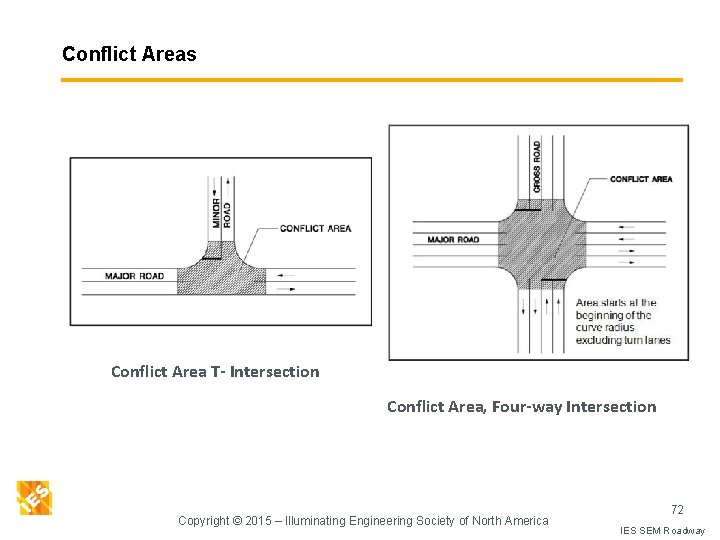
Conflict Areas Conflict Area T- Intersection Conflict Area, Four-way Intersection Copyright © 2015 – Illuminating Engineering Society of North America 72 IES SEM Roadway
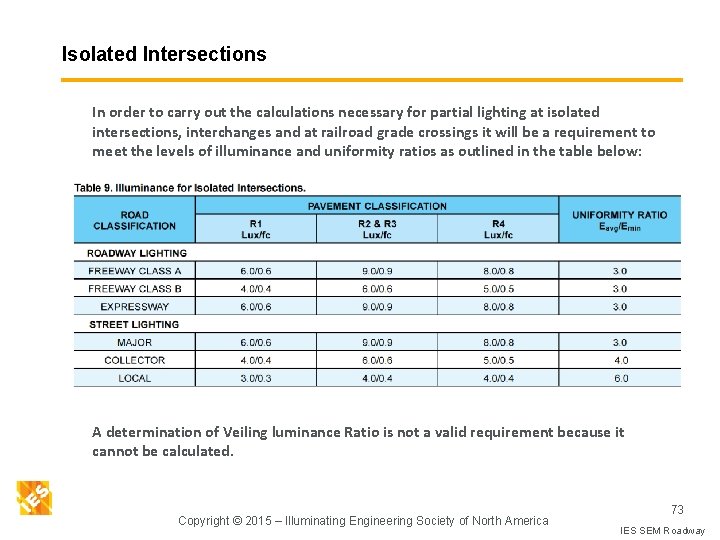
Isolated Intersections In order to carry out the calculations necessary for partial lighting at isolated intersections, interchanges and at railroad grade crossings it will be a requirement to meet the levels of illuminance and uniformity ratios as outlined in the table below: A determination of Veiling luminance Ratio is not a valid requirement because it cannot be calculated. Copyright © 2015 – Illuminating Engineering Society of North America 73 IES SEM Roadway
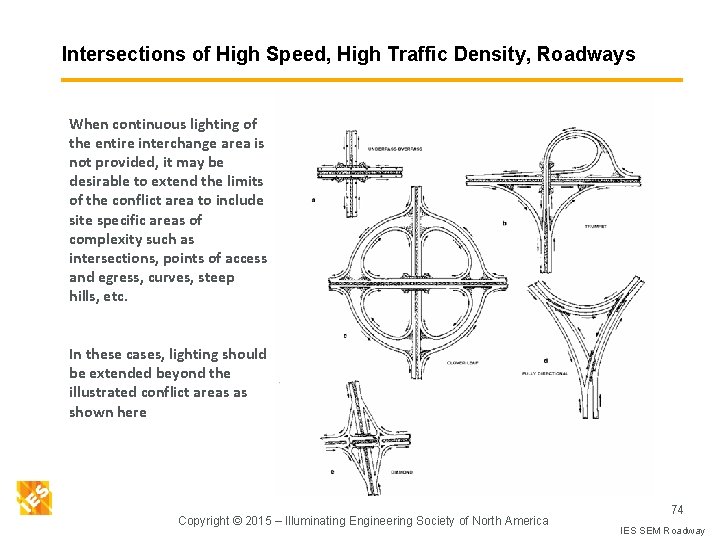
Intersections of High Speed, High Traffic Density, Roadways When continuous lighting of the entire interchange area is not provided, it may be desirable to extend the limits of the conflict area to include site specific areas of complexity such as intersections, points of access and egress, curves, steep hills, etc. In these cases, lighting should be extended beyond the illustrated conflict areas as shown here Copyright © 2015 – Illuminating Engineering Society of North America 74 IES SEM Roadway
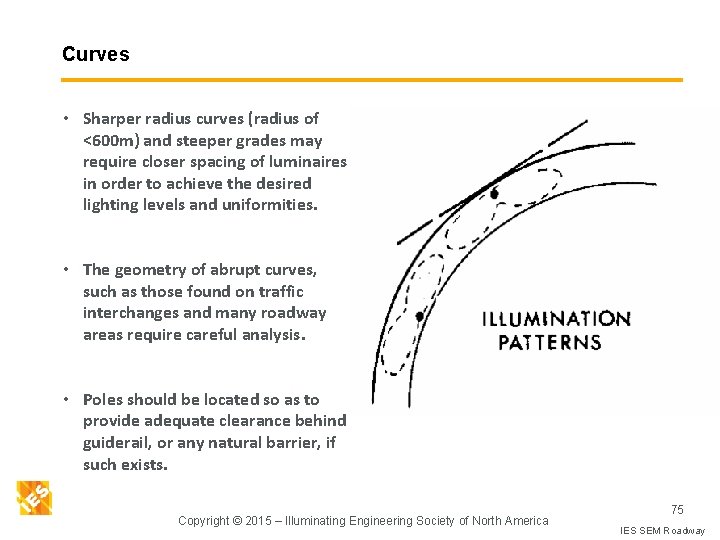
Curves • Sharper radius curves (radius of <600 m) and steeper grades may require closer spacing of luminaires in order to achieve the desired lighting levels and uniformities. • The geometry of abrupt curves, such as those found on traffic interchanges and many roadway areas require careful analysis. • Poles should be located so as to provide adequate clearance behind guiderail, or any natural barrier, if such exists. Copyright © 2015 – Illuminating Engineering Society of North America 75 IES SEM Roadway
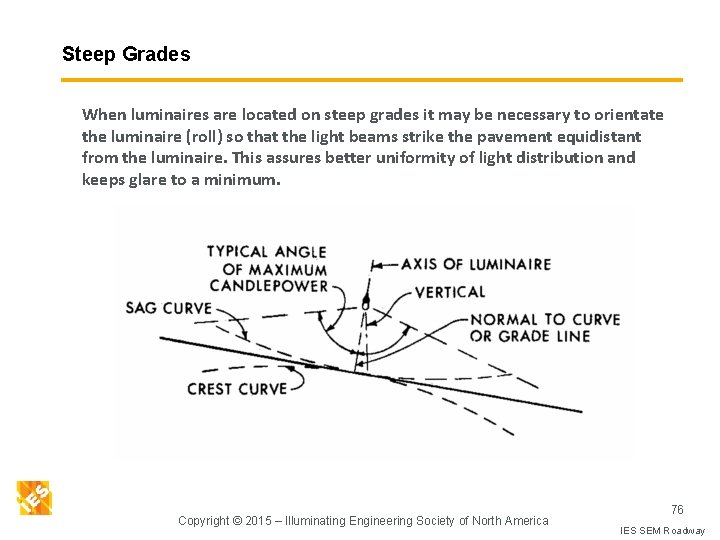
Steep Grades When luminaires are located on steep grades it may be necessary to orientate the luminaire (roll) so that the light beams strike the pavement equidistant from the luminaire. This assures better uniformity of light distribution and keeps glare to a minimum. Copyright © 2015 – Illuminating Engineering Society of North America 76 IES SEM Roadway
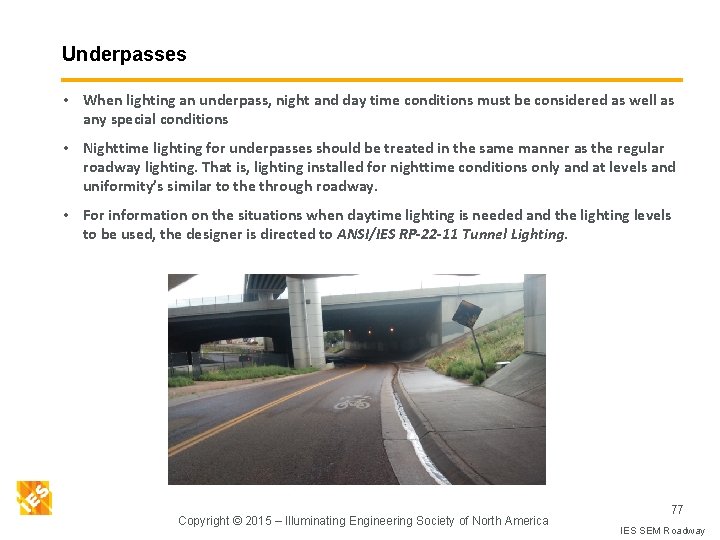
Underpasses • When lighting an underpass, night and day time conditions must be considered as well as any special conditions • Nighttime lighting for underpasses should be treated in the same manner as the regular roadway lighting. That is, lighting installed for nighttime conditions only and at levels and uniformity’s similar to the through roadway. • For information on the situations when daytime lighting is needed and the lighting levels to be used, the designer is directed to ANSI/IES RP-22 -11 Tunnel Lighting. Copyright © 2015 – Illuminating Engineering Society of North America 77 IES SEM Roadway
Overpasses • Overpasses are extensions of the roadway whereby the roadbed is constructed on a structural deck. • Thus, the lighting on the overpasses should match whatever lighting is present beyond the overpass. • On long structures, vibration due to vehicular traffic, becomes an issue for lamp and equipment life. • It is generally a good practice to limit pole heights in such a situation and to use equipment that can withstand the vibration. Copyright © 2015 – Illuminating Engineering Society of North America 78 IES SEM Roadway
Railroad Grade Crossings Lighting may be effective in reducing night time accidents and should be considered under the following circumstances: 1. Night-time train operations 2. Low train speeds 3. Blockage of the crossing for long periods at night 4. An accident history that indicates that motorists often fail to detect trains or traffic control devices at night 5. Horizontal and / or vertical alignment of the highway approach(es) are such that the vehicle headlight beams do not fall on the train until the vehicle has passed the safe stopping sight distance 6. Long dark trains (e. g. coal trains) 7. Restricted sight or stopping distance in rural areas 8. Humped crossings where oncoming vehicle headlights are visible under the train 9. Where the location of the crossing is difficult for a motorist to identify Copyright © 2015 – Illuminating Engineering Society of North America 79 IES SEM Roadway
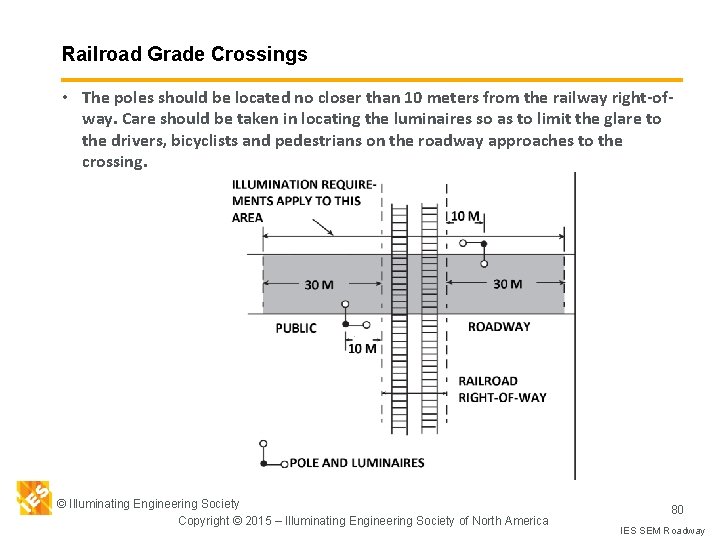
Railroad Grade Crossings • The poles should be located no closer than 10 meters from the railway right-ofway. Care should be taken in locating the luminaires so as to limit the glare to the drivers, bicyclists and pedestrians on the roadway approaches to the crossing. © Illuminating Engineering Society Copyright © 2015 – Illuminating Engineering Society of North America 80 IES SEM Roadway
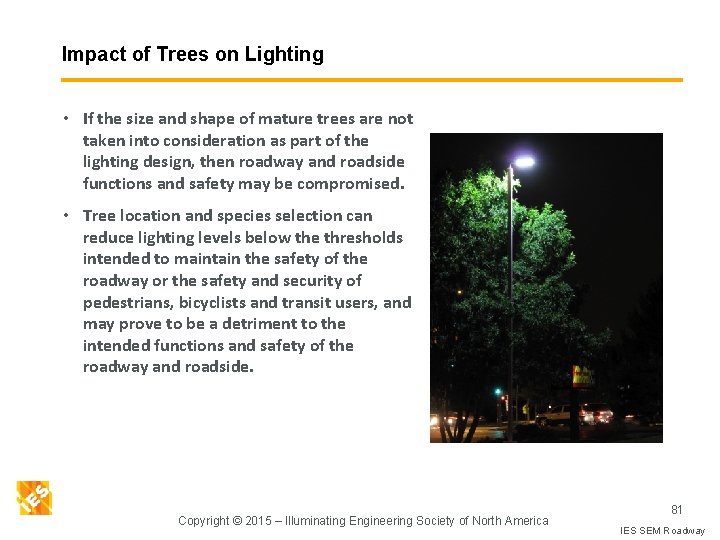
Impact of Trees on Lighting • If the size and shape of mature trees are not taken into consideration as part of the lighting design, then roadway and roadside functions and safety may be compromised. • Tree location and species selection can reduce lighting levels below the thresholds intended to maintain the safety of the roadway or the safety and security of pedestrians, bicyclists and transit users, and may prove to be a detriment to the intended functions and safety of the roadway and roadside. Copyright © 2015 – Illuminating Engineering Society of North America 81 IES SEM Roadway
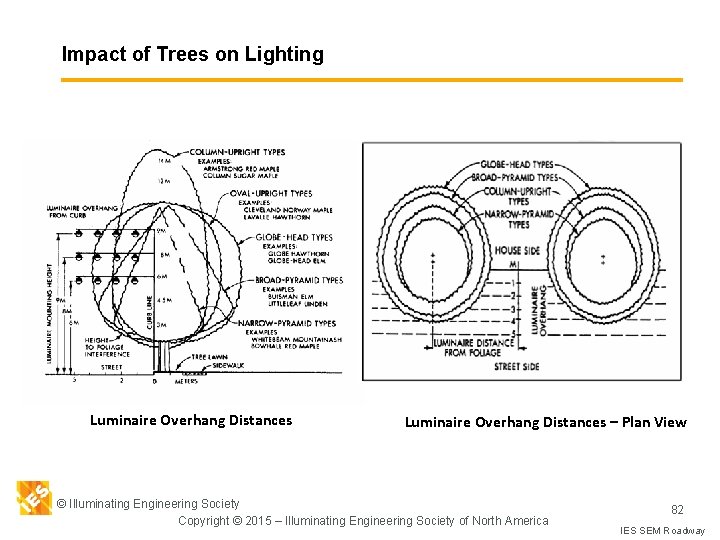
Impact of Trees on Lighting Luminaire Overhang Distances – Plan View © Illuminating Engineering Society Copyright © 2015 – Illuminating Engineering Society of North America 82 IES SEM Roadway
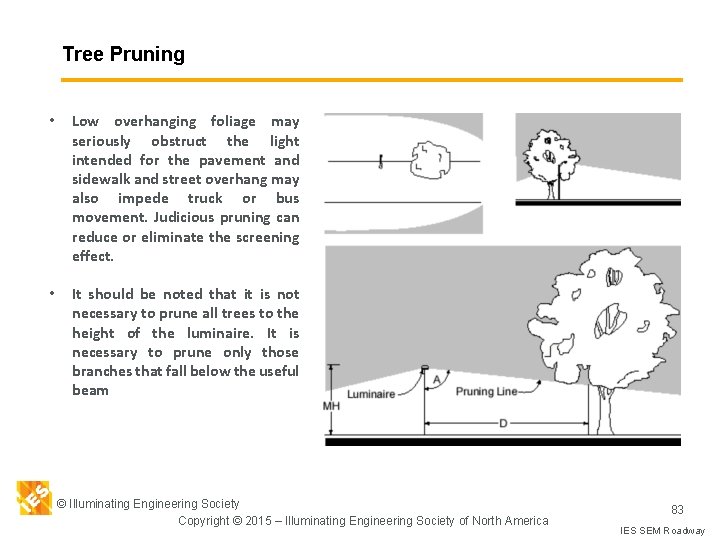
Tree Pruning • Low overhanging foliage may seriously obstruct the light intended for the pavement and sidewalk and street overhang may also impede truck or bus movement. Judicious pruning can reduce or eliminate the screening effect. • It should be noted that it is not necessary to prune all trees to the height of the luminaire. It is necessary to prune only those branches that fall below the useful beam © Illuminating Engineering Society Copyright © 2015 – Illuminating Engineering Society of North America 83 IES SEM Roadway
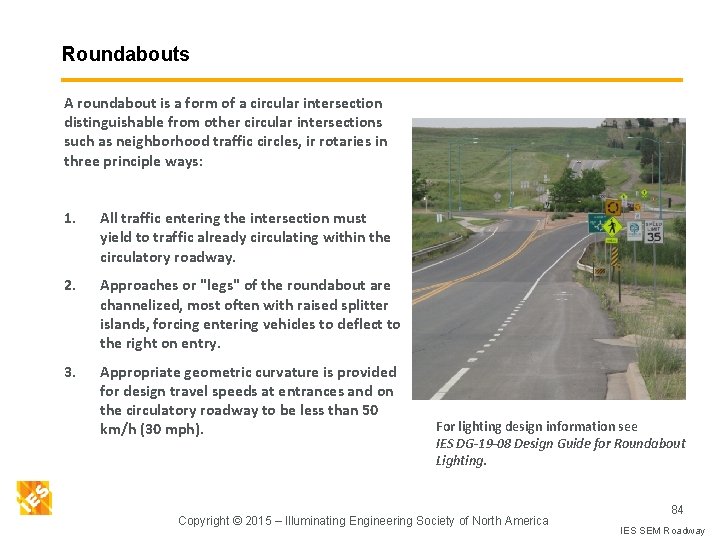
Roundabouts A roundabout is a form of a circular intersection distinguishable from other circular intersections such as neighborhood traffic circles, ir rotaries in three principle ways: 1. All traffic entering the intersection must yield to traffic already circulating within the circulatory roadway. 2. Approaches or "legs" of the roundabout are channelized, most often with raised splitter islands, forcing entering vehicles to deflect to the right on entry. 3. Appropriate geometric curvature is provided for design travel speeds at entrances and on the circulatory roadway to be less than 50 km/h (30 mph). For lighting design information see IES DG-19 -08 Design Guide for Roundabout Lighting. Copyright © 2015 – Illuminating Engineering Society of North America 84 IES SEM Roadway
Toll Plazas The lighting for Toll Plazas is defined by many tasks. Toll Plazas consist of four distinct areas with each area having a distinct task which requires special design considerations. 1. Approach/Departure Roads/Zones 2. Infield 3. Queuing/Areas 4. Toll Collection Island Copyright © 2015 – Illuminating Engineering Society of North America 85 IES SEM Roadway
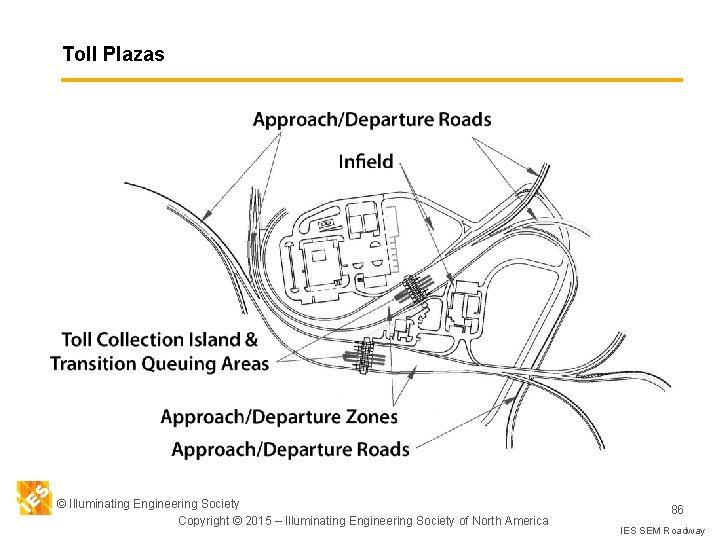
Toll Plazas © Illuminating Engineering Society Copyright © 2015 – Illuminating Engineering Society of North America 86 IES SEM Roadway
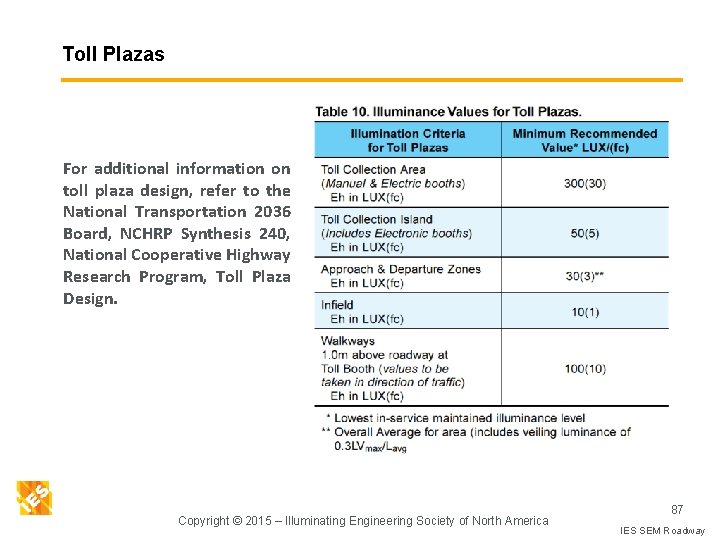
Toll Plazas For additional information on toll plaza design, refer to the National Transportation 2036 Board, NCHRP Synthesis 240, National Cooperative Highway Research Program, Toll Plaza Design. Copyright © 2015 – Illuminating Engineering Society of North America 87 IES SEM Roadway
Annexes to RP-8 -14 • Annex A – Calculations and Measurement Parameters • Annex B – Glare • Annex C – Glossary • Annex D – References • Annex E – Classification of Luminaire Light Distributions Copyright © 2015 – Illuminating Engineering Society of North America 88 IES SEM Roadway
Roadway Design Process Design Intersections using Illuminance Criteria Design Cul-de-sacs using Illuminance Method Fill in poles between intersections using spacing criteria generated by a Luminance optimization calculation • Curves with a radius of ≥ 600 m and minor grades can be treated as straight sections Copyright © 2015 – Illuminating Engineering Society of North America 89 IES SEM Roadway
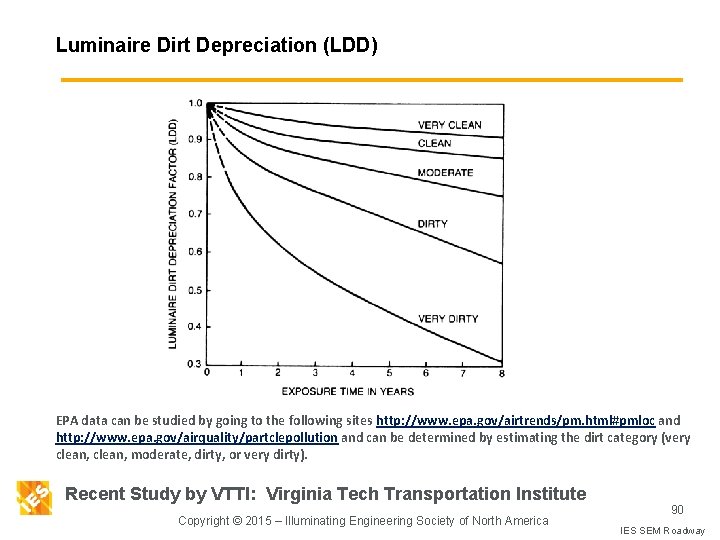
Luminaire Dirt Depreciation (LDD) EPA data can be studied by going to the following sites http: //www. epa. gov/airtrends/pm. html#pmloc and http: //www. epa. gov/airquality/partclepollution and can be determined by estimating the dirt category (very clean, moderate, dirty, or very dirty). Recent Study by VTTI: Virginia Tech Transportation Institute Copyright © 2015 – Illuminating Engineering Society of North America 90 IES SEM Roadway
Field Measurements • Recommended Equipment/Materials – Light Meter (Minolta T 10 or T 10 A). . . Calibrated within 12 months – Laser Measuring (Leica “Disto”. . Measure luminaire heights and street widths without pedestrian fatality [yours]) – Chalk, clip-board, flashlight, etc – Print-out of ILLUMINANCE values – Optional: Small Target “card” to set up – Camera: to photograph Small Target Copyright © 2015 – Illuminating Engineering Society of North America 91 IES SEM Roadway
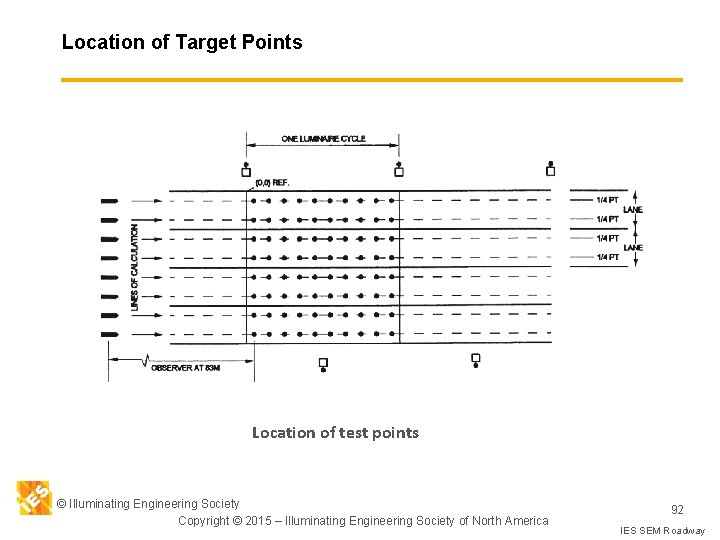
Location of Target Points Location of test points © Illuminating Engineering Society Copyright © 2015 – Illuminating Engineering Society of North America 92 IES SEM Roadway
Aging population issues (Old folks can’t see as well in the dark) • A 70 year-old-eye only gets 25% of the same light reaching the retina as a 25 year old. • Old folks pupils tend to be smaller • Older eyes don’t dark-adapt as quickly or as well as younger eyes • Diseases of the eyes make it even worse • Cataracts diffuse light across the retina (contrast decreases) • Retinal degeneration can take-out the center vision. 93 Copyright © 2015 – Illuminating Engineering Society of North America IES SEM Roadway
Reference Material • ANSI/IES RP-8 -14 Roadway Lighting • IES TM-12 -12 Spectral Effects of Lighting on Visual Performance at Mesopic Light Levels • IES TM-15 -11 Luminaire Classification System for Outdoor Luminaires • IES TM-11 -00/(R 06) Light Trespass: Research, Results, and Recommendations • IES RP-33 -14 Lighting for Exterior Environments • ANSI/IES RP-22 -11 Tunnel Lighting • IES DG-19 -08 Design Guide for Roundabout Lighting • IES Lighting Handbook, 10 th edition • CIE technical report 191: 2010 • CIE 115 Lighting of Roads for Motor and Pedestrian Traffic • AASHTO Lighting Design Guide Copyright © 2015 – Illuminating Engineering Society of North America 94 IES SEM Roadway

Disclaimer The Illuminating Engineering Society of North America (IES) education courses are developed through the consensus development process. This process considers varied viewpoints and interests to achieve consensus on lighting education. The IES administers the process and establishes policies and procedures to promote fairness in the development of consensus, but it does not make no representation, guaranty or warranty as to the accuracy or completeness of any information published herein on the date of publication or at any other time. The IES disclaims liability for any injury to persons or property or other damages of any nature whatsoever, whether special, indirect, consequential or compensatory, directly or indirectly resulting from the publication and/or the use of or reliance upon on this course or any view or opinion expressed therein. In issuing and making this course available, the IES is not undertaking to (1) render professional or other services for or on behalf of any person or entity or (2) perform any duty owed by any person or entity to someone else. Anyone taking this course should rely on his or her own independent judgment or, as appropriate, the advice of a competent professional in determining the exercise of reasonable care in any given circumstances. The IES has no power, nor does it undertake, to police or enforce compliance with the contents of this course. Nor does the IES list, certify, test or inspect any products, designs, or installations for compliance with this course. Any certification or statement of compliance with the requirements of this course shall not be attributable to the IES and is solely the responsibility of the certifier or maker of the statement. By enrolling in and attending this course, the participant agrees to the terms of this Disclaimer. Copyright © 2015 – Illuminating Engineering Society of North America 95 IES SEM Roadway
- Slides: 95