
IENG 475 Lecture 03 Tooling Fixturing 10302020 IENG
- Slides: 20
IENG 475 - Lecture 03 Tooling & Fixturing 10/30/2020 IENG 475: Computer-Controlled Manufacturing Systems 1
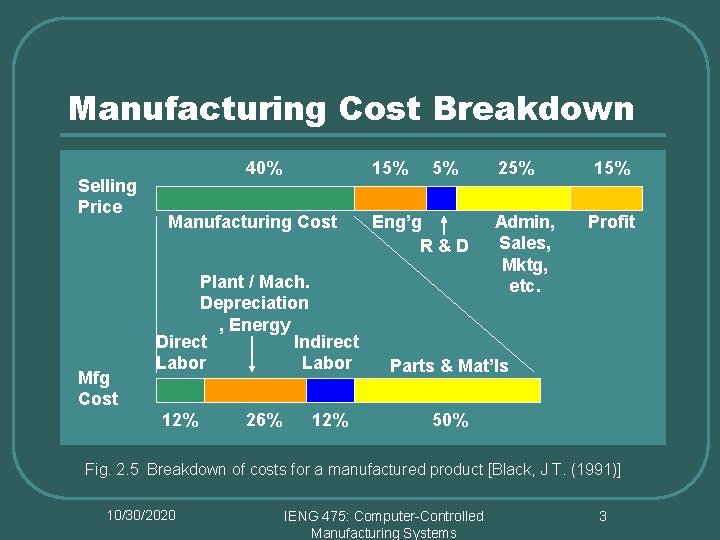
Manufacturing Cost Breakdown Selling Price Mfg Cost 40% 15% Manufacturing Cost Plant / Mach. Depreciation , Energy Direct Indirect Labor 12% 26% 12% 5% Eng’g R&D 25% Admin, Sales, Mktg, etc. 15% Profit Parts & Mat’ls 50% Fig. 2. 5 Breakdown of costs for a manufactured product [Black, J T. (1991)] 10/30/2020 IENG 475: Computer-Controlled Manufacturing Systems 3
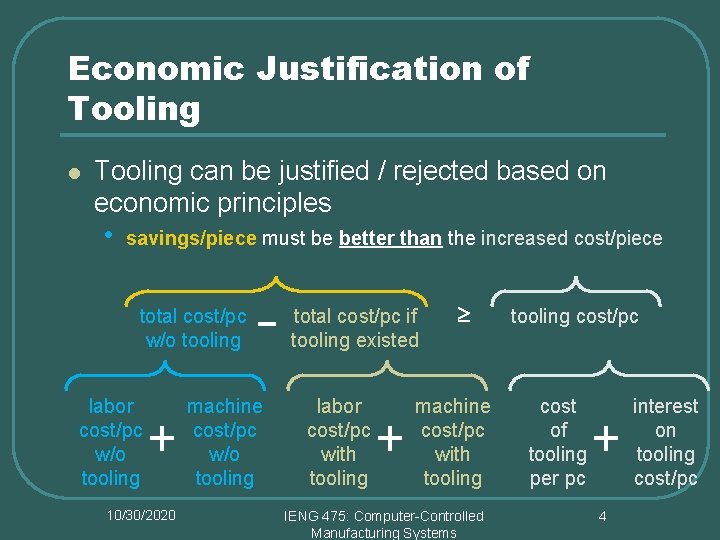
Economic Justification of Tooling l Tooling can be justified / rejected based on economic principles • savings/piece must be better than the increased cost/piece total cost/pc w/o tooling labor cost/pc w/o tooling 10/30/2020 machine cost/pc w/o tooling total cost/pc if tooling existed labor cost/pc with tooling machine cost/pc with tooling IENG 475: Computer-Controlled Manufacturing Systems tooling cost/pc cost of tooling per pc interest on tooling cost/pc 4
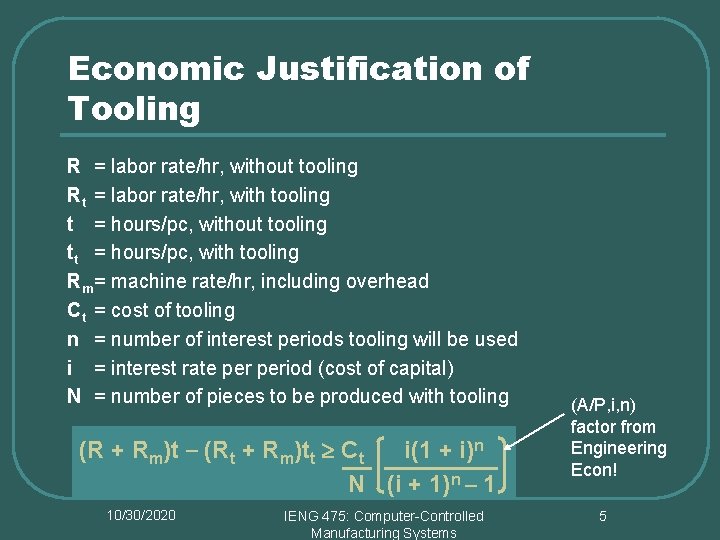
Economic Justification of Tooling R = labor rate/hr, without tooling Rt = labor rate/hr, with tooling t = hours/pc, without tooling tt = hours/pc, with tooling Rm = machine rate/hr, including overhead Ct = cost of tooling n = number of interest periods tooling will be used i = interest rate period (cost of capital) N = number of pieces to be produced with tooling (R + Rm)t _ (Rt + Rm)tt Ct i(1 + i)n N (i + 1)n _ 1 10/30/2020 IENG 475: Computer-Controlled Manufacturing Systems (A/P, i, n) factor from Engineering Econ! 5
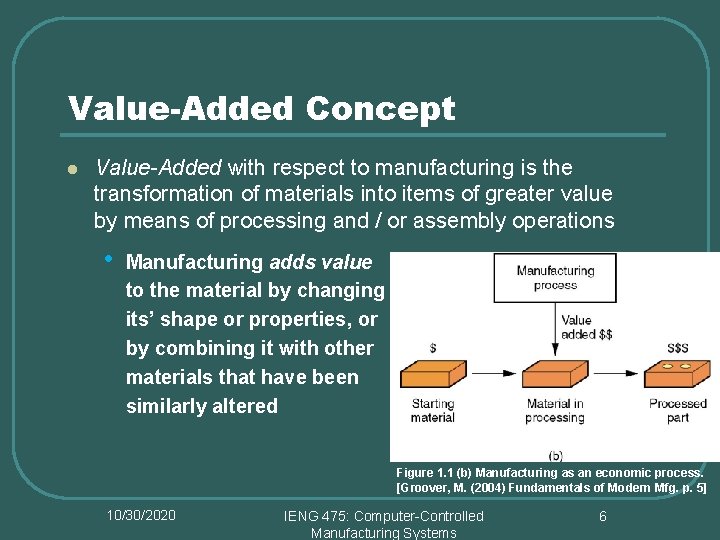
Value-Added Concept l Value-Added with respect to manufacturing is the transformation of materials into items of greater value by means of processing and / or assembly operations • Manufacturing adds value to the material by changing its’ shape or properties, or by combining it with other materials that have been similarly altered Figure 1. 1 (b) Manufacturing as an economic process. [Groover, M. (2004) Fundamentals of Modern Mfg. p. 5] 10/30/2020 IENG 475: Computer-Controlled Manufacturing Systems 6
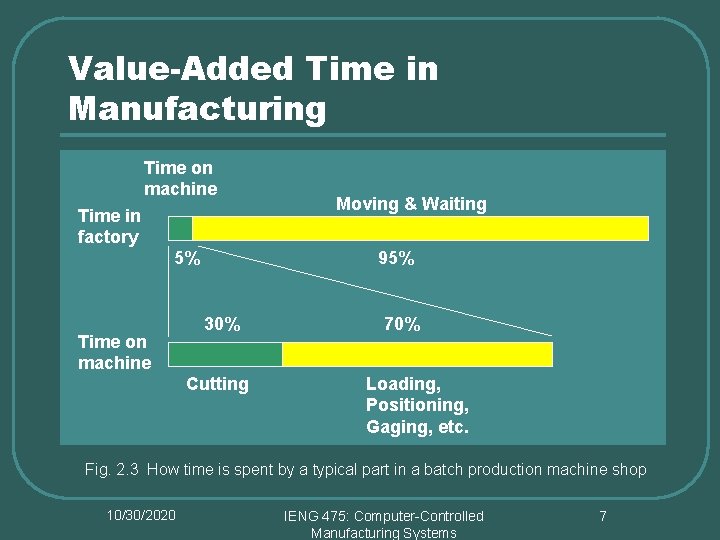
Value-Added Time in Manufacturing Time on machine Time in factory 5% Time on machine Moving & Waiting 95% 30% Cutting 70% Loading, Positioning, Gaging, etc. Fig. 2. 3 How time is spent by a typical part in a batch production machine shop 10/30/2020 IENG 475: Computer-Controlled Manufacturing Systems 7
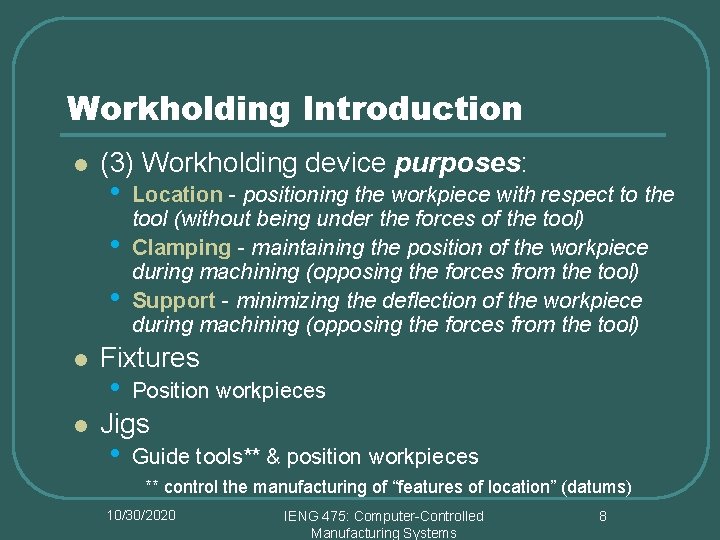
Workholding Introduction l (3) Workholding device purposes: • • • l l Location - positioning the workpiece with respect to the tool (without being under the forces of the tool) Clamping - maintaining the position of the workpiece during machining (opposing the forces from the tool) Support - minimizing the deflection of the workpiece during machining (opposing the forces from the tool) Fixtures • Position workpieces Jigs • Guide tools** & position workpieces ** control the manufacturing of “features of location” (datums) 10/30/2020 IENG 475: Computer-Controlled Manufacturing Systems 8
Fixturing l Five Principles: 1. Locating and clamping should reduce the idle time of a machine to a minimum 2. Locating and clamping should not interfere with the motions of the tool (sweep volume) 3. Adequate clearance and configuration should allow for easy removal of chips and access of coolant 4. Design should be robust enough to withstand all coupled cutting forces and vibrations 5. Design should encourage correct workpiece orientation, and eliminate incorrect orientation 10/30/2020 IENG 475: Computer-Controlled Manufacturing Systems 9
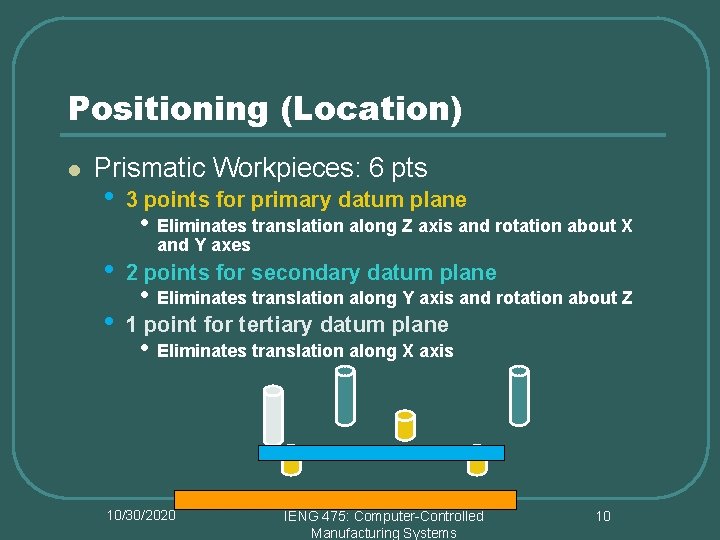
Positioning (Location) l Prismatic Workpieces: 6 pts • • • 3 points for primary datum plane • Eliminates translation along Z axis and rotation about X and Y axes 2 points for secondary datum plane • Eliminates translation along Y axis and rotation about Z 1 point for tertiary datum plane • Eliminates translation along X axis 10/30/2020 IENG 475: Computer-Controlled Manufacturing Systems 10
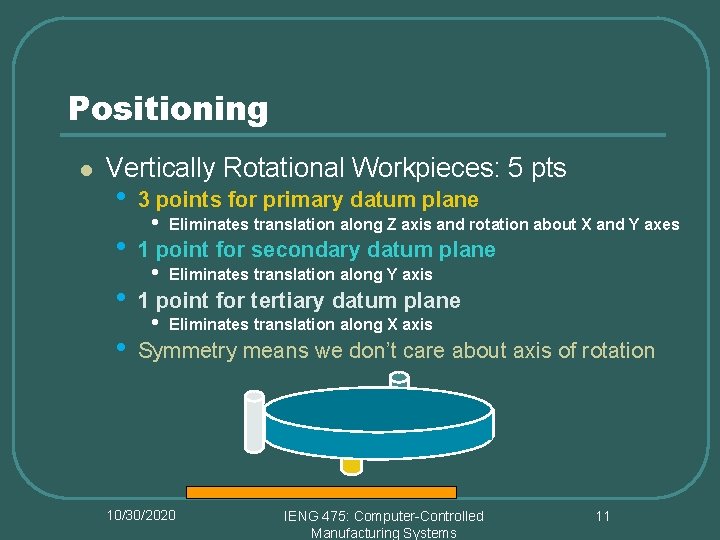
Positioning l Vertically Rotational Workpieces: 5 pts • • 3 points for primary datum plane • Eliminates translation along Z axis and rotation about X and Y axes 1 point for secondary datum plane • Eliminates translation along Y axis 1 point for tertiary datum plane • Eliminates translation along X axis Symmetry means we don’t care about axis of rotation 10/30/2020 IENG 475: Computer-Controlled Manufacturing Systems 11
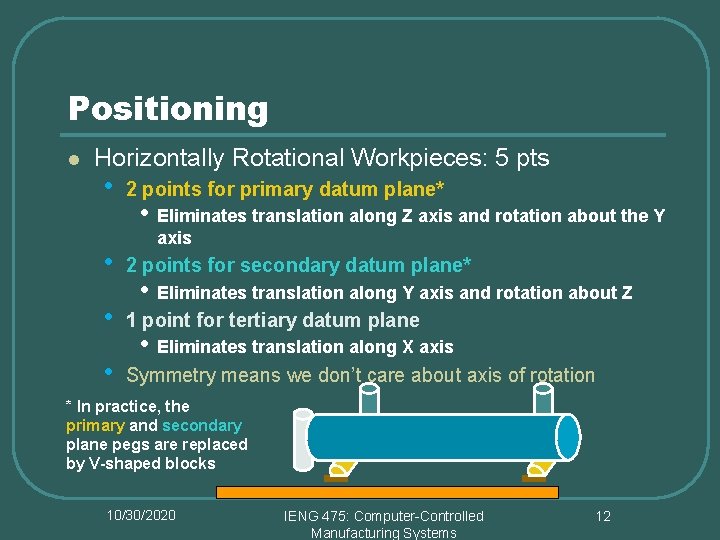
Positioning l Horizontally Rotational Workpieces: 5 pts • • 2 points for primary datum plane* • Eliminates translation along Z axis and rotation about the Y axis 2 points for secondary datum plane* • Eliminates translation along Y axis and rotation about Z 1 point for tertiary datum plane • Eliminates translation along X axis Symmetry means we don’t care about axis of rotation * In practice, the primary and secondary plane pegs are replaced by V-shaped blocks 10/30/2020 IENG 475: Computer-Controlled Manufacturing Systems 12
Locating and Supporting Principles l Position locating pins as far apart as possible for stability l Keep the center of mass low, and close to the centroid of the locator pins l l l Locating pin surfaces should have fixed positions – movable surfaces should be used for clamping l Buttons and pins should be preferred to planar surfaces for locational control – easier to remove chips / debris and easier to replace when worn l Error-proof locating schemes are the preferred positioning systems (poke yoke) Position locating pins to contact datum surfaces and help enforce geometric tolerance constraints Locating pin surfaces should be as small as possible and wear well 10/30/2020 IENG 475: Computer-Controlled Manufacturing Systems 13
Clamping and Supporting l Design clamping force directions to act against locators l Primary cutting forces should be directed toward the fixture body and not oppose clamping forces l Cutting forces should be absorbed by fixed locators/supports and not by clamping friction l Avoid clamping on surfaces with finish quality constraints 10/30/2020 IENG 475: Computer-Controlled Manufacturing Systems 14
Setup (Orientation) l Additional setups (reorientation and clamping of the workpiece) are required whenever an operation needs to access a currently inaccessible workpiece surface l Setups should be minimized, because: • • • Re-orientation time does not add value to the product and lowers throughput Additional fixtures increase the fixed costs of the product Re-orientation offers an additional opportunity for unacceptable variation in dimensional and geometric tolerances 10/30/2020 IENG 475: Computer-Controlled Manufacturing Systems 15
Fixturing Reduction l Multipurpose fixtures are preferred to special or single purpose fixtures • l Modular fixtures have reposition-able elements that may be reconfigured for reuse on a variety of parts • l Cost reduction opportunity Opportunity to recover fixturing costs over a larger number of products Fixtures should be as self-contained as possible • Fewer actuation (clamping) actions required of the operator and machine can result in greater product throughput 10/30/2020 IENG 475: Computer-Controlled Manufacturing Systems 16
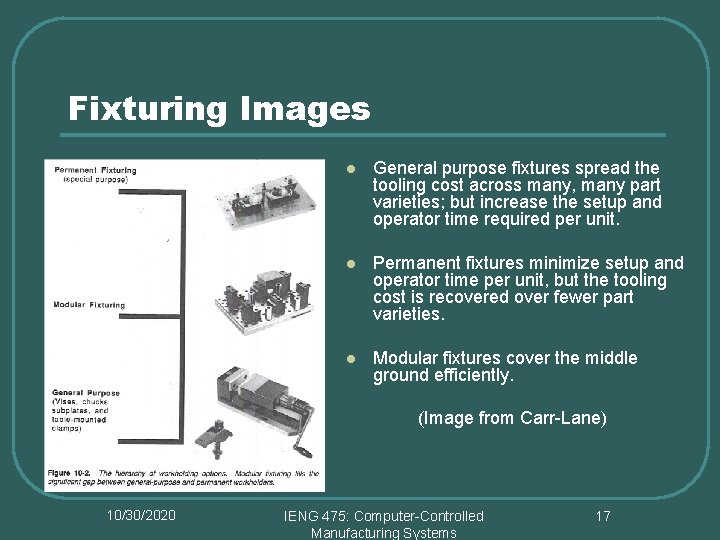
Fixturing Images l General purpose fixtures spread the tooling cost across many, many part varieties; but increase the setup and operator time required per unit. l Permanent fixtures minimize setup and operator time per unit, but the tooling cost is recovered over fewer part varieties. l Modular fixtures cover the middle ground efficiently. (Image from Carr-Lane) 10/30/2020 IENG 475: Computer-Controlled Manufacturing Systems 17
Fixturing Images l Modular fixturing components (Image from Carr-Lane) 10/30/2020 IENG 475: Computer-Controlled Manufacturing Systems 18
Fixturing Images l Modular fixturing example. (Image from Carr-Lane) 10/30/2020 IENG 475: Computer-Controlled Manufacturing Systems 19
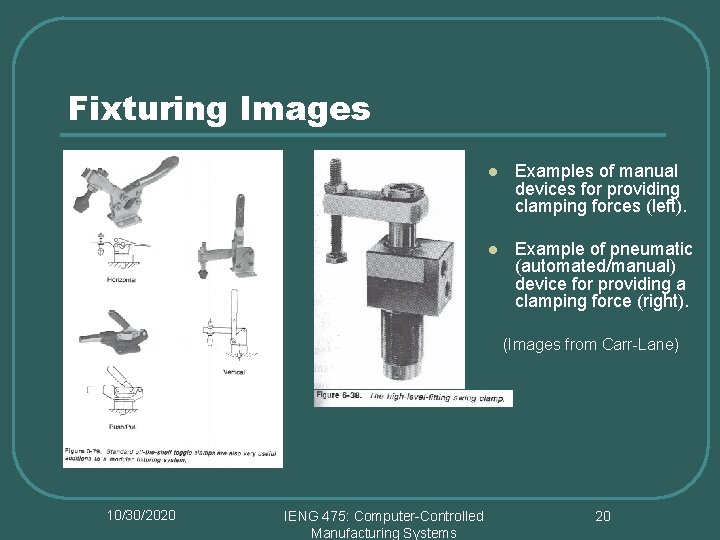
Fixturing Images l Examples of manual devices for providing clamping forces (left). l Example of pneumatic (automated/manual) device for providing a clamping force (right). (Images from Carr-Lane) 10/30/2020 IENG 475: Computer-Controlled Manufacturing Systems 20
Questions & Issues l l Start preparing your engineering notebooks • Lectures slides have formulas for: • Lathe Operations • Milling Operations • Drilling Operations Lab this week • Turn in ONE report per team: • Cover Sheet • Summary of Process • Safe Operation Check Sheet for each machine • Copy or original machine Fishbone from each member • Prepare to construct a Fixture 10/30/2020 IENG 475: Computer-Controlled Manufacturing Systems 21