
IENG 451 Lecture 16 MUDA Waste Wastes Impact
- Slides: 10
IENG 451 - Lecture 16 MUDA (Waste): Waste’s Impact on Systems 12/7/2020 IENG 451 Operational Strategies 1
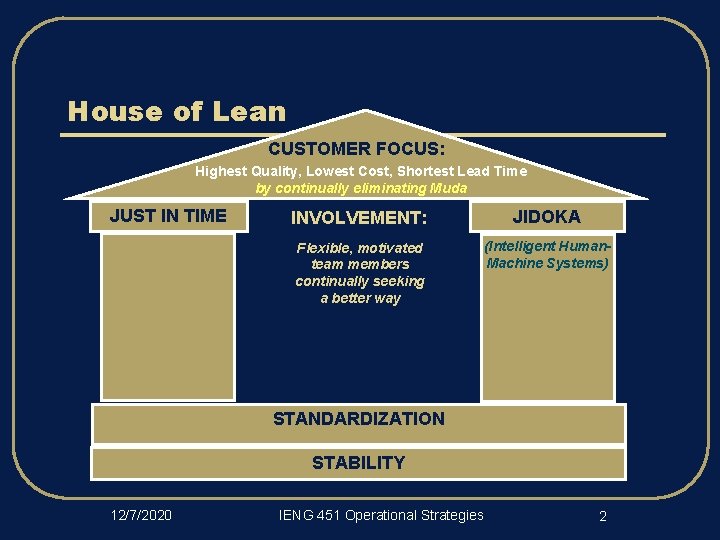
House of Lean CUSTOMER FOCUS: Highest Quality, Lowest Cost, Shortest Lead Time by continually eliminating Muda JUST IN TIME INVOLVEMENT: JIDOKA Flexible, motivated team members continually seeking a better way (Intelligent Human. Machine Systems) STANDARDIZATION STABILITY 12/7/2020 IENG 451 Operational Strategies 2
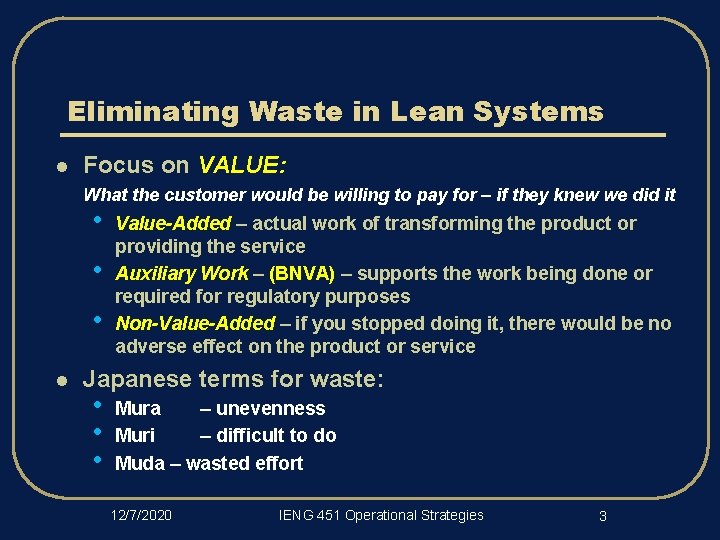
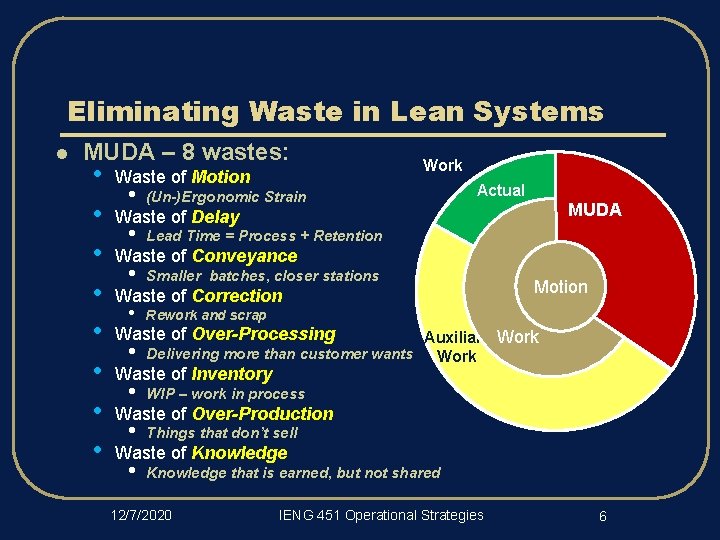
Eliminating Waste in Lean Systems l Focus on VALUE: What the customer would be willing to pay for – if they knew we did it • • • l Value-Added – actual work of transforming the product or providing the service Auxiliary Work – (BNVA) – supports the work being done or required for regulatory purposes Non-Value-Added – if you stopped doing it, there would be no adverse effect on the product or service Japanese terms for waste: • • • Mura – unevenness Muri – difficult to do Muda – wasted effort 12/7/2020 IENG 451 Operational Strategies 3
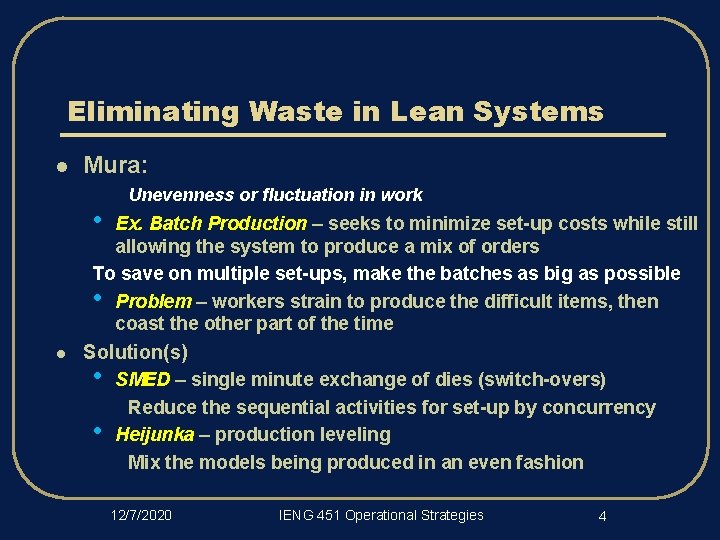
Eliminating Waste in Lean Systems l Mura: • Unevenness or fluctuation in work Ex. Batch Production – seeks to minimize set-up costs while still allowing the system to produce a mix of orders To save on multiple set-ups, make the batches as big as possible • Problem – workers strain to produce the difficult items, then coast the other part of the time l Solution(s) • • SMED – single minute exchange of dies (switch-overs) Reduce the sequential activities for set-up by concurrency Heijunka – production leveling Mix the models being produced in an even fashion 12/7/2020 IENG 451 Operational Strategies 4
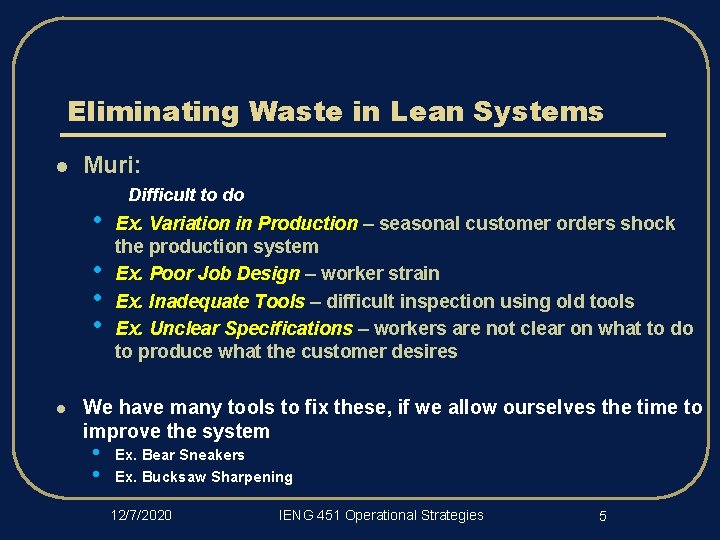
Eliminating Waste in Lean Systems l Muri: • • l Difficult to do Ex. Variation in Production – seasonal customer orders shock the production system Ex. Poor Job Design – worker strain Ex. Inadequate Tools – difficult inspection using old tools Ex. Unclear Specifications – workers are not clear on what to do to produce what the customer desires We have many tools to fix these, if we allow ourselves the time to improve the system • • Ex. Bear Sneakers Ex. Bucksaw Sharpening 12/7/2020 IENG 451 Operational Strategies 5
Eliminating Waste in Lean Systems l MUDA – 8 wastes: • • Waste of Motion Work • (Un-)Ergonomic Strain • Lead Time = Process + Retention • Smaller batches, closer stations • Rework and scrap • Auxiliary Work Delivering more than customer wants Work • WIP – work in process • Things that don’t sell • Knowledge that is earned, but not shared Actual MUDA Waste of Delay Waste of Conveyance Waste of Correction Motion Waste of Over-Processing Waste of Inventory Waste of Over-Production Waste of Knowledge 12/7/2020 IENG 451 Operational Strategies 6
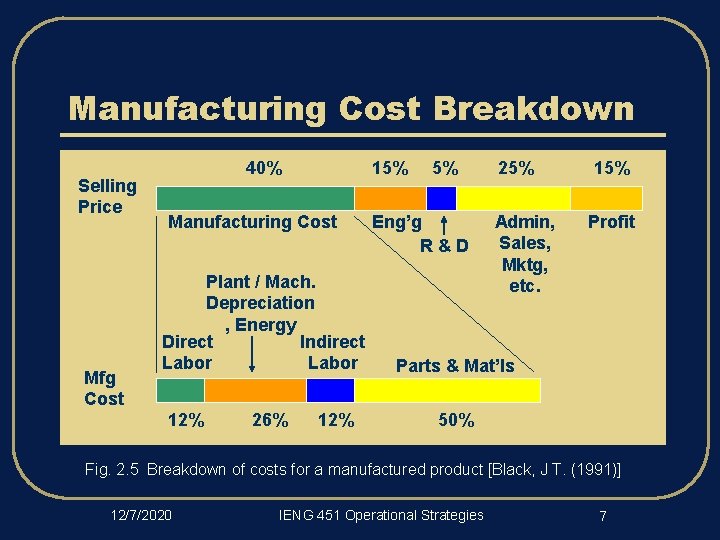
Manufacturing Cost Breakdown Selling Price Mfg Cost 40% 15% Manufacturing Cost Plant / Mach. Depreciation , Energy Direct Indirect Labor 12% 26% 12% 5% Eng’g R&D 25% Admin, Sales, Mktg, etc. 15% Profit Parts & Mat’ls 50% Fig. 2. 5 Breakdown of costs for a manufactured product [Black, J T. (1991)] 12/7/2020 IENG 451 Operational Strategies 7
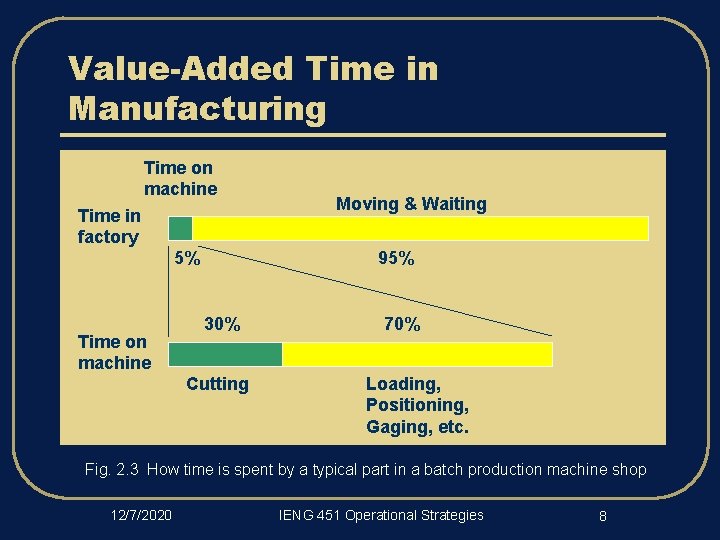
Value-Added Time in Manufacturing Time on machine Time in factory 5% Time on machine Moving & Waiting 95% 30% Cutting 70% Loading, Positioning, Gaging, etc. Fig. 2. 3 How time is spent by a typical part in a batch production machine shop 12/7/2020 IENG 451 Operational Strategies 8
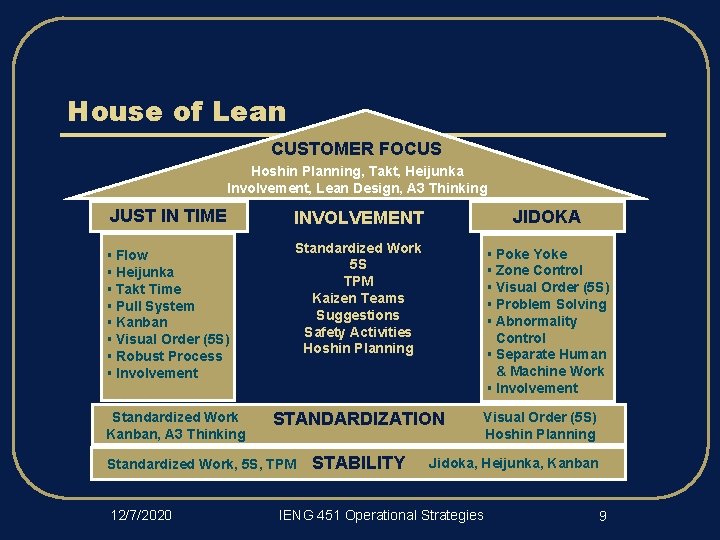
House of Lean CUSTOMER FOCUS Hoshin Planning, Takt, Heijunka Involvement, Lean Design, A 3 Thinking JUST IN TIME § Flow § Heijunka § Takt Time § Pull System § Kanban § Visual Order (5 S) § Robust Process § Involvement Standardized Work Kanban, A 3 Thinking INVOLVEMENT JIDOKA Standardized Work 5 S TPM Kaizen Teams Suggestions Safety Activities Hoshin Planning § Poke Yoke § Zone Control § Visual Order (5 S) § Problem Solving § Abnormality STANDARDIZATION Standardized Work, 5 S, TPM 12/7/2020 Control § Separate Human & Machine Work § Involvement STABILITY Visual Order (5 S) Hoshin Planning Jidoka, Heijunka, Kanban IENG 451 Operational Strategies 9
Questions & Issues 12/7/2020 IENG 451 Operational Strategies 10