
IEEECSC ESAS SUPERCONDUCTIVITY NEWS FORUM global edition October
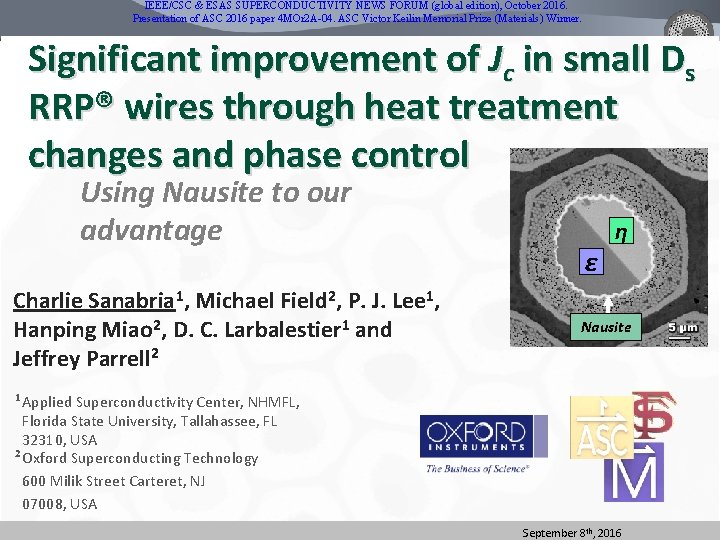
IEEE/CSC & ESAS SUPERCONDUCTIVITY NEWS FORUM (global edition), October 2016. Presentation of ASC 2016 paper 4 MOr 2 A-04. ASC Victor Keilin Memorial Prize (Materials) Winner. Significant improvement of Jc in small Ds RRP® wires through heat treatment changes and phase control Using Nausite to our advantage Charlie Sanabria 1, Michael Field 2, P. J. Lee 1, Hanping Miao 2, D. C. Larbalestier 1 and Jeffrey Parrell 2 ε η Nausite 1 Applied Superconductivity Center, NHMFL, Florida State University, Tallahassee, FL 32310, USA 2 Oxford Superconducting Technology 600 Milik Street Carteret, NJ 07008, USA September 8 th, 2016 Slide of 17
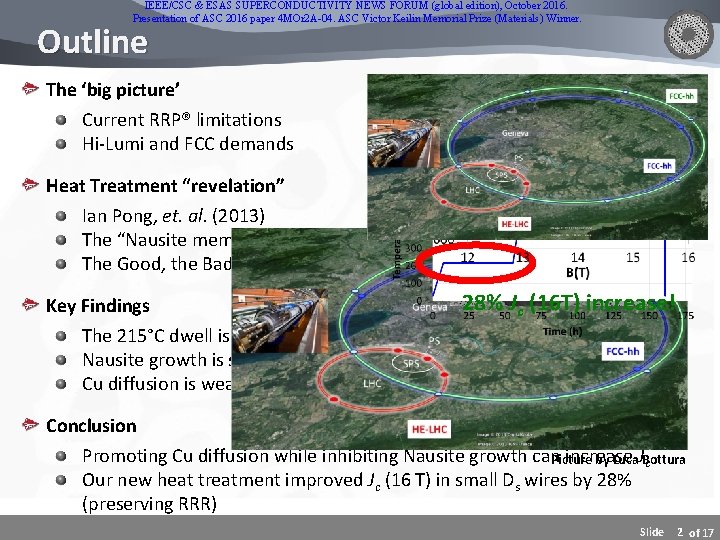
IEEE/CSC & ESAS SUPERCONDUCTIVITY NEWS FORUM (global edition), October 2016. Presentation of ASC 2016 paper 4 MOr 2 A-04. ASC Victor Keilin Memorial Prize (Materials) Winner. Outline The ‘big picture’ Current RRP® limitations Hi-Lumi and FCC demands Heat Treatment “revelation” Ian Pong, et. al. (2013) The “Nausite membrane” The Good, the Bad and the Ugly Useless! ε η Nausite 28% Jc (16 T) increase! Key Findings The 215°C dwell is useless Nausite growth is strongly dependent on temperature Cu diffusion is weakly dependent on temperature Conclusion Promoting Cu diffusion while inhibiting Nausite growth can increase J Picture by Luca Bottura c Our new heat treatment improved Jc (16 T) in small Ds wires by 28% (preserving RRR) Slide 2 of 17
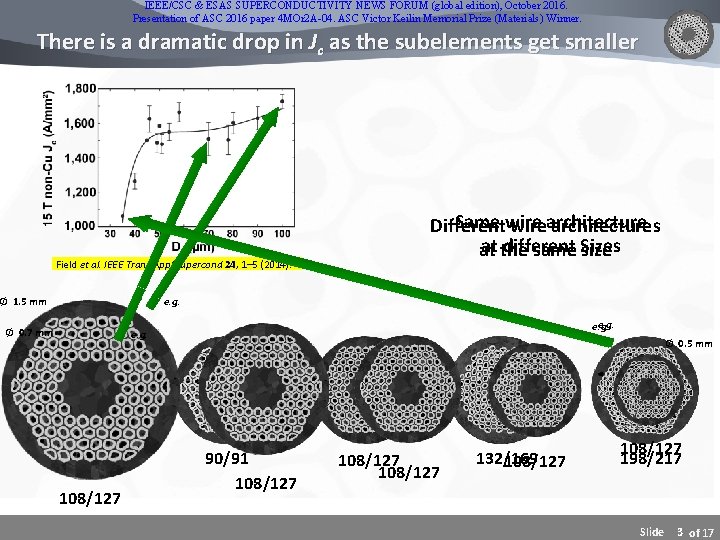
IEEE/CSC & ESAS SUPERCONDUCTIVITY NEWS FORUM (global edition), October 2016. Presentation of ASC 2016 paper 4 MOr 2 A-04. ASC Victor Keilin Memorial Prize (Materials) Winner. There is a dramatic drop in Jc as the subelements get smaller Field et al. IEEE Trans Appl Supercond 24, 1– 5 (2014). Same wire Different wirearchitectures at the different at same Sizes size e. g. Ø 1. 5 mm Ø 0. 7 mm e. g. 54/61 108/127 Ø 0. 5 mm 90/91 108/127 132/169 108/127 198/217 Slide 3 of 17
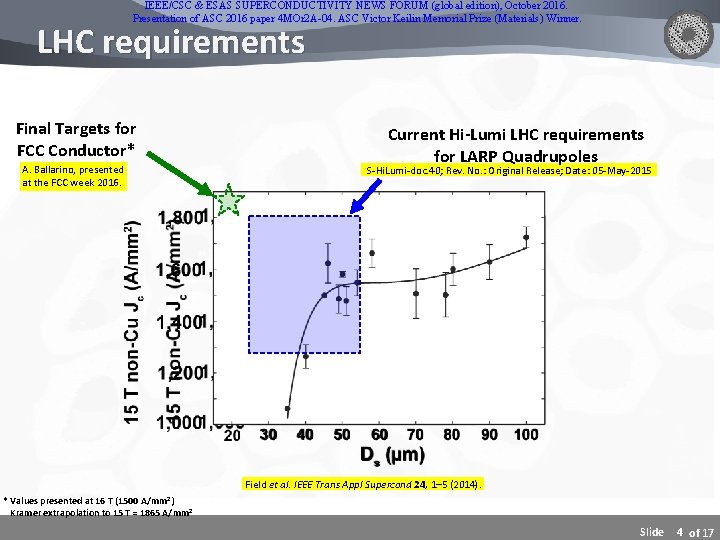
IEEE/CSC & ESAS SUPERCONDUCTIVITY NEWS FORUM (global edition), October 2016. Presentation of ASC 2016 paper 4 MOr 2 A-04. ASC Victor Keilin Memorial Prize (Materials) Winner. LHC requirements Final Targets for FCC Conductor* A. Ballarino, presented at the FCC week 2016. Current Hi-Lumi LHC requirements for LARP Quadrupoles S-Hi. Lumi-doc. 40; Rev. No. : Original Release; Date: 05 -May-2015 Field et al. IEEE Trans Appl Supercond 24, 1– 5 (2014). * Values presented at 16 T (1500 A/mm 2) Kramer extrapolation to 15 T = 1865 A/mm 2 Slide 4 of 17
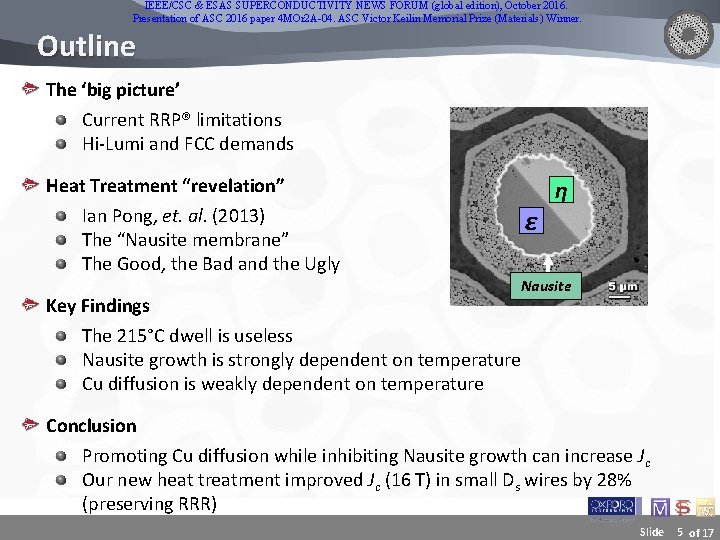
IEEE/CSC & ESAS SUPERCONDUCTIVITY NEWS FORUM (global edition), October 2016. Presentation of ASC 2016 paper 4 MOr 2 A-04. ASC Victor Keilin Memorial Prize (Materials) Winner. Outline The ‘big picture’ Current RRP® limitations Hi-Lumi and FCC demands Heat Treatment “revelation” Ian Pong, et. al. (2013) The “Nausite membrane” The Good, the Bad and the Ugly ε η Nausite Key Findings The 215°C dwell is useless Nausite growth is strongly dependent on temperature Cu diffusion is weakly dependent on temperature Conclusion Promoting Cu diffusion while inhibiting Nausite growth can increase Jc Our new heat treatment improved Jc (16 T) in small Ds wires by 28% (preserving RRR) Slide 5 of 17
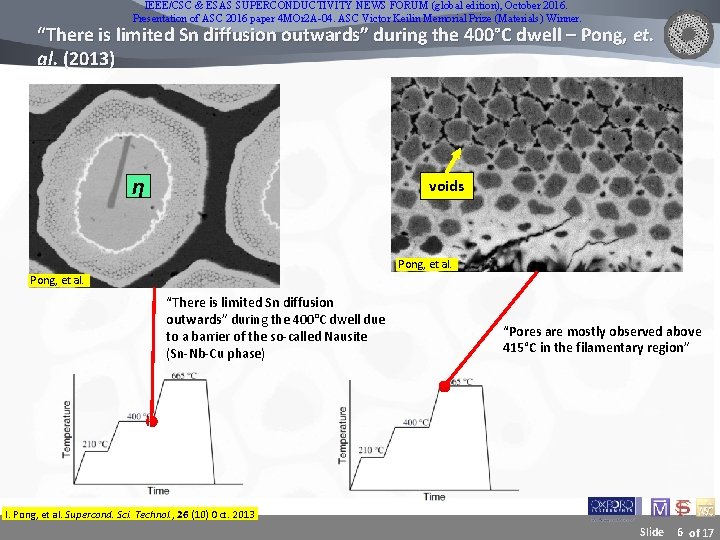
IEEE/CSC & ESAS SUPERCONDUCTIVITY NEWS FORUM (global edition), October 2016. Presentation of ASC 2016 paper 4 MOr 2 A-04. ASC Victor Keilin Memorial Prize (Materials) Winner. “There is limited Sn diffusion outwards” during the 400°C dwell – Pong, et. al. (2013) η voids Pong, et al. “There is limited Sn diffusion outwards” during the 400°C dwell due to a barrier of the so-called Nausite (Sn-Nb-Cu phase) “Pores are mostly observed above 415°C in the filamentary region” I. Pong, et al. Supercond. Sci. Technol. , 26 (10) Oct. 2013 Slide 6 of 17
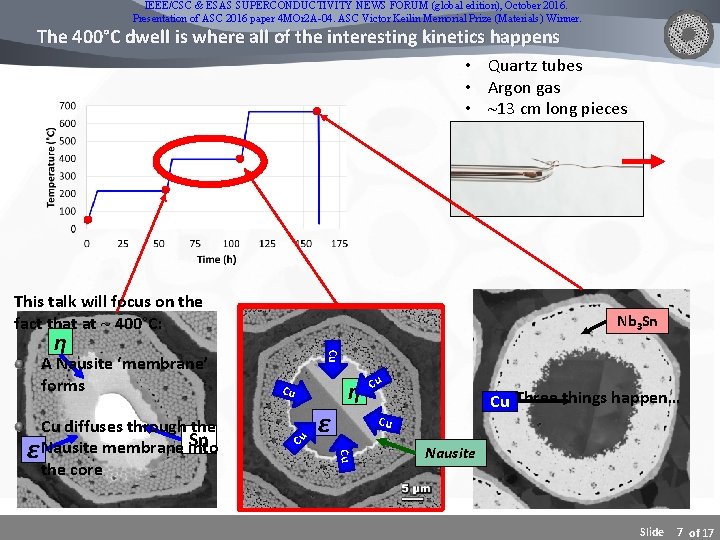
IEEE/CSC & ESAS SUPERCONDUCTIVITY NEWS FORUM (global edition), October 2016. Presentation of ASC 2016 paper 4 MOr 2 A-04. ASC Victor Keilin Memorial Prize (Materials) Winner. The 400°C dwell is where all of the interesting kinetics happens • Quartz tubes • Argon gas • ~13 cm long pieces This talk will focus on the fact that at ~ 400°C: Nb 3 Sn ε η Cu Cu Three things happen… Cu Cu Cu diffuses through the Sn ε Nausite membrane into the core Cu Cu A Nausite ‘membrane’ forms Cu η Nausite Slide 7 of 17
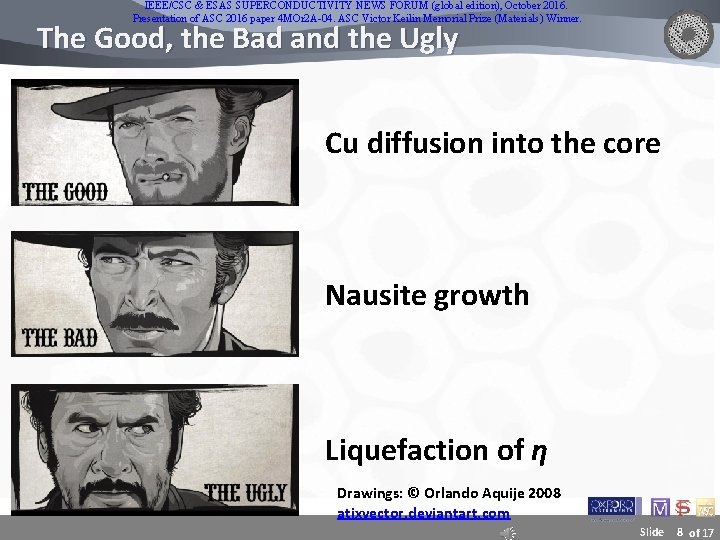
IEEE/CSC & ESAS SUPERCONDUCTIVITY NEWS FORUM (global edition), October 2016. Presentation of ASC 2016 paper 4 MOr 2 A-04. ASC Victor Keilin Memorial Prize (Materials) Winner. The Good, the Bad and the Ugly Cu diffusion into the core Nausite growth Liquefaction of η Drawings: © Orlando Aquije 2008 atixvector. deviantart. com Slide 8 of 17
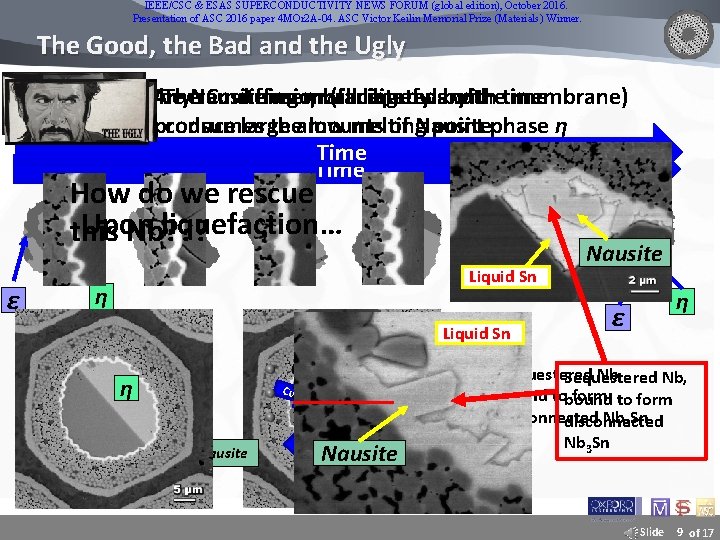
IEEE/CSC & ESAS SUPERCONDUCTIVITY NEWS FORUM (global edition), October 2016. Presentation of ASC 2016 paper 4 MOr 2 A-04. ASC Victor Keilin Memorial Prize (Materials) Winner. The Good, the Bad and the Ugly The Ugly: Good: The Bad: Any The. Nausite remaining Cu diffusion membrane η will (facilitated liquefy growsand by with thetime membrane) produce consumes large theamounts low melting of Nausite point phase η Time How do we rescue Upon liquefaction… this Nb? ? ? η Liquid Sn Cu 66. 8 at. %Sn Cu Cu 20. 7 at. η%Nb 12. 5 at. %Cu Cu ε η Nausite Cu ε Liquid Sn Nausite η ε Sequestered Nb, bound tobound form to form disconnected Nb 3 Sn Slide 9 of 17
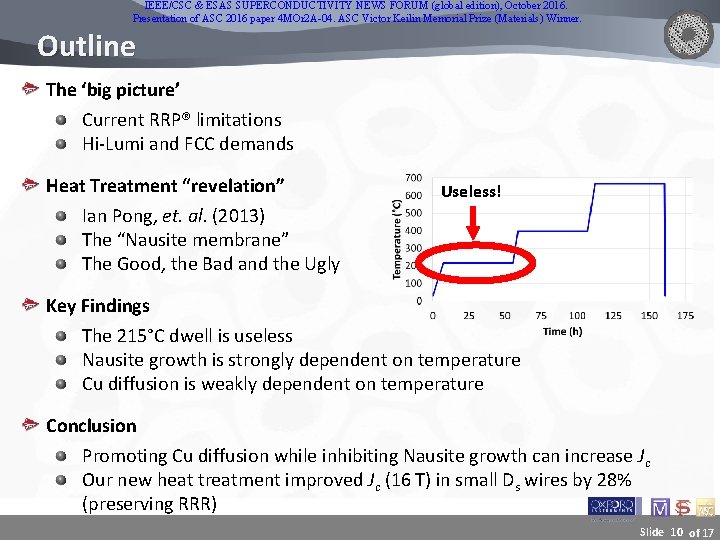
IEEE/CSC & ESAS SUPERCONDUCTIVITY NEWS FORUM (global edition), October 2016. Presentation of ASC 2016 paper 4 MOr 2 A-04. ASC Victor Keilin Memorial Prize (Materials) Winner. Outline The ‘big picture’ Current RRP® limitations Hi-Lumi and FCC demands Heat Treatment “revelation” Ian Pong, et. al. (2013) The “Nausite membrane” The Good, the Bad and the Ugly Useless! Nausite Key Findings The 215°C dwell is useless Nausite growth is strongly dependent on temperature Cu diffusion is weakly dependent on temperature Conclusion Promoting Cu diffusion while inhibiting Nausite growth can increase Jc Our new heat treatment improved Jc (16 T) in small Ds wires by 28% (preserving RRR) Slide 10 of 17
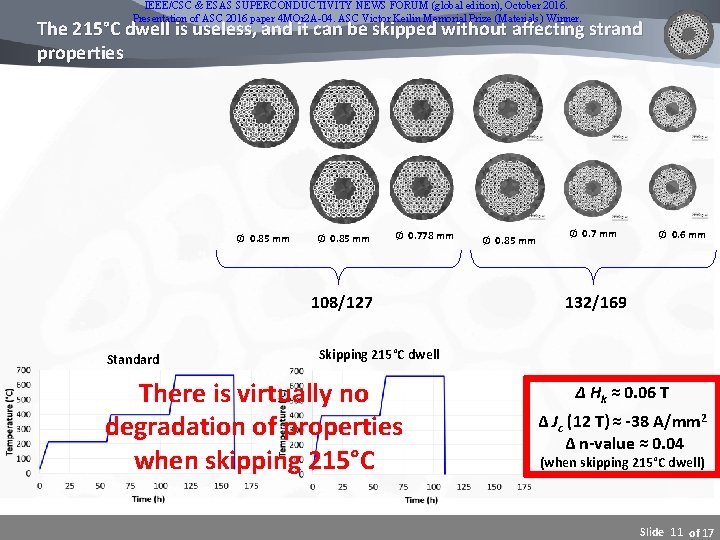
IEEE/CSC & ESAS SUPERCONDUCTIVITY NEWS FORUM (global edition), October 2016. Presentation of ASC 2016 paper 4 MOr 2 A-04. ASC Victor Keilin Memorial Prize (Materials) Winner. The 215°C dwell is useless, and it can be skipped without affecting strand properties Ø 0. 85 mm Ø 0. 778 mm 108/127 Standard Ø 0. 85 mm Ø 0. 7 mm Ø 0. 6 mm 132/169 Skipping 215°C dwell There is virtually no degradation of properties when skipping 215°C Δ Hk ≈ 0. 06 T Δ Jc (12 T) ≈ -38 A/mm 2 Δ n-value ≈ 0. 04 (when skipping 215°C dwell) Slide 11 of 17
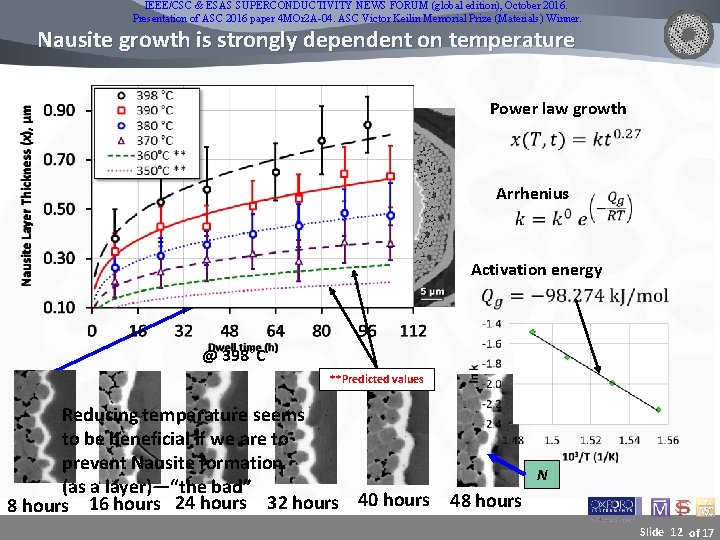
IEEE/CSC & ESAS SUPERCONDUCTIVITY NEWS FORUM (global edition), October 2016. Presentation of ASC 2016 paper 4 MOr 2 A-04. ASC Victor Keilin Memorial Prize (Materials) Winner. Nausite growth is strongly dependent on temperature Power law growth Arrhenius Activation energy @ 398°C **Predicted values Reducing temperature seems to be beneficial if we are to prevent Nausite formation (as a layer)—“the bad” 8 hours 16 hours 24 hours 32 hours 40 hours N 48 hours Slide 12 of 17
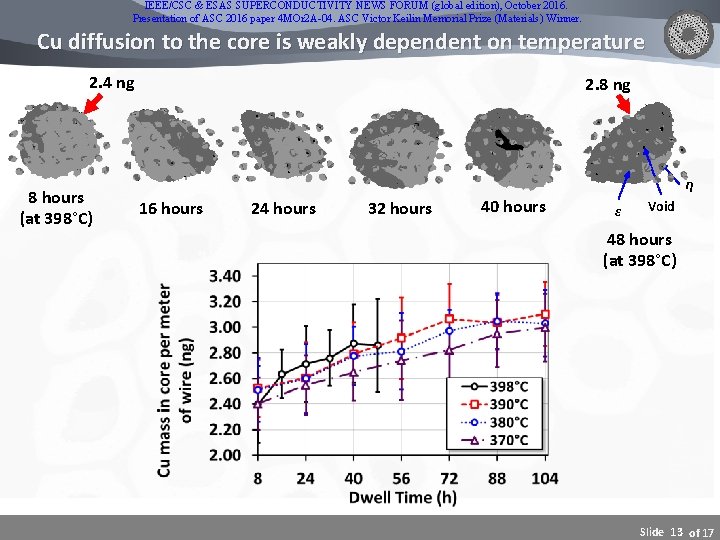
IEEE/CSC & ESAS SUPERCONDUCTIVITY NEWS FORUM (global edition), October 2016. Presentation of ASC 2016 paper 4 MOr 2 A-04. ASC Victor Keilin Memorial Prize (Materials) Winner. Cu diffusion to the core is weakly dependent on temperature 2. 4 ng 8 hours (at 398°C) 2. 8 ng η 16 hours 24 hours 32 hours 40 hours ε Void 48 hours (at 398°C) Slide 13 of 17
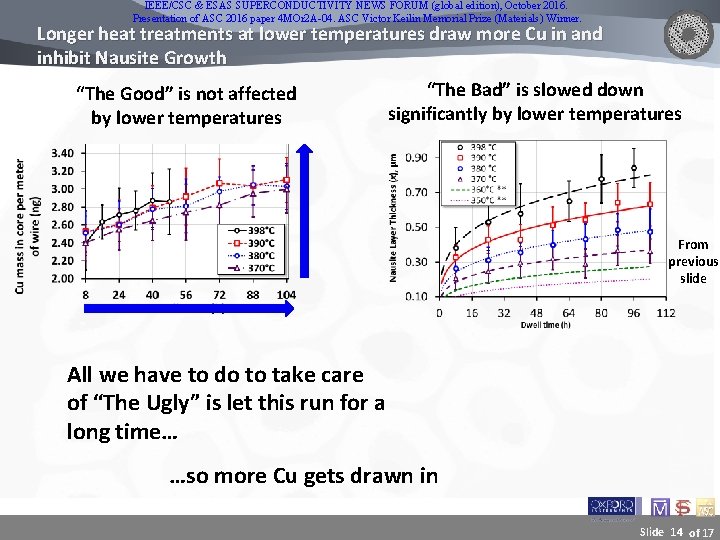
IEEE/CSC & ESAS SUPERCONDUCTIVITY NEWS FORUM (global edition), October 2016. Presentation of ASC 2016 paper 4 MOr 2 A-04. ASC Victor Keilin Memorial Prize (Materials) Winner. Longer heat treatments at lower temperatures draw more Cu in and inhibit Nausite Growth “The Good” is not affected by lower temperatures “The Bad” is slowed down significantly by lower temperatures From previous slide All we have to do to take care of “The Ugly” is let this run for a long time… …so more Cu gets drawn in Slide 14 of 17
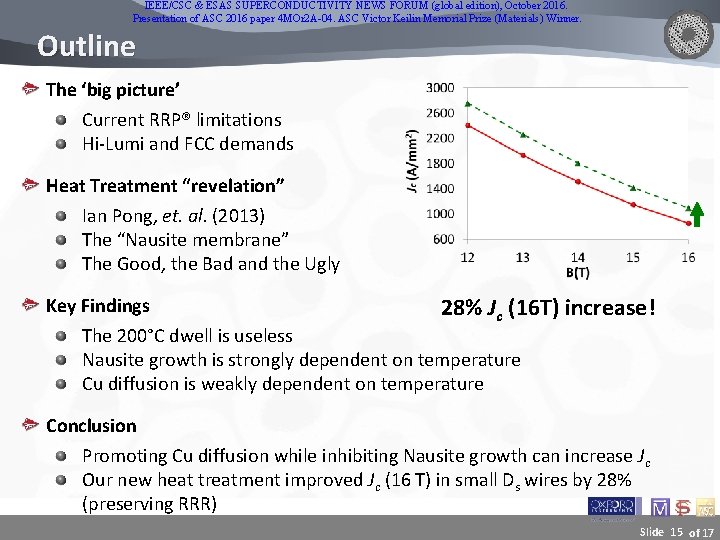
IEEE/CSC & ESAS SUPERCONDUCTIVITY NEWS FORUM (global edition), October 2016. Presentation of ASC 2016 paper 4 MOr 2 A-04. ASC Victor Keilin Memorial Prize (Materials) Winner. Outline The ‘big picture’ Current RRP® limitations Hi-Lumi and FCC demands Heat Treatment “revelation” Ian Pong, et. al. (2013) The “Nausite membrane” The Good, the Bad and the Ugly Key Findings 28% Jc (16 T) increase! The 200°C dwell is useless Nausite growth is strongly dependent on temperature Cu diffusion is weakly dependent on temperature Conclusion Promoting Cu diffusion while inhibiting Nausite growth can increase Jc Our new heat treatment improved Jc (16 T) in small Ds wires by 28% (preserving RRR) Slide 15 of 17
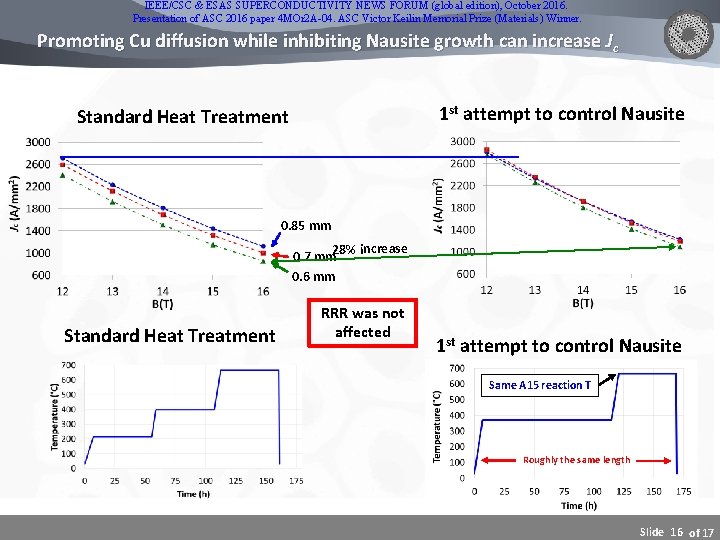
IEEE/CSC & ESAS SUPERCONDUCTIVITY NEWS FORUM (global edition), October 2016. Presentation of ASC 2016 paper 4 MOr 2 A-04. ASC Victor Keilin Memorial Prize (Materials) Winner. Promoting Cu diffusion while inhibiting Nausite growth can increase Jc 1 st attempt to control Nausite Standard Heat Treatment 0. 85 mm 28% increase 0. 7 mm 0. 6 mm Standard Heat Treatment RRR was not affected 1 st attempt to control Nausite Same A 15 reaction T Roughly the same length Slide 16 of 17
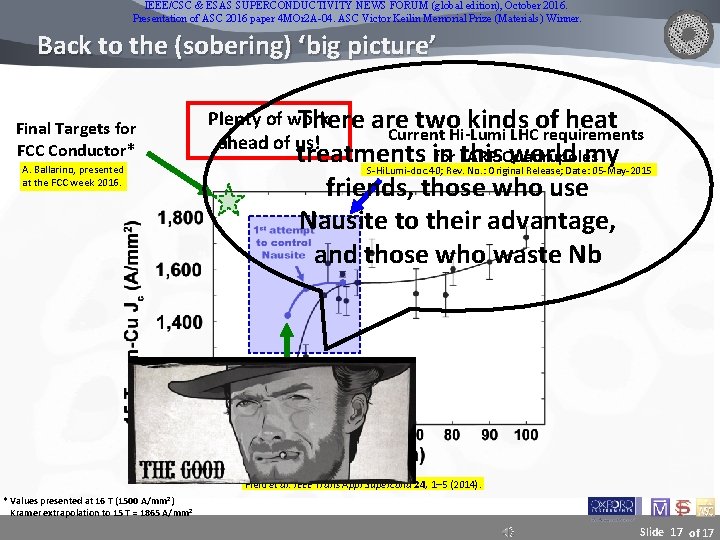
IEEE/CSC & ESAS SUPERCONDUCTIVITY NEWS FORUM (global edition), October 2016. Presentation of ASC 2016 paper 4 MOr 2 A-04. ASC Victor Keilin Memorial Prize (Materials) Winner. Back to the (sobering) ‘big picture’ Final Targets for FCC Conductor* A. Ballarino, presented at the FCC week 2016. Plenty of work There ahead of us! are two kinds of heat Current Hi-Lumi LHC requirements for LARP treatments in this. Quadrupoles world my friends, those who use Nausite to their advantage, and those who waste Nb S-Hi. Lumi-doc. 40; Rev. No. : Original Release; Date: 05 -May-2015 Field et al. IEEE Trans Appl Supercond 24, 1– 5 (2014). * Values presented at 16 T (1500 A/mm 2) Kramer extrapolation to 15 T = 1865 A/mm 2 Slide 17 of 17
IEEE/CSC & ESAS SUPERCONDUCTIVITY NEWS FORUM (global edition), October 2016. Presentation of ASC 2016 paper 4 MOr 2 A-04. ASC Victor Keilin Memorial Prize (Materials) Winner. Thank you Special thanks to Arup Ghosh (BNK), Ian Pong (LBNL), Dan Dietderich (LBNL), and Lance Cooley (Fermi Lab) for fruitful discussions. This work was funded by the Department of Energy under grant: DE-FOA-0001604 The National High Magnetic Field Laboratory where the experiments were performed is supported by the National Science Foundation Cooperative Agreement DMR-1157490 and by the State of Florida. Some of the wires used in this study were made under the US Conductor Development Program. September 8 th, 2016 Slide 18 of 17
- Slides: 18