
IEEE P 1622 Common Data Format Standardization Update

- Slides: 21
IEEE P 1622 Common Data Format Standardization Update John P. Wack National Institute of Standards and Technology http: //vote. nist. gov TGDC Meeting, December 2011
Outline n n n NIST/IEEE/OASIS CDF strategy review The IEEE P 1622 Blank Ballot Distribution standard Review process and remaining issues TGDC Meeting, December 2011 Page 2
Some Terms Used… n n n BBD – Blank Ballot Distribution BDS – Ballot Delivery System PAR – Project Authorization Request VIP – PEW’s Voting Information Project VRDB – Voter Registration DB EMS – Election Management System TGDC Meeting, December 2011 Page 3
IEEE P 1622 Review n n n Main goal: specify a standard or set of standards for a common data format for election systems Revitalized in 2010 with NIST involvement, NIST now vice-chair, editor of standard, secretary Sponsoring Society: IEEE Computer Society/Standards Activities Board (C/SAB) OASIS EML is now basis for the new standard Recently approved UOCAVA Blank Ballot Distribution standard Focused standards to follow targeting other aspects of elections TGDC Meeting, December 2011 Page 4
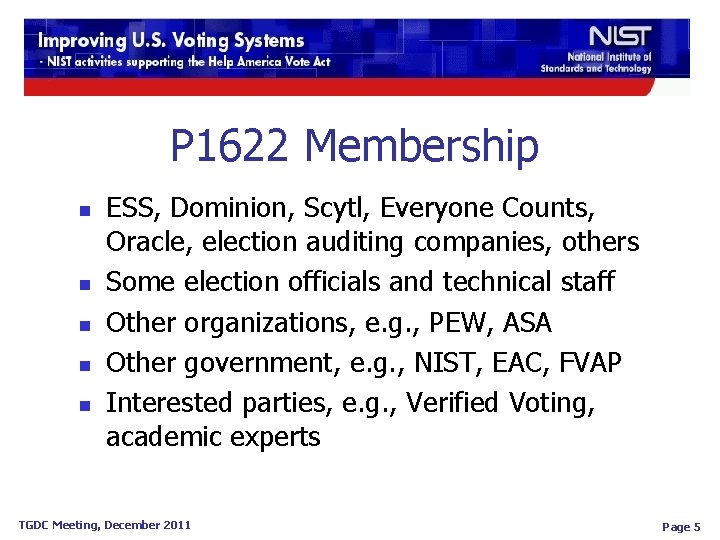
P 1622 Membership n n n ESS, Dominion, Scytl, Everyone Counts, Oracle, election auditing companies, others Some election officials and technical staff Other organizations, e. g. , PEW, ASA Other government, e. g. , NIST, EAC, FVAP Interested parties, e. g. , Verified Voting, academic experts TGDC Meeting, December 2011 Page 5
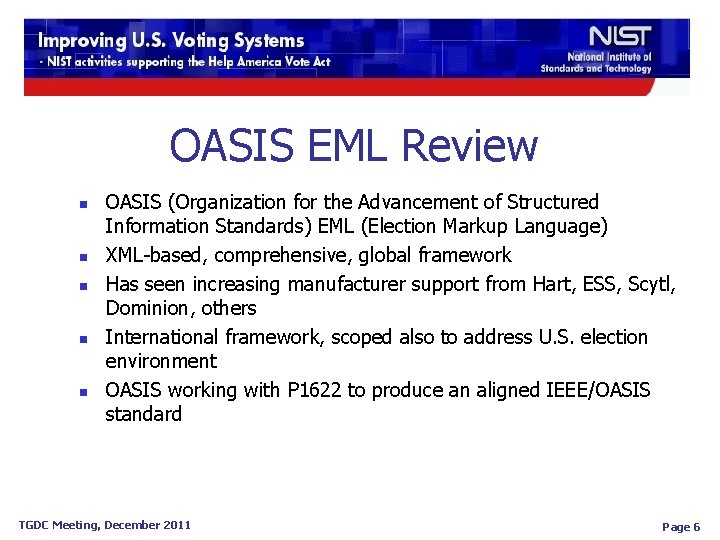
OASIS EML Review n n n OASIS (Organization for the Advancement of Structured Information Standards) EML (Election Markup Language) XML-based, comprehensive, global framework Has seen increasing manufacturer support from Hart, ESS, Scytl, Dominion, others International framework, scoped also to address U. S. election environment OASIS working with P 1622 to produce an aligned IEEE/OASIS standard TGDC Meeting, December 2011 Page 6
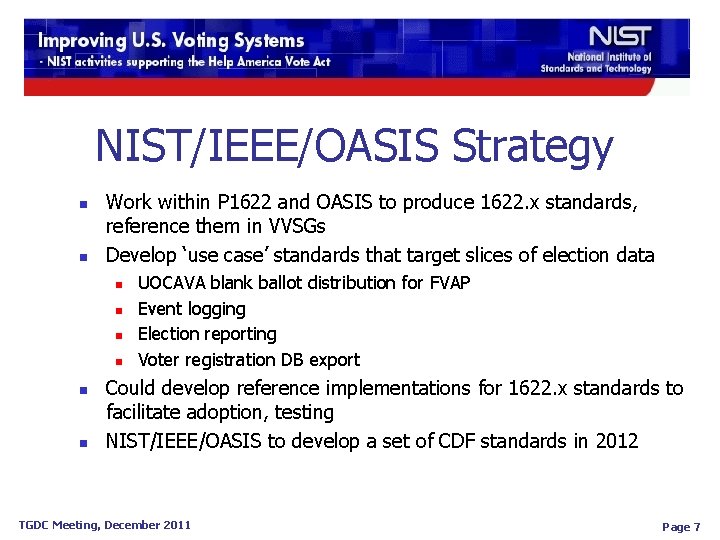
NIST/IEEE/OASIS Strategy n n Work within P 1622 and OASIS to produce 1622. x standards, reference them in VVSGs Develop ‘use case’ standards that target slices of election data n n n UOCAVA blank ballot distribution for FVAP Event logging Election reporting Voter registration DB export Could develop reference implementations for 1622. x standards to facilitate adoption, testing NIST/IEEE/OASIS to develop a set of CDF standards in 2012 TGDC Meeting, December 2011 Page 7
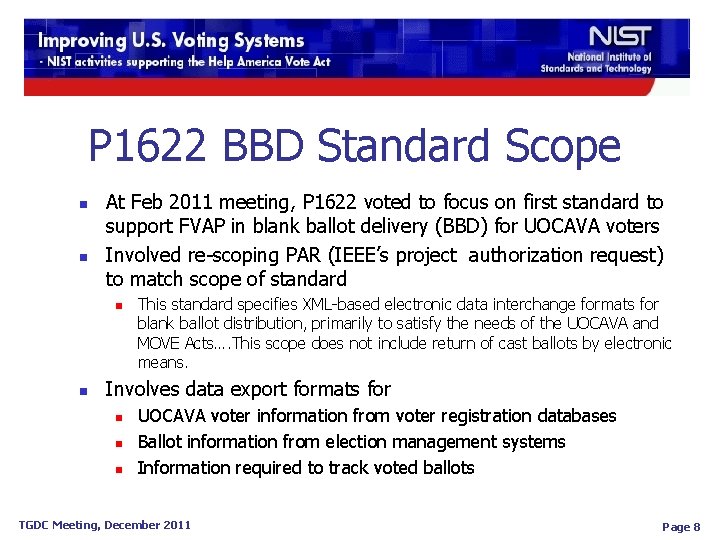
P 1622 BBD Standard Scope n n At Feb 2011 meeting, P 1622 voted to focus on first standard to support FVAP in blank ballot delivery (BBD) for UOCAVA voters Involved re-scoping PAR (IEEE’s project authorization request) to match scope of standard n n This standard specifies XML-based electronic data interchange formats for blank ballot distribution, primarily to satisfy the needs of the UOCAVA and MOVE Acts…. This scope does not include return of cast ballots by electronic means. Involves data export formats for n n n UOCAVA voter information from voter registration databases Ballot information from election management systems Information required to track voted ballots TGDC Meeting, December 2011 Page 8
FVAP Requirements n FVAP intention is to fund states via grants to develop blank ballot delivery systems (BDS) in time for 2012 elections n n UOCAVA voters will print paper ballots Ballots can be pre-formatted or built dynamically BDS will significantly improve ability to get ballots to voters on time EAC Roadmap Fall 2011 n For electronic transmission of blank ballots to be successful, they should be implemented in a manner that allows multiple states to participate. To assist in this the TGDC, with technical support from NIST, will develop common data format specifications for ballots and ballot definition that can be used by FVAP and the states. FVAP is also planning on assisting States in 2010 with data conversion services and tools to Common Data Formats. TGDC Meeting, December 2011 Page 9
BBD Standard Overview n Schemas involved n The SEAL digital signature structure n Associated example files n TGDC Meeting, December 2011 Page 10
Overview n n EML hybrid schema created to make it easier for states to start using EML files for BBD Combines elements from other schemas dealing with n n Information about the elections Contests and candidates Ballots EO’s can build the EML file from n n If already using VIP, a VIP feed file From VRDB and EMS exports TGDC Meeting, December 2011 Page 11
Overview (Cont’d) n The BDS can use the EML file to find and present to a voter an associated ballot n n n A generic ballot can be built dynamically from the information Or, can point to ballots, e. g. , PDF ballots Voter downloads the presented ballot from the BDS, prints it, and returns the marked ballot via postal mail TGDC Meeting, December 2011 Page 12
Overview (Cont’d) n Voter can be notified of received ballot status, as required by MOVE Act n n BDS can send an EML message file to jurisdiction indicting that a voter has downloaded a ballot Jurisdiction, upon receiving the ballot, can update its VRDB with ballot status Jurisdiction sends an EML message file to the BDS with received ballot status BDS can notify voter, e. g. , by an email TGDC Meeting, December 2011 Page 13
The SEAL Structure n n An EML structure for holding digital signatures, i. e. , for signing the EML file Based on W 3 C guidance for signing XML The Manifest element can hold hash of external objects referenced in <URL> element, e. g. , a PDF ballot Conformance requires using SEAL TGDC Meeting, December 2011 Page 14
Example files n n n Example files included to show structures within the associated EML files and the SEAL structure Must download example files from a persistent IEEE URL EML distribution available from OASIS TGDC Meeting, December 2011 Page 15
BBD Standard Status n Standard released for balloting Aug 17 n n n n 50 in ballot pool eligible to vote 39 affirmative votes 6 negative w/comments, 2 abstain 86% affirmative Released for recirculation Sep 30 Released for 2 nd recirculation Oct 17 IEEE recommended approval Dec 7 Publication expected Jan 2012 TGDC Meeting, December 2011 Page 16
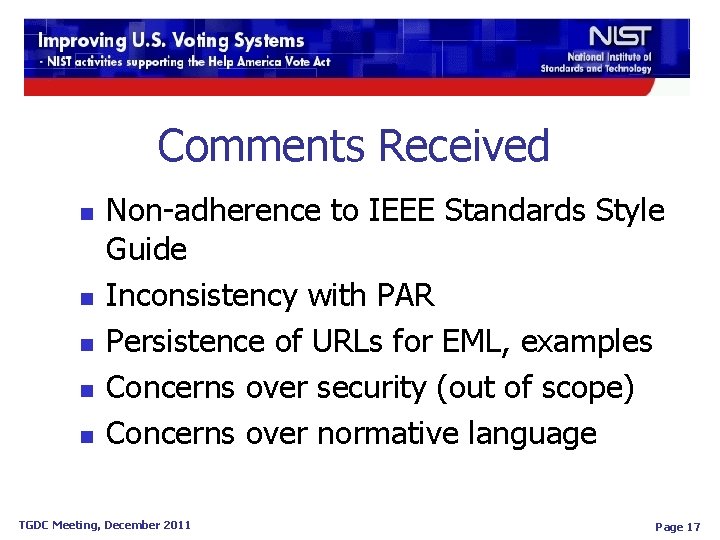
Comments Received n n n Non-adherence to IEEE Standards Style Guide Inconsistency with PAR Persistence of URLs for EML, examples Concerns over security (out of scope) Concerns over normative language TGDC Meeting, December 2011 Page 17
Responses n n n n Adhered carefully to IEEE style guidance Ensured conformance to PAR Clarified definitions, language, structure Added a conformance section and clarified requirement statements Created URLs to be persistent, will provide hashes Added security considerations section Added additional requirements for the SEAL structure and return postal address TGDC Meeting, December 2011 Page 18
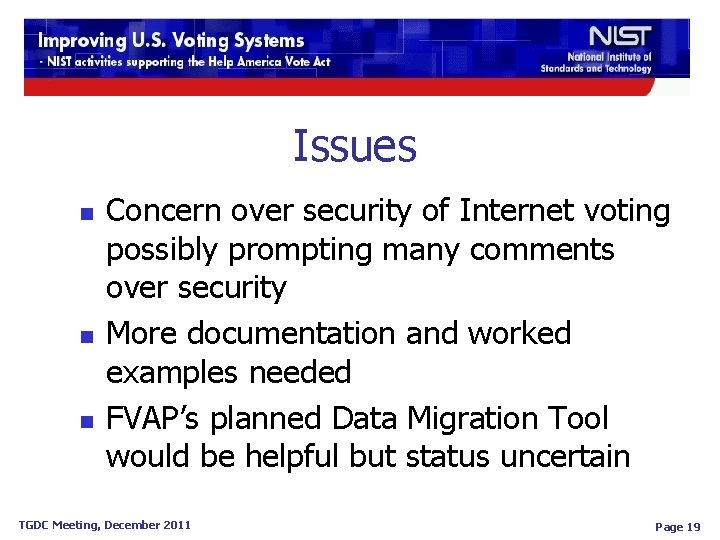
Issues n n n Concern over security of Internet voting possibly prompting many comments over security More documentation and worked examples needed FVAP’s planned Data Migration Tool would be helpful but status uncertain TGDC Meeting, December 2011 Page 19
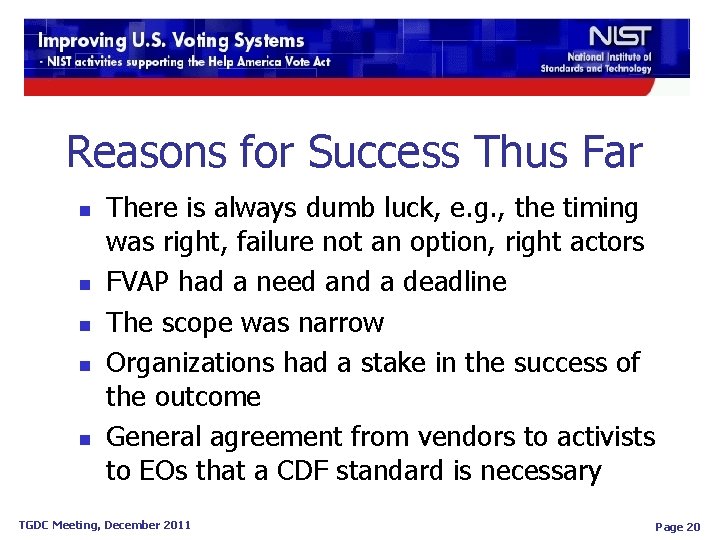
Reasons for Success Thus Far n n n There is always dumb luck, e. g. , the timing was right, failure not an option, right actors FVAP had a need and a deadline The scope was narrow Organizations had a stake in the success of the outcome General agreement from vendors to activists to EOs that a CDF standard is necessary TGDC Meeting, December 2011 Page 20
Discussion TGDC Meeting, December 2011 Page 21