
IEEE Competition Sample Maze 16 cells by 16
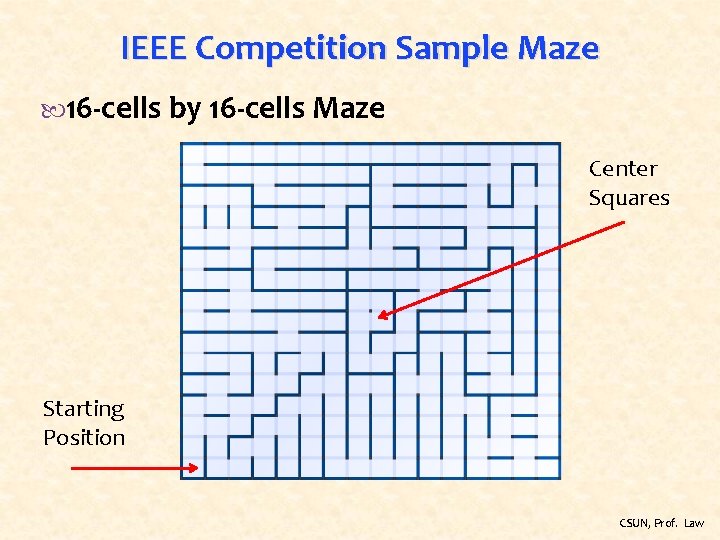
IEEE Competition Sample Maze 16 -cells by 16 -cells Maze Center Squares Starting Position CSUN, Prof. Law
Floodfill Algorithm Applies concept of water always flowing from a higher elevation to a lower one Assigns each cell in the maze a value that represents how far the cell is from the center. The center cells value is zero; the farther from the center the higher the values. Higher values represent higher elevation. The center cells have lowest elevation. CSUN, Prof. Law
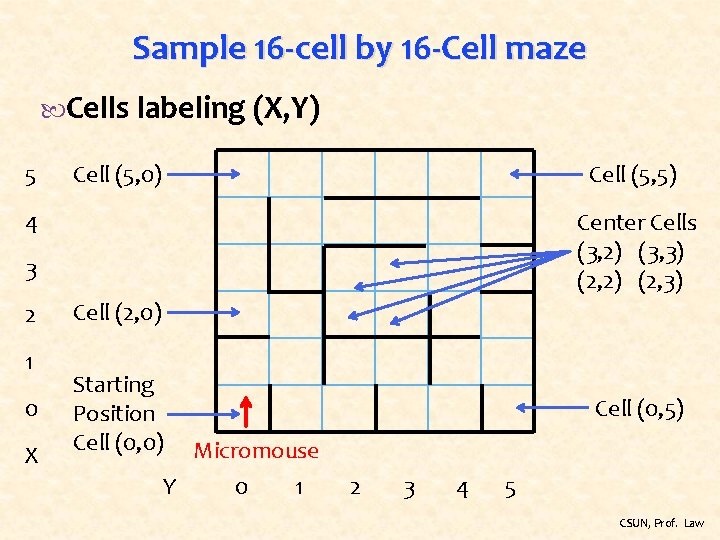
Sample 16 -cell by 16 -Cell maze Cells labeling (X, Y) 5 Cell (5, 0) Cell (5, 5) 4 Center Cells (3, 2) (3, 3) (2, 2) (2, 3) 3 2 1 0 X Cell (2, 0) Starting Position Cell (0, 0) Micromouse Y 0 1 Cell (0, 5) 2 3 4 5 CSUN, Prof. Law

Floodfill Algorithm Flooding Initially, no walls have been detected. Flooding of Maze with distances from center Starting Position Cell (0, 0) 4 3 2 2 3 4 3 2 1 1 2 3 2 1 0 0 1 2 3 2 1 1 2 3 4 3 2 2 3 4 Micromouse CSUN, Prof. Law
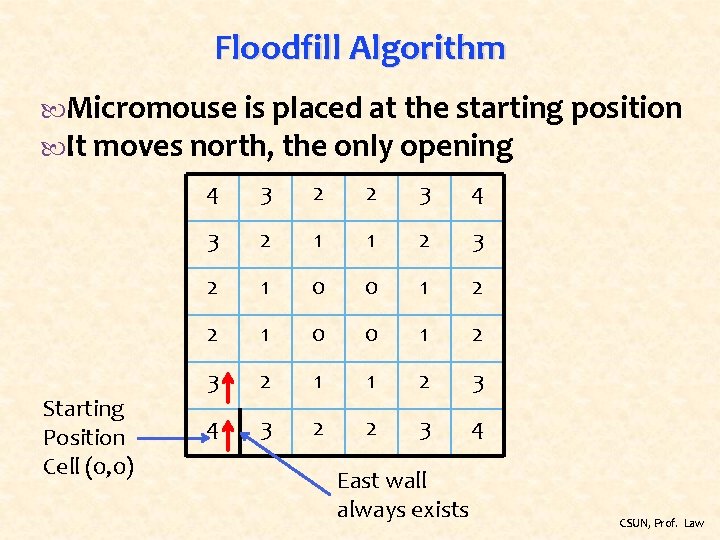
Floodfill Algorithm Micromouse is placed at the starting position It moves north, the only opening Starting Position Cell (0, 0) 4 3 2 2 3 4 3 2 1 1 2 3 2 1 0 0 1 2 3 2 1 1 2 3 4 3 2 2 3 4 East wall always exists CSUN, Prof. Law
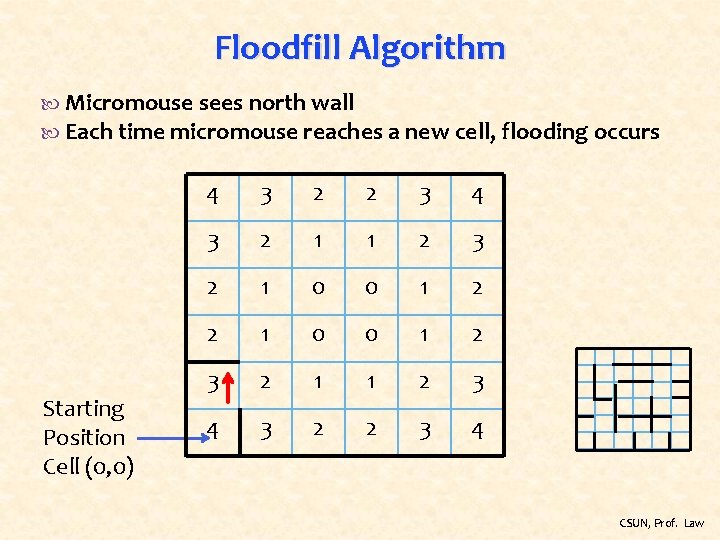
Floodfill Algorithm Micromouse sees north wall Each time micromouse reaches a new cell, flooding occurs Starting Position Cell (0, 0) 4 3 2 2 3 4 3 2 1 1 2 3 2 1 0 0 1 2 3 2 1 1 2 3 4 3 2 2 3 4 CSUN, Prof. Law
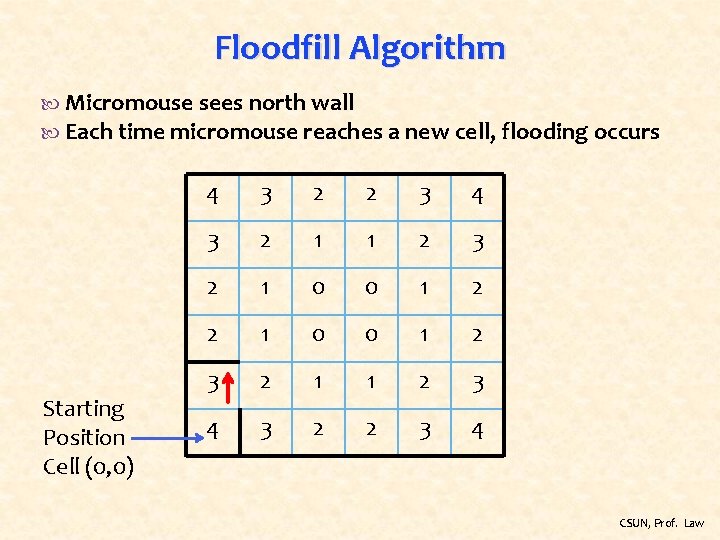
Floodfill Algorithm Micromouse sees north wall Each time micromouse reaches a new cell, flooding occurs Starting Position Cell (0, 0) 4 3 2 2 3 4 3 2 1 1 2 3 2 1 0 0 1 2 3 2 1 1 2 3 4 3 2 2 3 4 CSUN, Prof. Law
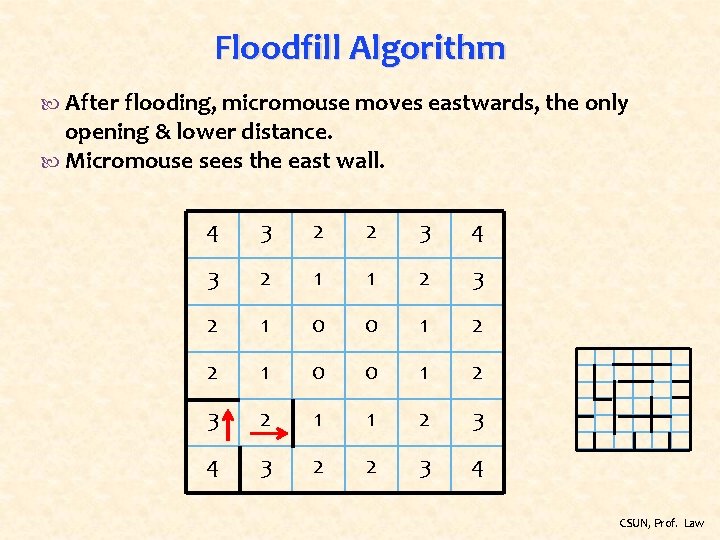
Floodfill Algorithm After flooding, micromouse moves eastwards, the only opening & lower distance. Micromouse sees the east wall. 4 3 2 2 3 4 3 2 1 1 2 3 2 1 0 0 1 2 3 2 1 1 2 3 4 3 2 2 3 4 CSUN, Prof. Law

Floodfill Algorithm Micromouse sees the east wall. Each time micromouse reaches a new cell, flooding occurs 4 3 2 2 3 4 3 2 1 1 2 3 2 1 0 0 1 2 3 2 1 1 2 3 4 3 2 2 3 4 CSUN, Prof. Law
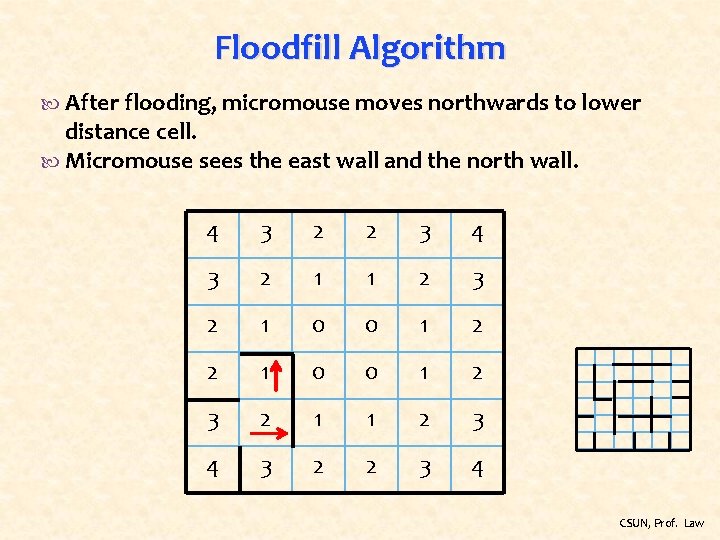
Floodfill Algorithm After flooding, micromouse moves northwards to lower distance cell. Micromouse sees the east wall and the north wall. 4 3 2 2 3 4 3 2 1 1 2 3 2 1 0 0 1 2 3 2 1 1 2 3 4 3 2 2 3 4 CSUN, Prof. Law
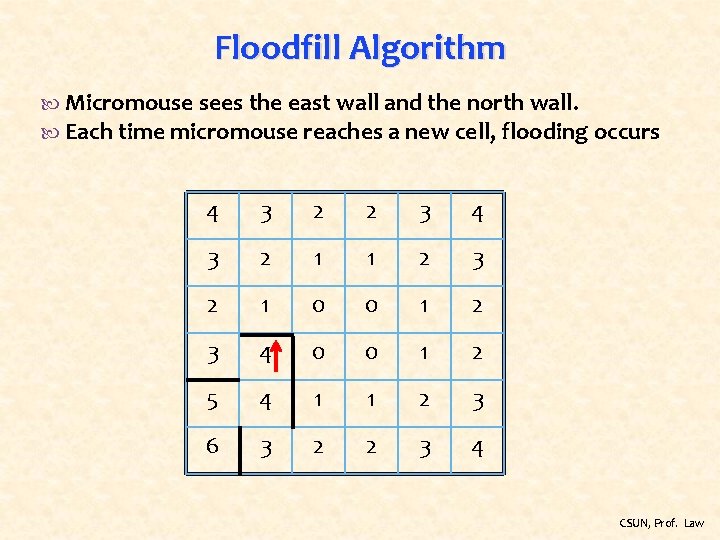
Floodfill Algorithm Micromouse sees the east wall and the north wall. Each time micromouse reaches a new cell, flooding occurs 4 3 2 2 3 4 3 2 1 1 2 3 2 1 0 0 1 2 3 4 0 0 1 2 5 4 1 1 2 3 6 3 2 2 3 4 CSUN, Prof. Law
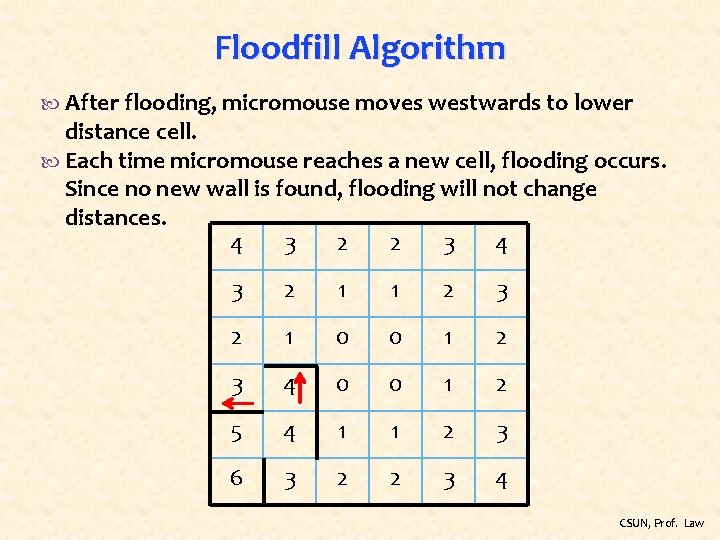
Floodfill Algorithm After flooding, micromouse moves westwards to lower distance cell. Each time micromouse reaches a new cell, flooding occurs. Since no new wall is found, flooding will not change distances. 4 3 2 2 3 4 3 2 1 1 2 3 2 1 0 0 1 2 3 4 0 0 1 2 5 4 1 1 2 3 6 3 2 2 3 4 CSUN, Prof. Law
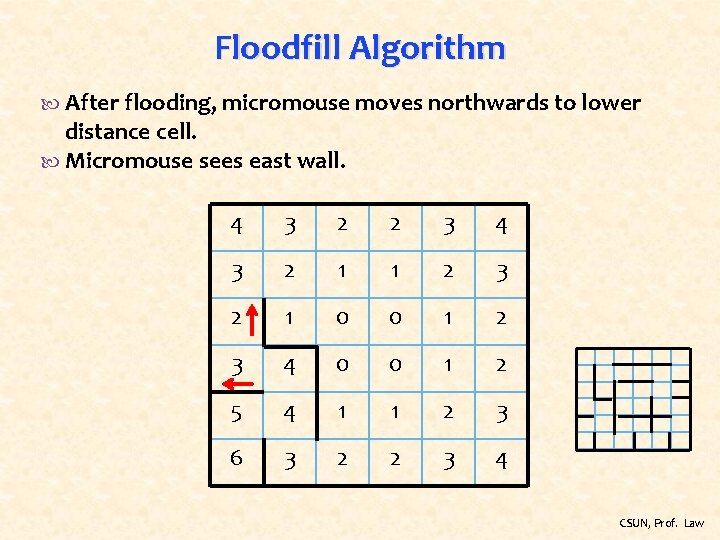
Floodfill Algorithm After flooding, micromouse moves northwards to lower distance cell. Micromouse sees east wall. 4 3 2 2 3 4 3 2 1 1 2 3 2 1 0 0 1 2 3 4 0 0 1 2 5 4 1 1 2 3 6 3 2 2 3 4 CSUN, Prof. Law
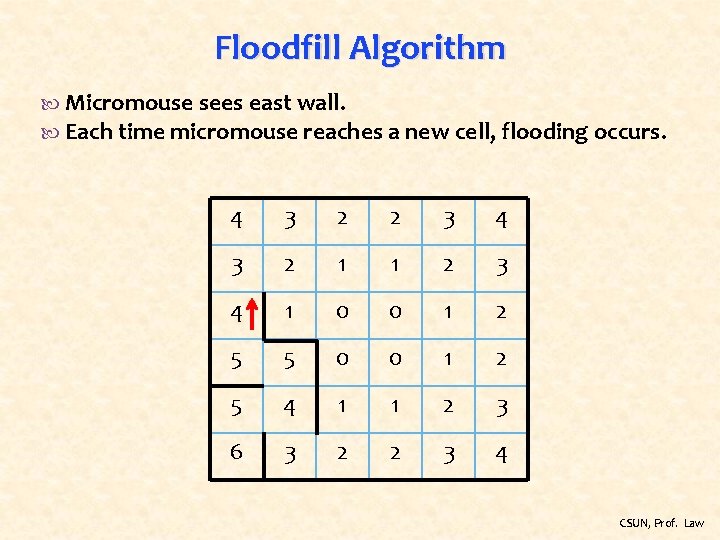
Floodfill Algorithm Micromouse sees east wall. Each time micromouse reaches a new cell, flooding occurs. 4 3 2 2 3 4 3 2 1 1 2 3 4 1 0 0 1 2 5 5 0 0 1 2 5 4 1 1 2 3 6 3 2 2 3 4 CSUN, Prof. Law
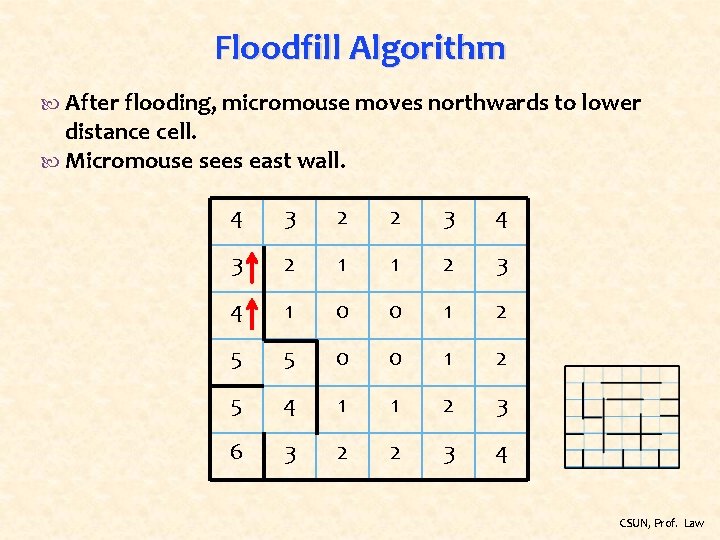
Floodfill Algorithm After flooding, micromouse moves northwards to lower distance cell. Micromouse sees east wall. 4 3 2 2 3 4 3 2 1 1 2 3 4 1 0 0 1 2 5 5 0 0 1 2 5 4 1 1 2 3 6 3 2 2 3 4 CSUN, Prof. Law
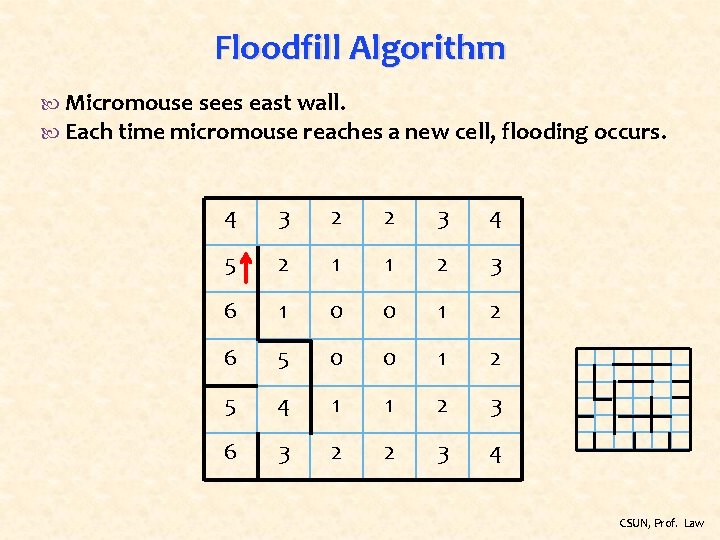
Floodfill Algorithm Micromouse sees east wall. Each time micromouse reaches a new cell, flooding occurs. 4 3 2 2 3 4 5 2 1 1 2 3 6 1 0 0 1 2 6 5 0 0 1 2 5 4 1 1 2 3 6 3 2 2 3 4 CSUN, Prof. Law
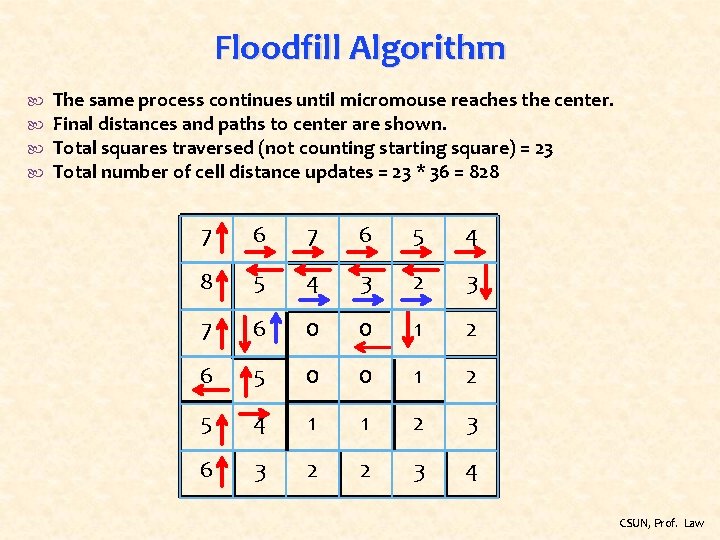
Floodfill Algorithm The same process continues until micromouse reaches the center. Final distances and paths to center are shown. Total squares traversed (not counting starting square) = 23 Total number of cell distance updates = 23 * 36 = 828 7 6 5 4 8 5 4 3 2 3 7 6 0 0 1 2 6 5 0 0 1 2 5 4 1 1 2 3 6 3 2 2 3 4 CSUN, Prof. Law
Modified Floodfill Algorithm The modified flood fill algorithm differs from Floodfill algorithm in that it does not flood the maze each time a new cell is reached. Instead it updates only the relevant neighboring cells using the following revised recursive steps: Push the current cell location (x, y) onto the stack. Repeat the following steps while the stack is not empty. a. Pull the cell location (x, y) from the stack. b. If the minimum distance of the neighboring open cells, md, is not equal to the present cell’s distance - 1, replace the present cell’s distance with md + 1, and push all neighbor locations onto the stack. CSUN, Prof. Law
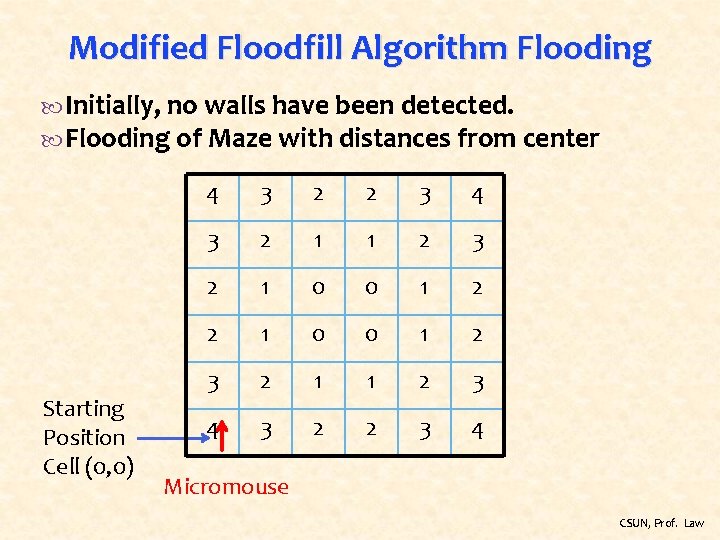
Modified Floodfill Algorithm Flooding Initially, no walls have been detected. Flooding of Maze with distances from center Starting Position Cell (0, 0) 4 3 2 2 3 4 3 2 1 1 2 3 2 1 0 0 1 2 3 2 1 1 2 3 4 3 2 2 3 4 Micromouse CSUN, Prof. Law
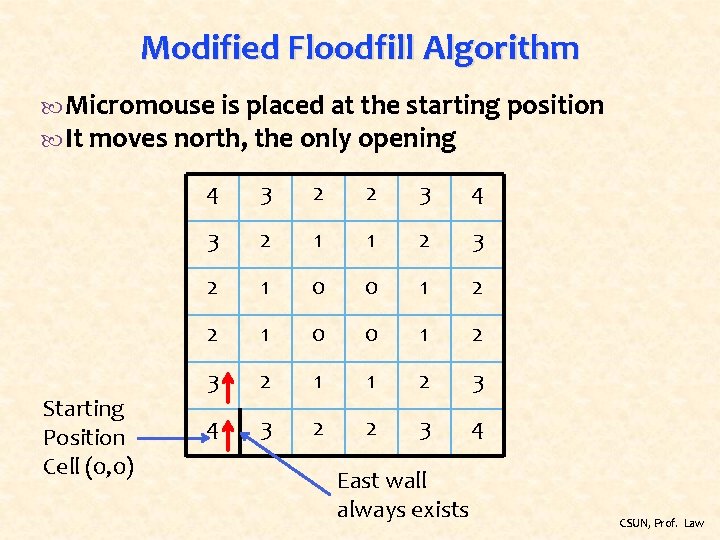
Modified Floodfill Algorithm Micromouse is placed at the starting position It moves north, the only opening Starting Position Cell (0, 0) 4 3 2 2 3 4 3 2 1 1 2 3 2 1 0 0 1 2 3 2 1 1 2 3 4 3 2 2 3 4 East wall always exists CSUN, Prof. Law
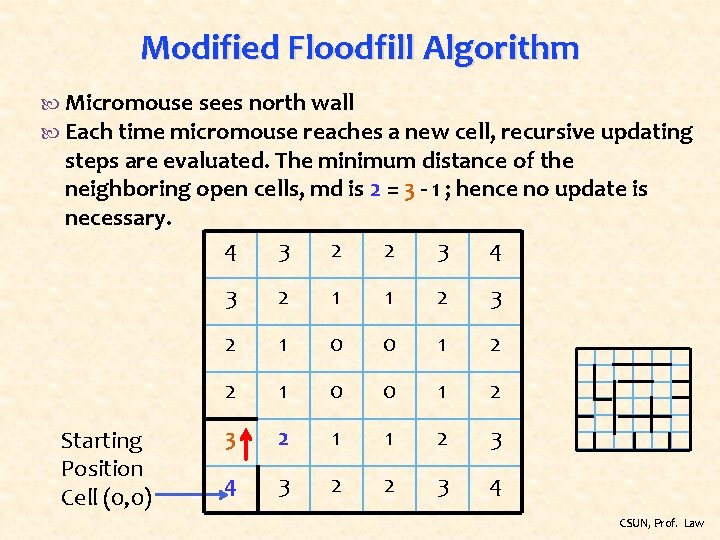
Modified Floodfill Algorithm Micromouse sees north wall Each time micromouse reaches a new cell, recursive updating steps are evaluated. The minimum distance of the neighboring open cells, md is 2 = 3 - 1 ; hence no update is necessary. 4 3 2 2 3 4 Starting Position Cell (0, 0) 3 2 1 1 2 3 2 1 0 0 1 2 3 2 1 1 2 3 4 3 2 2 3 4 CSUN, Prof. Law
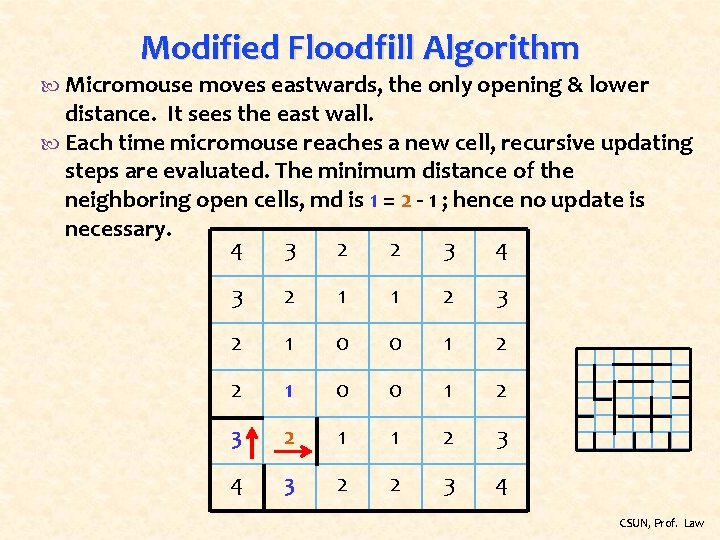
Modified Floodfill Algorithm Micromouse moves eastwards, the only opening & lower distance. It sees the east wall. Each time micromouse reaches a new cell, recursive updating steps are evaluated. The minimum distance of the neighboring open cells, md is 1 = 2 - 1 ; hence no update is necessary. 4 3 2 2 3 4 3 2 1 1 2 3 2 1 0 0 1 2 3 2 1 1 2 3 4 3 2 2 3 4 CSUN, Prof. Law
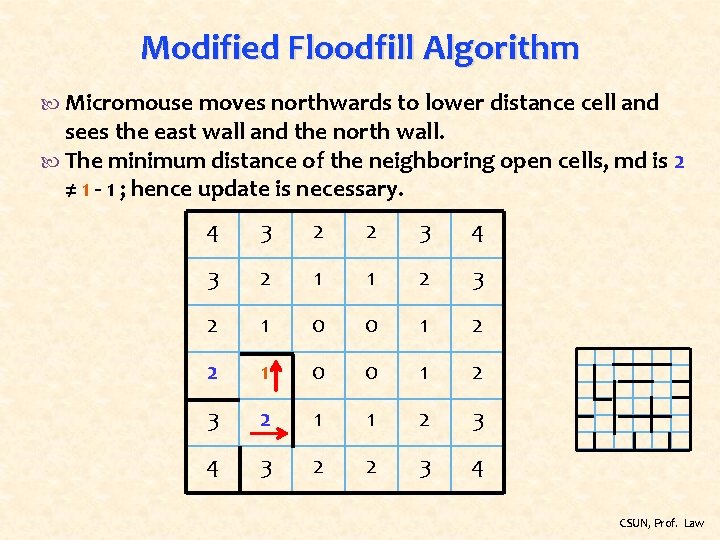
Modified Floodfill Algorithm Micromouse moves northwards to lower distance cell and sees the east wall and the north wall. The minimum distance of the neighboring open cells, md is 2 ≠ 1 - 1 ; hence update is necessary. 4 3 2 2 3 4 3 2 1 1 2 3 2 1 0 0 1 2 3 2 1 1 2 3 4 3 2 2 3 4 CSUN, Prof. Law
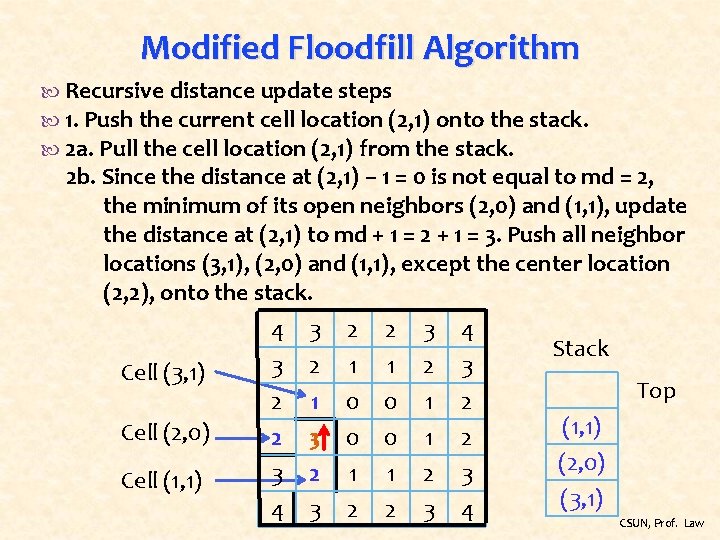
Modified Floodfill Algorithm Recursive distance update steps 1. Push the current cell location (2, 1) onto the stack. 2 a. Pull the cell location (2, 1) from the stack. 2 b. Since the distance at (2, 1) – 1 = 0 is not equal to md = 2, the minimum of its open neighbors (2, 0) and (1, 1), update the distance at (2, 1) to md + 1 = 2 + 1 = 3. Push all neighbor locations (3, 1), (2, 0) and (1, 1), except the center location (2, 2), onto the stack. Cell (3, 1) Cell (2, 0) Cell (1, 1) 4 3 2 2 3 2 1 31 2 1 0 0 3 2 1 1 4 3 2 2 3 4 2 3 1 2 2 3 3 4 Stack Top (1, 1) (2, 0) (3, 1) CSUN, Prof. Law
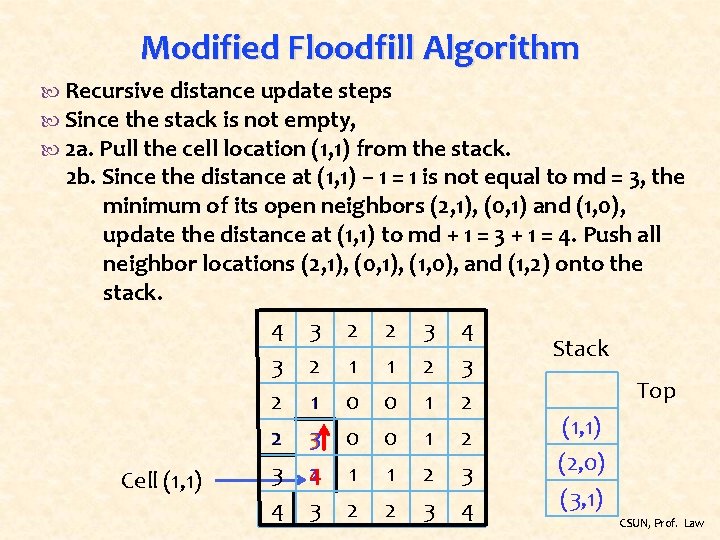
Modified Floodfill Algorithm Recursive distance update steps Since the stack is not empty, 2 a. Pull the cell location (1, 1) from the stack. 2 b. Since the distance at (1, 1) – 1 = 1 is not equal to md = 3, the minimum of its open neighbors (2, 1), (0, 1) and (1, 0), update the distance at (1, 1) to md + 1 = 3 + 1 = 4. Push all neighbor locations (2, 1), (0, 1), (1, 0), and (1, 2) onto the stack. Cell (1, 1) 4 3 2 2 3 2 1 0 0 3 2 1 1 4 3 2 2 3 4 2 4 3 1 2 2 3 3 4 Stack Top (1, 1) (2, 0) (3, 1) CSUN, Prof. Law
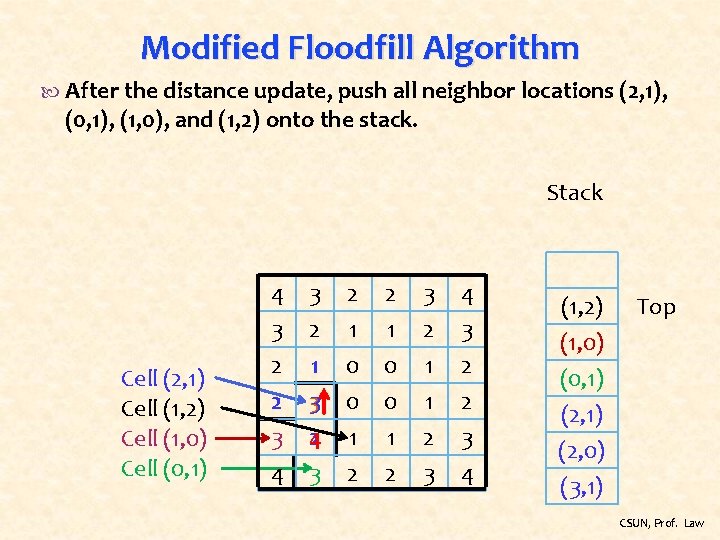
Modified Floodfill Algorithm After the distance update, push all neighbor locations (2, 1), (0, 1), (1, 0), and (1, 2) onto the stack. Stack Cell (2, 1) Cell (1, 2) Cell (1, 0) Cell (0, 1) 4 3 2 2 3 2 1 0 0 3 2 1 1 4 3 2 2 3 4 2 4 3 1 2 2 3 3 4 (1, 2) (1, 0) (0, 1) Top (2, 1) (2, 0) (3, 1) CSUN, Prof. Law
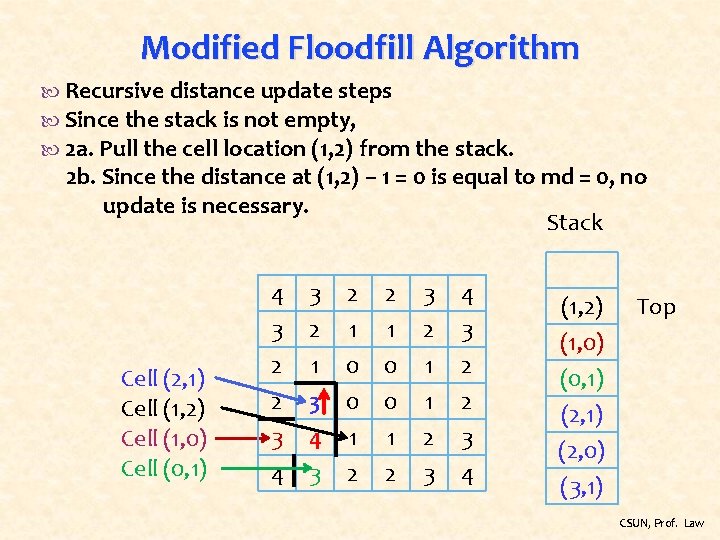
Modified Floodfill Algorithm Recursive distance update steps Since the stack is not empty, 2 a. Pull the cell location (1, 2) from the stack. 2 b. Since the distance at (1, 2) – 1 = 0 is equal to md = 0, no update is necessary. Stack Cell (2, 1) Cell (1, 2) Cell (1, 0) Cell (0, 1) 4 3 2 2 3 2 1 0 0 3 2 1 1 4 3 2 2 3 4 4 3 1 2 2 3 3 4 (1, 2) (1, 0) (0, 1) Top (2, 1) (2, 0) (3, 1) CSUN, Prof. Law
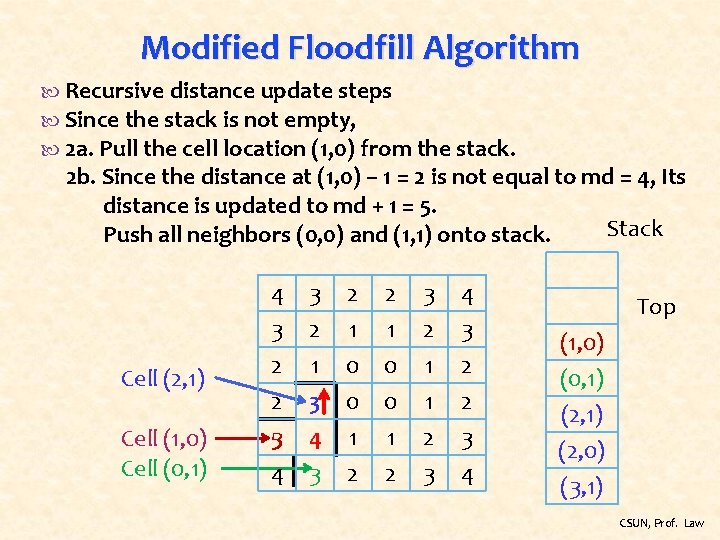
Modified Floodfill Algorithm Recursive distance update steps Since the stack is not empty, 2 a. Pull the cell location (1, 0) from the stack. 2 b. Since the distance at (1, 0) – 1 = 2 is not equal to md = 4, Its distance is updated to md + 1 = 5. Stack Push all neighbors (0, 0) and (1, 1) onto stack. Cell (2, 1) Cell (1, 0) Cell (0, 1) 4 3 2 2 3 2 1 0 0 3 2 1 1 4 3 2 2 53 4 4 3 1 2 2 3 3 4 Top (1, 0) (0, 1) (2, 0) (3, 1) CSUN, Prof. Law
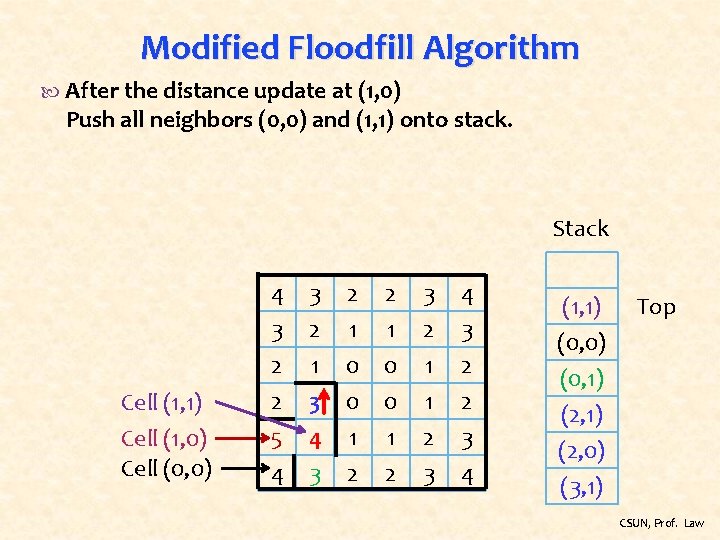
Modified Floodfill Algorithm After the distance update at (1, 0) Push all neighbors (0, 0) and (1, 1) onto stack. Stack Cell (1, 1) Cell (1, 0) Cell (0, 0) 4 3 2 2 3 2 1 0 0 3 2 1 1 4 3 2 2 5 4 4 3 1 2 2 3 3 4 (1, 1) (0, 0) (0, 1) Top (2, 1) (2, 0) (3, 1) CSUN, Prof. Law
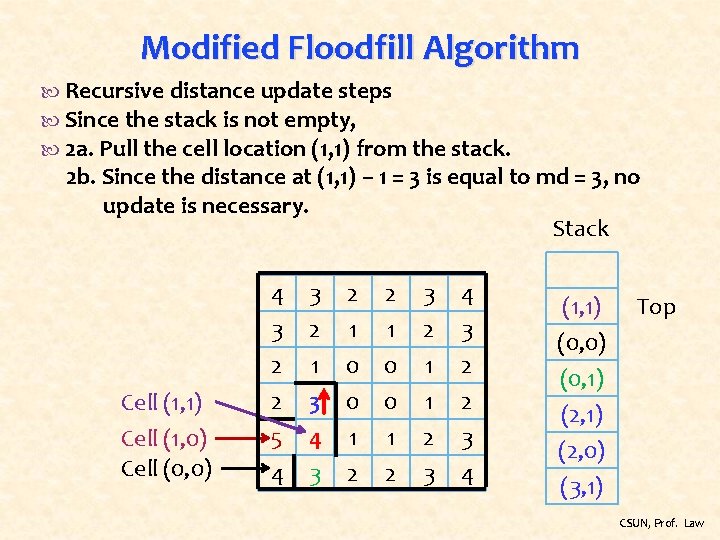
Modified Floodfill Algorithm Recursive distance update steps Since the stack is not empty, 2 a. Pull the cell location (1, 1) from the stack. 2 b. Since the distance at (1, 1) – 1 = 3 is equal to md = 3, no update is necessary. Stack Cell (1, 1) Cell (1, 0) Cell (0, 0) 4 3 2 2 3 2 1 0 0 3 2 1 1 4 3 2 2 5 4 4 3 1 2 2 3 3 4 (1, 1) (0, 0) (0, 1) Top (2, 1) (2, 0) (3, 1) CSUN, Prof. Law
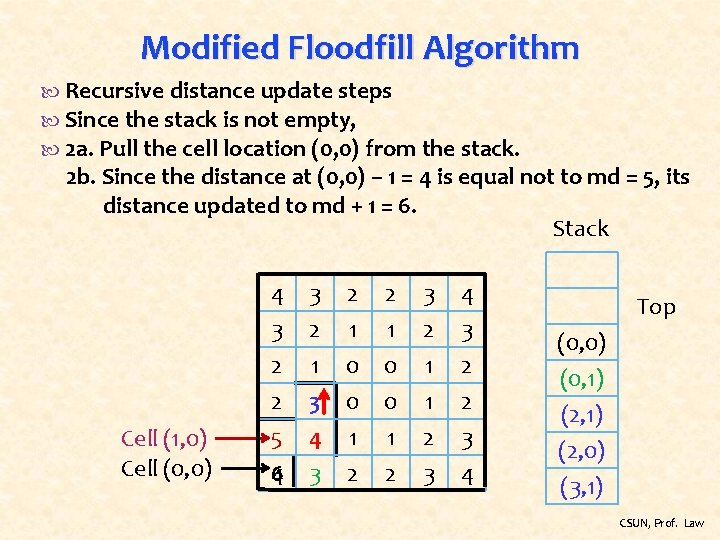
Modified Floodfill Algorithm Recursive distance update steps Since the stack is not empty, 2 a. Pull the cell location (0, 0) from the stack. 2 b. Since the distance at (0, 0) – 1 = 4 is equal not to md = 5, its distance updated to md + 1 = 6. Stack Cell (1, 0) Cell (0, 0) 4 3 2 2 3 2 1 0 0 3 2 1 1 4 3 2 2 5 4 6 4 3 1 2 2 3 3 4 Top (0, 0) (0, 1) (2, 0) (3, 1) CSUN, Prof. Law
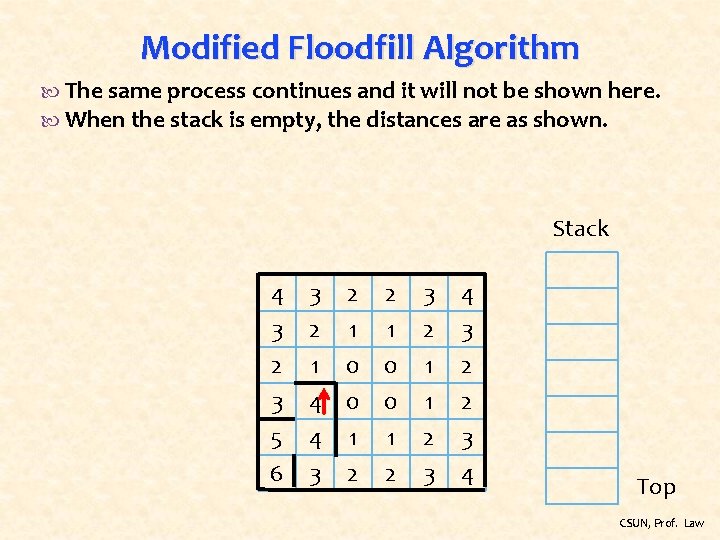
Modified Floodfill Algorithm The same process continues and it will not be shown here. When the stack is empty, the distances are as shown. Stack 4 3 2 3 3 2 1 4 2 1 0 0 3 2 1 1 4 3 2 2 5 6 4 3 1 2 2 3 3 4 Top CSUN, Prof. Law
- Slides: 32