
IEEE 802 11 s Mesh Network Advisor Dr


- Slides: 28
IEEE 802. 11 s Mesh Network Advisor : Dr. Kai-Wei Ke Speaker : Muhammad Reza Zulman
2 Outline Introduction. 802. 11 s Architecture. Forming the Mesh (Discovery, Peering, and Security). Best Path Routing Selection. Power Management Concern. Summary. References. Wireless Broadband Network Lab
3 Introduction. Rapid adoption of wireless networks with the need to provide wireless access in places where connection an AP to a switch was not possible. The limitation of Ethernet cable length make it difficult to position some access point in the center of large indoor environment. The issues become worse with the need to provide wireless coverage outdoors. i. e. a simple extension of the indoor wireless network to a parking lot, campus, or outdoor industrial area, etc. The use case are many and growing everyday. Wireless Broadband Network Lab
4 Introduction (Cont. ) The idea to replace Ethernet cables with a wireless link has been proposed as old as 802. 11. In 2003, the 802. 11 working group defined the concept of a Wireless Distribution System (WDS) as a mechanism for wireless communication using four address frame format between access points. But the working group could not go any further than this simple definition, and indicated that the standard described such a frame format, but did not describe how much a mechanism or frame format would be used. Wireless Broadband Network Lab
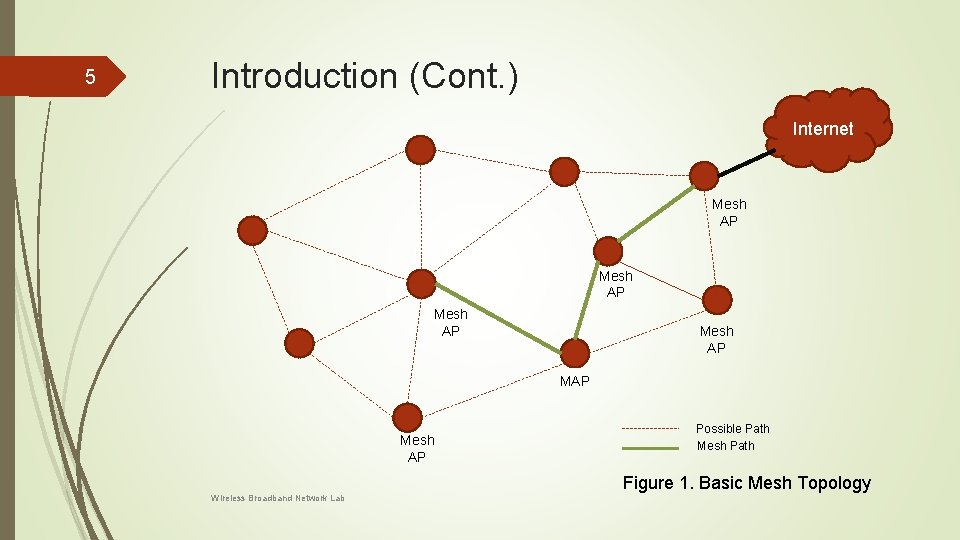
5 Introduction (Cont. ) Internet Mesh AP MAP Mesh AP Possible Path Mesh Path Figure 1. Basic Mesh Topology Wireless Broadband Network Lab
6 Introduction (Cont. ) Replacing Ethernet cable with wireless link indeed bring benefits : The first benefit is obviously the increase of flexibility. This benefit lies in the path taken by wireless link, any AP may be in range of one or several APs and it can choose the best radio path. The second benefit is self-forming, if an algorithm is embedded into a mesh AP to detect the best path to the wired network, building or expanding a wireless mesh network may be as simple as adding new AP and making sure that they are in range of others AP. The third benefit is self-healing, if an AP has several possible path to the wired network and able to choose the best path, then, when one of AP is down, the other AP can simply choose other path. Wireless Broadband Network Lab
7 Introduction (Cont. ) From those benefits prompted vendors to start designing and implementing mesh solution. However, some delicate questions appear such as: How does a mesh AP discover the others AP? How does the mesh AP determined the best path to the wired network ? What mechanism should an AP allow other AP to borrow it wireless link ? How to prevent unwanted AP ? How to secure communications ? Wireless Broadband Network Lab
8 Introduction (Cont. ) All These questions were left unanswered by 802. 11 standard that bring conflict between vendors due to different solution to some of those questions. Strong need for a framework providing a clear terminology, feature lists, and behaviors lead to the creation of 802. 11 s standard that approved in July 2011 and published in the same year. This amendment Is key to a common understanding of wireless mesh network because it defines mesh network protocols and functionalities. This amendment still leave wide space for proprietary implementations of each of the possible features. Wireless Broadband Network Lab
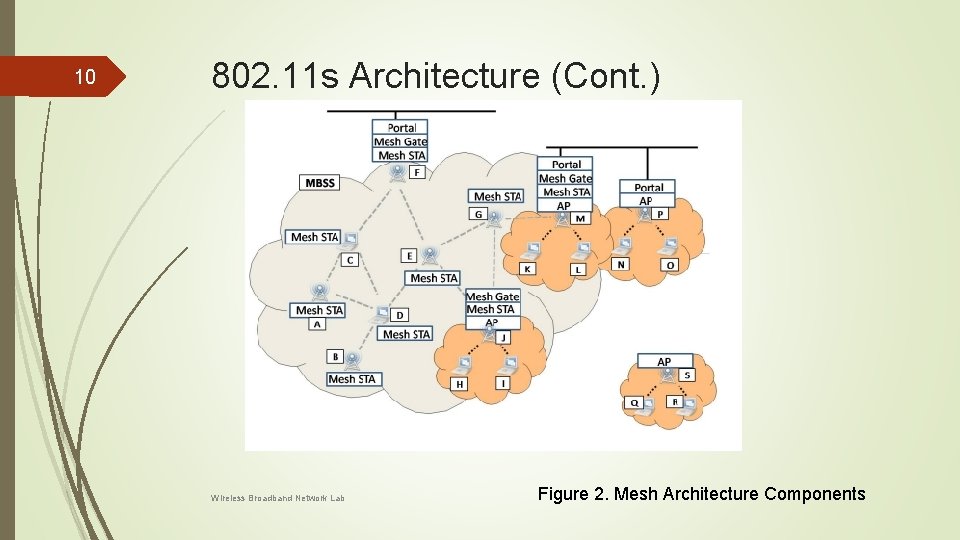
9 802. 11 s Architecture Because mesh network are different from traditional wireless network, the 802. 11 s amendment changes the name and functionality of several infrastructure component. A wireless client such can still associate to an access point’s BSS normally. Those client does not need to know if the access point connects to the wired network directly or through mesh AP. In figure 2, client stations H, I, K, L, N, O, Q and R does not need any specific 802. 11 s to connect to their respective access points. Wireless Broadband Network Lab
10 802. 11 s Architecture (Cont. ) Wireless Broadband Network Lab Figure 2. Mesh Architecture Components
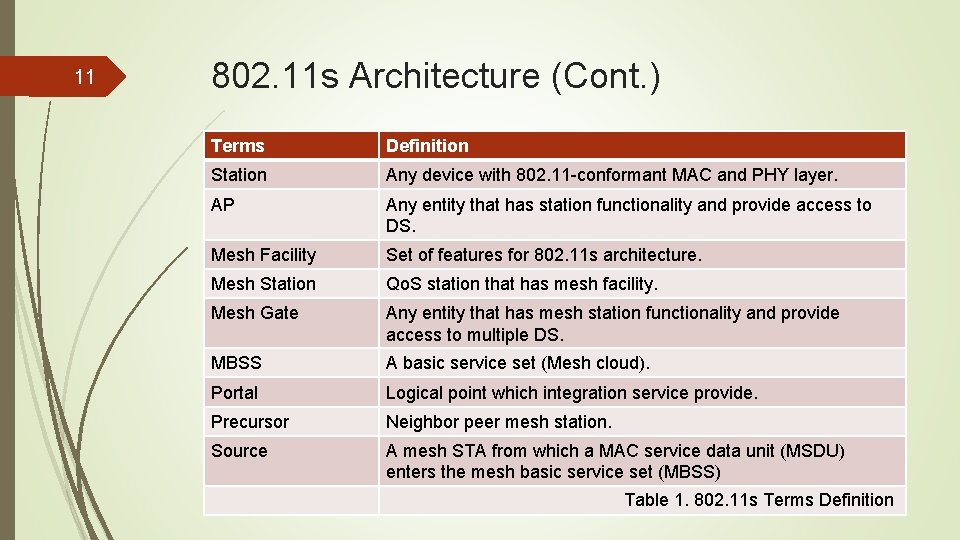
11 802. 11 s Architecture (Cont. ) Terms Definition Station Any device with 802. 11 -conformant MAC and PHY layer. AP Any entity that has station functionality and provide access to DS. Mesh Facility Set of features for 802. 11 s architecture. Mesh Station Qo. S station that has mesh facility. Mesh Gate Any entity that has mesh station functionality and provide access to multiple DS. MBSS A basic service set (Mesh cloud). Portal Logical point which integration service provide. Precursor Neighbor peer mesh station. Source A mesh STA from which a MAC service data unit (MSDU) enters the mesh basic service set (MBSS) Wireless Broadband Network Lab Table 1. 802. 11 s Terms Definition
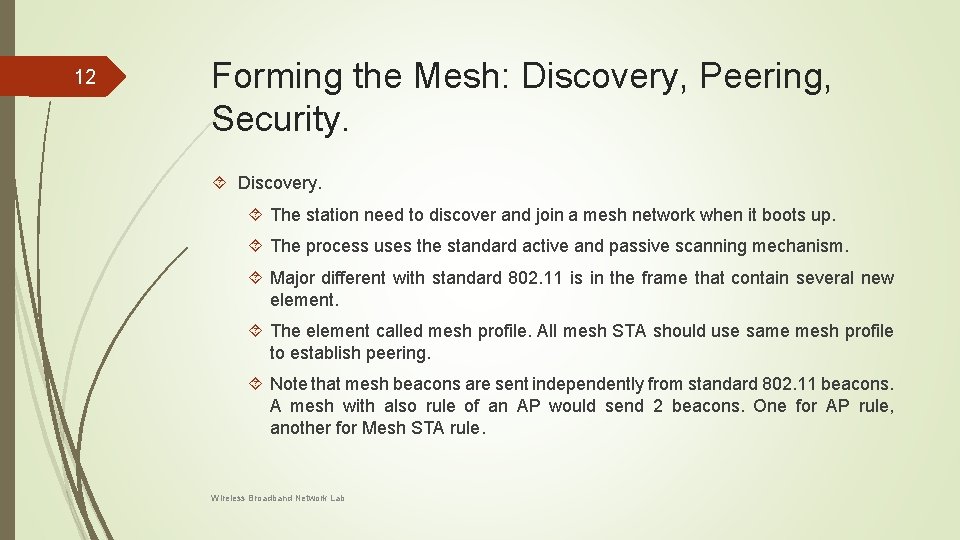
12 Forming the Mesh: Discovery, Peering, Security. Discovery. The station need to discover and join a mesh network when it boots up. The process uses the standard active and passive scanning mechanism. Major different with standard 802. 11 is in the frame that contain several new element. The element called mesh profile. All mesh STA should use same mesh profile to establish peering. Note that mesh beacons are sent independently from standard 802. 11 beacons. A mesh with also rule of an AP would send 2 beacons. One for AP rule, another for Mesh STA rule. Wireless Broadband Network Lab
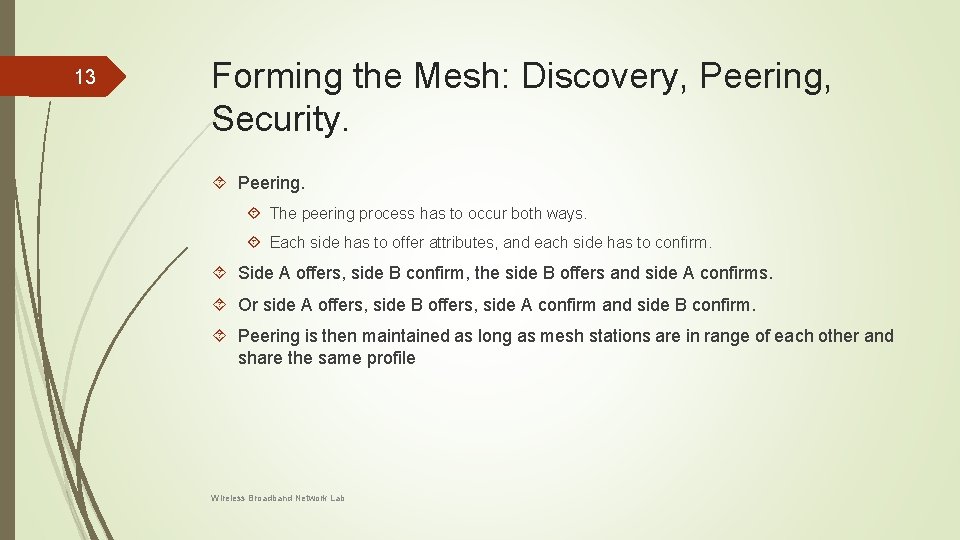
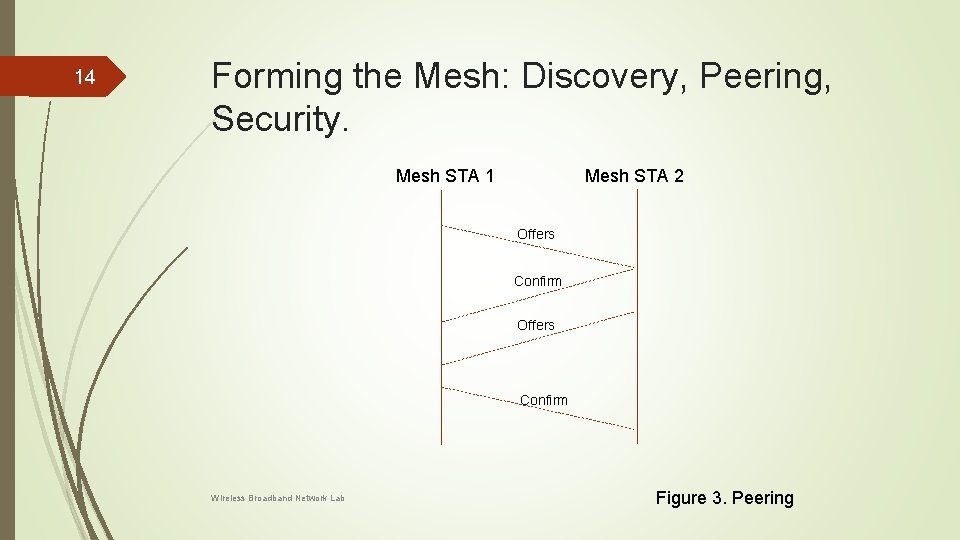
13 Forming the Mesh: Discovery, Peering, Security. Peering. The peering process has to occur both ways. Each side has to offer attributes, and each side has to confirm. Side A offers, side B confirm, the side B offers and side A confirms. Or side A offers, side B offers, side A confirm and side B confirm. Peering is then maintained as long as mesh stations are in range of each other and share the same profile Wireless Broadband Network Lab
14 Forming the Mesh: Discovery, Peering, Security. Mesh STA 1 Mesh STA 2 Offers Confirm Wireless Broadband Network Lab Figure 3. Peering
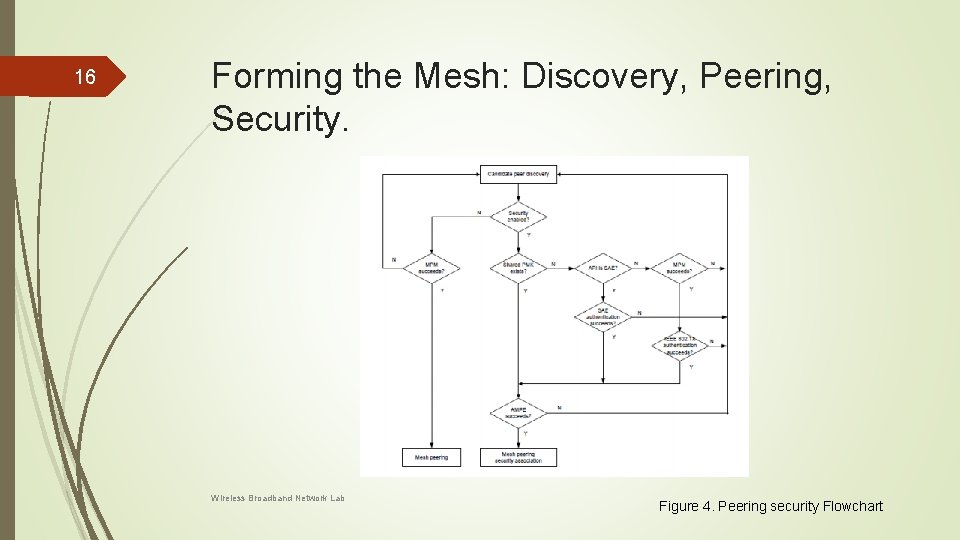
15 Forming the Mesh: Discovery, Peering, Security. Securing mesh peers. A key concern for peering is security. As peering is a very flexible process, the risk exist that a rouge mesh station would peer with a valid mesh station. Authenticated Mesh Peering Exchange is the expected common implementations. Figure 4 is a flowchart that summarize the different mesh peering authentication mechanisms. Wireless Broadband Network Lab
16 Forming the Mesh: Discovery, Peering, Security. Wireless Broadband Network Lab Figure 4. Peering security Flowchart
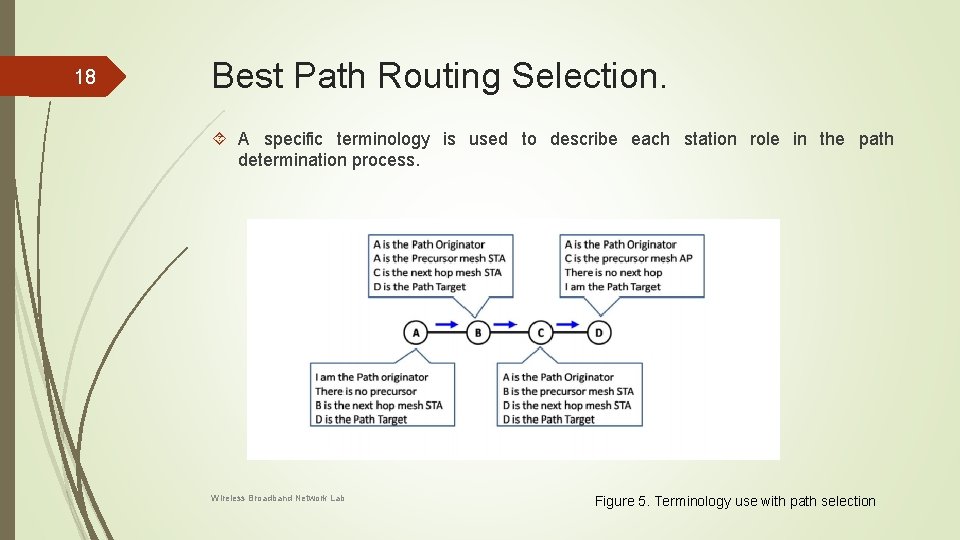
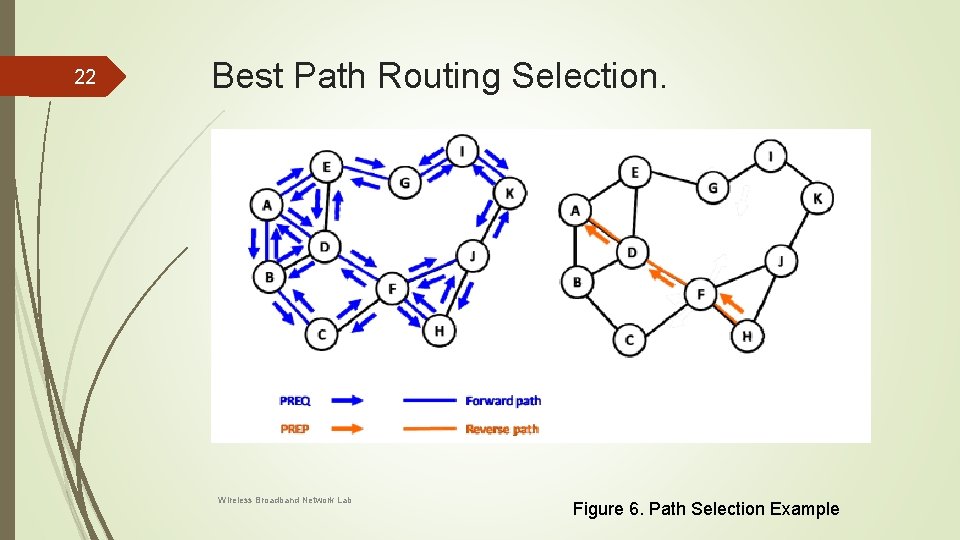
17 Best Path Routing Selection. A vendor proprietary method can be used for path discovery and selection, but mesh stations implementing 802. 11 s mush also support the default path selection protocol, Hybrid Wireless Mesh Protocol (HWMP) HWMP provide both proactive and reactive. A mesh station that need to transmit a frame to an unknown destination can dynamically discover the best path to this destination. Mesh stations can also proactively discover the MBSS and determine best paths to any point of the mesh before needing to sent any data frame. Wireless Broadband Network Lab
18 Best Path Routing Selection. A specific terminology is used to describe each station role in the path determination process. Wireless Broadband Network Lab Figure 5. Terminology use with path selection
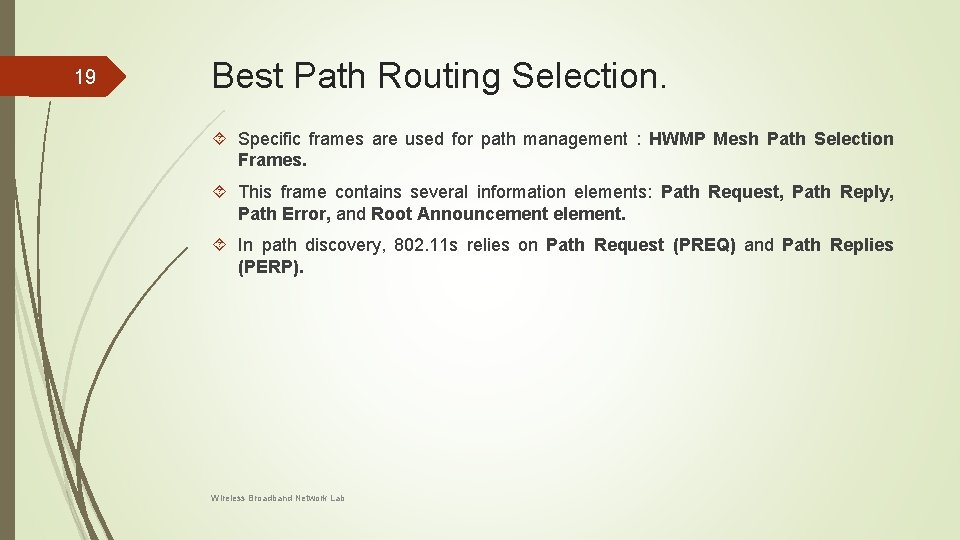
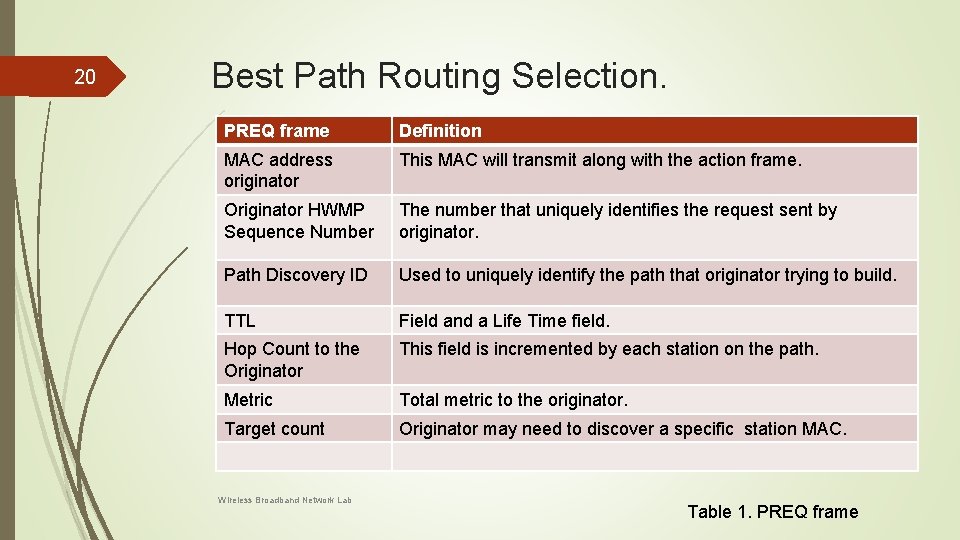
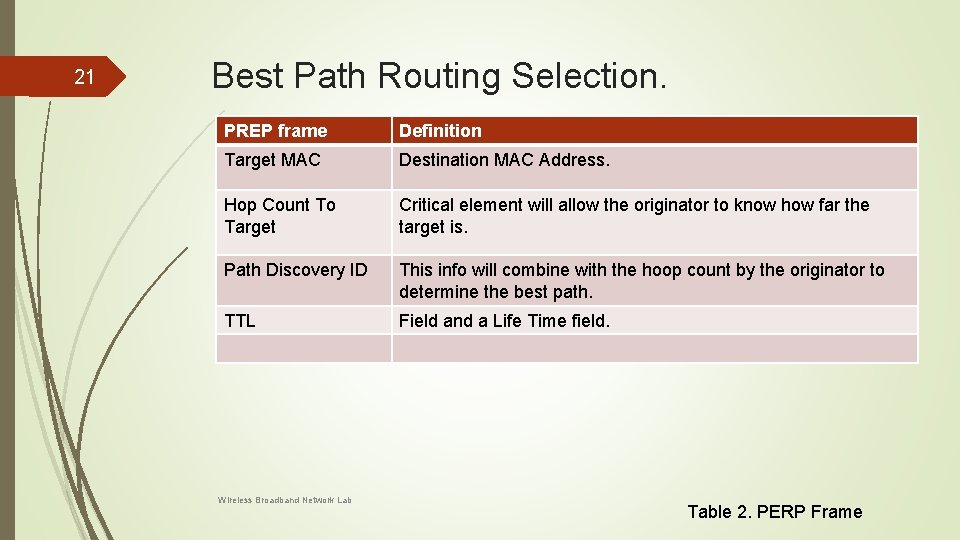
19 Best Path Routing Selection. Specific frames are used for path management : HWMP Mesh Path Selection Frames. This frame contains several information elements: Path Request, Path Reply, Path Error, and Root Announcement element. In path discovery, 802. 11 s relies on Path Request (PREQ) and Path Replies (PERP). Wireless Broadband Network Lab
20 Best Path Routing Selection. PREQ frame Definition MAC address originator This MAC will transmit along with the action frame. Originator HWMP Sequence Number The number that uniquely identifies the request sent by originator. Path Discovery ID Used to uniquely identify the path that originator trying to build. TTL Field and a Life Time field. Hop Count to the Originator This field is incremented by each station on the path. Metric Total metric to the originator. Target count Originator may need to discover a specific station MAC. Wireless Broadband Network Lab Table 1. PREQ frame
21 Best Path Routing Selection. PREP frame Definition Target MAC Destination MAC Address. Hop Count To Target Critical element will allow the originator to know how far the target is. Path Discovery ID This info will combine with the hoop count by the originator to determine the best path. TTL Field and a Life Time field. Wireless Broadband Network Lab Table 2. PERP Frame
22 Best Path Routing Selection. Wireless Broadband Network Lab Figure 6. Path Selection Example
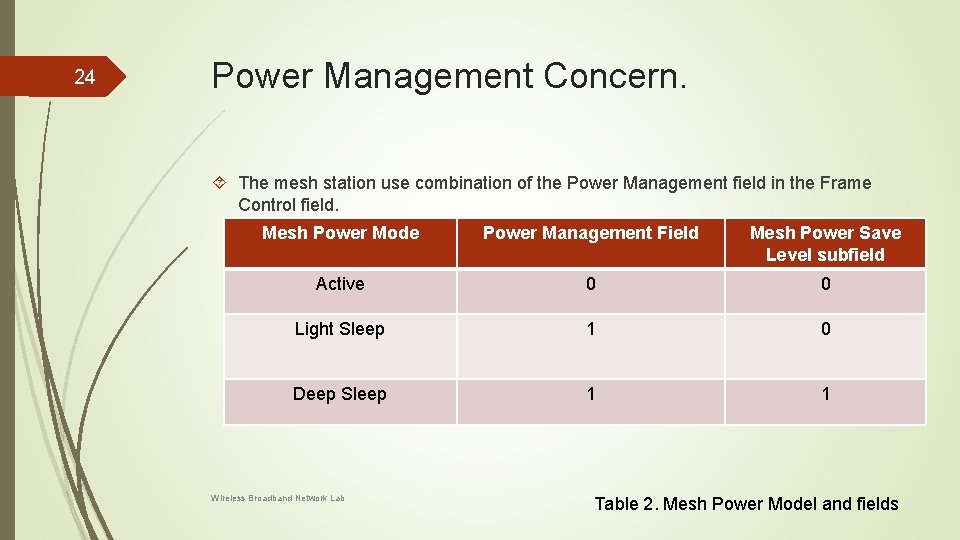
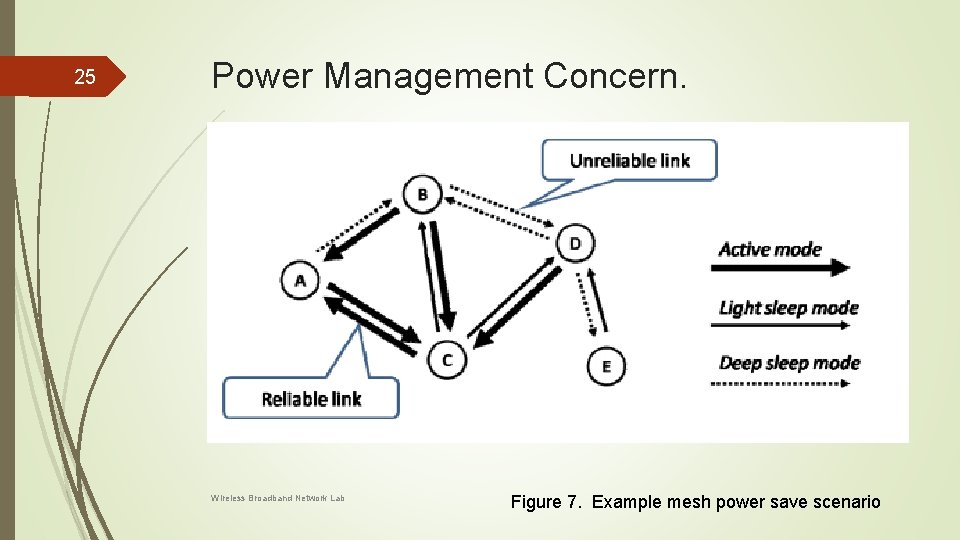
23 Power Management Concern. 802. 11 s describe three states related to power consumption for mesh stations: Active Mode. In this mode, the mesh station is available at any time. It is operates in the 802. 11 standard awake mode. Light Sleep Mode. Conserving battery while still performing some MBSS functions. Deep Sleep Mode. The station does not monitor its peer mesh station. It still has to awaken at regular interval to send its own message. Wireless Broadband Network Lab
24 Power Management Concern. The mesh station use combination of the Power Management field in the Frame Control field. Mesh Power Mode Power Management Field Mesh Power Save Level subfield Active 0 0 Light Sleep 1 0 Deep Sleep 1 1 Wireless Broadband Network Lab Table 2. Mesh Power Model and fields
25 Power Management Concern. Wireless Broadband Network Lab Figure 7. Example mesh power save scenario
26 Summary. 802. 11 s was originally designed to address concerns specific to mesh networks. The complexity of those networks generated many additional considerations that delayed the final amendment for several years. The final amendment reuses standard 802. 11 mechanisms for mesh stations to discover one another. During all the years while 802. 11 s was discussed, vendors have implemented specific mesh solutions without taking into account the features, terms, and considerations described in the 802. 11 s successive drafts. Today, most vendors’ mesh solutions are strongly established on a given set of features supported by vendor-specific functionality and terminology, and one may wonder if any vendor has any interest in implementing 802. 11 s. Wireless Broadband Network Lab
27 References. Henry, Jerome. Certified Wireless Network Professional. 802. 11 s Mesh network. November 2011, ” Joseph D. Camp and Edward W. Knightly. , “The IEEE 802. 11 s Extended Service Set Mesh Networking Standard”, IEEE Communications Magazine, 2008. Bari, S. M. S; Anwar, F; Masud, M. H. , “ Performance study of HWMP for IEEE 802. 11 s”, International Conference on Computer and Communication Engineering(ICCCE), 2012 IEEE, Kuala Lumpur. Pp. 713, 3 -5 July 2012 Wireless Broadband Network Lab
28 THANK YOU FOR YOUR ATTENTION Wireless Broadband Network Lab