
IEEE 802 11 Overview and Amendments under development

- Slides: 52
IEEE 802. 11 Overview and Amendments under development Overview of the 802. 11 Working Group The IEEE 802. 11 standard to date New Amendments: Markets, use cases and key technologies 2020 August Presenter: “At lectures, symposia, seminars, or educational courses, an individual presenting information on IEEE standards shall make it clear that his or her views should be considered the personal views of that individual rather than the formal position, explanation, or interpretation of the IEEE. ” IEEE-SA Standards Board Operation Manual (subclause 5. 9. 3) August 2020
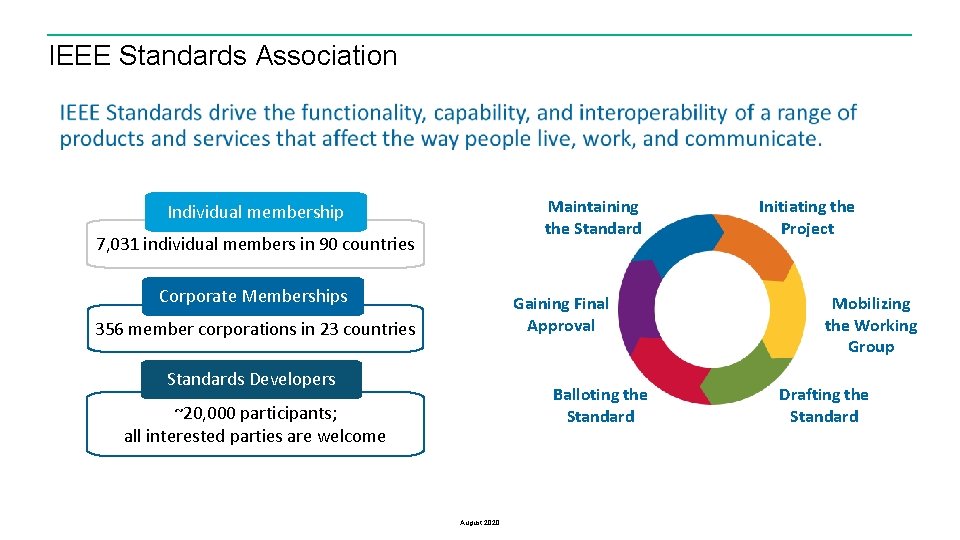
IEEE Standards Association Maintaining the Standard Individual membership 7, 031 individual members in 90 countries Corporate Memberships Gaining Final Approval 356 member corporations in 23 countries Standards Developers Balloting the Standard ~20, 000 participants; all interested parties are welcome August 2020 Initiating the Project Mobilizing the Working Group Drafting the Standard
The IEEE 802. 11 Working Group is one of the most active WGs in 802 Focus on link and physical layers of the network stack Leverage IETF protocols for upper layers OSI Reference Model IEEE 802 Local and Metropolitan Area Networks Standards Committee (LMSC) Application Presentation Session Transport Network IEEE 802. 1 Higher Layer LAN Protocols 802. 3 CSMA/CD Ethernet 802. 11 Wireless WLAN 802. 15 Wireless Specialty Networks Data Link 802. 16 Wireless Broadband Access 802. 18 Radio Regulatory TAG 802. 19 Co-existence WG 802. 21 Media Independent Handoff 802. 22 Wireless Regional Area Networks 802. 24 Vertical App. TAG IEEE 802. 11 WG Voting Members: 300+ Physical Medium August 2020
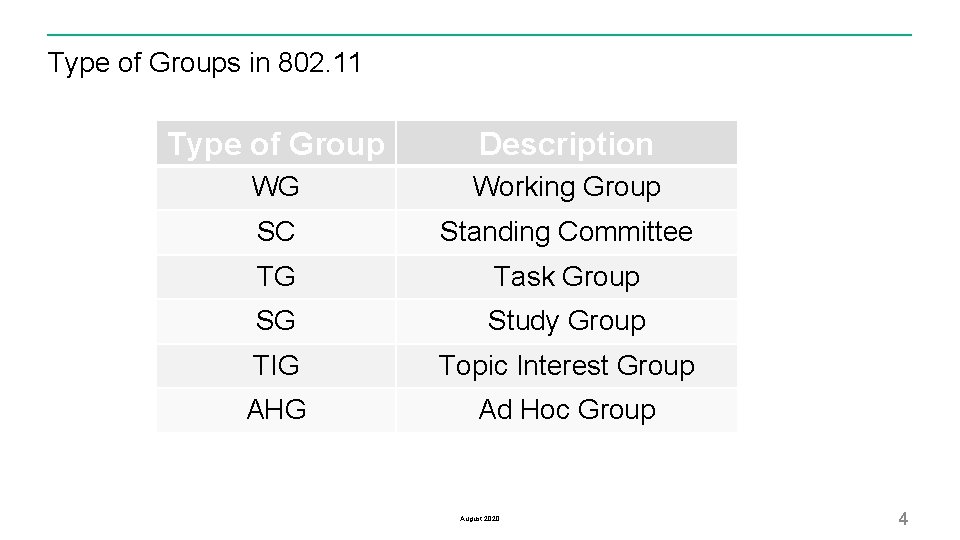
Type of Groups in 802. 11 Type of Group Description WG Working Group SC Standing Committee TG Task Group SG Study Group TIG Topic Interest Group AHG Ad Hoc Group August 2020 4
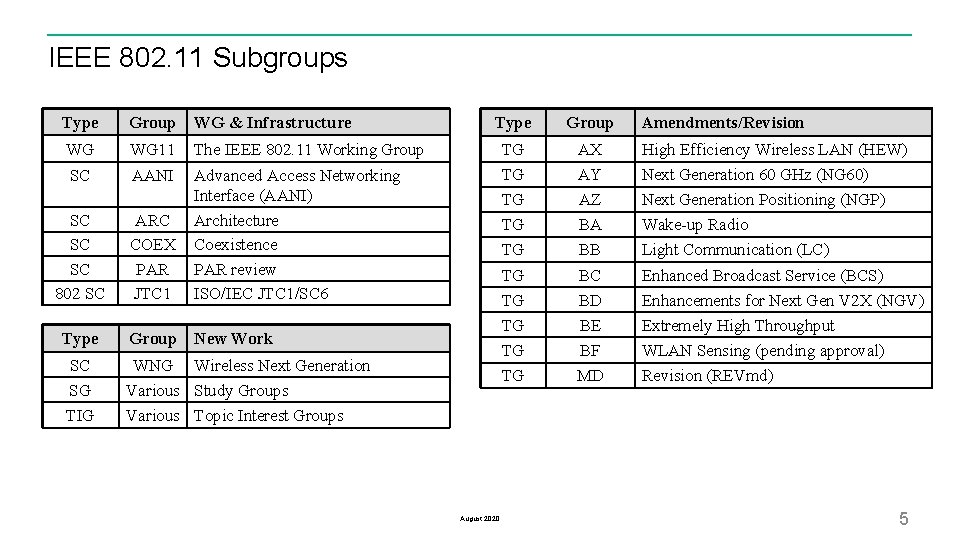
IEEE 802. 11 Subgroups Type Group WG & Infrastructure WG WG 11 The IEEE 802. 11 Working Group SC AANI SC SC SC 802 SC ARC COEX PAR JTC 1 Advanced Access Networking Interface (AANI) Architecture Coexistence PAR review ISO/IEC JTC 1/SC 6 Type Group New Work SC SG TIG WNG Wireless Next Generation Various Study Groups Various Topic Interest Groups Type Group TG TG TG AX AY AZ BA BB BC BD BE BF MD August 2020 Amendments/Revision High Efficiency Wireless LAN (HEW) Next Generation 60 GHz (NG 60) Next Generation Positioning (NGP) Wake-up Radio Light Communication (LC) Enhanced Broadcast Service (BCS) Enhancements for Next Gen V 2 X (NGV) Extremely High Throughput WLAN Sensing (pending approval) Revision (REVmd) 5
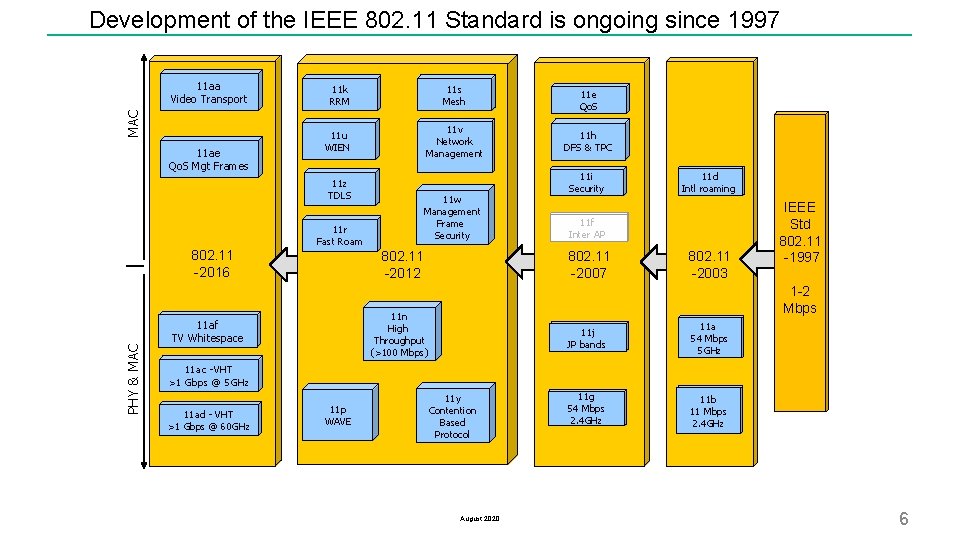
Development of the IEEE 802. 11 Standard is ongoing since 1997 MAC 11 aa Video Transport 11 ae Qo. S Mgt Frames 11 k RRM 11 s Mesh 11 u WIEN 11 v Network Management 11 z TDLS 11 w Management Frame Security 11 r Fast Roam PHY & MAC 802. 11 -2016 802. 11 -2012 11 h DFS & TPC 11 i Security 11 d Intl roaming 11 f Inter AP 802. 11 -2007 802. 11 -2003 IEEE Std 802. 11 -1997 1 -2 Mbps 11 n High Throughput (>100 Mbps) 11 af TV Whitespace 11 e Qo. S 11 j JP bands 11 a 54 Mbps 5 GHz 11 g 54 Mbps 2. 4 GHz 11 b 11 Mbps 2. 4 GHz 11 ac -VHT >1 Gbps @ 5 GHz 11 ad - VHT >1 Gbps @ 60 GHz 11 p WAVE 11 y Contention Based Protocol August 2020 6
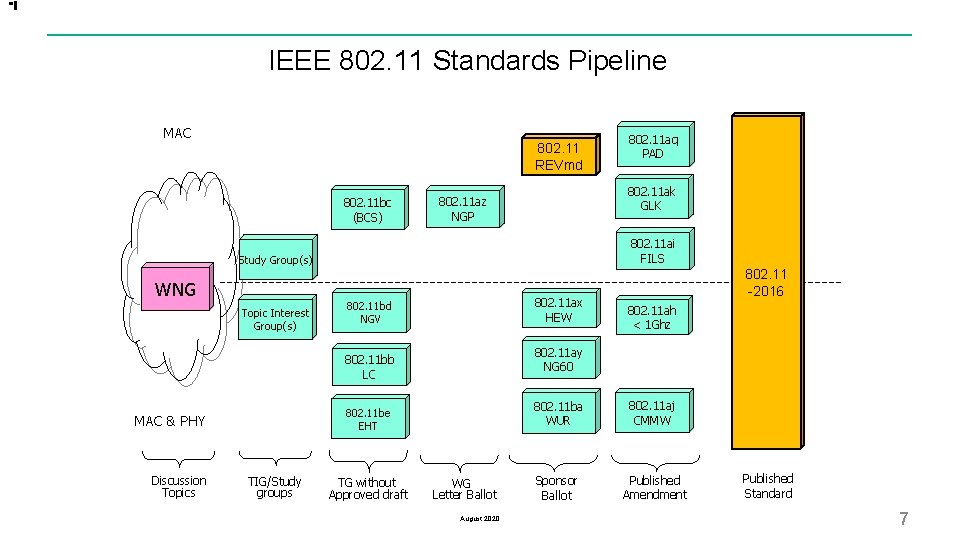
IEEE 802. 11 Standards Pipeline MAC 802. 11 REVmd 802. 11 bc (BCS) 802. 11 ak GLK 802. 11 az NGP 802. 11 ai FILS Study Group(s) WNG Topic Interest Group(s) 802. 11 ax HEW 802. 11 bd NGV Discussion Topics 802. 11 be EHT TIG/Study groups TG without Approved draft 802. 11 -2016 802. 11 ah < 1 Ghz 802. 11 ay NG 60 802. 11 bb LC MAC & PHY 802. 11 aq PAD WG Letter Ballot August 2020 802. 11 ba WUR 802. 11 aj CMMW Sponsor Ballot Published Amendment Published Standard 7
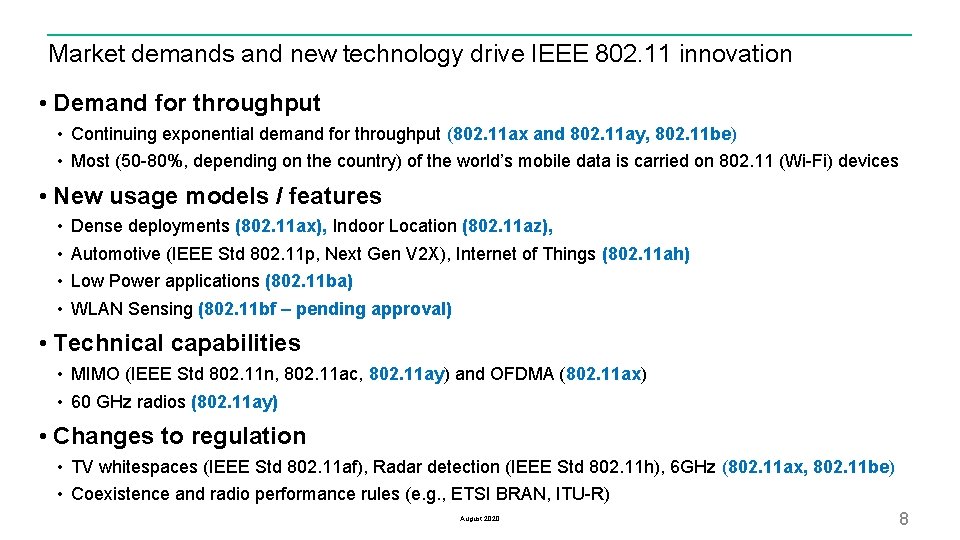
Market demands and new technology drive IEEE 802. 11 innovation • Demand for throughput • Continuing exponential demand for throughput (802. 11 ax and 802. 11 ay, 802. 11 be) • Most (50 -80%, depending on the country) of the world’s mobile data is carried on 802. 11 (Wi-Fi) devices • New usage models / features • • Dense deployments (802. 11 ax), Indoor Location (802. 11 az), Automotive (IEEE Std 802. 11 p, Next Gen V 2 X), Internet of Things (802. 11 ah) Low Power applications (802. 11 ba) WLAN Sensing (802. 11 bf – pending approval) • Technical capabilities • MIMO (IEEE Std 802. 11 n, 802. 11 ac, 802. 11 ay) and OFDMA (802. 11 ax) • 60 GHz radios (802. 11 ay) • Changes to regulation • TV whitespaces (IEEE Std 802. 11 af), Radar detection (IEEE Std 802. 11 h), 6 GHz (802. 11 ax, 802. 11 be) • Coexistence and radio performance rules (e. g. , ETSI BRAN, ITU-R) 8 August 2020
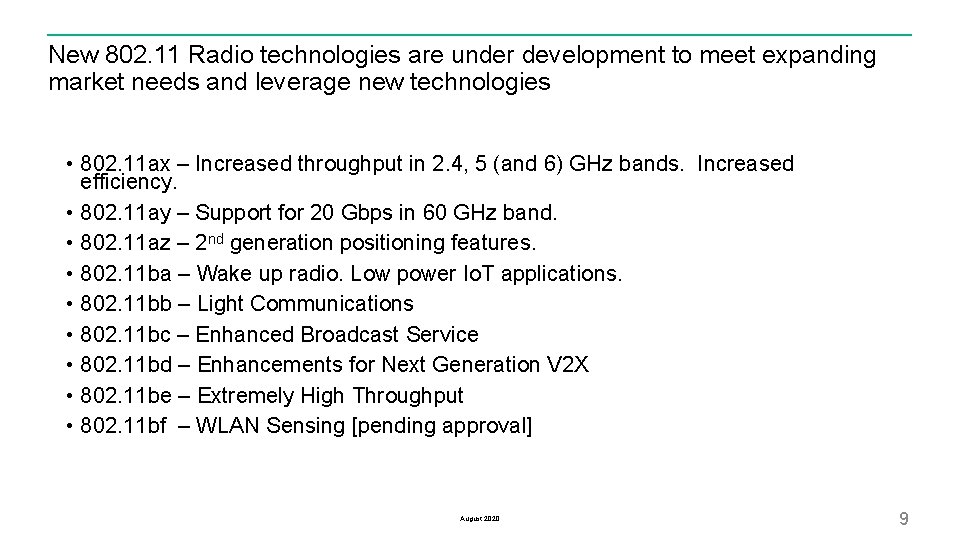
New 802. 11 Radio technologies are under development to meet expanding market needs and leverage new technologies • 802. 11 ax – Increased throughput in 2. 4, 5 (and 6) GHz bands. Increased efficiency. • 802. 11 ay – Support for 20 Gbps in 60 GHz band. • 802. 11 az – 2 nd generation positioning features. • 802. 11 ba – Wake up radio. Low power Io. T applications. • 802. 11 bb – Light Communications • 802. 11 bc – Enhanced Broadcast Service • 802. 11 bd – Enhancements for Next Generation V 2 X • 802. 11 be – Extremely High Throughput • 802. 11 bf – WLAN Sensing [pending approval] August 2020 9
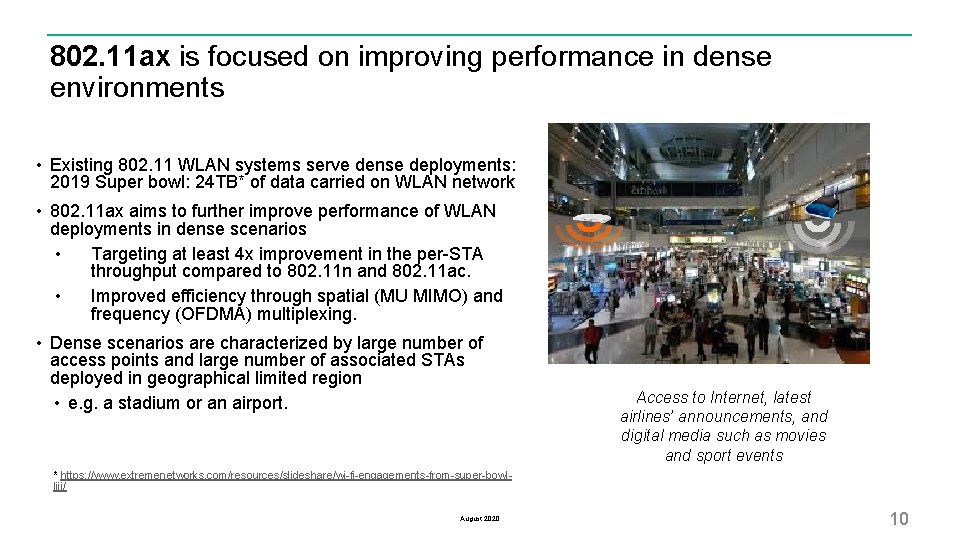
802. 11 ax is focused on improving performance in dense environments • Existing 802. 11 WLAN systems serve dense deployments: 2019 Super bowl: 24 TB* of data carried on WLAN network • 802. 11 ax aims to further improve performance of WLAN deployments in dense scenarios • Targeting at least 4 x improvement in the per-STA throughput compared to 802. 11 n and 802. 11 ac. • Improved efficiency through spatial (MU MIMO) and frequency (OFDMA) multiplexing. • Dense scenarios are characterized by large number of access points and large number of associated STAs deployed in geographical limited region • e. g. a stadium or an airport. Access to Internet, latest airlines’ announcements, and digital media such as movies and sport events * https: //www. extremenetworks. com/resources/slideshare/wi-fi-engagements-from-super-bowlliii/ August 2020 10
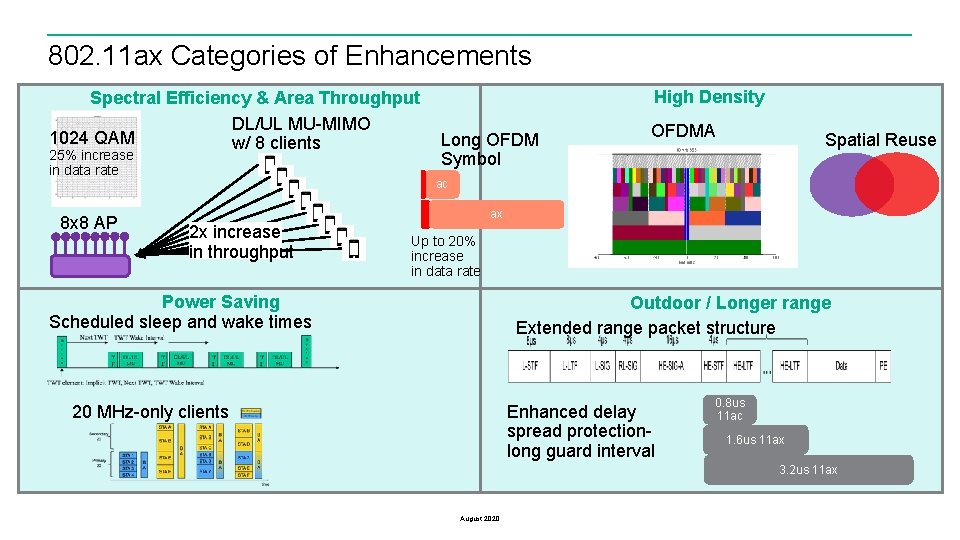
802. 11 ax Categories of Enhancements Spectral Efficiency & Area Throughput DL/UL MU-MIMO 1024 QAM w/ 8 clients 25% increase in data rate 8 x 8 AP High Density Long OFDM Symbol OFDMA Spatial Reuse ac ax 2 x increase in throughput Up to 20% increase in data rate Power Saving Scheduled sleep and wake times Outdoor / Longer range Extended range packet structure Enhanced delay spread protectionlong guard interval 20 MHz-only clients 0. 8 us 11 ac 1. 6 us 11 ax 3. 2 us 11 ax August 2020
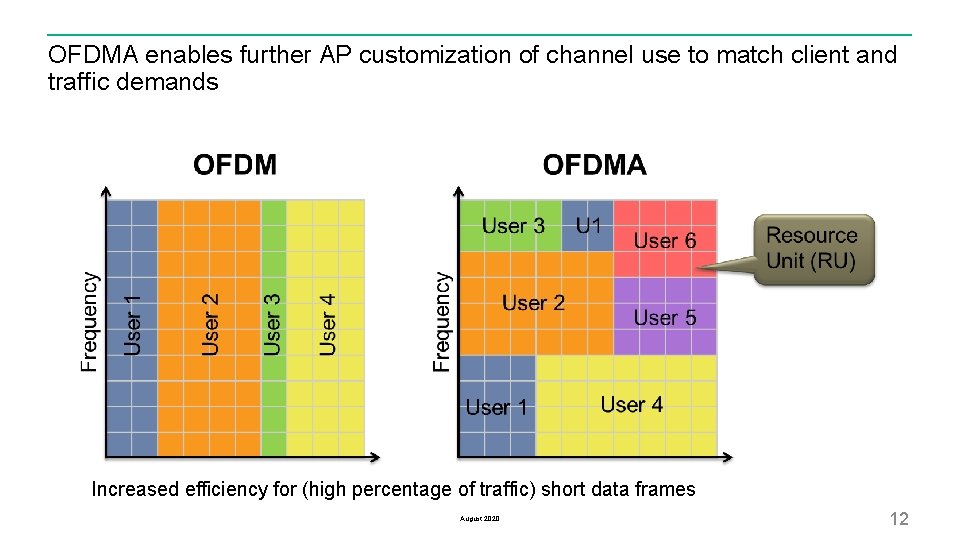
OFDMA enables further AP customization of channel use to match client and traffic demands Increased efficiency for (high percentage of traffic) short data frames August 2020 12
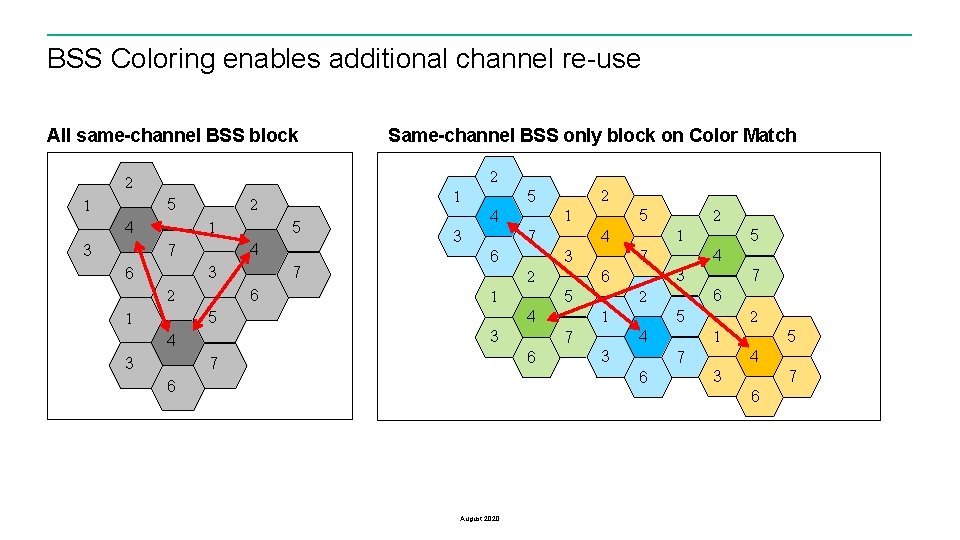
BSS Coloring enables additional channel re-use All same-channel BSS block 2 2 3 5 1 4 4 7 3 6 7 6 2 3 5 1 2 5 3 5 1 4 4 7 6 6 7 6 2 7 6 7 3 1 4 4 7 6 2 3 4 3 3 6 5 1 4 7 2 5 1 4 5 1 2 5 1 Same-channel BSS only block on Color Match 3 7 6 August 2020
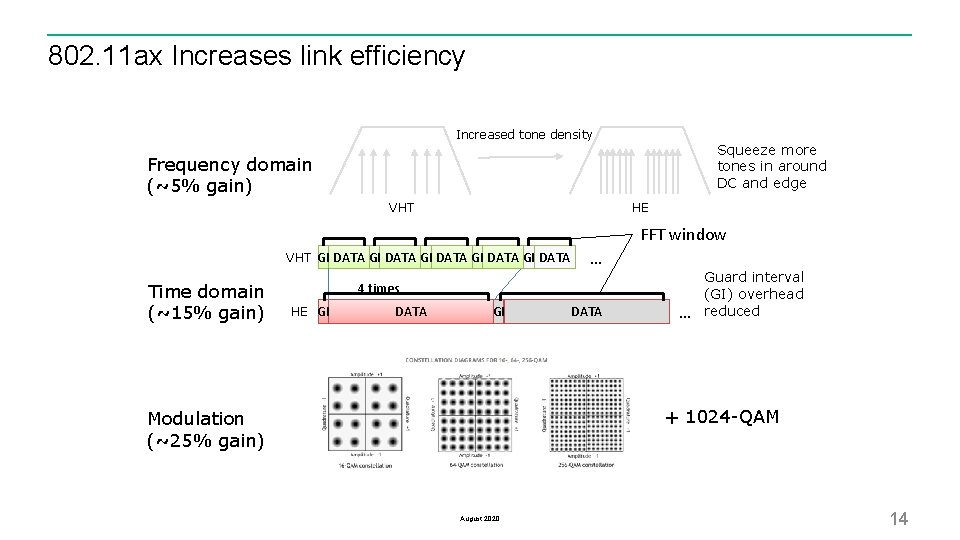
802. 11 ax Increases link efficiency Increased tone density Squeeze more tones in around DC and edge Frequency domain (~5% gain) HE VHT FFT window VHT GI DATA GI DATA Time domain (~15% gain) … 4 times HE GI DATA … Guard interval (GI) overhead reduced + 1024 -QAM Modulation (~25% gain) August 2020 14
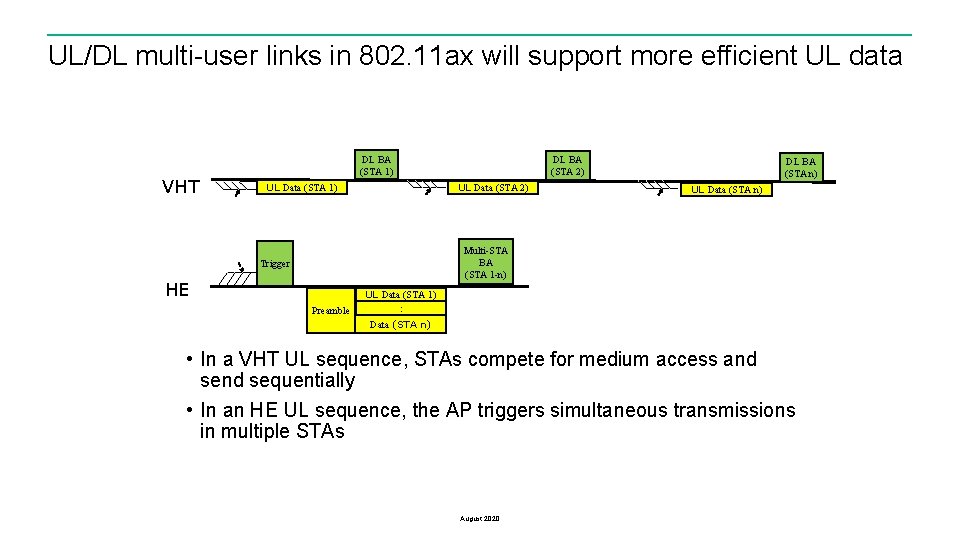
UL/DL multi-user links in 802. 11 ax will support more efficient UL data VHT DL BA (STA 1) UL Data (STA 1) DL BA (STA 2) UL Data (STA 2) DL BA (STA n) UL Data (STA n) Multi-STA BA (STA 1 -n) Trigger HE Preamble UL Data (STA 1) : Data (STA n) • In a VHT UL sequence, STAs compete for medium access and sequentially • In an HE UL sequence, the AP triggers simultaneous transmissions in multiple STAs August 2020
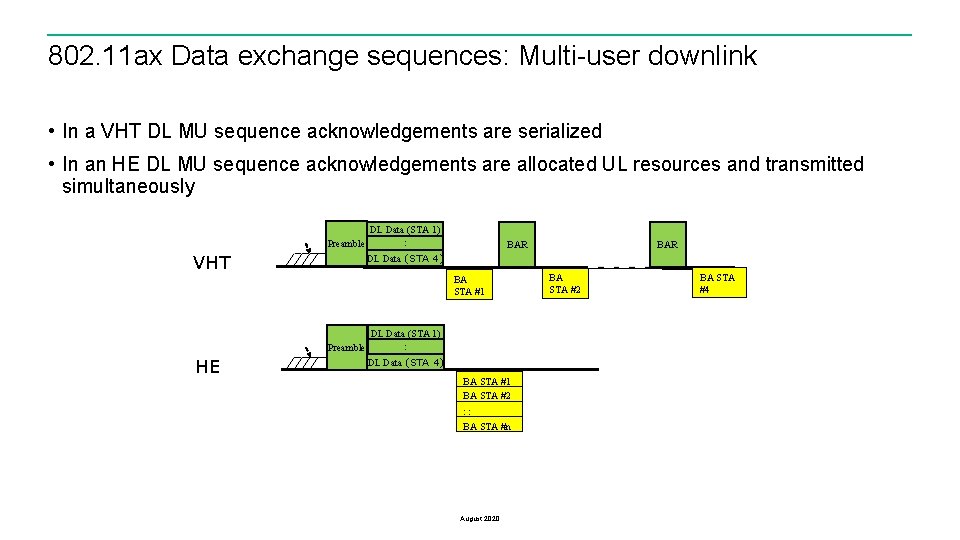
802. 11 ax Data exchange sequences: Multi-user downlink • In a VHT DL MU sequence acknowledgements are serialized • In an HE DL MU sequence acknowledgements are allocated UL resources and transmitted simultaneously Preamble VHT DL Data (STA 1) : BA STA #1 Preamble HE BAR DL Data (STA 4) DL Data (STA 1) : DL Data (STA 4) BA STA #1 BA STA #2 : : BA STA #n August 2020 BA STA #2 BA STA #4
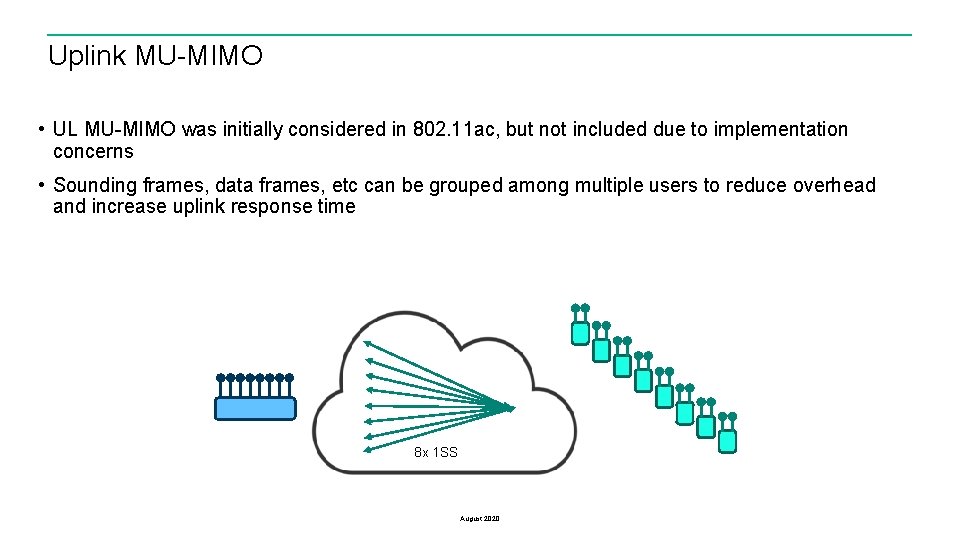
Uplink MU-MIMO • UL MU-MIMO was initially considered in 802. 11 ac, but not included due to implementation concerns • Sounding frames, data frames, etc can be grouped among multiple users to reduce overhead and increase uplink response time 8 x 1 SS August 2020
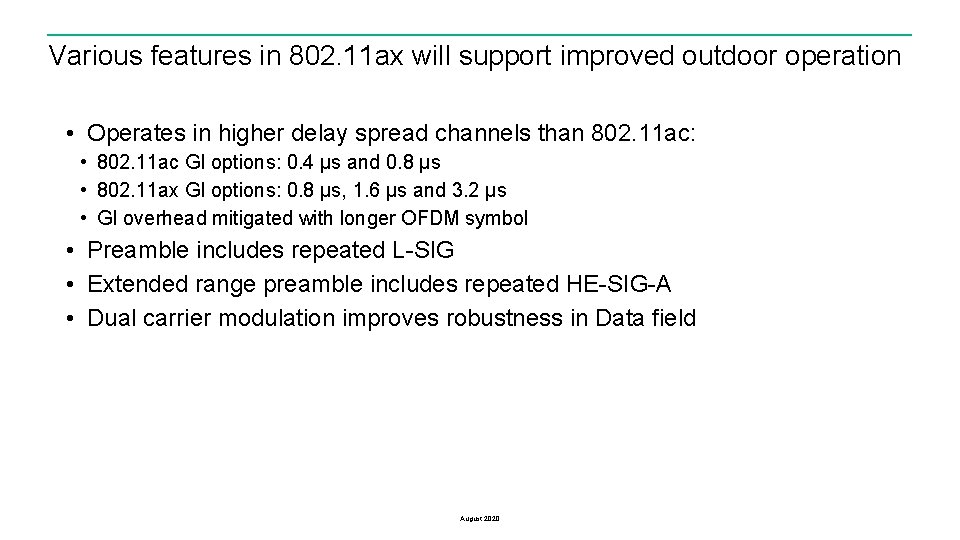
Various features in 802. 11 ax will support improved outdoor operation • Operates in higher delay spread channels than 802. 11 ac: • 802. 11 ac GI options: 0. 4 µs and 0. 8 µs • 802. 11 ax GI options: 0. 8 µs, 1. 6 µs and 3. 2 µs • GI overhead mitigated with longer OFDM symbol • Preamble includes repeated L-SIG • Extended range preamble includes repeated HE-SIG-A • Dual carrier modulation improves robustness in Data field August 2020
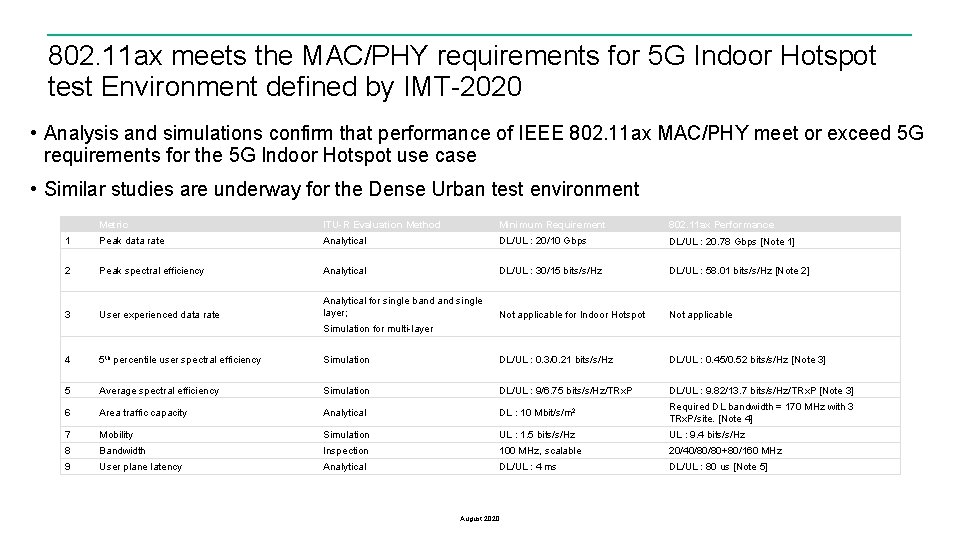
802. 11 ax meets the MAC/PHY requirements for 5 G Indoor Hotspot test Environment defined by IMT-2020 • Analysis and simulations confirm that performance of IEEE 802. 11 ax MAC/PHY meet or exceed 5 G requirements for the 5 G Indoor Hotspot use case • Similar studies are underway for the Dense Urban test environment Metric ITU-R Evaluation Method Minimum Requirement 802. 11 ax Performance 1 Peak data rate Analytical DL/UL : 20/10 Gbps DL/UL : 20. 78 Gbps [Note 1] 2 Peak spectral efficiency Analytical DL/UL : 30/15 bits/s/Hz DL/UL : 58. 01 bits/s/Hz [Note 2] User experienced data rate Analytical for single band single layer; Not applicable for Indoor Hotspot Not applicable 3 Simulation for multi-layer 4 5 th percentile user spectral efficiency Simulation DL/UL : 0. 3/0. 21 bits/s/Hz DL/UL : 0. 45/0. 52 bits/s/Hz [Note 3] 5 Average spectral efficiency Simulation DL/UL : 9/6. 75 bits/s/Hz/TRx. P DL/UL : 9. 82/13. 7 bits/s/Hz/TRx. P [Note 3] 6 Area traffic capacity Analytical DL : 10 Mbit/s/m 2 Required DL bandwidth = 170 MHz with 3 TRx. P/site. [Note 4] 7 Mobility Simulation UL : 1. 5 bits/s/Hz UL : 9. 4 bits/s/Hz 8 Bandwidth Inspection 100 MHz, scalable 20/40/80/80+80/160 MHz 9 User plane latency Analytical DL/UL : 4 ms DL/UL : 80 us [Note 5] August 2020
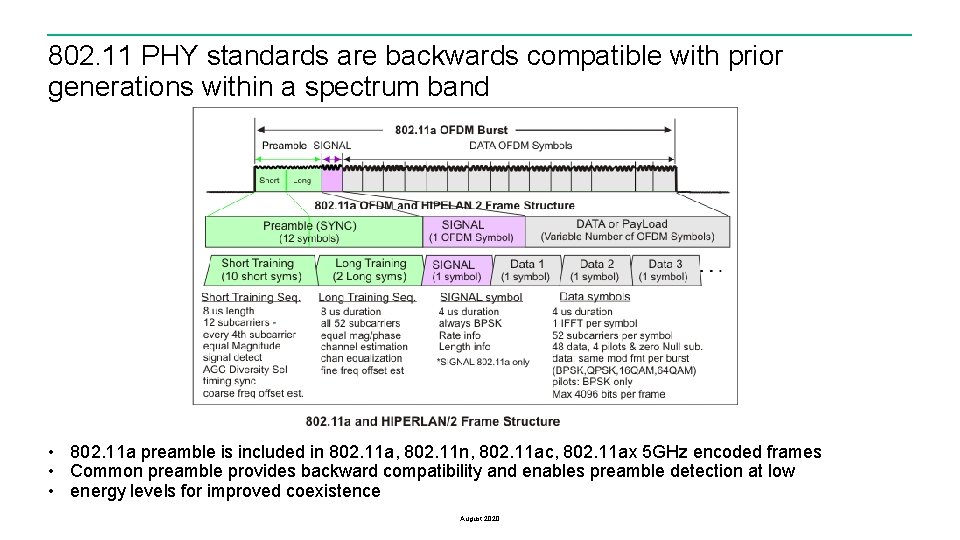
802. 11 PHY standards are backwards compatible with prior generations within a spectrum band • 802. 11 a preamble is included in 802. 11 a, 802. 11 n, 802. 11 ac, 802. 11 ax 5 GHz encoded frames • Common preamble provides backward compatibility and enables preamble detection at low • energy levels for improved coexistence August 2020
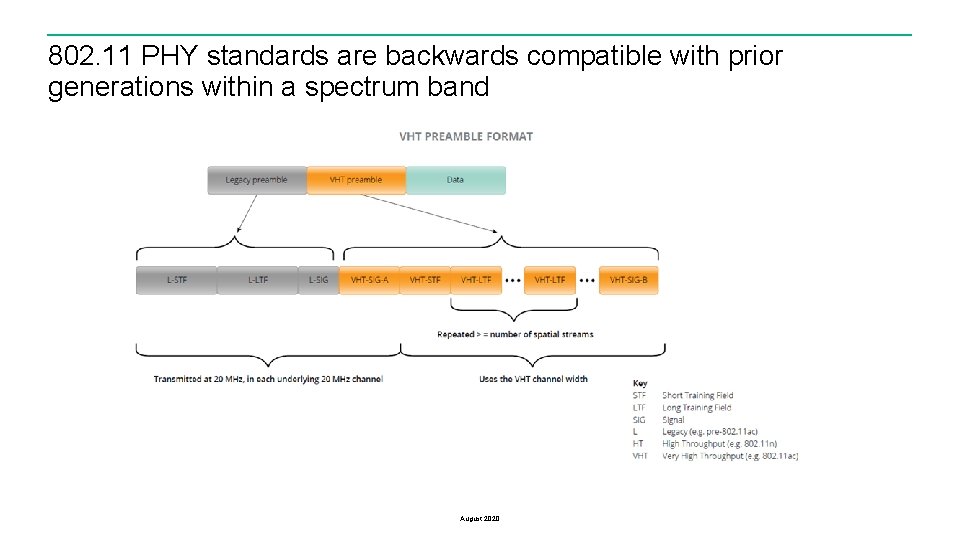
802. 11 PHY standards are backwards compatible with prior generations within a spectrum band August 2020
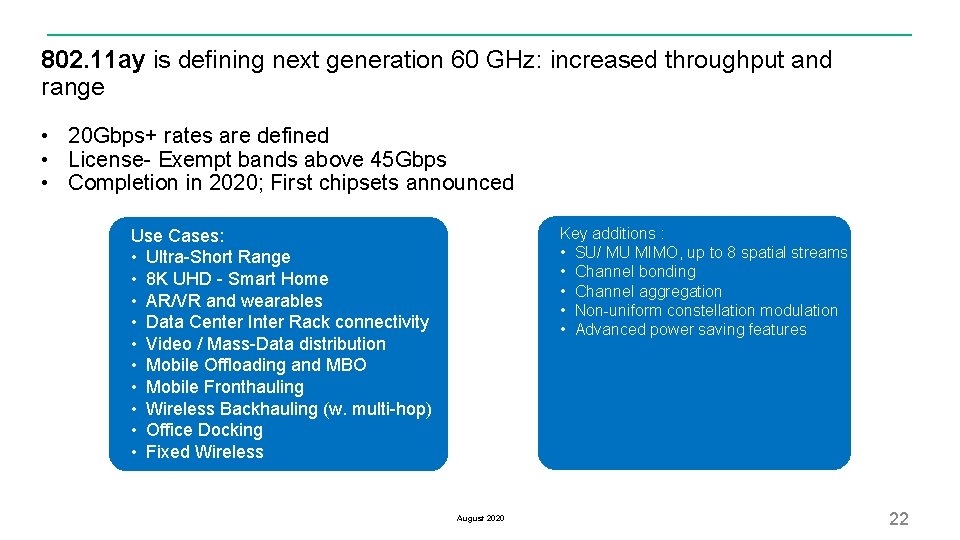
802. 11 ay is defining next generation 60 GHz: increased throughput and range • 20 Gbps+ rates are defined • License- Exempt bands above 45 Gbps • Completion in 2020; First chipsets announced Key additions : • SU/ MU MIMO, up to 8 spatial streams • Channel bonding • Channel aggregation • Non-uniform constellation modulation • Advanced power saving features Use Cases: • Ultra-Short Range • 8 K UHD - Smart Home • AR/VR and wearables • Data Center Inter Rack connectivity • Video / Mass-Data distribution • Mobile Offloading and MBO • Mobile Fronthauling • Wireless Backhauling (w. multi-hop) • Office Docking • Fixed Wireless August 2020 22
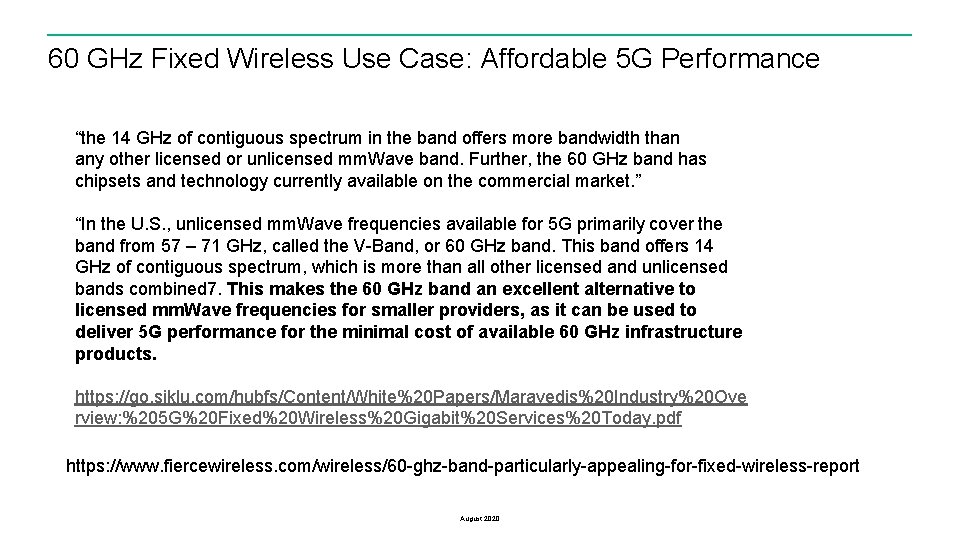
60 GHz Fixed Wireless Use Case: Affordable 5 G Performance “the 14 GHz of contiguous spectrum in the band offers more bandwidth than any other licensed or unlicensed mm. Wave band. Further, the 60 GHz band has chipsets and technology currently available on the commercial market. ” “In the U. S. , unlicensed mm. Wave frequencies available for 5 G primarily cover the band from 57 – 71 GHz, called the V-Band, or 60 GHz band. This band offers 14 GHz of contiguous spectrum, which is more than all other licensed and unlicensed bands combined 7. This makes the 60 GHz band an excellent alternative to licensed mm. Wave frequencies for smaller providers, as it can be used to deliver 5 G performance for the minimal cost of available 60 GHz infrastructure products. https: //go. siklu. com/hubfs/Content/White%20 Papers/Maravedis%20 Industry%20 Ove rview: %205 G%20 Fixed%20 Wireless%20 Gigabit%20 Services%20 Today. pdf https: //www. fiercewireless. com/wireless/60 -ghz-band-particularly-appealing-for-fixed-wireless-report August 2020
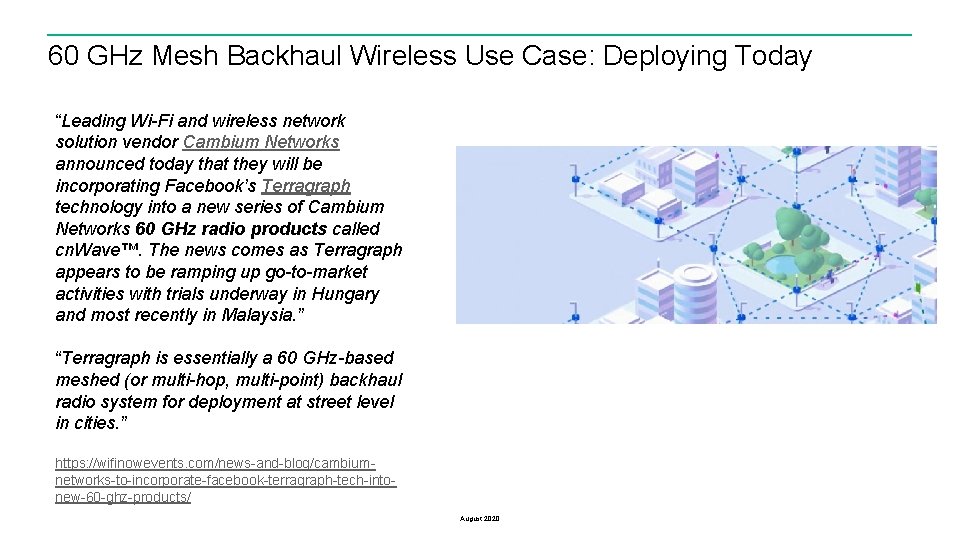
60 GHz Mesh Backhaul Wireless Use Case: Deploying Today “Leading Wi-Fi and wireless network solution vendor Cambium Networks announced today that they will be incorporating Facebook’s Terragraph technology into a new series of Cambium Networks 60 GHz radio products called cn. Wave™. The news comes as Terragraph appears to be ramping up go-to-market activities with trials underway in Hungary and most recently in Malaysia. ” “Terragraph is essentially a 60 GHz-based meshed (or multi-hop, multi-point) backhaul radio system for deployment at street level in cities. ” https: //wifinowevents. com/news-and-blog/cambiumnetworks-to-incorporate-facebook-terragraph-tech-intonew-60 -ghz-products/ August 2020
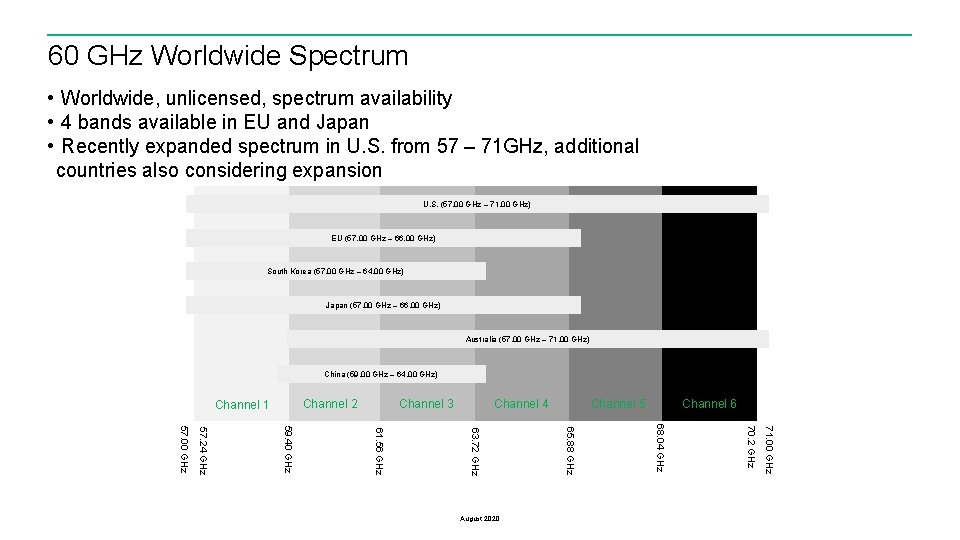
60 GHz Worldwide Spectrum • Worldwide, unlicensed, spectrum availability • 4 bands available in EU and Japan • Recently expanded spectrum in U. S. from 57 – 71 GHz, additional countries also considering expansion U. S. (57. 00 GHz – 71. 00 GHz) EU (57. 00 GHz – 66. 00 GHz) South Korea (57. 00 GHz – 64. 00 GHz) Japan (57. 00 GHz – 66. 00 GHz) Australia (57. 00 GHz – 71. 00 GHz) China (59. 00 GHz – 64. 00 GHz) Channel 3 Channel 2 Channel 1 71. 00 GHz 70. 2 GHz 68. 04 GHz 65. 88 GHz 63. 72 GHz 61. 56 GHz 59. 40 GHz 57. 24 GHz 57. 00 GHz August 2020 Channel 6 Channel 5 Channel 4
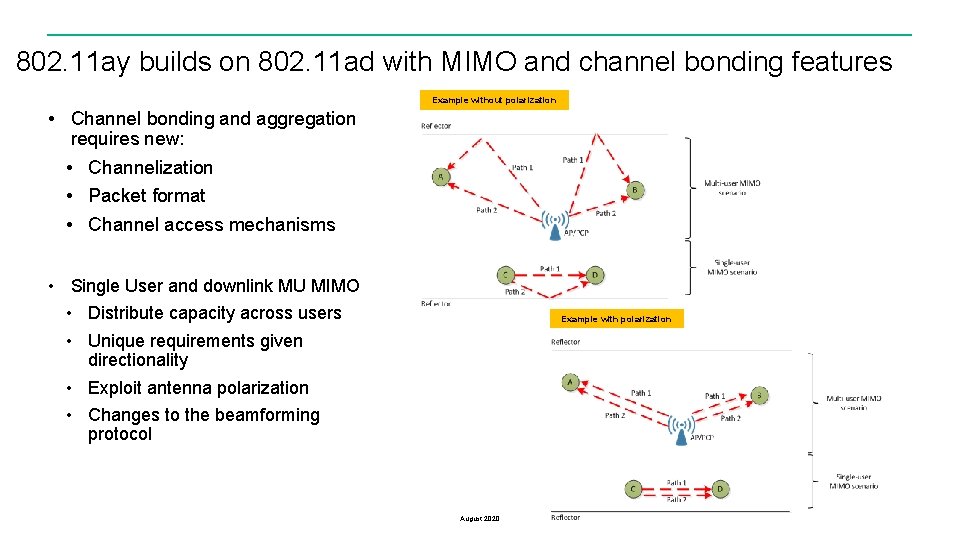
802. 11 ay builds on 802. 11 ad with MIMO and channel bonding features Example without polarization • Channel bonding and aggregation requires new: • Channelization • Packet format • Channel access mechanisms • Single User and downlink MU MIMO • Distribute capacity across users • Unique requirements given directionality • Exploit antenna polarization • Changes to the beamforming protocol Example with polarization August 2020
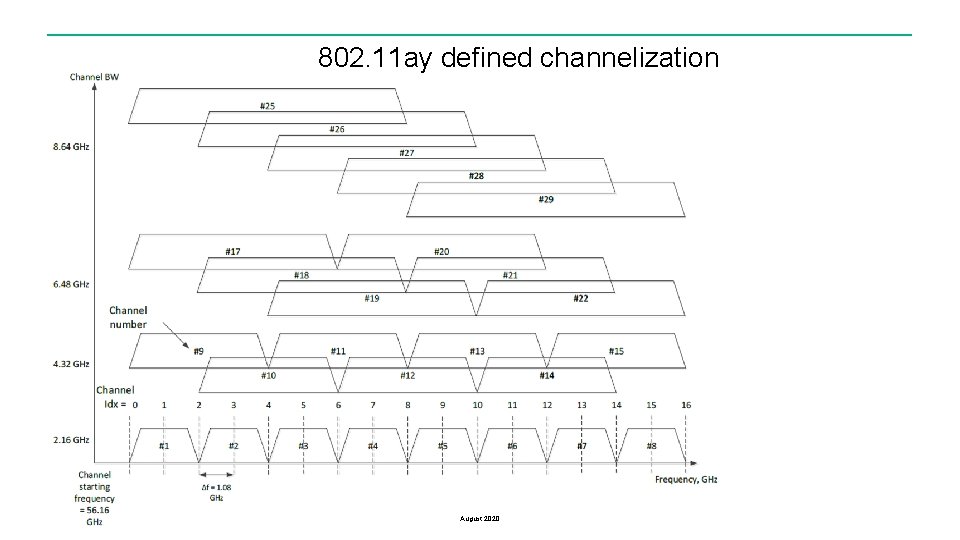
802. 11 ay defined channelization August 2020
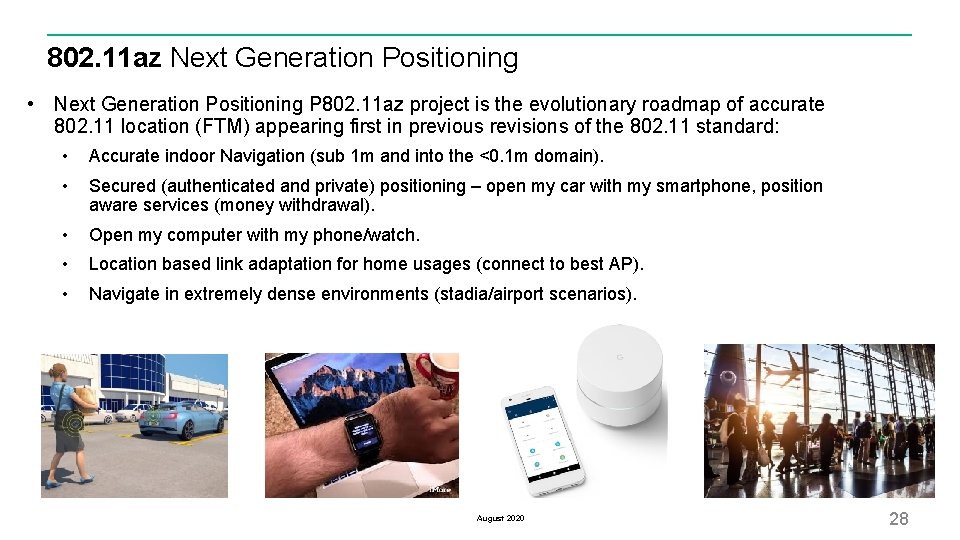
802. 11 az Next Generation Positioning • Next Generation Positioning P 802. 11 az project is the evolutionary roadmap of accurate 802. 11 location (FTM) appearing first in previous revisions of the 802. 11 standard: • Accurate indoor Navigation (sub 1 m and into the <0. 1 m domain). • Secured (authenticated and private) positioning – open my car with my smartphone, position aware services (money withdrawal). • Open my computer with my phone/watch. • Location based link adaptation for home usages (connect to best AP). • Navigate in extremely dense environments (stadia/airport scenarios). August 2020 28
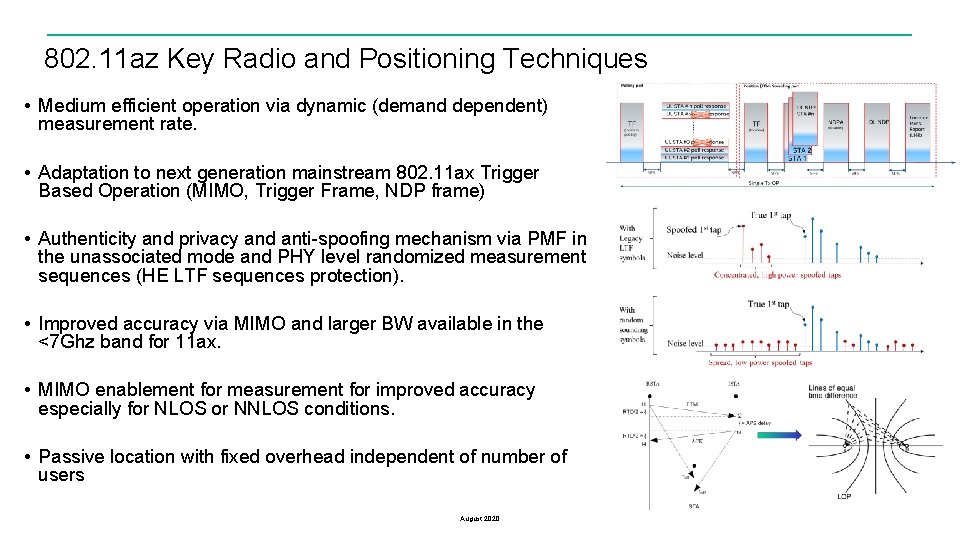
802. 11 az Key Radio and Positioning Techniques • Medium efficient operation via dynamic (demand dependent) measurement rate. • Adaptation to next generation mainstream 802. 11 ax Trigger Based Operation (MIMO, Trigger Frame, NDP frame) • Authenticity and privacy and anti-spoofing mechanism via PMF in the unassociated mode and PHY level randomized measurement sequences (HE LTF sequences protection). • Improved accuracy via MIMO and larger BW available in the <7 Ghz band for 11 ax. • MIMO enablement for measurement for improved accuracy especially for NLOS or NNLOS conditions. • Passive location with fixed overhead independent of number of users August 2020
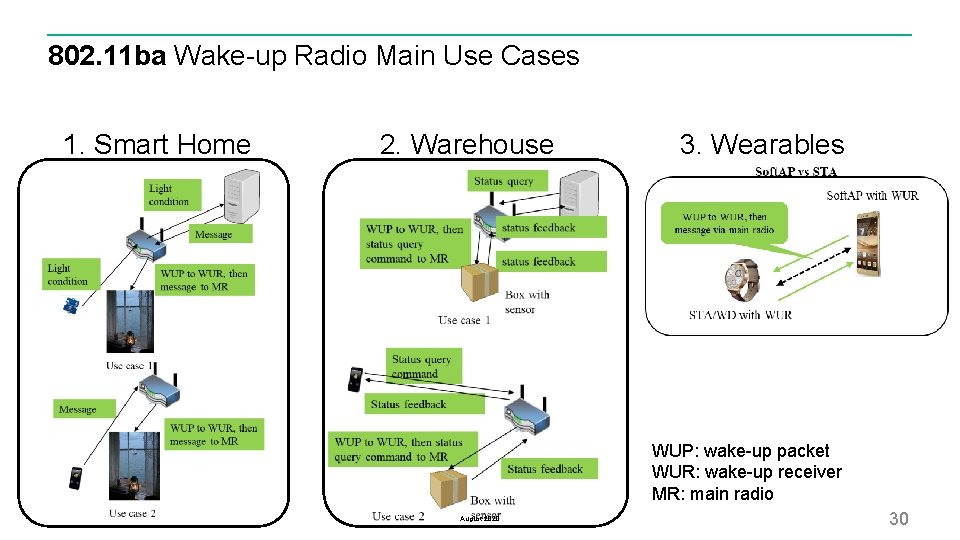
802. 11 ba Wake-up Radio Main Use Cases 1. Smart Home 2. Warehouse 3. Wearables WUP: wake-up packet WUR: wake-up receiver MR: main radio August 2020 30
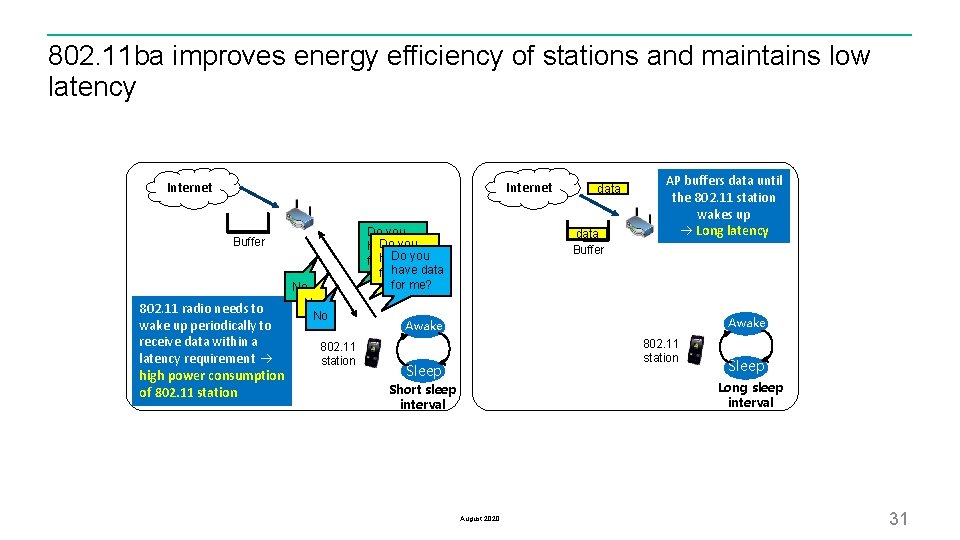
802. 11 ba improves energy efficiency of stations and maintains low latency Internet Buffer 802. 11 radio needs to wake up periodically to receive data within a latency requirement high power consumption of 802. 11 station No No No 802. 11 station Do you have data for me? data Buffer AP buffers data until the 802. 11 station wakes up Long latency Awake 802. 11 station Sleep Long sleep interval Short sleep interval August 2020 31
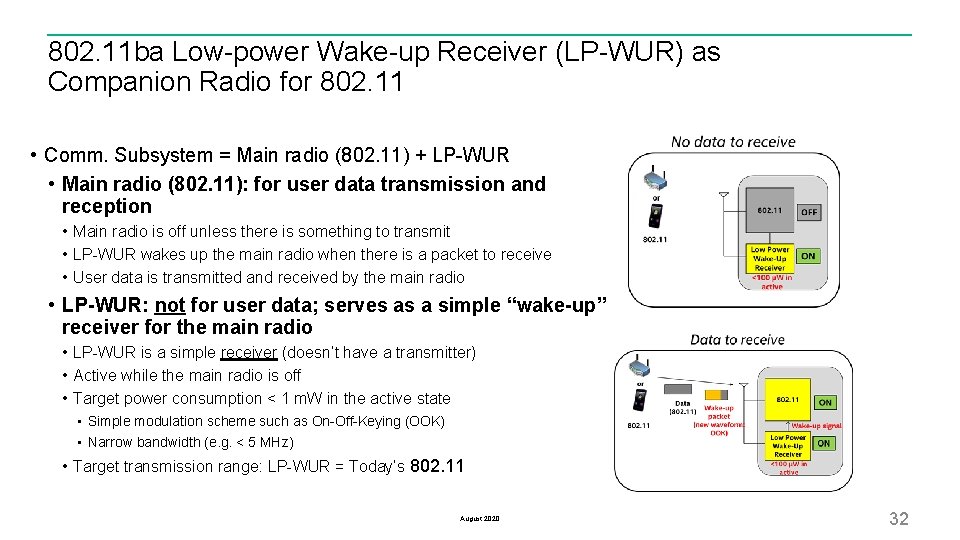
802. 11 ba Low-power Wake-up Receiver (LP-WUR) as Companion Radio for 802. 11 • Comm. Subsystem = Main radio (802. 11) + LP-WUR • Main radio (802. 11): for user data transmission and reception • Main radio is off unless there is something to transmit • LP-WUR wakes up the main radio when there is a packet to receive • User data is transmitted and received by the main radio • LP-WUR: not for user data; serves as a simple “wake-up” receiver for the main radio • LP-WUR is a simple receiver (doesn’t have a transmitter) • Active while the main radio is off • Target power consumption < 1 m. W in the active state • Simple modulation scheme such as On-Off-Keying (OOK) • Narrow bandwidth (e. g. < 5 MHz) • Target transmission range: LP-WUR = Today’s 802. 11 August 2020 32
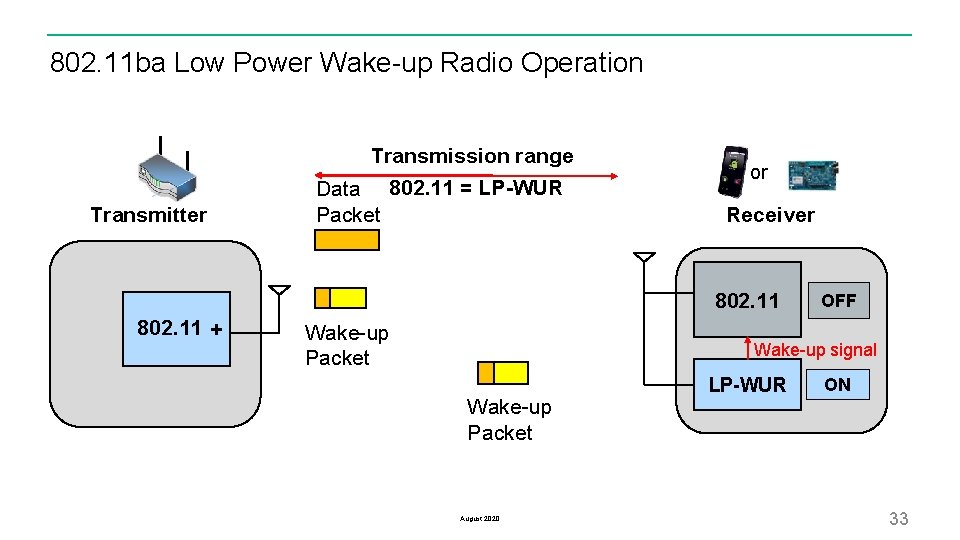
802. 11 ba Low Power Wake-up Radio Operation Transmitter Transmission range Data 802. 11 = LP-WUR Packet or Receiver 802. 11 + Wake-up Packet OFF ON Wake-up signal Wake-up Packet August 2020 LP-WUR ON 33
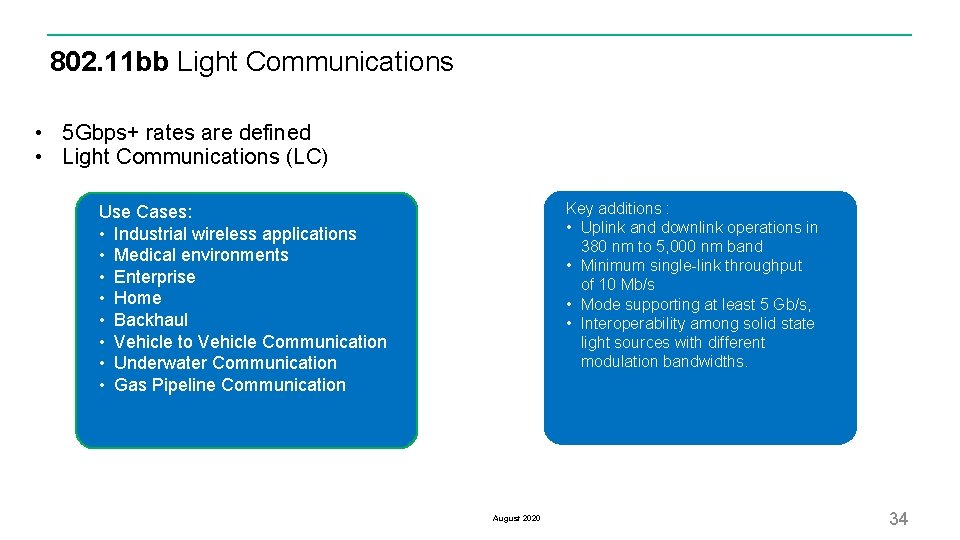
802. 11 bb Light Communications • 5 Gbps+ rates are defined • Light Communications (LC) Key additions : • Uplink and downlink operations in 380 nm to 5, 000 nm band • Minimum single-link throughput of 10 Mb/s • Mode supporting at least 5 Gb/s, • Interoperability among solid state light sources with different modulation bandwidths. Use Cases: • Industrial wireless applications • Medical environments • Enterprise • Home • Backhaul • Vehicle to Vehicle Communication • Underwater Communication • Gas Pipeline Communication August 2020 34
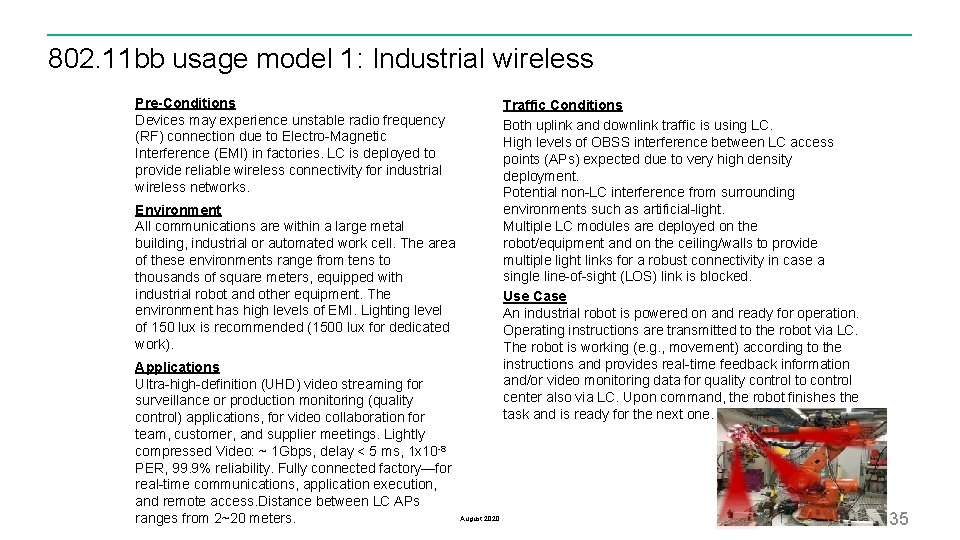
802. 11 bb usage model 1: Industrial wireless Pre-Conditions Devices may experience unstable radio frequency (RF) connection due to Electro-Magnetic Interference (EMI) in factories. LC is deployed to provide reliable wireless connectivity for industrial wireless networks. Traffic Conditions Both uplink and downlink traffic is using LC. High levels of OBSS interference between LC access points (APs) expected due to very high density deployment. Potential non-LC interference from surrounding environments such as artificial-light. Multiple LC modules are deployed on the robot/equipment and on the ceiling/walls to provide multiple light links for a robust connectivity in case a single line-of-sight (LOS) link is blocked. Use Case An industrial robot is powered on and ready for operation. Operating instructions are transmitted to the robot via LC. The robot is working (e. g. , movement) according to the instructions and provides real-time feedback information and/or video monitoring data for quality control to control center also via LC. Upon command, the robot finishes the task and is ready for the next one. Environment All communications are within a large metal building, industrial or automated work cell. The area of these environments range from tens to thousands of square meters, equipped with industrial robot and other equipment. The environment has high levels of EMI. Lighting level of 150 lux is recommended (1500 lux for dedicated work). Applications Ultra-high-definition (UHD) video streaming for surveillance or production monitoring (quality control) applications, for video collaboration for team, customer, and supplier meetings. Lightly compressed Video: ~ 1 Gbps, delay < 5 ms, 1 x 10 -8 PER, 99. 9% reliability. Fully connected factory—for real-time communications, application execution, and remote access. Distance between LC APs ranges from 2~20 meters. August 2020 35
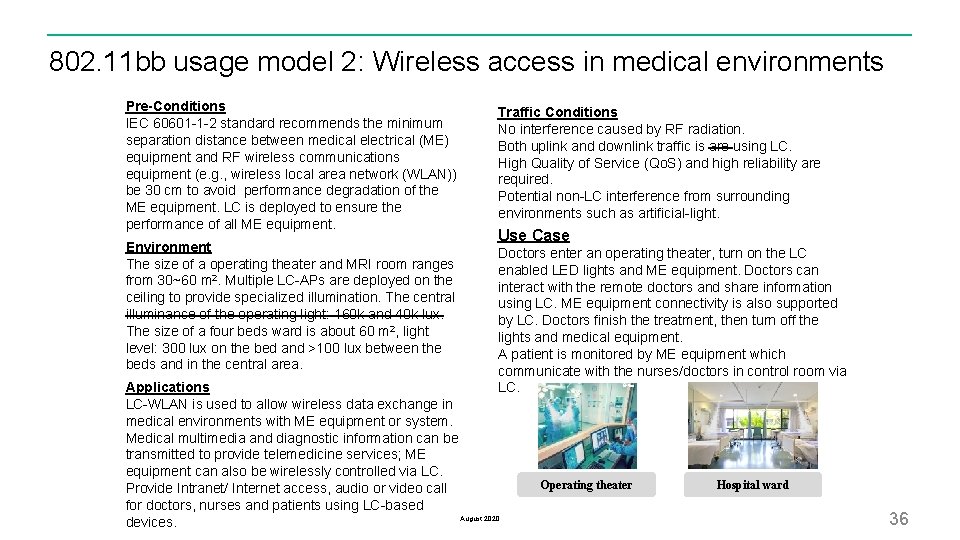
802. 11 bb usage model 2: Wireless access in medical environments Pre-Conditions IEC 60601 -1 -2 standard recommends the minimum separation distance between medical electrical (ME) equipment and RF wireless communications equipment (e. g. , wireless local area network (WLAN)) be 30 cm to avoid performance degradation of the ME equipment. LC is deployed to ensure the performance of all ME equipment. Traffic Conditions No interference caused by RF radiation. Both uplink and downlink traffic is are using LC. High Quality of Service (Qo. S) and high reliability are required. Potential non-LC interference from surrounding environments such as artificial-light. Environment The size of a operating theater and MRI room ranges from 30~60 m 2. Multiple LC-APs are deployed on the ceiling to provide specialized illumination. The central illuminance of the operating light: 160 k and 40 k lux. The size of a four beds ward is about 60 m 2, light level: 300 lux on the bed and >100 lux between the beds and in the central area. Doctors enter an operating theater, turn on the LC enabled LED lights and ME equipment. Doctors can interact with the remote doctors and share information using LC. ME equipment connectivity is also supported by LC. Doctors finish the treatment, then turn off the lights and medical equipment. A patient is monitored by ME equipment which communicate with the nurses/doctors in control room via LC. Use Case Applications LC-WLAN is used to allow wireless data exchange in medical environments with ME equipment or system. Medical multimedia and diagnostic information can be transmitted to provide telemedicine services; ME equipment can also be wirelessly controlled via LC. Provide Intranet/ Internet access, audio or video call for doctors, nurses and patients using LC-based August 2020 devices. © vm Operating theater Hospital ward 36
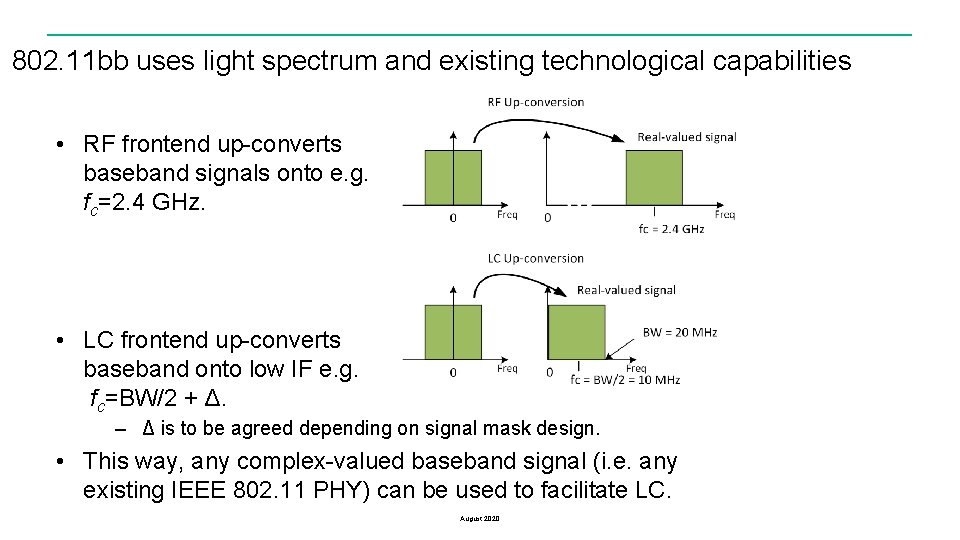
802. 11 bb uses light spectrum and existing technological capabilities • RF frontend up-converts baseband signals onto e. g. fc=2. 4 GHz. • LC frontend up-converts baseband onto low IF e. g. fc=BW/2 + Δ. – Δ is to be agreed depending on signal mask design. • This way, any complex-valued baseband signal (i. e. any existing IEEE 802. 11 PHY) can be used to facilitate LC. August 2020
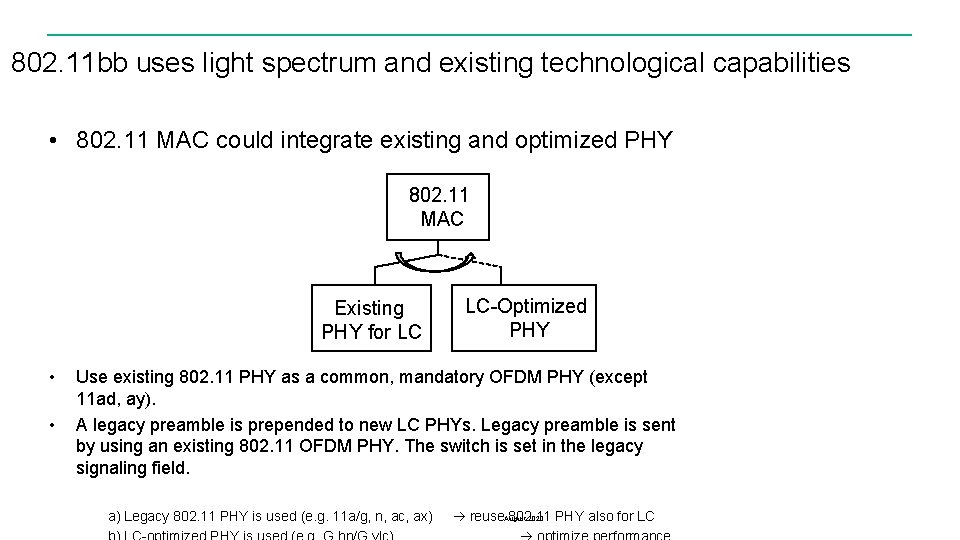
802. 11 bb uses light spectrum and existing technological capabilities • 802. 11 MAC could integrate existing and optimized PHY 802. 11 MAC Existing PHY for LC • • LC-Optimized PHY Use existing 802. 11 PHY as a common, mandatory OFDM PHY (except 11 ad, ay). A legacy preamble is prepended to new LC PHYs. Legacy preamble is sent by using an existing 802. 11 OFDM PHY. The switch is set in the legacy signaling field. a) Legacy 802. 11 PHY is used (e. g. 11 a/g, n, ac, ax) reuse 802. 11 PHY also for LC August 2020
802. 11 bc is defining Enhanced Broadcast Services • Enhanced Broadcast Services (e. BCS) define broadcast service enhancements within an 802. 11 -based network. • Client end devices broadcast information to an AP, e. g. in an Io. T environment, to other STAs so that any of the receiving APs act as an access node to the Internet. August 2020
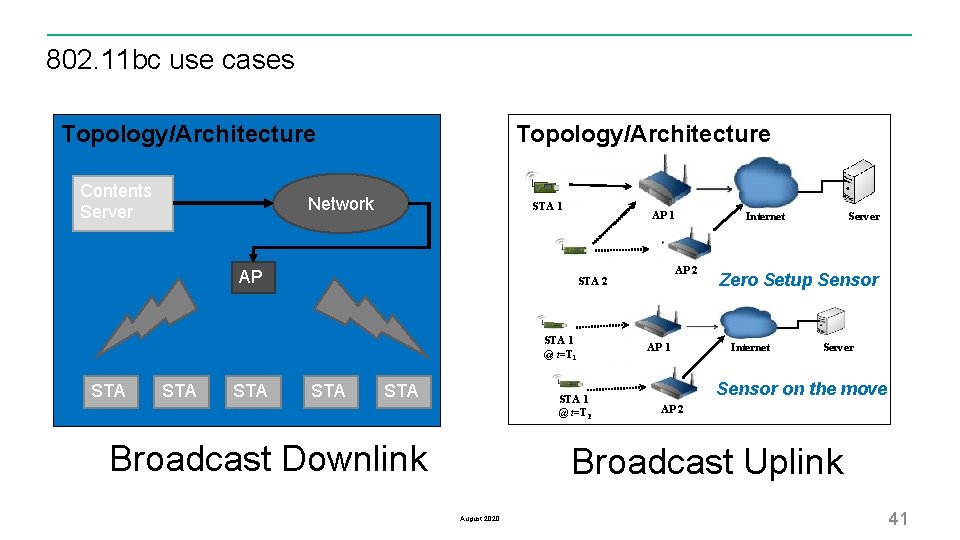
802. 11 bc use cases description • Broadcast Downlink • Provides enhanced Broadcast Services (e. BCS) of data (e. g. videos) to a large number of densely located STAs. These STAs may be associated, or un-associated with the AP or may be low-cost STAs that are receive only. • Broadcast Uplink • Pre-configured devices (e. g. Io. T) automatically connect to the end server through APs with zero setup action required. • Alternatively, low power Io. T devices that are in motion, report to their servers through APs without scanning and associating August 2020
802. 11 bc use cases Topology/Architecture Contents Server Topology/Architecture Network STA 1 AP AP 1 STA 1 @ t=T 1 STA STA AP 2 STA 2 STA STA 1 @ t=T 2 Broadcast Downlink AP 1 Internet Server Zero Setup Sensor Internet Server Sensor on the move AP 2 Broadcast Uplink August 2020 41
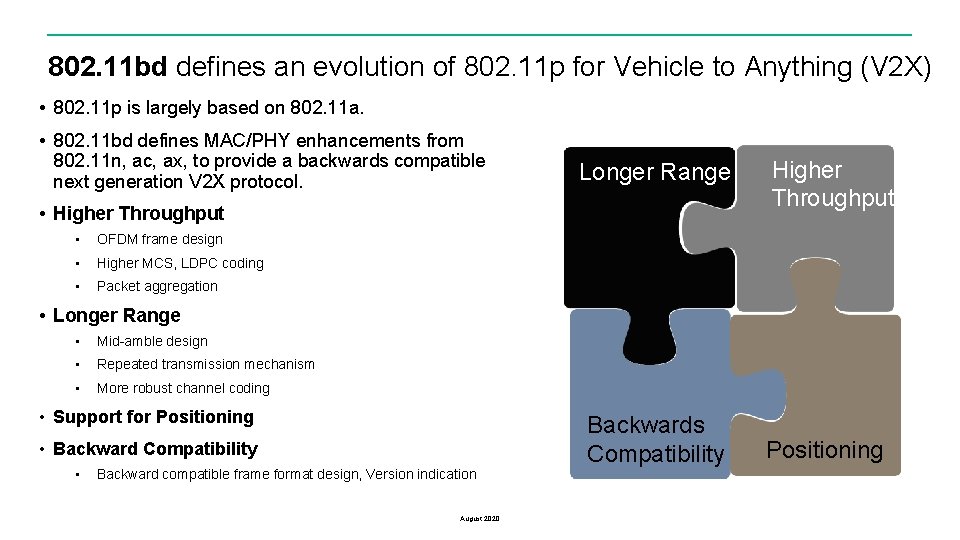
802. 11 bd defines an evolution of 802. 11 p for Vehicle to Anything (V 2 X) • 802. 11 p is largely based on 802. 11 a. • 802. 11 bd defines MAC/PHY enhancements from 802. 11 n, ac, ax, to provide a backwards compatible next generation V 2 X protocol. Longer Range • Higher Throughput • OFDM frame design • Higher MCS, LDPC coding • Packet aggregation Higher Throughput • Longer Range • Mid-amble design • Repeated transmission mechanism • More robust channel coding • Support for Positioning • Backward Compatibility • Backward compatible frame format design, Version indication August 2020 Backwards Compatibility Positioning
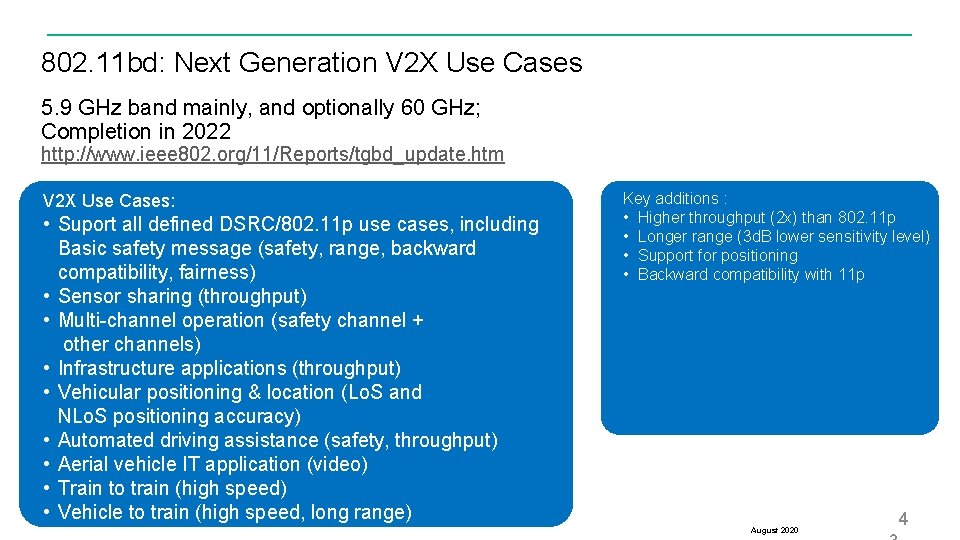
802. 11 bd: Next Generation V 2 X Use Cases 5. 9 GHz band mainly, and optionally 60 GHz; Completion in 2022 http: //www. ieee 802. org/11/Reports/tgbd_update. htm V 2 X Use Cases: • Suport all defined DSRC/802. 11 p use cases, including Basic safety message (safety, range, backward compatibility, fairness) • Sensor sharing (throughput) • Multi-channel operation (safety channel + other channels) • Infrastructure applications (throughput) • Vehicular positioning & location (Lo. S and NLo. S positioning accuracy) • Automated driving assistance (safety, throughput) • Aerial vehicle IT application (video) • Train to train (high speed) • Vehicle to train (high speed, long range) Key additions : • Higher throughput (2 x) than 802. 11 p • Longer range (3 d. B lower sensitivity level) • Support for positioning • Backward compatibility with 11 p August 2020 4
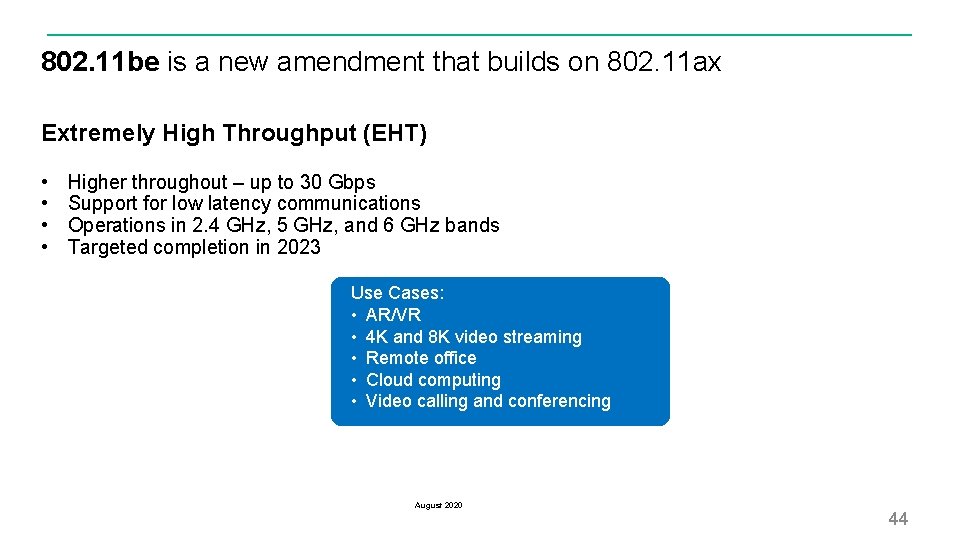
802. 11 be is a new amendment that builds on 802. 11 ax Extremely High Throughput (EHT) • • Higher throughout – up to 30 Gbps Support for low latency communications Operations in 2. 4 GHz, 5 GHz, and 6 GHz bands Targeted completion in 2023 Use Cases: • AR/VR • 4 K and 8 K video streaming • Remote office • Cloud computing • Video calling and conferencing August 2020 44
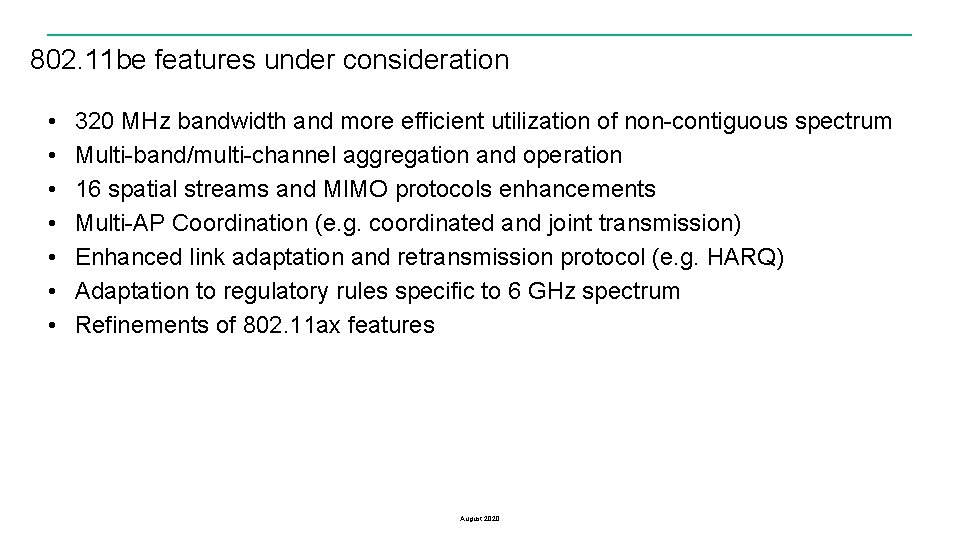
802. 11 be features under consideration • • 320 MHz bandwidth and more efficient utilization of non-contiguous spectrum Multi-band/multi-channel aggregation and operation 16 spatial streams and MIMO protocols enhancements Multi-AP Coordination (e. g. coordinated and joint transmission) Enhanced link adaptation and retransmission protocol (e. g. HARQ) Adaptation to regulatory rules specific to 6 GHz spectrum Refinements of 802. 11 ax features August 2020
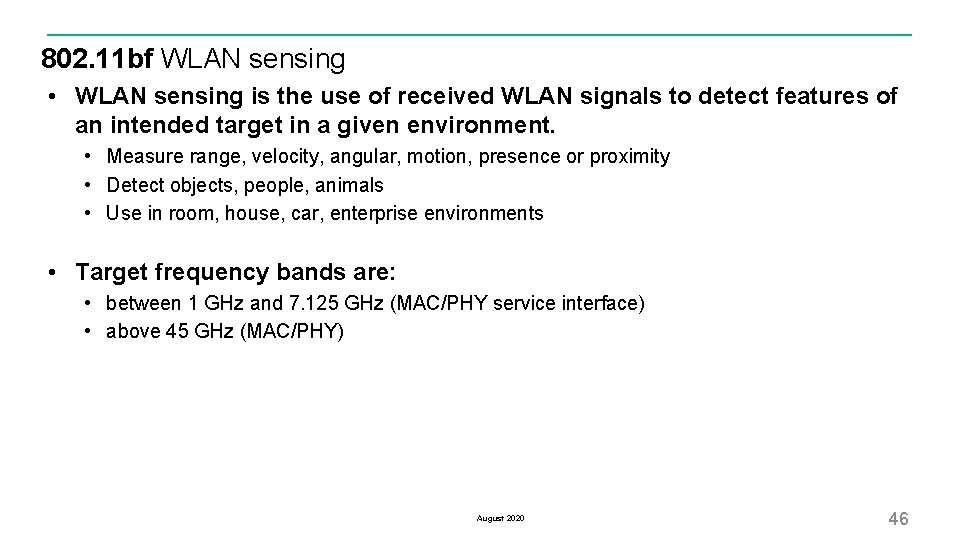
802. 11 bf WLAN sensing • WLAN sensing is the use of received WLAN signals to detect features of an intended target in a given environment. • Measure range, velocity, angular, motion, presence or proximity • Detect objects, people, animals • Use in room, house, car, enterprise environments • Target frequency bands are: • between 1 GHz and 7. 125 GHz (MAC/PHY service interface) • above 45 GHz (MAC/PHY) August 2020 46
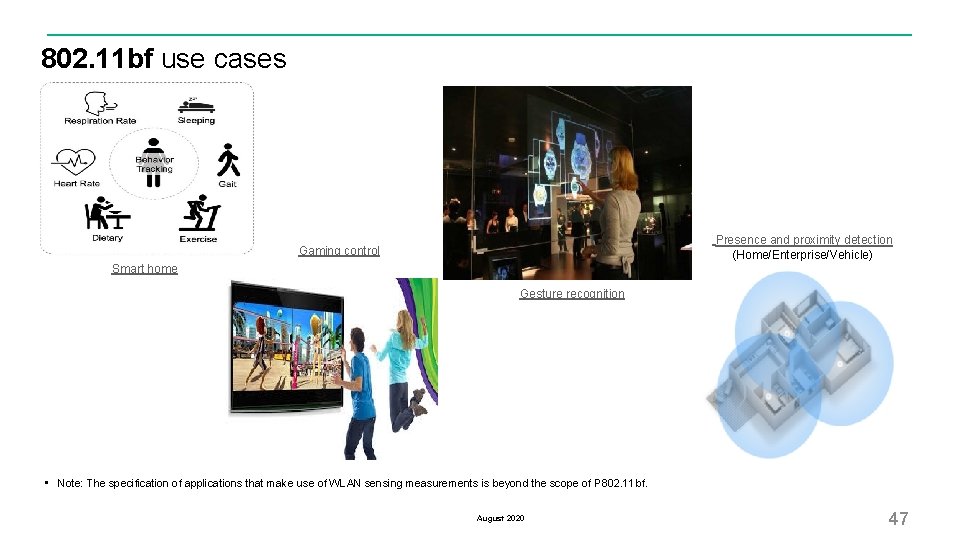
802. 11 bf use cases Presence and proximity detection Gaming control (Home/Enterprise/Vehicle) Smart home Gesture recognition • Note: The specification of applications that make use of WLAN sensing measurements is beyond the scope of P 802. 11 bf. August 2020 47
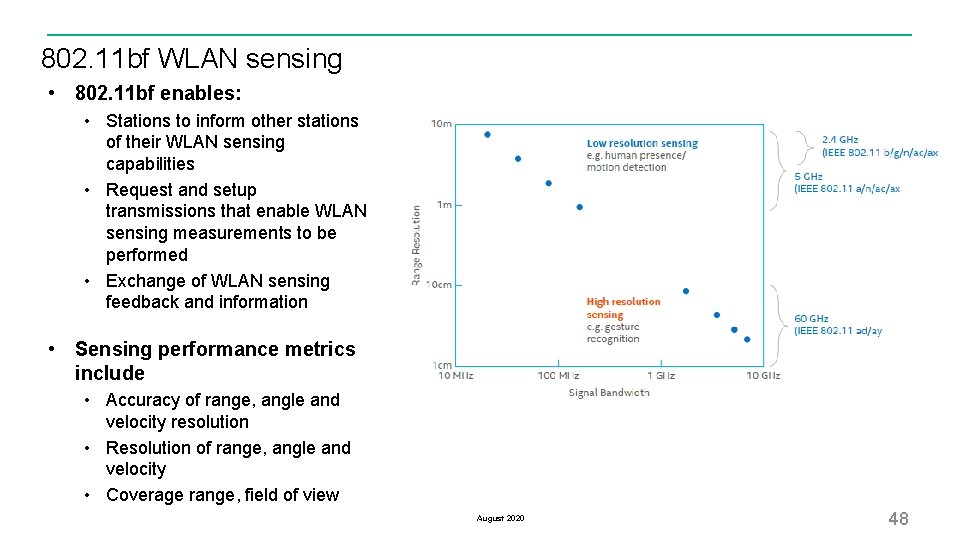
802. 11 bf WLAN sensing • 802. 11 bf enables: • Stations to inform other stations of their WLAN sensing capabilities • Request and setup transmissions that enable WLAN sensing measurements to be performed • Exchange of WLAN sensing feedback and information • Sensing performance metrics include • Accuracy of range, angle and velocity resolution • Resolution of range, angle and velocity • Coverage range, field of view August 2020 48
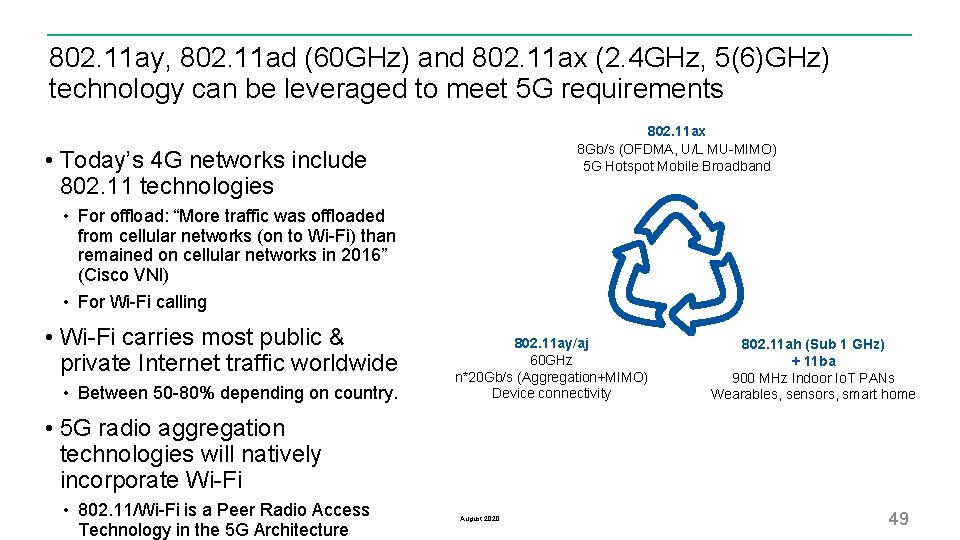
802. 11 ay, 802. 11 ad (60 GHz) and 802. 11 ax (2. 4 GHz, 5(6)GHz) technology can be leveraged to meet 5 G requirements 802. 11 ax 8 Gb/s (OFDMA, U/L MU-MIMO) 5 G Hotspot Mobile Broadband • Today’s 4 G networks include 802. 11 technologies • For offload: “More traffic was offloaded from cellular networks (on to Wi-Fi) than remained on cellular networks in 2016” (Cisco VNI) • For Wi-Fi calling • Wi-Fi carries most public & private Internet traffic worldwide • Between 50 -80% depending on country. 802. 11 ay/aj 60 GHz n*20 Gb/s (Aggregation+MIMO) Device connectivity 802. 11 ah (Sub 1 GHz) + 11 ba 900 MHz Indoor Io. T PANs Wearables, sensors, smart home • 5 G radio aggregation technologies will natively incorporate Wi-Fi • 802. 11/Wi-Fi is a Peer Radio Access Technology in the 5 G Architecture August 2020 49
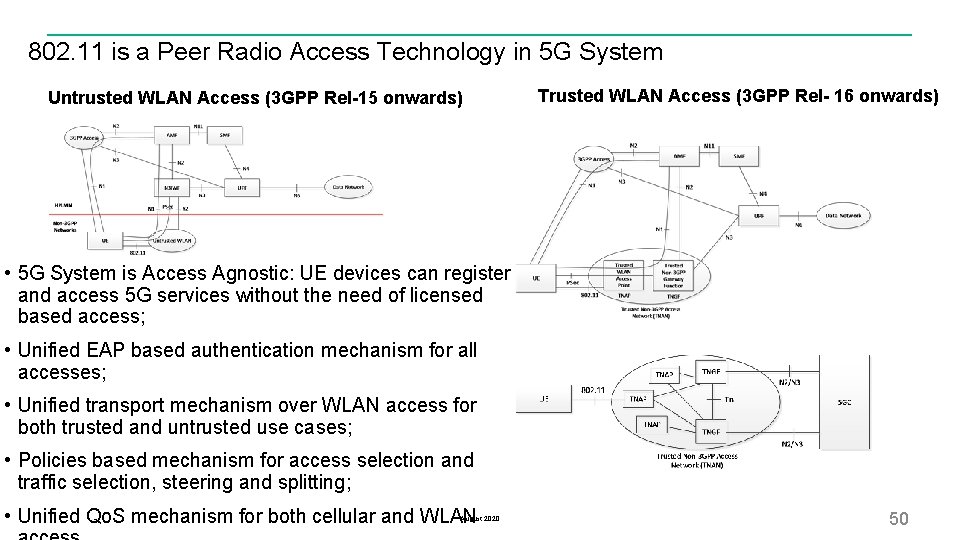
802. 11 is a Peer Radio Access Technology in 5 G System Untrusted WLAN Access (3 GPP Rel-15 onwards) Trusted WLAN Access (3 GPP Rel- 16 onwards) • 5 G System is Access Agnostic: UE devices can register and access 5 G services without the need of licensed based access; • Unified EAP based authentication mechanism for all accesses; • Unified transport mechanism over WLAN access for both trusted and untrusted use cases; • Policies based mechanism for access selection and traffic selection, steering and splitting; • Unified Qo. S mechanism for both cellular and WLAN August 2020 50
802. 11 and cellular radio technologies are largely complementary in meeting the comprehensive 5 G service vision • WLAN access is integral part of the into the 5 G system architecture developed by 3 GPP • 5 G architecture is a functional based architecture • This provides the flexibility that both core network anchoring and the RAN based anchoring from 4 G system are seamlessly supported in 5 G system architecture • 802. 11 defined technologies – 2. 4/5/6/60 GHz and cellular radio technologies are essential – and largely complementary - in meeting the comprehensive 5 G service vision August 2020 51
Thank You Questions August 2020