
IEC TC 111 WG 4 Activities 28 September
IEC TC 111 WG 4 Activities 28 September 2011 IEC/TC 111 Liaison and Environment Policy Division Information & Telecommunication Systems Company Hitachi, Ltd. Osamu NAMIKAWA
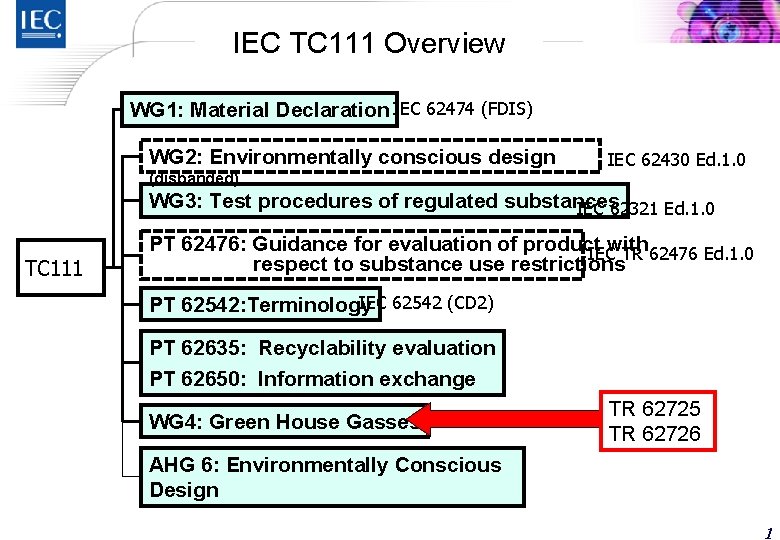
IEC TC 111 Overview WG 1: Material Declaration IEC 62474 (FDIS) WG 2: Environmentally conscious design (disbanded) IEC 62430 Ed. 1. 0 WG 3: Test procedures of regulated substances IEC 62321 Ed. 1. 0 TC 111 PT 62476: Guidance for evaluation of product with IEC TR 62476 Ed. 1. 0 respect to substance use restrictions IEC 62542 (CD 2) PT 62542: Terminology PT 62635: Recyclability evaluation PT 62650: Information exchange WG 4: Green House Gasses TR 62725 TR 62726 AHG 6: Environmentally Conscious Design PAS 62596 Ed. 1. 0: Sampling procedure 1
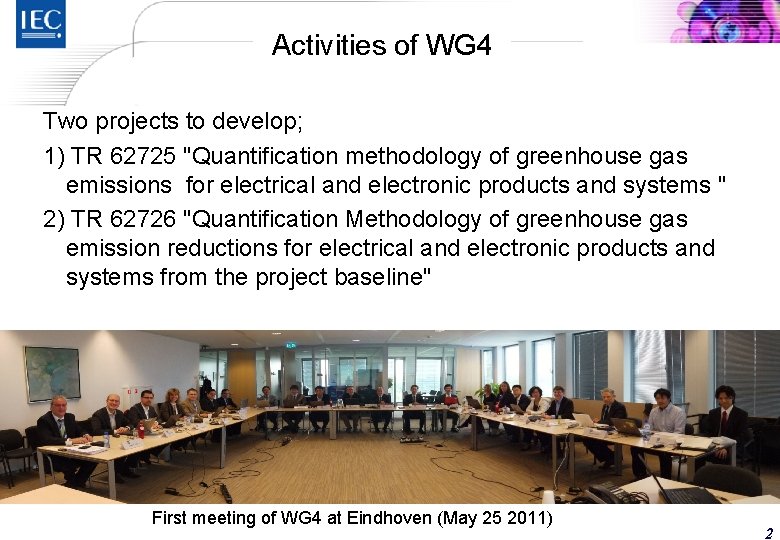
Activities of WG 4 Two projects to develop; 1) TR 62725 "Quantification methodology of greenhouse gas emissions for electrical and electronic products and systems " 2) TR 62726 "Quantification Methodology of greenhouse gas emission reductions for electrical and electronic products and systems from the project baseline" First meeting of WG 4 at Eindhoven (May 25 2011) 2
1 TR 62725 (product carbon footprint) 3
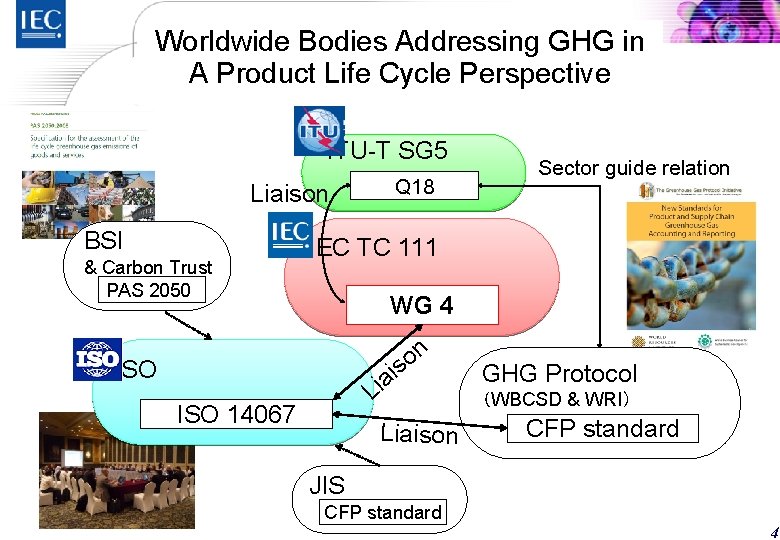
Worldwide Bodies Addressing GHG in A Product Life Cycle Perspective ITU-T SG 5 Liaison BSI & Carbon Trust PAS 2050 Q 18 Sector guide relation IEC TC 111 WG 4 ISO a Li ISO 14067 n o is Liaison GHG Protocol (WBCSD & WRI) CFP standard JIS CFP standard 4
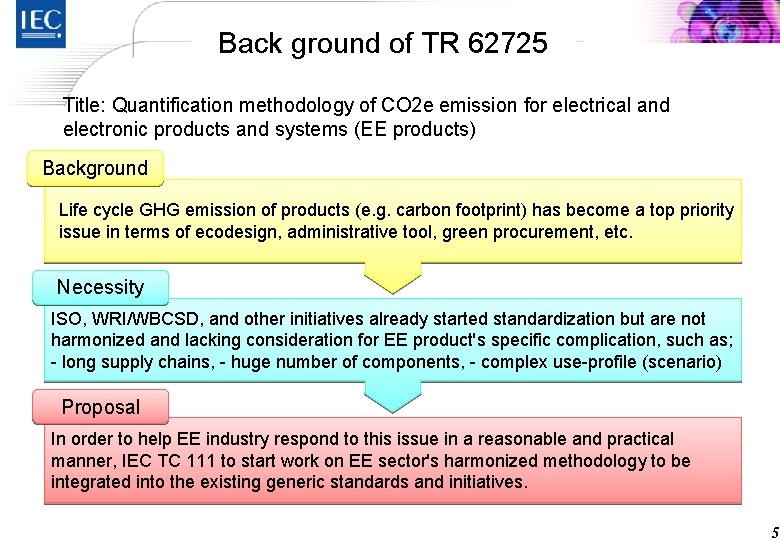
Back ground of TR 62725 Title: Quantification methodology of CO 2 e emission for electrical and electronic products and systems (EE products) Background Life cycle GHG emission of products (e. g. carbon footprint) has become a top priority issue in terms of ecodesign, administrative tool, green procurement, etc. Necessity ISO, WRI/WBCSD, and other initiatives already started standardization but are not harmonized and lacking consideration for EE product's specific complication, such as; - long supply chains, - huge number of components, - complex use-profile (scenario) Proposal In order to help EE industry respond to this issue in a reasonable and practical manner, IEC TC 111 to start work on EE sector's harmonized methodology to be integrated into the existing generic standards and initiatives. 5

Scope - 111/204/NP – TR 62725 ■ TR 62725 describes principles and guidance to quantify greenhouse gas emissions (CO 2 e) for EE products* based on the life-cycle thinking and is applicable to any type of EE products, which are new or modified. ➢Intended to be used by those involved in design and development of EE products, and their supply chains regardless of industry sectors, regions, types, activities and sizes of organizations. ➢Intended to guidance for implementing Carbon Footprint of Products (CFP) and relevant product category rules of EE products. ➢Intended facilitate product specific sectors to generate their own, more specific, standards or guidelines if needed. *products any goods or service Note: This includes interconnected and/or interrelated goods or services 6

Relation to Existing Std. – TR 62725 WBCSD/WRI GHG Protocol Issue (Target) Schedule: Oct, 2011 Scope 3 Accounting Report standard Product Life Cycle Accounting & Report standard ISO TC 207 SC 7 GHG Management ISO 14067 : Carbon footprint of products – Quantification & Communication Issue (Target) Schedule: latter half of 2012? Reference / Sector specific Liaison IEC TC 111 Subject TR 62725 Quantification methodology of greenhouse gas emissions (CO 2 e) for “EE products & service sector” GHG Assessment methodology for “EE products and service sector” (a)Guidance document - Quantification methodology of GHG emissions (CO 2 e) for EE products (b)Guidance document - Making of PCR according to each product category for EE products Issue (Target) Schedule: 2012 üCO 2 e emissions for Product Life cycle Liaison ICT Sector specific ITU-T SG-5 Issue (Target) Schedule: 2011 IEC Product TCs 7
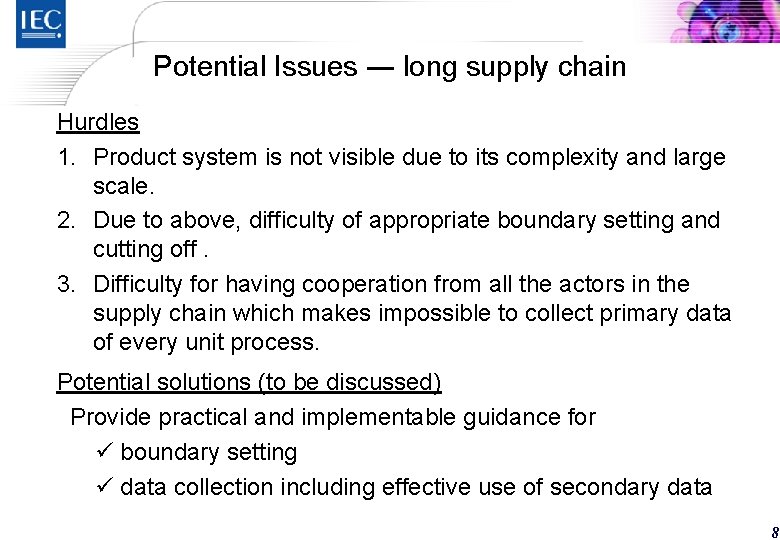
Potential Issues ― long supply chain Hurdles 1. Product system is not visible due to its complexity and large scale. 2. Due to above, difficulty of appropriate boundary setting and cutting off. 3. Difficulty for having cooperation from all the actors in the supply chain which makes impossible to collect primary data of every unit process. Potential solutions (to be discussed) Provide practical and implementable guidance for ü boundary setting ü data collection including effective use of secondary data 8
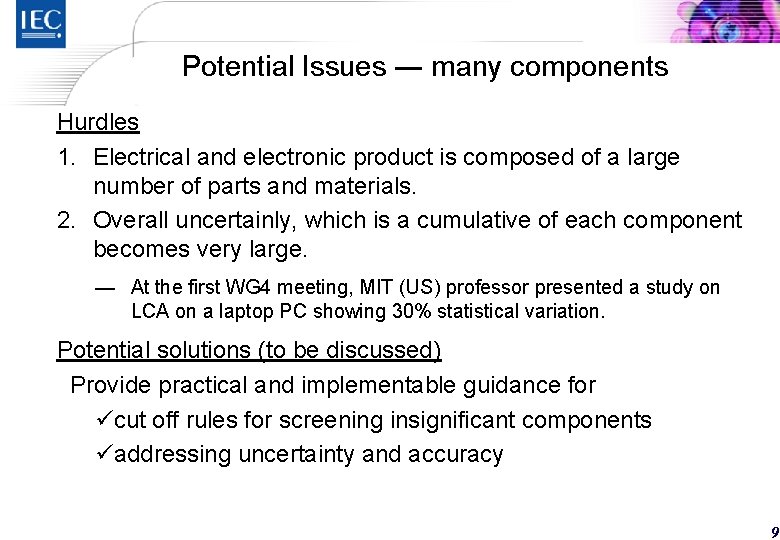
Potential Issues ― many components Hurdles 1. Electrical and electronic product is composed of a large number of parts and materials. 2. Overall uncertainly, which is a cumulative of each component becomes very large. — At the first WG 4 meeting, MIT (US) professor presented a study on LCA on a laptop PC showing 30% statistical variation. Potential solutions (to be discussed) Provide practical and implementable guidance for ücut off rules for screening insignificant components üaddressing uncertainty and accuracy 9
Potential Issues ― use stage Hurdles 1. Electrical and electronic products emit significant amount of CO 2 in the "use stage" in contrast to other industry. 2. The use profile or scenario may largely vary and lead to a large difference in results. Potential solutions (to be discussed) Provide practical and implementable guidance for üsetting an appropriate use profile for energy-using products üavoiding inappropriate comparison or misleading use of the results. 10
2 TR 62726 (enabling effect) 11
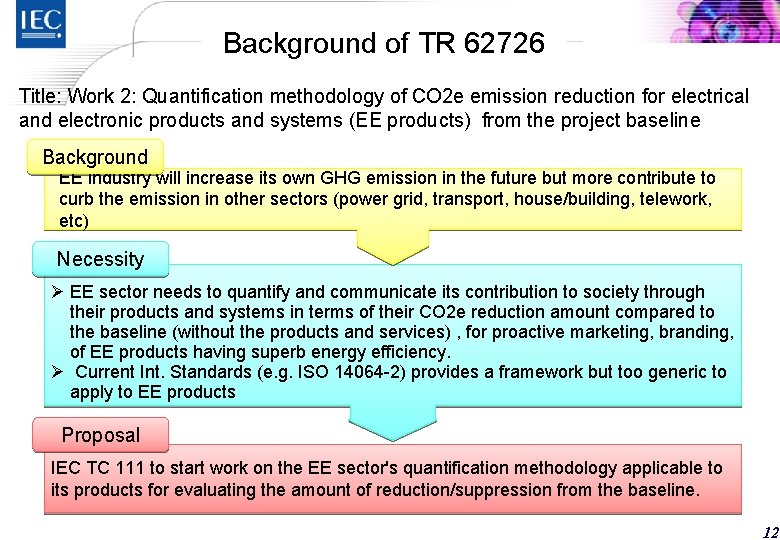
Background of TR 62726 Title: Work 2: Quantification methodology of CO 2 e emission reduction for electrical and electronic products and systems (EE products) from the project baseline Background EE industry will increase its own GHG emission in the future but more contribute to curb the emission in other sectors (power grid, transport, house/building, telework, etc) Necessity Ø EE sector needs to quantify and communicate its contribution to society through their products and systems in terms of their CO 2 e reduction amount compared to the baseline (without the products and services) , for proactive marketing, branding, of EE products having superb energy efficiency. Ø Current Int. Standards (e. g. ISO 14064 -2) provides a framework but too generic to apply to EE products Proposal IEC TC 111 to start work on the EE sector's quantification methodology applicable to its products for evaluating the amount of reduction/suppression from the baseline. 12
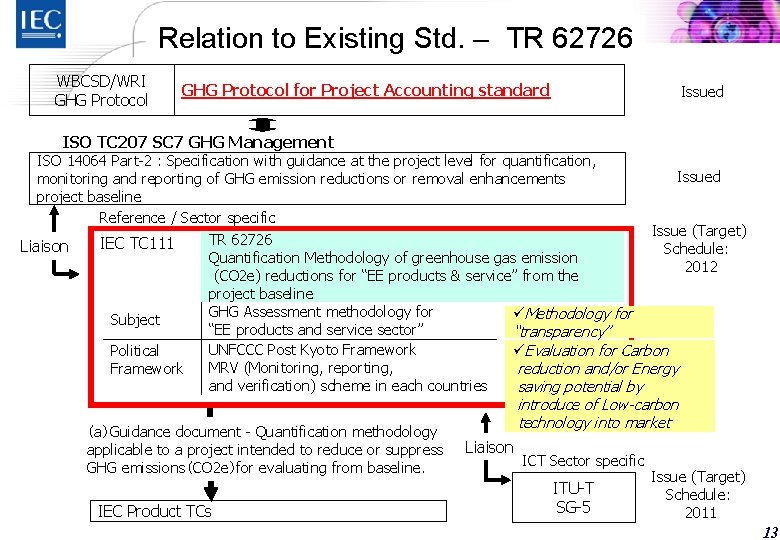
Relation to Existing Std. – TR 62726 WBCSD/WRI GHG Protocol for Project Accounting standard Issued ISO TC 207 SC 7 GHG Management ISO 14064 Part-2 : Specification with guidance at the project level for quantification, Issued monitoring and reporting of GHG emission reductions or removal enhancements project baseline Reference / Sector specific Issue (Target) TR 62726 IEC TC 111 Liaison Schedule: Quantification Methodology of greenhouse gas emission 2012 (CO 2 e) reductions for “EE products & service” from the project baseline GHG Assessment methodology for üMethodology for Subject “EE products and service sector” “transparency” UNFCCC Post Kyoto Framework üEvaluation for Carbon Political MRV (Monitoring, reporting, reduction and/or Energy Framework and verification) scheme in each countries saving potential by (a)Guidance document - Quantification methodology applicable to a project intended to reduce or suppress GHG emissions(CO 2 e)for evaluating from baseline. IEC Product TCs introduce of Low-carbon technology into market Liaison ICT Sector specific ITU-T SG-5 Issue (Target) Schedule: 2011 13
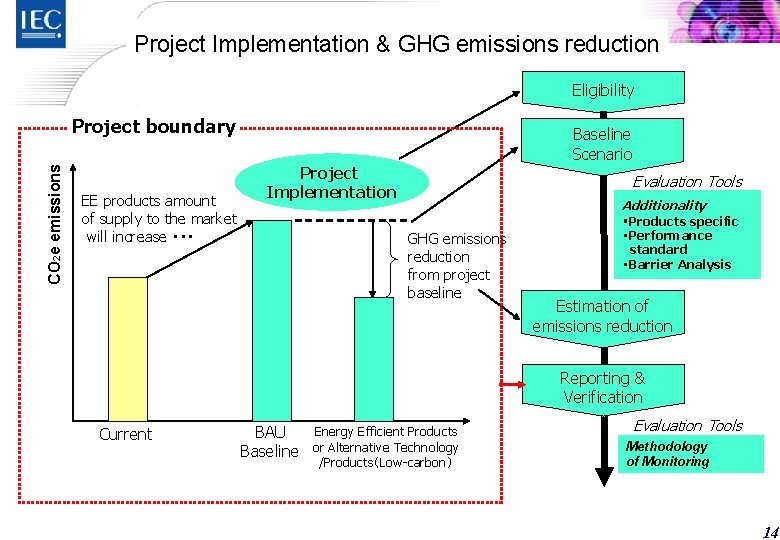
Project Implementation & GHG emissions reduction Eligibility CO 2 e emissions Project boundary EE products amount of supply to the market will increase ・・・ Baseline Scenario Project Implementation Evaluation Tools Additionality GHG emissions reduction from project baseline ・Products specific ・Performance standard ・Barrier Analysis Estimation of emissions reduction Reporting & Verification Current Energy Efficient Products BAU or Alternative Technology Baseline /Products(Low-carbon) Evaluation Tools Methodology of Monitoring 14

3 Schedule 15
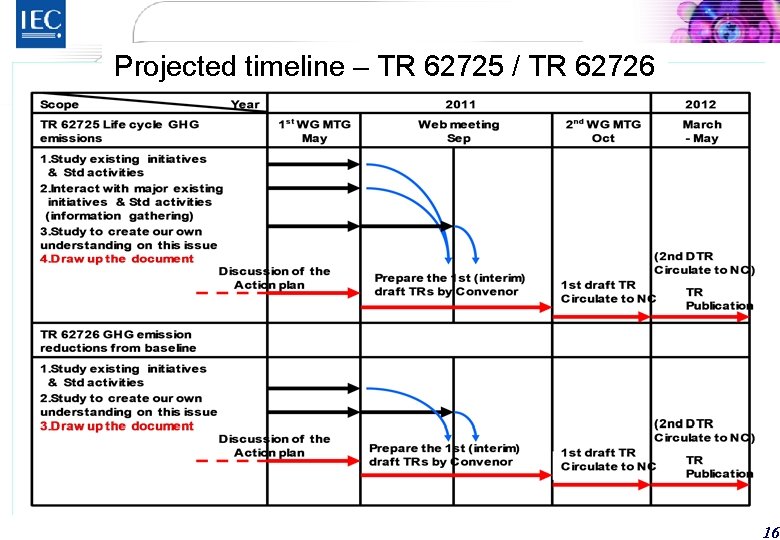
Projected timeline – TR 62725 / TR 62726 16
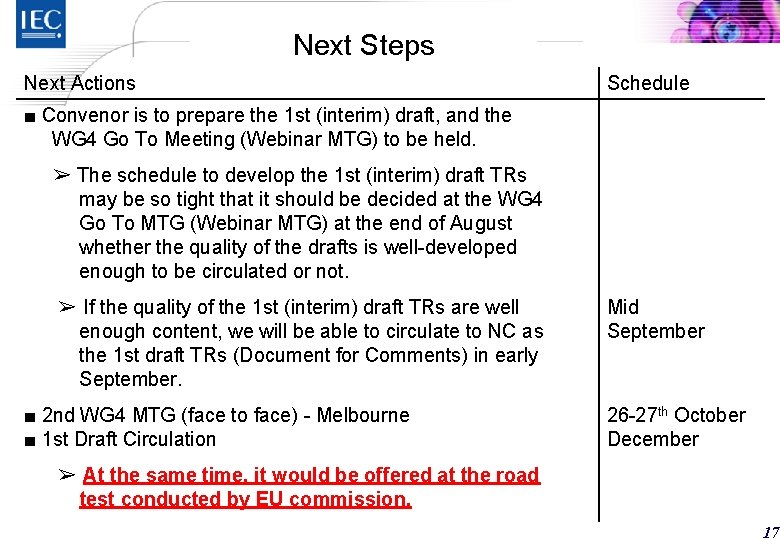
Next Steps Next Actions Schedule ■ Convenor is to prepare the 1 st (interim) draft, and the WG 4 Go To Meeting (Webinar MTG) to be held. ➢ The schedule to develop the 1 st (interim) draft TRs may be so tight that it should be decided at the WG 4 Go To MTG (Webinar MTG) at the end of August whether the quality of the drafts is well-developed enough to be circulated or not. ➢ If the quality of the 1 st (interim) draft TRs are well enough content, we will be able to circulate to NC as the 1 st draft TRs (Document for Comments) in early September. ■ 2 nd WG 4 MTG (face to face) - Melbourne ■ 1 st Draft Circulation Mid September 26 -27 th October December ➢ At the same time, it would be offered at the road test conducted by EU commission. 17
Thank you for your attention Contact Dr. Yoshiaki ICHIKAWA IEC TC 111 Chair Hitachi, Ltd. Mail : yoshiaki. ichikawa. rb@hitachi. com Mr. Kiyoshi SAITO IEC TC 111 WG 4 Convenor Japan Electrical Manufacturers' Association 18
- Slides: 19