
IDPH Obstetric Hemorrhage Update Olga Marrero DNP APN
IDPH Obstetric Hemorrhage Update Olga Marrero DNP, APN, RN-BC, IBCLC, Clinical Nurse Specialist, UIC Dimitrios Mastrogiannis, MD, Ph. D, MBA, FACOG, MFM Division Director, Co-Perinatal Center Director Debbie Schy, RNC-OB, C-EFM, MSN, IBCLC, APN/CNS, LCCE, OB Outreach Education, Lutheran Kim Kocur, RNC-OB, MSN, APN/CNS, Perinatal Coordinator, Christ Shirley Scott, MS, RN-BC, OB-EFM, APN, Perinatal Outreach Educator , UIC Maripat Zeschke, MSN, RNC-EFM, Network Administrator, UIC

Hemorrhage Course Goals To improve: Risk assessment and preparation for possible hemorrhage Quantification of blood loss (QBL) Recognition and treatment of hemorrhage/hypovolemia To review: How to initiate the obstetric and/or hospital wide Rapid Response team How to initiate the hospital’s rapid transfusion protocol The protocol for quantification of blood loss The protocol for active management of the third stage of labor
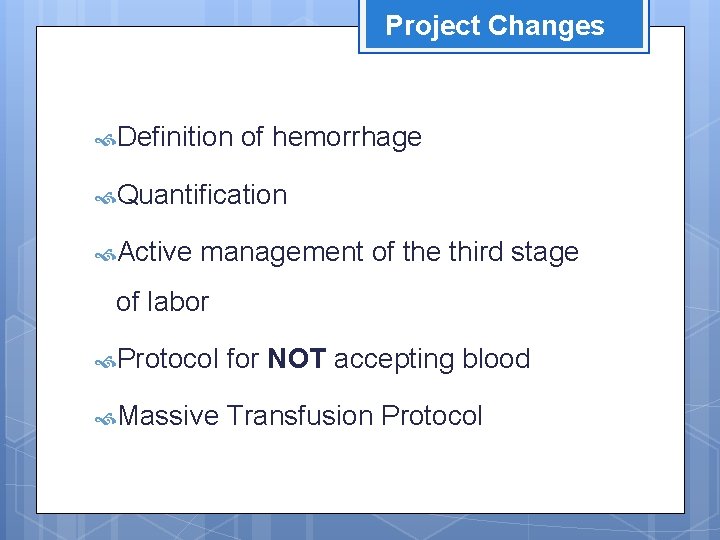
Project Changes Definition of hemorrhage Quantification Active management of the third stage of labor Protocol for NOT accepting blood Massive Transfusion Protocol
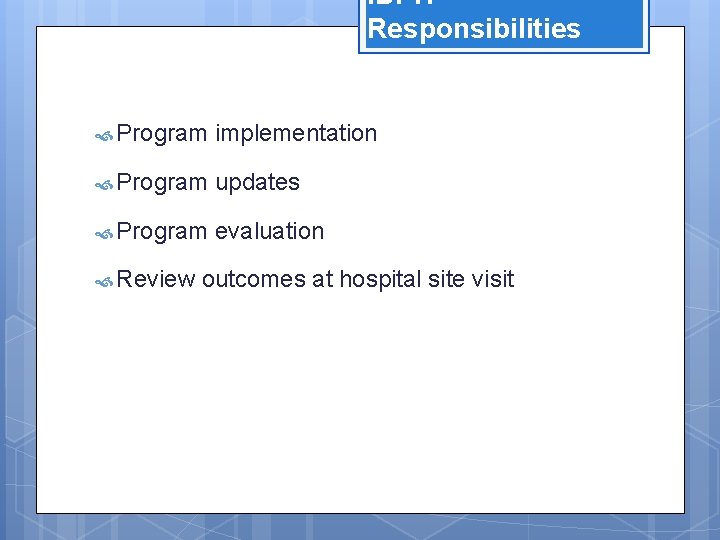
IDPH Responsibilities Program implementation Program updates Program evaluation Review outcomes at hospital site visit
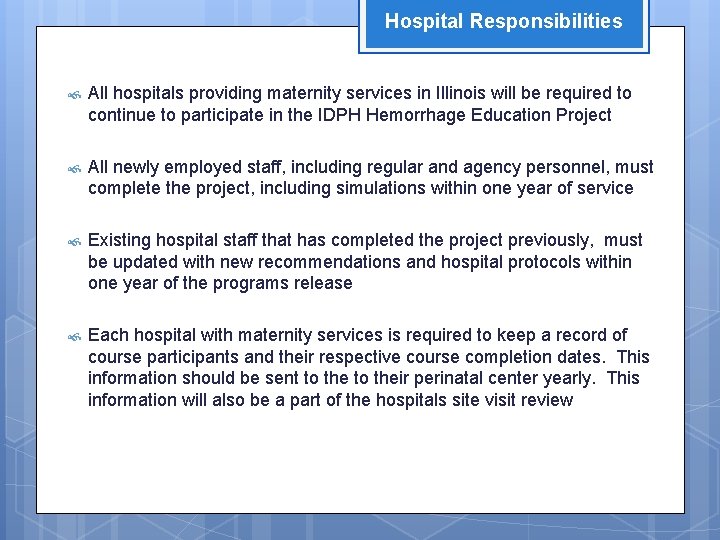
Hospital Responsibilities All hospitals providing maternity services in Illinois will be required to continue to participate in the IDPH Hemorrhage Education Project All newly employed staff, including regular and agency personnel, must complete the project, including simulations within one year of service Existing hospital staff that has completed the project previously, must be updated with new recommendations and hospital protocols within one year of the programs release Each hospital with maternity services is required to keep a record of course participants and their respective course completion dates. This information should be sent to their perinatal center yearly. This information will also be a part of the hospitals site visit review
Hospital Responsibilities Based on individual hospital resources, each hospital providing maternity services in Illinois will: Identify internal strengths and challenges in recognizing and managing patients experiencing obstetric hemorrhage All new members of the Obstetric Care Provider team to demonstrate completion of all components of the Obstetric Hemorrhage Education Project Continue to review patient who received > 4 units of blood for appropriate care, which is part of their continuous quality improvement program and morbidity and mortality review meetings Update hemorrhage policies /guidelines Continue with simulated drills and debriefing of simulated and actual cases

Hospital Deliverables Incorporate the definition of Perinatal Hemorrhage into hospital documentation Quantification of blood loss for all deliveries Active management of the third stage of labor for vaginal deliveries Establishing a protocol for patients who desire not to accept blood products Development and implementation of a OB Massive transfusion protocol for OB patients* Documentation of new and existing staff completion of the program
Hemorrhage Manual Review
Benchmark Assessment Purpose To assess the individual participant’s baseline knowledge To determine the knowledge base of staff To customize the program to most effectively meet the needs of the participants To assess program efficacy based on preassessment versus post-assessment validation scores
Benchmark Assessment Hospital Facilitators / Champions Responsibilities: From the test bank, select 25 test questions* Administer the assessment in the most time-effective method that does not compromise the integrity of the assessment questions Ensure participants take the benchmark validation assessment prior to participating in the lecture, discussion, skill station and drill Promote targeted teaching, review/clarify assessment outcome information during the lecture and drill Establish a system for scoring and recording assessment scores as well as tracking completion and reporting progress to the Perinatal Center Distribute and score the Benchmark Assessment Validation Offer and summarize Benchmark Assessment Validation and initiate group discussion to review answers with rationales *The same questionnaire will be used to assess the participant’s baseline knowledge prior to the education and should be repeated six months after the completion of the education
Didactic Lecture and Discussion Program Goal: Recognition and Prevention of Morbidity and Mortality from Obstetric Hemorrhage Lecture focus to improve upon: Risk assessment and preparation for OB hemorrhage Quantification of blood loss (QBL) Recognition and treatment of hemorrhage/hypovolemia
Didactic Lecture and Discussion Hospital Facilitators / Champions Responsibilities: Using the Power. Point© presentation developed by the OB Hemorrhage Education Project Workgroup, discuss key points of risk assessment, identification, diagnosis, treatment/interventions, communication and documentation Personalize information by incorporating hospital specific components into the didactic lecture: Each slide has a script with key points to emphasize Incorporation of hemorrhage definition into current documentation Current Massive transfusion/Hemorrhage Policy Current Rapid Response Policy Current par/baseline levels and turnaround times for blood products (can be taken from the hospital assessment) Expected lab results times Discuss other available hospital resources Example: Interventional Radiology, Surgical Subspecialists Quantification of blood loss Active management of the third stage of labor for vaginal deliveries Patients who desire not to accept blood products
Skill Stations Purpose To promote accurate quantification of blood loss by weighing clean and used hospital materials. For example: Peripads Disposable underpads Laparotomy sponges (18 X 18 in. ) 4 X 4 gauze squares Categorize the severity of blood loss Advocate for the practice of weighing blood-soaked items as the most accurate assessment of blood loss Review the dry weight of the most common hospital items (e. g. chux, peripads) Review process for using graduated drapes for vaginal deliveries Review how to measure blood loss during all deliveries Review surgical and nonsurgical techniques to decrease bleeding
Skill Stations Hospital Facilitators / Champions Responsibilities: Make imitation blood and clots, recipes included at the end of this section and in hemorrhage supply kit Determine dry weights of all products used for blood absorption Weigh peripads and lap sponges for saturation volumes Make a product chart and post Gather supplies Check participants answers
Simulation and Debriefing Purpose To plan and implement collaborative practice obstetric hemorrhage mock drills Facilitate interdisciplinary teamwork in a non- threating environment Identify potential needs for change and enhance communication and skill
Simulation and Debriefing Hospital Facilitators / Champions Responsibilities: Observe, record start and end times, and debrief participants on the mock drill Documents performance of the drill using the mock drill checklist (included at end of this section Implement a debriefing session after each mock drill is completed Complete debriefing evaluation tool for each mock drill

Debriefing Slides Kim
What is Debriefing? Facilitated discussion among team members about events that just occurred Facilitator’s job is to enable self-discovery among team members about What went well and why it went well What needs to improve and how that should be done
Feedback vs. Debriefing is a facilitated discussion Feedback is giving provisional information The amount of instructor feedback needed is inversely proportional to experience of the team members

Debriefing is Important The debriefing session is a necessary part of the simulation experience A great deal of learning takes place at the debriefing session
Good Facilitators are Important They must possess both good interpersonal skills and good communication skills *Mayo Clinic Simulation Workshop-September, 2008
Key points for good debriefing Facilitators should come prepared for the session Know your audience Know the goals & objectives (of the simulation) Know your co-debriefer *Mayo Clinic Simulation Workshop-September, 2008
Key points for good debriefing Facilitators should brush-up on basic debriefing principals Review debriefing sections under Tab 6 in your IDPH Obstetric Hemorrhage Education Project Instructor’s Resource Manual Take time to read a comprehensive debriefing article for tips. I liked: Rudolph, J. W. , Simon, R. , Rivard, P. , Dufresne, R. L. , Raemer, D. B. (2007) Debriefing with good judgment: combining rigorous feedback with genuine inquiry. Anesthesiology Clinics. 25(2): 361 -376.
Key points for good debriefing Facilitators should familiarize themselves with the principals of adult learning, assuming learners are independent, self-directed individuals Establish an effective learning climate where learners feel safe and comfortable expressing themselves Involve learners in evaluating their own learning-this can develop their skills of critical reflection *Knowles, MS & Associates. Andragogy in action: applying modern principals of adult learning. San Francisco: Josey-Bass 1984
Key points for good debriefing Facilitators should encourage group participation Engage all learners Model attentiveness Pay attention to who has spoken and who has not Restrain yourself from conveying your viewpoint Believe the learners can teach you Have faith learners can work through their own problems *Mayo Clinic Simulation Workshop-September, 2008
Key points for good debriefing Set Ground Rules This session will last approximately _____minutes This is a protected environment- what is said in this room, should stay in this room Simulation is a safe environment. It’s ok to make mistakes and talk about them-they are learning experiences We will be respectful of each other
Key points for good debriefing Suggested statement for opening comments State: “Everyone should help make this discussion as rich as possible by: Contributing their ideas Leaving time for others to do the same Listening and learning from each other *IDPH Obstetric Hemorrhage Education Project Instructor’s Resource Manual
Key points for good debriefing Additional Suggestions Progress through debriefing on some type of agenda Chronologic review of events “What happened when you first entered the room? ” Point-by-point according to learning objectives “Let’s talk about objective 2 which is team work? ” Observation by observation “Who was the team leader? ”
Key points for good debriefing Try to avoid a judgmental approach, one which might include harsh criticism and humiliation Example: “Can anyone tell me Patty’s big mistake? ” People may not feel safe and might be reluctant to raise questions, interfering with the learning process. * Rudolph, J. W. , Simon, R. , Rivard, P. , Dufresne, R. L. , Raemer, D. B. (2007) Debriefing with good judgment: combining rigorous feedback with genuine inquiry.
Key points for good debriefing But don’t be overly “nonjudgmental” either Example: " What do you think would have been a better idea? ” Although it allows the learner to save face, the critical message, i. e. : a mistake was made, might not be fully understood * Rudolph, J. W. , Simon, R. , Rivard, P. , Dufresne, R. L. , Raemer, D. B. (2007) Debriefing with good judgment: combining rigorous feedback with genuine inquiry

Key points for good debriefing Instead use the “good judgment approach”, which values the expert opinions and perspectives of both the facilitator and the learner Example: “I noticed you did not draw a specimen for type and cross- from my point of view it seemed problematic. I’m curious, How were you seeing the situation at that point in time? ” Helps the learner move toward learning objective * Rudolph, J. W. , Simon, R. , Rivard, P. , Dufresne, R. L. , Raemer, D. B. (2007) Debriefing with good judgment: combining rigorous feedback with genuine inquiry
Key points for good debriefing Facilitators should practice thie art of “Advocacy/Inquiry” 1 st : Putting observations/thoughts into an ADVOCACY statement Then, following up with probing INQUIRY Example: " It is hard to challenge a colleague even when they are wrong. Can you help me understand what might have prevented you from speaking up, when the resident ordered the wrong dose. ” * Argyris, C. , Putnam, R. , & Mc. Lain Smith, D. (1985) Action Science: Concepts, Methods, and Skills for Research and Intervention

Key points for good debriefing Questions to Dig Deeper “Tell us more about that…” “What would have happened if…” “Who else observed this? What did you notice, and what were you thinking about? ” “Why was that helpful? ”
Key points for good debriefing Videotaping Optional Be proficient in the use of the video, if you intend to tape the sessions Know how to index important event Select 1 -1. 5 minute long segments Do not show a video segment unless you intend to discuss it Pause video for comments It can help learners see the big picture of team dynamics But … some people may find it to be intimidating *Mayo Clinic Simulation Workshop-September, 2008
Key points for good debriefing Closing Remarks Ask “What was the single most important principle you learned from this experience today? ” Thank the participants for sharing *IDPH Obstetric Hemorrhage Education Project Instructor’s Resource Manual
References Mayo Clinic Simulation Workshop-September 24 th, 25 th, 26 th, 2008. Mayo Clinic, Rochester MN. IDPH Obstetric Hemorrhage Education Project Instructor’s Resource Manual, August 2008 Rudolph, J. W. , Simon, R. , Rivard, P. , Dufresne, R. L. , Raemer, D. B. (2007) Debriefing with good judgment: combining rigorous feedback with genuine inquiry. Anesthesiology Clinics. 25(2): 361 -376. Knowles, MS & Associates. Andragogy in action: applying modern principals of adult learning. San Francisco: Josey-Bass 1984 Argyris, C. , Putnam, R. , & Mc. Lain Smith, D. (1985) Action Science: Concepts, Methods, and Skills for Research and Intervention

Quality Improvement
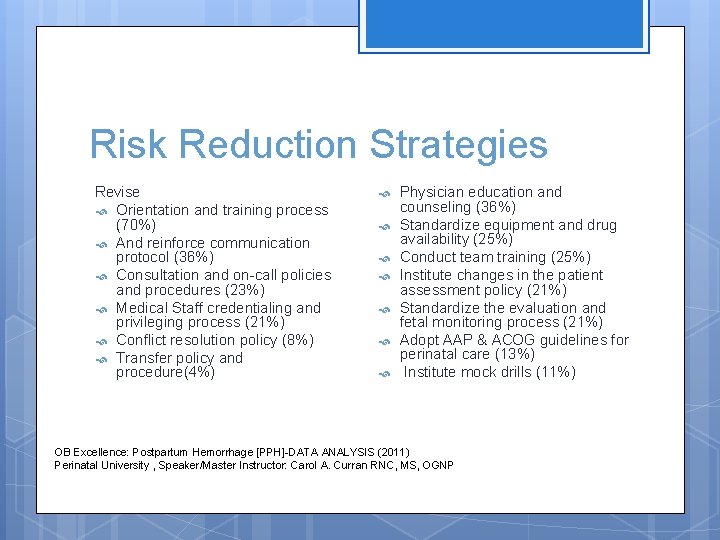
Risk Reduction Strategies Revise Orientation and training process (70%) And reinforce communication protocol (36%) Consultation and on-call policies and procedures (23%) Medical Staff credentialing and privileging process (21%) Conflict resolution policy (8%) Transfer policy and procedure(4%) Physician education and counseling (36%) Standardize equipment and drug availability (25%) Conduct team training (25%) Institute changes in the patient assessment policy (21%) Standardize the evaluation and fetal monitoring process (21%) Adopt AAP & ACOG guidelines for perinatal care (13%) Institute mock drills (11%) OB Excellence: Postpartum Hemorrhage [PPH]-DATA ANALYSIS (2011) Perinatal University , Speaker/Master Instructor: Carol A. Curran RNC, MS, OGNP
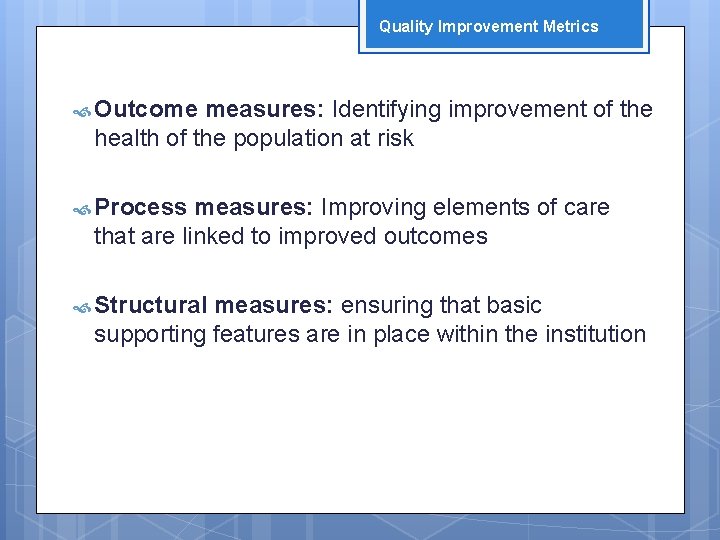
Quality Improvement Metrics Outcome measures: Identifying improvement of the health of the population at risk Process measures: Improving elements of care that are linked to improved outcomes Structural measures: ensuring that basic supporting features are in place within the institution
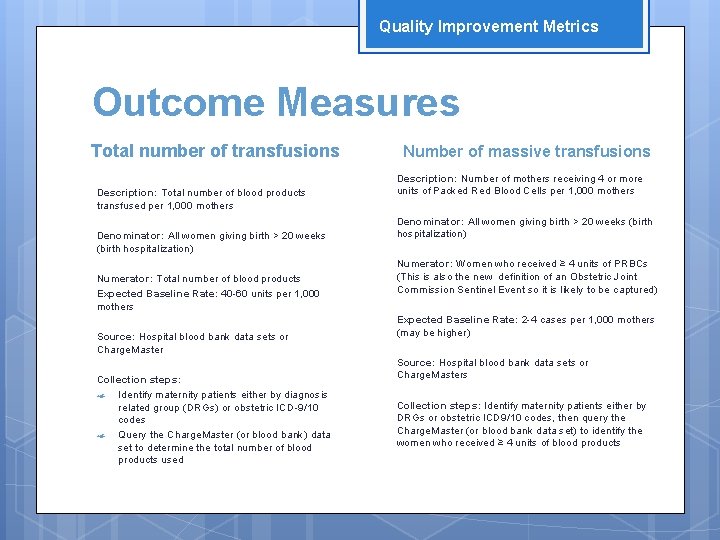
Quality Improvement Metrics Outcome Measures Total number of transfusions Description: Total number of blood products transfused per 1, 000 mothers Denominator: All women giving birth > 20 weeks (birth hospitalization) Numerator: Total number of blood products Expected Baseline Rate: 40 -60 units per 1, 000 mothers Source: Hospital blood bank data sets or Charge. Master Collection steps: Identify maternity patients either by diagnosis related group (DRGs) or obstetric ICD-9/10 codes Query the Charge. Master (or blood bank) data set to determine the total number of blood products used Number of massive transfusions Description: Number of mothers receiving 4 or more units of Packed Red Blood Cells per 1, 000 mothers Denominator: All women giving birth > 20 weeks (birth hospitalization) Numerator: Women who received ≥ 4 units of PRBCs (This is also the new definition of an Obstetric Joint Commission Sentinel Event so it is likely to be captured) Expected Baseline Rate: 2 -4 cases per 1, 000 mothers (may be higher) Source: Hospital blood bank data sets or Charge. Masters Collection steps: Identify maternity patients either by DRGs or obstetric ICD 9/10 codes, then query the Charge. Master (or blood bank data set) to identify the women who received ≥ 4 units of blood products
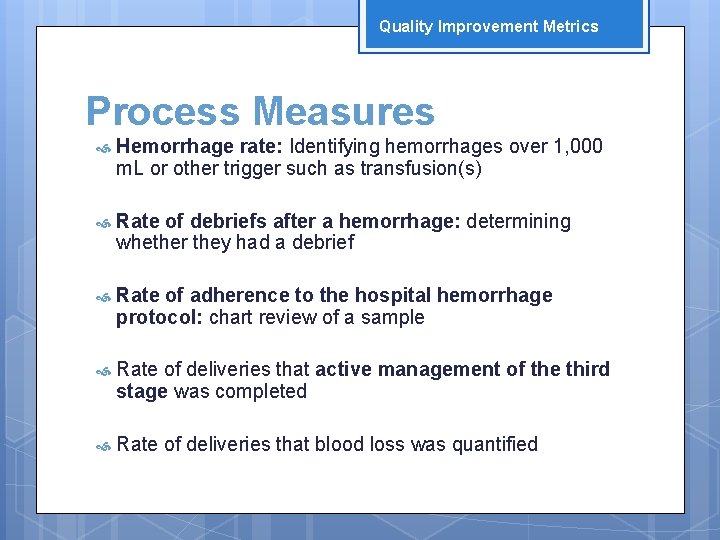
Quality Improvement Metrics Process Measures Hemorrhage rate: Identifying hemorrhages over 1, 000 m. L or other trigger such as transfusion(s) Rate of debriefs after a hemorrhage: determining whether they had a debrief Rate of adherence to the hospital hemorrhage protocol: chart review of a sample Rate of deliveries that active management of the third stage was completed Rate of deliveries that blood loss was quantified
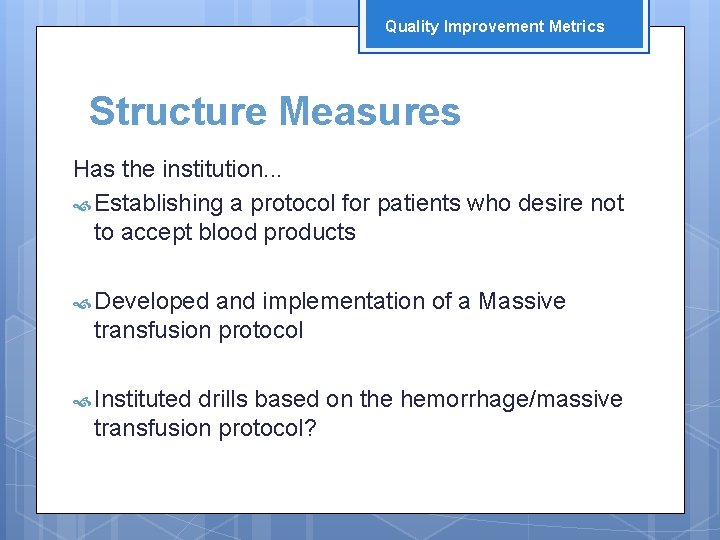
Quality Improvement Metrics Structure Measures Has the institution. . . Establishing a protocol for patients who desire not to accept blood products Developed and implementation of a Massive transfusion protocol Instituted drills based on the hemorrhage/massive transfusion protocol?
- Slides: 42