
Idiopathic Inflammatory Myopathy Complicated by Respiratory and Renal
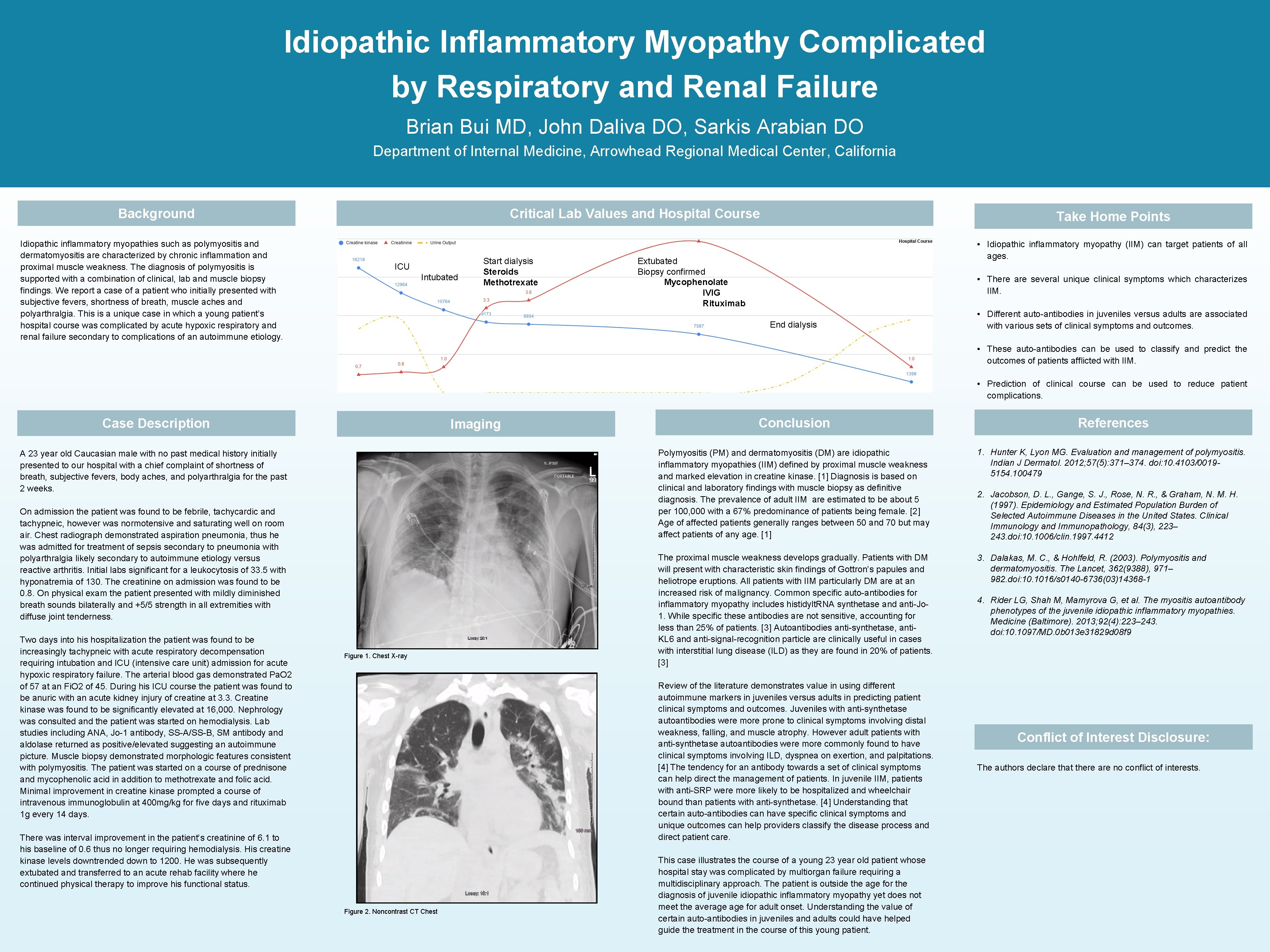
Idiopathic Inflammatory Myopathy Complicated by Respiratory and Renal Failure Brian Bui MD, John Daliva DO, Sarkis Arabian DO Department of Internal Medicine, Arrowhead Regional Medical Center, California Background Idiopathic inflammatory myopathies such as polymyositis and dermatomyositis are characterized by chronic inflammation and proximal muscle weakness. The diagnosis of polymyositis is supported with a combination of clinical, lab and muscle biopsy findings. We report a case of a patient who initially presented with subjective fevers, shortness of breath, muscle aches and polyarthralgia. This is a unique case in which a young patient’s hospital course was complicated by acute hypoxic respiratory and renal failure secondary to complications of an autoimmune etiology. Critical Lab Values and Hospital Course ICU Intubated Start dialysis Steroids Methotrexate Take Home Points • Idiopathic inflammatory myopathy (IIM) can target patients of all ages. Extubated Biopsy confirmed Mycophenolate IVIG Rituximab • There are several unique clinical symptoms which characterizes IIM. End dialysis • Different auto-antibodies in juveniles versus adults are associated with various sets of clinical symptoms and outcomes. • These auto-antibodies can be used to classify and predict the outcomes of patients afflicted with IIM. • Prediction of clinical course can be used to reduce patient complications. Case Description Imaging A 23 year old Caucasian male with no past medical history initially presented to our hospital with a chief complaint of shortness of breath, subjective fevers, body aches, and polyarthralgia for the past 2 weeks. On admission the patient was found to be febrile, tachycardic and tachypneic, however was normotensive and saturating well on room air. Chest radiograph demonstrated aspiration pneumonia, thus he was admitted for treatment of sepsis secondary to pneumonia with polyarthralgia likely secondary to autoimmune etiology versus reactive arthritis. Initial labs significant for a leukocytosis of 33. 5 with hyponatremia of 130. The creatinine on admission was found to be 0. 8. On physical exam the patient presented with mildly diminished breath sounds bilaterally and +5/5 strength in all extremities with diffuse joint tenderness. Two days into his hospitalization the patient was found to be increasingly tachypneic with acute respiratory decompensation requiring intubation and ICU (intensive care unit) admission for acute hypoxic respiratory failure. The arterial blood gas demonstrated Pa. O 2 of 57 at an Fi. O 2 of 45. During his ICU course the patient was found to be anuric with an acute kidney injury of creatine at 3. 3. Creatine kinase was found to be significantly elevated at 16, 000. Nephrology was consulted and the patient was started on hemodialysis. Lab studies including ANA, Jo-1 antibody, SS-A/SS-B, SM antibody and aldolase returned as positive/elevated suggesting an autoimmune picture. Muscle biopsy demonstrated morphologic features consistent with polymyositis. The patient was started on a course of prednisone and mycophenolic acid in addition to methotrexate and folic acid. Minimal improvement in creatine kinase prompted a course of intravenous immunoglobulin at 400 mg/kg for five days and rituximab 1 g every 14 days. Figure 1. Chest X-ray Conclusion References Polymyositis (PM) and dermatomyositis (DM) are idiopathic inflammatory myopathies (IIM) defined by proximal muscle weakness and marked elevation in creatine kinase. [1] Diagnosis is based on clinical and laboratory findings with muscle biopsy as definitive diagnosis. The prevalence of adult IIM are estimated to be about 5 per 100, 000 with a 67% predominance of patients being female. [2] Age of affected patients generally ranges between 50 and 70 but may affect patients of any age. [1] 1. Hunter K, Lyon MG. Evaluation and management of polymyositis. Indian J Dermatol. 2012; 57(5): 371– 374. doi: 10. 4103/00195154. 100479 The proximal muscle weakness develops gradually. Patients with DM will present with characteristic skin findings of Gottron’s papules and heliotrope eruptions. All patients with IIM particularly DM are at an increased risk of malignancy. Common specific auto-antibodies for inflammatory myopathy includes histidylt. RNA synthetase and anti-Jo 1. While specific these antibodies are not sensitive, accounting for less than 25% of patients. [3] Autoantibodies anti-synthetase, anti. KL 6 and anti-signal-recognition particle are clinically useful in cases with interstitial lung disease (ILD) as they are found in 20% of patients. [3] 3. Dalakas, M. C. , & Hohlfeld, R. (2003). Polymyositis and dermatomyositis. The Lancet, 362(9388), 971– 982. doi: 10. 1016/s 0140 -6736(03)14368 -1 Review of the literature demonstrates value in using different autoimmune markers in juveniles versus adults in predicting patient clinical symptoms and outcomes. Juveniles with anti-synthetase autoantibodies were more prone to clinical symptoms involving distal weakness, falling, and muscle atrophy. However adult patients with anti-synthetase autoantibodies were more commonly found to have clinical symptoms involving ILD, dyspnea on exertion, and palpitations. [4] The tendency for an antibody towards a set of clinical symptoms can help direct the management of patients. In juvenile IIM, patients with anti-SRP were more likely to be hospitalized and wheelchair bound than patients with anti-synthetase. [4] Understanding that certain auto-antibodies can have specific clinical symptoms and unique outcomes can help providers classify the disease process and direct patient care. There was interval improvement in the patient’s creatinine of 6. 1 to his baseline of 0. 6 thus no longer requiring hemodialysis. His creatine kinase levels downtrended down to 1200. He was subsequently extubated and transferred to an acute rehab facility where he continued physical therapy to improve his functional status. Figure 2. Noncontrast CT Chest This case illustrates the course of a young 23 year old patient whose hospital stay was complicated by multiorgan failure requiring a multidisciplinary approach. The patient is outside the age for the diagnosis of juvenile idiopathic inflammatory myopathy yet does not meet the average for adult onset. Understanding the value of certain auto-antibodies in juveniles and adults could have helped guide the treatment in the course of this young patient. 2. Jacobson, D. L. , Gange, S. J. , Rose, N. R. , & Graham, N. M. H. (1997). Epidemiology and Estimated Population Burden of Selected Autoimmune Diseases in the United States. Clinical Immunology and Immunopathology, 84(3), 223– 243. doi: 10. 1006/clin. 1997. 4412 4. Rider LG, Shah M, Mamyrova G, et al. The myositis autoantibody phenotypes of the juvenile idiopathic inflammatory myopathies. Medicine (Baltimore). 2013; 92(4): 223– 243. doi: 10. 1097/MD. 0 b 013 e 31829 d 08 f 9 Conflict of Interest Disclosure: The authors declare that there are no conflict of interests.
- Slides: 1