
IDHAYA COLLEGE FOR WOMEN KUMBAKONAM Semester II Subject
IDHAYA COLLEGE FOR WOMEN, KUMBAKONAM Semester : II Subject / Code : Production Management/ P 16 MBA 8 Class : I MBA Topic : Unit V 1. Flexible Manufacturing Systems 2. Poka yoke stages 3. Elements of kaizen 4. Implementing kaizen Faculty Name : Dr. N. Isvarya M. Com. , M. Phil. , MBA. , Ph. D. , Assistant Professor Department of Management Idhaya College for Women Kumbakonam
Flexible Manufacturing Systems • A flexible manufacturing system (FMS) is a manufacturing system in which there is some amount of flexibility that allows the system to react in the case of changes, whether predicted or unpredicted. This flexibility is generally considered to fall into two categories, subcategories. which both contain numerous
Poka Yoke • Poka Yoke is a Japanese phrase that means error prevention. It was developed in the sixties of the previous century by Shiego Shingo from Japan. He was an engineer at the Toyota car factory. Toyota is still the most famous multinational business using Poka Yoke today. • Poka Yoke is used to prevent and resolve defects during the production process, eliminating the need for quality control after the process. Poka Yoke is a frequently used method in Lean Manufacturing and Six. Sigma errors in a production process as possible. A ‘poka’ is an ‘inadvertent error’ and ‘yokeru’ is Japanese for ‘preventing’.
Poka yoke stages 1. Define • During this phase, the problem causing the defect is described and defined. It needs to be an objective description that doesn’t draw conclusions right away. • It’s possible to monitor the shop floor during the production process. This is also indicated with the word ‘Gemba’, which is Japanese for shop floor. • The shop floor is where the process happens, and that’s where the causes of problems may also be hiding. • If the problem occurs at the end user, it’s a good idea to define the problem objectively from this perspective.
2. Measure • Usually, the measuring stage is applied in case of complex problems in the production process. A test is used to discover how often the problem occurs. • A percentage is then calculated based on the results. The higher the percentage, the more important it is to solve the problem at its source. • Apart from a production error, it may also be a case of user error. In such a case, a so-called test group would be used that tests the product over a certain period. • The outcome of this determines how the problem will be dealt with and solved.
3. Analyse During this stage, it becomes clear whether a Poka Yoke measure can be applied. The process is analysed thoroughly, and the cause of the defect is tracked down. Only when the source of the issue is clear, can the search for a solution begin. 4. Improve During this phase, analysis is used to deal with the cause of the problem. A solution is developed and implemented. In many cases, Poka Yoke solutions seem obvious, but have a significant positive impact. They prevent the same mistake from being made in the future
5. Control • During this stage, the effect of the changes is measured. If the Poka Yoke measure in question works well, and the chance of further potential error is negligible, it concludes with the ‘Zero Quality Control’ and Zero Defects.
3 TYPES OF POKA YOKE 1. Visual aids These aids are clear and show the work instructions. These may be pictograms in a user manual or a traffic sign that shows a restriction or warning. 2. Visual control These refer to directing behavior and warning in case of deviations. One example would be a traffic sign that lights up red when drivers are speeding and green if they stick to the speed limit.
3. Fail-safes They force the user to either do or not do something. This can be road closures for motorway maintenance, for instance. Arrows on signs force drivers to go from 3 to 2 and from 2 to 1 lanes. The arrows are followed by red Xs on the signs until 2 of the 3 lanes are closed.
Kaizen is an approach to creating continuous improvement based on the idea that small, ongoing positive changes can reap significant improvements. Typically, it is based on cooperation and commitment and stands in contrast to approaches that use radical or top-down changes to achieve transformation.
5 Elements of Kaizen • Teamwork, • Personal discipline, • Improved morale, • Quality circles, and. • Suggestions for improvement
4 Types of Kaizen • Kaizen Teian: Bottom-Up Improvement. Kaizen Teian describes a form of improvement where people participate to improve their own processes. • Kaizen Events: Defined Improvements. • Kaikaku: Radical Change. • Kakushin: Break-through Innovation. • Finding The Right Tool.
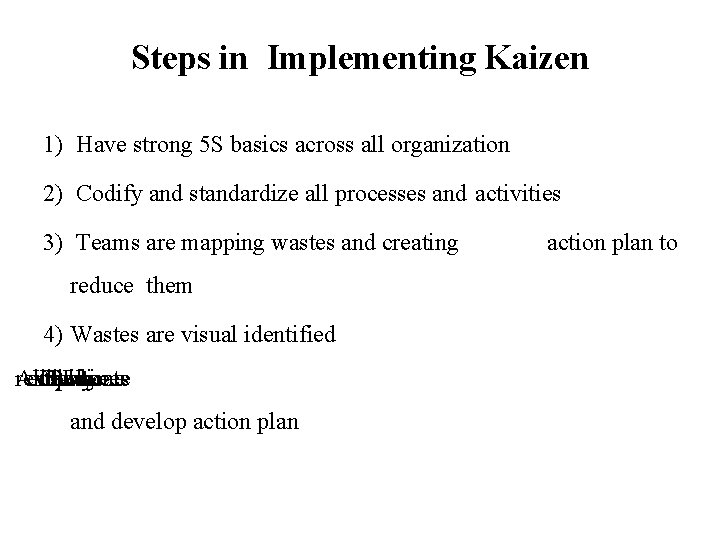
Steps in Implementing Kaizen 1) Have strong 5 S basics across all organization 2) Codify and standardize all processes and activities 3) Teams are mapping wastes and creating reduce them 4) Wastes are visual identified review Allow employees KPI 5) to basis daily dedicate in to time and develop action plan to
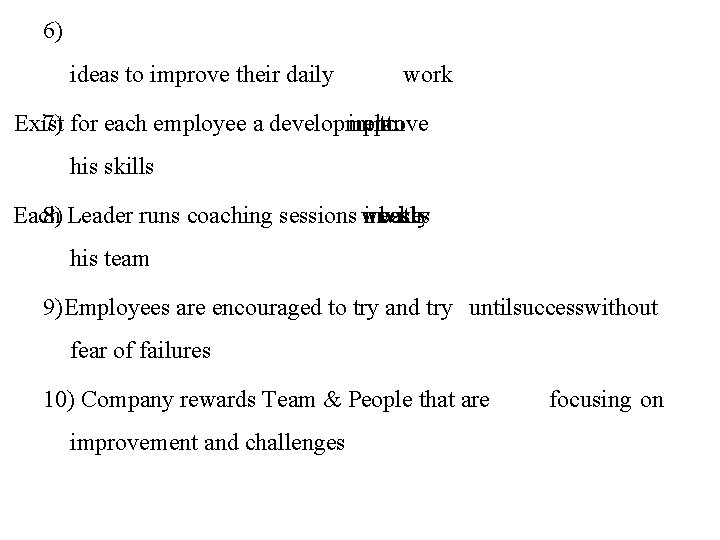
6) ideas to improve their daily work Exist for each employee a development 7) improve plan to his skills Each Leader runs coaching sessions in 8) weekly bases with his team 9) Employees are encouraged to try and try until success without fear of failures 10) Company rewards Team & People that are improvement and challenges focusing on
Thank You
- Slides: 15