
Ideology The Political Spectrum What is an Ideology
- Slides: 12
Ideology & The Political Spectrum
What is an Ideology? An organized collection of ideas that form a comprehensive belief system or worldview; n An ideology provides a way of understanding and ordering the world; n Ideologies help people cope with turbulent times and confusing circumstances. n
The Four Functions of an Ideology: Ideologies help to explain political phenomena; o o Why are there wars? Why are there conflicts between nations, social classes, races? Provide criteria for evaluation; o o Help people determine what is right/wrong, good/bad Ideologies help to orient people; o o o Gives people a sense of who they are and where they belong in society; Act as a social/cultural compass; Provide a political program for people to follow; o o What is to be done? Who is to do it?
Why do ideologies matter? n Ideologies are the force that drive people and governments to act. n A basic knowledge of the various ideologies will help us to understand why governments and people do the things they do.
The Political Spectrum Is a way of modeling or visually representing different ideologies and the underlying beliefs these ideologies represent n The terms “left” and “right” are often used to describe an ideology’s position on the spectrum; n
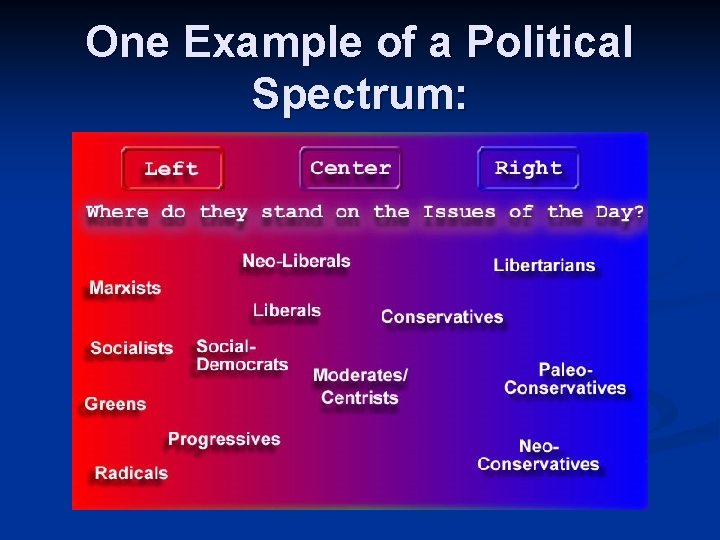
One Example of a Political Spectrum:
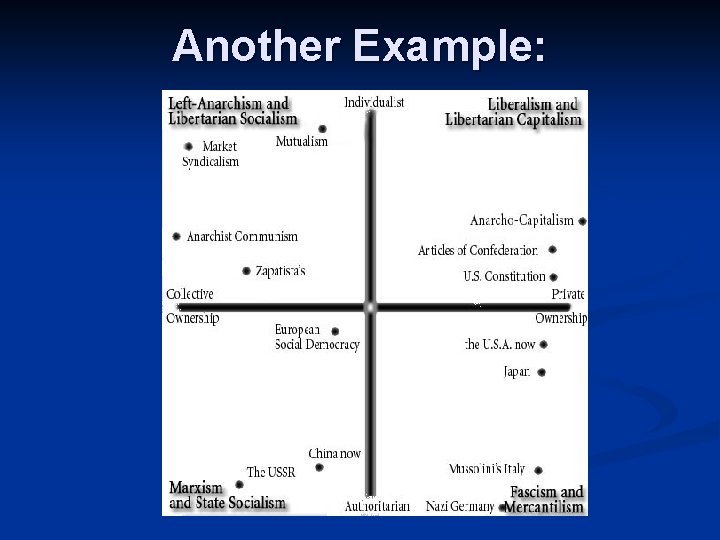
Another Example:
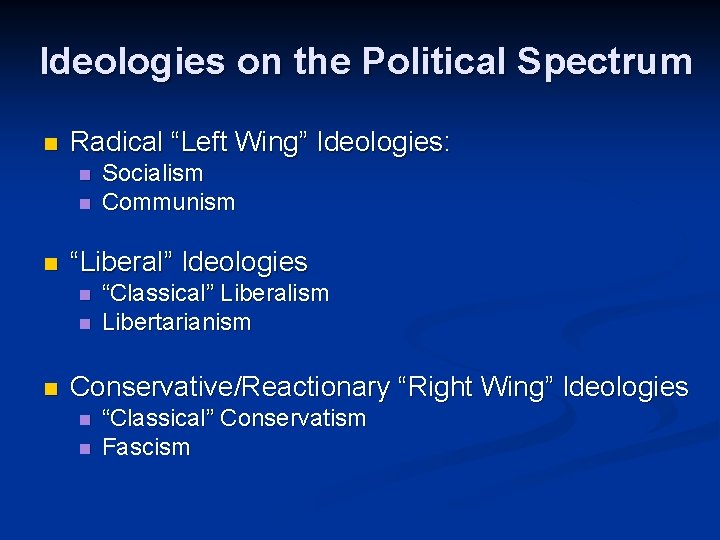
Ideologies on the Political Spectrum n Radical “Left Wing” Ideologies: n n n “Liberal” Ideologies n n n Socialism Communism “Classical” Liberalism Libertarianism Conservative/Reactionary “Right Wing” Ideologies n n “Classical” Conservatism Fascism
Radical Ideologies n Goal: Drastic change, a complete overhaul of the established social order; n n Utopia – an ideal society where everyone is equal and everything is shared Values: n n n The community takes priority over the individual; The public good over individual rights; Property should be distributed in such a way as to benefit, not just the wealthy few, but the public at large; Condemn the exploitation of one group by another; n Critical of capitalism as an economic system and liberalism as an ideology
Conservative/Reactionary Ideologies n Goal - To conserve (protect/save) traditions or a customary way of life. n n n Conservatives are resistant to change and want things to stay the way they are; Reactionaries – want to restore or return to an earlier way of life; an extreme form of conservatism. Values – n n n A person is not merely an individual, but part of a larger whole – the state – and has a duty to other members of society; People cannot be trusted to govern themselves – democracy can lead to chaos and anarchy; Generally respectful of private property rights.
Moderate “Liberal” Ideologies n n n The word “liberal” derives from the Latin, libre, meaning free. Goal – To create and preserve an open and tolerant society, where individuals are free to pursue their own ideas and interests with minimal interference Values – n n n The individual is given the highest priority; All individuals are equal; All individuals are born with certain rights – life, liberty and the right to own property
The American Political Spectrum n The American political system is based on the ideology of “Classical” Liberalism n In the United States, the two major political parties represent two sides of the same ideology: n “Right wing” Conservatives (usually associated with the Republican Party) and n “Left wing” Liberals (usually associated with the Democratic Party) n BUT - We are all Liberals because we all believe in the same principles of individual liberty, equality and private property.