
IDEOLOGIES an introduction ON TARGET Outline of Unit
- Slides: 68
IDEOLOGIES – an introduction
ON TARGET Outline of Unit What is ideology? Core themes of different ideologies The political spectrum
ON TARGET WHAT IS ‘IDEOLOGY’?
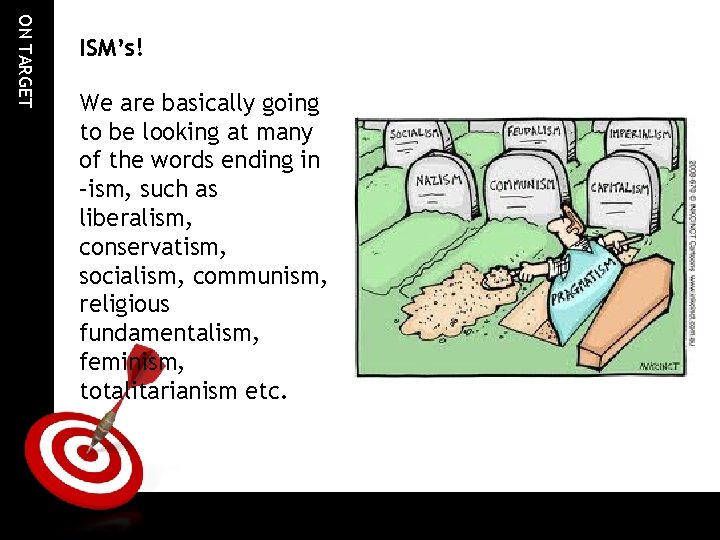
ON TARGET ISM’s! We are basically going to be looking at many of the words ending in –ism, such as liberalism, conservatism, socialism, communism, religious fundamentalism, feminism, totalitarianism etc.
ON TARGET What is ideology? • First thing to be clear on is that there really is no clear and agreed upon definition of ideology. It is a difficult term to really define properly.
ON TARGET Some attempted definitions of ‘ideology’ 1 • A political belief system • An action-orientated set of political ideas • The ideas of the ruling class • The world view of a particular social class or social group • Political ideas that embody or articulate class or social interests • Ideas that propagate false consciousness amongst the exploited or oppressed
ON TARGET Some attempted definitions of ‘ideology’ 2 • Ideas that situate the individual within a social context and generate a sense of collective belonging • An officially sanctioned set of ideas used to legitimise a political system or regime • An all-embracing political doctrine that claims a monopoly of truth • An abstract and highly systematic set of political ideas
ON TARGET Origin of the term The term was created during the French Revolution by Antoine Destutt de Tracy (1754 -1836), and first used in public in 1796 • For de Tracy, idéologie referred to a new ‘science of ideas’, or an idea-ology, like in biology, or psychology. •
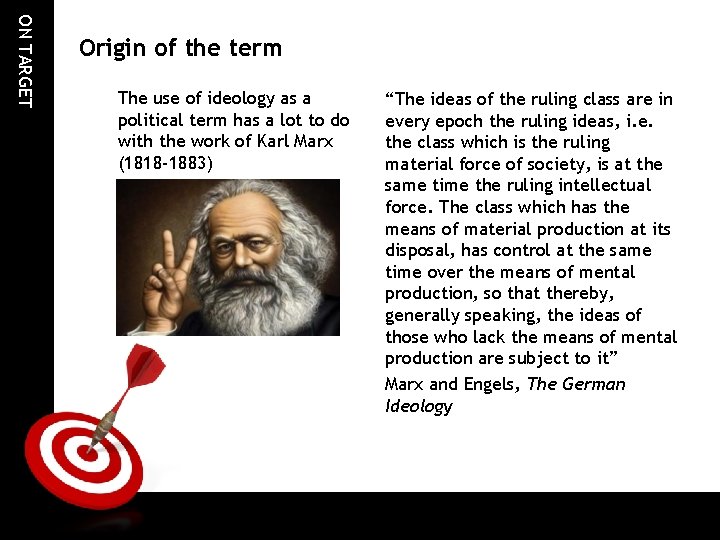
ON TARGET Origin of the term The use of ideology as a political term has a lot to do with the work of Karl Marx (1818 -1883) “The ideas of the ruling class are in every epoch the ruling ideas, i. e. the class which is the ruling material force of society, is at the same time the ruling intellectual force. The class which has the means of material production at its disposal, has control at the same time over the means of mental production, so that thereby, generally speaking, the ideas of those who lack the means of mental production are subject to it” Marx and Engels, The German Ideology
ON TARGET The definition we will use in our class: An ideology is a more or less coherent set of ideas that provides the basis for organised political action, whether this is intended to preserve, modify or overthrow the existing system of power. All ideologies therefore have the following features: a) They offer an account of the existing order, usually in the form of a ‘world view’ b) They advance a model of a desired future, a vision of the ‘good society’ c) They explain how political change can and should be brought about – how to get from (a) to (b) Heywood, A (2007). Political Ideologies – An Introduction. Palgrave Macmillan: New York.
ON TARGET Take note! It’s important to realise that ideology is not just something that is important to politics or politicians. Ideology influences all of our lives, but it works in such a way that we are often unaware of its influence!
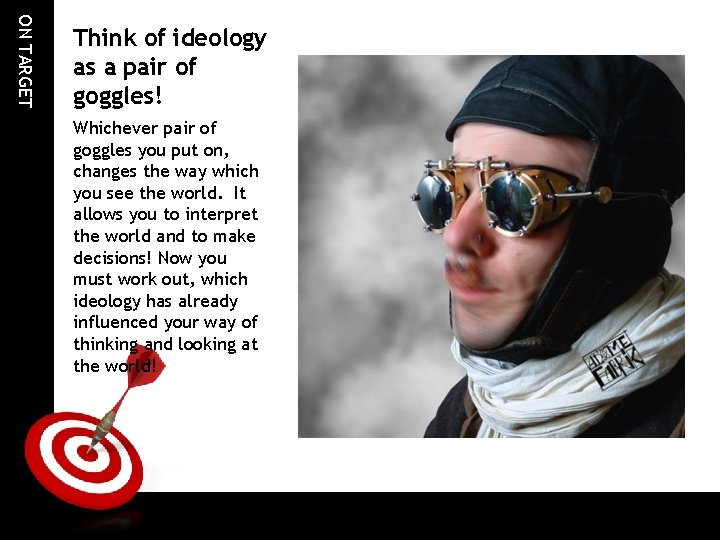
ON TARGET Think of ideology as a pair of goggles! Whichever pair of goggles you put on, changes the way which you see the world. It allows you to interpret the world and to make decisions! Now you must work out, which ideology has already influenced your way of thinking and looking at the world!
ON TARGET Core themes LIBERALISM
ON TARGET This ideology is in a sense the ideology of the ‘industrialised West’ It has a focus on a particular set of values: the individual, freedom, reason, justice, toleration
ON TARGET Liberalism: The Individual Liberalism emphasises the importance of the individual, both the uniqueness of each individual and at the same time the equality of all individuals.
ON TARGET Liberalism: The Individual Thus, liberalism emphasises a commitment to individual freedom. This does not mean though, that an individual is free to do whatever they like. There are still constraints on what you are actually allowed to do, one constraint being that you are not allowed to hurt another individual.
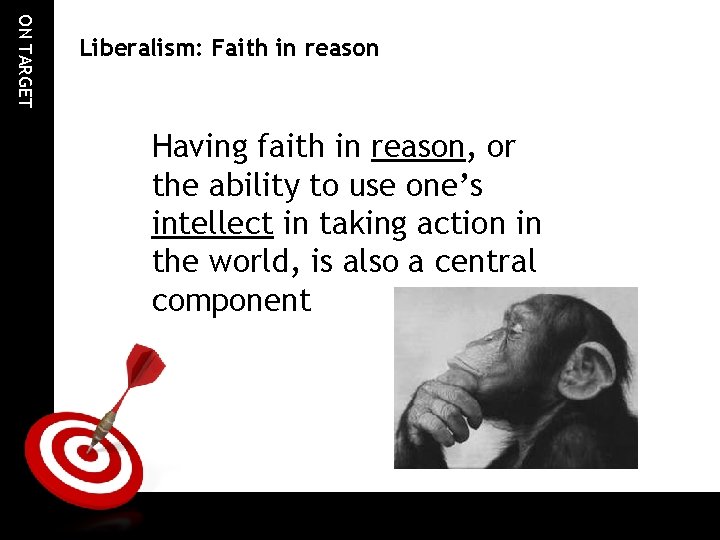
ON TARGET Liberalism: Faith in reason Having faith in reason, or the ability to use one’s intellect in taking action in the world, is also a central component
ON TARGET Liberalism: Justice and tolerance • Liberals look at justice in that each person should be given what they are ‘due’. • Because individual rights are central, this means that liberalism believes in tolerance and pluralism, or the idea that different moral, cultural and political cultures can exist together.
ON TARGET Core themes CONSERVATISM
ON TARGET Conservatism: Core themes Central beliefs of conservatism are based around the ideas of: • tradition • human imperfection • organic society • hierarchy and authority • property
ON TARGET Conservatism: Tradition • Conservatives argue for the preservation of ‘tradition’, in particular with regards to values, practices and institutions • They see tradition as being one of the foundations of society; without it, they believe society would crumble.
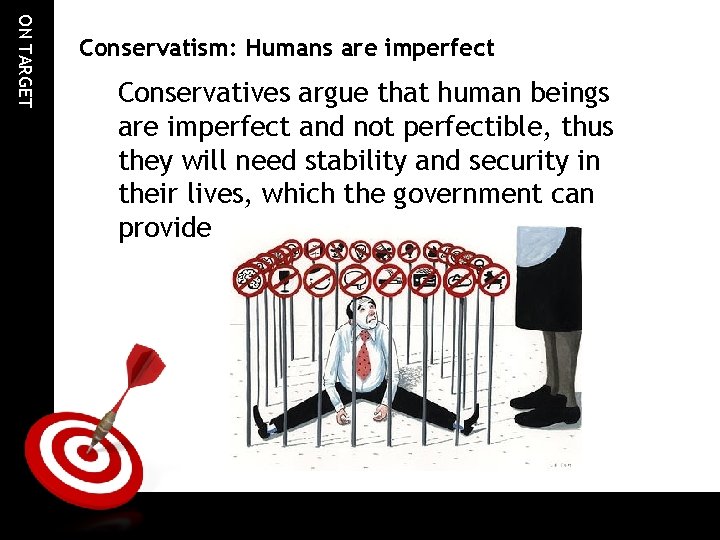
ON TARGET Conservatism: Humans are imperfect Conservatives argue that human beings are imperfect and not perfectible, thus they will need stability and security in their lives, which the government can provide
ON TARGET Conservatism: Organic society Conservatives believe that human beings cannot exist outside of society, or the social groups that nurture him/her, such as family, friends, colleagues, local community, and the nation
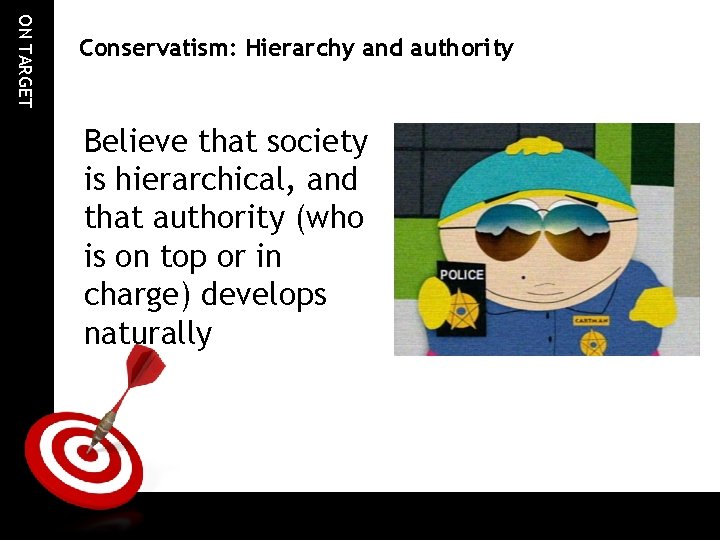
ON TARGET Conservatism: Hierarchy and authority Believe that society is hierarchical, and that authority (who is on top or in charge) develops naturally
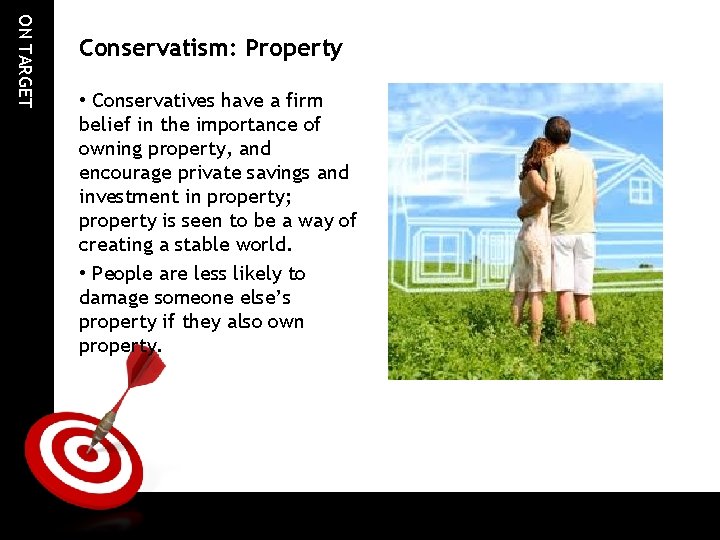
ON TARGET Conservatism: Property • Conservatives have a firm belief in the importance of owning property, and encourage private savings and investment in property; property is seen to be a way of creating a stable world. • People are less likely to damage someone else’s property if they also own property.
ON TARGET Core themes CAPITALISM
ON TARGET Capitalism • Is an economic system that is focussed on profit, and the major part of production is privately owned • Goods and services are created in order to generate profit
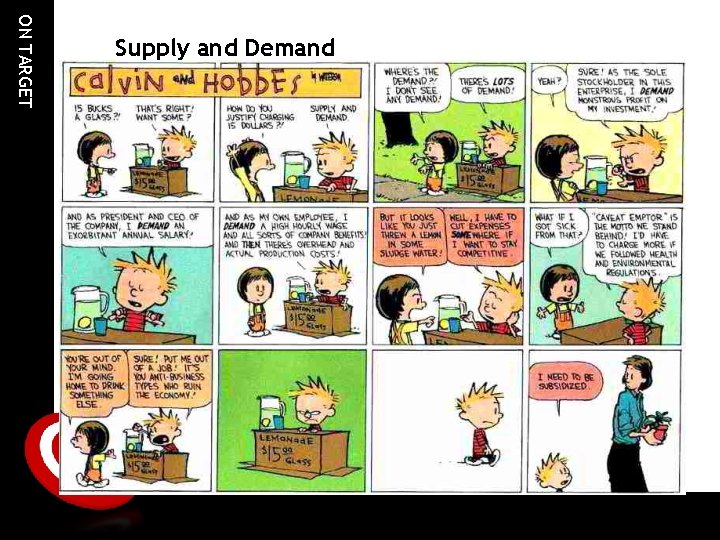
ON TARGET The ‘Market’ The market is seen to be the defining mechanism in ordering society. In this sense, ‘the market’ refers to the procedure of selling and buying goods in general (and anywhere), not necessarily a physical market like Preston Market! The market procedure is a way where people bring their goods to sell to consumers, and it is thought that through trade society’s order is maintained. In economics talk, ‘supply’ and ‘demand’ are terms used to describe this process.
ON TARGET Supply and Demand
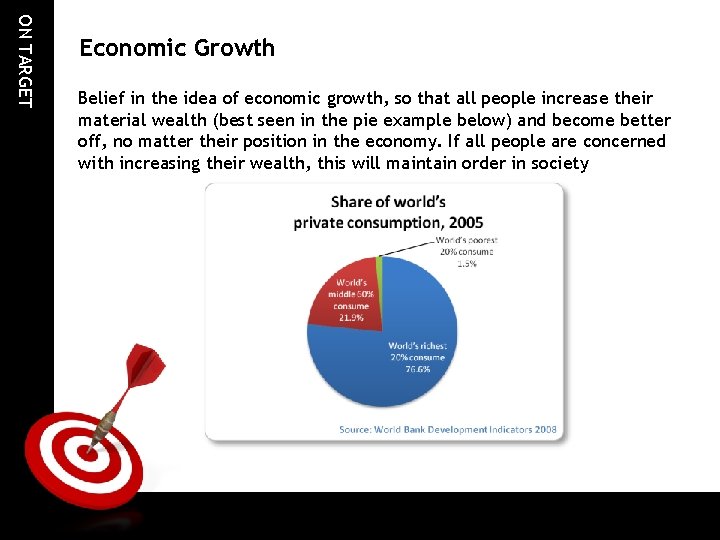
ON TARGET Economic Growth Belief in the idea of economic growth, so that all people increase their material wealth (best seen in the pie example below) and become better off, no matter their position in the economy. If all people are concerned with increasing their wealth, this will maintain order in society
ON TARGET Core themes SOCIALISM
ON TARGET Core Themes • Community • Cooperation • Equality • Class politics • Common ownership
ON TARGET Community • Human beings are tied to one another by the bonds of a common humanity • ‘We are all brothers and sisters’
ON TARGET View on human nature • Belief in the plasticity of human nature, or that humans can change and be moulded by life experience • Firm belief that humans are not predestined, but have the capacity to become something greater than what they are
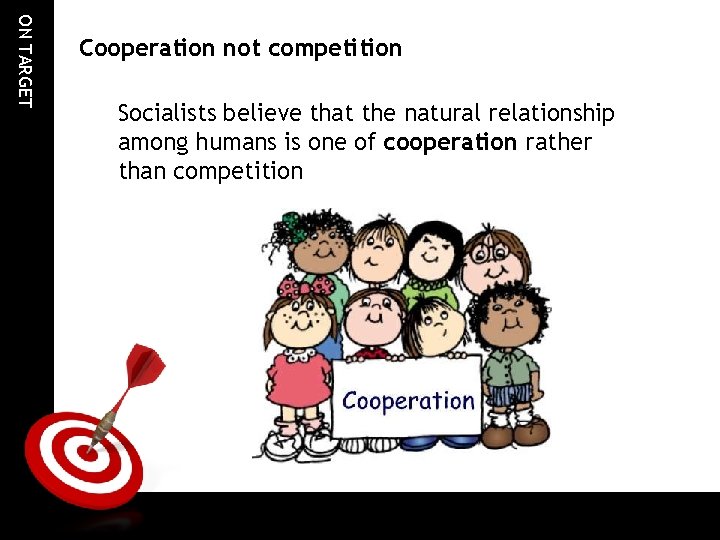
ON TARGET Cooperation not competition Socialists believe that the natural relationship among humans is one of cooperation rather than competition
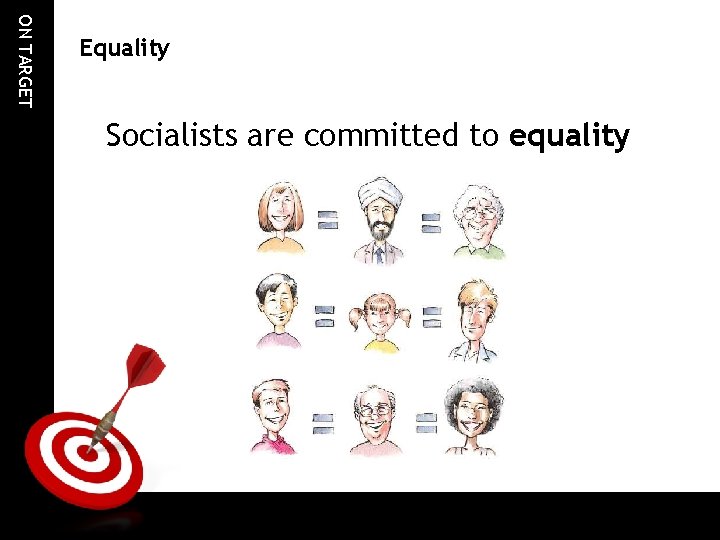
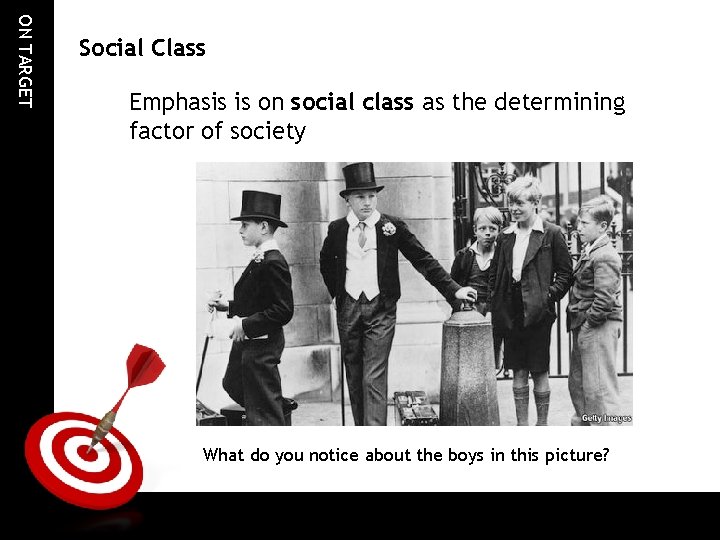
ON TARGET Equality Socialists are committed to equality
ON TARGET Social Class Emphasis is on social class as the determining factor of society What do you notice about the boys in this picture?
ON TARGET Common ownership • Disagree with the idea of private property, as they see this as one of the causes of competition and therefore social inequality. • Thus, have a view that all property should be communal • ‘From each according to his ability, to each according to his need’ – Karl Marx
ON TARGET Socialism vs. Communism • These two ideologies are often confused with one another • The similarities and differences are quite difficult to define • Communism is thought to be a classless society, where there is no hierarchy or authority. It has been argued by Marxists to be the end point of human development • Socialism is seen to be a middle point between capitalism and communism, where the state attempts to re-direct society towards its communist ideal
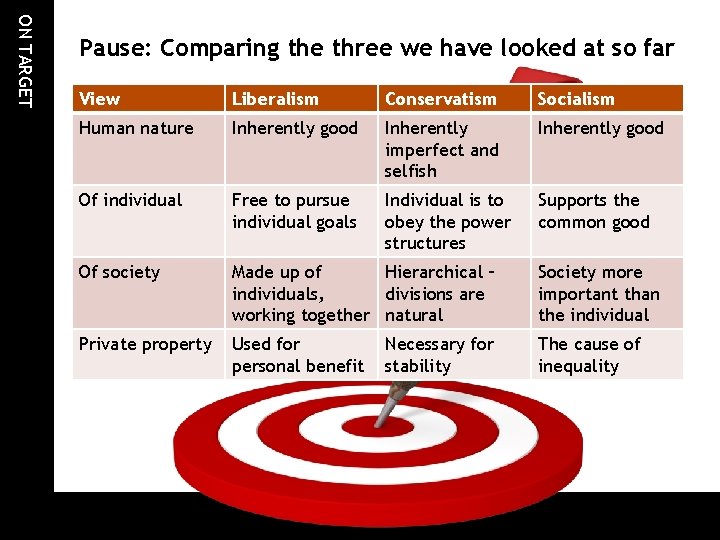
ON TARGET Pause: Comparing the three we have looked at so far View Liberalism Conservatism Socialism Human nature Inherently good Inherently imperfect and selfish Inherently good Of individual Free to pursue individual goals Individual is to obey the power structures Supports the common good Of society Made up of Hierarchical – individuals, divisions are working together natural Society more important than the individual Private property Used for personal benefit The cause of inequality Necessary for stability
ON TARGET Core themes FASCISM
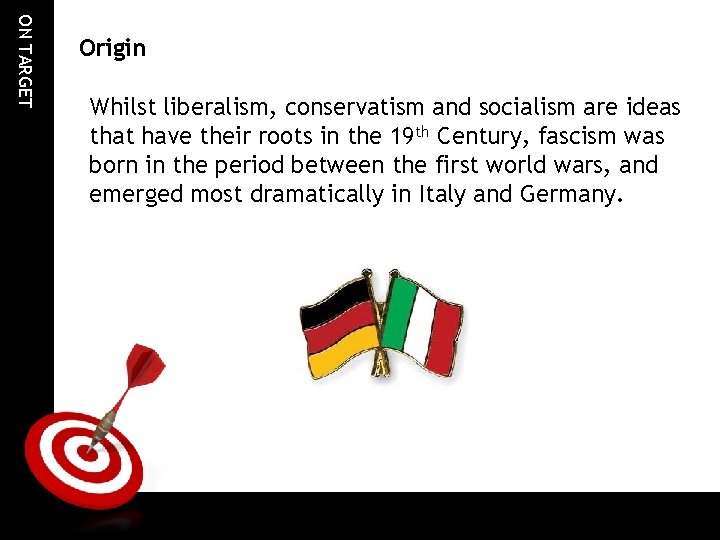
ON TARGET Origin Whilst liberalism, conservatism and socialism are ideas that have their roots in the 19 th Century, fascism was born in the period between the first world wars, and emerged most dramatically in Italy and Germany.
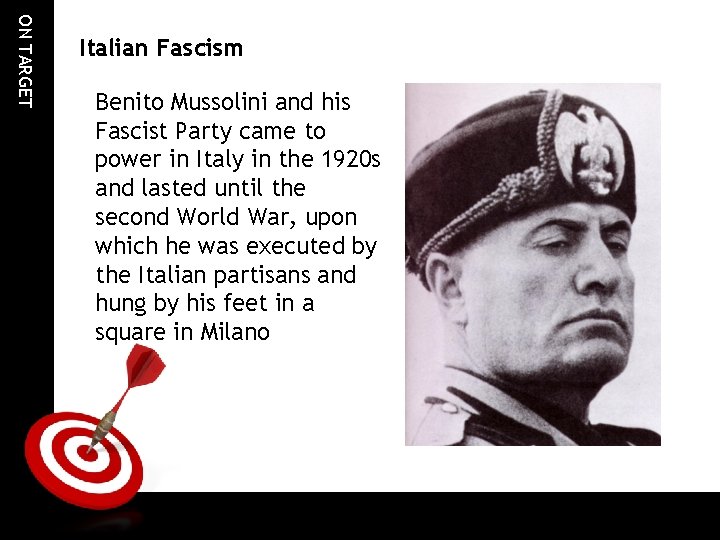
ON TARGET Italian Fascism Benito Mussolini and his Fascist Party came to power in Italy in the 1920 s and lasted until the second World War, upon which he was executed by the Italian partisans and hung by his feet in a square in Milano
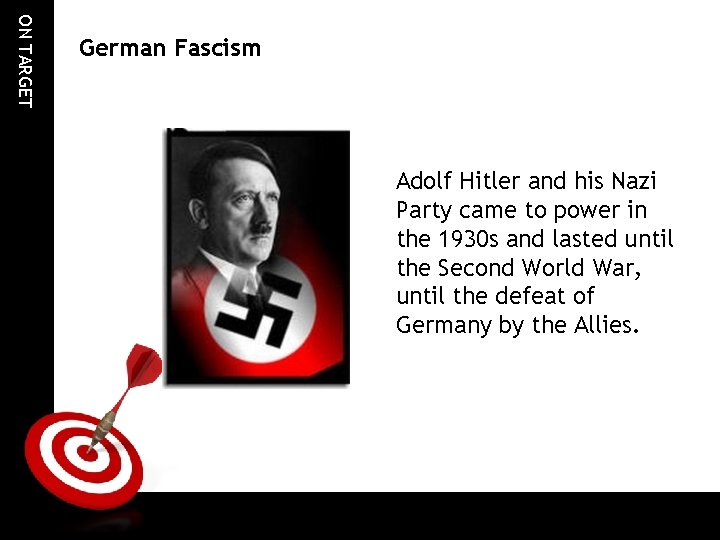
ON TARGET German Fascism Adolf Hitler and his Nazi Party came to power in the 1930 s and lasted until the Second World War, until the defeat of Germany by the Allies.
ON TARGET Features of fascism It is a difficult ideology to define, but some of its common themes include: • A reaction against rationalism, or the use of reason to make sense of the world • A belief that life is struggle, and that the strongest survive (influenced by Darwin’s idea of natural selection) • Does not believe in equality; instead believes in elitism, or that some people are born leaders • An extreme embrace of nationalism; incorporating a belief that certain nations are superior to others.
ON TARGET Core themes TOTALITARIANISM
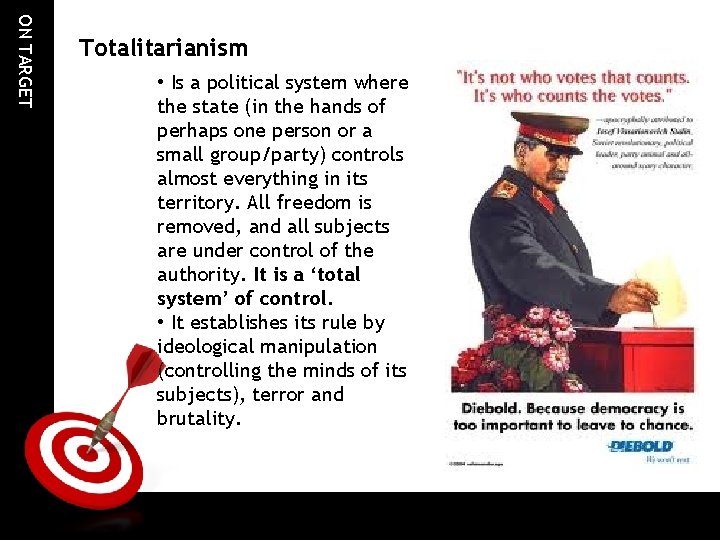
ON TARGET Totalitarianism • Is a political system where the state (in the hands of perhaps one person or a small group/party) controls almost everything in its territory. All freedom is removed, and all subjects are under control of the authority. It is a ‘total system’ of control. • It establishes its rule by ideological manipulation (controlling the minds of its subjects), terror and brutality.
ON TARGET Core themes RELIGIOUS FUNDAMENTALISM
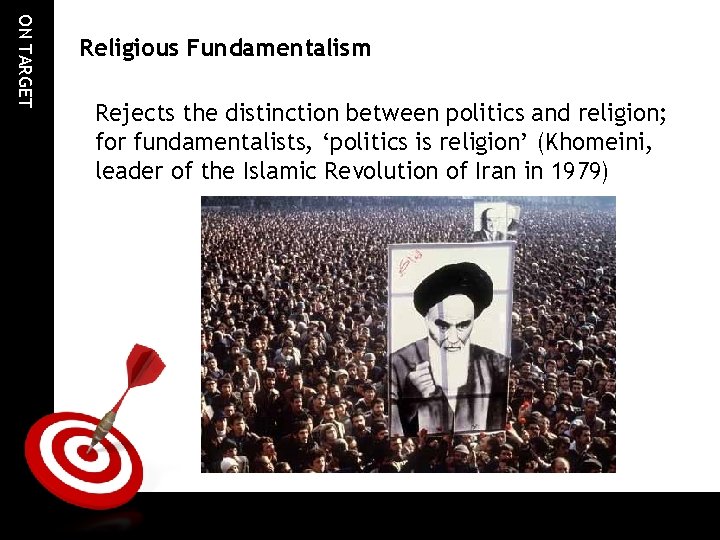
ON TARGET Religious Fundamentalism Rejects the distinction between politics and religion; for fundamentalists, ‘politics is religion’ (Khomeini, leader of the Islamic Revolution of Iran in 1979)
ON TARGET Religious Fundamentalism • Maintains a commitment to ideas and values that are seen as basic or fundamental • Most often turns its back on modernity, or the modern world we live in. Modernity is seen to be the root of decay in our world, where values are lacking and moral social fabric has disintegrated. • Very often it is a militaristic ideology, and the use of violence to achieve its aims is common
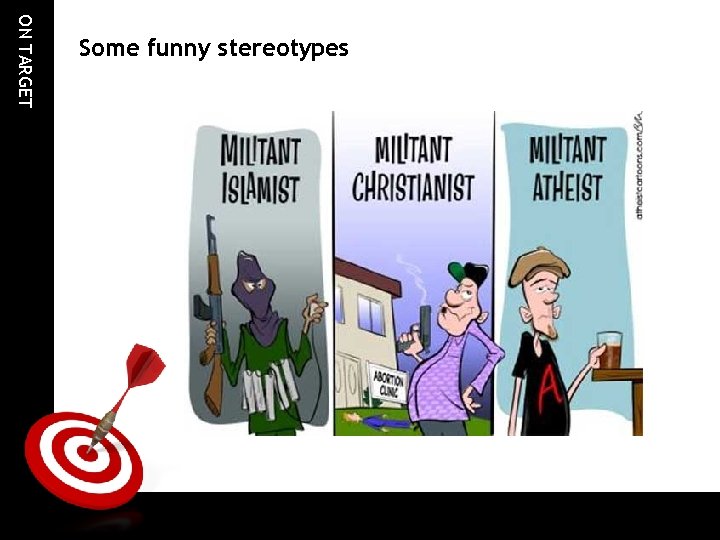
ON TARGET Some funny stereotypes
ON TARGET Core themes NATIONALISM
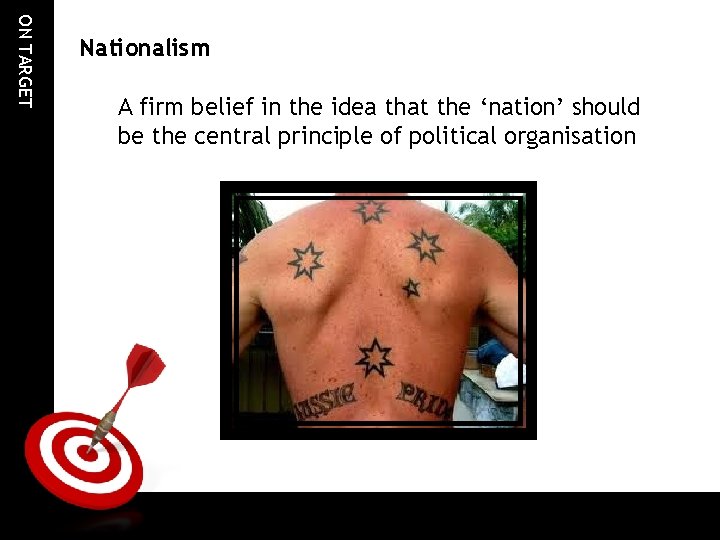
ON TARGET Nationalism A firm belief in the idea that the ‘nation’ should be the central principle of political organisation
ON TARGET FEMINISM
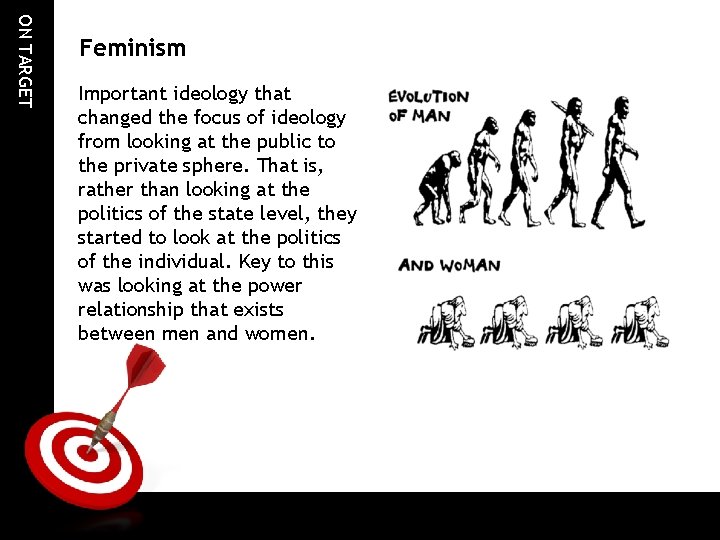
ON TARGET Feminism Important ideology that changed the focus of ideology from looking at the public to the private sphere. That is, rather than looking at the politics of the state level, they started to look at the politics of the individual. Key to this was looking at the power relationship that exists between men and women.
ON TARGET Feminism • Use of the concept of ‘patriarchy’ to describe the power relationship between men and women • Made a distinction between the idea of ‘sex’ and ‘gender’: sex is a biological term defined by birth, whereas gender is a cultural term which incorporates learning how to be female or male
ON TARGET Core themes ANARCHISM
ON TARGET Anarchism • The defining feature of anarchism is its opposition to the state and the institutions of government and law • Their main argument against authority is that they see authority as being an offence against the principles of freedom and equality • They believe in a natural goodness of humans, and that without a state governing humans would naturally fall into a state of cooperation with one another.
ON TARGET THE POLITICAL SPECTRUM
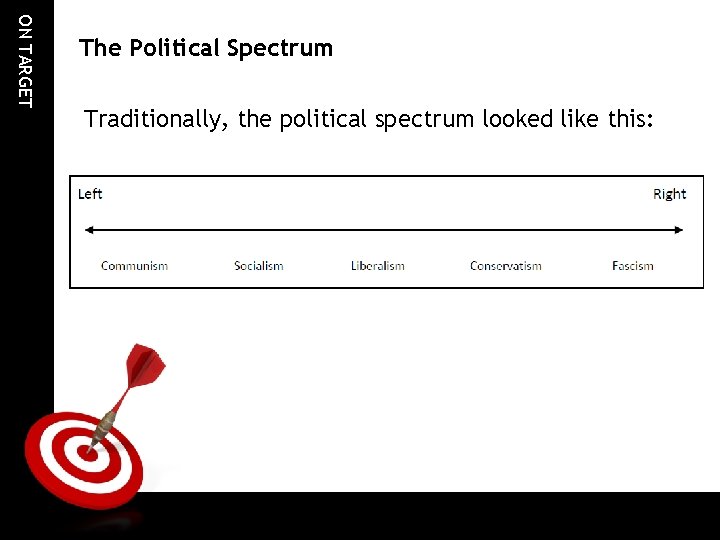
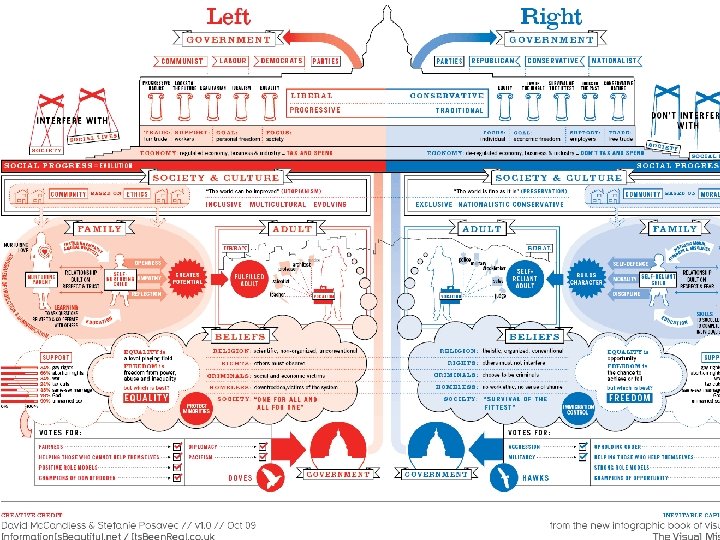
ON TARGET The Political Spectrum • You may have heard at various times terms used like ‘political left’ and ‘political right’ • This is quite a confusing and misleading area in understanding political science • The origin of the terms dates back to the French Revolution and the seating arrangements adopted by different groups in parliament.
ON TARGET The Political Spectrum Traditionally, the political spectrum looked like this:
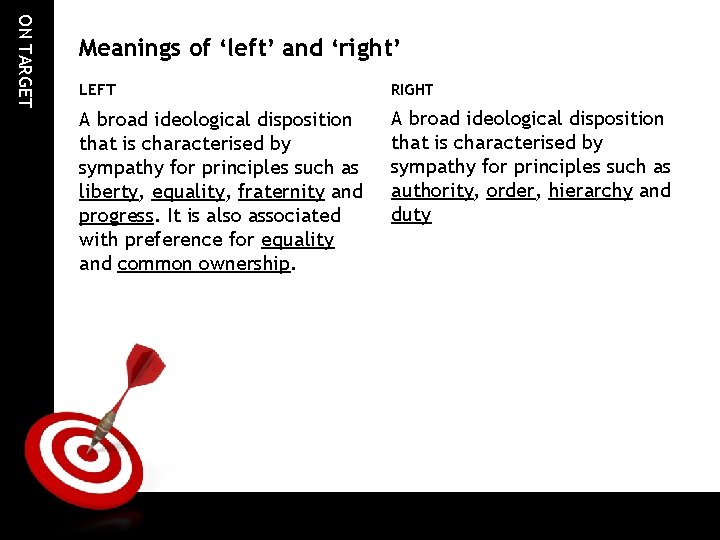
ON TARGET Meanings of ‘left’ and ‘right’ LEFT RIGHT A broad ideological disposition that is characterised by sympathy for principles such as liberty, equality, fraternity and progress. It is also associated with preference for equality and common ownership. A broad ideological disposition that is characterised by sympathy for principles such as authority, order, hierarchy and duty
ON TARGET
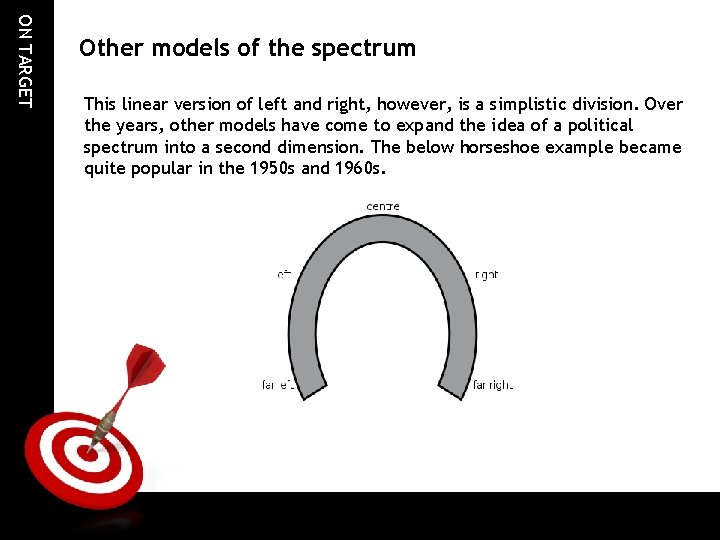
ON TARGET Other models of the spectrum This linear version of left and right, however, is a simplistic division. Over the years, other models have come to expand the idea of a political spectrum into a second dimension. The below horseshoe example became quite popular in the 1950 s and 1960 s.
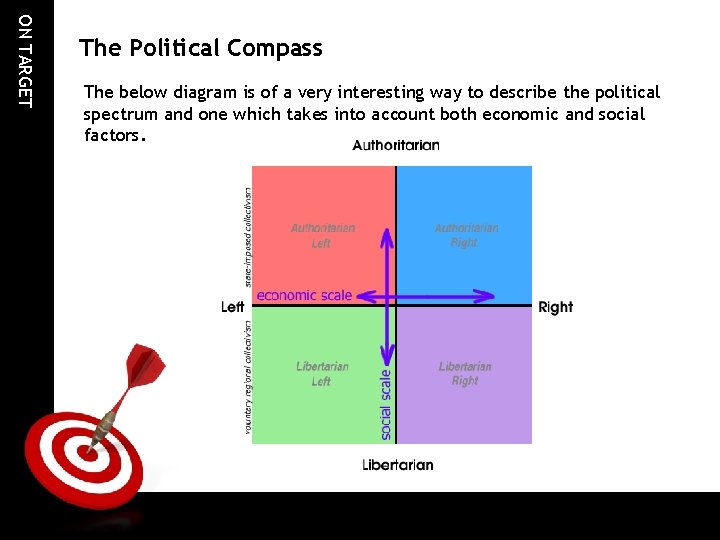
ON TARGET The Political Compass The below diagram is of a very interesting way to describe the political spectrum and one which takes into account both economic and social factors.
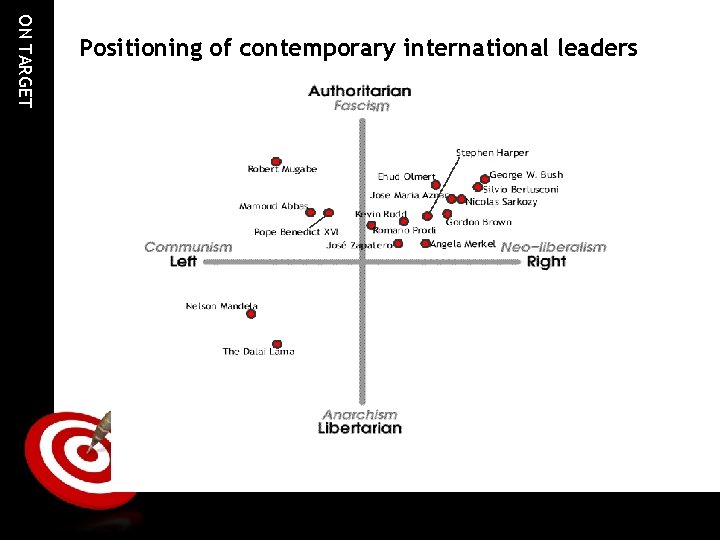
ON TARGET Positioning of contemporary international leaders
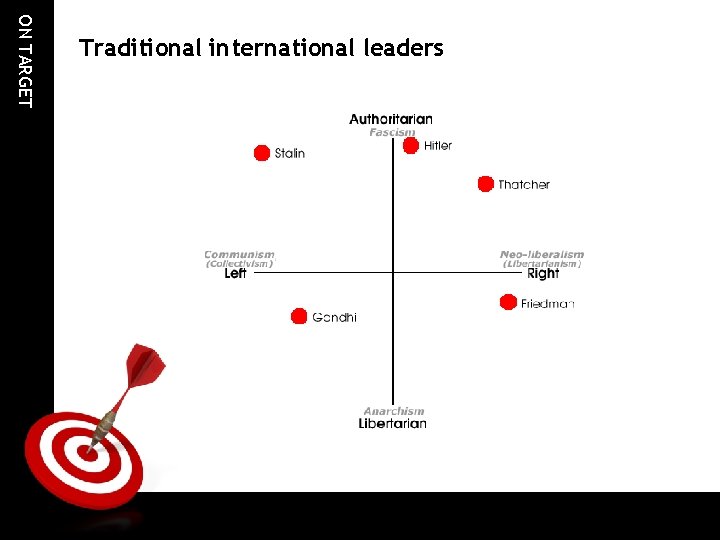
ON TARGET Traditional international leaders
ON TARGET Where do you stand on the political compass? Go to http: //www. politicalcompass. org/index to take the test and find out if you are a communist, fascist, budding dictator or more of a middle man!