
Identity Development in School The Critical Role of

![Why do teachers need to pay attention to identity development? …. . [c]hildren live](https://slidetodoc.com/presentation_image_h2/9af9cf867acca0ce676694613e10a87c/image-18.jpg "Why do teachers need to pay attention to identity development? …. . [c]hildren live")
- Slides: 48
Identity Development in School: The Critical Role of Teachers Rainbow History Month Colloquium Nancy Commins – Clinical Professor Emeritus University of Colorado, Denver Senior Fellow Turun Yliopisto 11 November 2019
My talk is sponsored by dyk i diversitet buokčal gillii ja kultuvrii Kieli- ja kulttuuritietoisen opettajuuden ja opettajankoulutuksen edistäminen Commins 11. 19 Rainbow Month Lecture
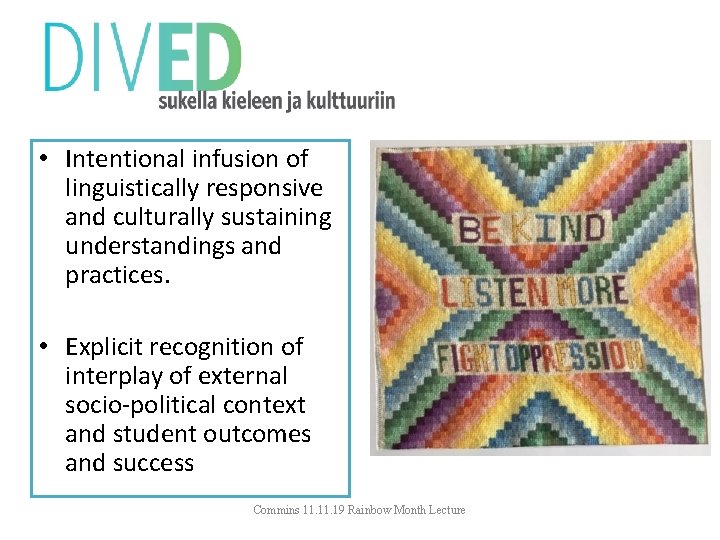
• Intentional infusion of linguistically responsive and culturally sustaining understandings and practices. • Explicit recognition of interplay of external socio-political context and student outcomes and success Commins 11. 19 Rainbow Month Lecture
3 Central Themes • Schools are a site for identity development • Teachers’ play a critical role in supporting or undermining students’ identities • Everything takes place within the lines of power and privilege of the larger social context Commins 11. 19 Rainbow Month Lecture
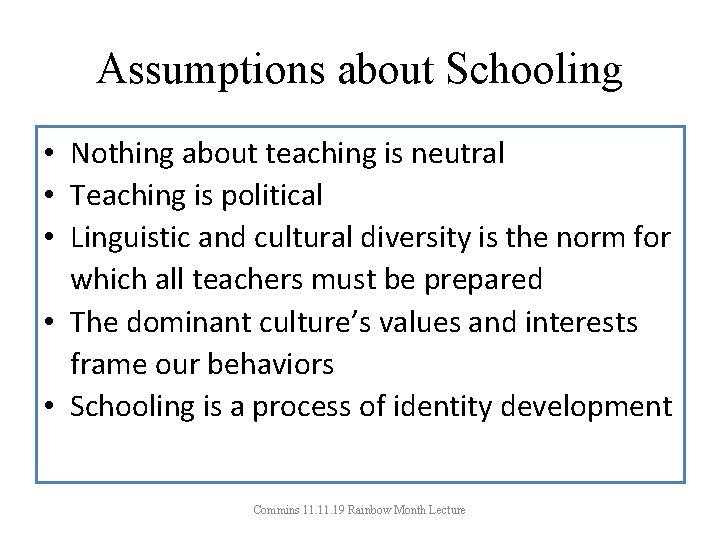
Assumptions about Schooling • Nothing about teaching is neutral • Teaching is political • Linguistic and cultural diversity is the norm for which all teachers must be prepared • The dominant culture’s values and interests frame our behaviors • Schooling is a process of identity development Commins 11. 19 Rainbow Month Lecture
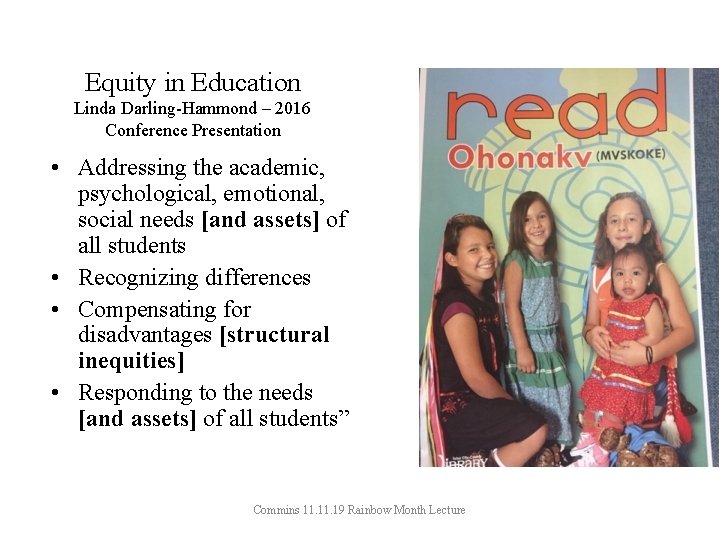
Equity in Education Linda Darling-Hammond – 2016 Conference Presentation • Addressing the academic, psychological, emotional, social needs [and assets] of all students • Recognizing differences • Compensating for disadvantages [structural inequities] • Responding to the needs [and assets] of all students” Commins 11. 19 Rainbow Month Lecture
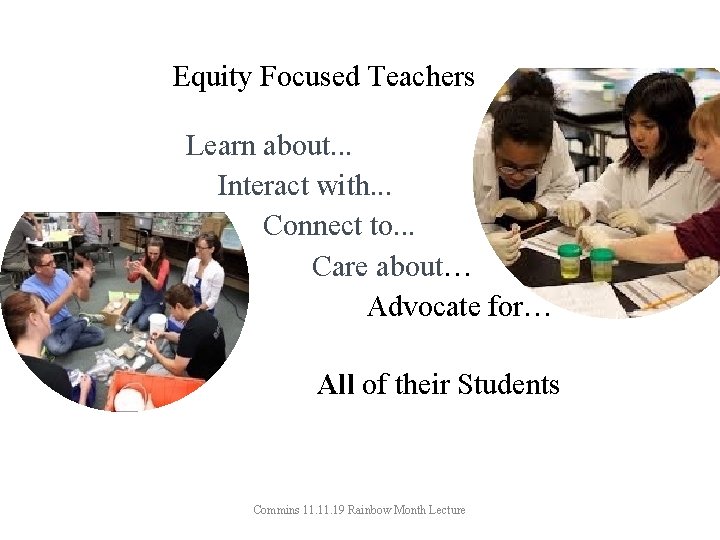
Equity Focused Teachers Learn about. . . Interact with. . . Connect to. . . Care about… Advocate for… All of their Students Commins 11. 19 Rainbow Month Lecture
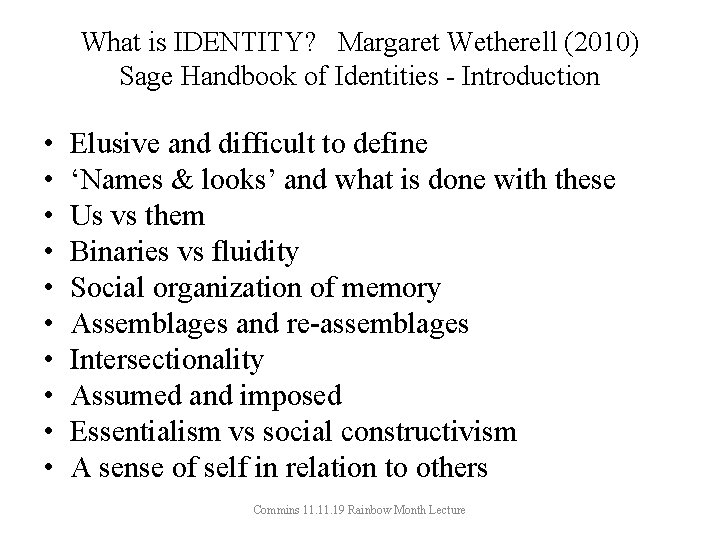
What is IDENTITY? Margaret Wetherell (2010) Sage Handbook of Identities - Introduction • • • Elusive and difficult to define ‘Names & looks’ and what is done with these Us vs them Binaries vs fluidity Social organization of memory Assemblages and re-assemblages Intersectionality Assumed and imposed Essentialism vs social constructivism A sense of self in relation to others Commins 11. 19 Rainbow Month Lecture
Different Paths in the Field Subjective individual achievement – A felt sense of personal place, continuity & location – field has move to seeing these personal and subjectively felt identities as mobile, flexibly negotiated, practically oriented and jointly accomplished with others. Study of social divisions and social solidarities and the practices of marginalization, exclusion, inclusion, resistance, segregation, denigration linked to belonging. P. 4. Social categories The ethical and political. How to live and how to act brings personal and social together. Commins 11. 19 Rainbow Month Lecture
How is your identity constructed? ØHeritage culture ØLanguage ØEthnicity ØGender Expression ØReligion ØGeography ØHome culture ØSchool culture ØProfessional culture ØAge, gender, hobby cultures ØClassroom cultures Commins 11. 19 Rainbow Month Lecture
The Past, Present, and Future of an Identity Theory Sheldon Stryker and Peter J. Burke Social Psychology Quarterly Vol. 63, No. 4, Special Millenium Issue on the State of Sociological Social Psychology (Dec. , 2000), pp. 284 -297 Identity refers to an internalized set of meanings attached to a role played in a network of social relationships, with a person’s self viewed as, in important part, an organization of the various identities held by the person’’ (p. 6). Commins 11. 19 Rainbow Month Lecture
From Kaylyn William’s 2017 Capstone Definition of Identity Tracy Robinson Individual identity is “both visible and invisible domains of the self that influence self-construction. They include, but are not limited to, ethnicity, skin color, gender, sexual orientation, nationality, and physical and intellectual ability. ” Edward Taylor: Cultural identity is “one’s understanding of the multilayered, interdependent, and nonsynchronous interaction of social status, language, race, ethnicity, values, and behaviors that permeate and influence nearly all aspects of our lives. ” Commins 11. 19 Rainbow Month Lecture
Esteban-Guitart & Moll (2018) • Identity—as with any other higher order psychological process—is essentially social in origin. People actively appropriate discourses, narratives, and visions or models of identity, but this is always cultural material. • Identities comprise all those people, skills, knowledge, practices, and resources that people have acquired and now use through their involvement in their various activities, in diverse social interactions. • These artifacts are internalized as well as externalized. People form their identities (visions of themselves) by engaging in social activities and by observing how members interact. Commins 11. 19 Rainbow Month Lecture
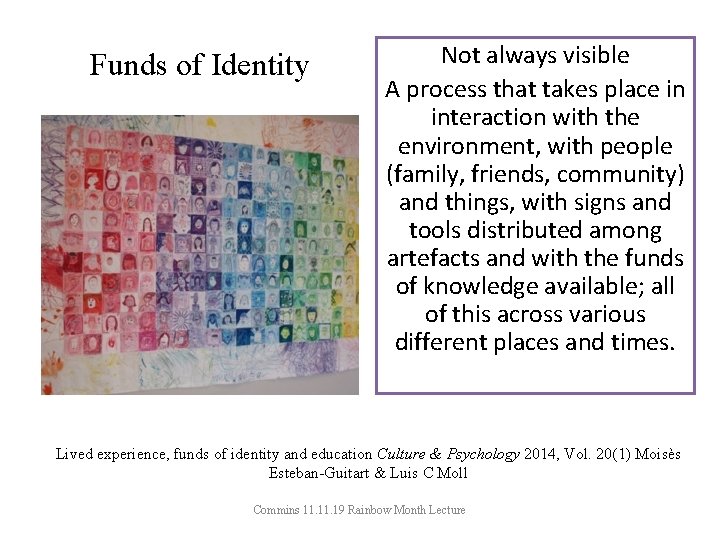
Funds of Identity Not always visible A process that takes place in interaction with the environment, with people (family, friends, community) and things, with signs and tools distributed among artefacts and with the funds of knowledge available; all of this across various different places and times. Lived experience, funds of identity and education Culture & Psychology 2014, Vol. 20(1) Moisès Esteban-Guitart & Luis C Moll Commins 11. 19 Rainbow Month Lecture
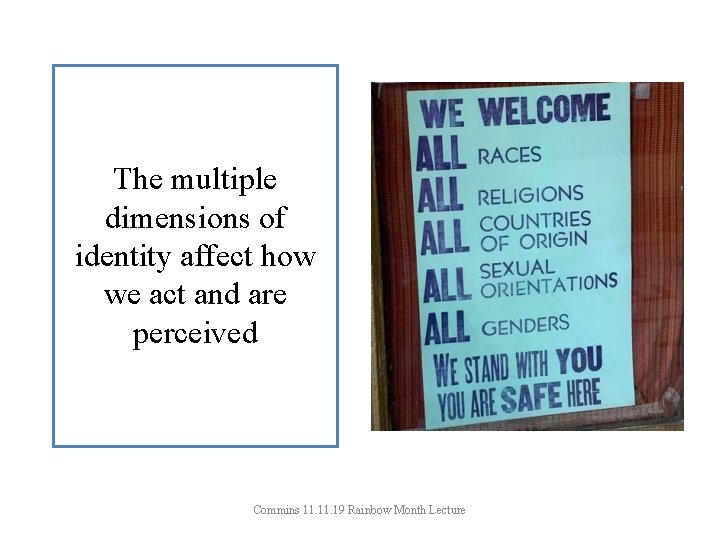
The multiple dimensions of identity affect how we act and are perceived Commins 11. 19 Rainbow Month Lecture
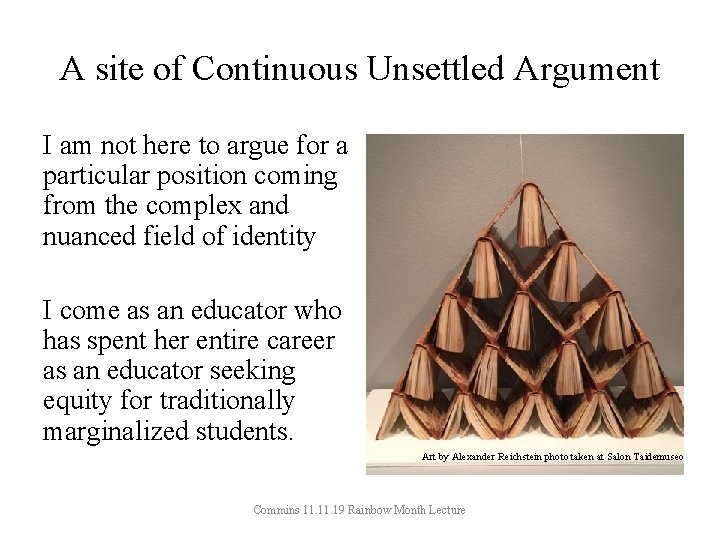
A site of Continuous Unsettled Argument I am not here to argue for a particular position coming from the complex and nuanced field of identity I come as an educator who has spent her entire career as an educator seeking equity for traditionally marginalized students. Art by Alexander Reichstein photo taken at Salon Taidemuseo Commins 11. 19 Rainbow Month Lecture
Move from either / or to neither / both something else. Allow students to be recognized as a person, as part of a community, a polity, a family or any other kind of human group. Commins 11. 19 Rainbow Month Lecture
Why do teachers need to pay attention to identity development? …. . [c]hildren live in a world that is not yet a place where all of them have equal opportunity to become all they could be. We know children need to feel safe and secure in all their many identities, feel pride in their families, and feel at home in [school]. We also know that children need tools to navigate the complex issues of identity diversity, prejudice, and power in their daily lives so that they may learn thrive and succeed. From: Julie Olsen. Rainbow Edwards and Louise Derman-Sparks (2010) Anti-bias Commins 11. 19 Monthfor Lecture Education Young Children and Ourselves. NAEYC
The importance of MESSAGE As a teacher you send powerful messages about the worth of each student by what you say and do about cultural and linguistic diversity. You can disrupt or perpetuate oppression and discrimination by how you treat your students and model for them how to treat each other. Commins 11. 19 Rainbow Month Lecture
The nature of teacher-student relationships is central to student learning “The way students are thought about and treated by society and consequently by the schools they attend and the educators who teach them is fundamental in creating academic success or failure. ” Sonia Nieto Pg. 167 The Light in Their Eyes: Creating Multicultural Learning Communities. Teachers College Press Commins 11. 19 Rainbow Month Lecture
My Belief Every child no matter their background no matter their circumstances Deserves a teacher who Cares deeply about them as an individual and their success as a learner and Sees their potential to contribute to society as a whole when they become adults Commins 11. 19 Rainbow Month Lecture
Teachers’ Actions Matter Only thing truly within control of a teacher: the relationships they construct with and among their students. • Teachers have to power to make students feel loved or unlovable, a part of the class family or an outsider. • Must insist on the intrinsic worth and dignity simply for being human Commins 11. 19 Rainbow Month Lecture
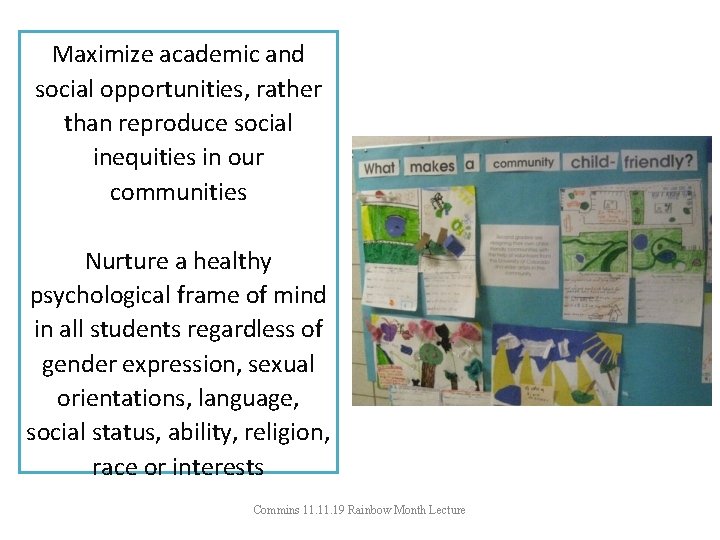
Maximize academic and social opportunities, rather than reproduce social inequities in our communities Nurture a healthy psychological frame of mind in all students regardless of gender expression, sexual orientations, language, social status, ability, religion, race or interests Commins 11. 19 Rainbow Month Lecture
Students have to work out who they are (and are not) within the constraints of the particular institutions (physical and virtual) in which they spend their time. You can only be who you are But you can still combat both actual and symbolic violence Commins 11. 19 Rainbow Month Lecture
An Example: Gender Stereotyping • Coercive behaviors on the part of teachers to insist that students who present themselves as representing one gender / sex or the other must perform in particular ways • Fixed gender separation in toys, clothes where to set, how to talk. Commins 11. 19 Rainbow Month Lecture
What happens when a feature of your identity is marginalized in school? from Louise & George Spindler (1993) • Enduring Self – sense of continuity of experience, meaning & social identity • Situated Self – contextualized and instrumental, changes selectively to meet the demands of the context • Endangered Self – sustained violation of enduring self – damaged identity Pathways to Cultural Awareness: Cultural Therapy With Teachers and Students Commins 11. 19 Rainbow Month Lecture
Author Robin Stevenson wrote an open letter to Wheaton Warrenville Unit District 200 after officials canceled her school visit. Here's what it said, edited for newspaper style: From Daily Herald. Suburban Chicago. November 6 2019 https: //www. dailyherald. com/news/20 191106/read-authors-letter-to-wheaton -warrenville-district-200 -after-herschool-visit-wascanceled? fbclid=Iw. AR 0 Zq. IJ 8 HAYqs Kri 85 Za 1 Ot. N 1 j. H 25 h. Bol. Vyr 9 vz. IF 35 IL 8 hr. Lf-ih. Aj_4 U Commins 11. 19 Rainbow Month Lecture
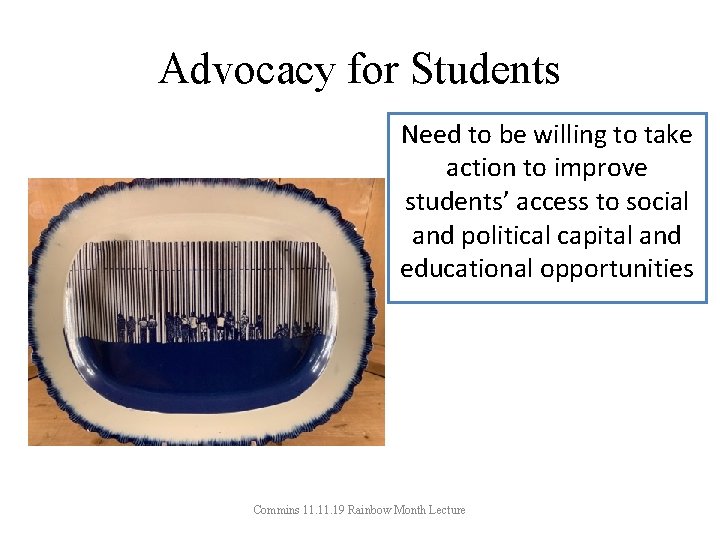
Advocacy for Students Need to be willing to take action to improve students’ access to social and political capital and educational opportunities Commins 11. 19 Rainbow Month Lecture
Resilient Students: Adapt to disturbances to functioning and development Respond to stress in a way that does not impact an individual behaviorally or psychologically Use resources towards positive outcomes Function in a positive way after adverse events Are vulnerable to adverse events From; "Supportive Relationships and Active Skill-Building Strengthen the Foundations of Resilience: Working Paper. Rainbow 13. " National Scientific Council on the Developing Child, 2015. Commins 11. 19 Month Lecture
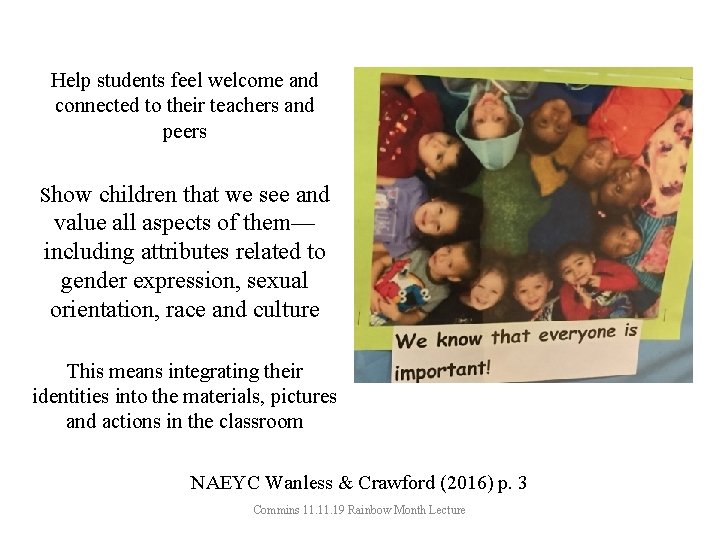
Help students feel welcome and connected to their teachers and peers Show children that we see and value all aspects of them— including attributes related to gender expression, sexual orientation, race and culture This means integrating their identities into the materials, pictures and actions in the classroom NAEYC Wanless & Crawford (2016) p. 3 Commins 11. 19 Rainbow Month Lecture
Why don’t most people from the dominant group fight oppression? • • • They don’t know it exists in the first place They don’t have to They think it’s just a personal problem - individuals usually get what they deserve They want to hang on to their privilege They’re prejudiced – racist, sexist, heterosexist, ableist, classist They’re afraid Johnson, Allan G. (2001). Privilege, power, and difference. Boston: Mc. Graw-Hill, Commins 11. 19 Rainbow Month Lecture
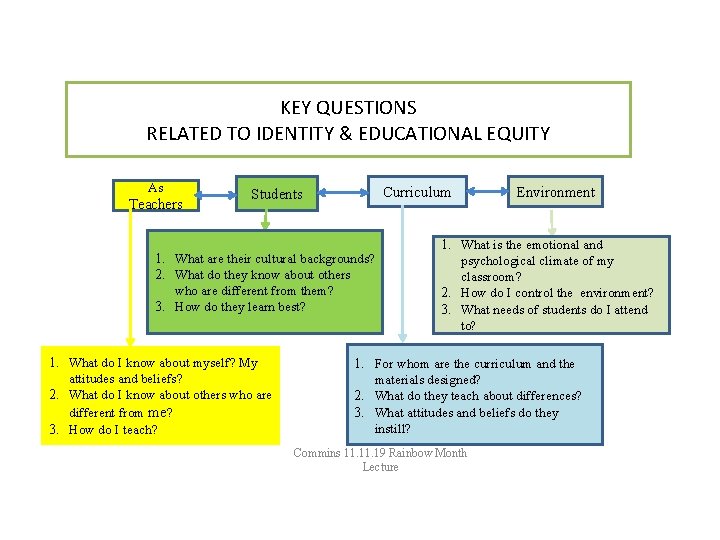
KEY QUESTIONS RELATED TO IDENTITY & EDUCATIONAL EQUITY As Teachers Curriculum Students 1. What are their cultural backgrounds? 2. What do they know about others who are different from them? 3. How do they learn best? 1. What do I know about myself? My attitudes and beliefs? 2. What do I know about others who are different from me? 3. How do I teach? Environment 1. What is the emotional and psychological climate of my classroom? 2. How do I control the environment? 3. What needs of students do I attend to? 1. For whom are the curriculum and the materials designed? 2. What do they teach about differences? 3. What attitudes and beliefs do they instill? Commins 11. 19 Rainbow Month Lecture
Key Questions for Educators: Ourselves • • What do I know about myself and my attitudes and beliefs? What do I know about others who are different from me? How do I teach and do I reach all students? Are there some students I’d rather work with more than others?
Key Questions for Educators: Students • • • What is their cultural background (along multiple dimensions of identity)? What do they know about others who are different from them? How does each student learn best?
Key Questions for Educators Curriculum • • • Who are the curriculum and the materials designed for? What does the curriculum teach about difference? What attitudes and beliefs do they instill?
Key Questions for Educators Environment • • • What is the emotional /psychological climate of my classroom? How do I control the environment? What needs of the students do I attend to?
We Are All the Same We Are All Different Project with Class 5 C Turun Normaalikoulu Kevät 2012 Based on Guidelines from the Anti-Defamation League https: //www. adl. org/education/resources/tools-and-strategies/anti-biascurriculum-guides
Goal of the Research • Determine if students’ attitudes towards others change / improve after focusing on intercultural competence. Open up a global perspective within the context of ethical behavior. • What brings us together? • What divides us? • What can I do to make a difference? Commins 11. 19 Rainbow Month Lecture
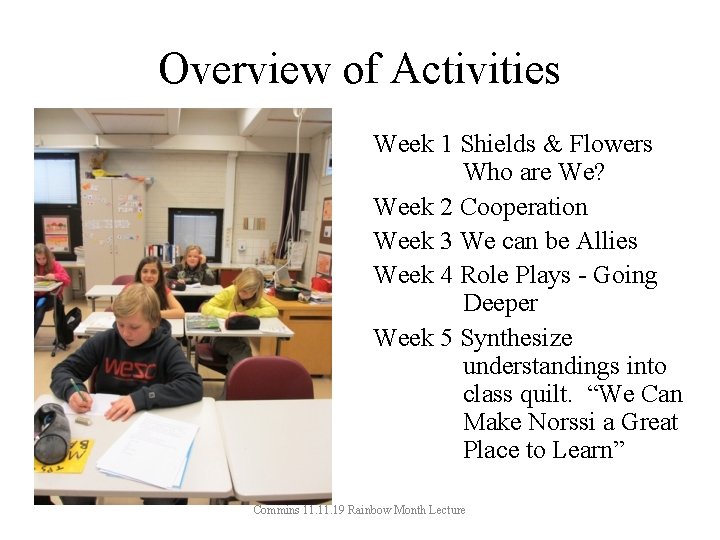
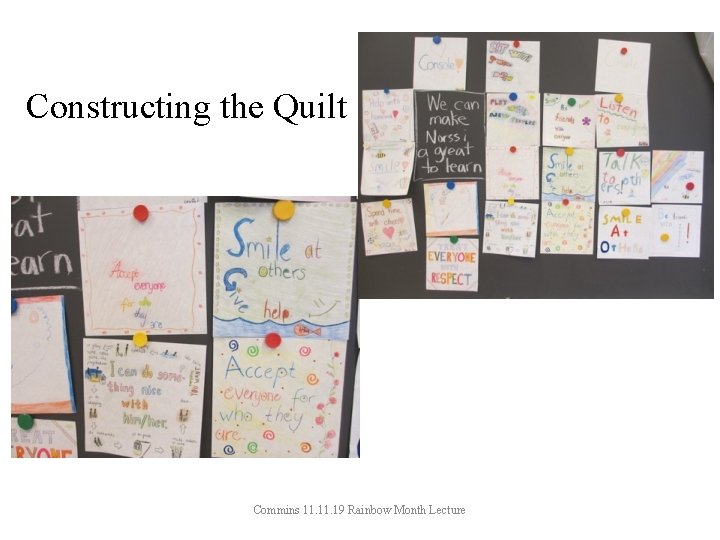
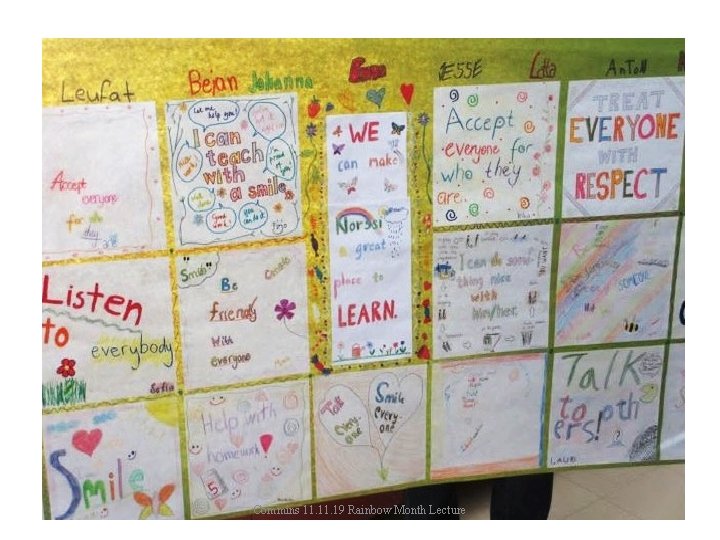
Overview of Activities Week 1 Shields & Flowers Who are We? Week 2 Cooperation Week 3 We can be Allies Week 4 Role Plays - Going Deeper Week 5 Synthesize understandings into class quilt. “We Can Make Norssi a Great Place to Learn” Commins 11. 19 Rainbow Month Lecture
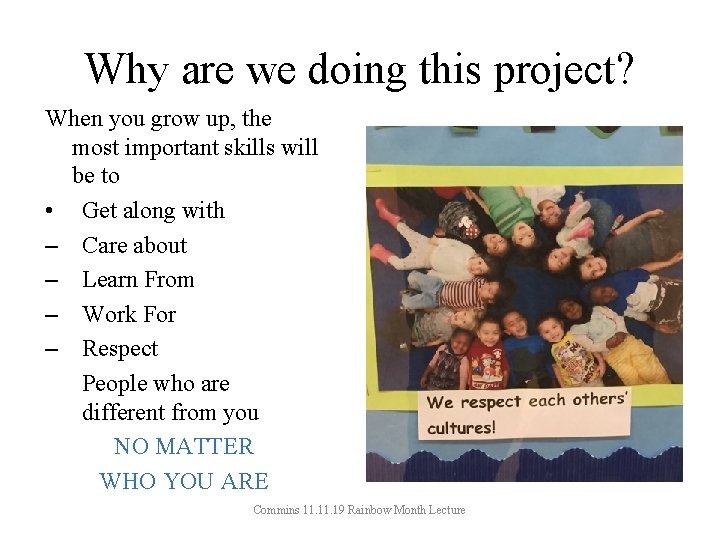
Why are we doing this project? When you grow up, the most important skills will be to • Get along with – Care about – Learn From – Work For – Respect People who are different from you NO MATTER WHO YOU ARE Commins 11. 19 Rainbow Month Lecture
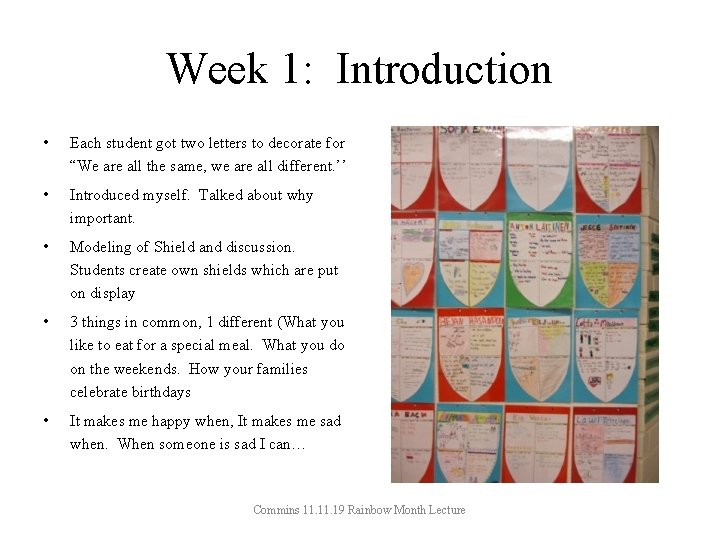
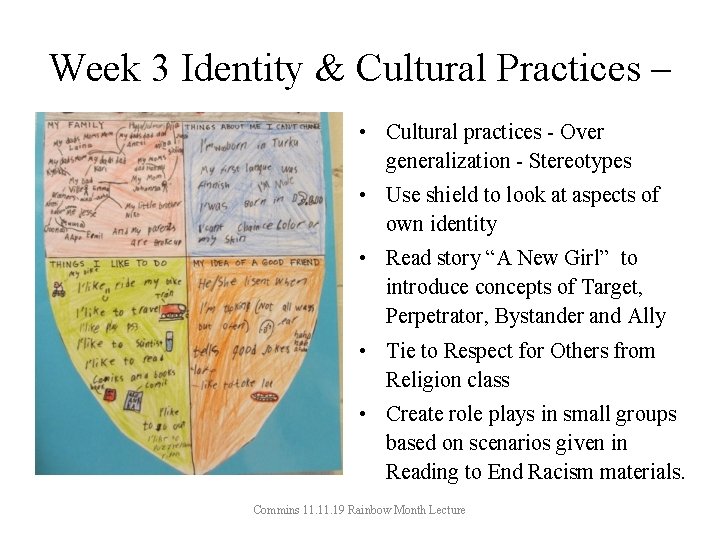
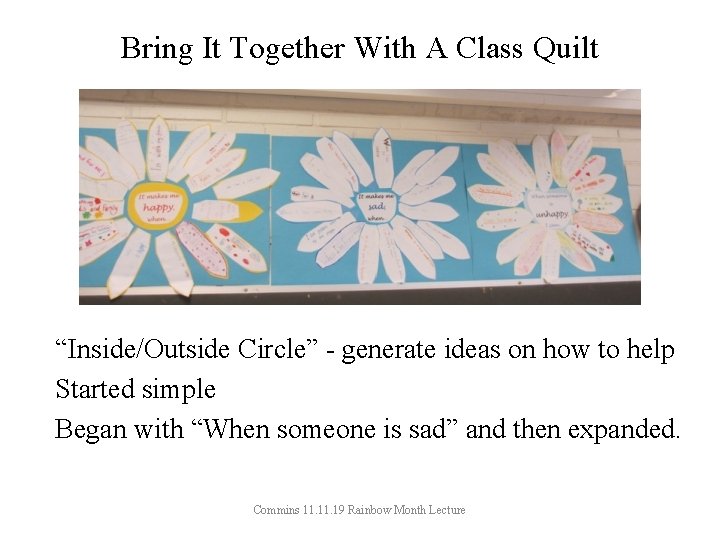
Week 1: Introduction • Each student got two letters to decorate for “We are all the same, we are all different. ’’ • Introduced myself. Talked about why important. • Modeling of Shield and discussion. Students create own shields which are put on display • 3 things in common, 1 different (What you like to eat for a special meal. What you do on the weekends. How your families celebrate birthdays • It makes me happy when, It makes me sad when. When someone is sad I can… Commins 11. 19 Rainbow Month Lecture
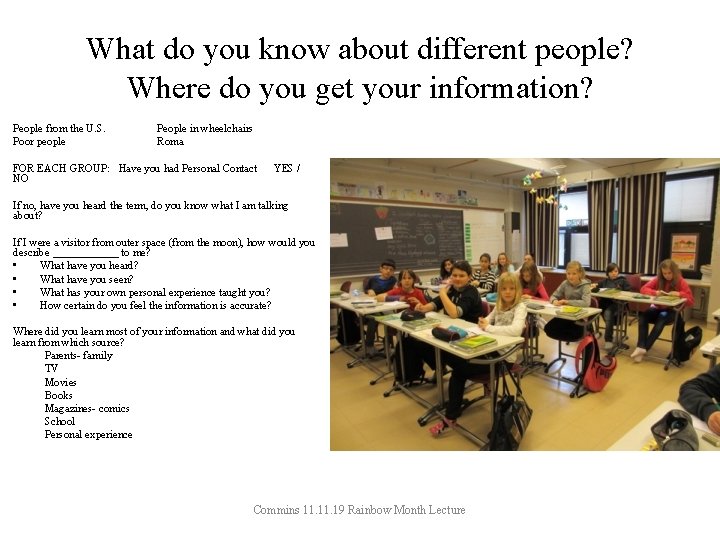
What do you know about different people? Where do you get your information? People from the U. S. Poor people People in wheelchairs Roma FOR EACH GROUP: Have you had Personal Contact NO YES / If no, have you heard the term, do you know what I am talking about? If I were a visitor from outer space (from the moon), how would you describe ______ to me? • What have you heard? • What have you seen? • What has your own personal experience taught you? • How certain do you feel the information is accurate? Where did you learn most of your information and what did you learn from which source? Parents- family TV Movies Books Magazines- comics School Personal experience Commins 11. 19 Rainbow Month Lecture
Week 3 Identity & Cultural Practices – • Cultural practices - Over generalization - Stereotypes • Use shield to look at aspects of own identity • Read story “A New Girl” to introduce concepts of Target, Perpetrator, Bystander and Ally • Tie to Respect for Others from Religion class • Create role plays in small groups based on scenarios given in Reading to End Racism materials. Commins 11. 19 Rainbow Month Lecture
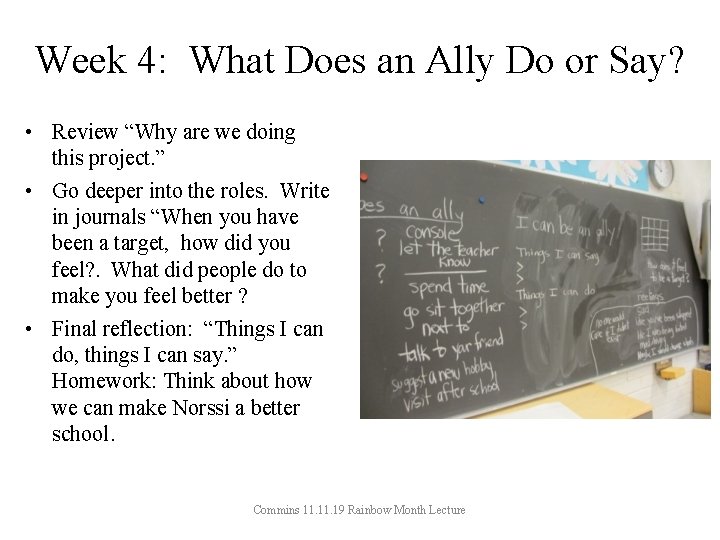
Week 4: What Does an Ally Do or Say? • Review “Why are we doing this project. ” • Go deeper into the roles. Write in journals “When you have been a target, how did you feel? . What did people do to make you feel better ? • Final reflection: “Things I can do, things I can say. ” Homework: Think about how we can make Norssi a better school. Commins 11. 19 Rainbow Month Lecture
Bring It Together With A Class Quilt “Inside/Outside Circle” - generate ideas on how to help Started simple Began with “When someone is sad” and then expanded. Commins 11. 19 Rainbow Month Lecture
Constructing the Quilt Commins 11. 19 Rainbow Month Lecture
Commins 11. 19 Rainbow Month Lecture
Before you leave, take a moment to reflect: How will you take these understandings forward in your work? Commins 11. 19 Rainbow Month Lecture