
Identity Broker Sprint demo 3 6 9 th
Identity Broker Sprint demo #3. 6 – 9 th February 2021 Alan Lewis/Branko Marovic/Jule Ziegler/Miika Tuisku Q 1 2021 Public www. geant. org 1 | www. geant. org
Background It is proposed…. . • Research collaborations and rising student numbers are increasing the pressure on enrolment processes • • Identity verification in person is costly and may be impractical Knowledge-based enrolment is vulnerable to data breaches Sending identity documentation is slow and open to fraud Increased drive for remote interaction • Solutions exist for automated ID verification that might • Improve efficiency • Reduce costs • Minimise errors ? ? Could they be of use to the R&E community? ? 2 | www. geant. org
Aims and objectives • Investigate business case for remote identity verification using ID documents • Validate the problem and explore the nature and extent of the need • Collect use cases from NRENs, research VOs and institutions • Onboarding users into a research community • Enrol ‘foreign’ students onto a campus • Investigate the capabilities of commercial solutions • If of interest, examine the ways to enable capabilities within R&E • • An identity broker service for a set of commercial solutions A centralised identity verification service offered by GÉANT A collective procurement exercise Information gathering and dissemination • Document findings and discuss with stakeholders 3 | www. geant. org
Activities status Status • Investigate solution providers • Identify interviewees • Build questionnaire • Conduct interviews • Revise questions • Analyse results • Stakeholder feedback • Investigate business case • Create recommendations report 4 | www. geant. org

Digital identity -overall workflow You are here Initiation Identity Proofing Registration and enrolment Issuance Record keeping Activation 5 | www. geant. org
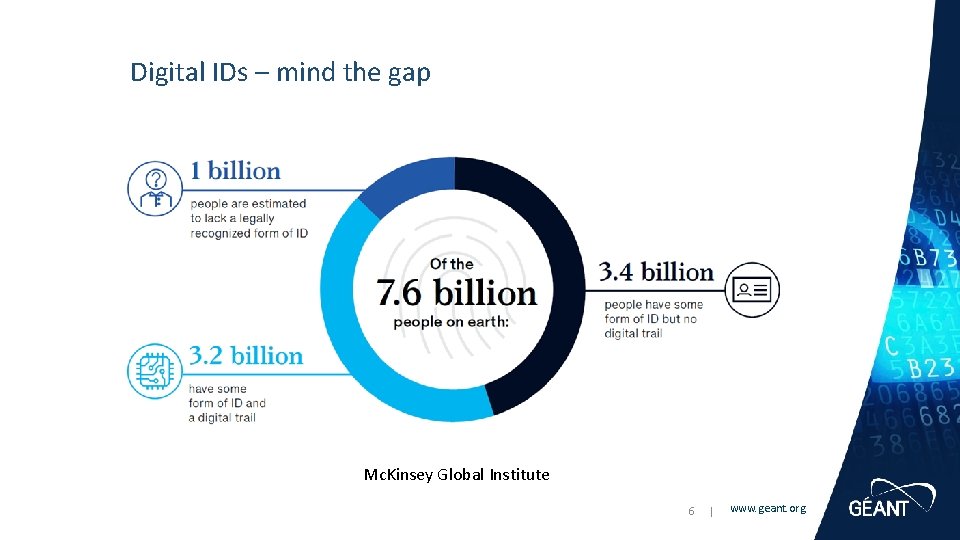
Digital IDs – mind the gap Mc. Kinsey Global Institute 6 | www. geant. org
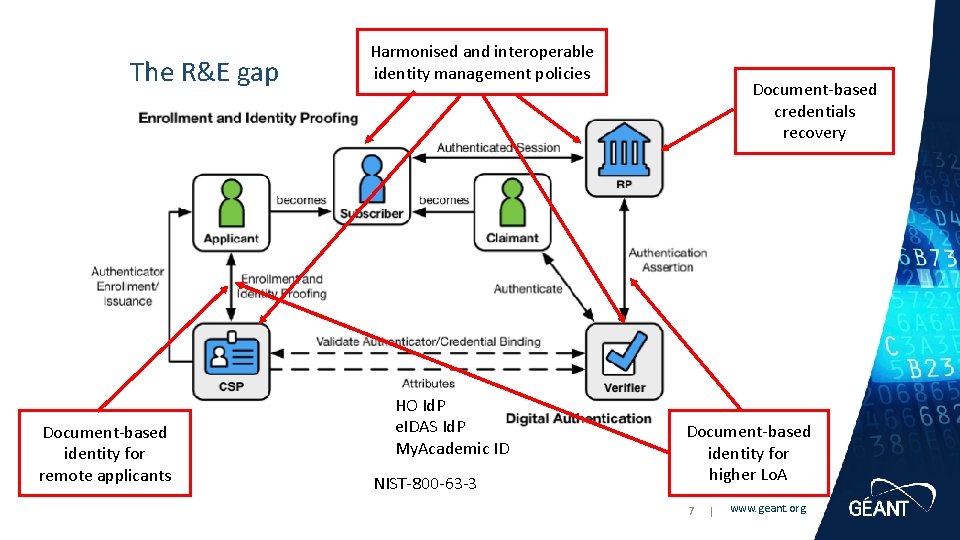
The R&E gap Document-based identity for remote applicants Harmonised and interoperable identity management policies HO Id. P e. IDAS Id. P My. Academic ID NIST-800 -63 -3 Document-based credentials recovery Document-based identity for higher Lo. A 7 | www. geant. org
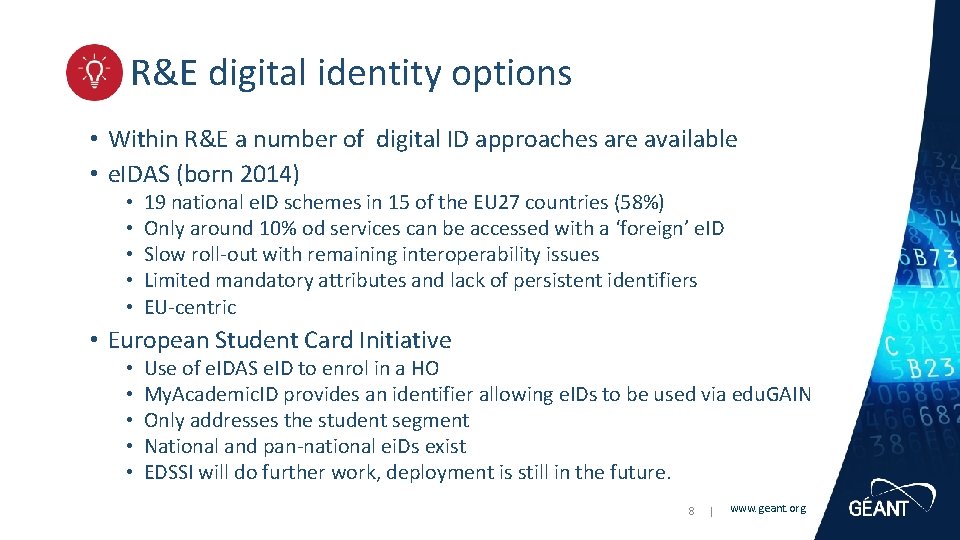
R&E digital identity options • Within R&E a number of digital ID approaches are available • e. IDAS (born 2014) • • • 19 national e. ID schemes in 15 of the EU 27 countries (58%) Only around 10% od services can be accessed with a ‘foreign’ e. ID Slow roll-out with remaining interoperability issues Limited mandatory attributes and lack of persistent identifiers EU-centric • European Student Card Initiative • • • Use of e. IDAS e. ID to enrol in a HO My. Academic. ID provides an identifier allowing e. IDs to be used via edu. GAIN Only addresses the student segment National and pan-national ei. Ds exist EDSSI will do further work, deployment is still in the future. 8 | www. geant. org

Identity proofing steps 9 | www. geant. org
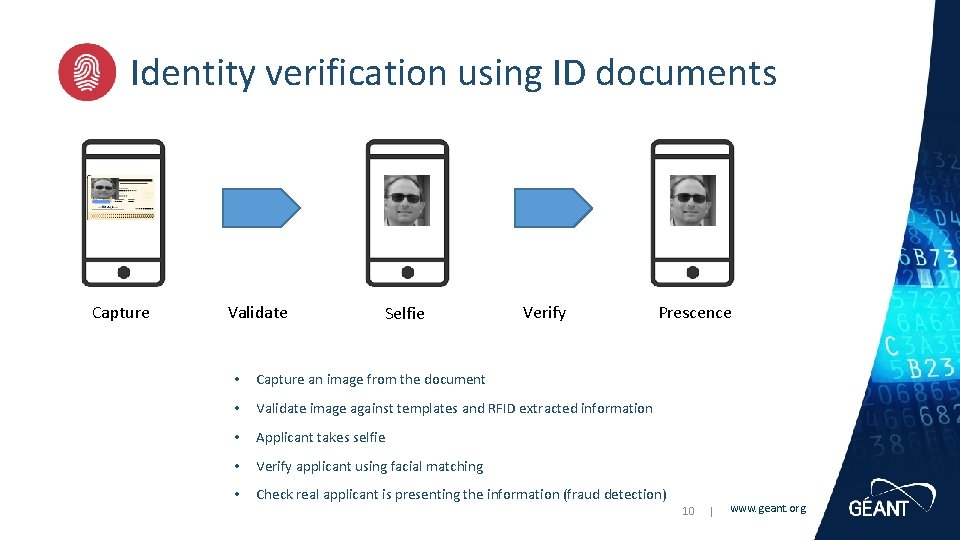
Identity verification using ID documents Capture Validate Selfie Verify Prescence • Capture an image from the document • Validate image against templates and RFID extracted information • Applicant takes selfie • Verify applicant using facial matching • Check real applicant is presenting the information (fraud detection) 10 | www. geant. org
Commercial solution providers • Identified around 20 document-centric ID proofing vendors • Many originated in the digital payments industry to speed onboarding and fraud prevention • Platform offering and components for biometric and/or document matching • Examples • Signicat (Norway) • https: //www. signicat. com/en • Platform Identity hub for e. ID/social ids, document scanning, live interviews, validation with authoritative sources • Sisu. ID (Finland – consortium) • https: //sisuid. com/index. html • Identity and authentication platform supporting document scanning and facial recognition • Onfido (UK) • https: //onfido. com/ • Document verification, facial matching and authentication solution • Read. ID (Innovalor NL) • https: //readid. com/ • Document verification using NFC and facial matching • Electronic. ID (Spain) • https: //www. electronicid. eu/en • Document verification using optical capture with video-based facial matching 11 | www. geant. org
Methodology • Interview sessions with NRENs, institutions and VOs • Designed a set of questions covering key areas • • • Current and future use cases Present approaches and status Problems and drivers Requirements Operational and business needs But • Very early for most: little clear idea on many specifics • Approach adapted as interview progressed • Feedback of points raised to interviewees 12 | www. geant. org
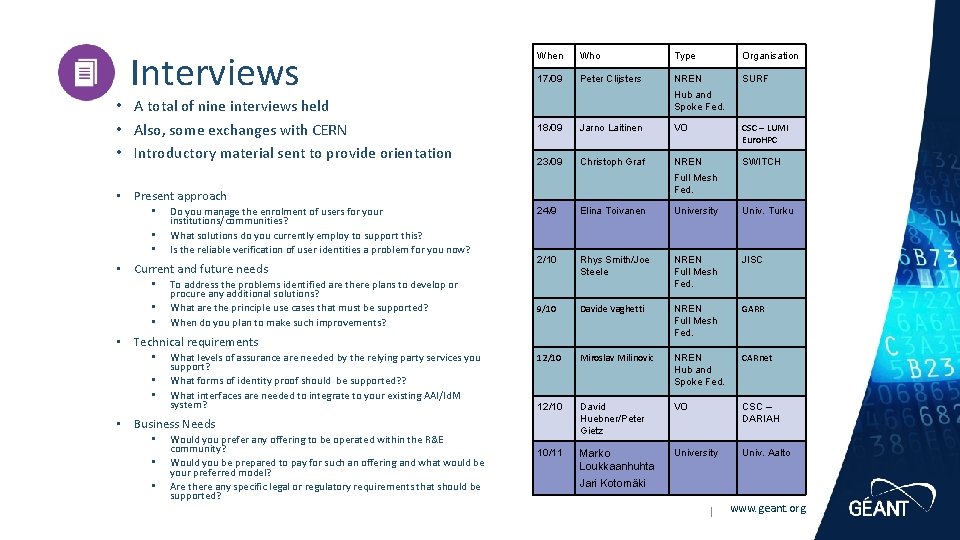
Interviews • A total of nine interviews held • Also, some exchanges with CERN • Introductory material sent to provide orientation When Who Type Organisation 17/09 Peter Clijsters NREN SURF Hub and Spoke Fed. 18/09 Jarno Laitinen VO CSC – LUMI Euro. HPC 23/09 Christoph Graf NREN SWITCH Full Mesh Fed. • Present approach • • • Do you manage the enrolment of users for your institutions/communities? What solutions do you currently employ to support this? Is the reliable verification of user identities a problem for you now? • Current and future needs • • • To address the problems identified are there plans to develop or procure any additional solutions? What are the principle use cases that must be supported? When do you plan to make such improvements? 24/9 Elina Toivanen University Univ. Turku 2/10 Rhys Smith/Joe Steele NREN Full Mesh Fed. JISC 9/10 Davide Vaghetti NREN Full Mesh Fed. GARR 12/10 Miroslav Milinovic NREN Hub and Spoke Fed. CARnet 12/10 David Huebner/Peter Gietz VO CSC – DARIAH 10/11 Marko Loukkaanhuhta University Univ. Aalto • Technical requirements • • • What levels of assurance are needed by the relying party services you support? What forms of identity proof should be supported? ? What interfaces are needed to integrate to your existing AAI/Id. M system? • Business Needs • • • Would you prefer any offering to be operated within the R&E community? Would you be prepared to pay for such an offering and what would be your preferred model? Are there any specific legal or regulatory requirements that should be supported? Jari Kotomäki | www. geant. org
Findings • Findings were grouped into a number of categories • Scope and use cases • Change drivers • Current status and solution landscape • Requirements • Business factors • Implementation approach 14 | www. geant. org
Findings – Scope and use cases • The inferred/conjectured use cases were validated • Enrolment of (often remote) students or of researchers into RO or VO • Enrolment of ‘foreign’ students into a university • In addition we found • Enhanced vetting for issuing or recovery of second-factor authentication tokens • Identity vetting for password recovery • Enrolment of remote or short-term institutional staff and contract employees • Perhaps also remote learning has additional use cases 15 | www. geant. org
Findings – Change drivers • No strong sense of urgency from NRENs – institution driven • Research organisations are motivated – global memberships • Key motivations • Increased efficiency leading to cost reductions and applicant satisfaction • Improvements in quality of vetting process • Lack of suitably trained staff • Responding to growth in remote enrolment and on-line learning • Reduction in errors – improving security 16 | www. geant. org
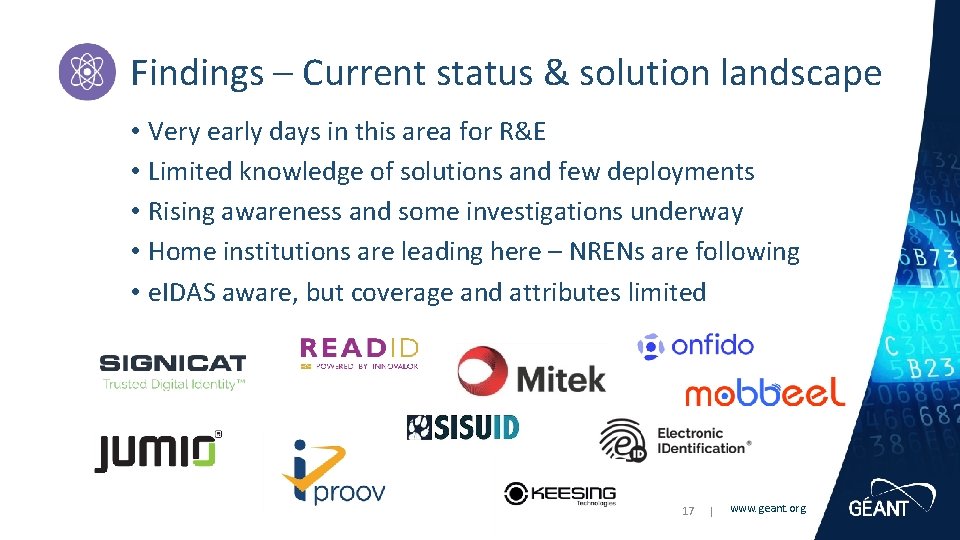
Findings – Current status & solution landscape • Very early days in this area for R&E • Limited knowledge of solutions and few deployments • Rising awareness and some investigations underway • Home institutions are leading here – NRENs are following • e. IDAS aware, but coverage and attributes limited 17 | www. geant. org
Findings – Requirements • Complete requirements set, as yet non-authoritative • Proposed requirements were generally accepted • Some expressed requirements are not fully aligned and may depend on needs • Requirements were grouped into broad themes • • Identification and verification methods Level of Assurance needs Usability and functionality Credential issuance Solution interfaces – APIs Trust and regulatory compliance Cost and flexibility • The report gives all the details 18 | www. geant. org
Findings – Business factors • Probably too early to deduce much here but • Help with making solution selections would be welcome • Too early to determine best approaches – procurement, service etc. • Quantified cost savings will be key to adoption • Pricing model unclear – subscription preferrable for some • Trust model and privacy are key considerations, but…… • Third-party solutions acceptable if they tick key boxes • National regulatory considerations are an important factor for some 19 | www. geant. org
Findings – Implementation approach • Home institutions will have a central role in ID proofing • Even with a solution, responsibility and liability chiefly with HOs • NRENs could help support common standards • Solutions must be flexible to accommodate different needs • A GÉANT solution could be welcomed if it brings benefits • VOs and ROs could benefit from use as an Id. P add-on 20 | www. geant. org
Conclusions • Efficient onboarding requires effective identity proofing • This is most acute in some segments, but true generally • Digital identity solutions do not offer universal coverage • Automated document-based ID proofing could help • Requirements hard to establish in an early market • A strong need for congruency and more information exists 21 | www. geant. org
Recommendations and next steps • Determine extent of need through a broad survey of R&E Assuming a positive result… • Establish a forum for information capture and exchange • Benchmark and compare available solutions • Investigate the business case for a community operated service 22 | www. geant. org
Thank you www. geant. org © GÉANT Association on behalf of the GN 4 Phase 2 project (GN 4 -2). The research leading to these results has received funding from the European Union’s Horizon 2020 research and innovation programme under Grant Agreement No. 731122 (GN 4 -2). 23 | www. geant. org
- Slides: 23