
Identity and History Literary Theory and Criticism History
![A 2: History –what Kinds – O O Official history [history-making]; grand narrative (for](https://slidetodoc.com/presentation_image_h/ad755e61ef9a288fcc464149736f8a11/image-9.jpg "A 2: History –what Kinds – O O Official history [history-making]; grand narrative (for")
![Example 1 – Official/National History [the 2004 version] O Exact dates, numbers and ‘facts’](https://slidetodoc.com/presentation_image_h/ad755e61ef9a288fcc464149736f8a11/image-34.jpg "Example 1 – Official/National History [the 2004 version] O Exact dates, numbers and ‘facts’")
- Slides: 50
Identity and History Literary Theory and Criticism: History, Trauma and Globalization Introduction & Formalist Approach Spring 2012 Kate Liu
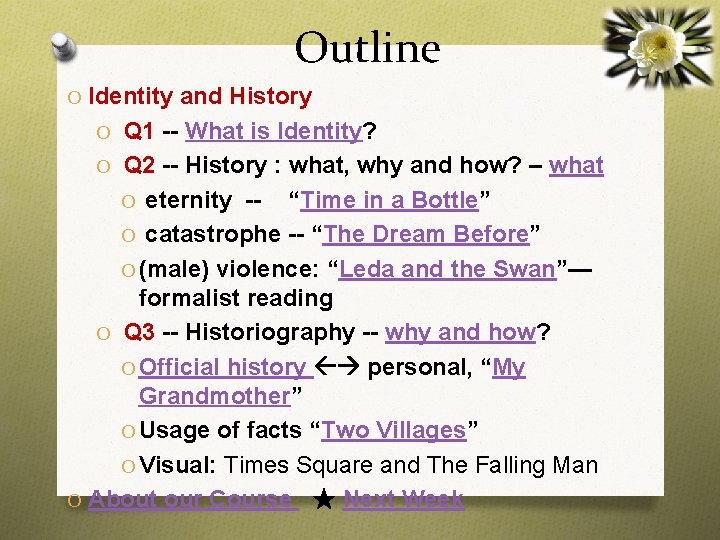
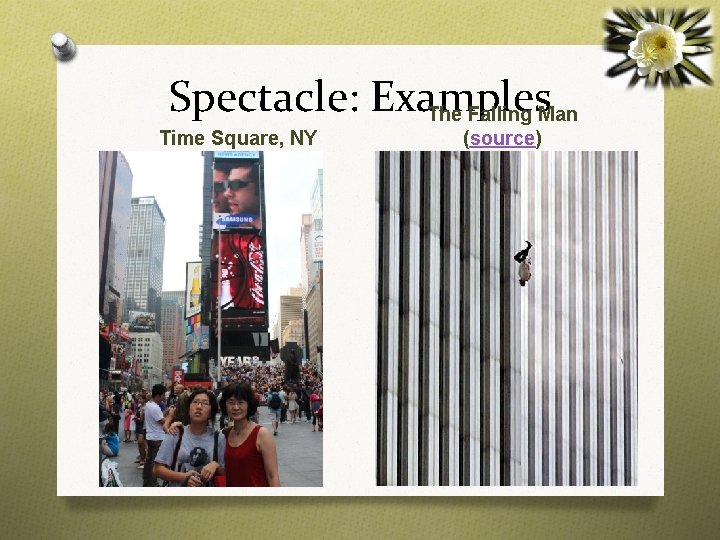
Outline O Identity and History O Q 1 -- What is Identity? O Q 2 -- History : what, why and how? – what O eternity -- “Time in a Bottle” O catastrophe -- “The Dream Before” O (male) violence: “Leda and the Swan”— formalist reading O Q 3 -- Historiography -- why and how? O Official history personal, “My Grandmother” O Usage of facts “Two Villages” O Visual: Times Square and The Falling Man O About our Course ★ Next Week
Q 1: Identity O What is Identity? O Does it matter to you? If so, how do you define your identity (or identities)?
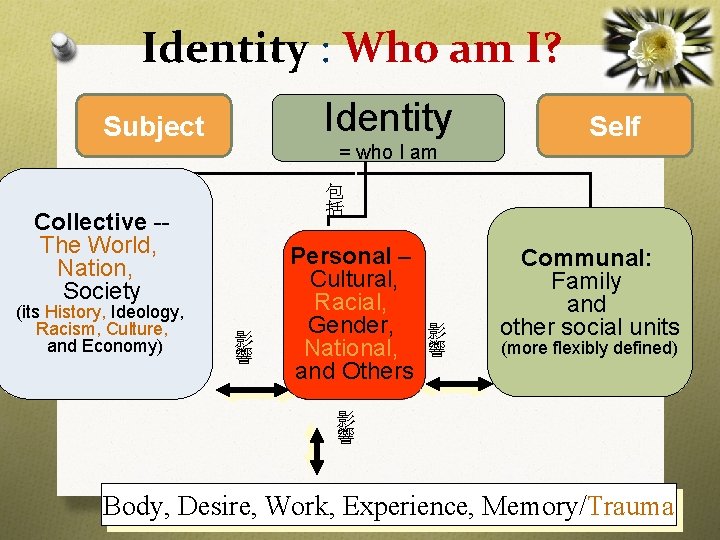
Identity : Who am I? Identity Subject = who I am 包 括 Collective -The World, Nation, Society (its History, Ideology, Racism, Culture, and Economy) Self 影 響 Personal – Cultural, Racial, Gender, National, and Others 影 響 Communal: Family and other social units (more flexibly defined) 影 響 Body, Desire, Work, Experience, Memory/Trauma
Identity : Who am I? To talk about our identity, we try to answer the question, "Who am I? " 2. Our identity seem “natural” and can be taken for granted—like our ID cards. 3. Plural and provisional: The answer can be plural and made from time to time. (Identity is a process of identification. ) 1.
Identity : Who am I? (2) O We have different kinds of collective identity: O national identity, social identity, cultural/racial identity, class identity, familial identity, gender identity, sexual identity, etc. O All these identities are formed beyond our control (at least partly). (This explains why some contemporary theorists say that our identities are fragmentary and split. )
Identity : Who am I? (3) O Conscious and unconscious: Out of all of these inter-related kinds of collective identity we form our personal (sense of) identity. But “usually" we do not loudly pronounce (articulate and/or defend) a certain kind of identity unless it is strongly related to our beliefs or unless it is threatened. O Written on our bodies and into history: However, our personal senses or, more precisely, our constructions of our identities, consciously or not, are written on our bodies and embodied in our daily actions, which, in turn, become ‘historical’ documents of society’s archive.
Q 2: What is history? O What do you think about the following statements: O O O S/he’s history. // We should put the past behind us and move forward. History is progressive. // History repeats itself. History is who we are and why we are the way we are. (David Mc. Cullough) “. . . to [the elderly] all the past is not a diminishing road but, instead, a huge meadow which no winter ever quite touches. divided from them now by the narrow bottleneck of the most recent decade of years“ (“A Rose for Emily”). History is the present. That's why every generation writes it anew. But what most people think of as history is its end product, myth. (E. L. Doctorow) History is fiction, fiction history.
A 2: History –what Kinds – O O Official history [history-making]; grand narrative (for legitimation); “objective” Personal histories (biography, memoir, anecdote, diary, etc. ); small narrative; “subjective” Is our daily life part of history? It is, when it is selected into a “historical text. ” O History as text, interpretation or myth: O “History is the present. That's why every generation writes it anew. O But what most people think of as history is its end product, myth” (E. L. Doctorow). O History is fiction, history.
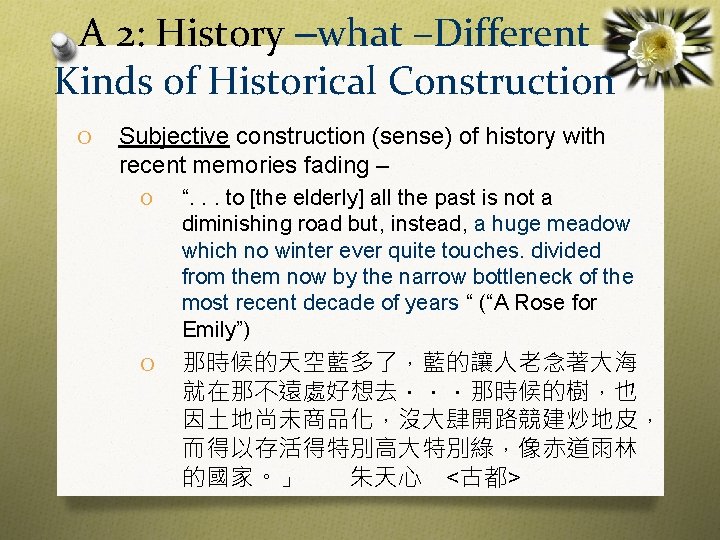
A 2: History –what –Different Kinds of Historical Construction O Subjective construction (sense) of history with recent memories fading – O “. . . to [the elderly] all the past is not a diminishing road but, instead, a huge meadow which no winter ever quite touches. divided from them now by the narrow bottleneck of the most recent decade of years “ (“A Rose for Emily”) O 那時候的天空藍多了,藍的讓人老念著大海 就在那不遠處好想去...那時候的樹,也 因土地尚未商品化,沒大肆開路競建炒地皮, 而得以存活得特別高大特別綠,像赤道雨林 的國家。」 朱天心 <古都>
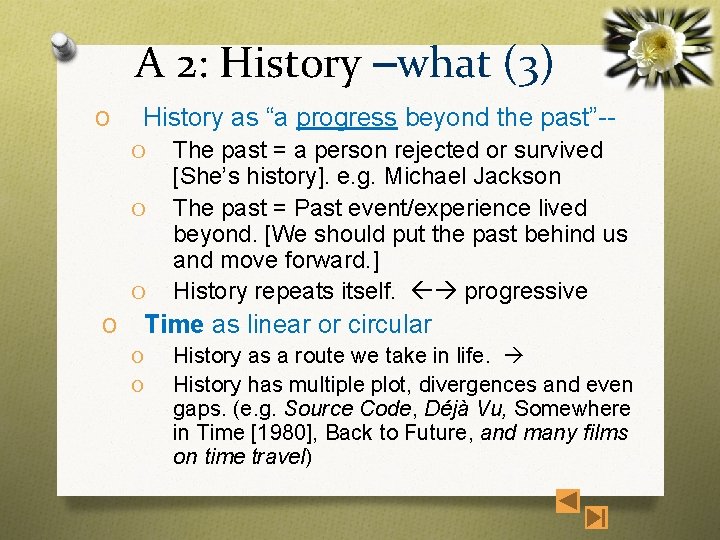
A 2: History –what (3) O History as “a progress beyond the past”-- O O The past = a person rejected or survived [She’s history]. e. g. Michael Jackson The past = Past event/experience lived beyond. [We should put the past behind us and move forward. ] History repeats itself. progressive Time as linear or circular O O History as a route we take in life. History has multiple plot, divergences and even gaps. (e. g. Source Code, Déjà Vu, Somewhere in Time [1980], Back to Future, and many films on time travel)
A 2: History –what History and Identity: “History is who we are and why we are the way we are. ” But the problem is: it is impossible for us to know history, or our selves, completely, not to mention our subjective coloring and involuntary forgetting of it.
Examples of Artistic Constructions of History Taking a Formalist Approach
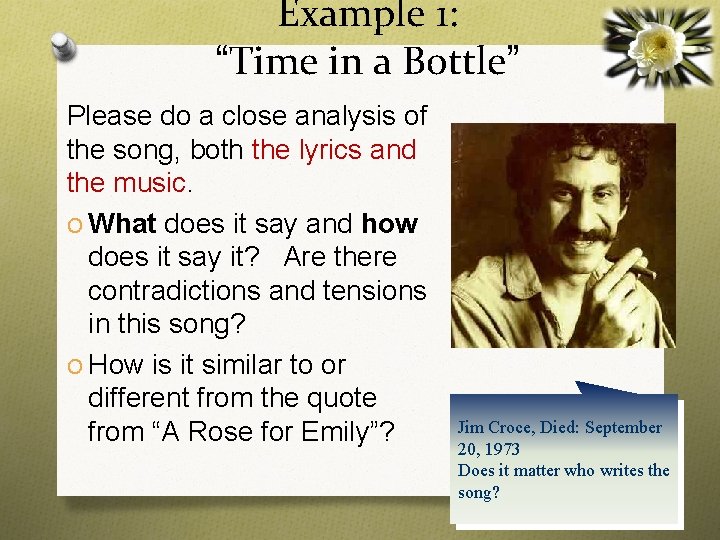
Example 1: “Time in a Bottle” Please do a close analysis of the song, both the lyrics and the music. O What does it say and how does it say it? Are there contradictions and tensions in this song? O How is it similar to or different from the quote from “A Rose for Emily”? Jim Croce, Died: September 20, 1973 Does it matter who writes the song?
Time in a Bottle If I could save time in a bottle The first thing that I'd like to do Is to save every day Till Eternity passes away Just to spend them with you If I could make days last forever If words could make wishes come true I'd save every day like a treasure and then, Again, I would spend them with you If I had a box just for wishes And dreams that had never come true The box would be empty Except for the memory Of how they were answered by you But there never seems to be enough time To do the things you want to do Once you find them I've looked around enough to know But there never seems to to be be enough time That you're the one I want to go Through time with To do the things you want to do Once you find them I've looked around enough to know That you're the one I want to go Through time with
Example 1: “Time in a Bottle” O The song O What – The speaker wants to spend everyday with “you” till eternity, and keep a box with all the memories of “your” answering his dreams, but there is not enough time (mortality) and the box is for impossible dreams. O How – slow, rhythmic (3 -beat) and repetitive melody; seemingly unfinished both in meaning and in music, as if the song could be repeated again and again. O The elderly in “A Rose for Emily” – remote past frozen in their mind. Two futile attempts to treat history as eternity.
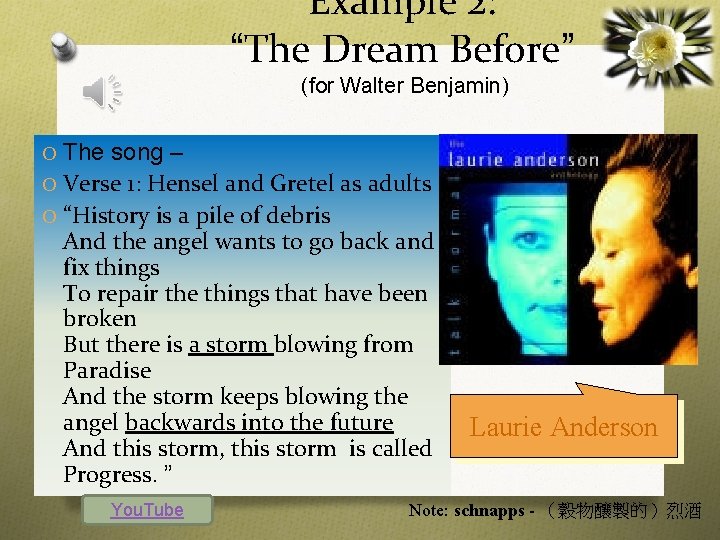
Example 2: “The Dream Before” (for Walter Benjamin) O The song – O Verse 1: Hensel and Gretel as adults O “History is a pile of debris And the angel wants to go back and fix things To repair the things that have been broken But there is a storm blowing from Paradise And the storm keeps blowing the angel backwards into the future And this storm, this storm is called Progress. ” You. Tube Laurie Anderson Note: schnapps - (穀物釀製的)烈酒
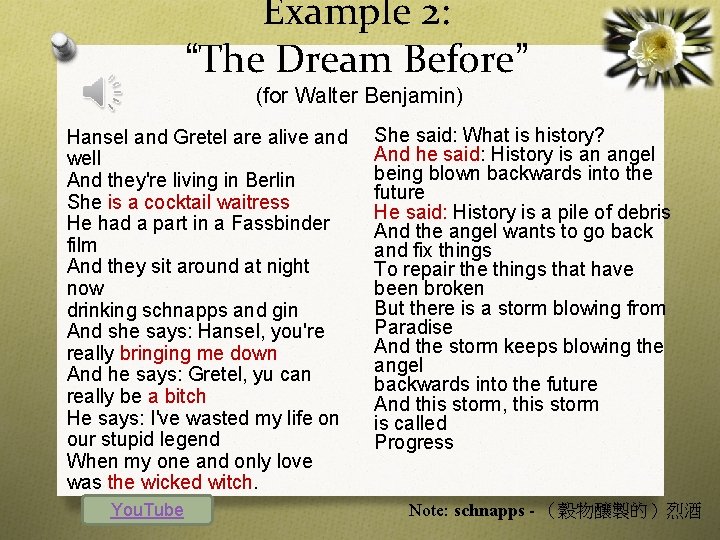
Example 2: “The Dream Before” (for Walter Benjamin) Hansel and Gretel are alive and well And they're living in Berlin She is a cocktail waitress He had a part in a Fassbinder film And they sit around at night now drinking schnapps and gin And she says: Hansel, you're really bringing me down And he says: Gretel, yu can really be a bitch He says: I've wasted my life on our stupid legend When my one and only love was the wicked witch. You. Tube She said: What is history? And he said: History is an angel being blown backwards into the future He said: History is a pile of debris And the angel wants to go back and fix things To repair the things that have been broken But there is a storm blowing from Paradise And the storm keeps blowing the angel backwards into the future And this storm, this storm is called Progress Note: schnapps - (穀物釀製的)烈酒
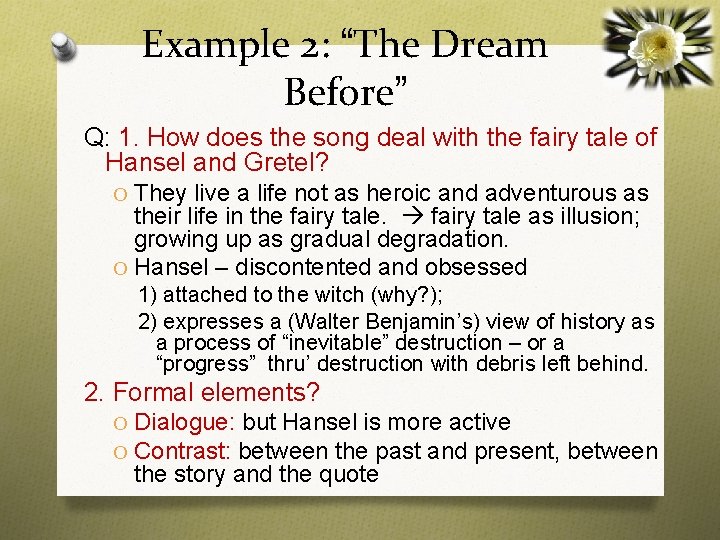
Example 2: “The Dream Before” Q: 1. How does the song deal with the fairy tale of Hansel and Gretel? O They live a life not as heroic and adventurous as their life in the fairy tale as illusion; growing up as gradual degradation. O Hansel – discontented and obsessed 1) attached to the witch (why? ); 2) expresses a (Walter Benjamin’s) view of history as a process of “inevitable” destruction – or a “progress” thru’ destruction with debris left behind. 2. Formal elements? O Dialogue: but Hansel is more active O Contrast: between the past and present, between the story and the quote
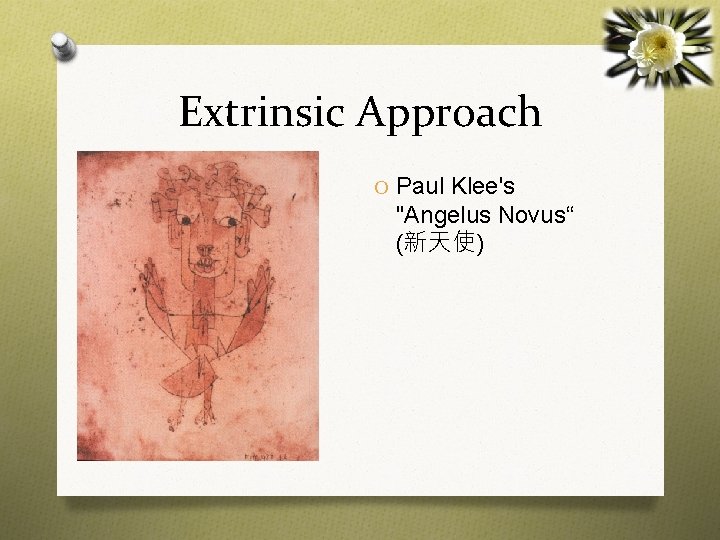
Extrinsic Approach O Paul Klee's "Angelus Novus“ (新天使)
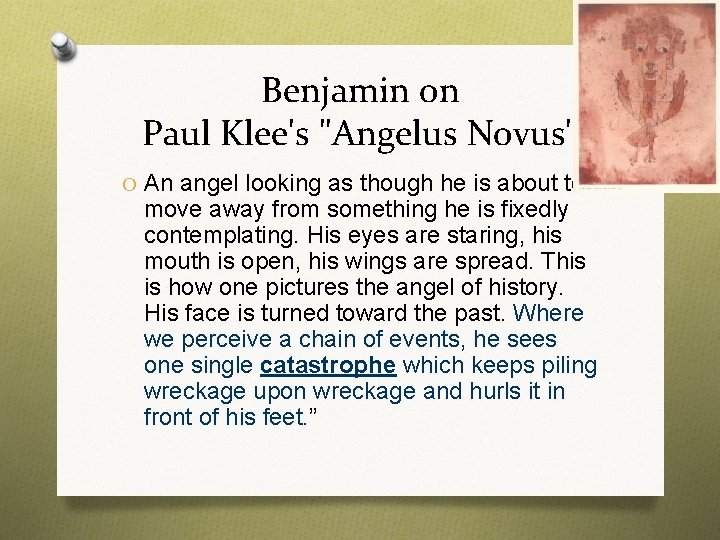
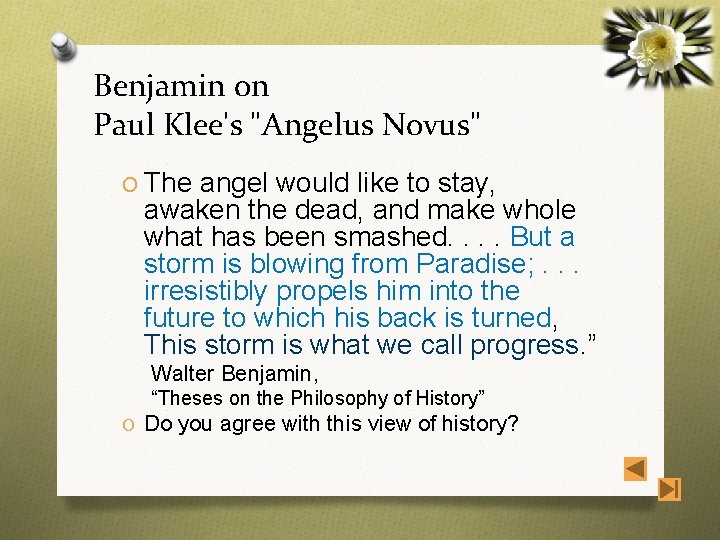
Benjamin on Paul Klee's "Angelus Novus" O An angel looking as though he is about to move away from something he is fixedly contemplating. His eyes are staring, his mouth is open, his wings are spread. This is how one pictures the angel of history. His face is turned toward the past. Where we perceive a chain of events, he sees one single catastrophe which keeps piling wreckage upon wreckage and hurls it in front of his feet. ”
Benjamin on Paul Klee's "Angelus Novus" O The angel would like to stay, awaken the dead, and make whole what has been smashed. . But a storm is blowing from Paradise; . . . irresistibly propels him into the future to which his back is turned, This storm is what we call progress. ” Walter Benjamin, “Theses on the Philosophy of History” O Do you agree with this view of history?
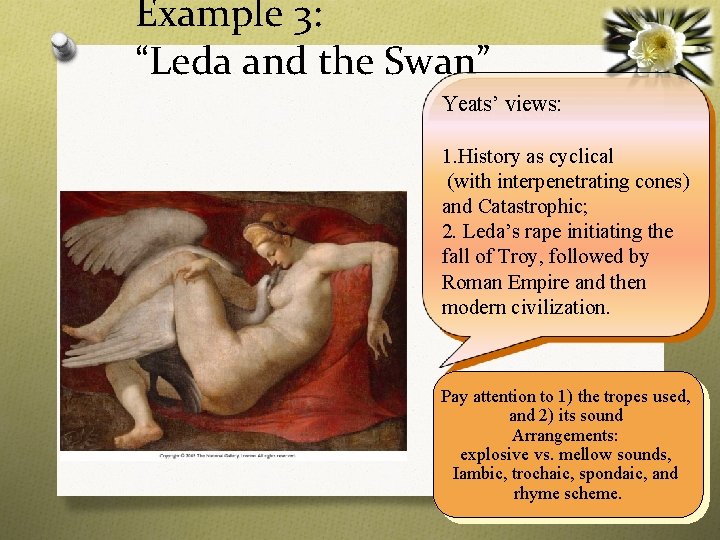
Example 3: “Leda and the Swan” Yeats’ views: 1. History as cyclical (with interpenetrating cones) and Catastrophic; 2. Leda’s rape initiating the fall of Troy, followed by Roman Empire and then modern civilization. Pay attention to 1) the tropes used, and 2) its sound Arrangements: explosive vs. mellow sounds, Iambic, trochaic, spondaic, and rhyme scheme.
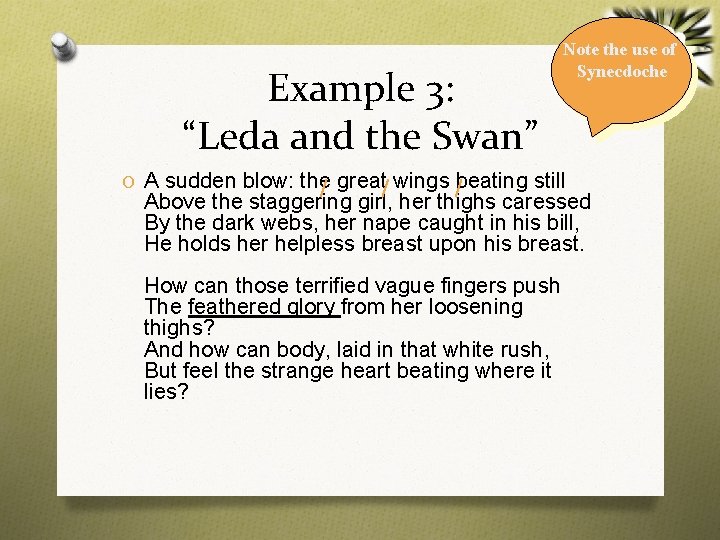
Example 3: “Leda and the Swan” Note the use of Synecdoche O A sudden blow: the great wings beating still Above the staggering girl, her thighs caressed By the dark webs, her nape caught in his bill, He holds her helpless breast upon his breast. How can those terrified vague fingers push The feathered glory from her loosening thighs? And how can body, laid in that white rush, But feel the strange heart beating where it lies?
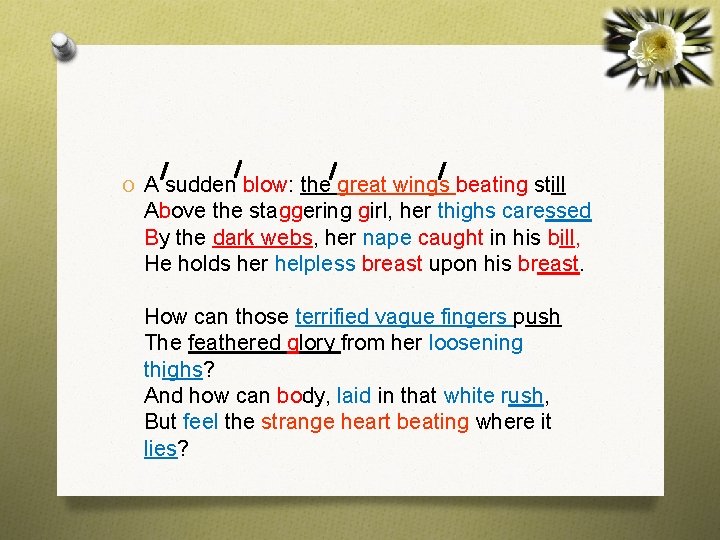
O A sudden blow: the great wings beating still Above the staggering girl, her thighs caressed By the dark webs, her nape caught in his bill, He holds her helpless breast upon his breast. How can those terrified vague fingers push The feathered glory from her loosening thighs? And how can body, laid in that white rush, But feel the strange heart beating where it lies?
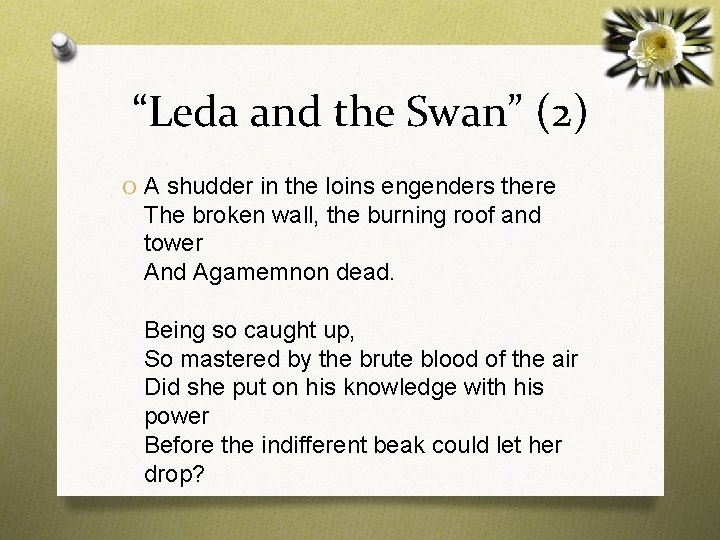
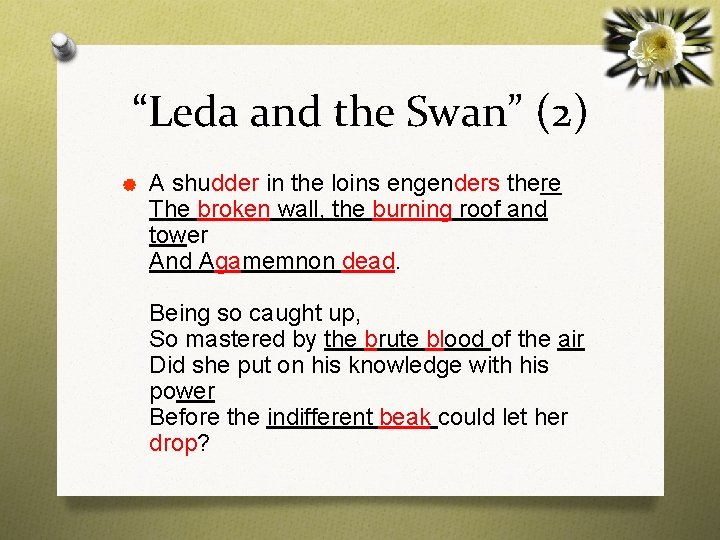
“Leda and the Swan” (2) O A shudder in the loins engenders there The broken wall, the burning roof and tower And Agamemnon dead. Being so caught up, So mastered by the brute blood of the air Did she put on his knowledge with his power Before the indifferent beak could let her drop?
“Leda and the Swan” (2) | A shudder in the loins engenders there The broken wall, the burning roof and tower And Agamemnon dead. Being so caught up, So mastered by the brute blood of the air Did she put on his knowledge with his power Before the indifferent beak could let her drop?
“Leda and the Swan” (3) History as Violent Catastrophe O A. New Critical (or formalist) Approach: 1. sound and sense: the poem is a sensual presentation of Zeus’ rape of Leda. Sensuality conveyed thru’ the alteration between explosive and mellifluous sounds.
“Leda and the Swan” (4) Formalist Approach (cont’d) 2. Figurative language: the use of synecdoche. The rape is presented in close-up, so is the fall of Troy. Plus the effects of the explosive sounds, the poem uses such language to convey 1) the largeness of the swan, its indifference to Leda as a person, and 2) the powerful impact of both the rape and the Trojan war. 3. Irony and/or contradiction: besides the contrast between power and powerlessness, there is also a contrast between fear (terrified vague fingers) and willingness (loosening, feel the heart), birth (engendered) and destruction (what is engendered) , passive (caught and mastered) and active (put on his knowledge)
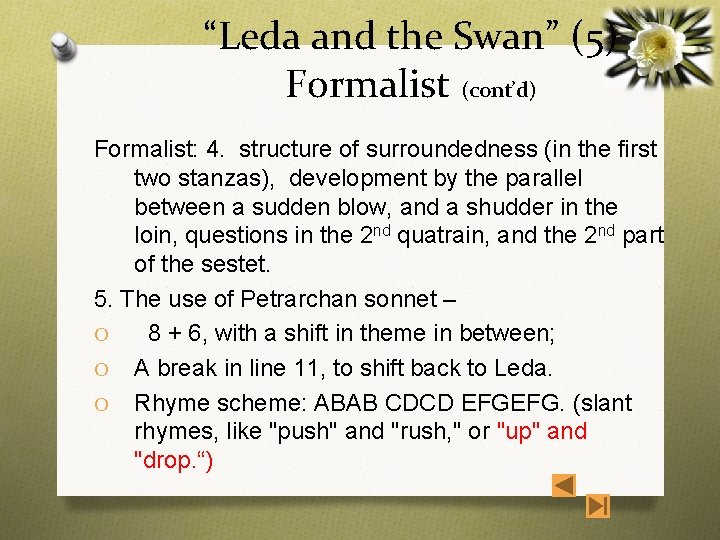
“Leda and the Swan” (5) Formalist (cont’d) Formalist: 4. structure of surroundedness (in the first two stanzas), development by the parallel between a sudden blow, and a shudder in the loin, questions in the 2 nd quatrain, and the 2 nd part of the sestet. 5. The use of Petrarchan sonnet – O 8 + 6, with a shift in theme in between; O A break in line 11, to shift back to Leda. O Rhyme scheme: ABAB CDCD EFGEFG. (slant rhymes, like "push" and "rush, " or "up" and "drop. “)
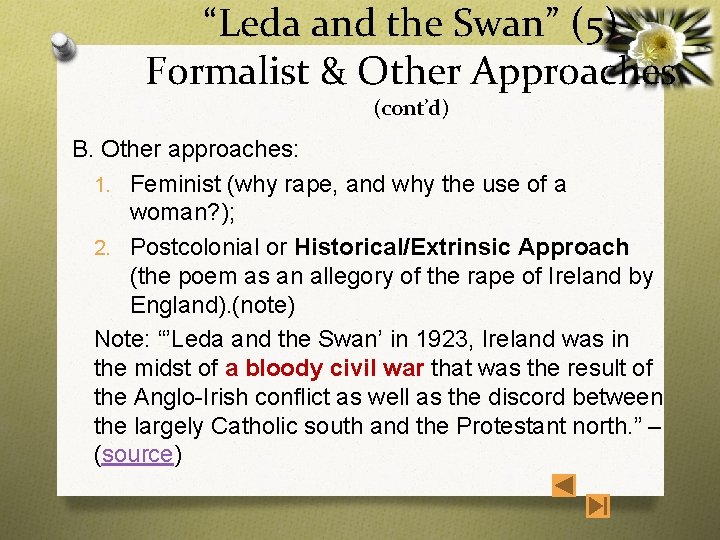
“Leda and the Swan” (5) Formalist & Other Approaches (cont’d) B. Other approaches: 1. Feminist (why rape, and why the use of a woman? ); 2. Postcolonial or Historical/Extrinsic Approach (the poem as an allegory of the rape of Ireland by England). (note) Note: “’Leda and the Swan’ in 1923, Ireland was in the midst of a bloody civil war that was the result of the Anglo-Irish conflict as well as the discord between the largely Catholic south and the Protestant north. ” – (source)
Q 3: History –why and how? O O Why do we write and read histories? To record events only? What are the functions of history? To serve their functions, how are ‘histories’ told?
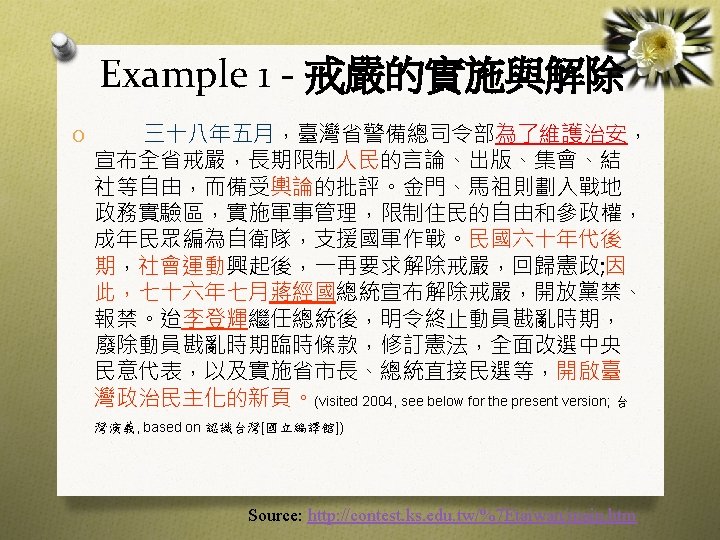
Example 1 – Official/National History [the 2004 version] O Exact dates, numbers and ‘facts’ O Only the names of VIP’s; His-story; O General – avoiding and/or erasing sensitive details (of 228) O Partially justifying martial law, and suggesting progress
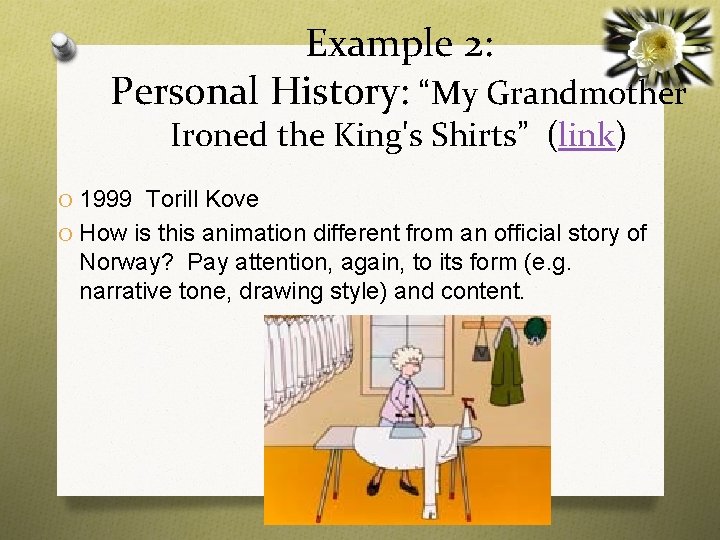
Example 2: Personal History: “My Grandmother Ironed the King's Shirts” (link) O 1999 Torill Kove O How is this animation different from an official story of Norway? Pay attention, again, to its form (e. g. narrative tone, drawing style) and content.
Example 2: “My Grandmother Ironed the King's Shirts” O Content: O Characterization – the grandmother a royalist and a professional ‘shirt-presser’ O history – In the 60’s, “She no longer approved. ” O Form: O child-like drawing + historical (black-andwhite) photos O digressions ice-skating dancer, the ending. O language – humorous: “unemployed” royals. O ending: another family legend after this one.
For your reference O 挪威王國首都奧斯陸(Oslo) O 1905, separated from The Bernadottes the union between Sweden and Norway to be a separate nation. O On 18 November, 1905, the solemn election of Prince Carl as king of Norway took place in the Storting, taking the name of Haakon the seventh. O The Royan family of Norway: http: //www. kongehuset. no/default. asp? lang=eng
For your reference (2) O When the Norwegian forces in Northern Norway capitulated after two months of fighting in June 1940, the king, prime minister and government evacuated to Great Britain. Throughout the war years, Norway retained an operating government in exile. And as the years passed by, the number of Norwegian refugees abroad grew to some 80. 000. O ★ Norway's resistance in World War II included civil disobedience, such as pretending to not know German, and students’ wearing paper clips O (source: http: //home. online. no/~gestrom/history/norartxt. htm ; http: //en. wikipedia. org/wiki/Norwegian_resistance_movement#Civil_disobedien ce )
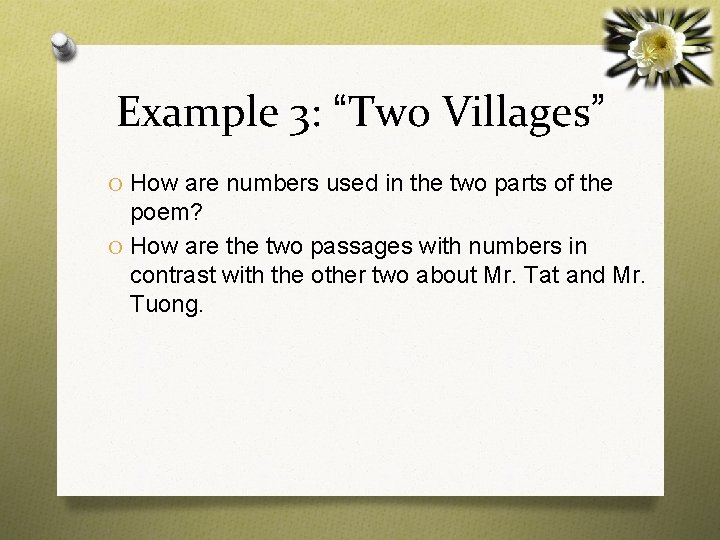
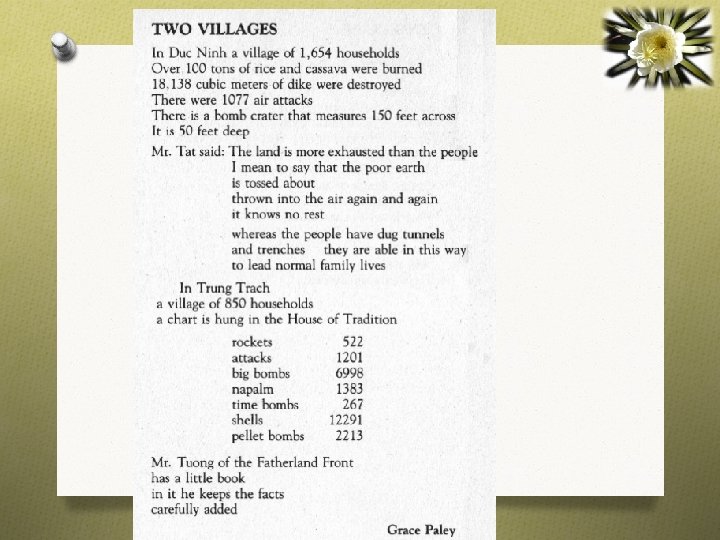
Example 3: “Two Villages” O How are numbers used in the two parts of the poem? O How are the two passages with numbers in contrast with the other two about Mr. Tat and Mr. Tuong.
For your reference History—the use of hard facts and photos e. g. Paul Hardcastle '19‘ O In a newscaster’s voice: "In world war two the average of the combat soldier was twenty six. In Vietnam he was nineteen. I-I-In Vietnam he was nineteen. Nn-n-n-nineteen. "
More Examples in our class… O In diary form: “Snowed Up” O Metafictional and about Trauma– Slaughterhouse V, Atonement O Magical Realism and allegorical – Cereus Blooms at Night O More we may not have time to deal with: Midnight’s Children, Forrest Gump, Anil’s Ghost, Robber Bride, JFK and the other Oliver Stone film …
A 2: History –why and how? Why? Purposes – a memento to keep (and past to immortalize), and to be fixated by, Somewhere in Time -- sense-making, legitimating or empowering . grandmother; -- re-interpretation relating it to our present world (society and its ideology, discourse and images) and selves. O How: Cannot be re-presenting the past; histories have to be fictions, or constructions. O
Q 4: History and Identity O History and Identity: How does History/histories shape our identities? O And how do we establish/construct our identities through telling stories?
About our Course Themes: Spectacl e a. Identity History b. Self, Trauma and Their Visual Constructions c. Racial Other and its Visual Constructions d. Globalization and its Visual Impact 2. Literary Approaches & Critical Theories a. New Criticism b. Discourse Analysis c. Psychoanalysis d. Postcolonialism and Globalization 1.
Spectacle 奇觀 O Definition: O 1) OED 1. A specially prepared or arranged display of a more or less public nature (esp. one on a large scale), forming an impressive or interesting show or entertainment for those viewing it. O 2. A person or thing exhibited to, or set before, the public gaze as an object either (a) of curiosity or contempt, or (b) of marvel or admiration. O 3. a. …; something presented to the view, esp. of a striking or unusual character; a sight O Society of the Spectacle (Sp as a social relation among people, mediated by images" (4)) How do we relate to the spectacles around us?
Spectacle: Examples The Falling Man Time Square, NY (source)
Spectacle: Examples (2) O About a Nation: O Mosaika in Ottawa, Image Mill in Quebec City O Promoting a film O 3 D Projection Mapping promoting The Tourist in Dallas O Social Welfare, World Vision O Follow the Wings O Mapping projection on the Christ Rio by Fernando Salis (Brazil against child abuse) O Interview with Fernando Salis
Questions Review 1. What is identity? 2. What is history? How do we record or represent history? For what? 3. History and Fiction: O How do we read a literary text? What’re the differences between an intrinsic approach and an extrinsic one? O How do we relate fiction, or art, to history?
★ Next Week O text-personal history: "Snowed Up: A Mistletoe Story" (3) O (introd) "The Work of Representation. " (2: 1 -3) O (if you have time) Slaughterhouse V Chap 1