
Identity and Equality Identity vs Equality Simple idea
- Slides: 60
Identity and Equality
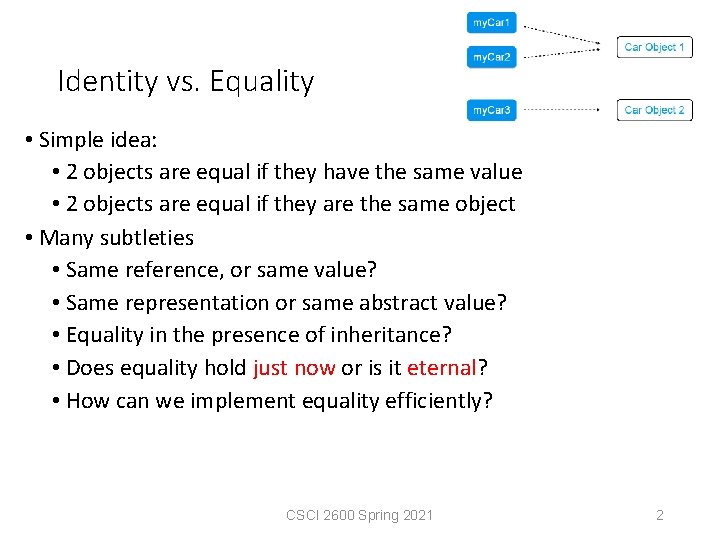
Identity vs. Equality • Simple idea: • 2 objects are equal if they have the same value • 2 objects are equal if they are the same object • Many subtleties • Same reference, or same value? • Same representation or same abstract value? • Equality in the presence of inheritance? • Does equality hold just now or is it eternal? • How can we implement equality efficiently? CSCI 2600 Spring 2021 2
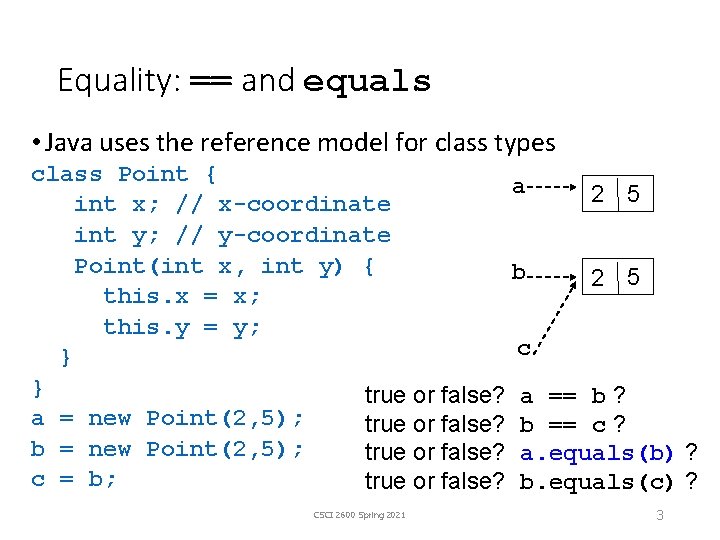
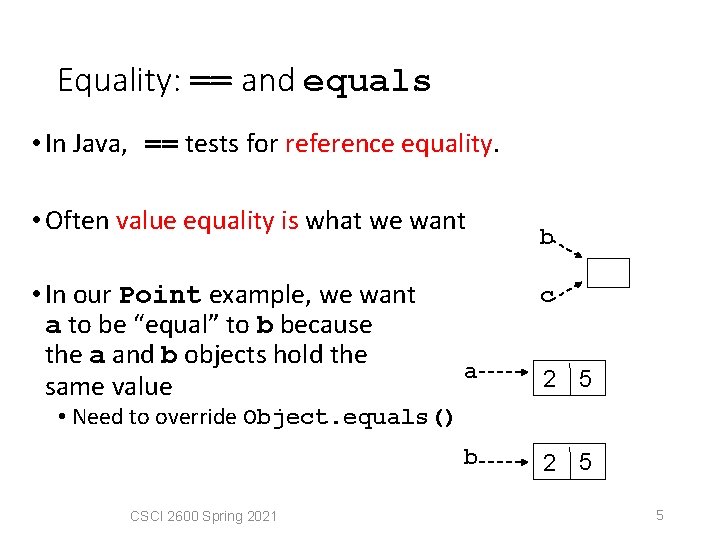
Equality: == and equals • Java uses the reference model for class types class Point { a 2 5 int x; // x-coordinate int y; // y-coordinate Point(int x, int y) { b 2 5 this. x = x; this. y = y; c } } true or false? a == b ? a = new Point(2, 5); true or false? b == c ? b = new Point(2, 5); true or false? a. equals(b) ? c = b; true or false? b. equals(c) ? CSCI 2600 Spring 2021 3
Assignment Operator "=" • = operator copies references for objects not “stuff” • For primitives, it copies data
Equality: == and equals • In Java, == tests for reference equality. • Often value equality is what we want • In our Point example, we want a to be “equal” to b because the a and b objects hold the same value b c a 2 5 b 2 5 • Need to override Object. equals() CSCI 2600 Spring 2021 5
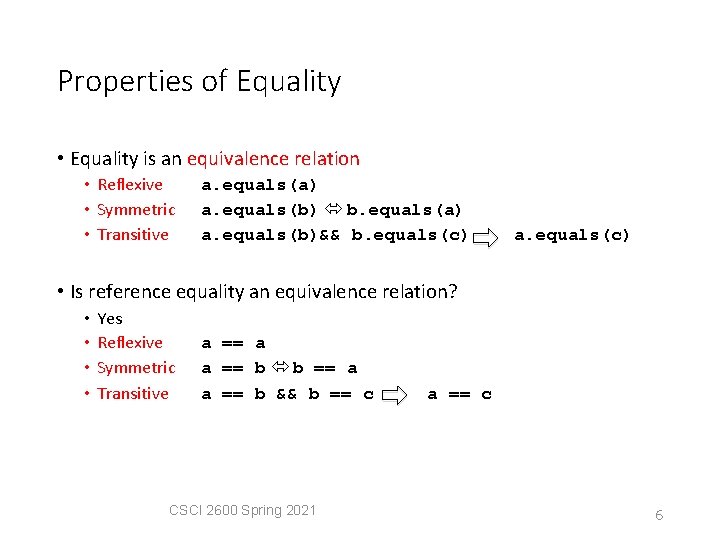
Properties of Equality • Equality is an equivalence relation • Reflexive • Symmetric • Transitive a. equals(a) a. equals(b) b. equals(a) a. equals(b)&& b. equals(c) a. equals(c) • Is reference equality an equivalence relation? • • Yes Reflexive Symmetric Transitive a == a a == b b == a a == b && b == c CSCI 2600 Spring 2021 a == c 6
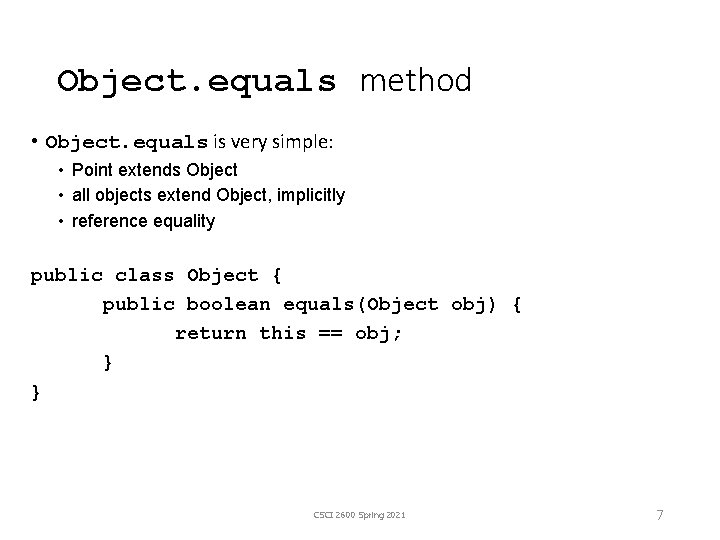
Object. equals method • Object. equals is very simple: • Point extends Object • all objects extend Object, implicitly • reference equality public class Object { public boolean equals(Object obj) { return this == obj; } } CSCI 2600 Spring 2021 7
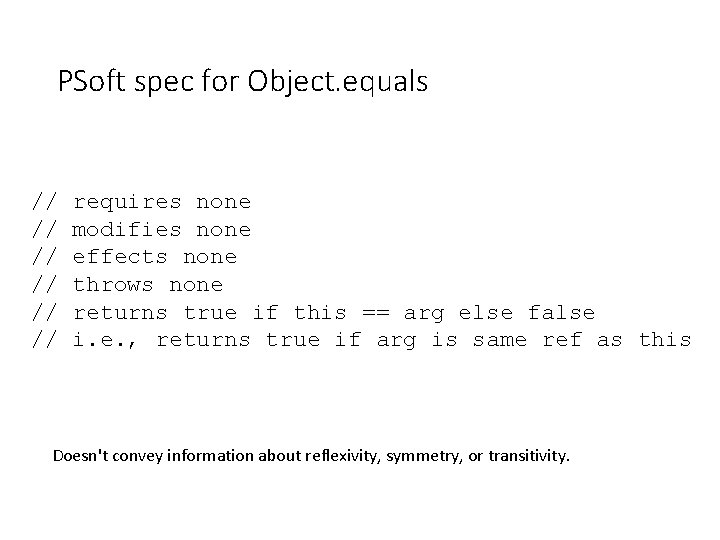
PSoft spec for Object. equals // // // requires none modifies none effects none throws none returns true if this == arg else false i. e. , returns true if arg is same ref as this Doesn't convey information about reflexivity, symmetry, or transitivity.
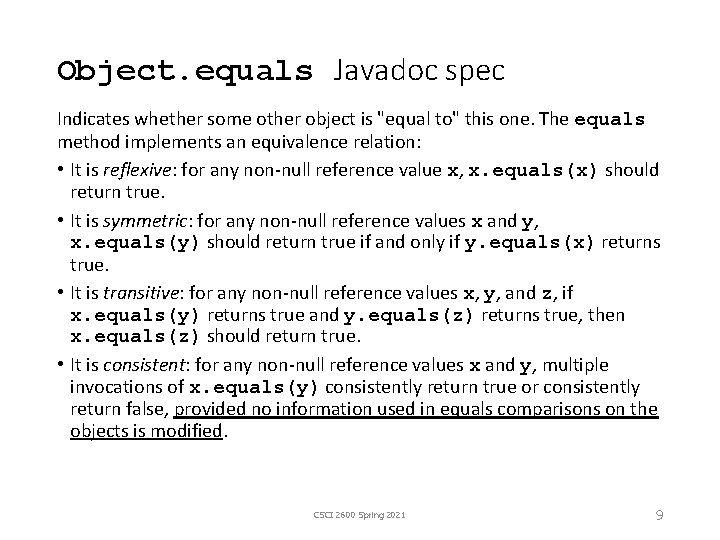
Object. equals Javadoc spec Indicates whether some other object is "equal to" this one. The equals method implements an equivalence relation: • It is reflexive: for any non-null reference value x, x. equals(x) should return true. • It is symmetric: for any non-null reference values x and y, x. equals(y) should return true if and only if y. equals(x) returns true. • It is transitive: for any non-null reference values x, y, and z, if x. equals(y) returns true and y. equals(z) returns true, then x. equals(z) should return true. • It is consistent: for any non-null reference values x and y, multiple invocations of x. equals(y) consistently return true or consistently return false, provided no information used in equals comparisons on the objects is modified. CSCI 2600 Spring 2021 9
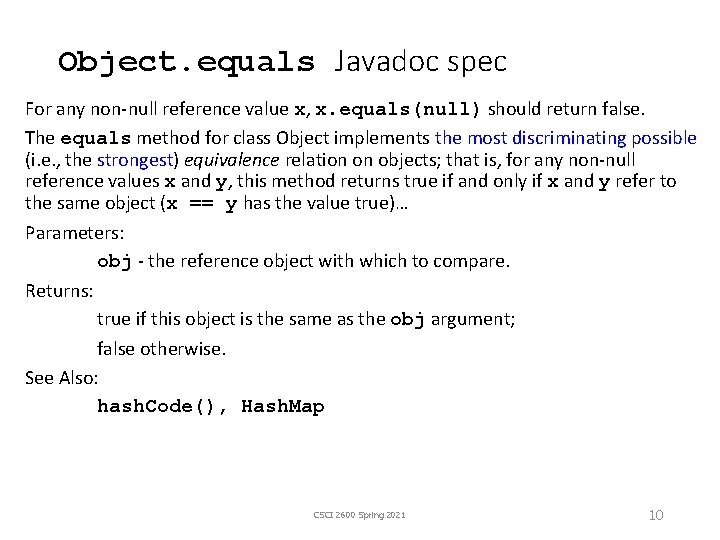
Object. equals Javadoc spec For any non-null reference value x, x. equals(null) should return false. The equals method for class Object implements the most discriminating possible (i. e. , the strongest) equivalence relation on objects; that is, for any non-null reference values x and y, this method returns true if and only if x and y refer to the same object (x == y has the value true)… Parameters: obj - the reference object with which to compare. Returns: true if this object is the same as the obj argument; false otherwise. See Also: hash. Code(), Hash. Map CSCI 2600 Spring 2021 10
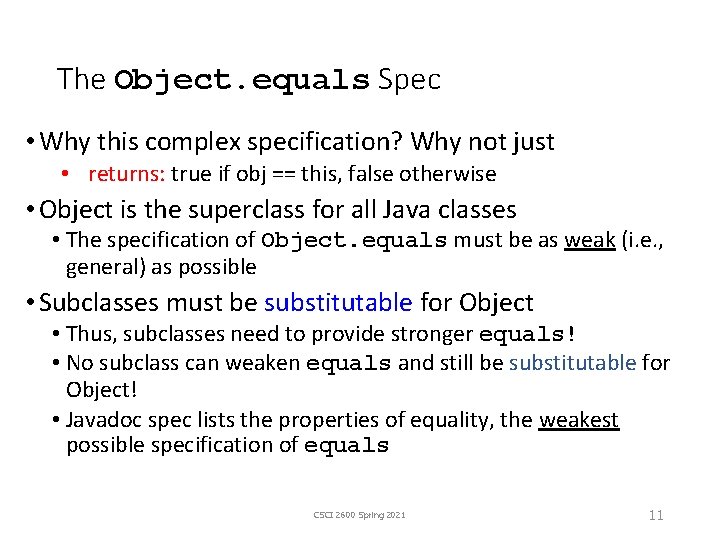
The Object. equals Spec • Why this complex specification? Why not just • returns: true if obj == this, false otherwise • Object is the superclass for all Java classes • The specification of Object. equals must be as weak (i. e. , general) as possible • Subclasses must be substitutable for Object • Thus, subclasses need to provide stronger equals! • No subclass can weaken equals and still be substitutable for Object! • Javadoc spec lists the properties of equality, the weakest possible specification of equals CSCI 2600 Spring 2021 11
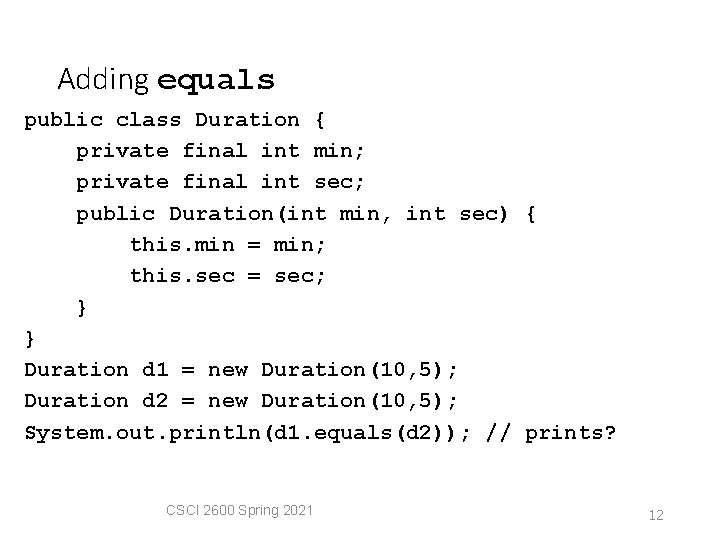
Adding equals public class Duration { private final int min; private final int sec; public Duration(int min, int sec) { this. min = min; this. sec = sec; } } Duration d 1 = new Duration(10, 5); Duration d 2 = new Duration(10, 5); System. out. println(d 1. equals(d 2)); // prints? CSCI 2600 Spring 2021 12
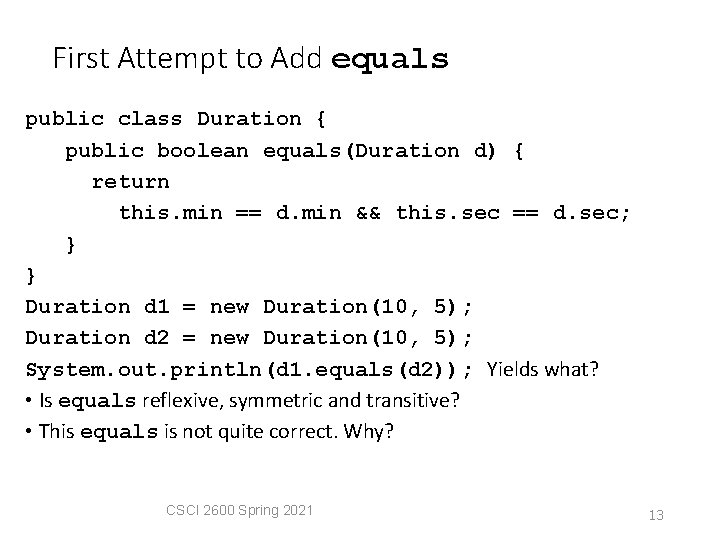
First Attempt to Add equals public class Duration { public boolean equals(Duration d) { return this. min == d. min && this. sec == d. sec; } } Duration d 1 = new Duration(10, 5); Duration d 2 = new Duration(10, 5); System. out. println(d 1. equals(d 2)); Yields what? • Is equals reflexive, symmetric and transitive? • This equals is not quite correct. Why? CSCI 2600 Spring 2021 13
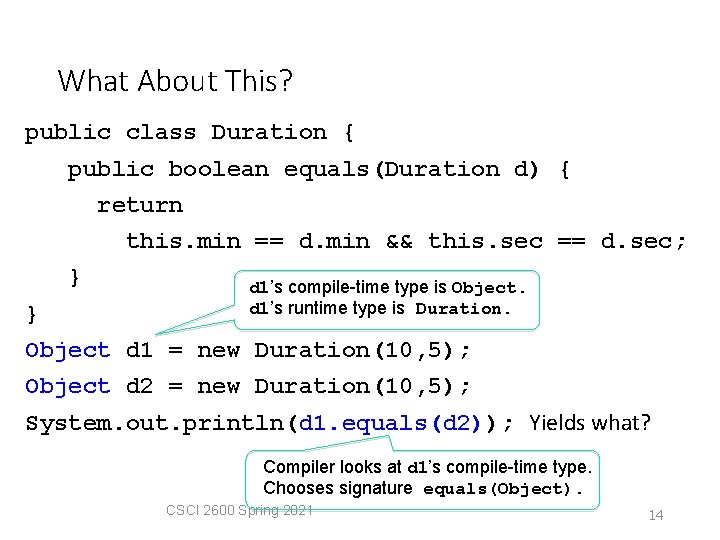
What About This? public class Duration { public boolean equals(Duration d) { return this. min == d. min && this. sec == d. sec; } } d 1’s compile-time type is Object. d 1’s runtime type is Duration. Object d 1 = new Duration(10, 5); Object d 2 = new Duration(10, 5); System. out. println(d 1. equals(d 2)); Yields what? Compiler looks at d 1’s compile-time type. Chooses signature equals(Object). CSCI 2600 Spring 2021 14
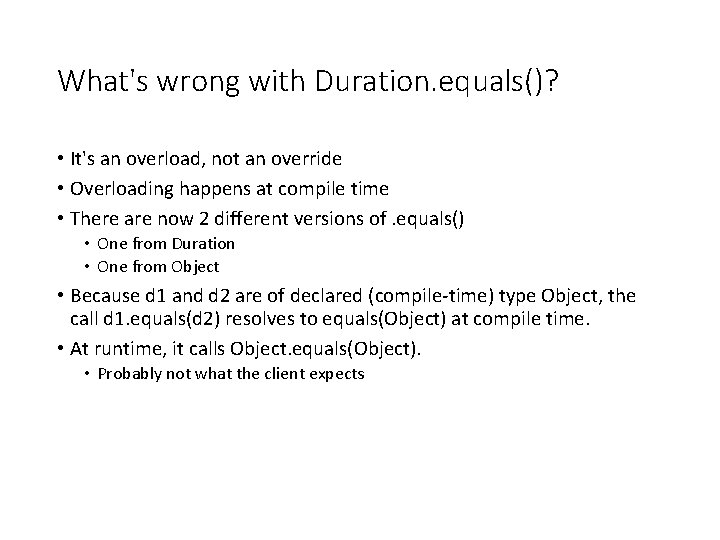
What's wrong with Duration. equals()? • It's an overload, not an override • Overloading happens at compile time • There are now 2 different versions of. equals() • One from Duration • One from Object • Because d 1 and d 2 are of declared (compile-time) type Object, the call d 1. equals(d 2) resolves to equals(Object) at compile time. • At runtime, it calls Object. equals(Object). • Probably not what the client expects
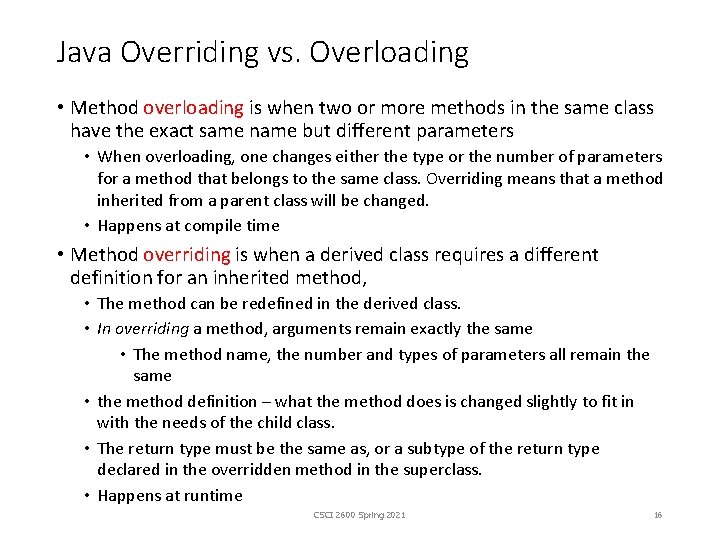
Java Overriding vs. Overloading • Method overloading is when two or more methods in the same class have the exact same name but different parameters • When overloading, one changes either the type or the number of parameters for a method that belongs to the same class. Overriding means that a method inherited from a parent class will be changed. • Happens at compile time • Method overriding is when a derived class requires a different definition for an inherited method, • The method can be redefined in the derived class. • In overriding a method, arguments remain exactly the same • The method name, the number and types of parameters all remain the same • the method definition – what the method does is changed slightly to fit in with the needs of the child class. • The return type must be the same as, or a subtype of the return type declared in the overridden method in the superclass. • Happens at runtime CSCI 2600 Spring 2021 16
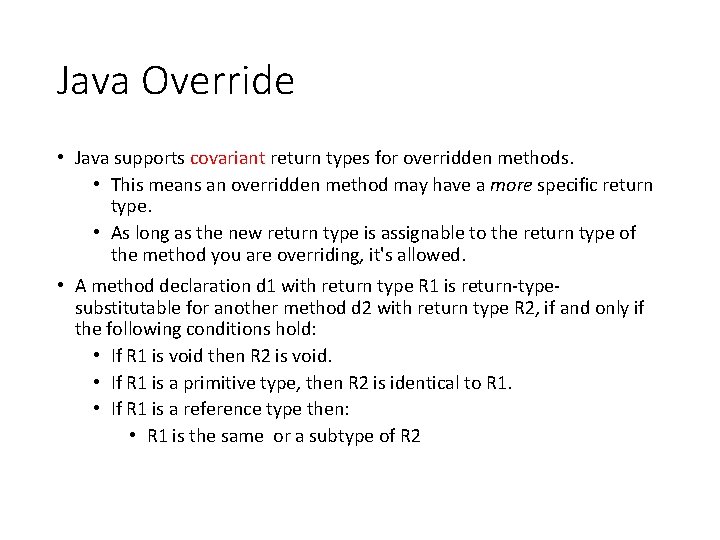
Java Override • Java supports covariant return types for overridden methods. • This means an overridden method may have a more specific return type. • As long as the new return type is assignable to the return type of the method you are overriding, it's allowed. • A method declaration d 1 with return type R 1 is return-typesubstitutable for another method d 2 with return type R 2, if and only if the following conditions hold: • If R 1 is void then R 2 is void. • If R 1 is a primitive type, then R 2 is identical to R 1. • If R 1 is a reference type then: • R 1 is the same or a subtype of R 2
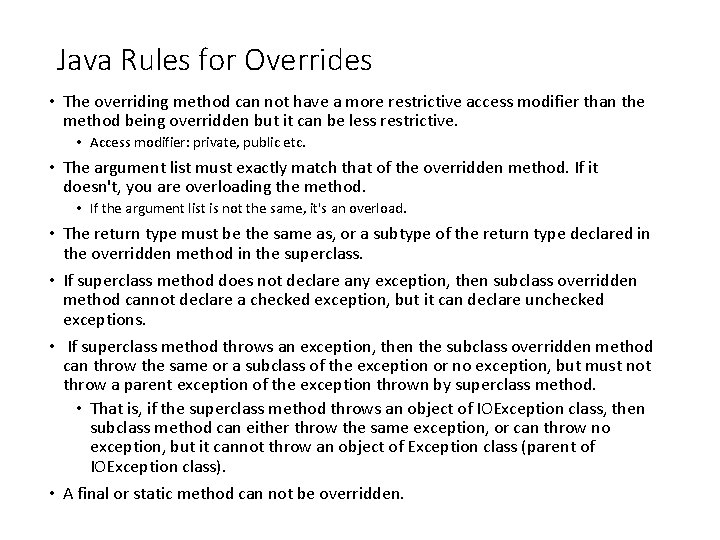
Java Rules for Overrides • The overriding method can not have a more restrictive access modifier than the method being overridden but it can be less restrictive. • Access modifier: private, public etc. • The argument list must exactly match that of the overridden method. If it doesn't, you are overloading the method. • If the argument list is not the same, it's an overload. • The return type must be the same as, or a subtype of the return type declared in the overridden method in the superclass. • If superclass method does not declare any exception, then subclass overridden method cannot declare a checked exception, but it can declare unchecked exceptions. • If superclass method throws an exception, then the subclass overridden method can throw the same or a subclass of the exception or no exception, but must not throw a parent exception of the exception thrown by superclass method. • That is, if the superclass method throws an object of IOException class, then subclass method can either throw the same exception, or can throw no exception, but it cannot throw an object of Exception class (parent of IOException class). • A final or static method can not be overridden.
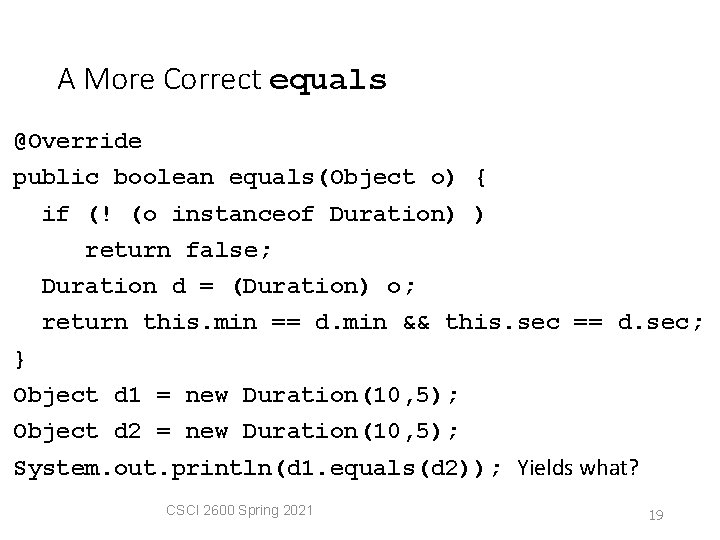
A More Correct equals @Override public boolean equals(Object o) { if (! (o instanceof Duration) ) return false; Duration d = (Duration) o; return this. min == d. min && this. sec == d. sec; } Object d 1 = new Duration(10, 5); Object d 2 = new Duration(10, 5); System. out. println(d 1. equals(d 2)); Yields what? CSCI 2600 Spring 2021 19
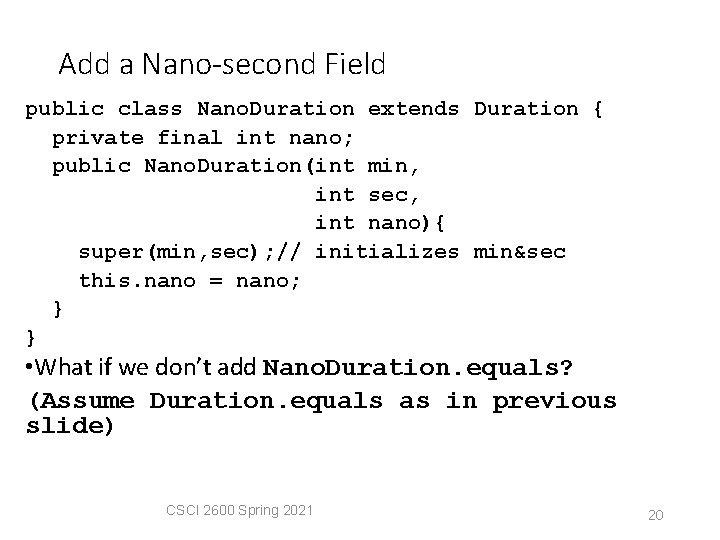
Add a Nano-second Field public class Nano. Duration extends Duration { private final int nano; public Nano. Duration(int min, int sec, int nano){ super(min, sec); // initializes min&sec this. nano = nano; } } • What if we don’t add Nano. Duration. equals? (Assume Duration. equals as in previous slide) CSCI 2600 Spring 2021 20
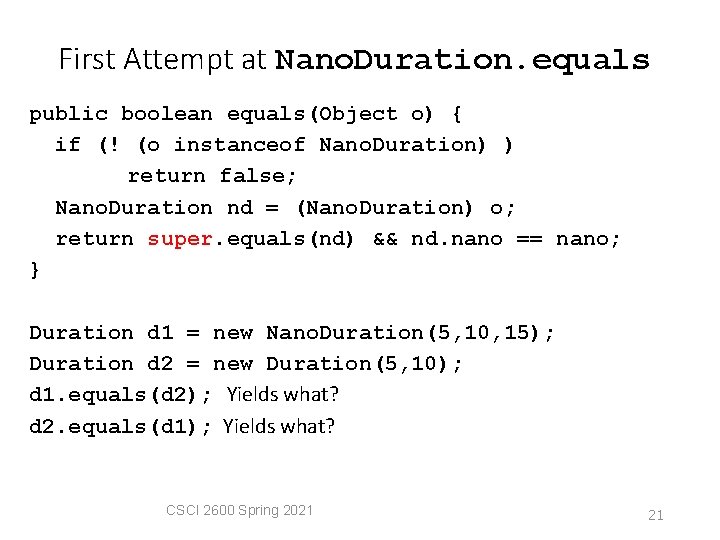
First Attempt at Nano. Duration. equals public boolean equals(Object o) { if (! (o instanceof Nano. Duration) ) return false; Nano. Duration nd = (Nano. Duration) o; return super. equals(nd) && nd. nano == nano; } Duration d 1 = new Nano. Duration(5, 10, 15); Duration d 2 = new Duration(5, 10); d 1. equals(d 2); Yields what? d 2. equals(d 1); Yields what? CSCI 2600 Spring 2021 21
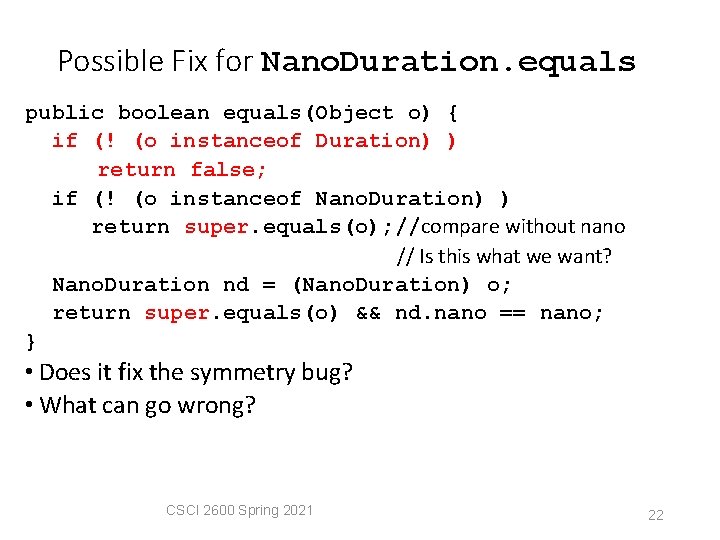
Possible Fix for Nano. Duration. equals public boolean equals(Object o) { if (! (o instanceof Duration) ) return false; if (! (o instanceof Nano. Duration) ) return super. equals(o); //compare without nano // Is this what we want? Nano. Duration nd = (Nano. Duration) o; return super. equals(o) && nd. nano == nano; } • Does it fix the symmetry bug? • What can go wrong? CSCI 2600 Spring 2021 22
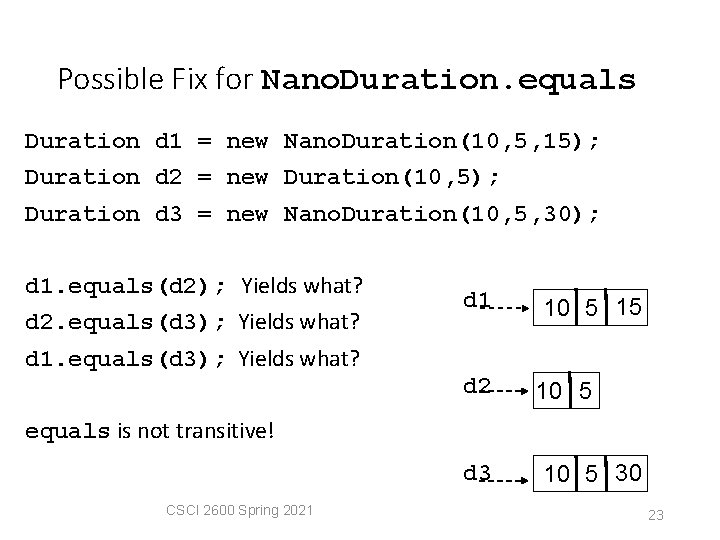
Possible Fix for Nano. Duration. equals Duration d 1 = new Nano. Duration(10, 5, 15); Duration d 2 = new Duration(10, 5); Duration d 3 = new Nano. Duration(10, 5, 30); d 1. equals(d 2); Yields what? d 2. equals(d 3); Yields what? d 1 10 5 15 d 1. equals(d 3); Yields what? d 2 10 5 equals is not transitive! d 3 CSCI 2600 Spring 2021 10 5 30 23
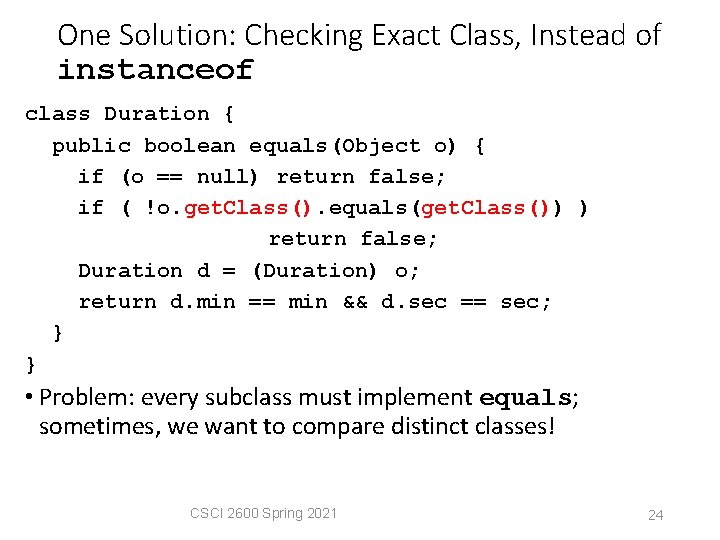
One Solution: Checking Exact Class, Instead of instanceof class Duration { public boolean equals(Object o) { if (o == null) return false; if ( !o. get. Class(). equals(get. Class()) ) return false; Duration d = (Duration) o; return d. min == min && d. sec == sec; } } • Problem: every subclass must implement equals; sometimes, we want to compare distinct classes! CSCI 2600 Spring 2021 24
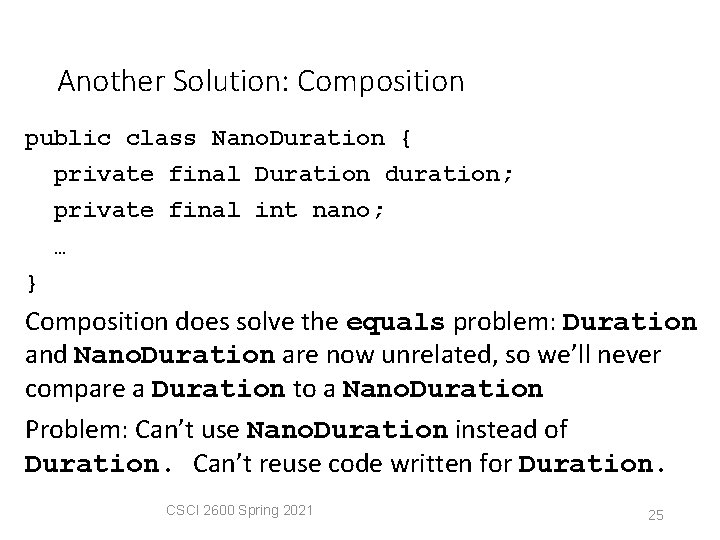
Another Solution: Composition public class Nano. Duration { private final Duration duration; private final int nano; … } Composition does solve the equals problem: Duration and Nano. Duration are now unrelated, so we’ll never compare a Duration to a Nano. Duration Problem: Can’t use Nano. Duration instead of Duration. Can’t reuse code written for Duration. CSCI 2600 Spring 2021 25
A Reason to Avoid Subclassing Concrete Classes. More later • In the JDK, subclassing of concrete classes is relatively rare. When it happens, there can be problems • One example: Timestamp extends Date • Extends Date with a nanosecond value • But Timestamp spec lists several caveats • E. g. , Timestamp. equals(Object) method is not symmetric with respect to Date. equals(Object) • (the symmetry problem we saw on the previous slides) CSCI 2600 Spring 2021 26
Abstract Classes • Prefer subclassing abstract classes • “Superclasses” cannot be instantiated • There is no equality problem if superclass cannot be instantiated! • E. g. , if Duration were abstract, the issue of comparing Duration and Nano. Duration never arises CSCI 2600 Spring 2021 27
Our Story So Far… • Java supports two kinds of equality for objects • Reference equality • Do these 2 variables refer to the same object? • Value equality • Do these 2 variables refer to two objects with the same value? • What does "the same value" mean? • If you don't override. equals(), you get Object. equals() • Object. equals() is reference equality • Equality is an equivalence relationship • Equality can get complicated in the context of inheritance
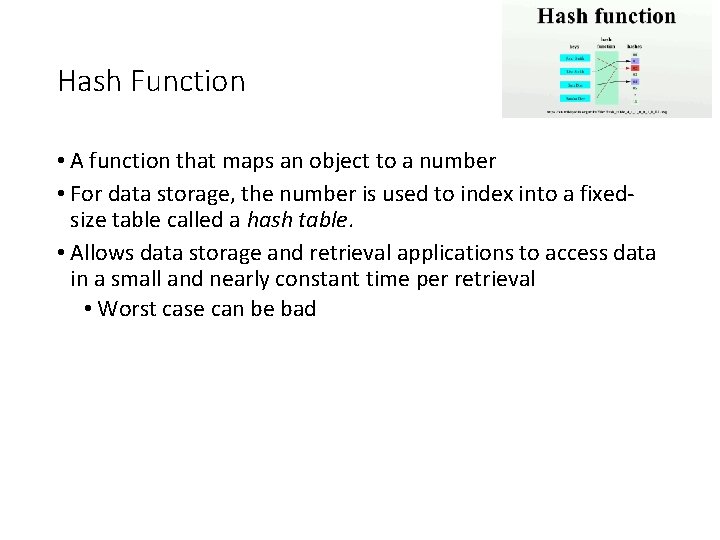
Hash Function • A function that maps an object to a number • For data storage, the number is used to index into a fixedsize table called a hash table. • Allows data storage and retrieval applications to access data in a small and nearly constant time per retrieval • Worst case can be bad
The int hash. Code Method • hash. Code computes an index for the object (to be used in hashtables) • Javadoc for Object. hash. Code(): • “Returns a hash code value of the object. This method is supported for the benefit of hashtables such as those provided by Hash. Map. ” • Self-consistent: o. hash. Code() == o. hash. Code() … as long as o does not change between the calls • Consistent with equals() method: a. equals(b) => a. hash. Code() == b. hash. Code() • If a. equals(b), a and b must have the same hash. Code • Not necessarily true the other way around • Collections such as Hash. Map calculate unicity using. equals and. hash. Code CSCI 2600 Spring 2021 30
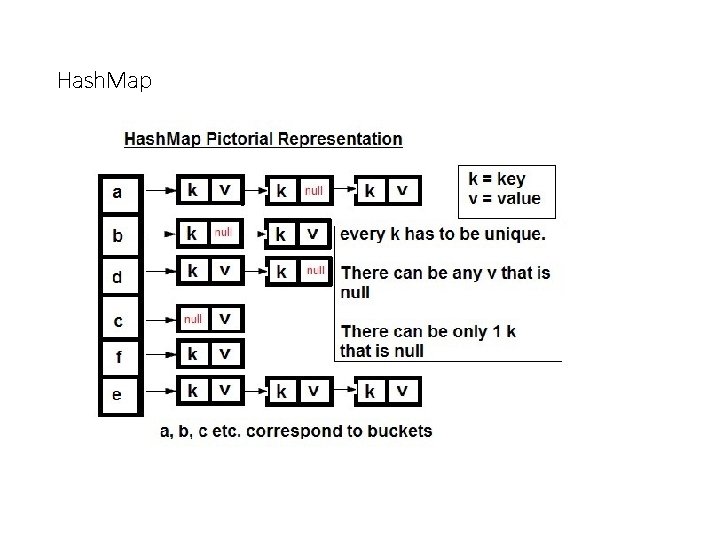
Hash Code • hash. Code() is used for bucketing in Hash implementations • Hash. Map, Hash. Table, Hash. Set, etc. • The value received from hash. Code() is used to determine the bucket for storing elements of the set/map. • The bucket is the address of the element inside the set/map. • When you do contains() it will take the hash code of the element, then look for the bucket where hash code points. • Multiple objects can have the same hash code • It uses the equals() method to evaluate if the objects are equal • Only looks in the current bucket • Then decide if contains() is true or false
Hash. Set CSCI 2600 Spring 2021
Hash. Map
Hash Code • By definition, if two objects are equal, their hash code must also be equal. • If you override the equals() method, you change the way two objects are equated • Object's implementation of hash. Code() is no longer valid. • Therefore, if you override the equals() method, you must also override the hash. Code() method as well. • We didn't do this for Duration to keep the description simple • But we should have
The Object. hash. Code Method • Object. hash. Code’s implementation returns a distinct integer for each distinct object, typically by converting the object’s address into an integer • hash. Code must be consistent with equality • equals and hash. Code are used in hashtables • If hash. Code is inconsistent with equals, the hashtable behaves incorrectly • Rule: if you override equals, override hash. Code; must be consistent with equals • Eclipse has an option to automatically generate a hash. Code() method. CSCI 2600 Spring 2021 35
Rules for Hash. Codes • During the execution of the application, if hash. Code() is invoked more than once on the same Object then it must consistently return the same Integer value, provided no information used in equals(Object) comparison on the Object is modified. • It is not necessary that this Integer value remain the same from one execution of the application to another execution of the same application. • If two Objects are equal, according to the equals(Object) method, then hash. Code() method must produce the same Integer on each of the two Objects. • If two Objects are unequal, according to the equals(Object) method, it is not necessary that the Integer value produced by the hash. Code() method on each of the two Objects be distinct. • Objects which are distinct by the equals(Object) method may still compute the same hash. Code() value • It can be same but producing a distinct Integer on each of the two Objects is better for improving the performance of hashing based Collections like Hash. Map, Hash. Table…etc.
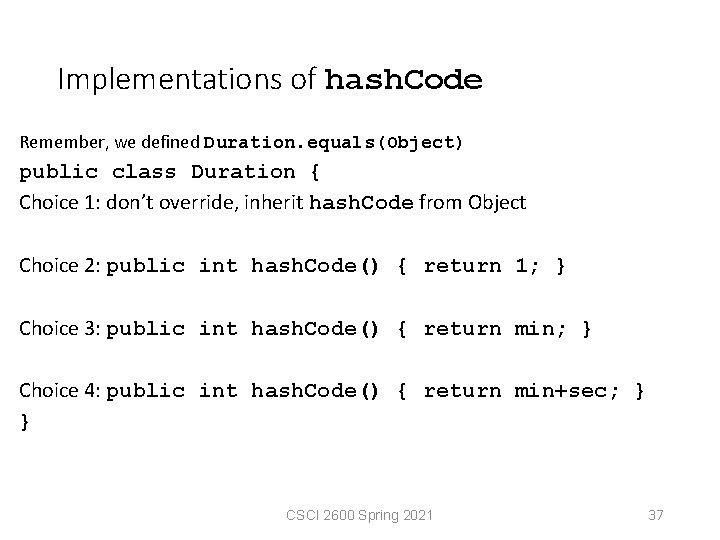
Implementations of hash. Code Remember, we defined Duration. equals(Object) public class Duration { Choice 1: don’t override, inherit hash. Code from Object Choice 2: public int hash. Code() { return 1; } Choice 3: public int hash. Code() { return min; } Choice 4: public int hash. Code() { return min+sec; } } CSCI 2600 Spring 2021 37
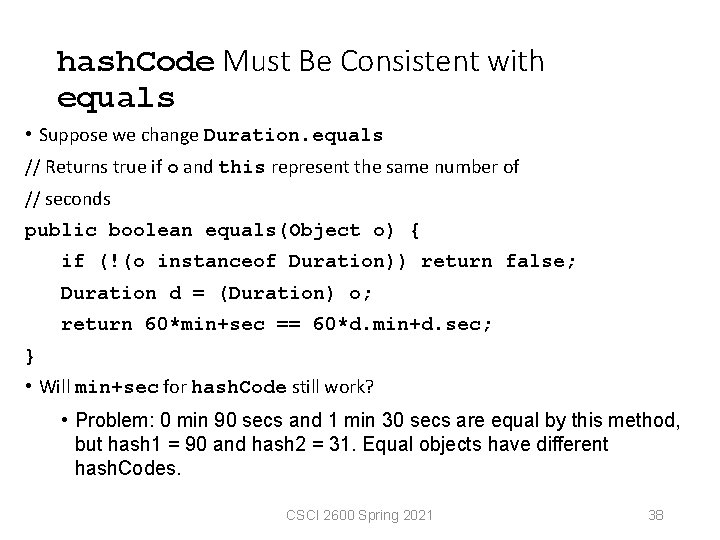
hash. Code Must Be Consistent with equals • Suppose we change Duration. equals // Returns true if o and this represent the same number of // seconds public boolean equals(Object o) { if (!(o instanceof Duration)) return false; Duration d = (Duration) o; return 60*min+sec == 60*d. min+d. sec; } • Will min+sec for hash. Code still work? • Problem: 0 min 90 secs and 1 min 30 secs are equal by this method, but hash 1 = 90 and hash 2 = 31. Equal objects have different hash. Codes. CSCI 2600 Spring 2021 38
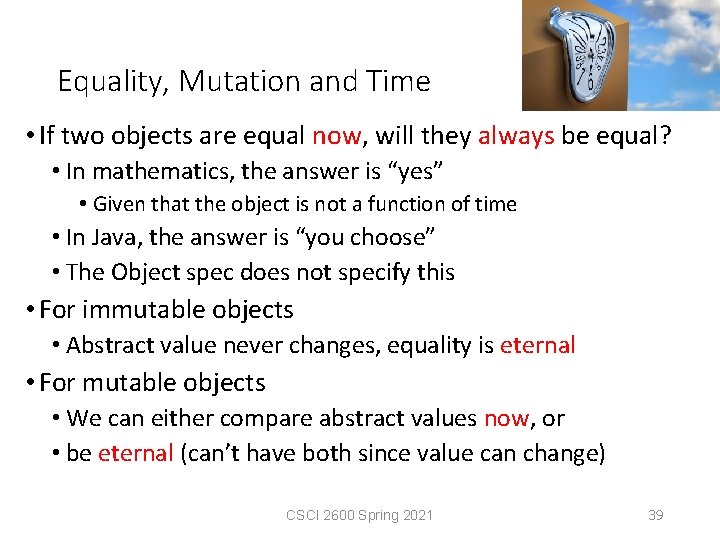
Equality, Mutation and Time • If two objects are equal now, will they always be equal? • In mathematics, the answer is “yes” • Given that the object is not a function of time • In Java, the answer is “you choose” • The Object spec does not specify this • For immutable objects • Abstract value never changes, equality is eternal • For mutable objects • We can either compare abstract values now, or • be eternal (can’t have both since value can change) CSCI 2600 Spring 2021 39
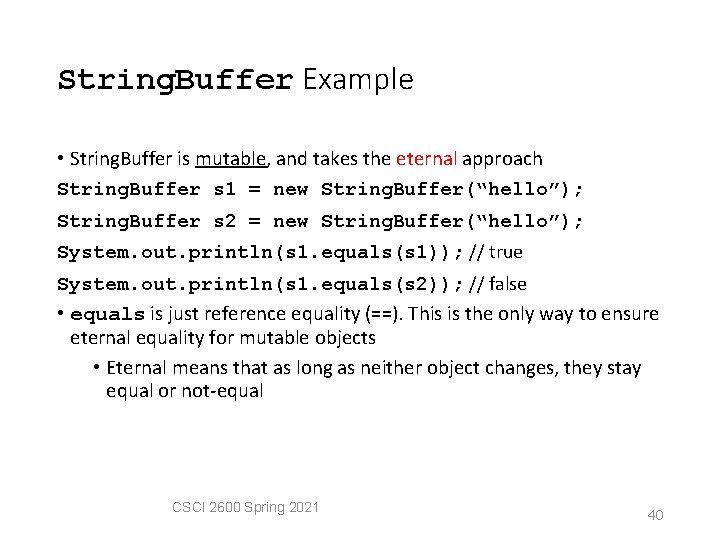
String. Buffer Example • String. Buffer is mutable, and takes the eternal approach String. Buffer s 1 = new String. Buffer(“hello”); String. Buffer s 2 = new String. Buffer(“hello”); System. out. println(s 1. equals(s 1)); // true System. out. println(s 1. equals(s 2)); // false • equals is just reference equality (==). This is the only way to ensure eternal equality for mutable objects • Eternal means that as long as neither object changes, they stay equal or not-equal CSCI 2600 Spring 2021 40
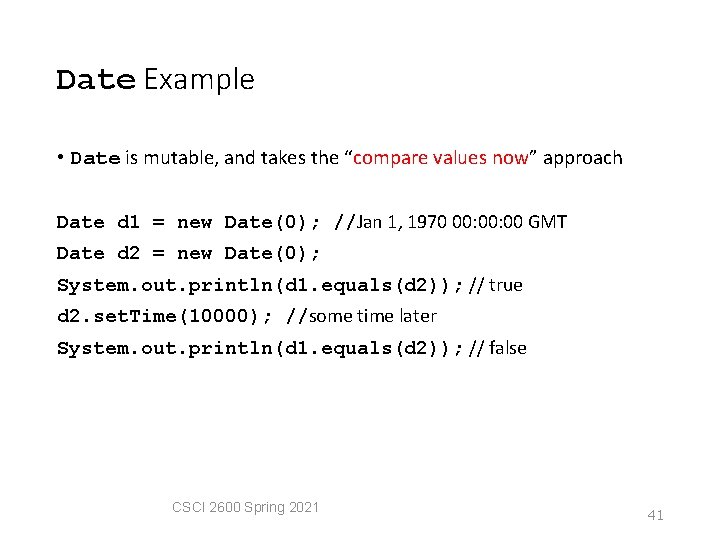
Date Example • Date is mutable, and takes the “compare values now” approach Date d 1 = new Date(0); //Jan 1, 1970 00: 00 GMT Date d 2 = new Date(0); System. out. println(d 1. equals(d 2)); // true d 2. set. Time(10000); //some time later System. out. println(d 1. equals(d 2)); // false CSCI 2600 Spring 2021 41
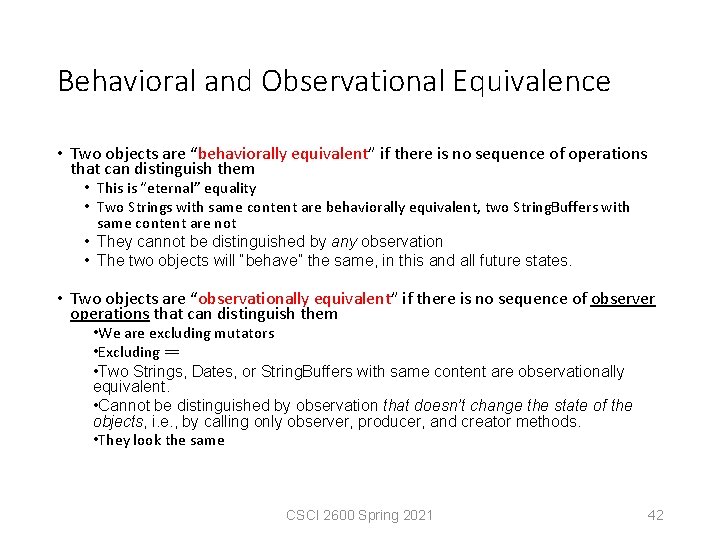
Behavioral and Observational Equivalence • Two objects are “behaviorally equivalent” if there is no sequence of operations that can distinguish them • This is “eternal” equality • Two Strings with same content are behaviorally equivalent, two String. Buffers with same content are not • They cannot be distinguished by any observation • The two objects will “behave” the same, in this and all future states. • Two objects are “observationally equivalent” if there is no sequence of observer operations that can distinguish them • We are excluding mutators • Excluding == • Two Strings, Dates, or String. Buffers with same content are observationally equivalent. • Cannot be distinguished by observation that doesn’t change the state of the objects, i. e. , by calling only observer, producer, and creator methods. • They look the same CSCI 2600 Spring 2021 42
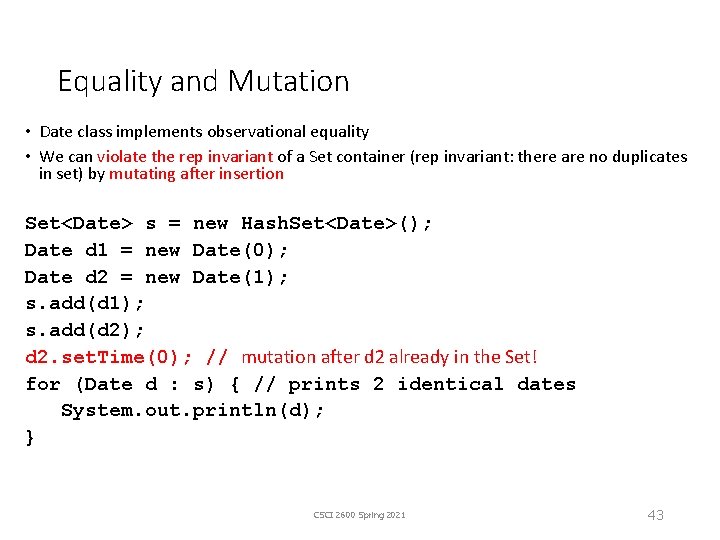
Equality and Mutation • Date class implements observational equality • We can violate the rep invariant of a Set container (rep invariant: there are no duplicates in set) by mutating after insertion Set<Date> s = new Hash. Set<Date>(); Date d 1 = new Date(0); Date d 2 = new Date(1); s. add(d 2); d 2. set. Time(0); // mutation after d 2 already in the Set! for (Date d : s) { // prints 2 identical dates System. out. println(d); } CSCI 2600 Spring 2021 43
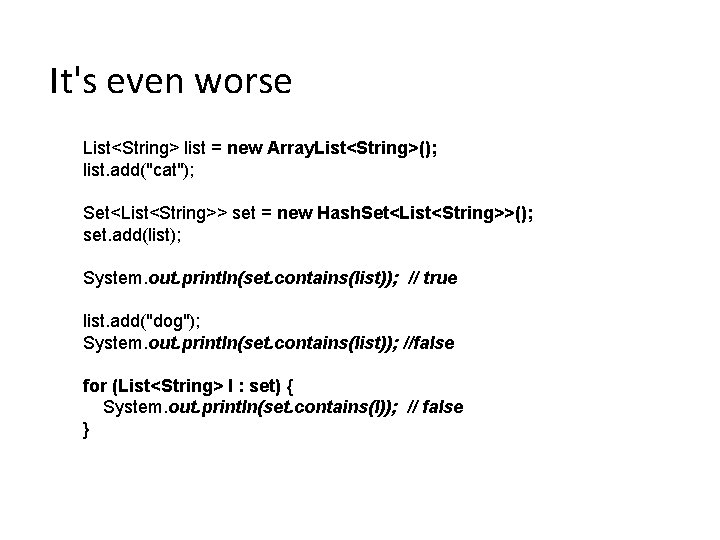
It's even worse List<String> list = new Array. List<String>(); list. add("cat"); Set<List<String>> set = new Hash. Set<List<String>>(); set. add(list); System. out. println(set. contains(list)); // true list. add("dog"); System. out. println(set. contains(list)); //false for (List<String> l : set) { System. out. println(set. contains(l)); // false }
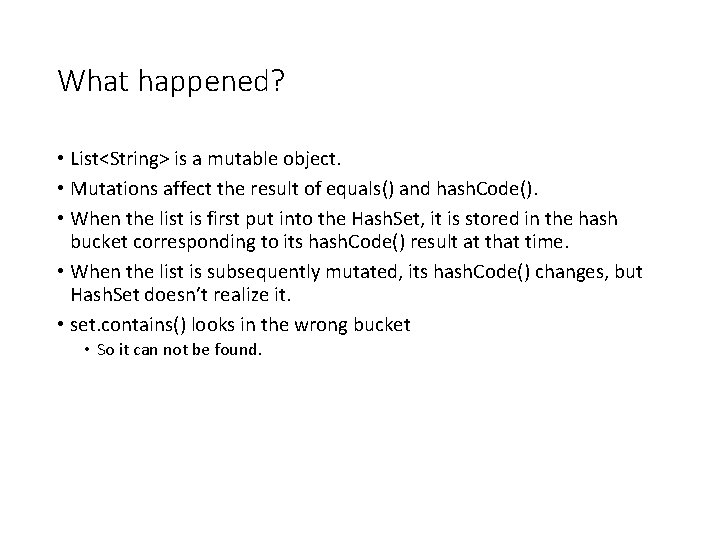
What happened? • List<String> is a mutable object. • Mutations affect the result of equals() and hash. Code(). • When the list is first put into the Hash. Set, it is stored in the hash bucket corresponding to its hash. Code() result at that time. • When the list is subsequently mutated, its hash. Code() changes, but Hash. Set doesn’t realize it. • set. contains() looks in the wrong bucket • So it can not be found.
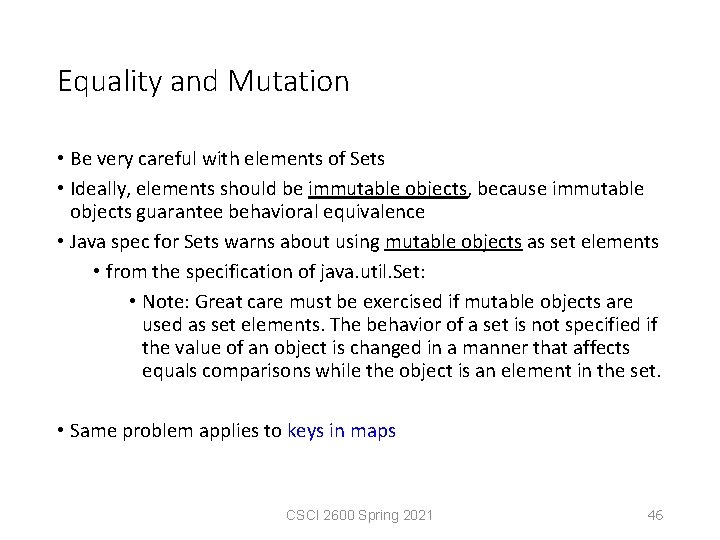
Equality and Mutation • Be very careful with elements of Sets • Ideally, elements should be immutable objects, because immutable objects guarantee behavioral equivalence • Java spec for Sets warns about using mutable objects as set elements • from the specification of java. util. Set: • Note: Great care must be exercised if mutable objects are used as set elements. The behavior of a set is not specified if the value of an object is changed in a manner that affects equals comparisons while the object is an element in the set. • Same problem applies to keys in maps CSCI 2600 Spring 2021 46
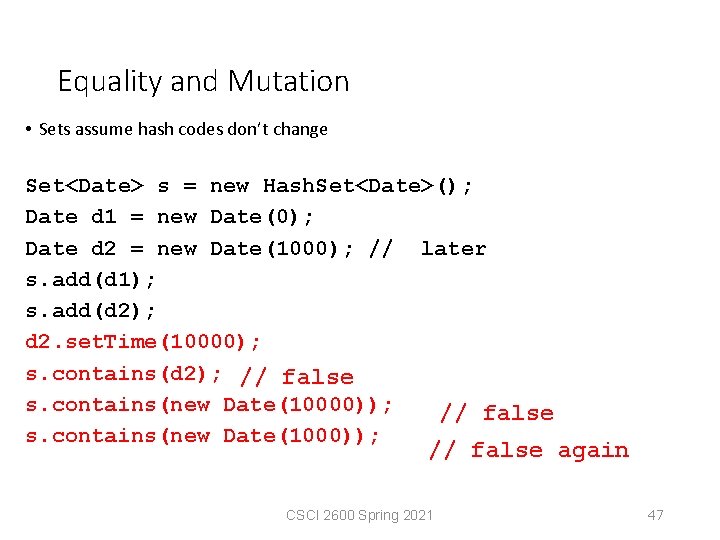
Equality and Mutation • Sets assume hash codes don’t change Set<Date> s = new Hash. Set<Date>(); Date d 1 = new Date(0); Date d 2 = new Date(1000); // later s. add(d 1); s. add(d 2); d 2. set. Time(10000); s. contains(d 2); // false s. contains(new Date(10000)); // false s. contains(new Date(1000)); // false again CSCI 2600 Spring 2021 47
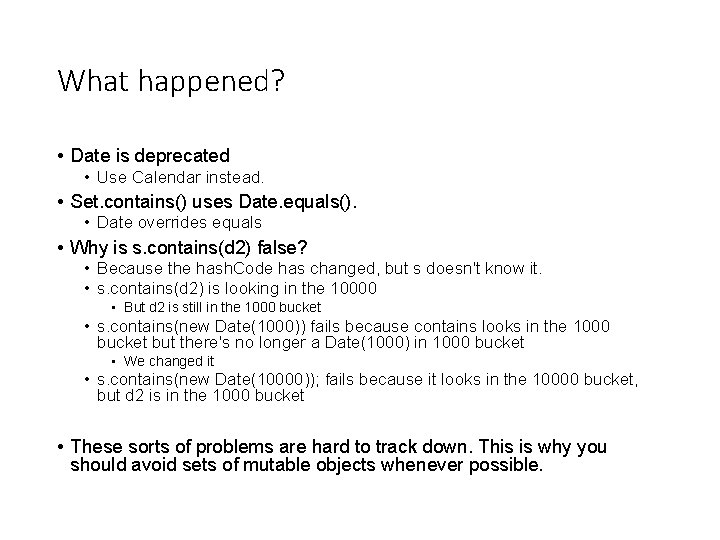
What happened? • Date is deprecated • Use Calendar instead. • Set. contains() uses Date. equals(). • Date overrides equals • Why is s. contains(d 2) false? • Because the hash. Code has changed, but s doesn't know it. • s. contains(d 2) is looking in the 10000 • But d 2 is still in the 1000 bucket • s. contains(new Date(1000)) fails because contains looks in the 1000 bucket but there's no longer a Date(1000) in 1000 bucket • We changed it • s. contains(new Date(10000)); fails because it looks in the 10000 bucket, but d 2 is in the 1000 bucket • These sorts of problems are hard to track down. This is why you should avoid sets of mutable objects whenever possible.
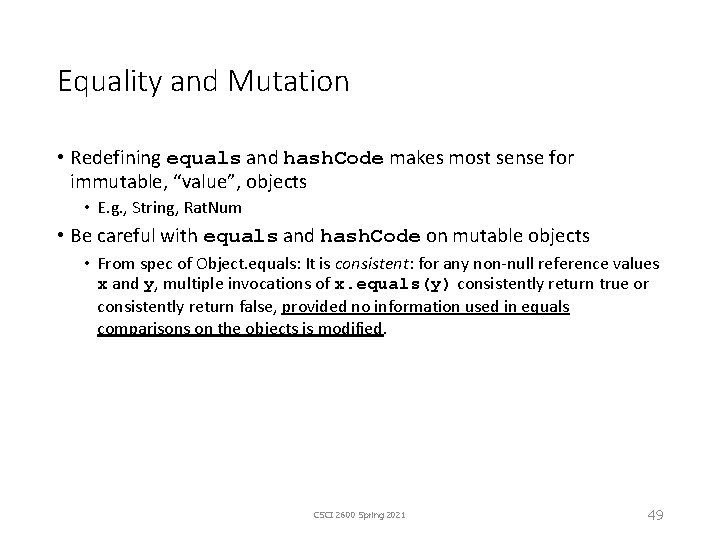
Equality and Mutation • Redefining equals and hash. Code makes most sense for immutable, “value”, objects • E. g. , String, Rat. Num • Be careful with equals and hash. Code on mutable objects • From spec of Object. equals: It is consistent: for any non-null reference values x and y, multiple invocations of x. equals(y) consistently return true or consistently return false, provided no information used in equals comparisons on the objects is modified. CSCI 2600 Spring 2021 49
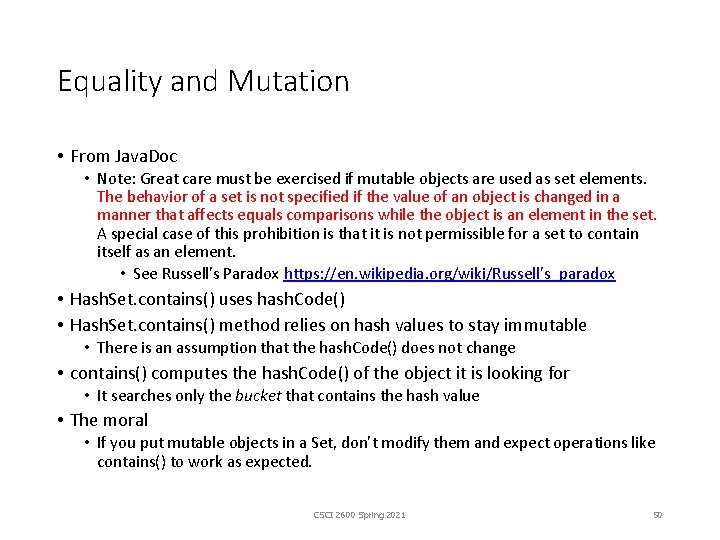
Equality and Mutation • From Java. Doc • Note: Great care must be exercised if mutable objects are used as set elements. The behavior of a set is not specified if the value of an object is changed in a manner that affects equals comparisons while the object is an element in the set. A special case of this prohibition is that it is not permissible for a set to contain itself as an element. • See Russell's Paradox https: //en. wikipedia. org/wiki/Russell's_paradox • Hash. Set. contains() uses hash. Code() • Hash. Set. contains() method relies on hash values to stay immutable • There is an assumption that the hash. Code() does not change • contains() computes the hash. Code() of the object it is looking for • It searches only the bucket that contains the hash value • The moral • If you put mutable objects in a Set, don’t modify them and expect operations like contains() to work as expected. CSCI 2600 Spring 2021 50
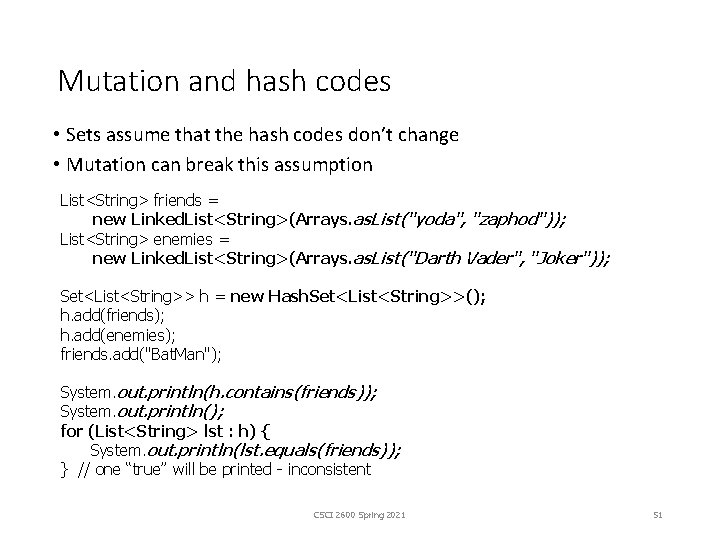
Mutation and hash codes • Sets assume that the hash codes don’t change • Mutation can break this assumption List<String> friends = new Linked. List<String>(Arrays. as. List("yoda", "zaphod")); List<String> enemies = new Linked. List<String>(Arrays. as. List("Darth Vader", "Joker")); Set<List<String>> h = new Hash. Set<List<String>>(); h. add(friends); h. add(enemies); friends. add("Bat. Man"); System. out. println(h. contains(friends)); System. out. println(); for (List<String> lst : h) { System. out. println(lst. equals(friends)); } // one “true” will be printed - inconsistent CSCI 2600 Spring 2021 51
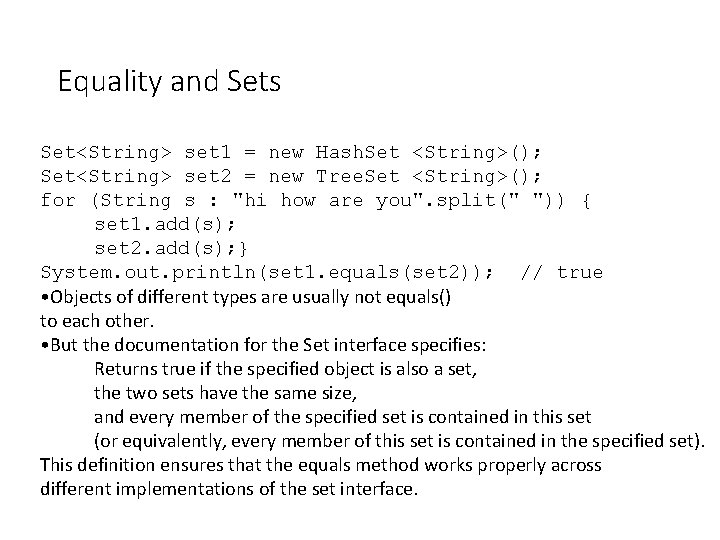
Equality and Sets Set<String> set 1 = new Hash. Set <String>(); Set<String> set 2 = new Tree. Set <String>(); for (String s : "hi how are you". split(" ")) { set 1. add(s); set 2. add(s); } System. out. println(set 1. equals(set 2)); // true • Objects of different types are usually not equals() to each other. • But the documentation for the Set interface specifies: Returns true if the specified object is also a set, the two sets have the same size, and every member of the specified set is contained in this set (or equivalently, every member of this set is contained in the specified set). This definition ensures that the equals method works properly across different implementations of the set interface.
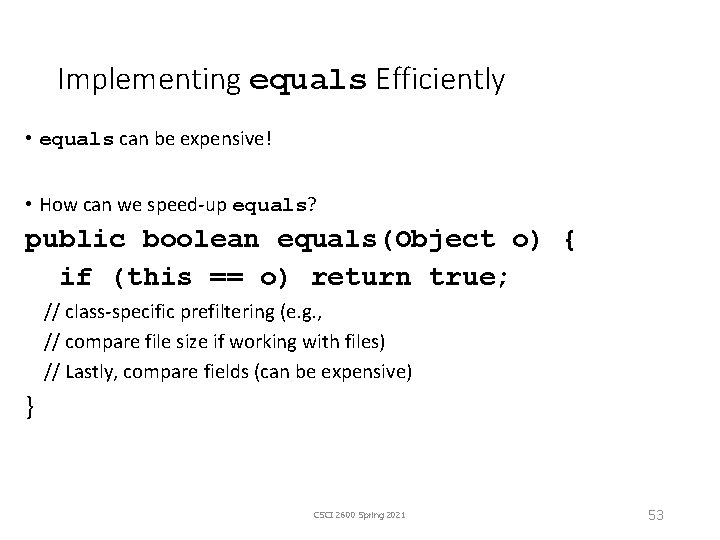
Implementing equals Efficiently • equals can be expensive! • How can we speed-up equals? public boolean equals(Object o) { if (this == o) return true; // class-specific prefiltering (e. g. , // compare file size if working with files) // Lastly, compare fields (can be expensive) } CSCI 2600 Spring 2021 53
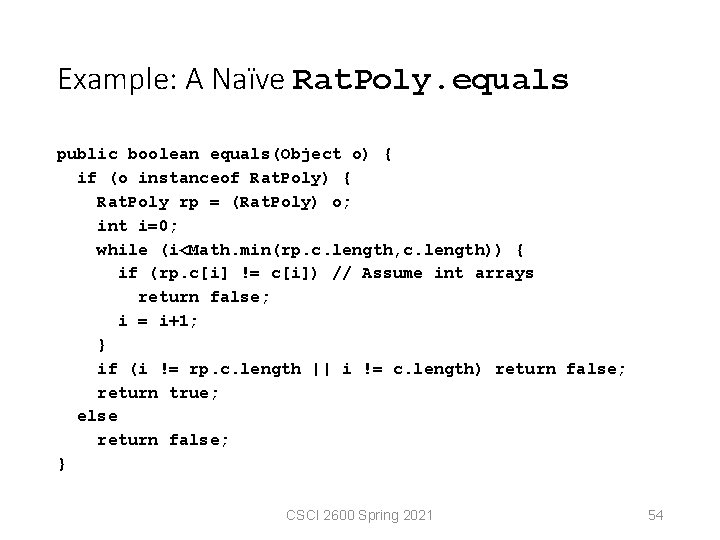
Example: A Naïve Rat. Poly. equals public boolean equals(Object o) { if (o instanceof Rat. Poly) { Rat. Poly rp = (Rat. Poly) o; int i=0; while (i<Math. min(rp. c. length, c. length)) { if (rp. c[i] != c[i]) // Assume int arrays return false; i = i+1; } if (i != rp. c. length || i != c. length) return false; return true; else return false; } CSCI 2600 Spring 2021 54
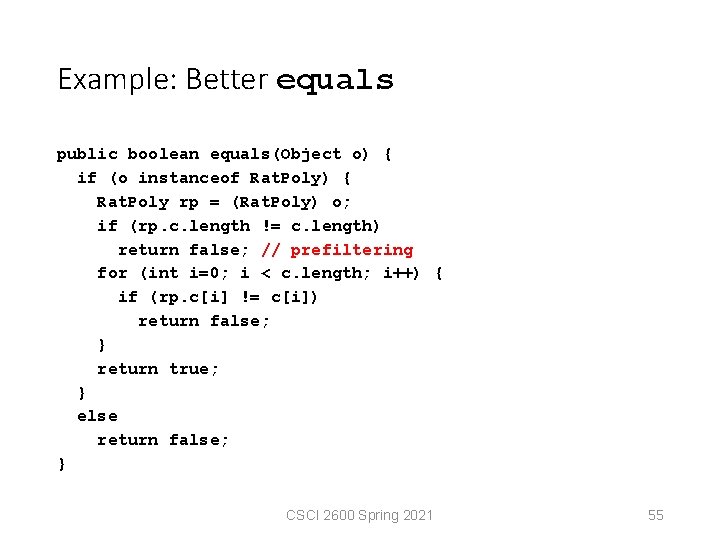
Example: Better equals public boolean equals(Object o) { if (o instanceof Rat. Poly) { Rat. Poly rp = (Rat. Poly) o; if (rp. c. length != c. length) return false; // prefiltering for (int i=0; i < c. length; i++) { if (rp. c[i] != c[i]) return false; } return true; } else return false; } CSCI 2600 Spring 2021 55
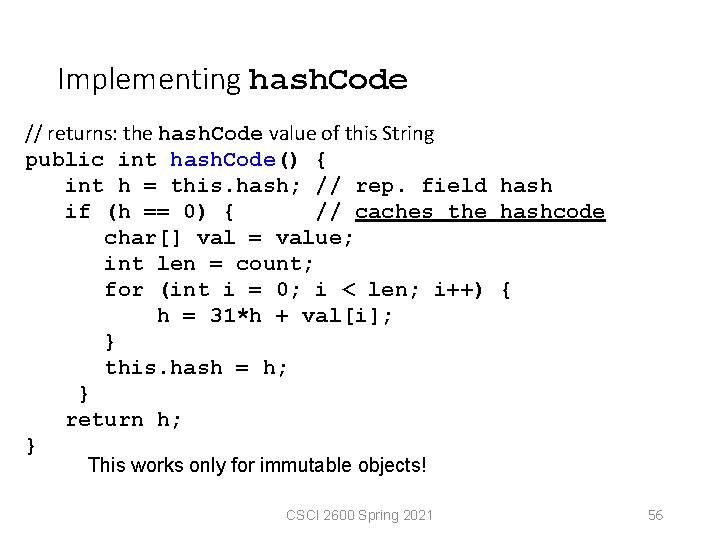
Implementing hash. Code // returns: the hash. Code value of this String public int hash. Code() { int h = this. hash; // rep. field hash if (h == 0) { // caches the hashcode char[] val = value; int len = count; for (int i = 0; i < len; i++) { h = 31*h + val[i]; } this. hash = h; } return h; } This works only for immutable objects! CSCI 2600 Spring 2021 56
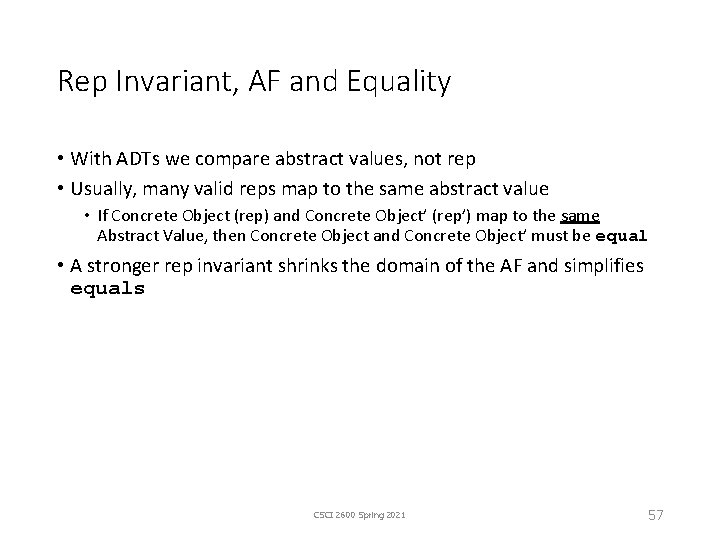
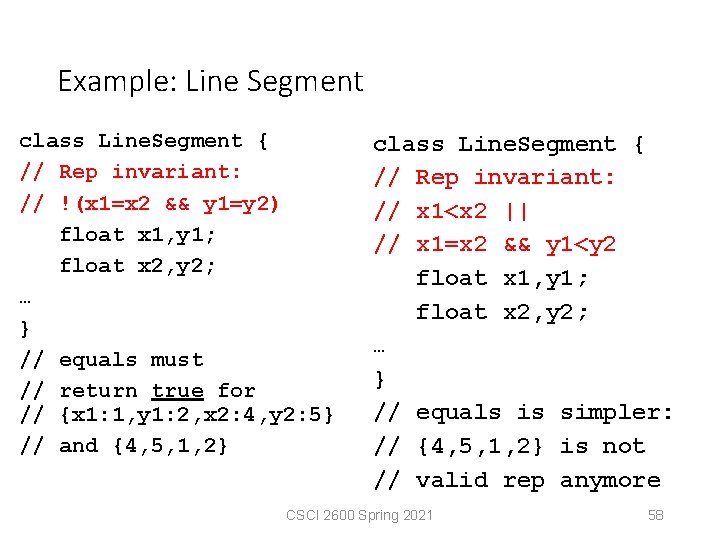
Rep Invariant, AF and Equality • With ADTs we compare abstract values, not rep • Usually, many valid reps map to the same abstract value • If Concrete Object (rep) and Concrete Object’ (rep’) map to the same Abstract Value, then Concrete Object and Concrete Object’ must be equal • A stronger rep invariant shrinks the domain of the AF and simplifies equals CSCI 2600 Spring 2021 57
Example: Line Segment class Line. Segment { // Rep invariant: // !(x 1=x 2 && y 1=y 2) float x 1, y 1; float x 2, y 2; … } // equals must // return true for // {x 1: 1, y 1: 2, x 2: 4, y 2: 5} // and {4, 5, 1, 2} class Line. Segment { // Rep invariant: // x 1<x 2 || // x 1=x 2 && y 1<y 2 float x 1, y 1; float x 2, y 2; … } // equals is simpler: // {4, 5, 1, 2} is not // valid rep anymore CSCI 2600 Spring 2021 58
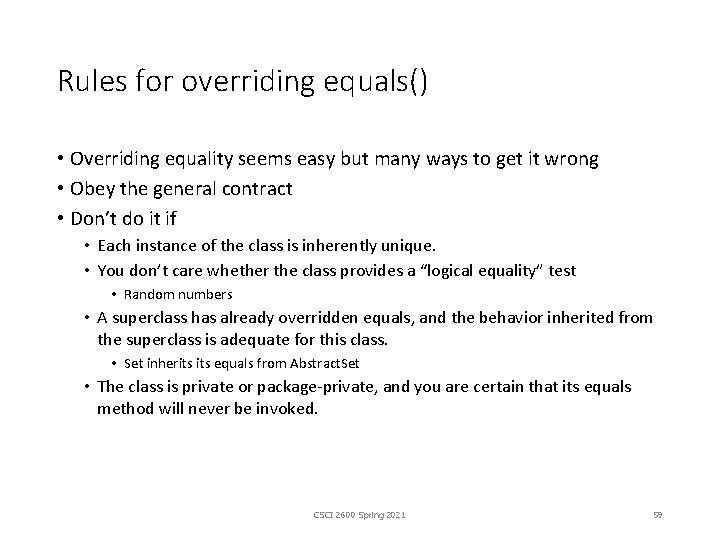
Rules for overriding equals() • Overriding equality seems easy but many ways to get it wrong • Obey the general contract • Don’t do it if • Each instance of the class is inherently unique. • You don’t care whether the class provides a “logical equality” test • Random numbers • A superclass has already overridden equals, and the behavior inherited from the superclass is adequate for this class. • Set inherits equals from Abstract. Set • The class is private or package-private, and you are certain that its equals method will never be invoked. CSCI 2600 Spring 2021 59
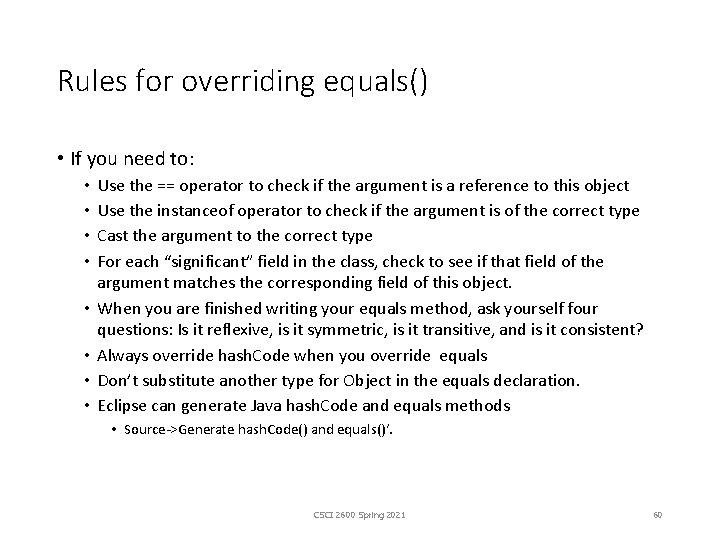
Rules for overriding equals() • If you need to: • • Use the == operator to check if the argument is a reference to this object Use the instanceof operator to check if the argument is of the correct type Cast the argument to the correct type For each “significant” field in the class, check to see if that field of the argument matches the corresponding field of this object. When you are finished writing your equals method, ask yourself four questions: Is it reflexive, is it symmetric, is it transitive, and is it consistent? Always override hash. Code when you override equals Don’t substitute another type for Object in the equals declaration. Eclipse can generate Java hash. Code and equals methods • Source->Generate hash. Code() and equals()‘. CSCI 2600 Spring 2021 60