
Identities in the New Ethnic Politics The Rise



- Slides: 16
Identities in the New Ethnic Politics: The Rise of “Pan-ethnicity” Political Science 61 / Chicano/Latino Studies 64 October 9, 2007
Today’s Topic Pan-ethnicity: The Final Pillar of Contemporary Minority Politics
Pan-Ethnicity § Definition – an ethnic identity defined by region, not country, of origin § § Examples—Asian American or Latino U. S. ethnicities traditionally understood in national terms Intergroup cooperation among multiple nationalorigin groups Political – building a political agenda or movement around this regional identity and shared policy needs
General Rule 1: U. S. Ethnic Identities Fluid n Immigrants learn U. S. conceptions of their identity n n 19 th Century European immigrants immigrated with subnational/regional identities … and, became “national ethics” from newly forming countries Institutions (church, politics, neighborhood) reinforced national identities Meaning and racial conception of European national identities changed over time Exception – African migrants to slavery had most national or regional roots taken from them and were always understood racially
General Rule 2: Ethnic Identities Diminish Over 2 nd/3 rd Generations n n Intermarriage quickly blurs “pure” national origin categories Other identities blur ethnic distinctions n n n Religion Race Ideology Immigrant generation In other words, local institutions see diminished ability to maintain identities
At Least Until Contemporary Era n Immigration from high sending countries slows/stops after 20 -30 years n n Allows the 2 nd/3 rd generation to reshape national origin identity to ethnic identity In current era, however, Mexican immigration high since the 1950 s n Several other national-origin groups will soon see a third generation
General Rule 3: Counting is Highly Contested n Census inconsistent in measuring race and ethnicity n n Race and ethnicity are socially constructed, so no consistent understanding of categories Generally behind mass practices Ethnic group leaders have sought to avoid categorization as a racial group Today’s controversies (see Prewitt reading) n Latinos as “ethnic, ” not racial category n n n At mass level, many Latinos identify racially Arab/Middle Eastern racial category Multi-racial self-identification
Contemporary Pan-Ethnicity is Substantively Different n Government has promoted n n n VRA an example Government collects data to measure pan-ethnicity, so relative status can be measured Access to some state resources allocated by race/ethnicity Ethnic leaders organize pan-ethnically Sustained immigration creates foundation for more durable identities across generations Communications ensure that immigrants know about U. S. ethnic categories before migration
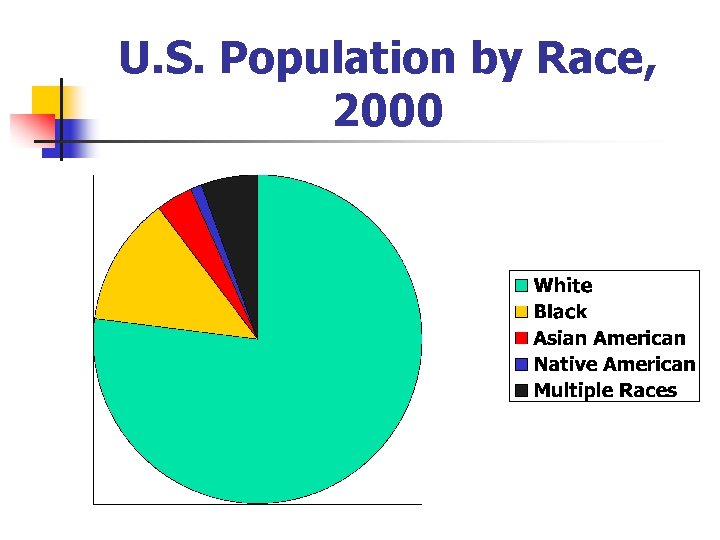
U. S. Population by Race, 2000
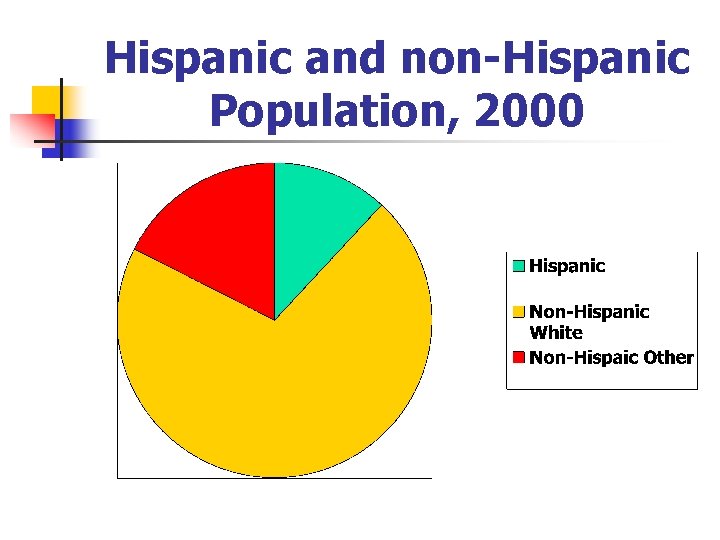
Hispanic and non-Hispanic Population, 2000
But, Pan-Ethnicity the Exception at the Mass Level n Low affect across national origin populations within pan-ethnic groups n n to choose (Webster's Dictionary) Traditionally, little contact between Asian Americans or Latinos n n Affect—To show a fondness for; to like to use or practice; Latinos and Asian Americans increasingly living around each other Perception of “common” Latino or Asian American culture low by Latinos or Asian Americans
When Does a Pan-ethnic Identity Form? Felix Padilla (“On the Nature of Latino Ethnicity”) n 1. 2. 3. n Latinos (or Asian Americans) come into contact with each other Latinos (or Asian Americans) share experiences that exclude them from majority communities Latinos (or Asian Americans) of different origins work together to address their common exclusion and form a new identity based on shared struggle Padilla—Latino (or Asian American) identity is inherently political
Who is Likely to Adopt a Pan-ethnic Identity? n From Lien, Conway, and Wong (for Asian Americans) n n n n Indians (relative to Chinese) Asian Americans who perceive a shared Asian culture Strong partisans U. S. citizens Involved in ethnic causes Older people Employed people Negative predictors – Asian Americans who experienced discrimination, 1 st generation, women
Pan-Ethnic Identification Among Asian Americans Source: Lien, Conway, and Wong
So, Why Does Pan. Ethnicity Matter? n n Provides foundation for the allocation of state resources Majority populations increasingly view minorities in pan-ethnic terms Ethnic leaders organize pan-ethnically So, pan-ethnic identification will grow among Latinos and Asian Americans n And other pan-ethnic populations?
For Next Time The first essay is due next Tuesday. Be prepared to discuss your thesis Thursday. 1) QUESTION FOR READING – As Reconstruction came to an end, African Americans in the South lost rights they had exercised. 2) n Identify these rights and how they were taken away.