
Identifying Your Social Brain Neural pathways to connection
Identifying Your Social Brain Neural pathways to connection Presented by Dr. Reza Samvat & Dr. Arini Verwer
Identifying Your Social Brain Understanding Your Social Brain Value of knowing your Social Brain: You will understand how: • People processes information and what information is important to them • How to connect to others using their social brain mode • How to appreciate and leverage their talents • How to motivate and bring out their best • How to work with their learning style • Build teams and create work harmony
i. HEART Protocol Workshop“The role of social brain in developing values " Tools to develop personal, interpersonal and societal based capabilities as a leader, based on the neurosciences. Identification of your Social Brain Mode Strengthening qualities at the physical level (Personal) Strengthening qualities at the emotional level (Personal) Strengthening qualities at the relational level (Interpersonal) Strengthening qualities at the Leadership level (Societal) Using your learning style to accelerate development of strategic leadership capabilities • How to monitor and reward progress • • •
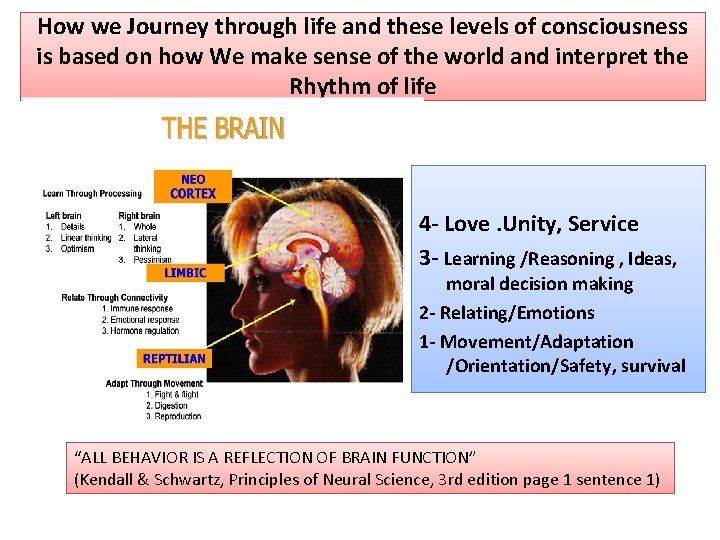
How we Journey through life and these levels of consciousness is based on how We make sense of the world and interpret the Rhythm of life 4 - Love. Unity, Service 3 - Learning /Reasoning , Ideas, moral decision making 2 - Relating/Emotions 1 - Movement/Adaptation /Orientation/Safety, survival “ALL BEHAVIOR IS A REFLECTION OF BRAIN FUNCTION” (Kendall & Schwartz, Principles of Neural Science, 3 rd edition page 1 sentence 1)
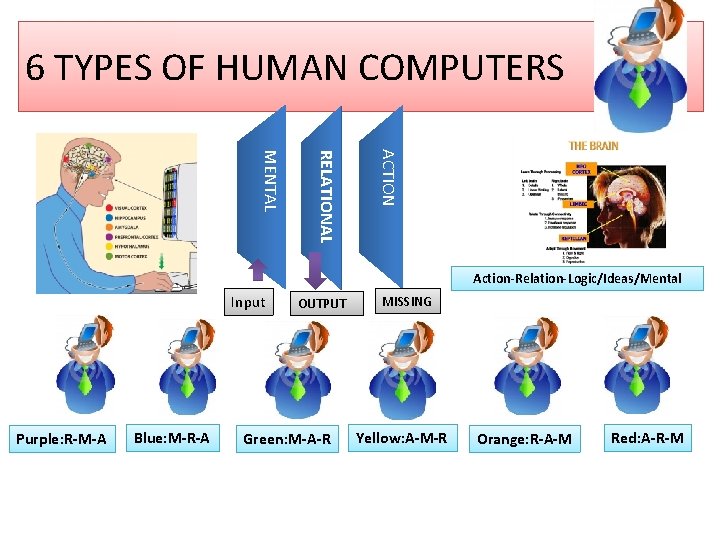
6 TYPES OF HUMAN COMPUTERS ACTION RELATIONAL MENTAL Action-Relation-Logic/Ideas/Mental Input Purple: R-M-A Blue: M-R-A OUTPUT Green: M-A-R MISSING Yellow: A-M-R Orange: R-A-M Red: A-R-M
Identifying Your Social Brain Ways of processing information • While there are three possible domains of processing we are born with only two domains: Ø how we process- highly developed Ø what we process- partly developed, and § The third mode is not natural to us - We need to learn this domain termed our acquired domain to integrate our social brain
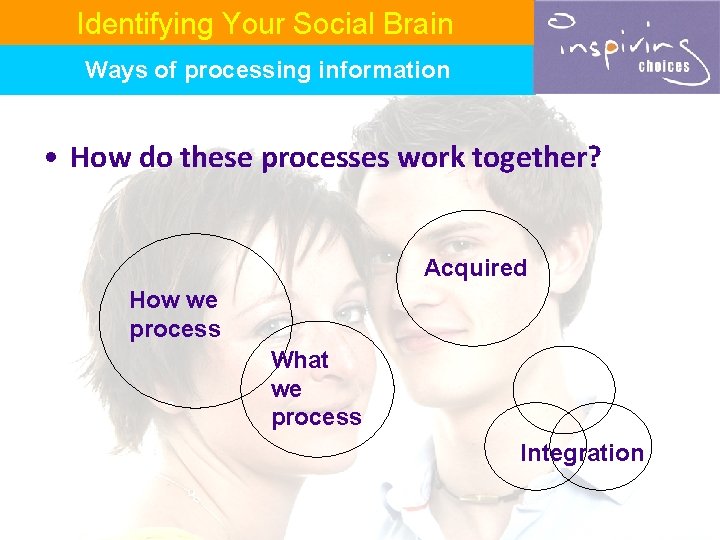
Understand your Communication Code Understanding People Identifying Your Social Brain Work towards integration Ways of processing information Great Relationships • How do these processes work together? Acquired How we process What we process Integration
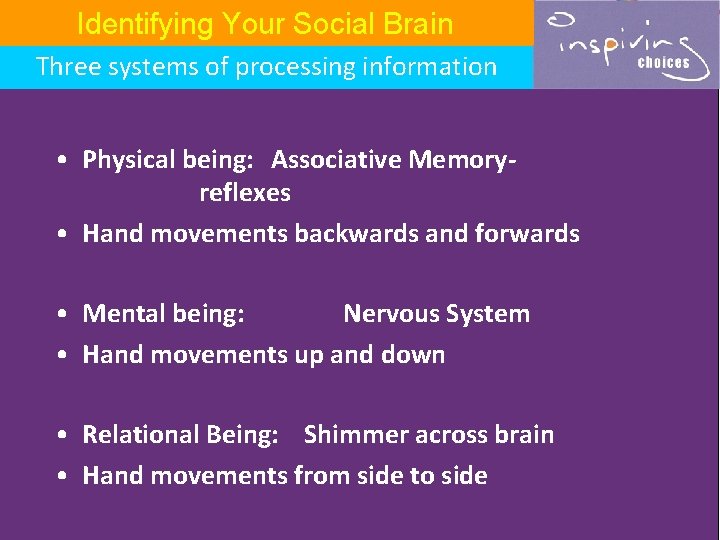
Understand your Communication Code Understanding Children’s Behaviour Identifying Your Social Brain Understanding People Three systems of processing information Ways of processing information Work towards integration Great Relationships • • How do these together? Physical being: processes Associativework Memoryreflexes • Hand movements backwards and forwards Acquired How we • Mental being: Nervous System process • Hand movements up and down What we process • Relational Being: Shimmer across brain Integration • Hand movements from side to side

Identifying Your Social Brain Three domains of how people solve problems and situations, one dominant, active in each of us, but to a different degree Mind Thinking Objectivity Vision Overview Structure Values Relational Feeling Subjectivity Relations Communication Organization Visualisation Action Making Doing Realizing Sensory Awareness Practical Systems view
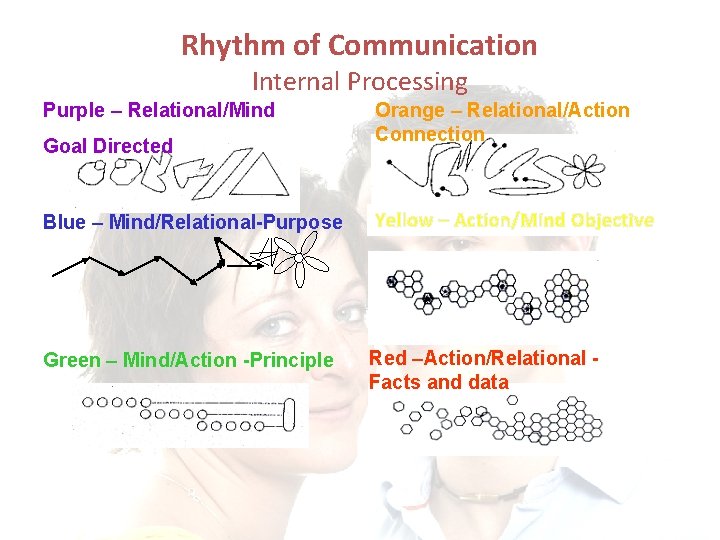
Rhythm of Communication Internal Processing Purple – Relational/Mind Goal Directed Orange – Relational/Action Connection Blue – Mind/Relational-Purpose Yellow – Action/Mind Objective Green – Mind/Action -Principle Red –Action/Relational Facts and data
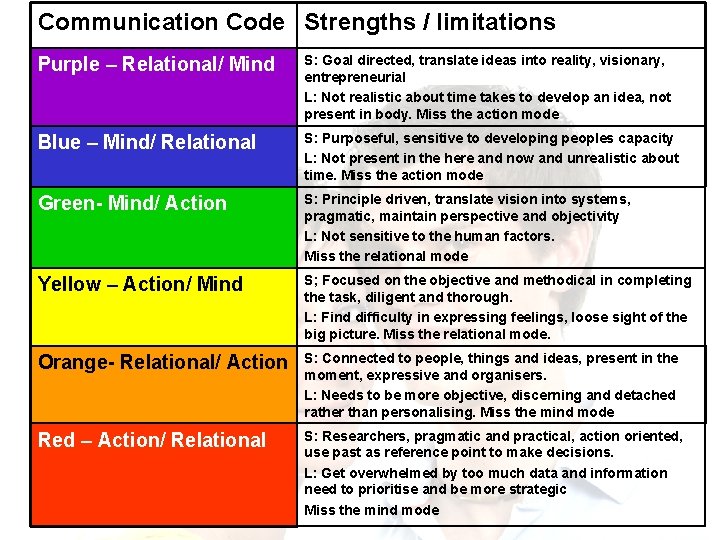
Communication Code Strengths / limitations Purple – Relational/ Mind S: Goal directed, translate ideas into reality, visionary, entrepreneurial L: Not realistic about time takes to develop an idea, not present in body. Miss the action mode Blue – Mind/ Relational S: Purposeful, sensitive to developing peoples capacity L: Not present in the here and now and unrealistic about time. Miss the action mode Green- Mind/ Action S: Principle driven, translate vision into systems, pragmatic, maintain perspective and objectivity L: Not sensitive to the human factors. Miss the relational mode Yellow – Action/ Mind S; Focused on the objective and methodical in completing the task, diligent and thorough. L: Find difficulty in expressing feelings, loose sight of the big picture. Miss the relational mode. Orange- Relational/ Action S: Connected to people, things and ideas, present in the moment, expressive and organisers. L: Needs to be more objective, discerning and detached rather than personalising. Miss the mind mode Red – Action/ Relational S: Researchers, pragmatic and practical, action oriented, use past as reference point to make decisions. L: Get overwhelmed by too much data and information need to prioritise and be more strategic Miss the mind mode
Understanding People Identifying Your Social Brain How the mode influences learning • There are six different modes of interaction with the environment-all unique • Each mode has different strengths and challenges • How do we stimulate each of the different modes? • How do we arrange the environment for each of the modes to learn effectively?
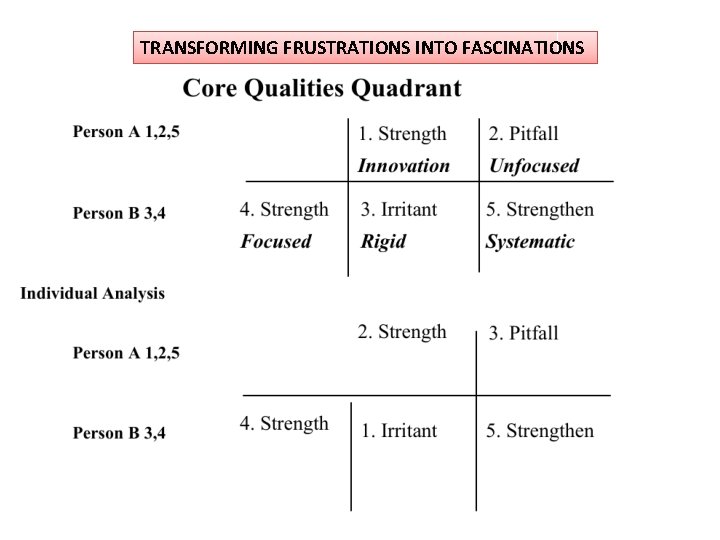
TRANSFORMING FRUSTRATIONS INTO FASCINATIONS
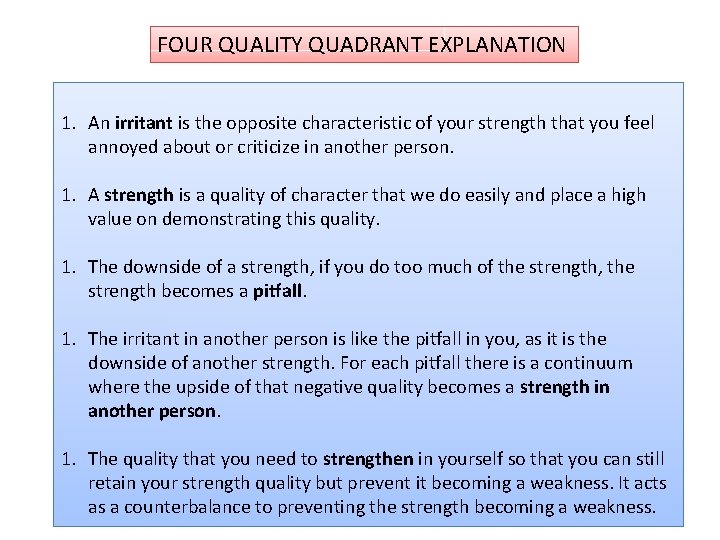
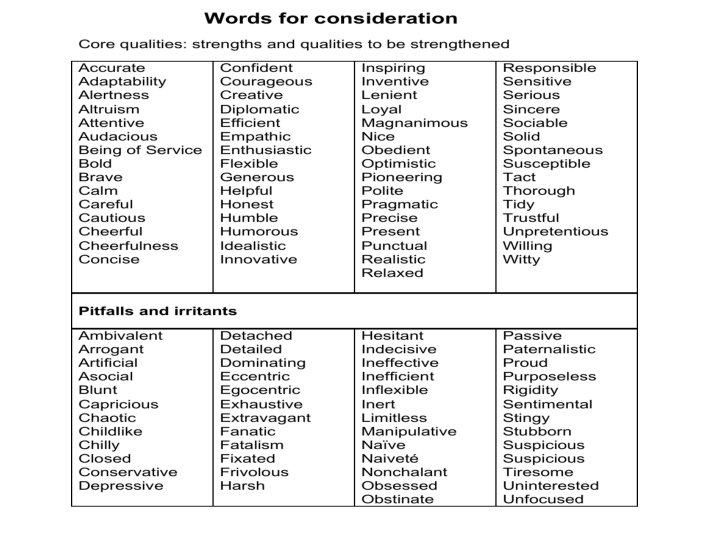
FOUR QUALITY QUADRANT EXPLANATION 1. An irritant is the opposite characteristic of your strength that you feel annoyed about or criticize in another person. 1. A strength is a quality of character that we do easily and place a high value on demonstrating this quality. 1. The downside of a strength, if you do too much of the strength, the strength becomes a pitfall. 1. The irritant in another person is like the pitfall in you, as it is the downside of another strength. For each pitfall there is a continuum where the upside of that negative quality becomes a strength in another person. 1. The quality that you need to strengthen in yourself so that you can still retain your strength quality but prevent it becoming a weakness. It acts as a counterbalance to preventing the strength becoming a weakness.
- Slides: 15