
Identifying Vortical Structures and Their Impact From Laboratory

Identifying Vortical Structures and Their Impact From Laboratory Studies of Wall Turbulence K. T. Christensen Students: Y. Wu and V. K. Natrajan Laboratory for Turbulence and Complex Flow (LTCF) Department of Mechanical Science and Engineering University of Illinois at Urbana-Champaign Urbana, IL 61801 USA Supported by AFOSR, NSF and the University of Illinois Laboratory for Turbulence and Complex Flow University of Illinois at Urbana-Champaign NCAR Workshop May 29, 2008
Wall turbulence • Refers to a broad class of turbulent flows bounded by a surface: – – Atmospheric boundary layer Boundary layer on ocean floor Flows over aircraft, ships, submarines, etc. Flows over turbine blades, blades of windmills, etc. • These flows are extremely difficult to study both experimentally and computationally. – As such, the simplest (canonical) cases have received the vast majority of research attention despite most practical flows of interest occurring in the presence of significantly more complexity. • High Reynolds numbers (Re) • Other influences: Surface roughness, pressure gradients, curvature, freestream effects, multiple phases, buoyancy, etc. • Coherent structures play a pivotal role in the evolution of such flows. Laboratory for Turbulence and Complex Flow University of Illinois at Urbana-Champaign NCAR Workshop May 29, 2008

Boundary-layer wind tunnel Inlet and flow conditioning • Low-speed suction wind tunnel • Test section: 1 m crosssection; 6 m streamwise fetch • Boundary-layer thickness: mm • Free-stream velocities: < U∞ < 40 m/s • Reynolds-number range: 1000 < Re < 15000 300 < d+ < 5000 ~100 3 test section Laboratory for Turbulence and Complex Flow University of Illinois at Urbana-Champaign NCAR Workshop May 29, 2008
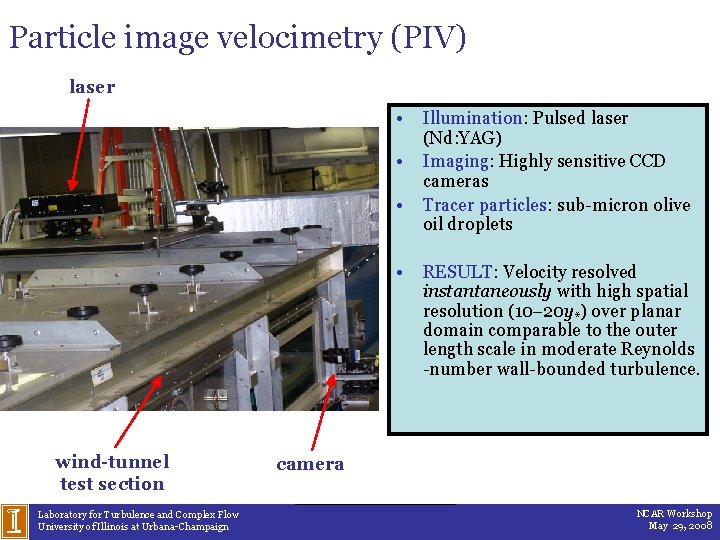
Particle image velocimetry (PIV) laser • • wind-tunnel test section Laboratory for Turbulence and Complex Flow University of Illinois at Urbana-Champaign Illumination: Pulsed laser (Nd: YAG) Imaging: Highly sensitive CCD cameras Tracer particles: sub-micron olive oil droplets RESULT: Velocity resolved instantaneously with high spatial resolution (10 20 y*) over planar domain comparable to the outer length scale in moderate Reynolds -number wall-bounded turbulence. camera NCAR Workshop May 29, 2008

Outer-layer structure of wall turbulence y x Head of hairpin vortex (“prograde” spanwise vortex) z Adrian, Meinhart and Tomkins (2000), JFM Laboratory for Turbulence and Complex Flow University of Illinois at Urbana-Champaign NCAR Workshop May 29, 2008

Assessing the importance of underlying structure • It is now well established that an underlying structural foundation exists in wall-bounded turbulent flows. – What role do these structures play in the turbulence statistics (single- as well as multi-point)? – What are the basic characteristics of this organization? – What role might this structural foundation play in turbulence modeling and control? • Challenges – Structures must be effectively extracted from the background turbulence. • Galilean decomposition (visualization in the reference frame of structure) • Local vortex markers – Analysis methodologies must be devised to study their importance and impact on the overall flow. • Spatial correlations • Conditional averaging Laboratory for Turbulence and Complex Flow University of Illinois at Urbana-Champaign NCAR Workshop May 29, 2008
Galilean decomposition of representative instantaneous PIV velocity field Flow Galilean decomposition reveals only those vortices traveling at the chosen advection velocity Laboratory for Turbulence and Complex Flow University of Illinois at Urbana-Champaign NCAR Workshop May 29, 2008
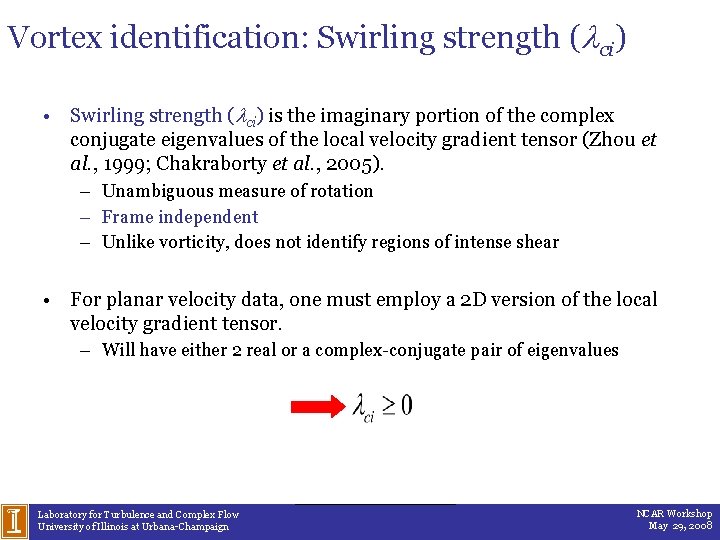
Vortex identification: Swirling strength ( ci) • Swirling strength ( ci) is the imaginary portion of the complex conjugate eigenvalues of the local velocity gradient tensor (Zhou et al. , 1999; Chakraborty et al. , 2005). – Unambiguous measure of rotation – Frame independent – Unlike vorticity, does not identify regions of intense shear • For planar velocity data, one must employ a 2 D version of the local velocity gradient tensor. – Will have either 2 real or a complex-conjugate pair of eigenvalues Laboratory for Turbulence and Complex Flow University of Illinois at Urbana-Champaign NCAR Workshop May 29, 2008
Galilean decomposition of representative instantaneous PIV velocity field Flow Laboratory for Turbulence and Complex Flow University of Illinois at Urbana-Champaign NCAR Workshop May 29, 2008

Associated Lci field Clockwise Laboratory for Turbulence and Complex Flow University of Illinois at Urbana-Champaign Counterclockwise NCAR Workshop May 29, 2008
Local Galilean decomposition around Lci events Laboratory for Turbulence and Complex Flow University of Illinois at Urbana-Champaign NCAR Workshop May 29, 2008

Outer-layer structure of wall turbulence y x Head of hairpin vortex (“prograde” spanwise vortex) z Adrian, Meinhart and Tomkins (2000), JFM Laboratory for Turbulence and Complex Flow University of Illinois at Urbana-Champaign NCAR Workshop May 29, 2008
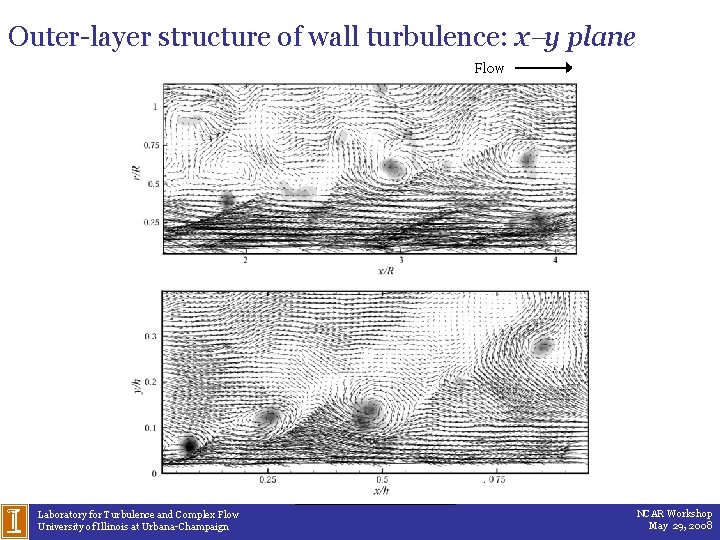
Outer-layer structure of wall turbulence: x y plane Flow Laboratory for Turbulence and Complex Flow University of Illinois at Urbana-Champaign NCAR Workshop May 29, 2008
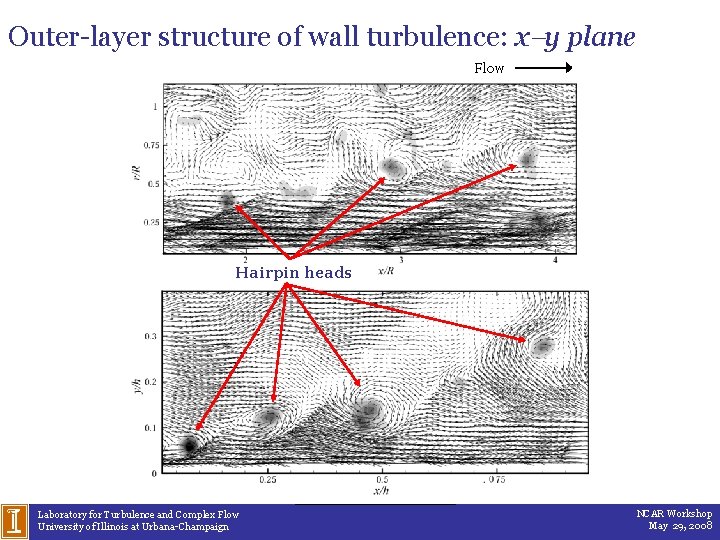
Outer-layer structure of wall turbulence: x y plane Flow Hairpin heads Laboratory for Turbulence and Complex Flow University of Illinois at Urbana-Champaign NCAR Workshop May 29, 2008
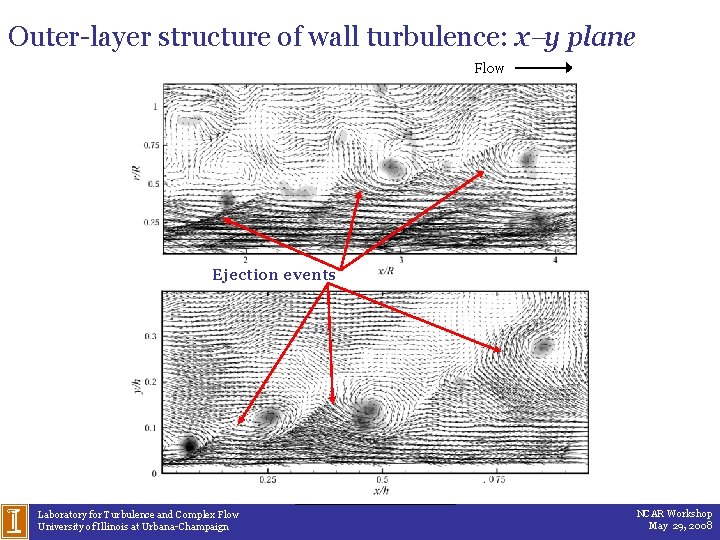
Outer-layer structure of wall turbulence: x y plane Flow Ejection events Laboratory for Turbulence and Complex Flow University of Illinois at Urbana-Champaign NCAR Workshop May 29, 2008
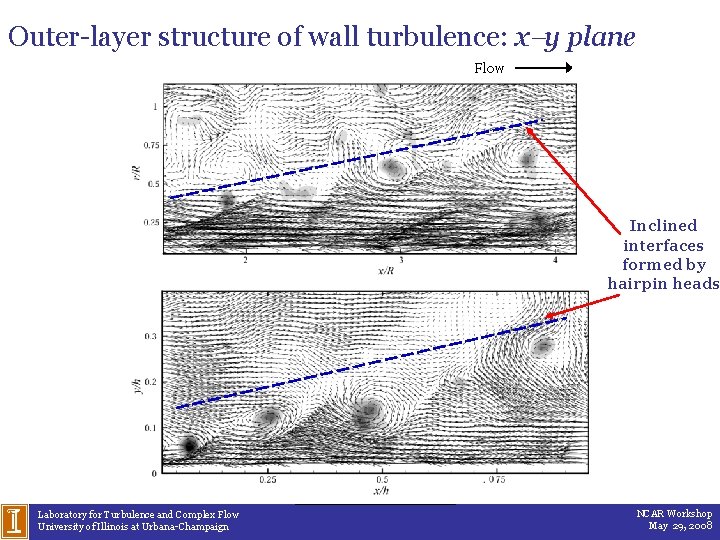
Outer-layer structure of wall turbulence: x y plane Flow Inclined interfaces formed by hairpin heads Laboratory for Turbulence and Complex Flow University of Illinois at Urbana-Champaign NCAR Workshop May 29, 2008
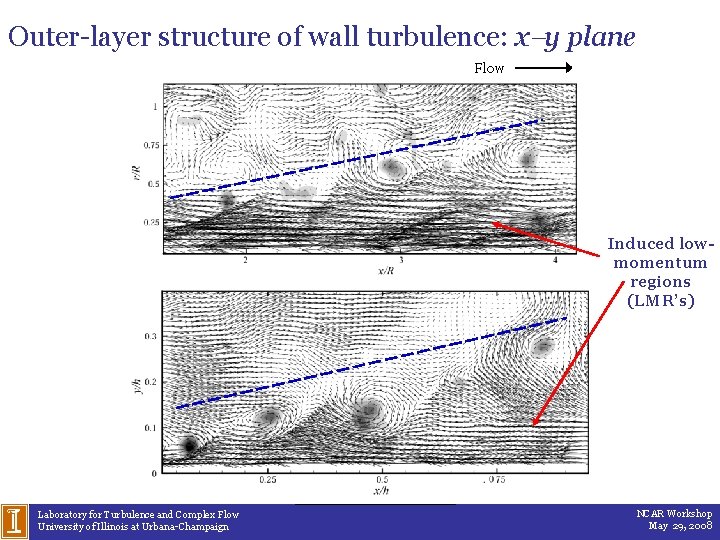
Outer-layer structure of wall turbulence: x y plane Flow Induced lowmomentum regions (LMR’s) Laboratory for Turbulence and Complex Flow University of Illinois at Urbana-Champaign NCAR Workshop May 29, 2008
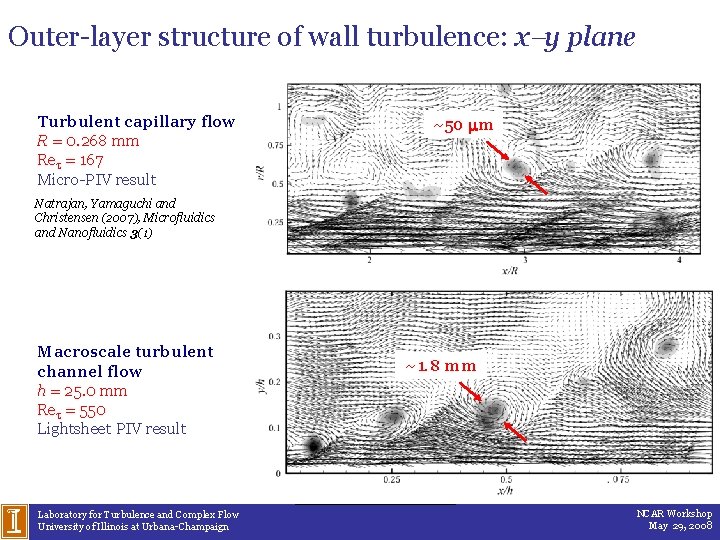
Outer-layer structure of wall turbulence: x y plane Turbulent capillary flow R = 0. 268 mm Ret = 167 Micro-PIV result ~50 mm Natrajan, Yamaguchi and Christensen (2007), Microfluidics and Nanofluidics 3(1) Macroscale turbulent channel flow h = 25. 0 mm Ret = 550 Lightsheet PIV result Laboratory for Turbulence and Complex Flow University of Illinois at Urbana-Champaign ~1. 8 mm NCAR Workshop May 29, 2008
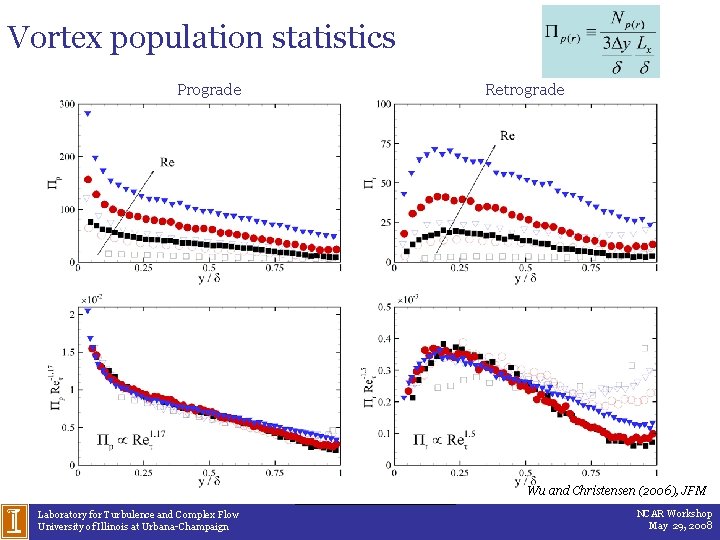
Vortex population statistics Prograde Retrograde Wu and Christensen (2006), JFM Laboratory for Turbulence and Complex Flow University of Illinois at Urbana-Champaign NCAR Workshop May 29, 2008
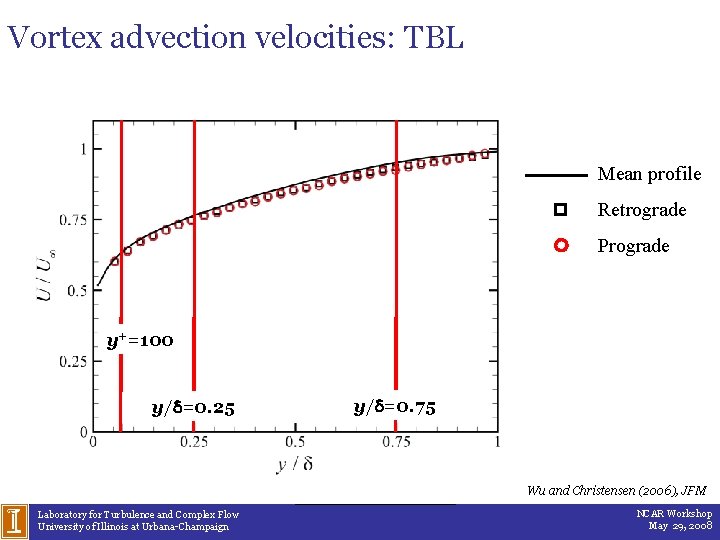
Vortex advection velocities: TBL Mean profile Retrograde Prograde y+=100 y/d=0. 25 y/d=0. 75 Wu and Christensen (2006), JFM Laboratory for Turbulence and Complex Flow University of Illinois at Urbana-Champaign NCAR Workshop May 29, 2008
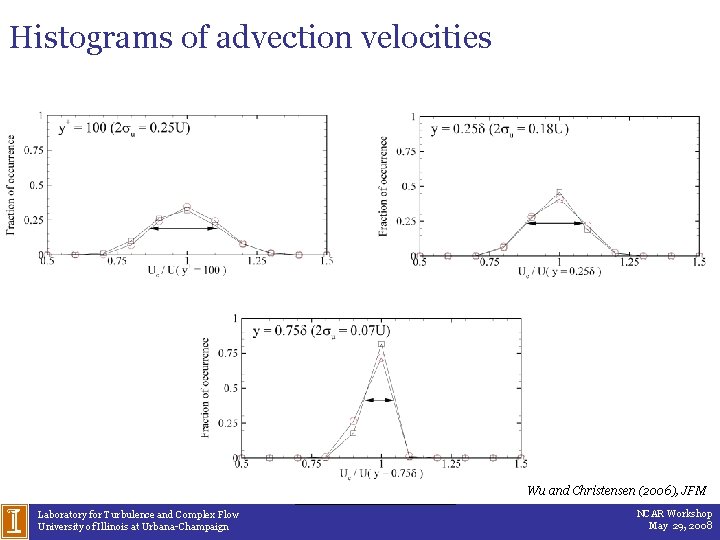
Histograms of advection velocities Wu and Christensen (2006), JFM Laboratory for Turbulence and Complex Flow University of Illinois at Urbana-Champaign NCAR Workshop May 29, 2008
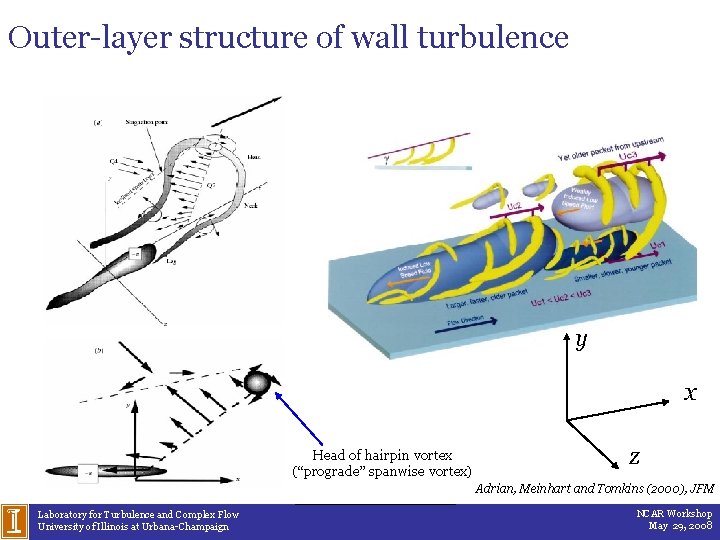
Outer-layer structure of wall turbulence y x Head of hairpin vortex (“prograde” spanwise vortex) z Adrian, Meinhart and Tomkins (2000), JFM Laboratory for Turbulence and Complex Flow University of Illinois at Urbana-Champaign NCAR Workshop May 29, 2008
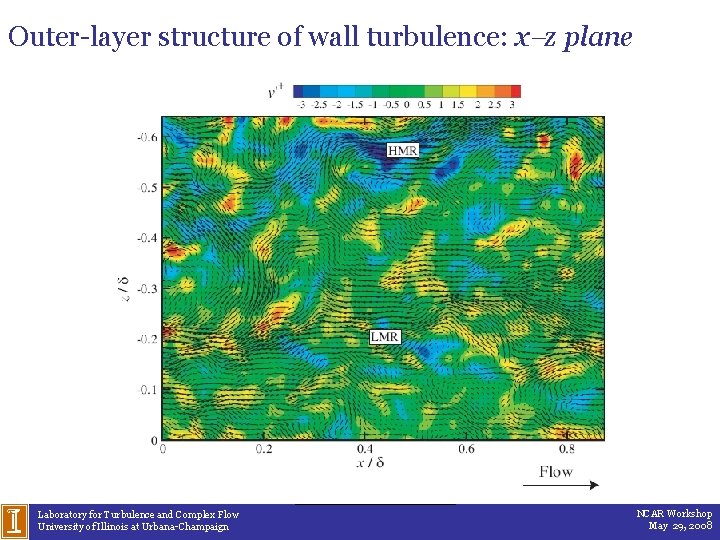
Outer-layer structure of wall turbulence: x z plane Laboratory for Turbulence and Complex Flow University of Illinois at Urbana-Champaign NCAR Workshop May 29, 2008
Outer-layer structure of wall turbulence: x z plane Laboratory for Turbulence and Complex Flow University of Illinois at Urbana-Champaign NCAR Workshop May 29, 2008
Outer-layer structure of wall turbulence: x z plane Laboratory for Turbulence and Complex Flow University of Illinois at Urbana-Champaign NCAR Workshop May 29, 2008
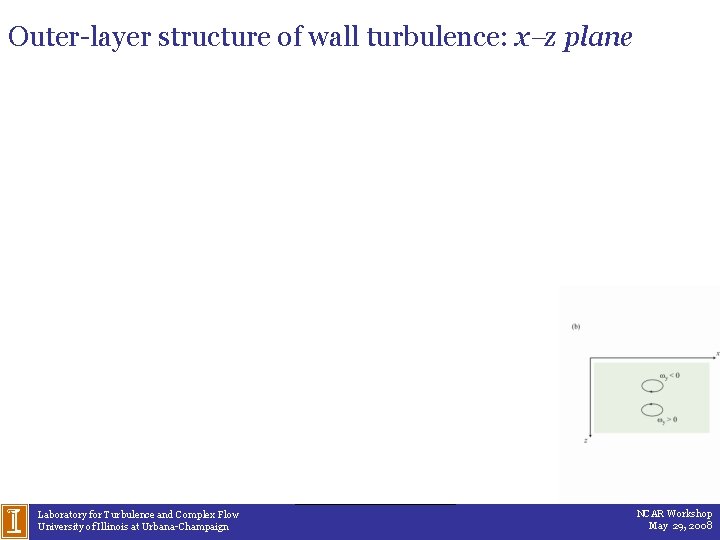
Outer-layer structure of wall turbulence: x z plane Laboratory for Turbulence and Complex Flow University of Illinois at Urbana-Champaign NCAR Workshop May 29, 2008
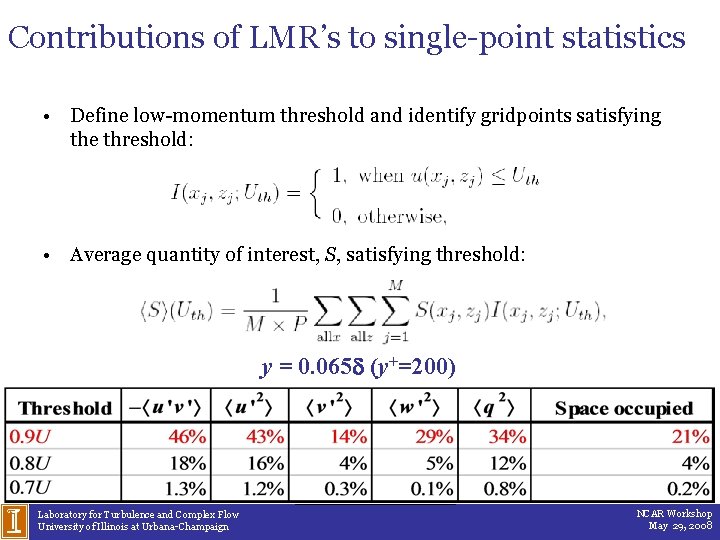
Contributions of LMR’s to single-point statistics • Define low-momentum threshold and identify gridpoints satisfying the threshold: • Average quantity of interest, S, satisfying threshold: y = 0. 065 d (y+=200) Laboratory for Turbulence and Complex Flow University of Illinois at Urbana-Champaign NCAR Workshop May 29, 2008
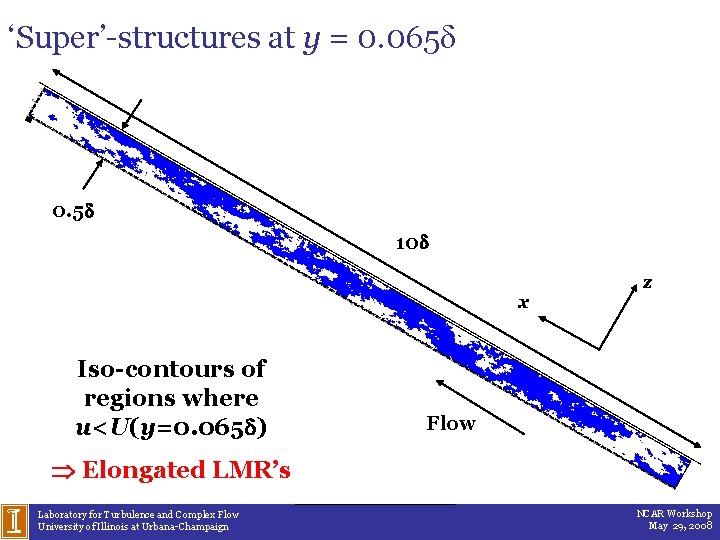
‘Super’-structures at y = 0. 065 d 0. 5 d 10 d z x Iso-contours of regions where u<U(y=0. 065 d) Flow Elongated LMR’s Laboratory for Turbulence and Complex Flow University of Illinois at Urbana-Champaign NCAR Workshop May 29, 2008
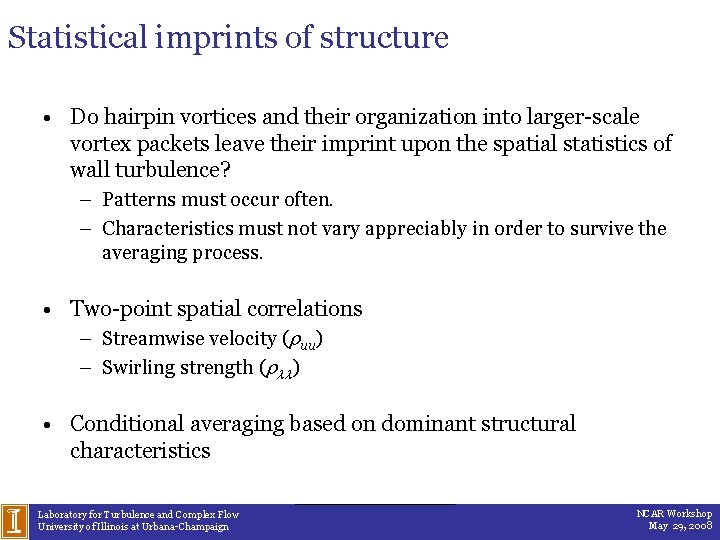
Statistical imprints of structure • Do hairpin vortices and their organization into larger-scale vortex packets leave their imprint upon the spatial statistics of wall turbulence? – Patterns must occur often. – Characteristics must not vary appreciably in order to survive the averaging process. • Two-point spatial correlations – Streamwise velocity (ruu) – Swirling strength (r ) • Conditional averaging based on dominant structural characteristics Laboratory for Turbulence and Complex Flow University of Illinois at Urbana-Champaign NCAR Workshop May 29, 2008
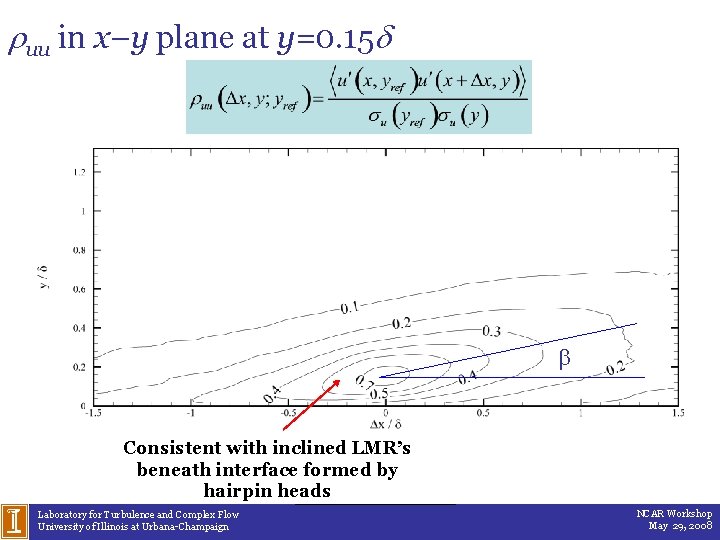
ruu in x–y plane at y=0. 15 d Consistent with inclined LMR’s beneath interface formed by hairpin heads Laboratory for Turbulence and Complex Flow University of Illinois at Urbana-Champaign NCAR Workshop May 29, 2008
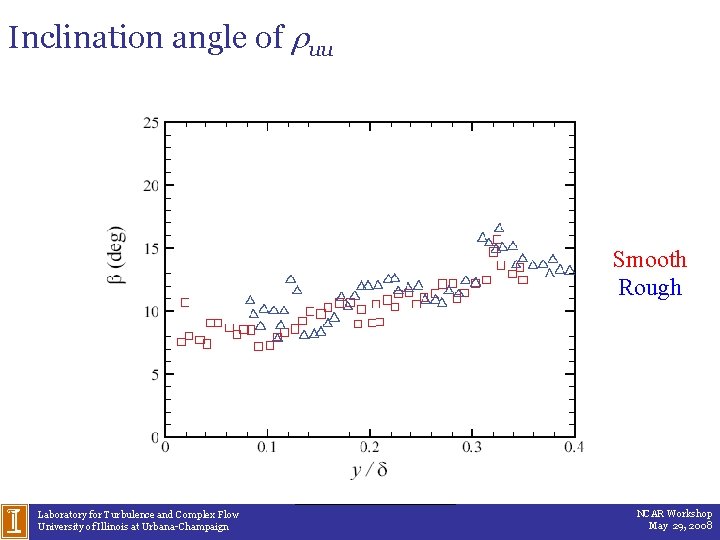
Inclination angle of ruu Smooth Rough Laboratory for Turbulence and Complex Flow University of Illinois at Urbana-Champaign NCAR Workshop May 29, 2008
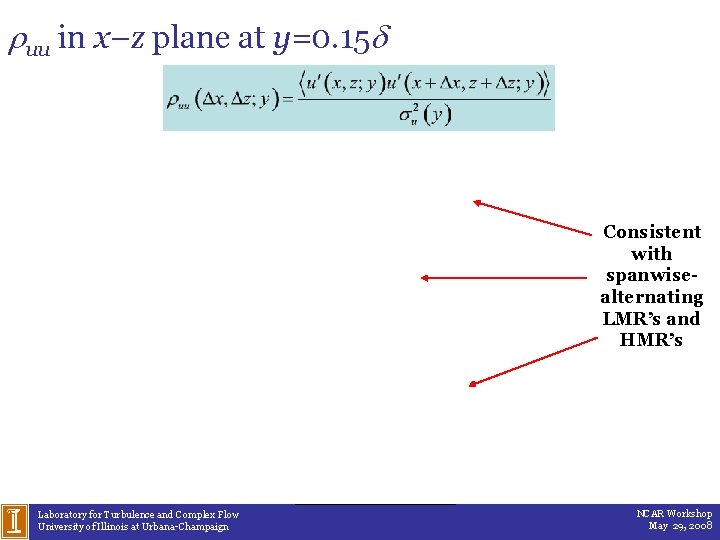
ruu in x–z plane at y=0. 15 d Consistent with spanwisealternating LMR’s and HMR’s Laboratory for Turbulence and Complex Flow University of Illinois at Urbana-Champaign NCAR Workshop May 29, 2008
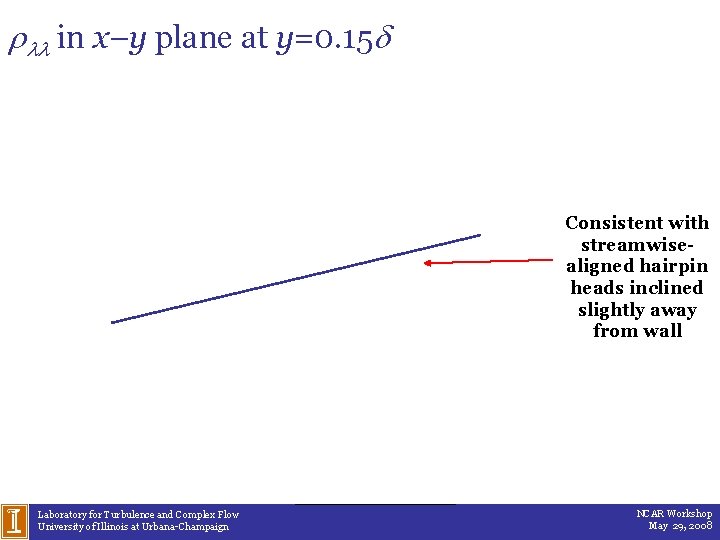
r in x–y plane at y=0. 15 d Consistent with streamwisealigned hairpin heads inclined slightly away from wall Laboratory for Turbulence and Complex Flow University of Illinois at Urbana-Champaign NCAR Workshop May 29, 2008
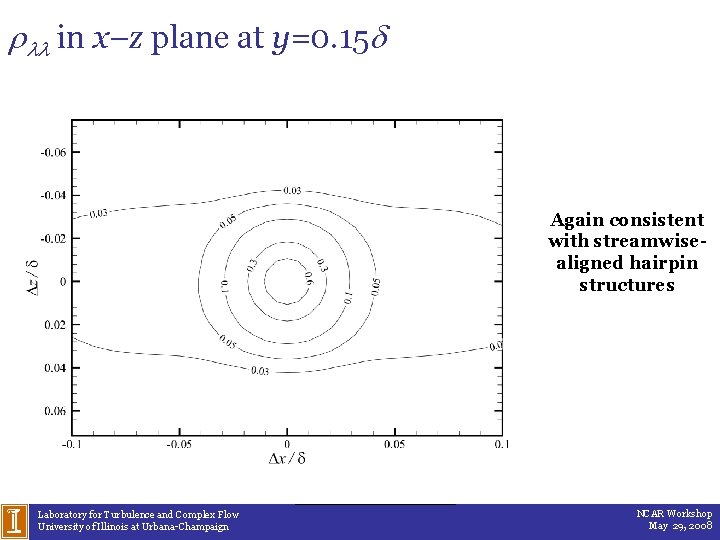
r in x–z plane at y=0. 15 d Again consistent with streamwisealigned hairpin structures Laboratory for Turbulence and Complex Flow University of Illinois at Urbana-Champaign NCAR Workshop May 29, 2008
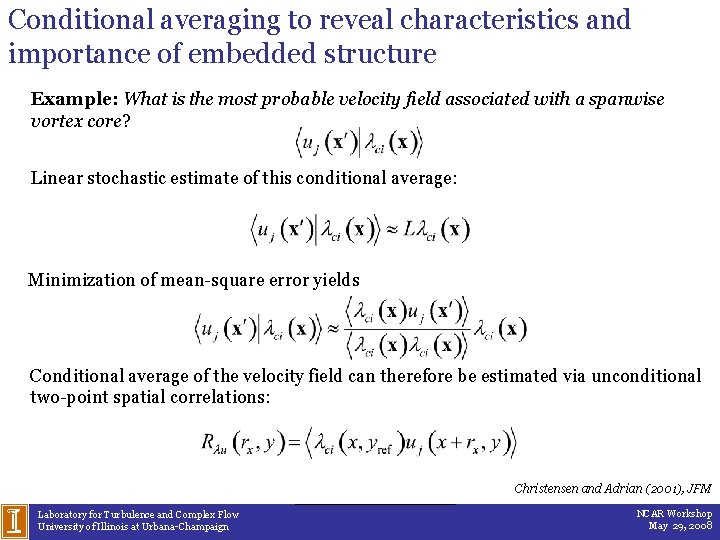
Conditional averaging to reveal characteristics and importance of embedded structure Example: What is the most probable velocity field associated with a spanwise vortex core? Linear stochastic estimate of this conditional average: Minimization of mean-square error yields Conditional average of the velocity field can therefore be estimated via unconditional two-point spatial correlations: Christensen and Adrian (2001), JFM Laboratory for Turbulence and Complex Flow University of Illinois at Urbana-Champaign NCAR Workshop May 29, 2008
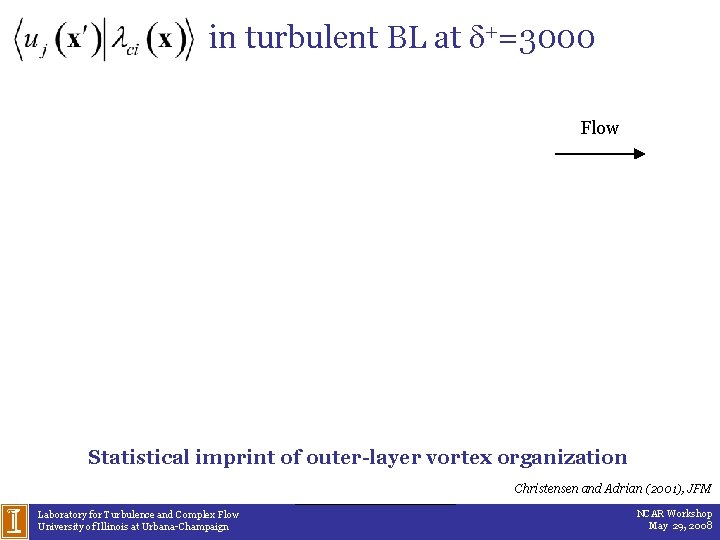
in turbulent BL at d+=3000 Flow Statistical imprint of outer-layer vortex organization Christensen and Adrian (2001), JFM Laboratory for Turbulence and Complex Flow University of Illinois at Urbana-Champaign NCAR Workshop May 29, 2008
Another example: Large-eddy simulation (LES) • IDEA: Only resolve a subset of the dynamically-important spatial scales in order to reduce the overall cost of the computation. – Larger scales are solved for directly while the smaller scales are modeled in some fashion. – One can run an LES at a much higher Re for the same cost as a lower-Re direct numerical simulation (DNS). • Implementation – Equations of motion are low-pass filtered, yielding a set of “filtered” equations for the resolved scales. • Difficulties – One must define a spatial-scale boundary between the resolved and unresolved scales as well as an appropriate filtering methodology. – The influence of the smaller (unresolved) scales on the evolution of the larger (resolved) scales must be modeled. – What role do hairpin vortex packets play in SGS physics? Laboratory for Turbulence and Complex Flow University of Illinois at Urbana-Champaign NCAR Workshop May 29, 2008
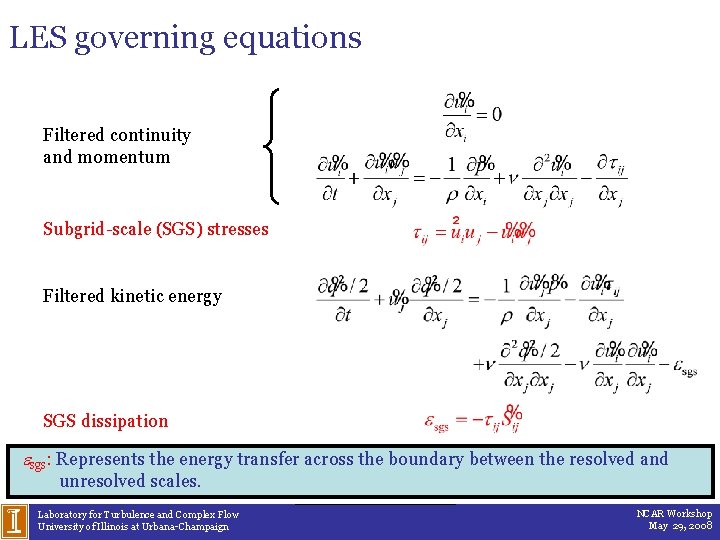
LES governing equations Filtered continuity and momentum Subgrid-scale (SGS) stresses Filtered kinetic energy SGS dissipation sgs: Represents the energy transfer across the boundary between the resolved and unresolved scales. Laboratory for Turbulence and Complex Flow University of Illinois at Urbana-Champaign NCAR Workshop May 29, 2008
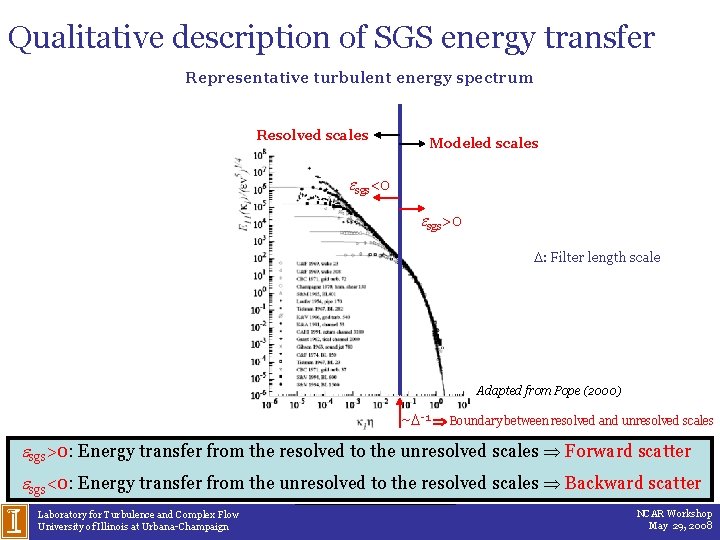
Qualitative description of SGS energy transfer Representative turbulent energy spectrum Resolved scales Modeled scales sgs<0 sgs>0 D: Filter length scale Adapted from Pope (2000) ~D-1 Boundary between resolved and unresolved scales sgs>0: Energy transfer from the resolved to the unresolved scales Forward scatter sgs<0: Energy transfer from the unresolved to the resolved scales Backward scatter Laboratory for Turbulence and Complex Flow University of Illinois at Urbana-Champaign NCAR Workshop May 29, 2008
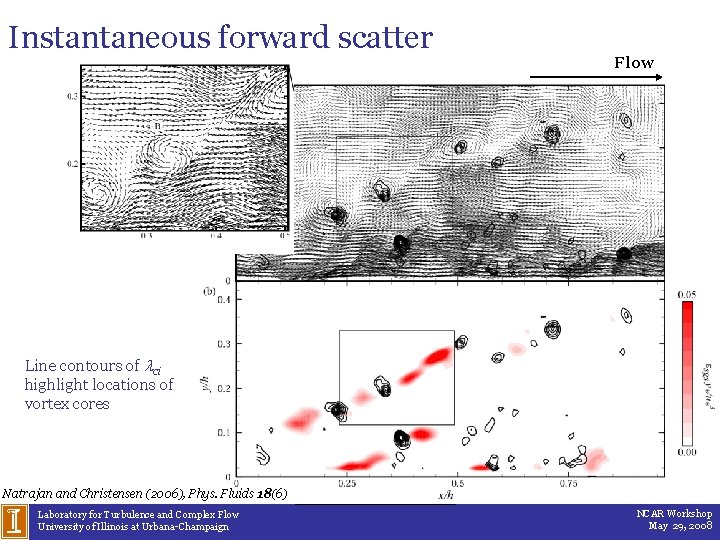
Instantaneous forward scatter Flow Line contours of ci highlight locations of vortex cores Natrajan and Christensen (2006), Phys. Fluids 18(6) Laboratory for Turbulence and Complex Flow University of Illinois at Urbana-Champaign NCAR Workshop May 29, 2008
y/h Instantaneous backscatter x/h Laboratory for Turbulence and Complex Flow University of Illinois at Urbana-Champaign Natrajan and Christensen (2006), Phys. Fluids 18(6) NCAR Workshop May 29, 2008
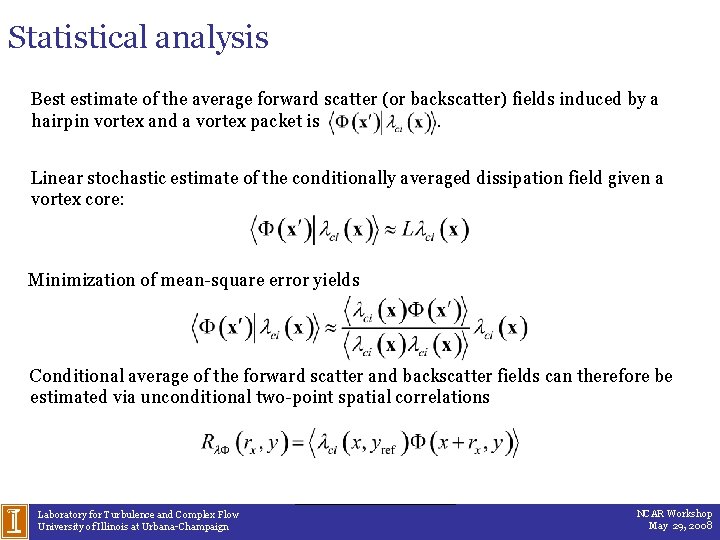
Statistical analysis Best estimate of the average forward scatter (or backscatter) fields induced by a hairpin vortex and a vortex packet is. Linear stochastic estimate of the conditionally averaged dissipation field given a vortex core: Minimization of mean-square error yields Conditional average of the forward scatter and backscatter fields can therefore be estimated via unconditional two-point spatial correlations Laboratory for Turbulence and Complex Flow University of Illinois at Urbana-Champaign NCAR Workshop May 29, 2008
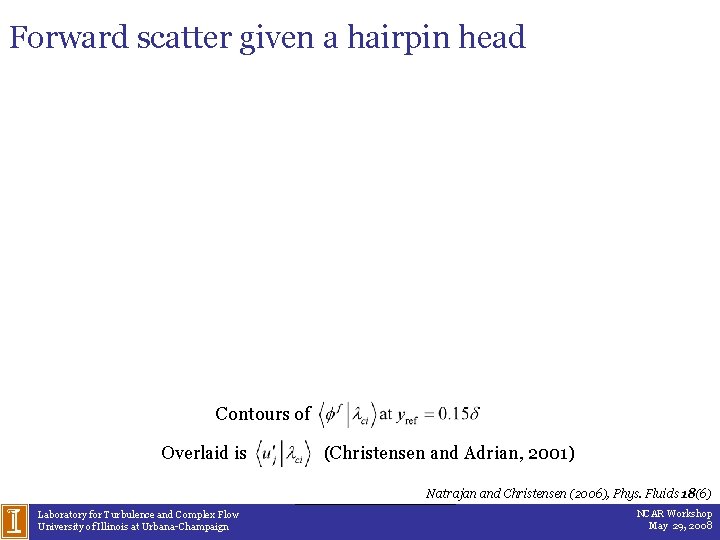
Forward scatter given a hairpin head Contours of Overlaid is (Christensen and Adrian, 2001) Natrajan and Christensen (2006), Phys. Fluids 18(6) Laboratory for Turbulence and Complex Flow University of Illinois at Urbana-Champaign NCAR Workshop May 29, 2008
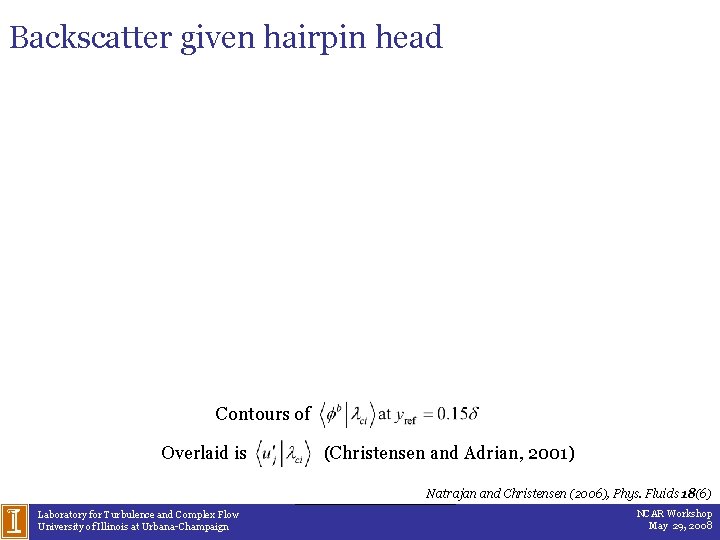
Backscatter given hairpin head Contours of Overlaid is (Christensen and Adrian, 2001) Natrajan and Christensen (2006), Phys. Fluids 18(6) Laboratory for Turbulence and Complex Flow University of Illinois at Urbana-Champaign NCAR Workshop May 29, 2008
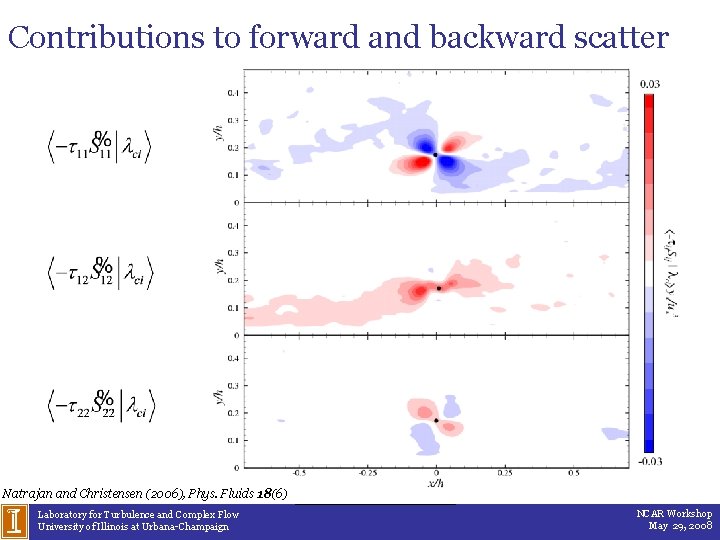
Contributions to forward and backward scatter Natrajan and Christensen (2006), Phys. Fluids 18(6) Laboratory for Turbulence and Complex Flow University of Illinois at Urbana-Champaign NCAR Workshop May 29, 2008
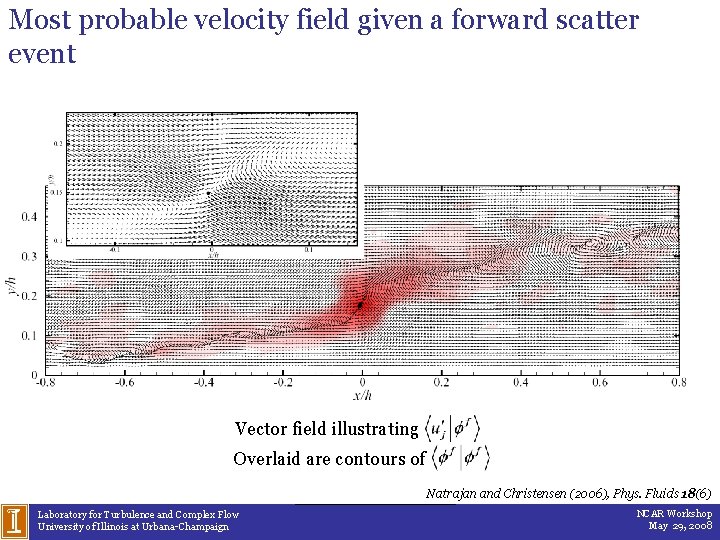
Most probable velocity field given a forward scatter event Vector field illustrating Overlaid are contours of Natrajan and Christensen (2006), Phys. Fluids 18(6) Laboratory for Turbulence and Complex Flow University of Illinois at Urbana-Champaign NCAR Workshop May 29, 2008
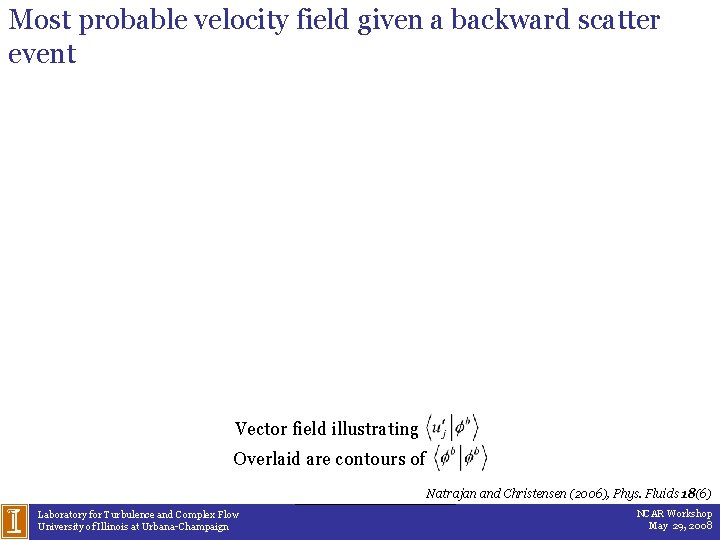
Most probable velocity field given a backward scatter event Vector field illustrating Overlaid are contours of Natrajan and Christensen (2006), Phys. Fluids 18(6) Laboratory for Turbulence and Complex Flow University of Illinois at Urbana-Champaign NCAR Workshop May 29, 2008
Instantaneous backscatter revisited Flow Natrajan and Christensen (2006), Phys. Fluids 18(6) Laboratory for Turbulence and Complex Flow University of Illinois at Urbana-Champaign NCAR Workshop May 29, 2008
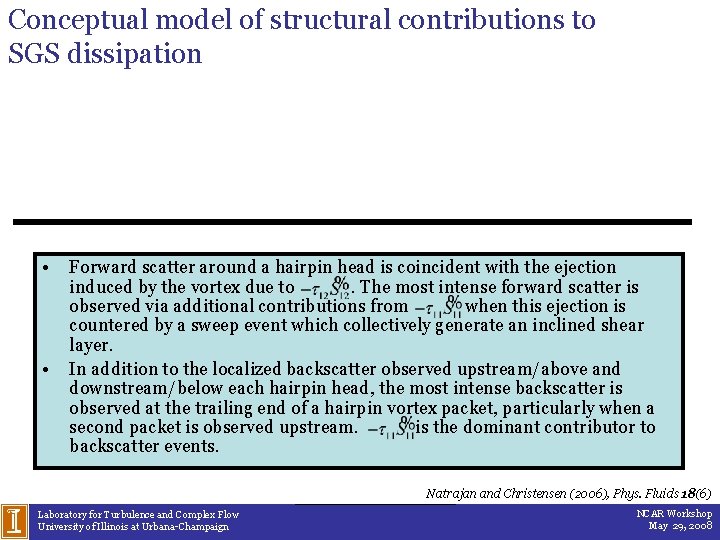
Conceptual model of structural contributions to SGS dissipation • • Forward scatter around a hairpin head is coincident with the ejection induced by the vortex due to. The most intense forward scatter is observed via additional contributions from when this ejection is countered by a sweep event which collectively generate an inclined shear layer. In addition to the localized backscatter observed upstream/above and downstream/below each hairpin head, the most intense backscatter is observed at the trailing end of a hairpin vortex packet, particularly when a second packet is observed upstream. is the dominant contributor to backscatter events. Natrajan and Christensen (2006), Phys. Fluids 18(6) Laboratory for Turbulence and Complex Flow University of Illinois at Urbana-Champaign NCAR Workshop May 29, 2008

Summary • Whatever the experimental/computational protocol employed, identification of coherent structures in data is pivotal to understanding the evolution of turbulent flows. • Robust identification methodology must be applied – “Quality” of data can impact choice • Once structures are identified, key challenge lies in extracting their influence and importance. – Success tightly coupled to clarity of goals – Conditional averaging methods can be extremely helpful in this regard – Key is choosing appropriate averaging conditions Laboratory for Turbulence and Complex Flow University of Illinois at Urbana-Champaign NCAR Workshop May 29, 2008
- Slides: 50