
IDENTIFYING USERS TOPICAL TASKS IN WEB SEARCH Date
IDENTIFYING USERS' TOPICAL TASKS IN WEB SEARCH Date: 2013/12/25 Author: Wen Hua, Yangqiu Song, Haixun Wang, Xiaofang Zhou Source: WSDM’ 13 Advisor: Jia-ling Koh Speaker: Sz-Han Wang
Outline Introduction Method Similarity Calculation p Task Identification p Experiments Conclusion 2
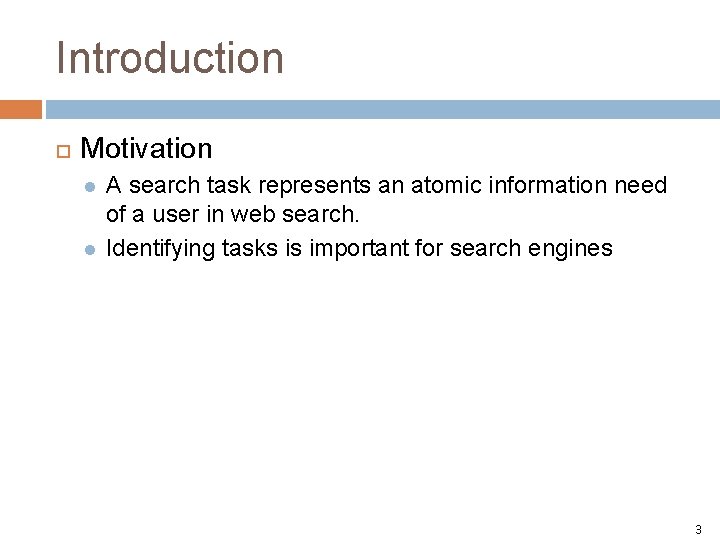
Introduction Motivation l l A search task represents an atomic information need of a user in web search. Identifying tasks is important for search engines 3
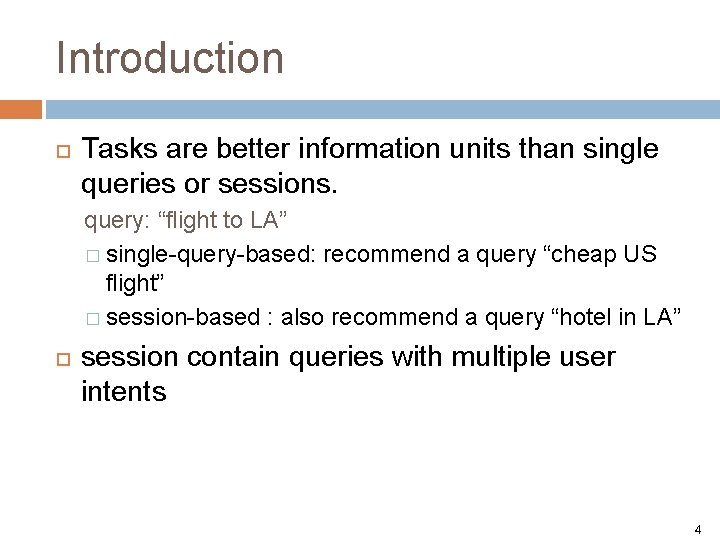
Introduction Tasks are better information units than single queries or sessions. query: “flight to LA” � single-query-based: recommend a query “cheap US flight” � session-based : also recommend a query “hotel in LA” session contain queries with multiple user intents 4

Introduction Task identification itself is far from simple, due to the following reasons: 1. not trivial to decide whether two queries belong to the same task queries 4, 5, and 6 in Table 1 may belong to the same task “cat” , “dog” and “snake” may be of the same topic (“animal”) →need a semantic mechanism to identify topical query refinements. 5
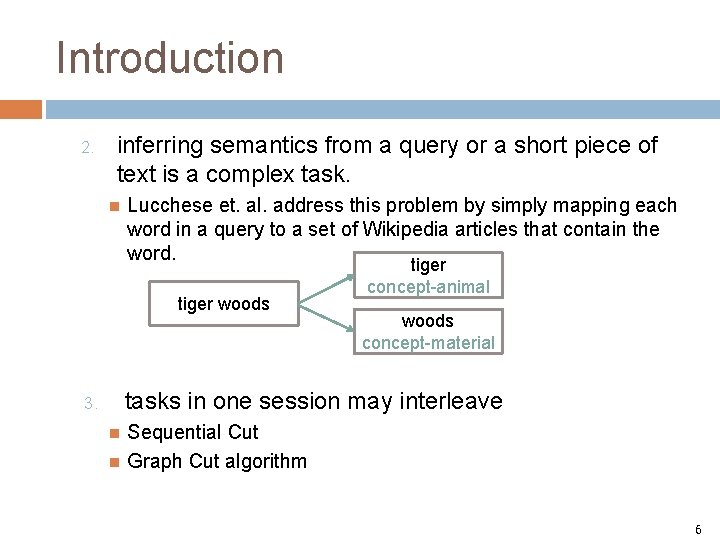
Introduction 2. inferring semantics from a query or a short piece of text is a complex task. Lucchese et. al. address this problem by simply mapping each word in a query to a set of Wikipedia articles that contain the word. tiger woods tiger concept-animal woods concept-material tasks in one session may interleave 3. Sequential Cut Graph Cut algorithm 6
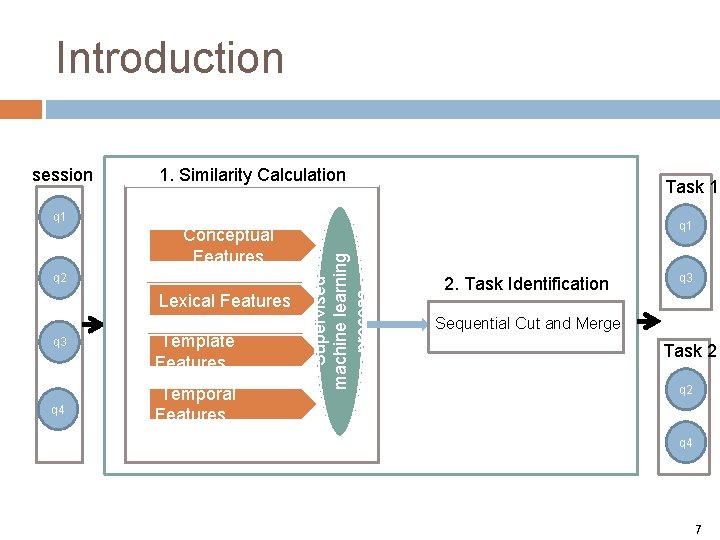
Introduction session 1. Similarity Calculation Task 1 q 2 Lexical Features q 3 q 4 Template Features Temporal Features q 1 Supervised machine learning process Conceptual Features 2. Task Identification q 3 Sequential Cut and Merge Task 2 q 4 7
Outline Introduction Method � Similarity Calculation � Task Identification Experiments Conclusion 8
Probase A huge semantic network Node divided into three categories � � � entities (e. g. , “Barack Obama”) concepts (e. g. , “President of America”) attributes (e. g. , “age”, “color”) Edges represent the relationships between nodes is. Attribute. Of between attributes and concepts (e. g. , “ population” is. Attribute. Of “country”) � is. A between entities and concepts (e. g. , “Barack Obama” is. A “President of America”) � 9
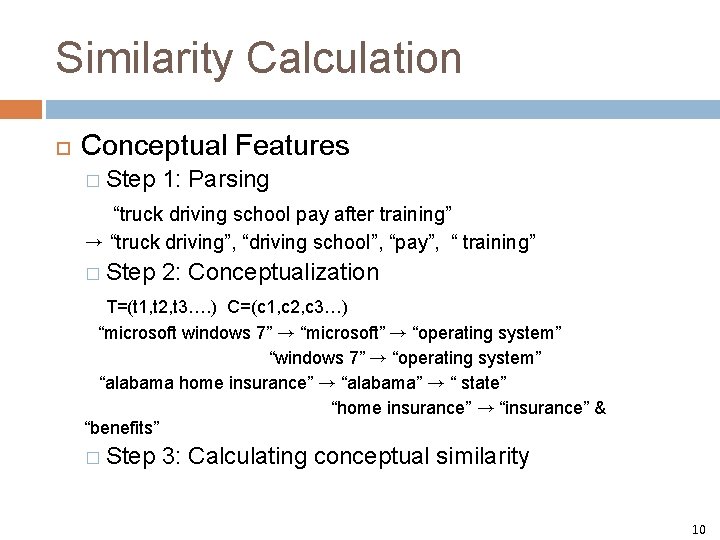
Similarity Calculation Conceptual Features � Step 1: Parsing “truck driving school pay after training” → “truck driving”, “driving school”, “pay”, “ training” � Step 2: Conceptualization T=(t 1, t 2, t 3…. ) C=(c 1, c 2, c 3…) “microsoft windows 7” → “microsoft” → “operating system” “windows 7” → “operating system” “alabama home insurance” → “alabama” → “ state” “home insurance” → “insurance” & “benefits” � Step 3: Calculating conceptual similarity 10
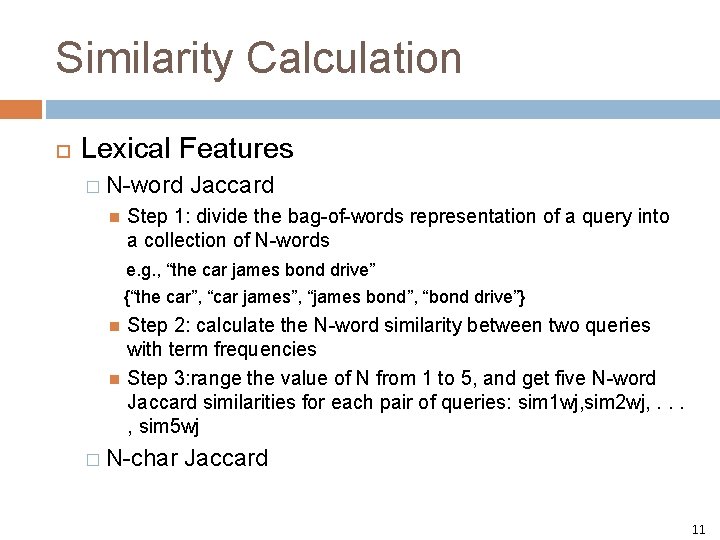
Similarity Calculation Lexical Features � N-word Jaccard Step 1: divide the bag-of-words representation of a query into a collection of N-words e. g. , “the car james bond drive” {“the car”, “car james”, “james bond”, “bond drive”} Step 2: calculate the N-word similarity between two queries with term frequencies Step 3: range the value of N from 1 to 5, and get five N-word Jaccard similarities for each pair of queries: sim 1 wj, sim 2 wj, . . . , sim 5 wj � N-char Jaccard 11
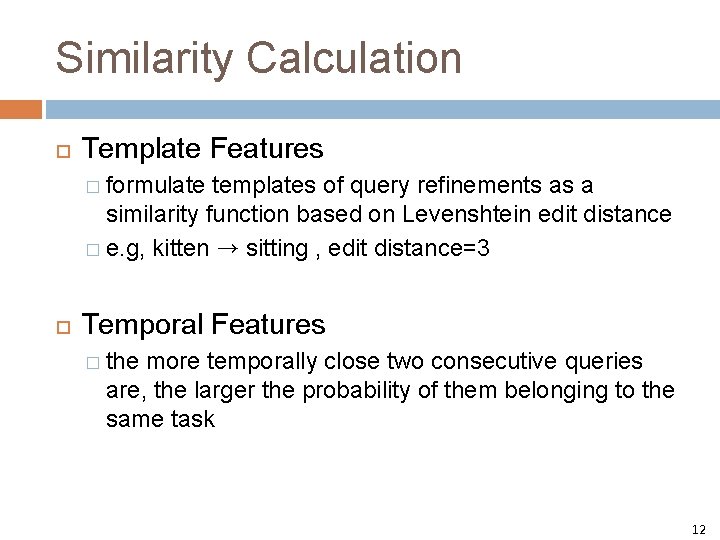
Similarity Calculation Template Features � formulate templates of query refinements as a similarity function based on Levenshtein edit distance � e. g, kitten → sitting , edit distance=3 Temporal Features � the more temporally close two consecutive queries are, the larger the probability of them belonging to the same task 12
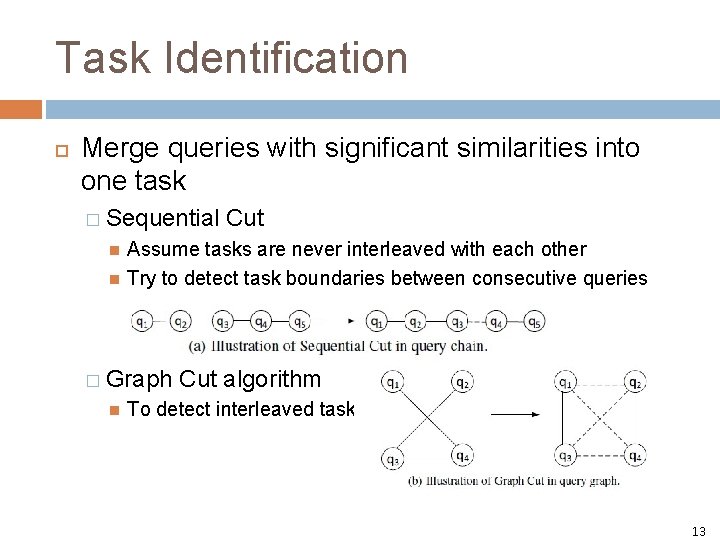
Task Identification Merge queries with significant similarities into one task � Sequential Assume tasks are never interleaved with each other Try to detect task boundaries between consecutive queries � Graph Cut algorithm To detect interleaved tasks 13
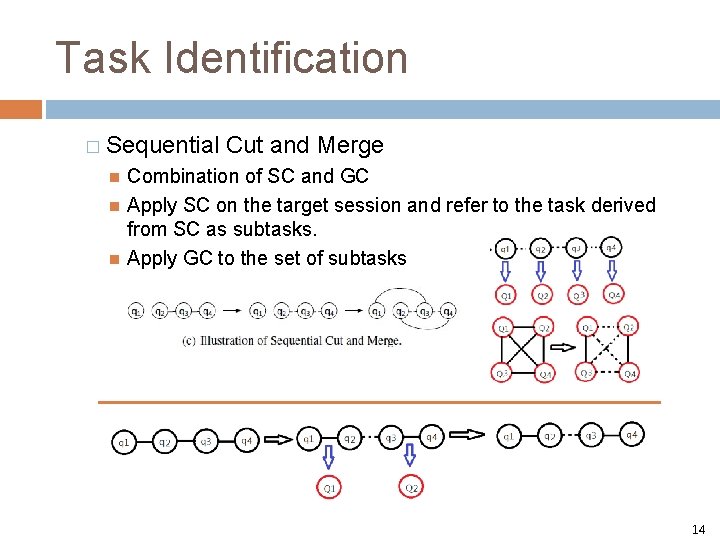
Task Identification � Sequential Cut and Merge Combination of SC and GC Apply SC on the target session and refer to the task derived from SC as subtasks. Apply GC to the set of subtasks 14
Outline Introduction Method Similarity Calculation p Task Identification p Experiments Conclusion 15
Dataset All the session one day in May 2012 from a commercial internet � Session: a sequence of queries issued in the browser without the use closing it Constraints: � Users in the “United Stated” � Queries be written in “English” � Each session contained at least 10 queries After filtering obtain 45, 813 sessions Randomly sample 600 sessions 16
Evaluation metrics Effectiveness of Classifiers and Features � Error Rate Accuracy of Algorithms � F-measure � Jaccard Index 17
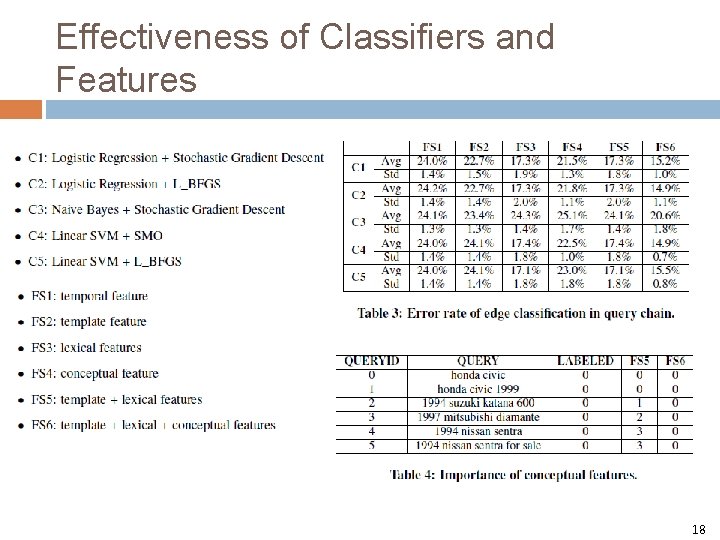
Effectiveness of Classifiers and Features 18
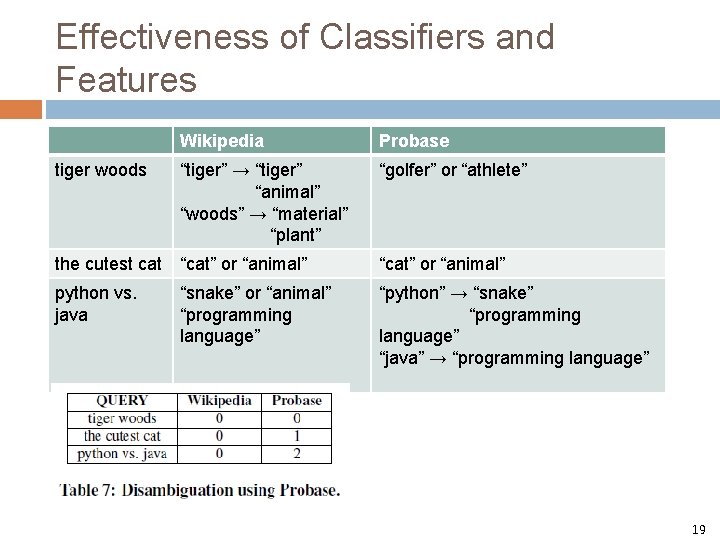
Effectiveness of Classifiers and Features tiger woods Wikipedia Probase “tiger” → “tiger” “animal” “woods” → “material” “plant” “golfer” or “athlete” the cutest cat “cat” or “animal” python vs. java “python” → “snake” “programming language” “java” → “programming language” “snake” or “animal” “programming language” 19
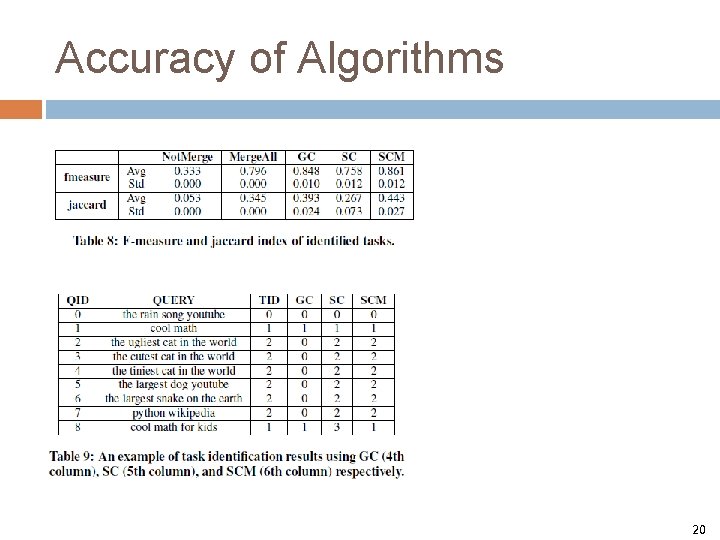
Accuracy of Algorithms 20
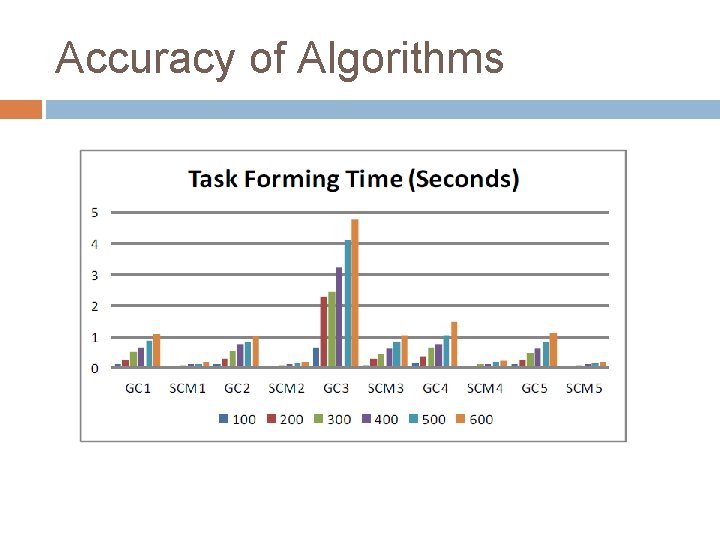
Accuracy of Algorithms
Outline Introduction Method Similarity Calculation p Task Identification p Experiments Conclusion
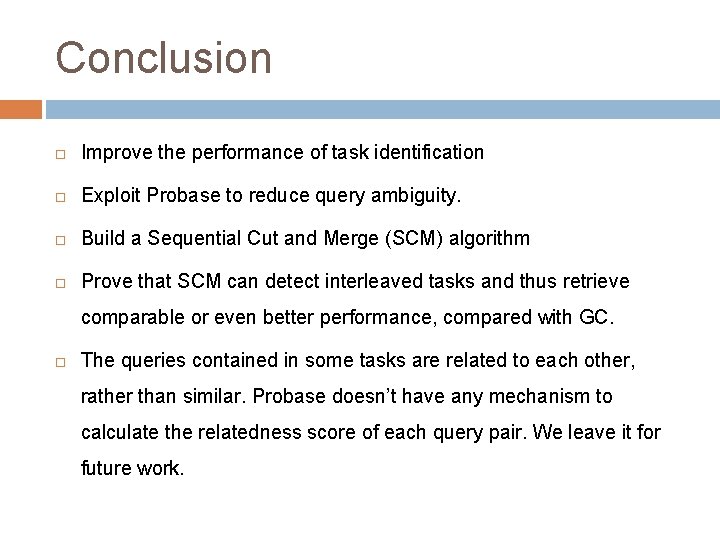
Conclusion Improve the performance of task identification Exploit Probase to reduce query ambiguity. Build a Sequential Cut and Merge (SCM) algorithm Prove that SCM can detect interleaved tasks and thus retrieve comparable or even better performance, compared with GC. The queries contained in some tasks are related to each other, rather than similar. Probase doesn’t have any mechanism to calculate the relatedness score of each query pair. We leave it for future work.
- Slides: 23