
Identifying TwoWay Knowledge Sharing in Online Communities Authors



- Slides: 30
Identifying Two-Way Knowledge Sharing in Online Communities
Authors Laurie F. Ruberg, Ph. D. , Associate Director Debra Burkey Piecka, Ed. D. , Educational Researcher Center for Educational Technologies Wheeling (WV) Jesuit University Tyra Good, American Evaluation Association Graduate Education Diversity Alumnae Duquesne University, Pittsburgh, PA
How do we measure knowledge sharing in an online collaborative website? This presentation explores: • How indicators of knowledge sharing in online communities can be identified, measured, and analyzed. • How techniques used to measure knowledge transfer and knowledge generation in online business communities can be applied to evaluation of educational virtual communities. • Examples of strategies and contextual factors that show genuine knowledge sharing.
Context • The context for this evaluation is a STEM education online community that offers both public and private collaborative groups. • Visual presentation of results—showing the online context, case examples, data coding scheme, data summary system, and visual representation of results • Highlighting successful strategies, and contexts for future evaluation
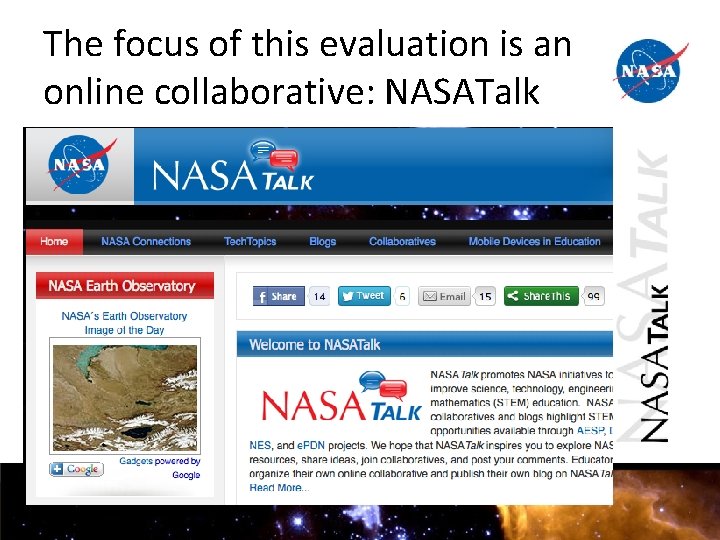
The focus of this evaluation is an online collaborative: NASATalk
What is NASATalk? • NASATalk is a web 2. 0 collaborative designed to spark interest in NASA STEM education resources. • http: //www. nasatalk. com
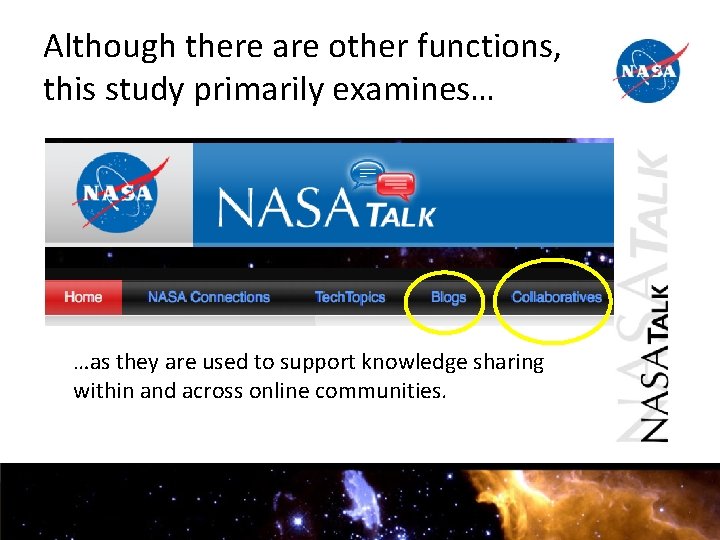
Although there are other functions, this study primarily examines… …as they are used to support knowledge sharing within and across online communities.
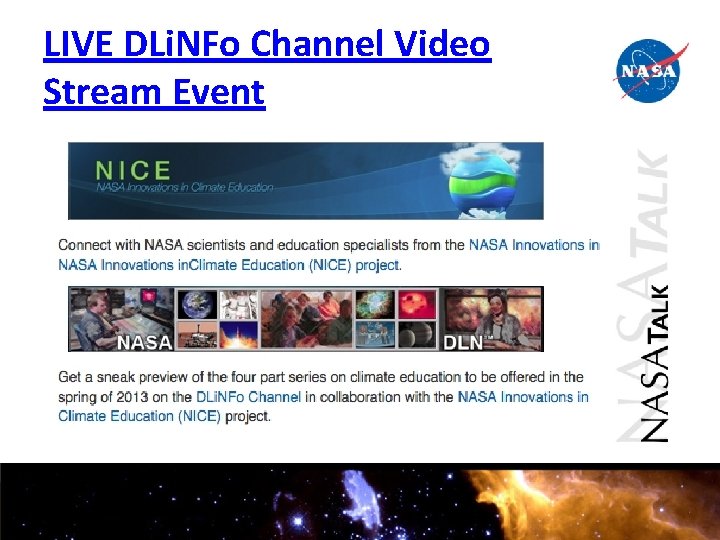
LIVE DLi. NFo Channel Video Stream Event
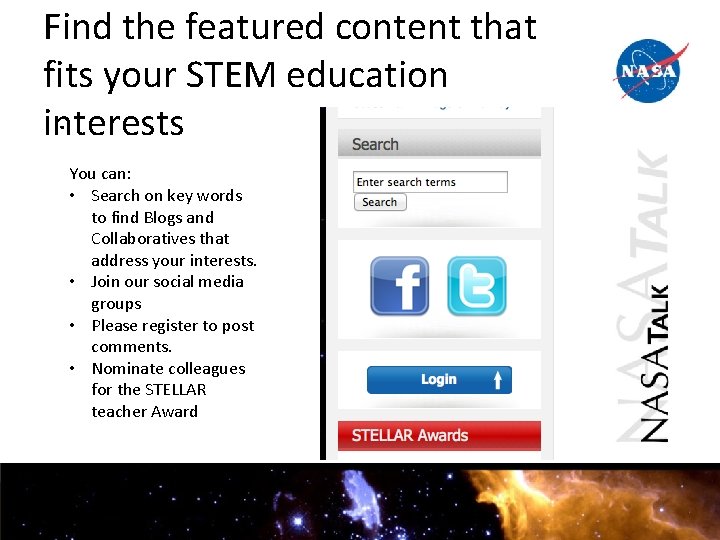
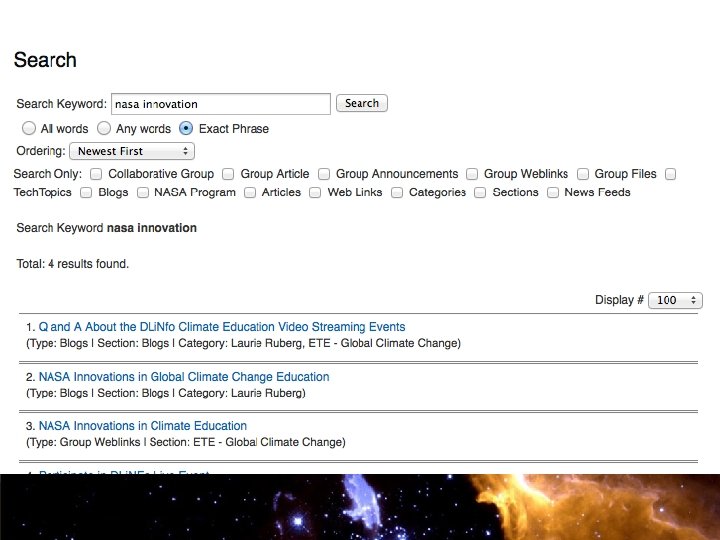
Find the featured content that fits your STEM education. interests You can: • Search on key words to find Blogs and Collaboratives that address your interests. • Join our social media groups • Please register to post comments. • Nominate colleagues for the STELLAR teacher Award
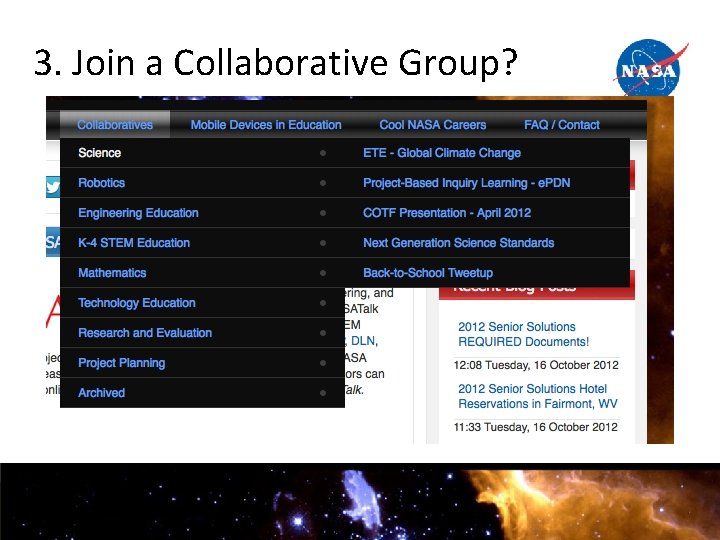
3. Join a Collaborative Group?
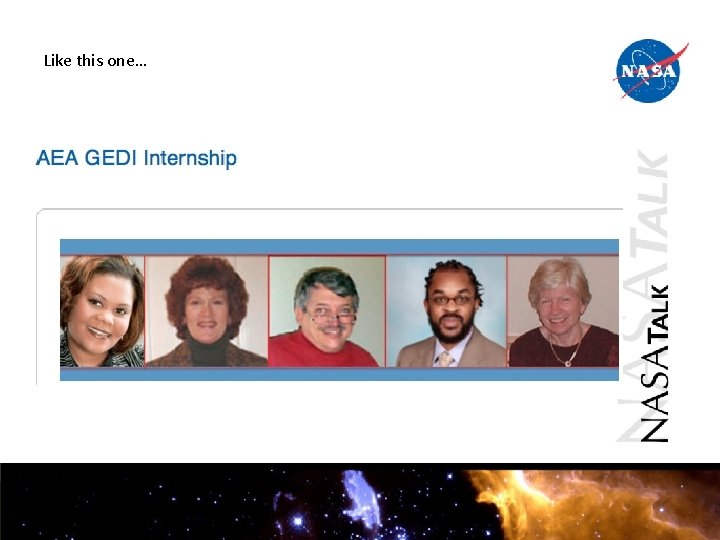
Like this one…
Design Guidelines Based on Theoretical Framework A virtual professional community must • Organize communities of practice and online discussion forums with a set of goals and objectives and timeframe for achieving these. • Give participants opportunities to contribute to a project, event, or task that is concrete and meaningful (O’Brien & Richey, 2010).
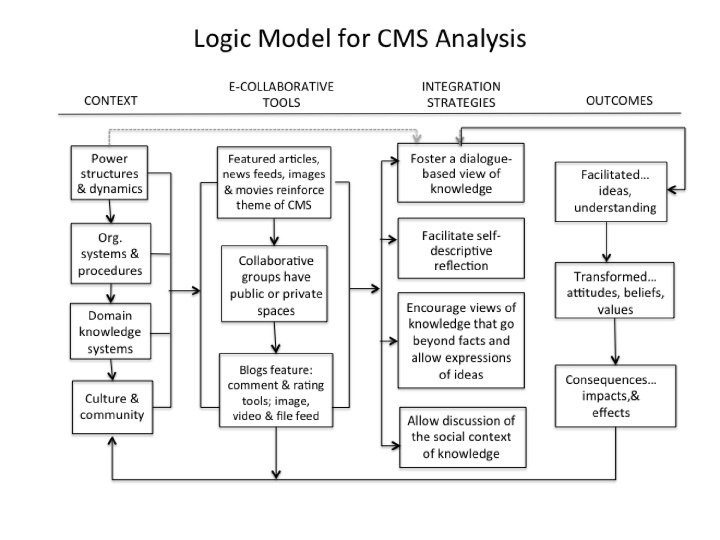
Design Guidelines Based on Theoretical Framework (cont. ) The goals and objectives of a collaborative community must be positioned within a context that includes: • a set of power structures and dynamics, • organizational systems and procedures, • domain knowledge systems, and • a set of cultural and community norms.
Roles & Responsibilities • The level of online responsibility is usually connected to the work-related task that is being channeled to the collaborative website. • The role one plays in the virtual community is often similar to the role one plays with a particular group in the face-to-face context.
Learning in Virtual Communities • A basic premise of social cognitive theory (SCT) is that people learn not just through their own experiences, but also by observing the actions of others and the results of those actions (Bandura 1986). • Key constructs of SCT relevant to behavior change in STEM education in both face-to-face and online settings include observational learning, reinforcement, self-control, and selfefficacy.
Fitting Evaluation for Web 2. 0 • Changes in the field of evaluation run parallel with the ever-expanding use of Web 2. 0 resources. • If stakeholders are invited to share their ideas in online environments with each other and with workplace, school, and government leaders, how does this change the role of the evaluator? • Cheuk and Dervin (2011) suggest that values and practices in online communities should be guided by a set of coherent assumptions about knowledge transfer, leadership, and the nature of human communication. • The focus of our study is to Identify genuine knowledge sharing among the variety of online community services provided.
Metrics for Evaluating Web 2. 0 • NASATalk offers public and private blog posts, file sharing, asynchronous discussion, live chat services, and opportunities throughout for media-rich commenting. • Our challenge, as a Federally-funded project, is to find ways to measure the knowledge sharing transactions that take place in the online context. • Online forums are often organized around a group interest or topical theme such as Engineering Education and Robotics or Exploring Climate Change Through Problem-based Learning.
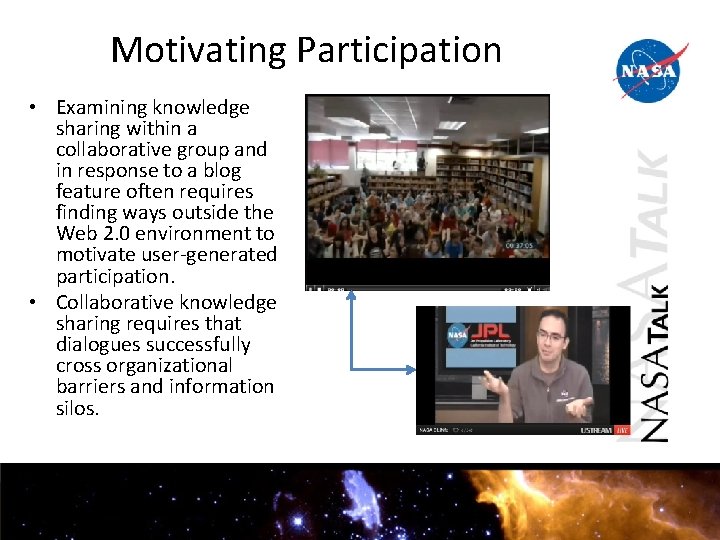
Motivating Participation • Examining knowledge sharing within a collaborative group and in response to a blog feature often requires finding ways outside the Web 2. 0 environment to motivate user-generated participation. • Collaborative knowledge sharing requires that dialogues successfully cross organizational barriers and information silos.
Goal-setting & Reinforcement • Goal setting and self-monitoring seem to be particularly useful components of effective, facilitated virtual professional communities. Successful virtual professional communities will include e-collaborative tools that support these SCT characteristics. • Thus, to promote changes in a virtual professional community, exemplary behavior from role models and reinforcements for exemplary behavior can be used to promote the desired outcomes.
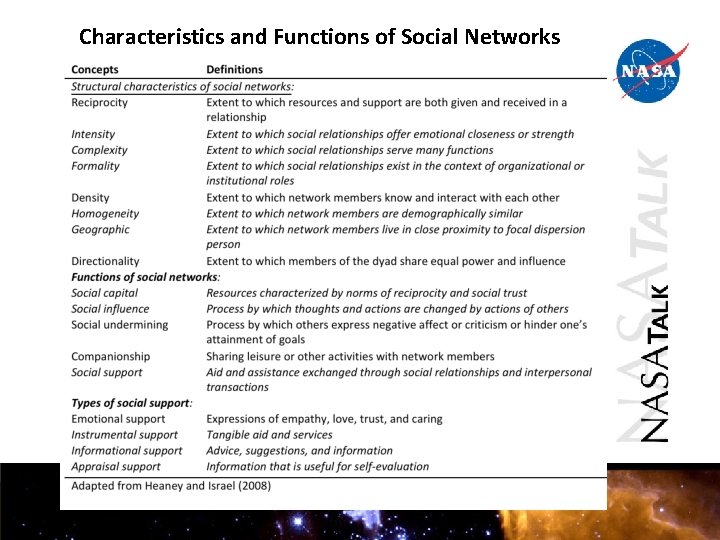
Characteristics and Functions of Social Networks
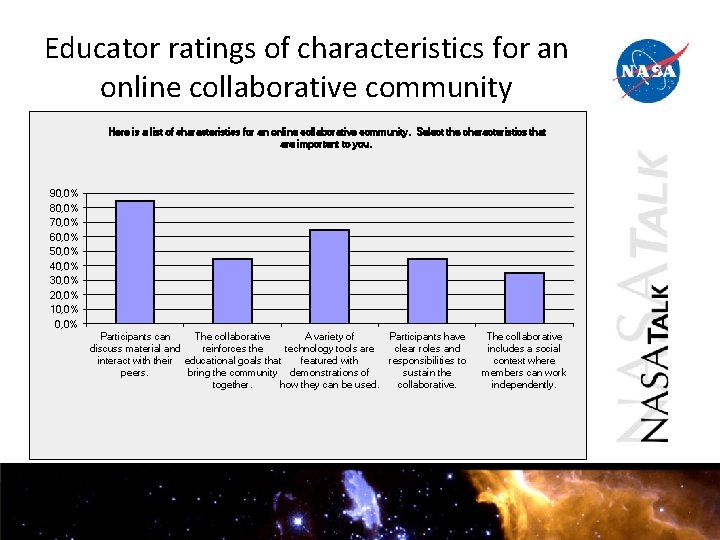
Educator ratings of characteristics for an online collaborative community Here is a list of characteristics for an online collaborative community. Select the characteristics that are important to you. 90, 0% 80, 0% 70, 0% 60, 0% 50, 0% 40, 0% 30, 0% 20, 0% 10, 0% Participants can The collaborative A variety of Participants have discuss material and reinforces the technology tools are clear roles and interact with their educational goals that featured with responsibilities to peers. bring the community demonstrations of sustain the together. how they can be used. collaborative. The collaborative includes a social context where members can work independently.
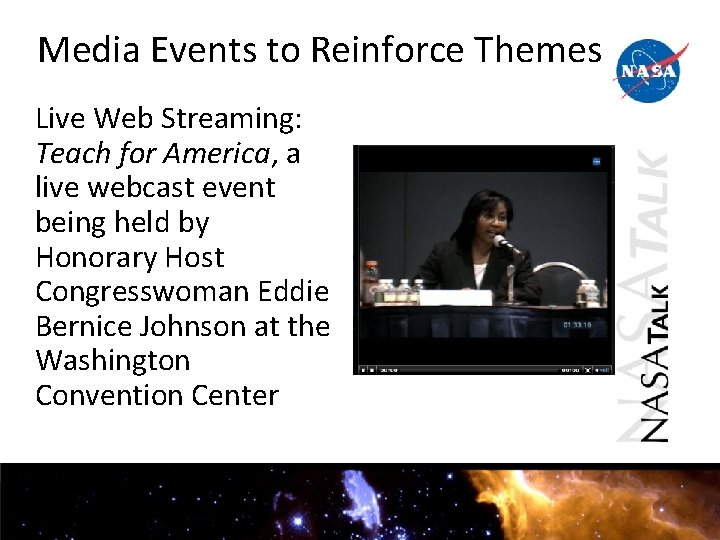
Media Events to Reinforce Themes Live Web Streaming: Teach for America, a live webcast event being held by Honorary Host Congresswoman Eddie Bernice Johnson at the Washington Convention Center
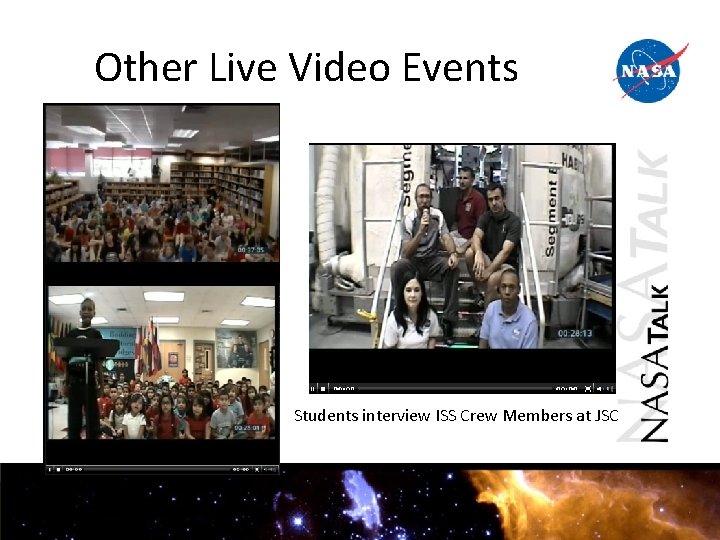
Other Live Video Events Students interview ISS Crew Members at JSC
Quantitative Measures
Summary of Findings Virtual learning communities can be effective means to facilitate peer interactions and collaborations, but each of these cases demonstrate that improvements can be made in future offerings through effective application of theory framework to iterative goal setting
References Bandura A. 1986. Social Foundations of Thought and Action: A Social Cognitive Theory. Englewood Cliffs, NJ: Prentice-Hall. Cheuk, B. , & Dervin, B. (2011). Leadership 2. 0 in Action: a Journey from Knowledge Management to "Knowledging. " Knowledge Management & E-Learning: An International Journal, 3, (2), 119 -138. Dervin, B. (2003, May). A Sense-Making Methodology primer: What is methodological about Sense-Making. Introductory essay presented at a nondivisional workshop held at the meeting of the International Communication Association, San Diego, CA. O'Brien, M. , & Richey, C. (2010). Knowledge Networking for Family Planning: The Potential for Virtual Communities of Practice to Move Forward the Global Reproductive Health Agenda. Knowledge Management & E-Learning: An International Journal, 2(2), 109 -121. Ruberg, L. F. , Cummings, M. , Piecka, D. C. B. , Ruckman, C. , & Seward, R. (2011). A logical approach to supporting professional learning communities. Knowledge Management & E-Learning: An International Journal, 3(4), 599 -620.
Read more and comment on NASATalk Weblink for this presentation: http: //j. mp/Vpq. Yfh Contact authors: Laurie Ruberg, Ph. D. – lruberg@cet. edu Debbie Piecka, Ed. D. – dpiecka@cet. edu Tyra Good – goodt@duq. edu nasatalk@cet. edu Web: nasatalk. com