
Identifying Trauma to Understand Hearing Voices Peter Bullimore
Identifying Trauma to Understand Hearing Voices Peter Bullimore
The focus of helping at this stage should be the reduction of anxiety through anxiety management techniques. Medication may be useful at this time in helping to reduce anxiety.
Help must be given with full recognition and acceptance of the actual voice hearing experience of the person. The next step is to seek possible ways of gaining control over the voices. It is important to foster a sense of security by showing amongst other things, emotional involvement and by taking careful note of events and their timings.
Contact with other voice hearers during this phase can be valuable in reassuring people that they are not alone. In due course one should try to bring some fundamental order to the person’s daily routine. It is important for friends and family to be supportive rather than critical at this stage.

When the initial anxiety and confusion has been reduced or temporarily suspended it is possible to concentrate on organising the voices and the hearer’s relationship with them. During this stage detailed attention is paid to such issues as;
• Analysis of the possible significance of the voices to the hearer with the regard to both past and present. This can be done through an exploration of the hearer’s history. • The meaning of the voices in the person’s daily life. • The influence of the family’s attitude to the voices. • Accompanying symptoms of dissociation or emotional repression. • And/or any symptoms suggesting a delayed development of the self.
• Particular circumstances under which the voices are heard. • What they have to say. • The nature of any triggers and accompanying perceptions. • Attention will be paid to the social position of the person, her or his degree of dependence, the necessary social provisions, and the available opportunities to develop and present a full identity as someone who hears voices.
HOUSING BEING BELIEVED “JOB” SELF-CONFIDENCE SELF-ESTEEM SELF-BELIEF • •
In this phase, the focus is primarily on expanding knowledge and developing the personality through the use of various therapies. This is the period when people have begun to learn to live in balance with their voices, the voices are seen as being a part of the person.
The relationship with the voices is more reasonable, they have a more positive influence and become less controlling, but people can choose to follow their advice if they want to. In this phase people are less anxious about their voices.
‘What this research shows is that we must accept that the voices exist. We must also accept that we cannot change the voices. They are not curable, just as you cannot cure left-handedness-human variations are not open to cure- only to coping. Therefore to assist people to cope we should not give them therapy that does not work. We should let people decide for themselves what helps or not. It takes time for people to accept that hearing voices is something that belongs to them. ’ Marius Romme
Trauma is a cognitive fog, it stops the person thinking that the trauma has stopped, because it’s 100% remembered, fogging stops a person becoming an adult because it becomes a fear to stop you seeing the person to tell them what they did was wrong If you dare not look you cannot see, if you cannot see you cannot think the trauma is in a freeze frame it hasn’t stopped for them they are waiting for it to happen again (Infantism) But you know ( the worker) it has stopped
Irrational logic and rational logic come from infancy. People are brainwashed into fear A lot of infants deal with trauma with denial, experiences recurring shows that trauma is not totally over we eliminate the trauma / fear to a level to what the person needs to continue in life As long as we repress traumatic memories we remain in the trauma
Fear Is the master emotion
Frozen Terror Stops Emotional Development
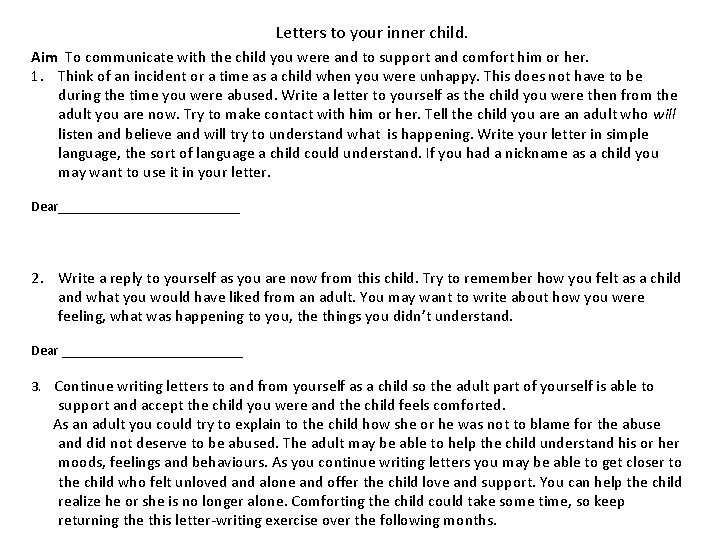
Letters to your inner child. Aim To communicate with the child you were and to support and comfort him or her. 1. Think of an incident or a time as a child when you were unhappy. This does not have to be during the time you were abused. Write a letter to yourself as the child you were then from the adult you are now. Try to make contact with him or her. Tell the child you are an adult who will listen and believe and will try to understand what is happening. Write your letter in simple language, the sort of language a child could understand. If you had a nickname as a child you may want to use it in your letter. Dear_____________ 2. Write a reply to yourself as you are now from this child. Try to remember how you felt as a child and what you would have liked from an adult. You may want to write about how you were feeling, what was happening to you, the things you didn’t understand. Dear _____________ 3. Continue writing letters to and from yourself as a child so the adult part of yourself is able to support and accept the child you were and the child feels comforted. As an adult you could try to explain to the child how she or he was not to blame for the abuse and did not deserve to be abused. The adult may be able to help the child understand his or her moods, feelings and behaviours. As you continue writing letters you may be able to get closer to the child who felt unloved and alone and offer the child love and support. You can help the child realize he or she is no longer alone. Comforting the child could take some time, so keep returning the this letter-writing exercise over the following months.
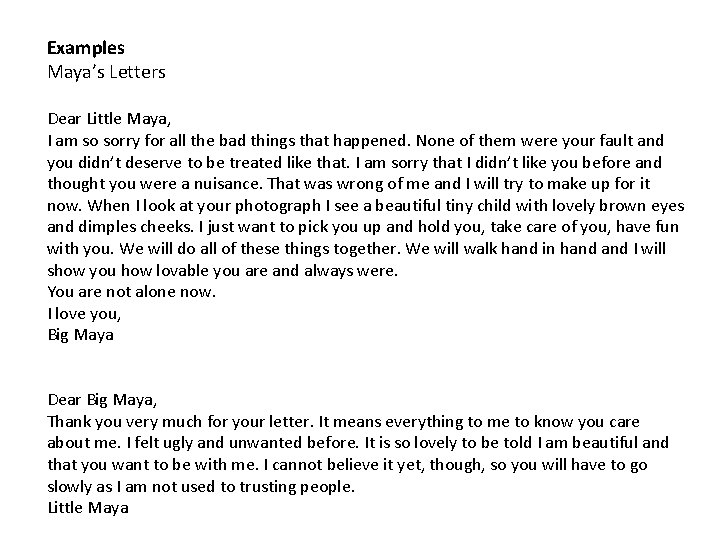
Examples Maya’s Letters Dear Little Maya, I am so sorry for all the bad things that happened. None of them were your fault and you didn’t deserve to be treated like that. I am sorry that I didn’t like you before and thought you were a nuisance. That was wrong of me and I will try to make up for it now. When I look at your photograph I see a beautiful tiny child with lovely brown eyes and dimples cheeks. I just want to pick you up and hold you, take care of you, have fun with you. We will do all of these things together. We will walk hand in hand I will show you how lovable you are and always were. You are not alone now. I love you, Big Maya Dear Big Maya, Thank you very much for your letter. It means everything to me to know you care about me. I felt ugly and unwanted before. It is so lovely to be told I am beautiful and that you want to be with me. I cannot believe it yet, though, so you will have to go slowly as I am not used to trusting people. Little Maya
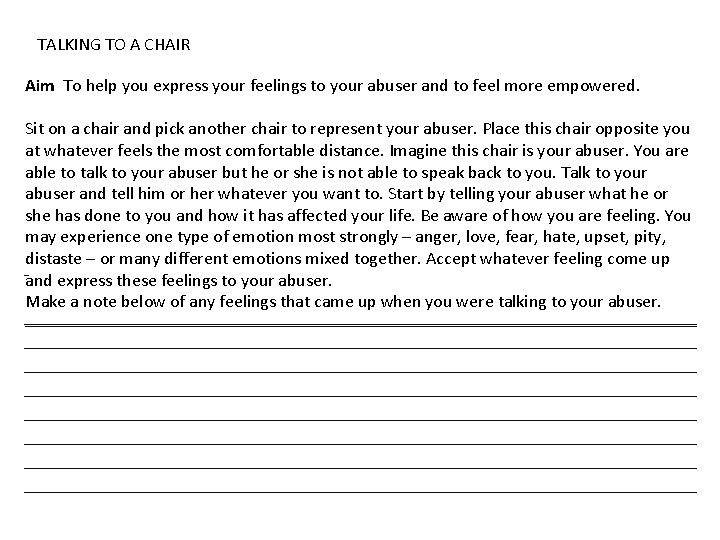
TALKING TO A CHAIR Aim To help you express your feelings to your abuser and to feel more empowered. Sit on a chair and pick another chair to represent your abuser. Place this chair opposite you at whatever feels the most comfortable distance. Imagine this chair is your abuser. You are able to talk to your abuser but he or she is not able to speak back to you. Talk to your abuser and tell him or her whatever you want to. Start by telling your abuser what he or she has done to you and how it has affected your life. Be aware of how you are feeling. You may experience one type of emotion most strongly – anger, love, fear, hate, upset, pity, distaste – or many different emotions mixed together. Accept whatever feeling come up and express these feelings to your abuser. Make a note below of any feelings that came up when you were talking to your abuser.
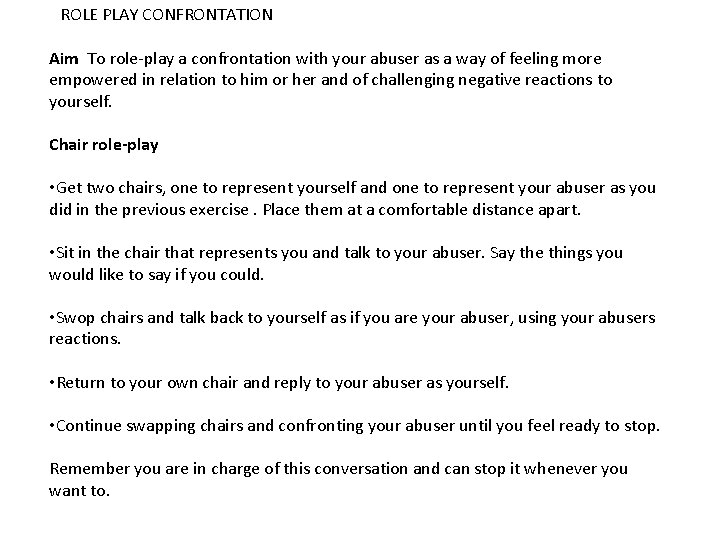
ROLE PLAY CONFRONTATION Aim To role-play a confrontation with your abuser as a way of feeling more empowered in relation to him or her and of challenging negative reactions to yourself. Chair role-play • Get two chairs, one to represent yourself and one to represent your abuser as you did in the previous exercise. Place them at a comfortable distance apart. • Sit in the chair that represents you and talk to your abuser. Say the things you would like to say if you could. • Swop chairs and talk back to yourself as if you are your abuser, using your abusers reactions. • Return to your own chair and reply to your abuser as yourself. • Continue swapping chairs and confronting your abuser until you feel ready to stop. Remember you are in charge of this conversation and can stop it whenever you want to.
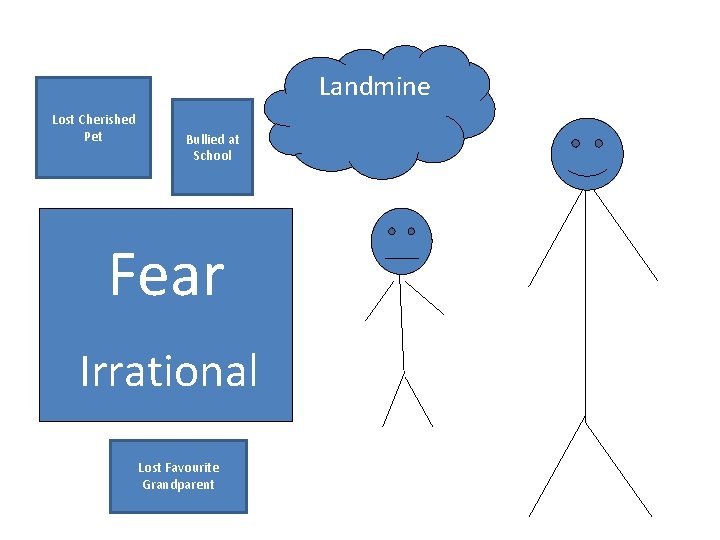
Landmine Lost Cherished Pet Bullied at School Fear Irrational Lost Favourite Grandparent
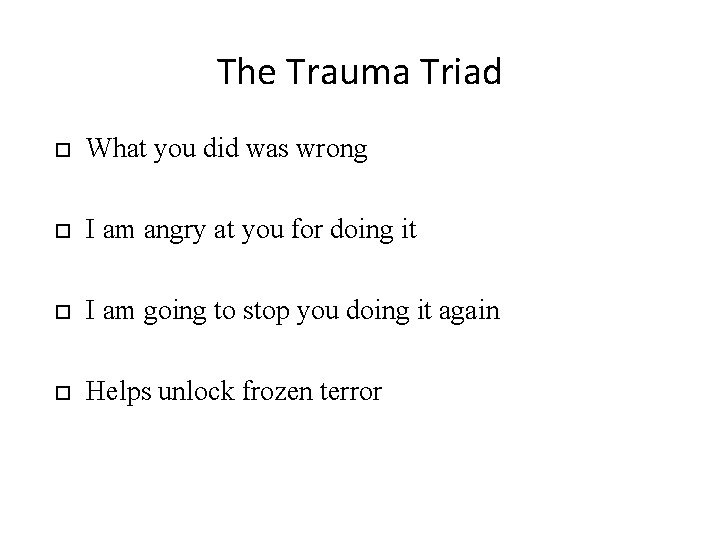
The Trauma Triad What you did was wrong I am angry at you for doing it I am going to stop you doing it again Helps unlock frozen terror
3 Main Points to Remember Before Engagement Truth Trust Consent
• Truth - What is really out there • Trust - The Antidote • Consent- Empowers
You have to be aware of your own fears and traumas before working with another persons experiences Focus on bits they don’t want to see ask them to explain in their own words
What You Need You need to know the persons trauma is over Your task is to convey this fact from you to them (Without parenting or re-traumatising) So a pre-requisite on your part is to believe it yourself at least to believe that this is the problem Until cognitions start again ( the fog lifts) It releases the cognitive traction this begins to reduce painful memories, the person can see they are 40 yrs old not 4 yrs old
Remember Do not Parenting Keeps Kids Alive and Adults Insane
Three important questions • How have you got here (what happened? ) • Who are you? • What’s your biggest fear?
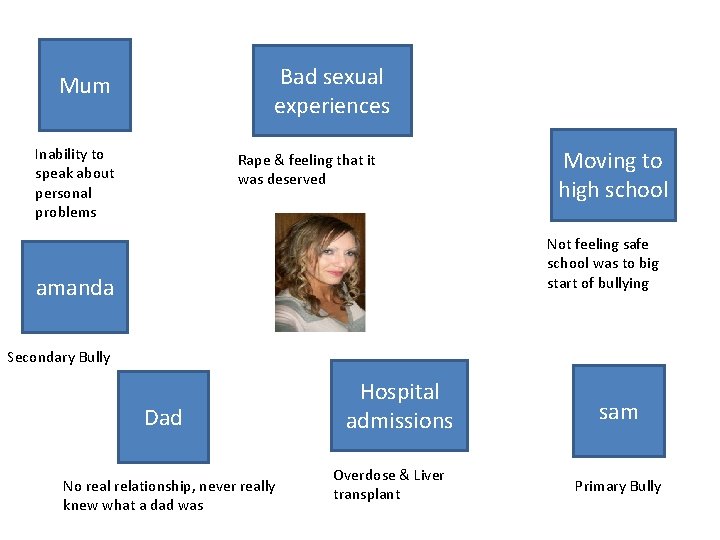
Bad sexual experiences Mum Inability to speak about personal problems Rape & feeling that it was deserved Moving to high school Not feeling safe school was to big start of bullying amanda Secondary Bully Dad No real relationship, never really knew what a dad was Hospital admissions Overdose & Liver transplant sam Primary Bully
Voice profiling looks at who the voices are and how they influence you. The purpose of profiling is to make it clearer to yourself and others what exactly are the natures of your experiences and how they influence your life.
You need to try and identify who the voices are and how they affect you. If you do not know who the voice/s are give it a name maybe one that sums it up. A voice profile is a representation of who your significant voices are and how they affect you.
• This helps in two ways. Firstly, when you can be clear about the identity of the voice/s you tend to feel more in control. • Secondly, if people want to help you they can see from profiles what the real problems are and when you need them most. • Remember profiles can change over time, for many people there are many voices, only one or two of them are usually problems, sometimes the other voices can be helpful. To start voice profiling use a I have just heard a voice check list.
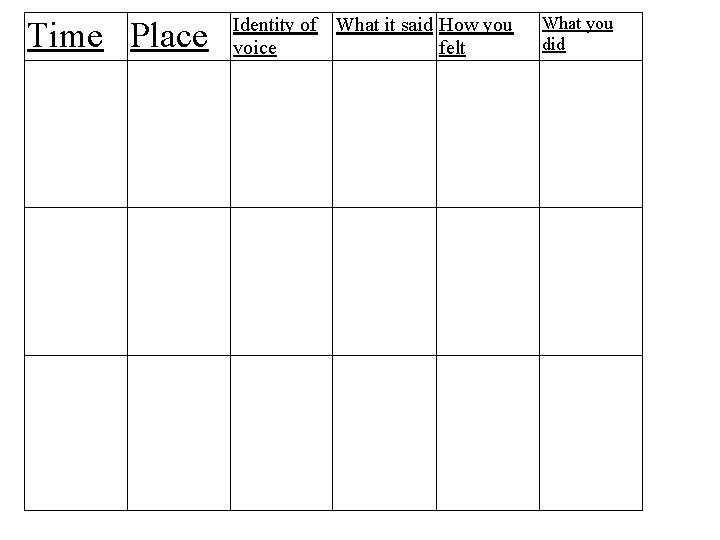
Time Place Identity of What it said How you voice felt What you did
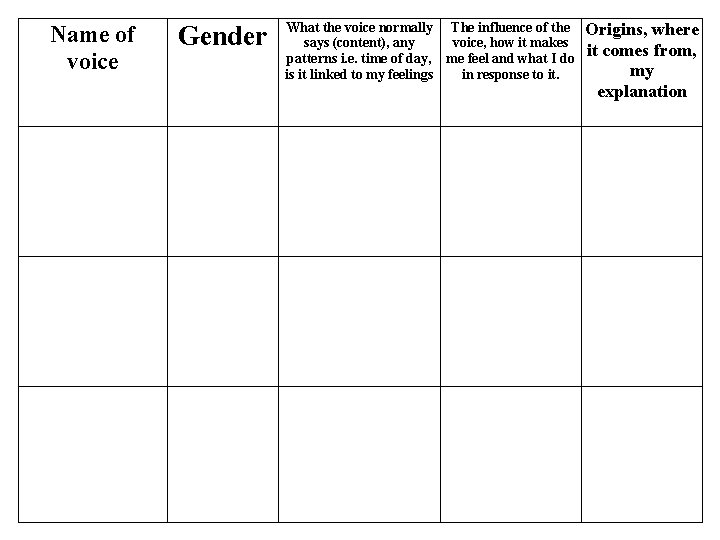
Name of voice Gender What the voice normally The influence of the says (content), any voice, how it makes patterns i. e. time of day, me feel and what I do is it linked to my feelings in response to it. Origins, where it comes from, my explanation
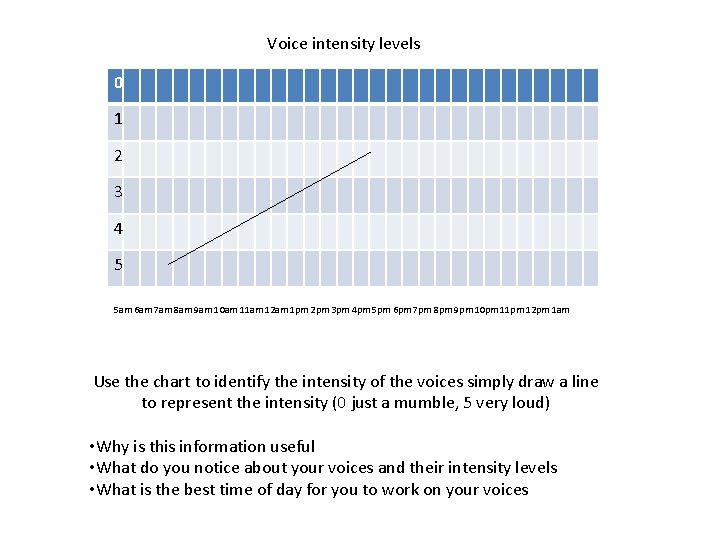
Voice intensity levels 0 1 2 3 4 5 5 am 6 am 7 am 8 am 9 am 10 am 11 am 12 am 1 pm 2 pm 3 pm 4 pm 5 pm 6 pm 7 pm 8 pm 9 pm 10 pm 11 pm 12 pm 1 am Use the chart to identify the intensity of the voices simply draw a line to represent the intensity (0 just a mumble, 5 very loud) • Why is this information useful • What do you notice about your voices and their intensity levels • What is the best time of day for you to work on your voices
Thought stopping This is a technique originally developed for people with disabling obsessions. It is used to try to control unwanted intrusive thoughts. For some people there a lot of similarities between these kind of thoughts, voices and persecutory feelings and so it was thought that the technique might be useful.
FIRST SESSION – You raise your hand when the voices start. The person with you then shouts, “stop it”, until you drop your hand to indicate that the voices have stopped. This is then repeated. Counting the number of times “stop it” is shouted before there is an effect can be a useful barometer of progress as this usually decreases with repeats of the exercise. SECOND SESSION – Everything is the same apart from now it is you that shouts, “stop it”, until the voices go. You can try decreasing the volume of your voice as you get more practised.
Practice between sessions before saying, “stop it” in your head if in a public place. THIRD SESSION – As before but you whisper “stop it”, until the voices go. FOURTH SESSION – As before but now you practise just thinking “stop it”, until the voices go.
Focussing on your voices can have positive effects for a number of reasons. Firstly, unless you know who your voices are and what they are saying it is hard to understand them and take some control. People who hide or run from their voices end up with little peace. Focussing on voices has been shown, for some people, to reduce the frequency of and distress caused when people hear voices. This approach has worked best for people who can attribute elements of their voices to how they themselves feel. Focussing looks at your experience today and by knowing more about that, things can be made less frightening and your power over your voices can be increased.
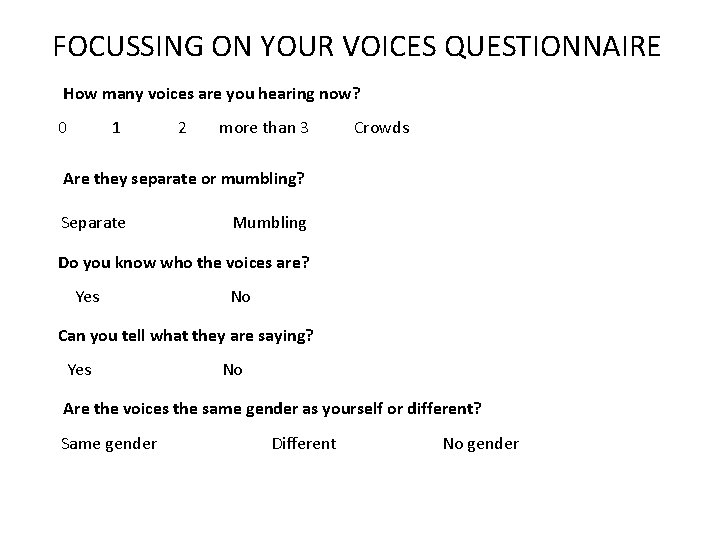
FOCUSSING ON YOUR VOICES QUESTIONNAIRE How many voices are you hearing now? 0 1 2 more than 3 Crowds Are they separate or mumbling? Separate Mumbling Do you know who the voices are? Yes No Can you tell what they are saying? Yes No Are the voices the same gender as yourself or different? Same gender Different No gender
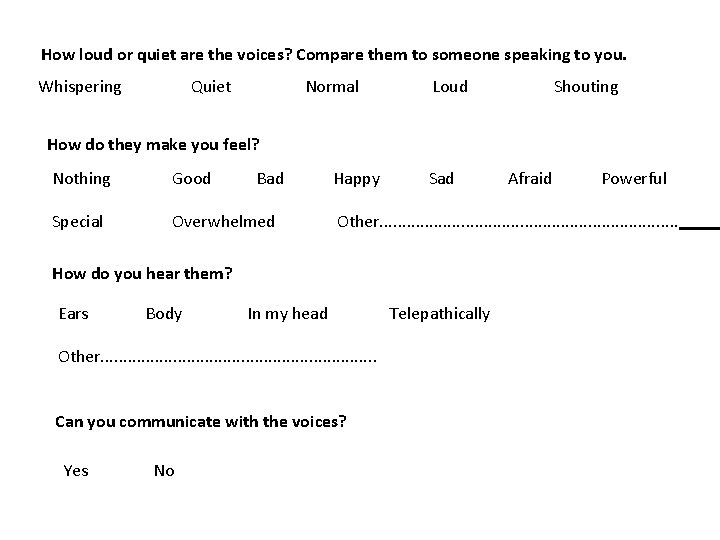
How loud or quiet are the voices? Compare them to someone speaking to you. Whispering Quiet Normal Loud Shouting How do they make you feel? Nothing Good Bad Special Overwhelmed Happy Sad Body In my head Other. . . . Can you communicate with the voices? Yes No Powerful Other. . . . How do you hear them? Ears Afraid Telepathically
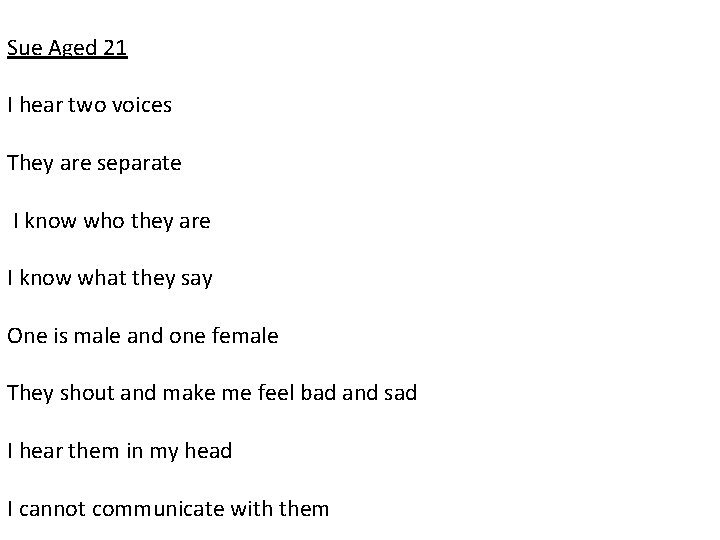
Sue Aged 21 I hear two voices They are separate I know who they are I know what they say One is male and one female They shout and make me feel bad and sad I hear them in my head I cannot communicate with them
A Conversation between myself and Sue Aged 21 Me) So there are two voices, you describe as male and female and you know their identities. Can you tell me who they are? S) Mum & Dad Me) They shout at you and this makes you feel bad & sad. Can you tell me what they say? S) At times we wish you had never been born Me) Do you hear this constantly in your head? S) Yes Me) Do you believe what they say is true? S) Yes because they said it
Me) Can you tell me when they said it? S) When I was 16 years old Me) Do you no why? S) Yes Me) Can you explain the circumstances? S) I had stopped out until 4 am with my new boyfriend and not told them where I was Me) Do your parents love you? S) Yes Me) Could they have been really worried? S) I Guess so
Me) Did you ever apologise to them? S) No Me) Your parents said at times we wish you had never been born, not we wish you had never been born. Would you have been angry if you had been in their situation? S) Guess so I would ground a child of mine if they stayed out that late Me) Do you think you are feeling guilty still for not apologising? S) I do feel guilty Me) Do you think the voices might be trying to help with your guilt? S) It makes sense
Me) Did you ever apologise to them? S) No Me) Your parents said at times we wish you had never been born, not we wish you had never been born. Would you have been angry if you had been in their situation? S) Guess so I would ground a child of mine if they stayed out that late Me) Do you think you are feeling guilty still for not apologising? S) I do feel guilty Me) Do you think the voices might be trying to help with your guilt? S) It makes sense
A Critical Voice is a "self", that criticizes the person before anyone else can. The Critical Voice is extremely anxious, almost desperate, for the person to succeed in the world and to be accepted and liked by others. The Critical Voice does not know when enough is enough. It has a tendency to grow until it is out of control and begins to undermine and to do real damage. At this point, its original intent gets lost.
Example: Voice: ‘You are worthless, you would be better of dead’. The ultimate protector in a situation when the primary self cannot cope. A reaction to life stresses, when experiences are overwhelming, in a vulnerable person. Translated: ‘Don’t feel anymore, don’t be anymore’. Or: ‘Don’t live this life anymore, live a new life’.
KATIE VOICES ARE GOD AND DEVIL SAYS GOD IS ONLY KEEPING YOU ALIVE TO BE TORMENTED 4 MAIN POINTS 1 SHE IS INVOLVED IN A CULT 2 VISITED DAD ON A FRIDAY THROUGH LOYALTY BUT HE WAS ALWAYS DRUNK 3 VOICES 4 BAD SELF HARM

www. nationalparanoianetwork. org peterbullimore@yahoo. co. uk www. hearing-voices. org
- Slides: 49