
Identifying the Role of SolarWind Number Density in
Identifying the Role of Solar-Wind Number Density in Ring Current Evolution Paul O’Brien and Robert Mc. Pherron UCLA/IGPP
Outline • Background – CIR Topology Model – Plasma Entry Model • New Analysis – – 1994 -1997 1964 -1997 Solar Min Solar Max • Conclusions Does enhanced solarwind number density drive the ring current? The observed relationship between solar-wind number density and Dst is best explained by the solar-wind topology of corotating interaction regions
![CIR Topology Model • Rosenberg [JGR April 1982] proposed that the typical structure of](http://slidetodoc.com/presentation_image_h2/93fe4b9e4a94b43f5d7fbbb764f9360f/image-3.jpg "CIR Topology Model • Rosenberg [JGR April 1982] proposed that the typical structure of")
CIR Topology Model • Rosenberg [JGR April 1982] proposed that the typical structure of corotating interaction regions (CIRs) gave rise to a dense plasma front 6 hours (time-of-flight) prior to a strong IMF-Bz (North or South) x VFast y VSlow IMF – A strong southward Bz would then cause a magnetic storm in Dst – 25 density enhancements from 19781979 were used in a super-posed epoch analysis Bz 6 hours • Pizzo [JGR March 1994] reproduced this behavior in MHD simulations – North-South velocity and IMF were seen behind the CIR density front – CIRs are dominant only during Solar Minimum z VFast x z y Bz 6 hours VSlow
![Plasma Entry Model Solar Wind • Borovsky et al. [JGR August 1998] suggested that](http://slidetodoc.com/presentation_image_h2/93fe4b9e4a94b43f5d7fbbb764f9360f/image-4.jpg "Plasma Entry Model Solar Wind • Borovsky et al. [JGR August 1998] suggested that")
Plasma Entry Model Solar Wind • Borovsky et al. [JGR August 1998] suggested that solar wind plasma enters the ring current through the plasma sheet – Enhanced solar wind density leads to stronger ring current after 4+ hours – This process should occur at all phases of the Solar Cycle 4 hr Lag 2 hr Lag
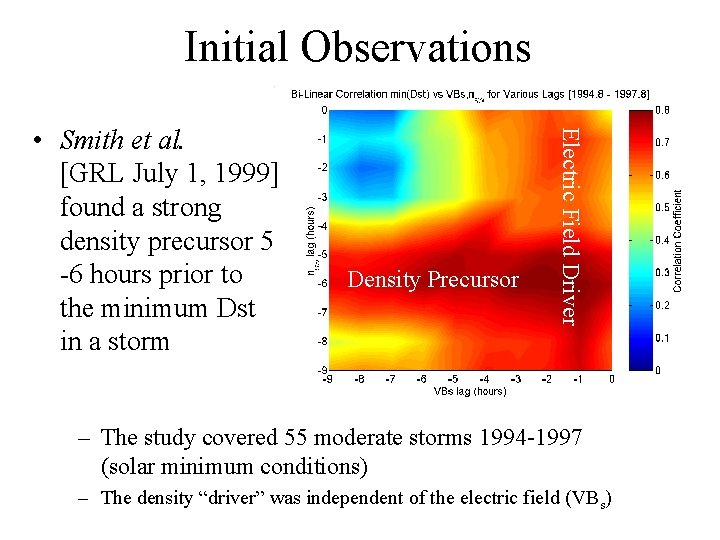
Initial Observations Density Precursor Electric Field Driver • Smith et al. [GRL July 1, 1999] found a strong density precursor 5 -6 hours prior to the minimum Dst in a storm – The study covered 55 moderate storms 1994 -1997 (solar minimum conditions) – The density “driver” was independent of the electric field (VBs)
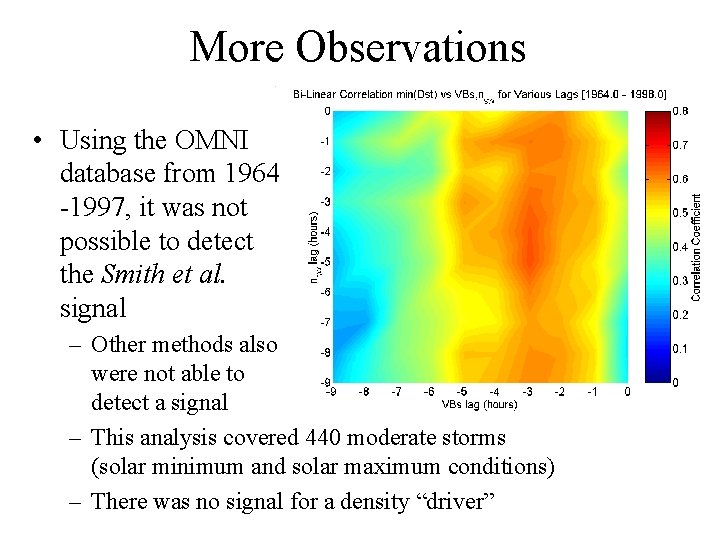
More Observations • Using the OMNI database from 1964 -1997, it was not possible to detect the Smith et al. signal – Other methods also were not able to detect a signal – This analysis covered 440 moderate storms (solar minimum and solar maximum conditions) – There was no signal for a density “driver”
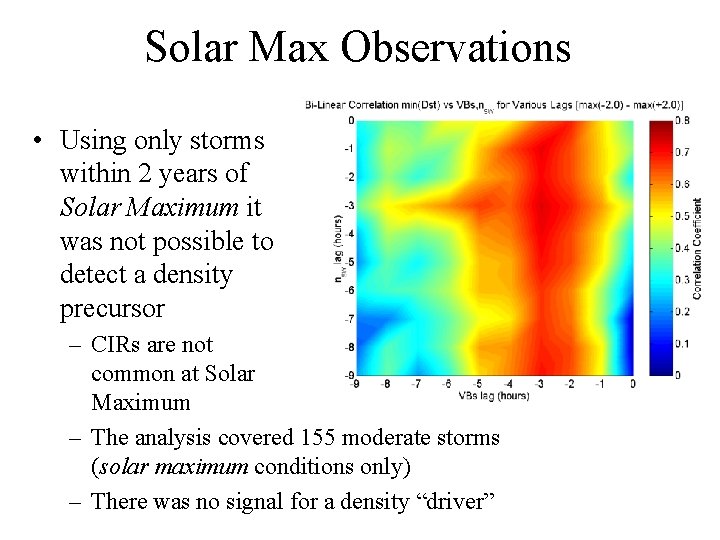
Solar Max Observations • Using only storms within 2 years of Solar Maximum it was not possible to detect a density precursor – CIRs are not common at Solar Maximum – The analysis covered 155 moderate storms (solar maximum conditions only) – There was no signal for a density “driver”
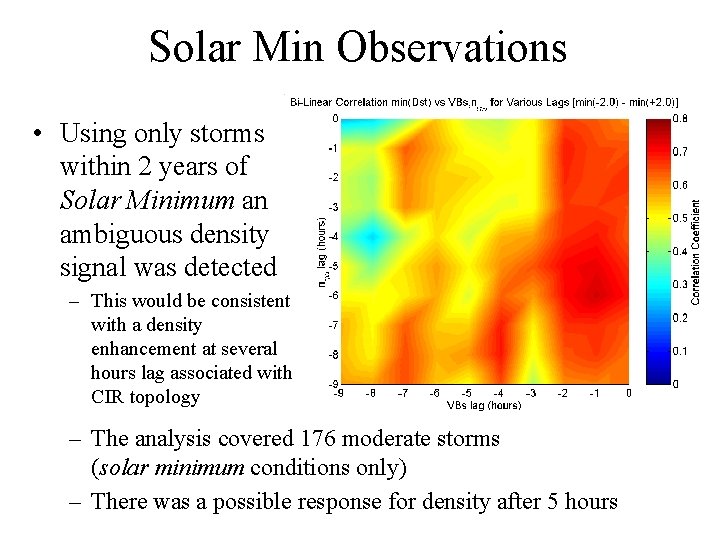
Solar Min Observations • Using only storms within 2 years of Solar Minimum an ambiguous density signal was detected – This would be consistent with a density enhancement at several hours lag associated with CIR topology – The analysis covered 176 moderate storms (solar minimum conditions only) – There was a possible response for density after 5 hours
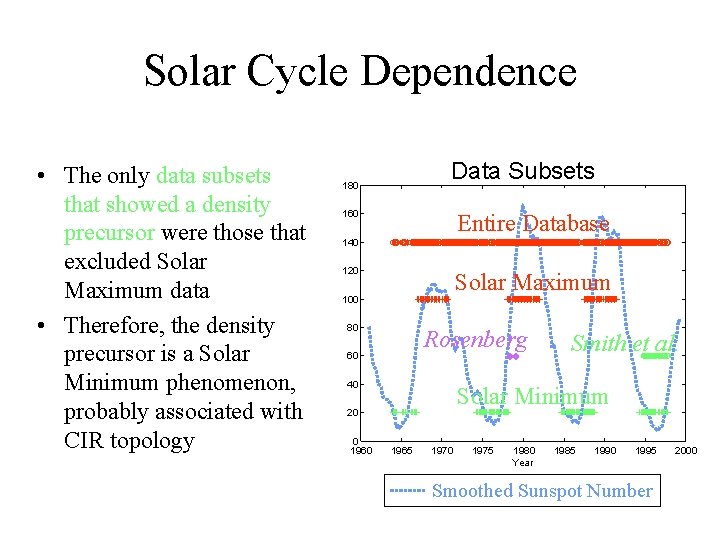
Solar Cycle Dependence • The only data subsets that showed a density precursor were those that excluded Solar Maximum data • Therefore, the density precursor is a Solar Minimum phenomenon, probably associated with CIR topology Data Subsets 180 160 Entire Database 140 120 Solar Maximum 100 80 Rosenberg 60 40 Solar Minimum 20 0 1960 Smith et al. 1965 1970 1975 1980 Year 1985 1990 1995 Smoothed Sunspot Number 2000
Conclusions • The observed relationship between solar-wind number density and Dst is best explained by the solar-wind topology of corotating interaction regions • Solar wind number density is probably a precursor but not a driver of the ring current at a lag of 5+ hours – The correlation is only seen at Solar Minimum – The strength of the ring current does not appear to be causally related to solar wind density enhancements – Other methods (not presented) support this conclusion: • Statistical Dst phase-space analysis • Analytical Dst dynamics optimization • Neural Network Dst dynamics simulation
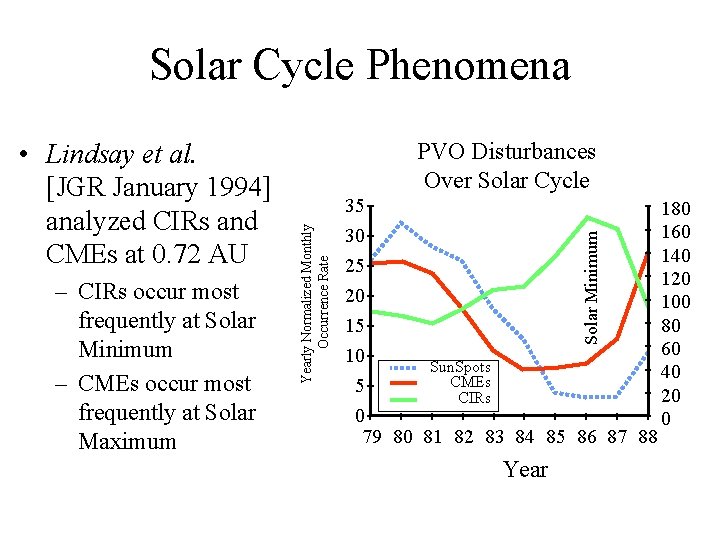
Solar Cycle Phenomena 35 30 25 Solar Minimum – CIRs occur most frequently at Solar Minimum – CMEs occur most frequently at Solar Maximum PVO Disturbances Over Solar Cycle Yearly Normalized Monthly Occurrence Rate • Lindsay et al. [JGR January 1994] analyzed CIRs and CMEs at 0. 72 AU 20 15 10 Sun. Spots CMEs 5 CIRs 0 79 80 81 82 83 84 85 86 87 88 Year 180 160 140 120 100 80 60 40 20 0
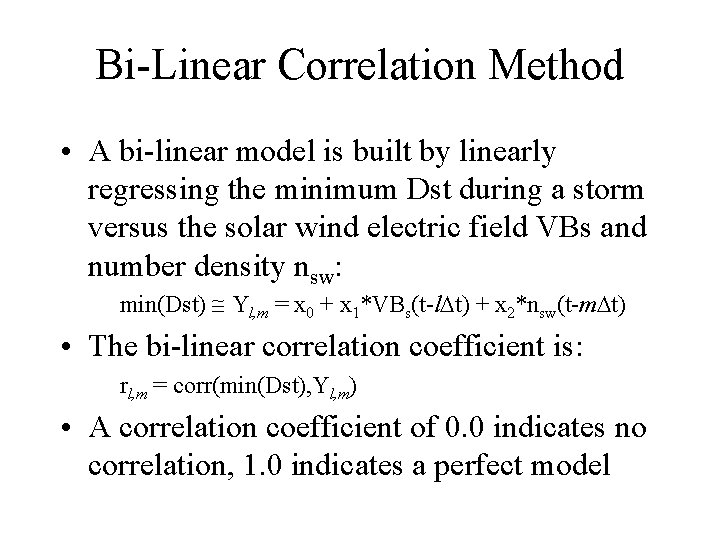
Bi-Linear Correlation Method • A bi-linear model is built by linearly regressing the minimum Dst during a storm versus the solar wind electric field VBs and number density nsw: min(Dst) Yl, m = x 0 + x 1*VBs(t-l. Dt) + x 2*nsw(t-m. Dt) • The bi-linear correlation coefficient is: rl, m = corr(min(Dst), Yl, m) • A correlation coefficient of 0. 0 indicates no correlation, 1. 0 indicates a perfect model
- Slides: 12