
Identifying the Issue l l The first step
- Slides: 14
Identifying the Issue l l The first step in preparing almost any legal writing is to identify the issue or issues that need to be addressed. This is necessary for many reasons: • • To know where to look for relevant statutes To come up with proper search terms to seek appropriate case law To avoid confusing your audience by discussing irrelevant issues To avoid wasting your time researching irrelevant issues Advanced Legal Analysis and Writing Class 3 1
Tips for Spotting the Appropriate Issues l Legal Memos should discuss only those questions necessary to resolve the question presented. • • l If you have been presented with a question, this step is easy. Otherwise, you need to frame the question before starting your legal research or drafting. Procedural facts of the case should be discussed only insofar as they are relevant to the question or to set up the question. For example: • If the question is whether John is guilty of burglary, you should generally discuss the incident, the elements of burglary, etc. , but not whether John is a nice guy or what he does for a living. Advanced Legal Analysis and Writing Class 3 2
Using the Elements to Frame the Issue l If the question involves a tort or a crime (or anything that’s measured by whether elements are met), you first need to: • • • l Lay out all of the elements that need to be established Determine which ones have been met and which ones are in dispute Decide what questions must be answered to determine whether the disputed elements are met; those are the questions you should focus on Exclude all “givens” from your discussion. These may have to be noted in your writing, but should not be belabored or discussed at length. Advanced Legal Analysis and Writing Class 3 3
Sub Issues l Sometimes, whether an element is met depends on answering one or more sub-questions, such as: • • l Mitigating factors that may be relevant to criminal charges Possible exceptions to rules that apply to certain elements Don’t be afraid to break your issue up into a lot of subquestions. Just make sure they’re all necessary and relevant. Advanced Legal Analysis and Writing Class 3 4
Exercise 6 l Recently, Neil Mc. Kay telephoned Hugh Green and, as a joke, offered to sell his $100, 000 yacht for $10, 000 cash. Mc. Kay has a reputation as a practical joker. Although Green knew the true value of the boat, he did not know Mc. Kay’s reputation. Green said to Mc. Kay, “You can’t be serious, ” and then told Mc. Kay he needed time to think it over and raise the money. l Three days later, Green telephoned Mc. Kay to accept the offer but Mc. Kay was golfing. Green told Mc. Kay’s secretary to tell Mc. Kay that he had called concerning the boat. The secretary called the golf course and left a message for Mc. Kay: “Green called—something about the yacht. ” By that time Mc. Kay was in the clubhouse and was intoxicated. The bartender took the secretary’s message to Mc. Kay, who then telephoned Green. Advanced Legal Analysis and Writing Class 3 5
Exercise 6 l Immediately after he started talking with Green, Mc. Kay passed out in the phone booth. While Mc. Kay was unconscious, Green told him, “I accept the offer, ” and added, “But I’d like to see your golf clubs thrown into the deal, too. ” Mc. Kay does not remember the telephone conversation and now refuses to sell the yacht to Green. Is there an enforceable contract? Advanced Legal Analysis and Writing Class 3 6
Exercise 6 l You have found two cases from your state and some secondary authority. l l Derek v. Beir (1985) The appellant, Morse Beir, was a known eccentric with a reputation for playing practical jokes on his neighbors. One day he approached his neighbor, Bob Derek, whom he disliked. Beir stated, “For five bucks I will build a ten-foot-high wall at my own expense between our lots just so I will never have to look at your ridiculous face again. ” Derek, who was well aware of Beir’s reputation, immediately agreed and paid Beir five dollars. Beir failed to build the wall, and the appellee filed this suit for breach of contract. The trial court awarded Derek $3, 000 in damages, which represented the cost of building the wall. Beir appealed. Advanced Legal Analysis and Writing Class 3 7
Exercise 6 l Although the trial court made several errors in this case, we do not have to discuss most of them here because we find the contract unenforceable. The general rule is that a contract is not enforceable unless there is an effective offer. For an offer to be effective, the offeror must intend to make a binding contract. In this state, the test for intent by the offeror is whether a reasonable person in the offeree’s shoes would believe that the offeror intended to make a binding contract. We conclude that Derek knew or should have known that Beir was not serious and did not intend to make a contract. Because there was no offer, we do not have to reach the question of whether the consideration was so grossly disproportionate that it would shock the conscience of the court to enforce the contract. Reversed. Advanced Legal Analysis and Writing Class 3 8
Exercise 6 Caldwell, J. , dissenting. It is axiomatic that the appellate court will not set aside a jury finding unless it is clearly contrary to the preponderance of the evidence. The jury in the court below heard testimony from both Derek and Beir as to Beir’s true intent and Derek’s conception of it. After a correct instruction from the judge on the rule of law in this state, which rule the majority has stated correctly and succinctly, the jury decided that the parties intended to make a contract. It is not up to this court to decide whether the contract was nonsensical or absurd or ill-advised. The court below, after consideration of conflicting evidence, found that the parties intended to enter into a contract. Because that finding was not clearly against the weight of the evidence, I would affirm on the issue of intent to make a valid offer. Although the majority did not reach the issue of adequacy of consideration, having disposed of the case on other grounds, I would remind the court that any consideration, no matter how small, is generally sufficient to support a contract freely entered into by the parties. Lewis J. Holloway, A Treatise on Contract Law 10 (2 d. ed. 1982). Advanced Legal Analysis and Writing Class 3 9
Exercise 6 l l Anselm v. Kinnet Textiles, Inc. (1986) The appellant, Charles Anselm, offered to sell 200 bales of cotton to the appellee, Kinnet Textiles, Inc. One hundred bales were to be delivered on March 1, and the remaining 100 were to be delivered on April 1. Kinnet sent a messenger to Anselm’s office with a written note that stated, “We agree to your offer in all respects if we can instead take delivery on March 5 and April 5. ” Because Anselm was out of the office, his secretary accepted the note from the messenger and placed it on Anselm’s cluttered desk. Anselm did not see it for several weeks and, in the meantime, committed the cotton to another buyer. Kinnet filed suit for breach of contract. The trial court found that the contract was valid and awarded damages to Kinnet. We disagree. Advanced Legal Analysis and Writing Class 3 10
Exercise 6 l A contract is not formed unless there is a valid acceptance. Because we have not adopted the Uniform Commercial Code in this state, the case is governed by common law. The appellant claims there was not a valid acceptance for two reasons. First, the appellant claims there was no acceptance because he did not see or read the note. We find the delivery and placement of the acceptance on the appellant’s desk to be a sufficient communication of the acceptance. Once the offeree has delivered a written acceptance, it would be unreasonable to require the offeree to ensure that the acceptance is read. We do, however, agree with Anselm that the contract is invalid because the acceptance differs from the offer. The rule in this state is that the acceptance must mirror the offer in every respect. If it varies from the offer, it is considered a counteroffer and not an acceptance. Because the dates for delivery in the acceptance here varied from those in the offer, we find there was no acceptance and thus no enforceable contract. Reversed. Advanced Legal Analysis and Writing Class 3 11
Exercise 6 l l Morris, J. , concurring. I agree with the majority that there was no acceptance of the offer in this case. However, I disagree that this result must be reached by the application of the mirror-image rule. The creative and regenerative power of the law has been strong enough to break chains imposed by outmoded former decisions. What the courts have power to create, they also have power to modify, reject, and recreate in response to the needs of a dynamic society. The exercise of this power is an imperative function of the courts and is the strength of the common law. It cannot be surrendered to legislative action. Most states have discarded the archaic mirror-image rule and have replaced it with section 2 -207 of the Uniform Commercial Code, which treats additional terms in a contract as proposals for additions to the contract unless the acceptance is expressly made conditional on assent to the additional terms. U. C. C. § 2 -207. In this case, the acceptance was conditional on Anselm’s agreeing to the changed dates. Hence, it was not an acceptance at all but was, instead, a counteroffer. Thus, there was no contract. Advanced Legal Analysis and Writing Class 3 12
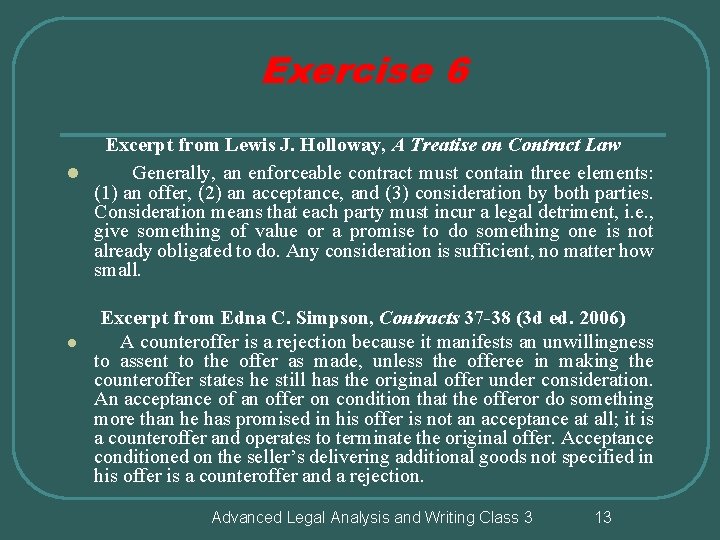
Exercise 6 Excerpt from Lewis J. Holloway, A Treatise on Contract Law l Generally, an enforceable contract must contain three elements: (1) an offer, (2) an acceptance, and (3) consideration by both parties. Consideration means that each party must incur a legal detriment, i. e. , give something of value or a promise to do something one is not already obligated to do. Any consideration is sufficient, no matter how small. l Excerpt from Edna C. Simpson, Contracts 37 -38 (3 d ed. 2006) A counteroffer is a rejection because it manifests an unwillingness to assent to the offer as made, unless the offeree in making the counteroffer states he still has the original offer under consideration. An acceptance of an offer on condition that the offeror do something more than he has promised in his offer is not an acceptance at all; it is a counteroffer and operates to terminate the original offer. Acceptance conditioned on the seller’s delivering additional goods not specified in his offer is a counteroffer and a rejection. Advanced Legal Analysis and Writing Class 3 13
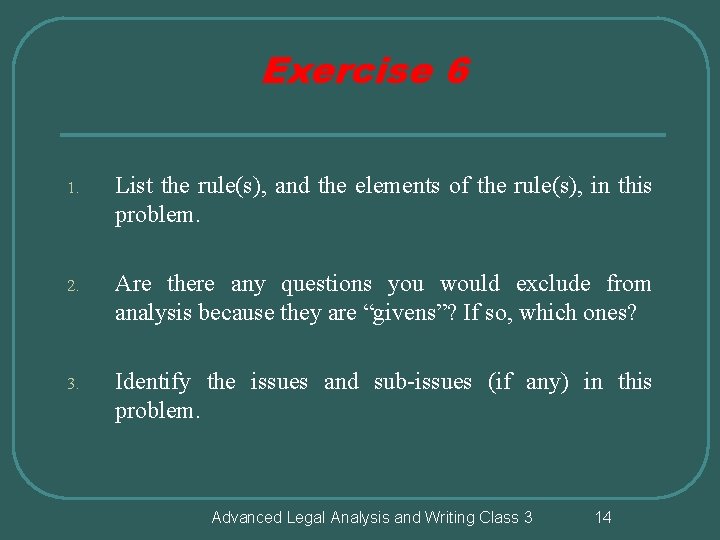
Exercise 6 1. List the rule(s), and the elements of the rule(s), in this problem. 2. Are there any questions you would exclude from analysis because they are “givens”? If so, which ones? 3. Identify the issues and sub-issues (if any) in this problem. Advanced Legal Analysis and Writing Class 3 14