
Identifying the components of a Compound Microscope Class
- Slides: 14
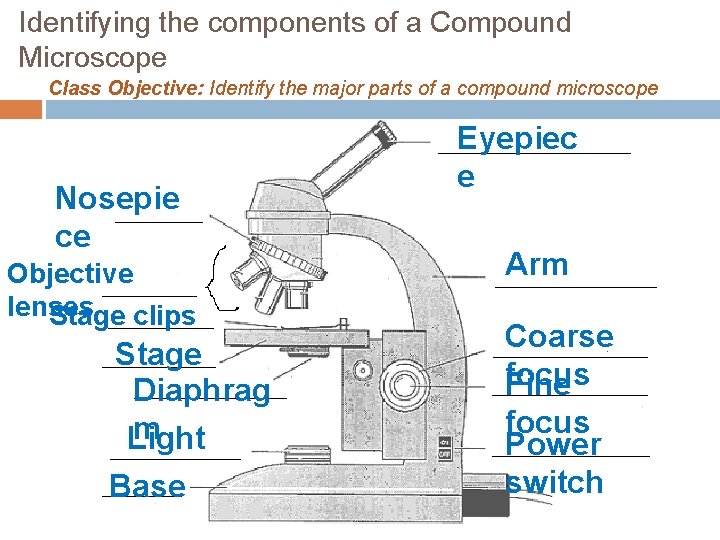
Identifying the components of a Compound Microscope Class Objective: Identify the major parts of a compound microscope Nosepie ce Objective lenses Stage clips Stage Diaphrag m Light Base Eyepiec e Arm Coarse focus Fine focus Power switch
WHAT ARE CELLS? 9/29/11
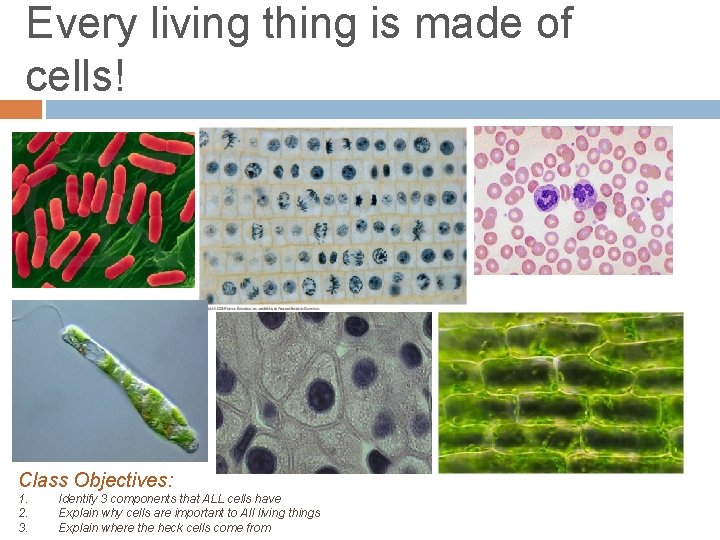
Every living thing is made of cells! Class Objectives: 1. 2. 3. Identify 3 components that ALL cells have Explain why cells are important to All living things Explain where the heck cells come from
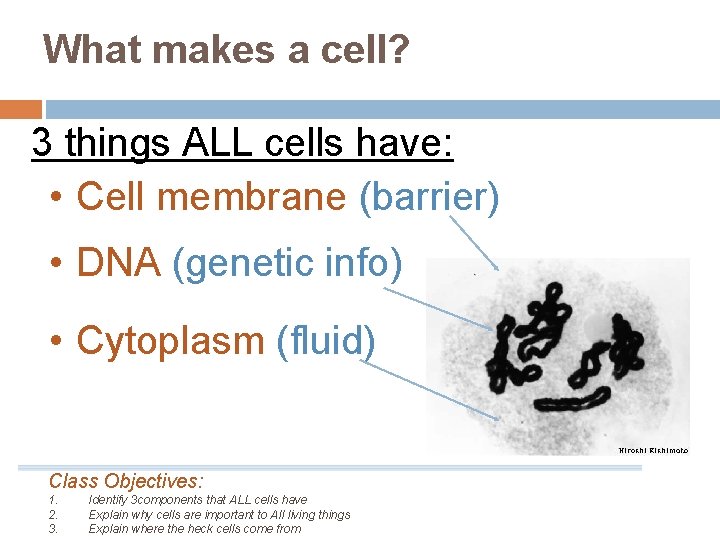
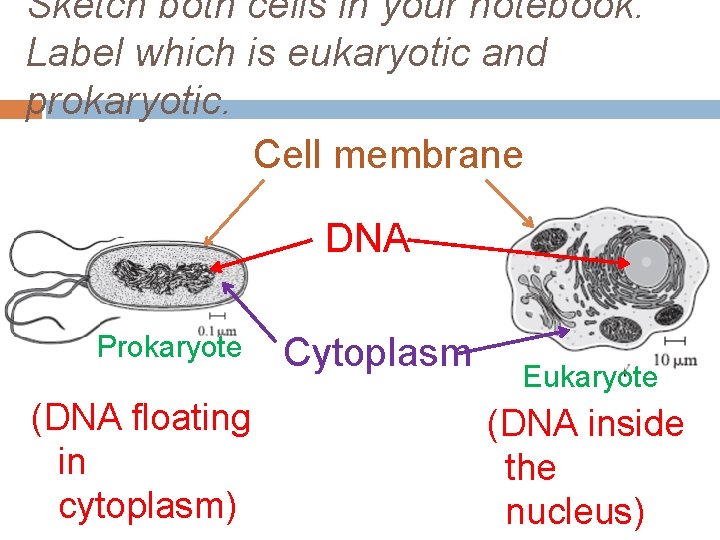
What makes a cell? 3 things ALL cells have: • Cell membrane (barrier) • DNA (genetic info) • Cytoplasm (fluid) Class Objectives: 1. 2. 3. Identify 3 components that ALL cells have Explain why cells are important to All living things Explain where the heck cells come from
Sketch both cells in your notebook. Label which is eukaryotic and prokaryotic. Cell membrane DNA Prokaryote (DNA floating in cytoplasm) Cytoplasm Eukaryote (DNA inside the nucleus)
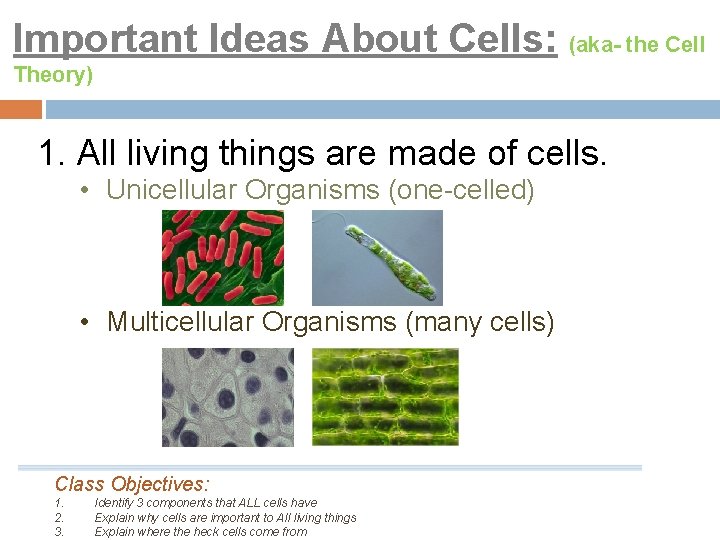
Important Ideas About Cells: (aka- the Cell Theory) 1. All living things are made of cells. • Unicellular Organisms (one-celled) • Multicellular Organisms (many cells) Class Objectives: 1. 2. 3. Identify 3 components that ALL cells have Explain why cells are important to All living things Explain where the heck cells come from
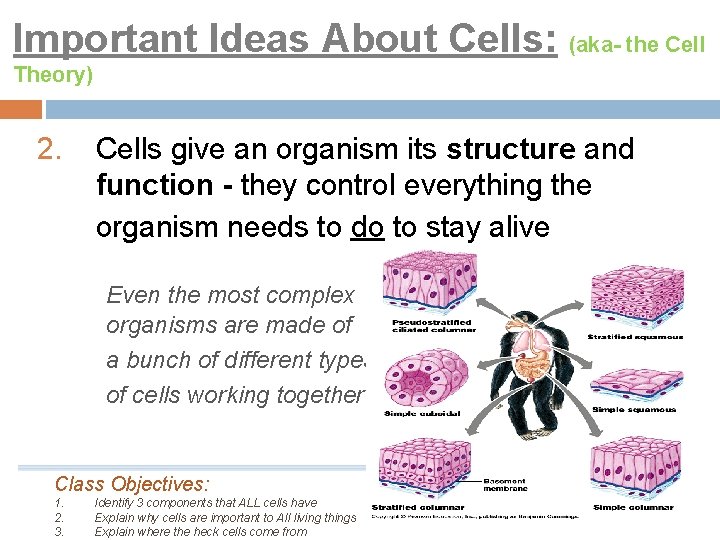
Important Ideas About Cells: (aka- the Cell Theory) 2. Cells give an organism its structure and function - they control everything the organism needs to do to stay alive Even the most complex organisms are made of a bunch of different types of cells working together. Class Objectives: 1. 2. 3. Identify 3 components that ALL cells have Explain why cells are important to All living things Explain where the heck cells come from
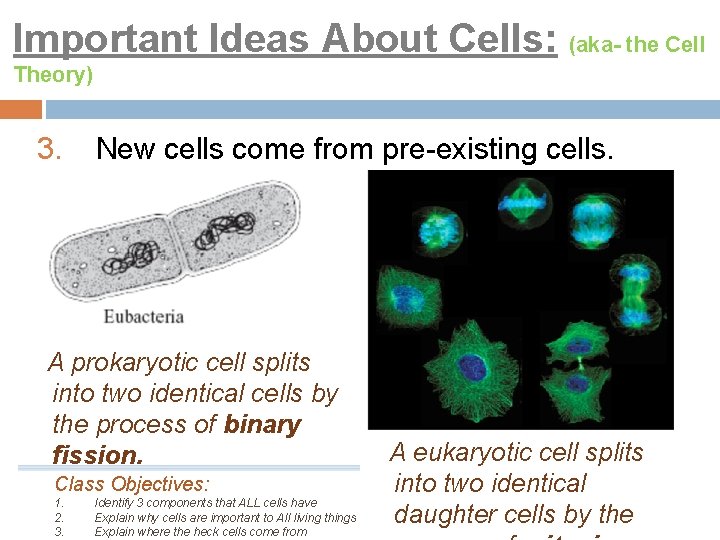
Important Ideas About Cells: (aka- the Cell Theory) 3. New cells come from pre-existing cells. A prokaryotic cell splits into two identical cells by the process of binary fission. Class Objectives: 1. 2. 3. Identify 3 components that ALL cells have Explain why cells are important to All living things Explain where the heck cells come from A eukaryotic cell splits into two identical daughter cells by the
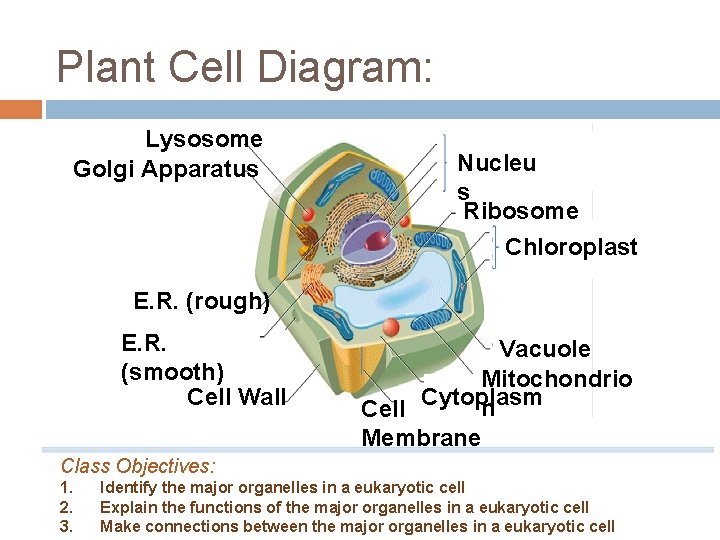
Plant Cell Diagram: Lysosome Golgi Apparatus Nucleu s Ribosome Chloroplast E. R. (rough) E. R. (smooth) Cell Wall Vacuole Mitochondrio n Cell Cytoplasm Membrane Class Objectives: 1. 2. 3. Identify the major organelles in a eukaryotic cell Explain the functions of the major organelles in a eukaryotic cell Make connections between the major organelles in a eukaryotic cell
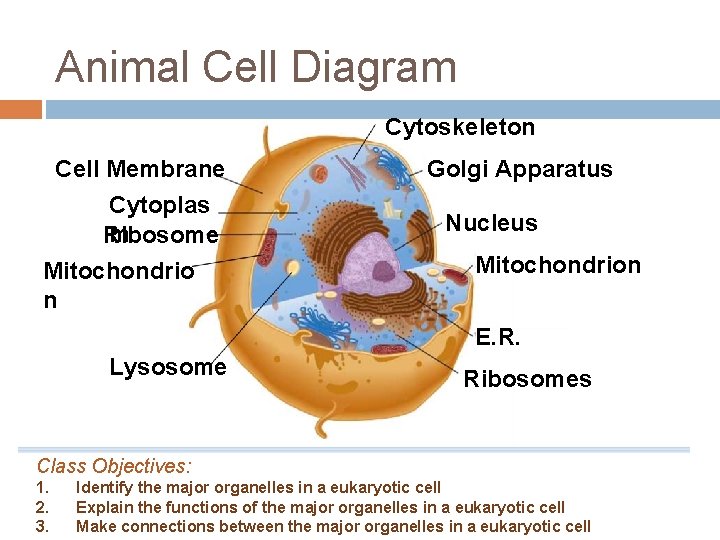
Animal Cell Diagram Cytoskeleton Cell Membrane Cytoplas m Ribosome Mitochondrio n Golgi Apparatus Nucleus Mitochondrion E. R. Lysosome Ribosomes Class Objectives: 1. 2. 3. Identify the major organelles in a eukaryotic cell Explain the functions of the major organelles in a eukaryotic cell Make connections between the major organelles in a eukaryotic cell
A DAY IN THE LIFE OF A CELL How Cells Make and Use Proteins
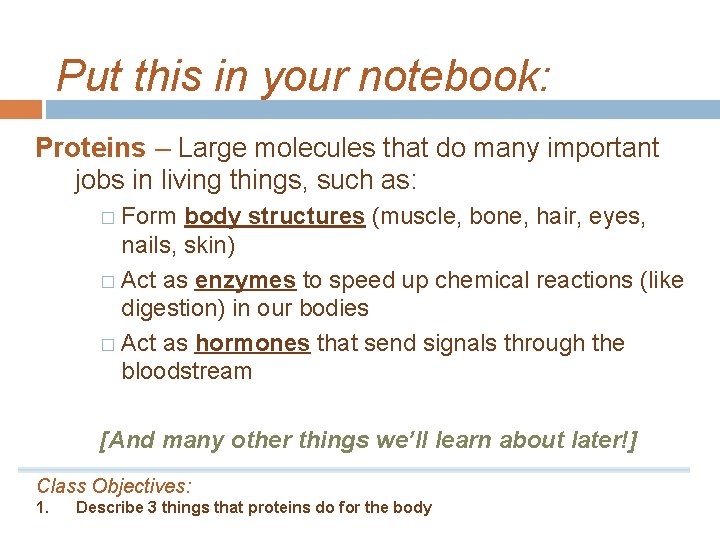
Put this in your notebook: Proteins – Large molecules that do many important jobs in living things, such as: Form body structures (muscle, bone, hair, eyes, nails, skin) � Act as enzymes to speed up chemical reactions (like digestion) in our bodies � Act as hormones that send signals through the bloodstream � [And many other things we’ll learn about later!] Class Objectives: 1. Describe 3 things that proteins do for the body
A DAY IN THE LIFE OF THE CELL Proteins are large molecules that do many important jobs in living things, such as: � Form body structures (muscle, bone, hair, nails, skin) � Act as enzymes to speed up chemical reactions (like digestion) in our bodies � Act as hormones that send signals through the bloodstream [And many other things we’ll learn about later!]
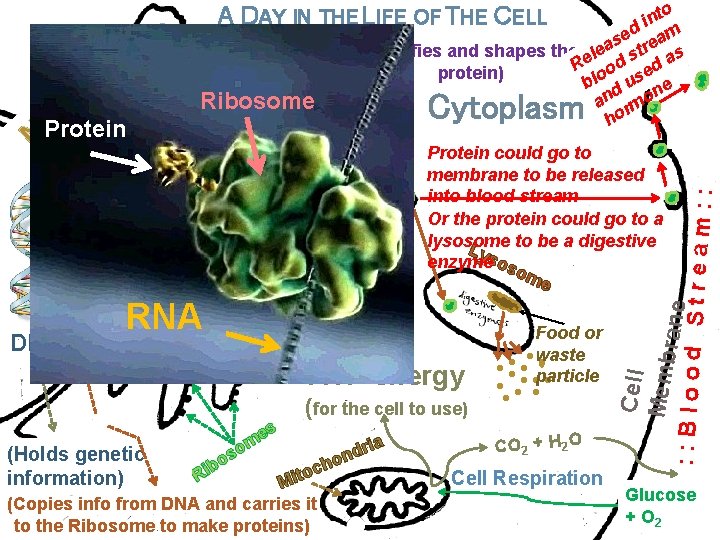
nto i ed eam i s g l Go tus (Modifies and shapes the elea d str as R o ra Protein ed protein) a o p s l p b d u ne being A Ribosome an rmo formed at ho Protein Ribosom Protein could go to e membrane to be released into blood stream Or the protein could go to a lysosome to be a digestive L e y l t enzymesos c i. s s om t e ha r t V o ” En. s. R e e p l b s b t (tra nd “bu spor ( a RNA s tran teins) e g ka Food or c pro ) a s p DNA waste tein o r p particle ATP energy A DAY IN THE LIFE OF THE CELL s u e l c u N RNA (Holds genetic information) bo i R so s e m (for the cell to use) oc t i M (Copies info from DNA and carries it to the Ribosome to make proteins) ria d n ho CO 2 + H 2 O Cell Respiration Cell Memb rane : : Blood Str eam: : Cytoplasm Glucose + O 2