
Identifying Students for Tier II Interventions Images in
- Slides: 44
Identifying Students for Tier II Interventions Images in this module were obtained at google. com/images unless otherwise specified.
Purpose of This Module To guide schools and teams in creating a system for identifying and referring students for Tier II interventions
Objectives • Assess current school and/or district initiatives and interventions • Learn what is needed to develop a system to identify students for Tier II interventions • Data decision rules for Tier II interventions • Procedures for referring students for Tier II interventions • Screening Tools
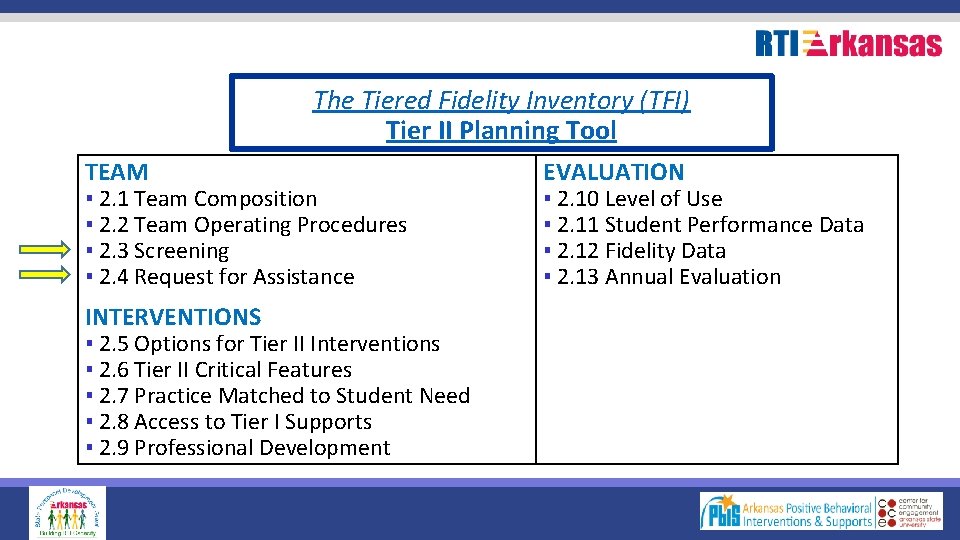
The Tiered Fidelity Inventory (TFI) Tier II Planning Tool TEAM ▪ 2. 1 Team Composition ▪ 2. 2 Team Operating Procedures ▪ 2. 3 Screening ▪ 2. 4 Request for Assistance INTERVENTIONS ▪ 2. 5 Options for Tier II Interventions ▪ 2. 6 Tier II Critical Features ▪ 2. 7 Practice Matched to Student Need ▪ 2. 8 Access to Tier I Supports ▪ 2. 9 Professional Development EVALUATION ▪ 2. 10 Level of Use ▪ 2. 11 Student Performance Data ▪ 2. 12 Fidelity Data ▪ 2. 13 Annual Evaluation
Assess Current Initiatives and Interventions
What is Already in Place? • What initiatives in the school or district are currently addressing student behavior (e. g. , Olweus, Trauma-informed initiative, etc. )? • What interventions are currently supporting groups of students with common behavior needs (e. g. , social skills groups, mentoring, etc. )? • What interventions are currently in place to support individual students?
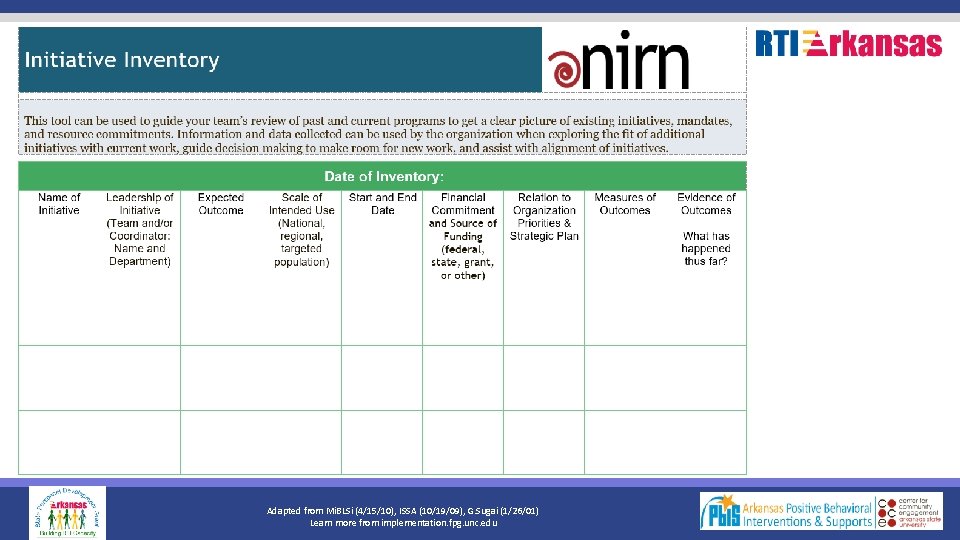
Activity • Document any supports currently in place for small groups or individual students. • What can be incorporated as you build your Tier II systems? • The Initiative Inventory (next slide) is a tool to help give a snapshot of current initiatives and resource allocation.
Adapted from Mi. BLSi (4/15/10), ISSA (10/19/09), G. Sugai (1/26/01) Learn more from implementation. fpg. unc. edu
Developing a System for Identifying Students for Tier II Interventions
What is Needed? • Data decision rules • Procedures for referring students • Screening tool(s)* *Screening tool(s) can be used to identify potential at-risk students
Data Decision Rules
What are Data Decision Rules? • Rules that help you determine if students are eligible for receiving Tier II interventions • Rules that help you determine next steps for students in Tier II interventions (e. g. , maintaining the intervention, graduating, modifying, etc. )
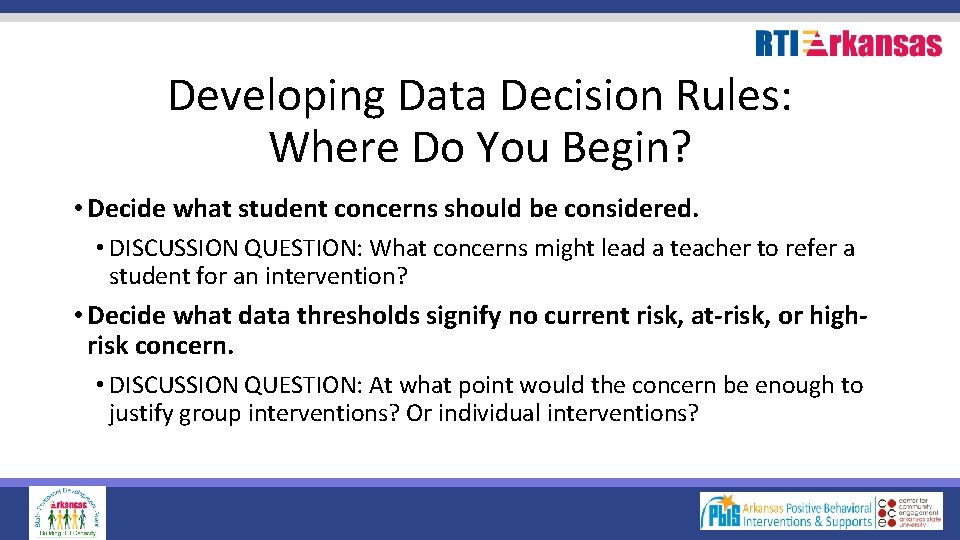
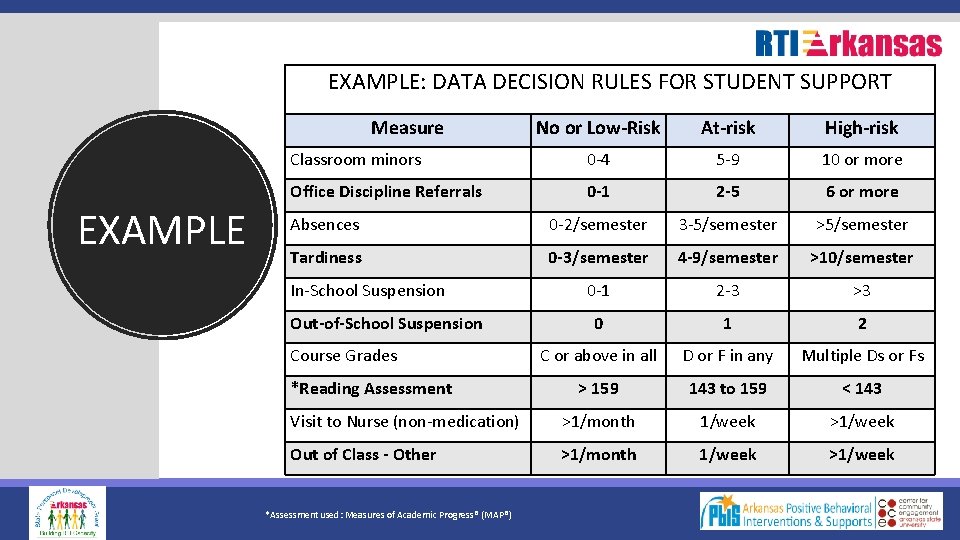
Developing Data Decision Rules: Where Do You Begin? • Decide what student concerns should be considered. • DISCUSSION QUESTION: What concerns might lead a teacher to refer a student for an intervention? • Decide what data thresholds signify no current risk, at-risk, or highrisk concern. • DISCUSSION QUESTION: At what point would the concern be enough to justify group interventions? Or individual interventions?
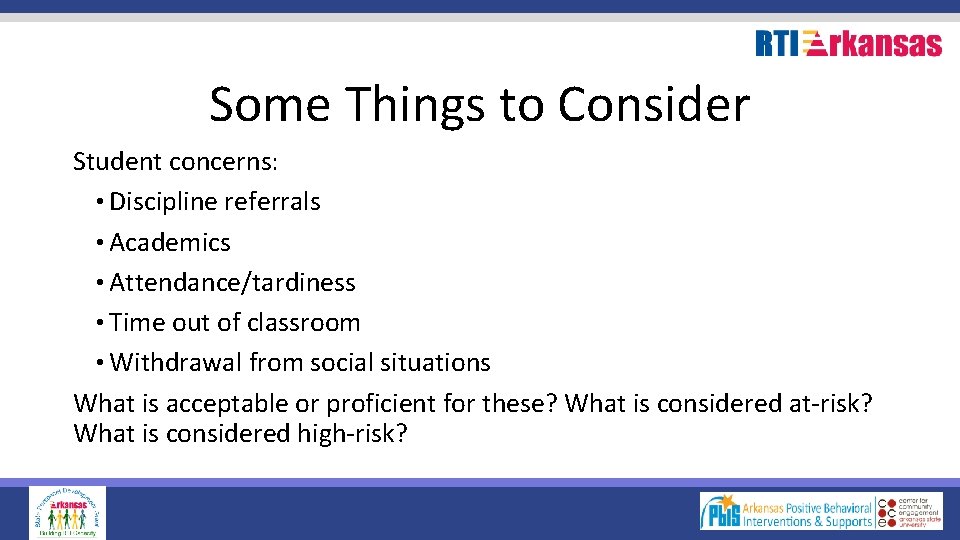
Some Things to Consider Student concerns: • Discipline referrals • Academics • Attendance/tardiness • Time out of classroom • Withdrawal from social situations What is acceptable or proficient for these? What is considered at-risk? What is considered high-risk?
Some Other Considerations • Students that were in interventions in the previous year or at a previous school • Students re-entering school from an alternative setting (e. g. , alternative high school, mental health facility, etc. )
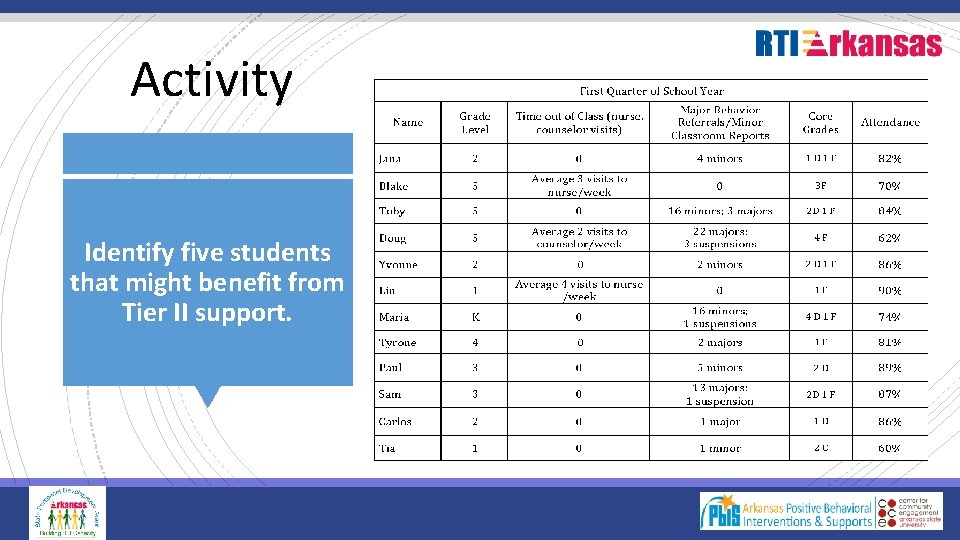
Activity Identify five students that might benefit from Tier II support.
EXAMPLE: DATA DECISION RULES FOR STUDENT SUPPORT Measure EXAMPLE No or Low-Risk At-risk High-risk Classroom minors 0 -4 5 -9 10 or more Office Discipline Referrals 0 -1 2 -5 6 or more Absences 0 -2/semester 3 -5/semester >5/semester Tardiness 0 -3/semester 4 -9/semester >10/semester 0 -1 2 -3 >3 0 1 2 C or above in all D or F in any Multiple Ds or Fs > 159 143 to 159 < 143 Visit to Nurse (non-medication) >1/month 1/week >1/week Out of Class - Other >1/month 1/week >1/week In-School Suspension Out-of-School Suspension Course Grades *Reading Assessment *Assessment used: Measures of Academic Progress® (MAP®)
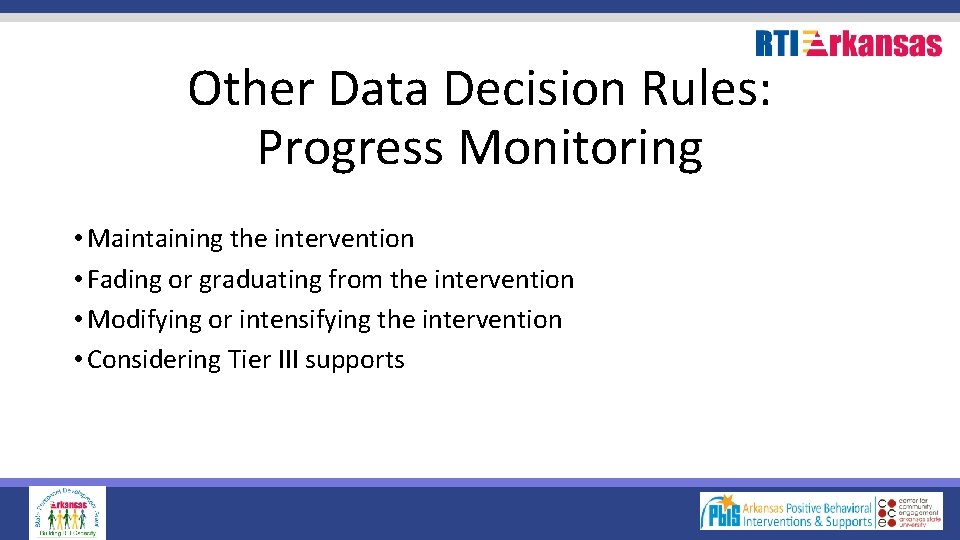
Other Data Decision Rules: Progress Monitoring • Maintaining the intervention • Fading or graduating from the intervention • Modifying or intensifying the intervention • Considering Tier III supports
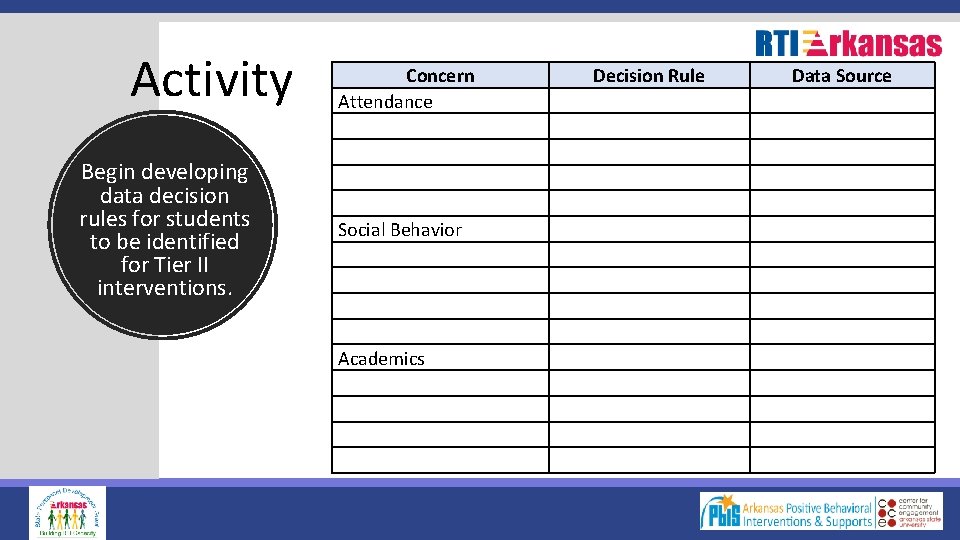
Activity Begin developing data decision rules for students to be identified for Tier II interventions. Concern Attendance Decision Rule Data Source • Begin developing data decision rules for students to be identified for Tier II interventions Social Behavior Academics
Procedures for Referring Students to Tier II Interventions
Things to Consider • How often will school-wide data be reviewed to identify possible atrisk students? • Who can refer a student for Tier II interventions? • What will be the procedures for referring a student?
Review School-wide Data • School-wide data should be reviewed at least monthly (Tier I meetings). • The data manager can look for students with multiple infractions.
Develop Procedures: Step 1: Determine who can refer a student. • Who can refer students for Tier II interventions? • Tier I team (based on school-wide data reviews) • Classroom teachers? (based on classroom concerns, minor behavior, office referrals, etc. ) • What about parents? (based on concerns at school, home, and other locations [educational or behavior concerns]) • Any others? Consider this as a team, and then get input from teachers.
Develop Procedures: Step 2: Establish a process for referring a student. • What type of referral will you use? Paper or digital? • Where will teachers access the referral forms? • To whom will teachers give the form? • How will others, such as parents access Tier II resources?
Develop Procedures: Step 3: Establish a process to determine if the student had full access to Tier I. • How will you verify if the student has been taught the behavior expectations (school-wide and in the classroom)? • Has the student received any feedback or acknowledgements for following the expectations?
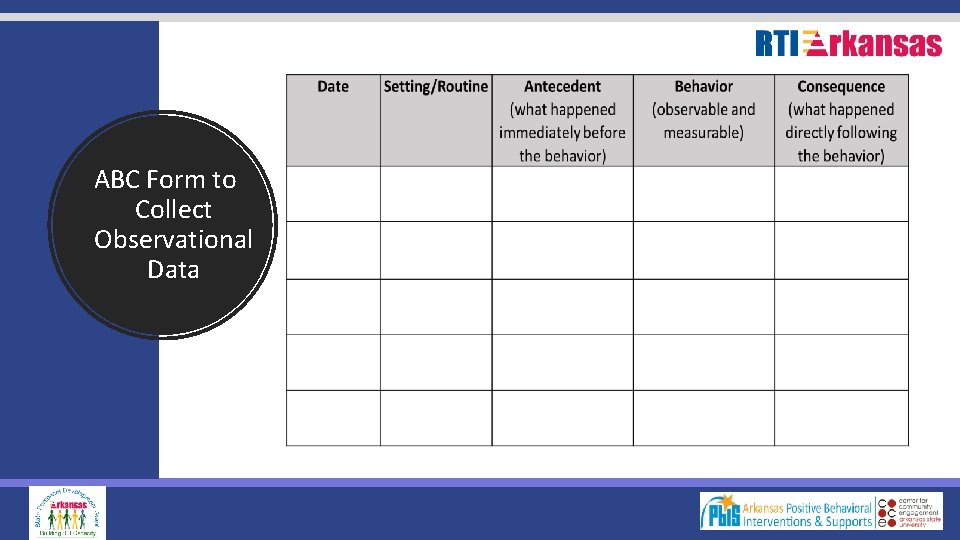
Develop Procedures: Step 4: Develop a process for collecting supporting data. • In order to determine the appropriate intervention, how will you collect the data you need? For example: • Type of behavior • Where behavior is happening • How behavior is maintained • What happens right before the behavior • What strategies have been tried • Other info that might be useful for determining placement (e. g. , grades, out of classroom time, etc. )
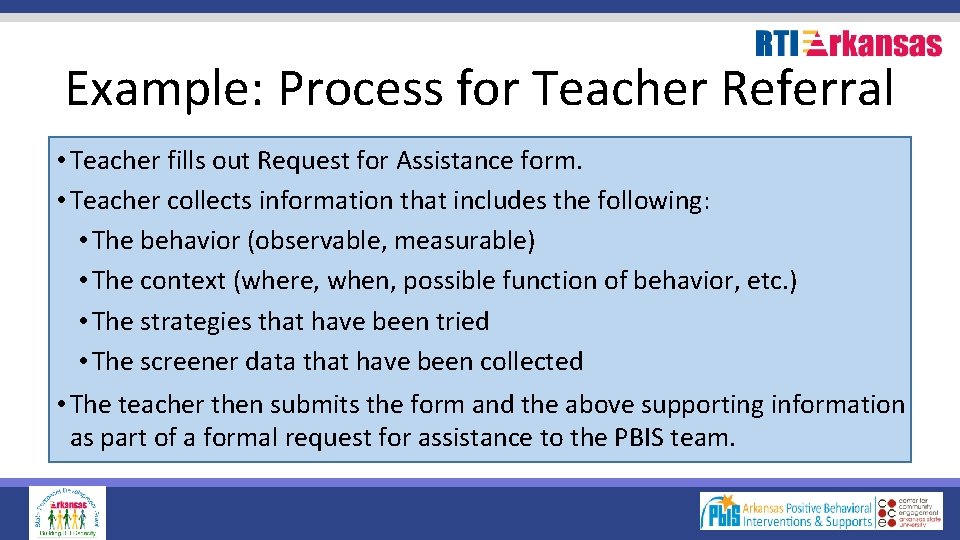
Example: Process for Teacher Referral • Teacher fills out Request for Assistance form. • Teacher collects information that includes the following: • The behavior (observable, measurable) • The context (where, when, possible function of behavior, etc. ) • The strategies that have been tried • The screener data that have been collected • The teacher then submits the form and the above supporting information as part of a formal request for assistance to the PBIS team.
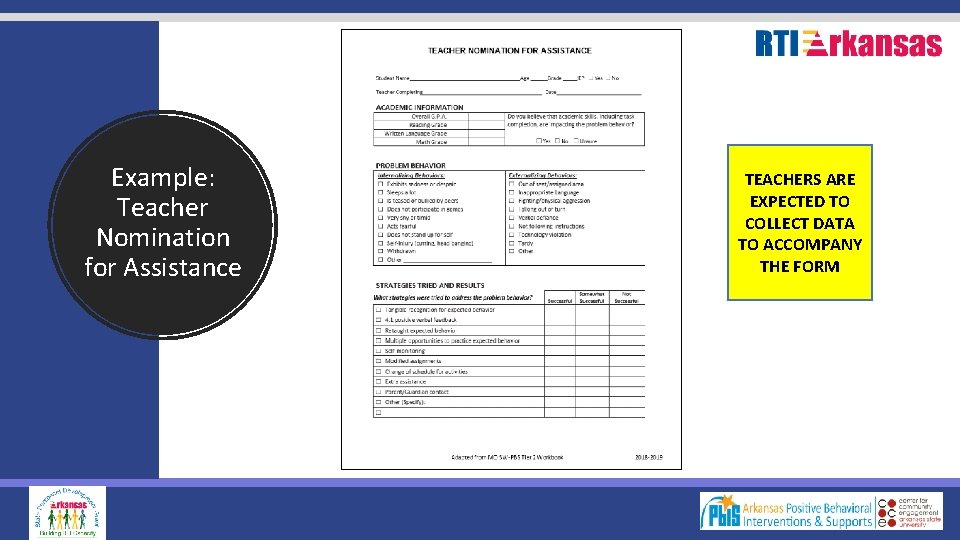
Example: Teacher Nomination for Assistance TEACHERS ARE EXPECTED TO COLLECT DATA TO ACCOMPANY THE FORM
ABC Form to Collect Observational Data
Example: Process For Parent Referral • Parents will receive an overview of Tier II and available supports provided in the… • Parent handbook • PBIS monthly emails • Parent-teacher conferences • Overview includes… • Who to contact • How to contact the above • Examples of concerning behaviors that can be addressed with Tier II supports • How the request will be addressed at the school • Parents will be able to follow the process outlined in the overview to request assistance in addressing their child’s behavior.
Develop Procedures: Step 5: Establish how you will use data decision rules to determine eligibility. Once data are gathered, use the data decision rules to determine what level of support would be appropriate for the student.
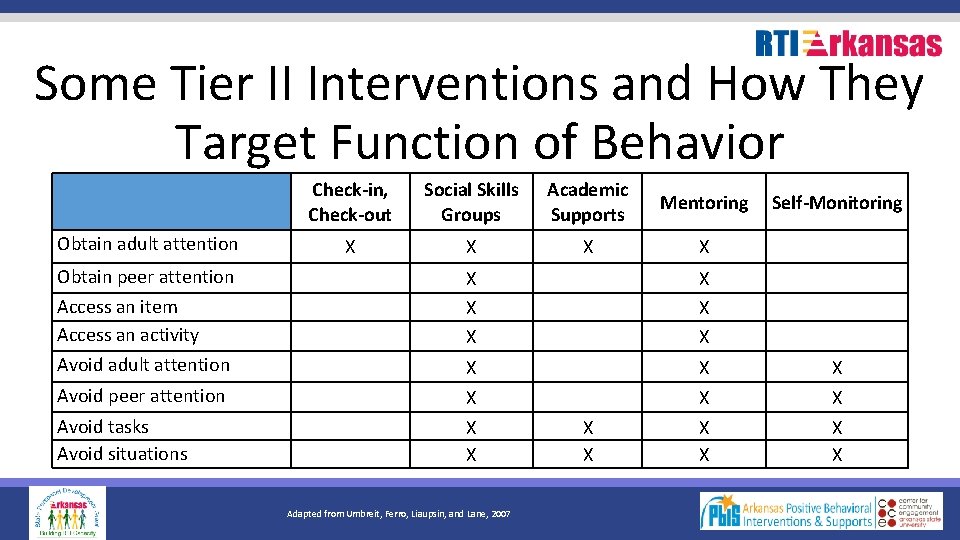
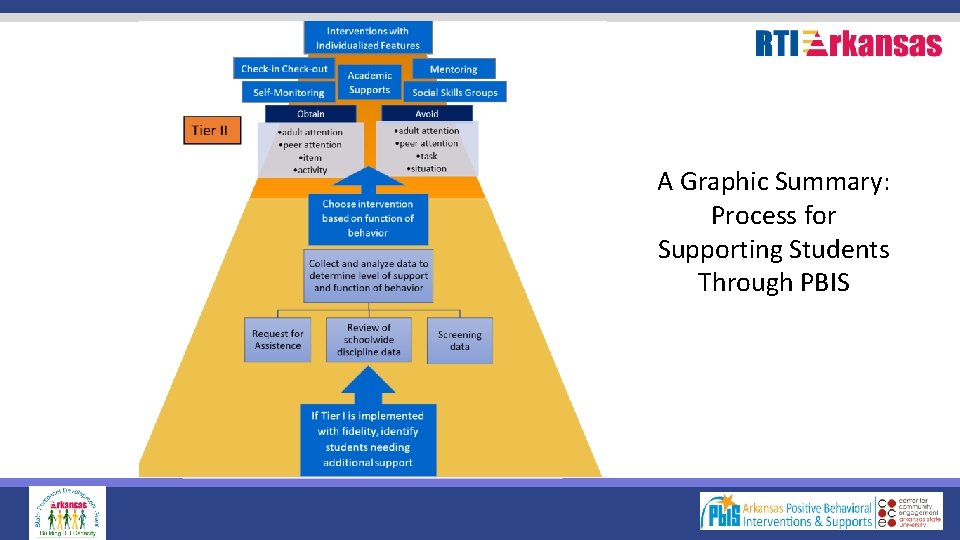
Develop Procedures: Step 6: Determine how you will choose the appropriate intervention based on function of behavior. For example, if the student is seeking adult attention, the appropriate intervention may be Check-in, Check-out.
Some Tier II Interventions and How They Target Function of Behavior Obtain adult attention Obtain peer attention Check-in, Check-out Social Skills Groups Academic Supports Mentoring X X Self-Monitoring Access an item Access an activity X X X Avoid adult attention X X X Avoid peer attention X X X X X Avoid tasks Avoid situations Adapted from Umbreit, Ferro, Liaupsin, and Lane, 2007 X X
A Graphic Summary: Process for Supporting Students Through PBIS
Screening Tools
Why Consider Screening Tools? • Give classroom teachers more options for identifying students • May identify students with internalizing behaviors • Help better determine the function of behavior and the appropriate intervention
Example of a Screening Tool • Student Risk Screening Scale (SRSS) - available from the Michigan Integrated Behavior and Learning Support Initiative (Mi. BLSi) • Universal screener used by classroom teachers to determine at-risk behavior • Link: https: //miblsi. org/evaluation/student-assessments/student-riskscreening-scale
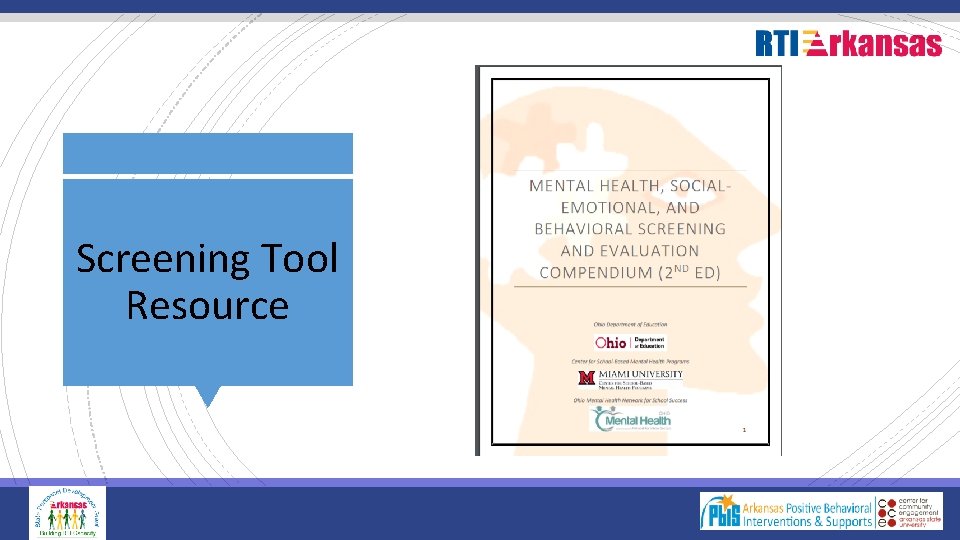
Screening Tool Resource
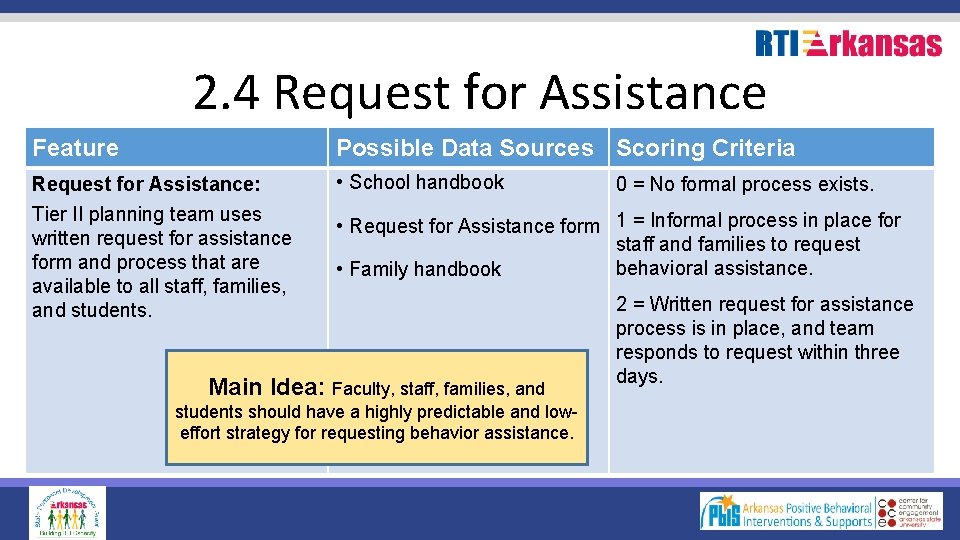
Do it With Fidelity! Tiered Fidelity Inventory (TFI) • Section 2. 3: Screening • Section 2. 4: Request for Assistance
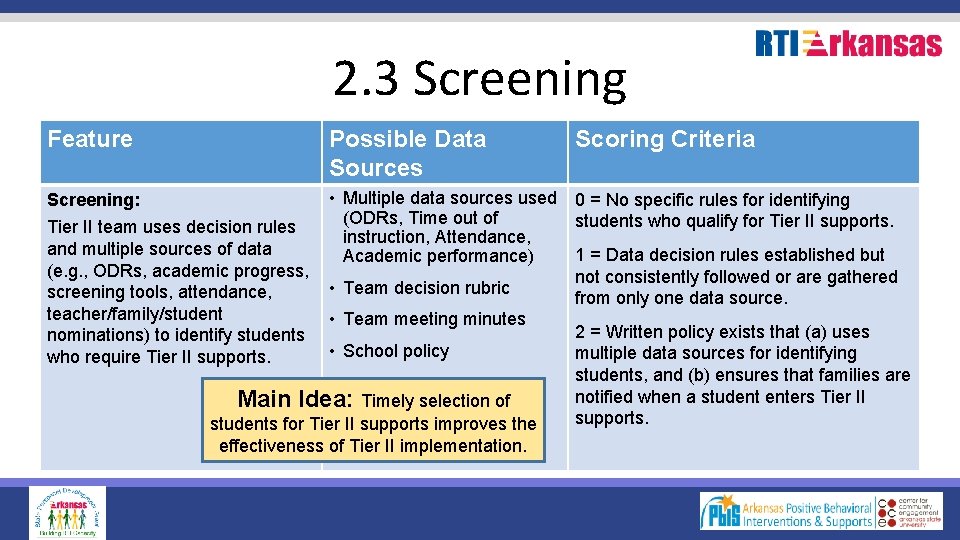
2. 3 Screening Feature Possible Data Sources Scoring Criteria • Multiple data sources used 0 = No specific rules for identifying (ODRs, Time out of students who qualify for Tier II supports. Tier II team uses decision rules instruction, Attendance, and multiple sources of data 1 = Data decision rules established but Academic performance) (e. g. , ODRs, academic progress, not consistently followed or are gathered • Team decision rubric screening tools, attendance, from only one data source. teacher/family/student • Team meeting minutes 2 = Written policy exists that (a) uses nominations) to identify students • School policy multiple data sources for identifying who require Tier II supports. students, and (b) ensures that families are notified when a student enters Tier II Main Idea: Timely selection of supports. students for Tier II supports improves the effectiveness of Tier II implementation. Screening:
2. 4 Request for Assistance Feature Possible Data Sources Scoring Criteria Request for Assistance: Tier II planning team uses written request for assistance form and process that are available to all staff, families, and students. • School handbook 0 = No formal process exists. • Request for Assistance form 1 = Informal process in place for staff and families to request behavioral assistance. • Family handbook Main Idea: Faculty, staff, families, and students should have a highly predictable and loweffort strategy for requesting behavior assistance. 2 = Written request for assistance process is in place, and team responds to request within three days.
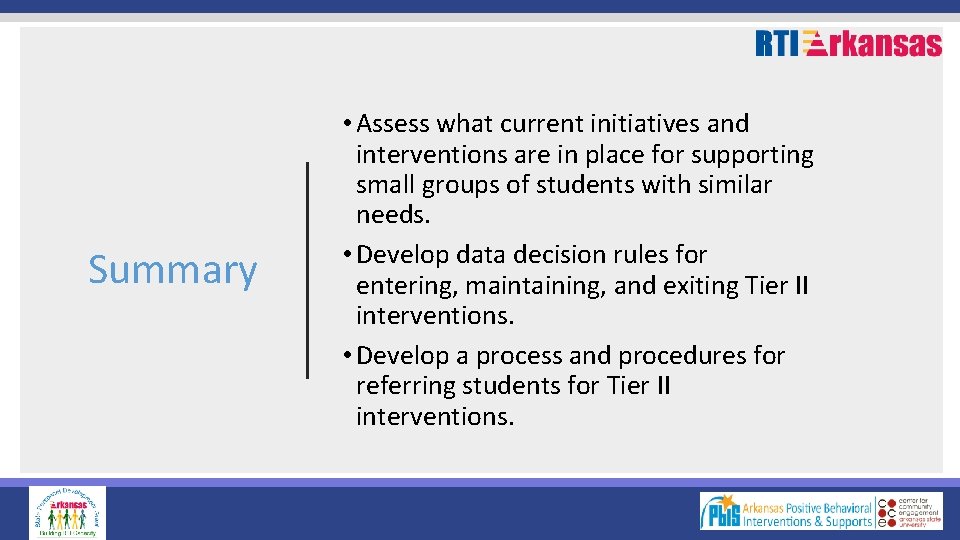
Summary • Assess what current initiatives and interventions are in place for supporting small groups of students with similar needs. • Develop data decision rules for entering, maintaining, and exiting Tier II interventions. • Develop a process and procedures for referring students for Tier II interventions.
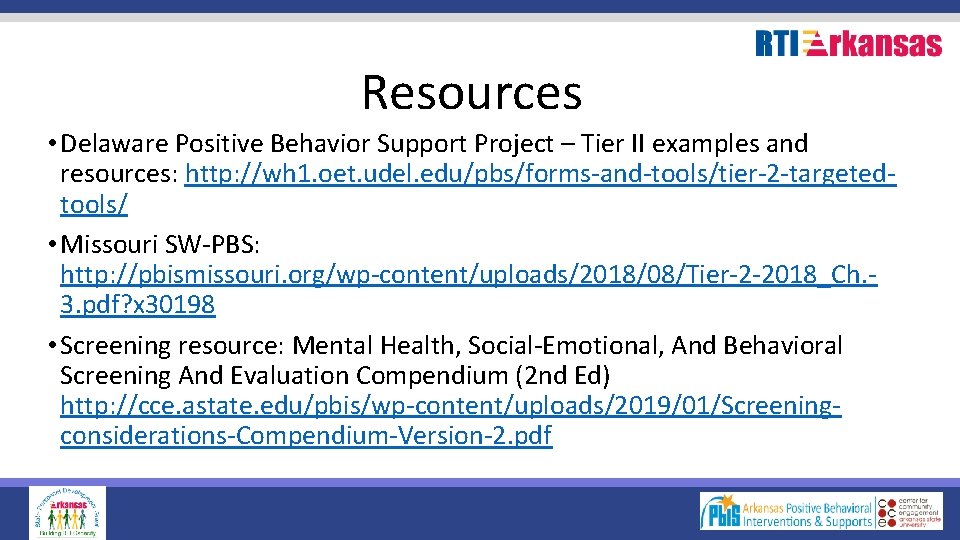
Resources • Delaware Positive Behavior Support Project – Tier II examples and resources: http: //wh 1. oet. udel. edu/pbs/forms-and-tools/tier-2 -targetedtools/ • Missouri SW-PBS: http: //pbismissouri. org/wp-content/uploads/2018/08/Tier-2 -2018_Ch. 3. pdf? x 30198 • Screening resource: Mental Health, Social-Emotional, And Behavioral Screening And Evaluation Compendium (2 nd Ed) http: //cce. astate. edu/pbis/wp-content/uploads/2019/01/Screeningconsiderations-Compendium-Version-2. pdf
We appreciate the following for sharing information: • Missouri School-Wide Positive Behavior Support • PBIS OSEP Technical Assistance Center • Delaware Positive Behavior Support Project • Michigan Integrated Behavior and Learning Support Initiative