
Identifying Sources in the Sciences Outline Library Basics
Identifying Sources in the Sciences

Outline • Library Basics • Identifying Sources Activity • Citation Activity • Library Search Demo

Peer Review
Peer Review • Experts in a particular field evaluate the quality, validity, and relevance of a work • Used to determine an articles suitability for publication • An article can be • Accepted • Require revisions • Rejected

Primary, Secondary, Tertiary Scholarly, Popular
Primary, Secondary, Tertiary • Primary – reports experimental results • Secondary – synthesis, evaluation, interpretation of experimental results • Tertiary – generally accepted knowledge Scholarly, Popular • Scholarly – geared to researchers, technical language • Popular – for the general public, simpler language
Identifying Sources in the Sciences • Activity Goal • Information is packaged in different formats • It is important to be able to recognize these formats • This will help you know what type of source is appropriate to use
Identifying Sources in the Sciences • Activity (10 min) 1. As a group look over all the sources on your table (DON’T READ each source in its entirety) 2. Try to identify the sources on your table. • How do you know what each item is? What are the distinguishing features? 3. Write the title of the source next to the type of format (Not all formats are on each table) 4. Indicate if each source is primary, secondary, or tertiary • How do you know? 5. Indicate if each source is popular or scholarly • Discussion (20 min)

Citation
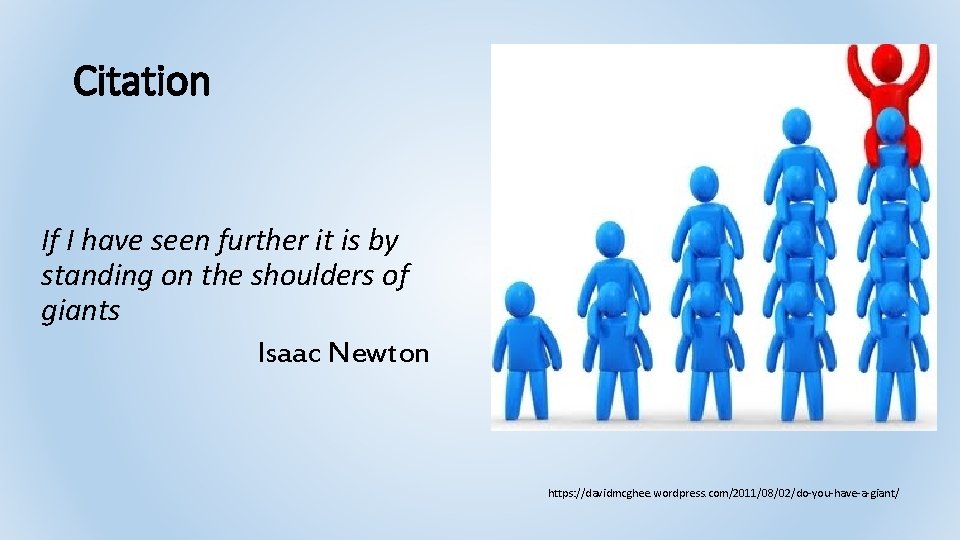
Citation If I have seen further it is by standing on the shoulders of giants Isaac Newton https: //davidmcghee. wordpress. com/2011/08/02/do-you-have-a-giant/
Citation Examples • Research Article (doi: 10. 1038/nm. 3730) (look at the PDF) • Book Chapter
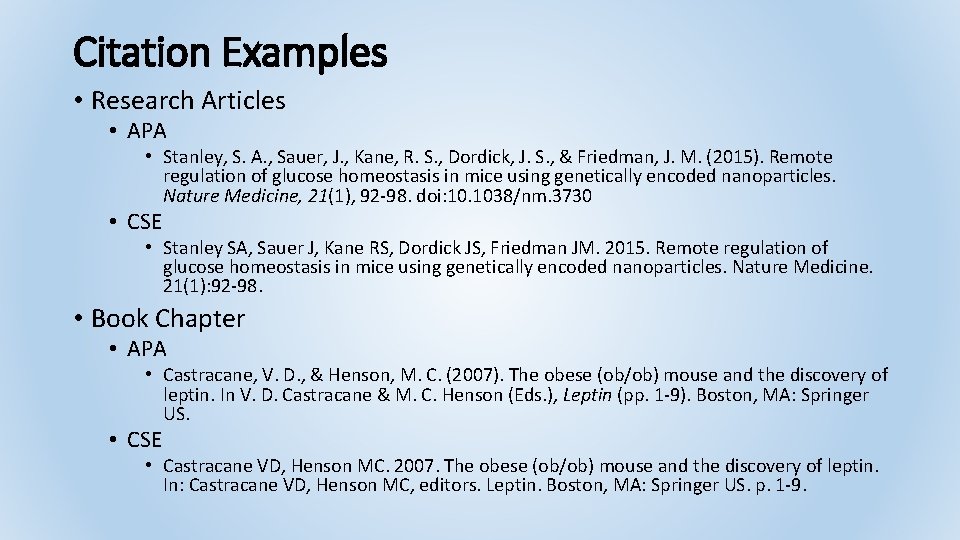
Citation Examples • Research Articles • APA • Stanley, S. A. , Sauer, J. , Kane, R. S. , Dordick, J. S. , & Friedman, J. M. (2015). Remote regulation of glucose homeostasis in mice using genetically encoded nanoparticles. Nature Medicine, 21(1), 92 -98. doi: 10. 1038/nm. 3730 • CSE • Stanley SA, Sauer J, Kane RS, Dordick JS, Friedman JM. 2015. Remote regulation of glucose homeostasis in mice using genetically encoded nanoparticles. Nature Medicine. 21(1): 92 -98. • Book Chapter • APA • Castracane, V. D. , & Henson, M. C. (2007). The obese (ob/ob) mouse and the discovery of leptin. In V. D. Castracane & M. C. Henson (Eds. ), Leptin (pp. 1 -9). Boston, MA: Springer US. • CSE • Castracane VD, Henson MC. 2007. The obese (ob/ob) mouse and the discovery of leptin. In: Castracane VD, Henson MC, editors. Leptin. Boston, MA: Springer US. p. 1 -9.
Searching • What tool to use? • Google (or another internet search engine) • Google Scholar • Library Search • Pubmed • Web of Science • Scopus
- Slides: 13