
Identifying Similarities and Differences Quote of the Day
![References Marzano, R. J. [et al. ] (2001). A Handbook for Classroom Instruction that](https://slidetodoc.com/presentation_image_h2/96c15e21bee44ad3168d0209a4710706/image-17.jpg "References Marzano, R. J. [et al. ] (2001). A Handbook for Classroom Instruction that")
- Slides: 17
Identifying Similarities and Differences
Quote of the Day “If you think you are too small to be effective, you have never been in the dark with a mosquito. ” –Unknown
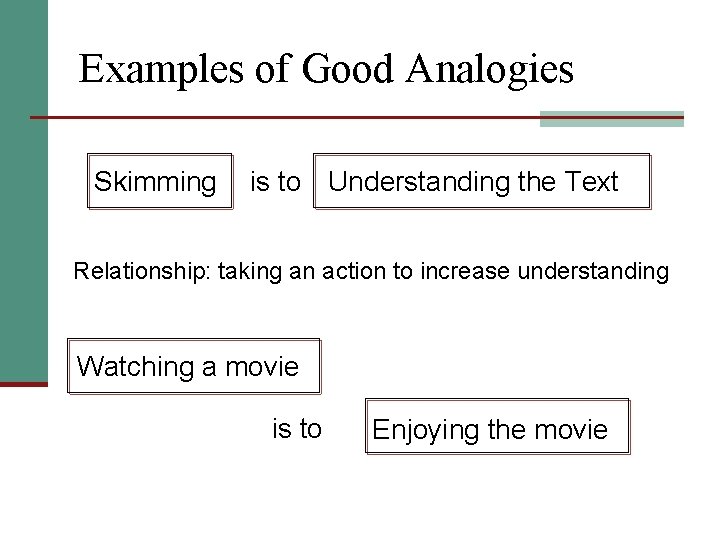
Examples of Good Analogies Skimming is to Understanding the Text Relationship: taking an action to increase understanding Watching a movie is to Enjoying the movie
Celebrate Effort - Reflection n What did you experience when using your advance organizers in your classroom? What went well? n What would you do differently next time? n
Today’s Agenda n Objectives n Participant Activity Outline n What did you learn? n For next time … n Also for next time …
Objectives After completing Session Eight and its fieldwork, teacher participants will be able to … n utilize the online modules. n describe the specific strategies, research generalizations, and resulting classroom implications for the identifying similarities and differences strategies.
Objectives (Continued) n recognize the ways in which they currently use the identifying similarities and differences strategies as part of their practice. n recognize when these instructional strategies are used appropriately and meaningfully at their grade level range. n assess their own use of the instructional strategies in their classrooms.
Quick Write n How has your understanding of Similarities and Differences been frontloaded from the beginning of this learning?
Learn About It: Mental Set Questions n Why is it important that teachers use the instructional strategy of Identifying Similarities and Differences in their instructional practice? n How can the use of the Identifying Similarities and Differences instructional strategy enhance student learning?
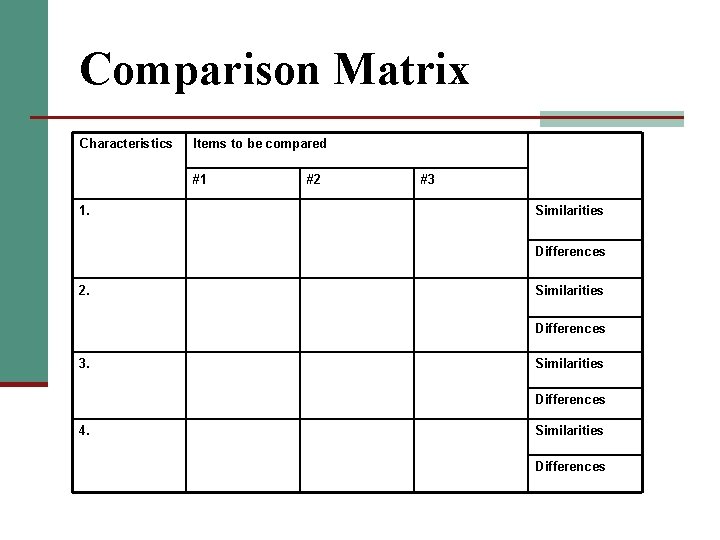
Comparison Matrix Characteristics Items to be compared #1 1. #2 #3 Similarities Differences 2. Similarities Differences 3. Similarities Differences 4. Similarities Differences
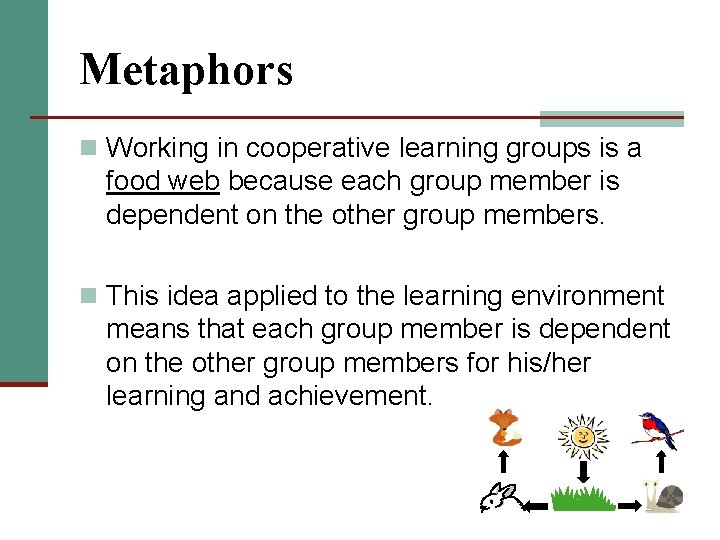
Metaphors n Working in cooperative learning groups is a food web because each group member is dependent on the other group members. n This idea applied to the learning environment means that each group member is dependent on the other group members for his/her learning and achievement.
Objectives After completing Session Eight and its fieldwork, teacher participants will be able to … n utilize the online modules. n describe the specific strategies, research generalizations, and resulting classroom implications for the identifying similarities and differences strategies.
Objectives (Continued) n recognize the ways in which they currently use the identifying similarities and differences strategies as part of their practice. n recognize when these instructional strategies are used appropriately and meaningfully at their grade level range. n assess their own use of the instructional strategies in their classrooms.
For next time … n Are you ready to try the list-group-label strategy in your classroom? n Write a half-page reflection on your experiences. n n n What went well? What would you do differently next time? Be prepared to share.
Also for next time … n Be sure to participate in the online discussion. n Our focus will be on the “Summarizing and Note-Taking” strategy. n To prepare, please skim Chapter 3 of Classroom Instruction that Works. n Bring a photocopy of a piece of content area text you will be using with your students.
Any Questions?
References Marzano, R. J. [et al. ] (2001). A Handbook for Classroom Instruction that Works. Alexandria, VA: Association for Supervision and Curriculum Development. Marzano, R. J. , Pickering, D. J. , and Pollock, J. E. (2005). Classroom Instruction that Works: Researchbased Strategies for Increasing Student Achievement. Upper Saddle River, NJ: Pearson Education, Inc.