
IDENTIFYING PROPORTIONAL RELATIONSHIPS FROM GRAPHS Today we will
- Slides: 7
IDENTIFYING PROPORTIONAL RELATIONSHIPS FROM GRAPHS Today, we will graph the information from the tables of values that we worked with yesterday in class. Our objective is to use a graph to identify if a relationship is proportional or not.
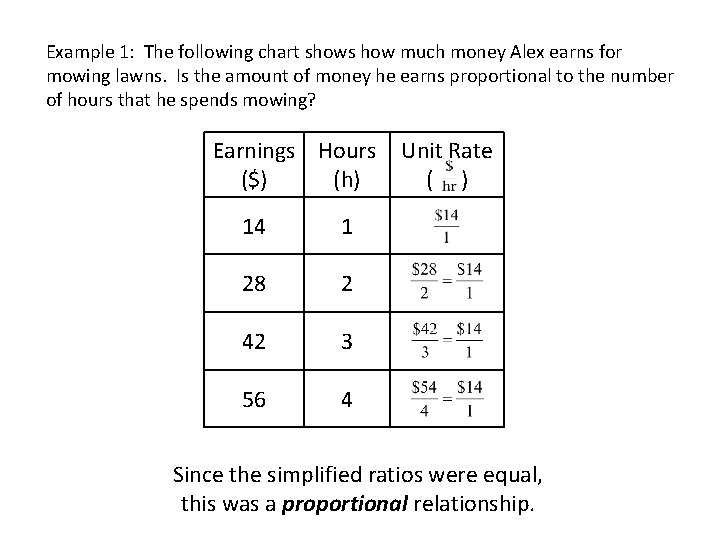
Example 1: The following chart shows how much money Alex earns for mowing lawns. Is the amount of money he earns proportional to the number of hours that he spends mowing? Earnings Hours ($) (h) 14 1 28 2 42 3 56 4 Unit Rate ( ) Since the simplified ratios were equal, this was a proportional relationship.
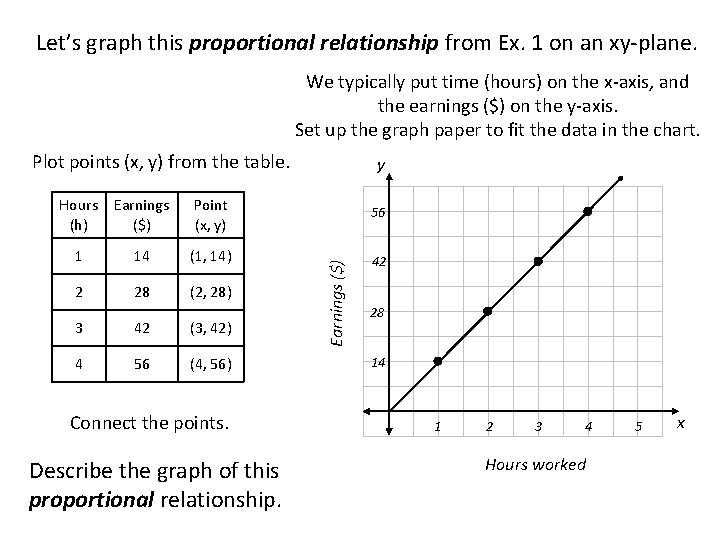
Let’s graph this proportional relationship from Ex. 1 on an xy-plane. We typically put time (hours) on the x-axis, and the earnings ($) on the y-axis. Set up the graph paper to fit the data in the chart. Plot points (x, y) from the table. y Earnings ($) Point (x, y) 56 1 14 (1, 14) 42 2 28 (2, 28) 3 42 (3, 42) 4 56 (4, 56) Connect the points. Describe the graph of this proportional relationship. Earnings ($) Hours (h) 28 14 1 2 3 4 Hours worked 5 x
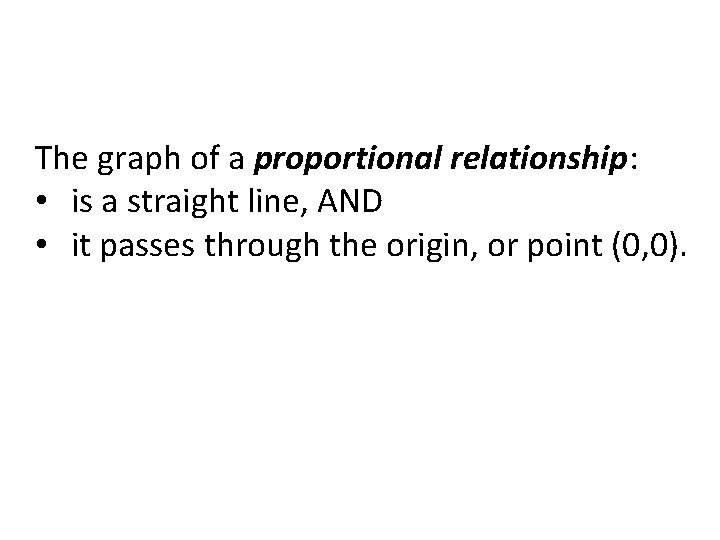
The graph of a proportional relationship: • is a straight line, AND • it passes through the origin, or point (0, 0).
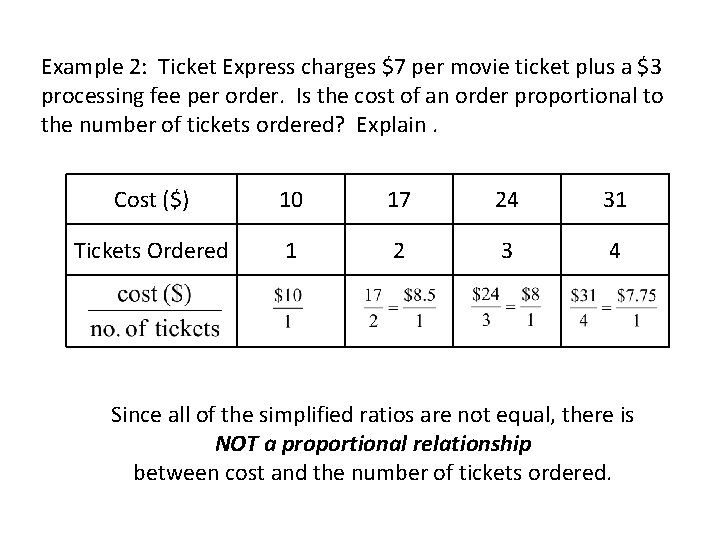
Example 2: Ticket Express charges $7 per movie ticket plus a $3 processing fee per order. Is the cost of an order proportional to the number of tickets ordered? Explain. Cost ($) 10 17 24 31 Tickets Ordered 1 2 3 4 Since all of the simplified ratios are not equal, there is NOT a proportional relationship between cost and the number of tickets ordered.
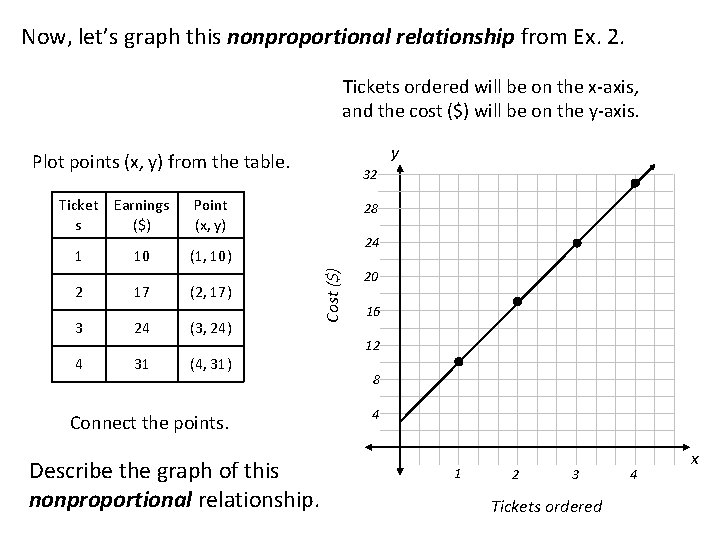
Now, let’s graph this nonproportional relationship from Ex. 2. Tickets ordered will be on the x-axis, and the cost ($) will be on the y-axis. y Plot points (x, y) from the table. 1 2 10 17 Point (x, y) 28 24 (1, 10) (2, 17) 3 24 (3, 24) 4 31 (4, 31) Connect the points. Describe the graph of this nonproportional relationship. Cost ($) Ticket Earnings s ($) 32 20 16 12 8 4 1 2 3 Tickets ordered 4 x
This graph shows a nonproportional relationship. It is a straight line, but it does not pass through the origin.