
Identifying Pedestrian Safety Risks Through Systemic Crash Analysis




- Slides: 42
Identifying Pedestrian Safety Risks Through Systemic Crash Analysis Wesley Kumfer, Ph. D, RSP 1 Tex. ITE Greater Dallas and Fort Worth Sections January 12, 2022
Overview • • • Why do we need a systemic safety approach? How do we measure safety? How is a systemic approach different? What countermeasures can we use? How have State DOTs used systemic safety approaches? January 12, 2022
Introduction • Tell me about yourself • Are you in public or private practice? • Do you consider yourself a planner, an engineer, or something else? • Do you measure transportation safety as part of your job? • If so, what method(s) do you use? January 12, 2022
Introduction • Relevant projects and reports: – NCHRP 893: Systemic Pedestrian Safety Analysis – Implementing Safe Systems in the United States: Guiding Principles and Lessons from International Practice – A Safe System-Based Framework and Analytical Methodology for Assessing Intersections – NCHRP 17 -87: Guide to Pedestrian Analysis – Shaping the narrative around traffic injury: A media framing guide for transportation and public health professionals January 12, 2022
Why do we need a systemic safety approach? January 12, 2022
Pedestrian Safety Trends • From 2009 to 2018, pedestrian fatalities in the United States increased by 53%. – All other traffic fatalities increased over that same period by only 2%. – In 2018, pedestrian fatalities accounted for 17% of all traffic fatalities, despite low share of miles of travel and project funds. – The share of SUV-involved pedestrian fatalities during that time rose by 81%. • In 2019, the projected number of pedestrian fatalities rose to a 30 year high of 6, 590. Source: Retting, 2020 January 12, 2022
Pedestrian Safety Trends • Findings are similar in Texas. • In 2019, there were: – 5, 975 crashes involving pedestrians – 1, 317 serious injuries – 669 deaths • This was an 18% increase from 2015 to 2019 • Pedestrians now account for 20% of all traffic fatalities in Texas Source: Tx. DOT, 2020 January 12, 2022
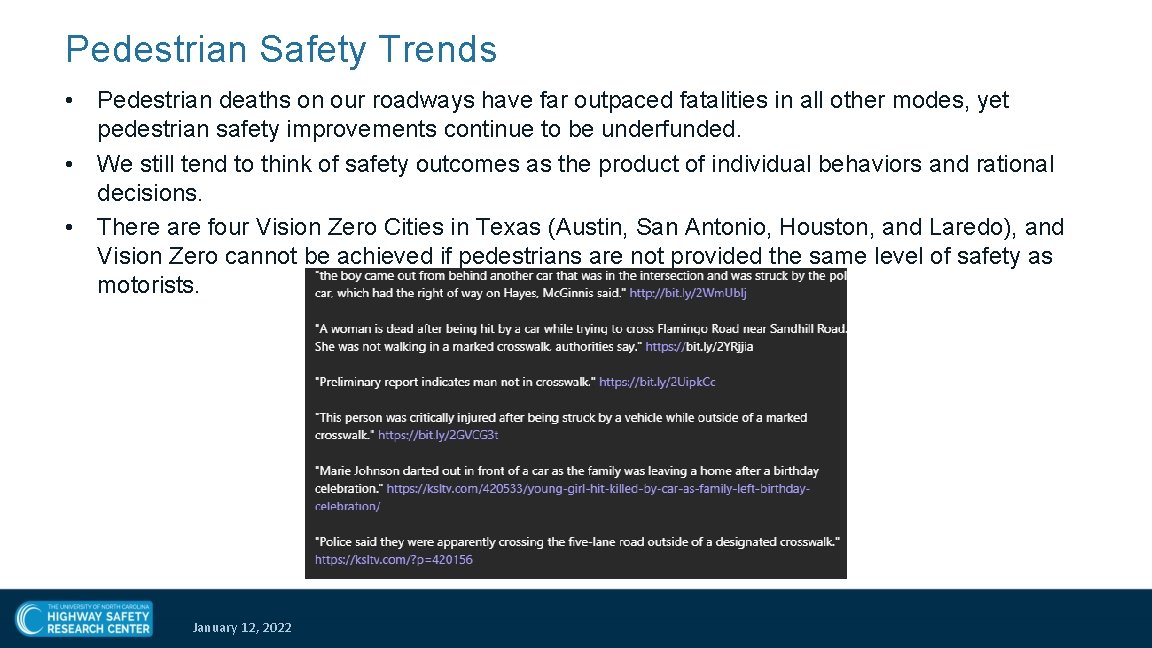
Pedestrian Safety Trends • Pedestrian deaths on our roadways have far outpaced fatalities in all other modes, yet pedestrian safety improvements continue to be underfunded. • We still tend to think of safety outcomes as the product of individual behaviors and rational decisions. • There are four Vision Zero Cities in Texas (Austin, San Antonio, Houston, and Laredo), and Vision Zero cannot be achieved if pedestrians are not provided the same level of safety as motorists. January 12, 2022
How do we measure safety? January 12, 2022
The Traditional Approach • The traditional transportation safety management system tends to rely on “hot spot” (high crash location) identification. • While this approach is important, there are several limitations: – A hot spot approach is inherently reactive and based on crash history. – Pedestrian crashes may be rare or widely dispersed across a network, making a hot spot approach unreliable and cost-ineffective. – Crash risk factors for pedestrians may be different than for motor vehicles. – The process needs to be tailored to data related to pedestrians, and to provide guidance on how to gather needed data. • We need a method to identify locations of risk. January 12, 2022
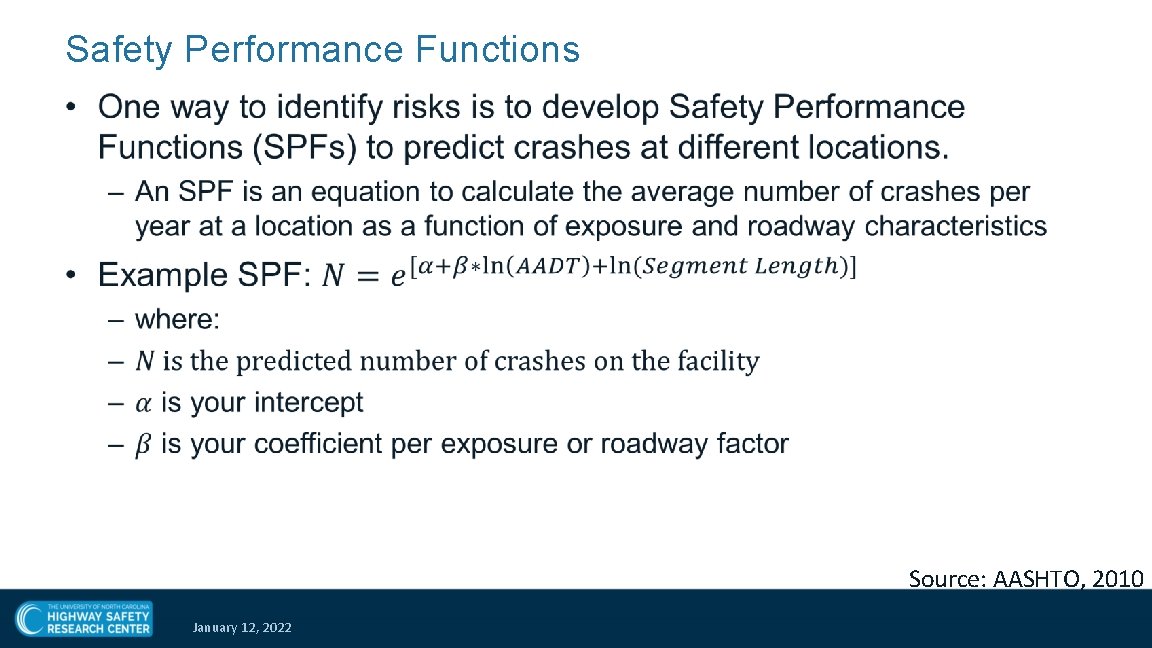
Safety Performance Functions • Source: AASHTO, 2010 January 12, 2022
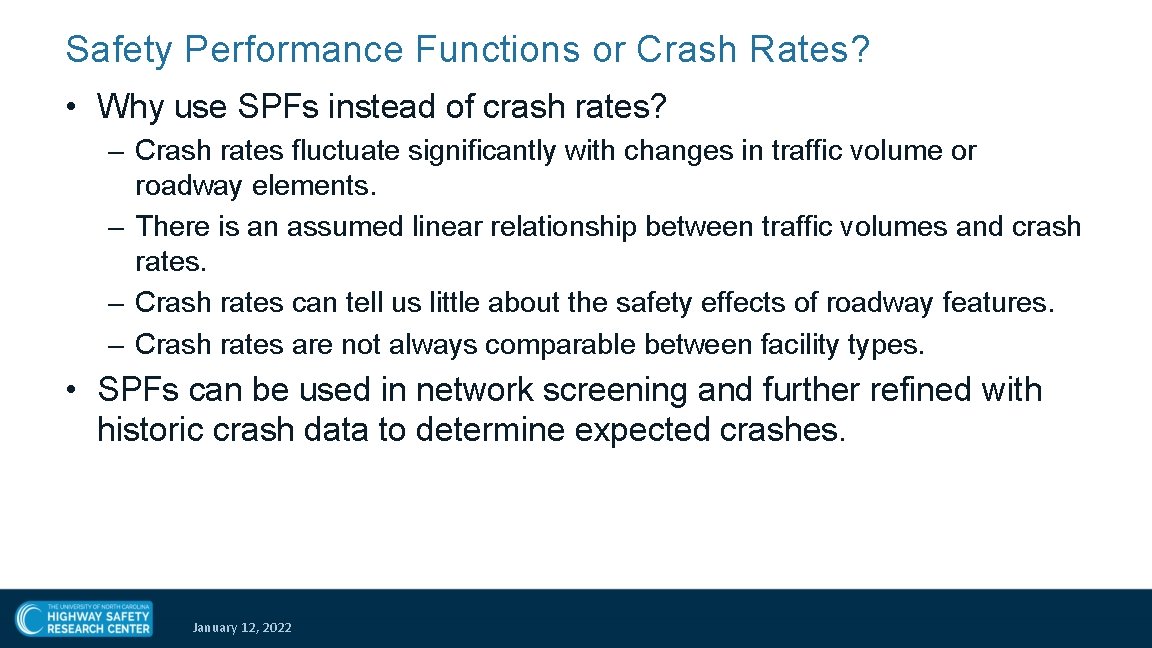
Safety Performance Functions or Crash Rates? • Why use SPFs instead of crash rates? – Crash rates fluctuate significantly with changes in traffic volume or roadway elements. – There is an assumed linear relationship between traffic volumes and crash rates. – Crash rates can tell us little about the safety effects of roadway features. – Crash rates are not always comparable between facility types. • SPFs can be used in network screening and further refined with historic crash data to determine expected crashes. January 12, 2022
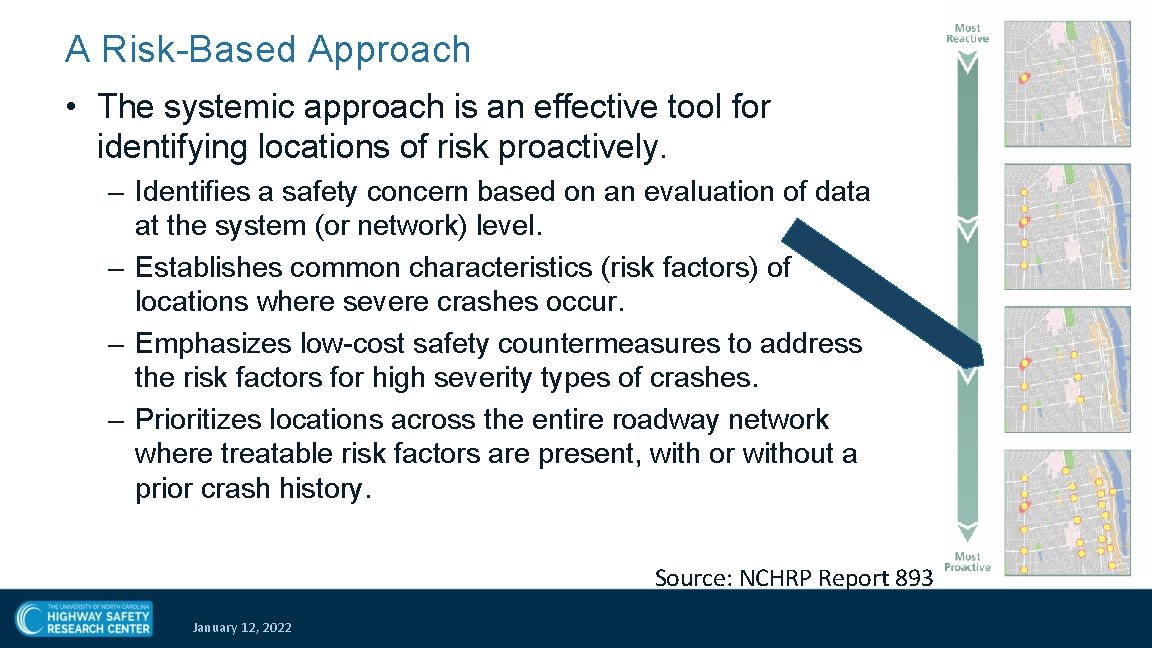
A Risk-Based Approach • The systemic approach is an effective tool for identifying locations of risk proactively. – Identifies a safety concern based on an evaluation of data at the system (or network) level. – Establishes common characteristics (risk factors) of locations where severe crashes occur. – Emphasizes low-cost safety countermeasures to address the risk factors for high severity types of crashes. – Prioritizes locations across the entire roadway network where treatable risk factors are present, with or without a prior crash history. Source: NCHRP Report 893 January 12, 2022
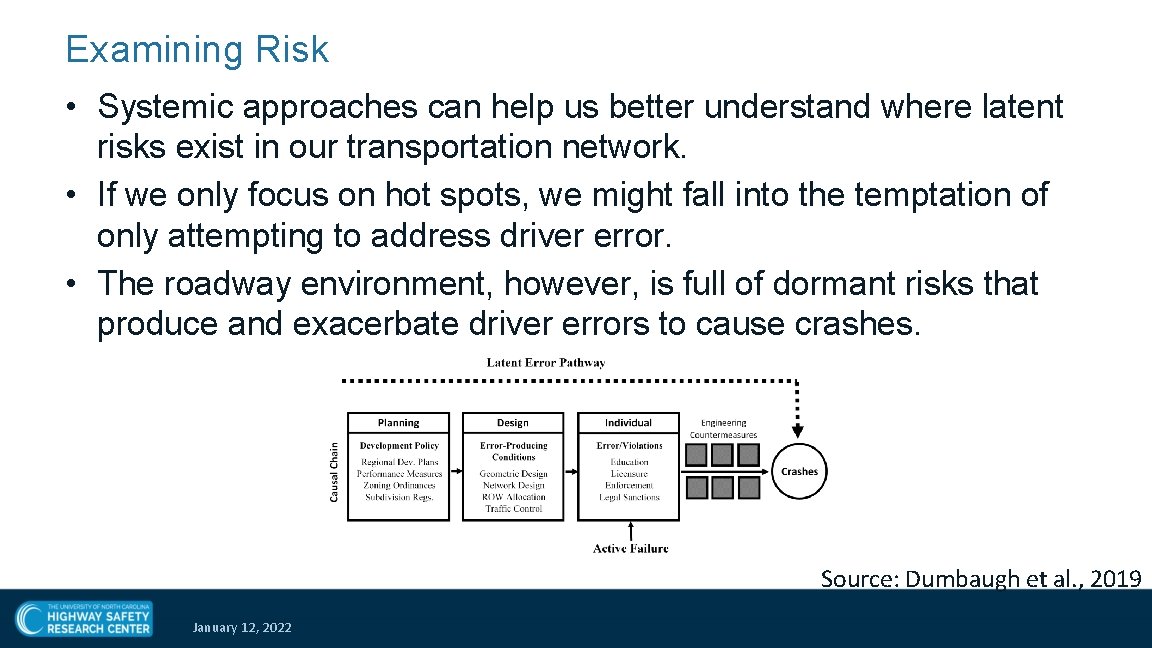
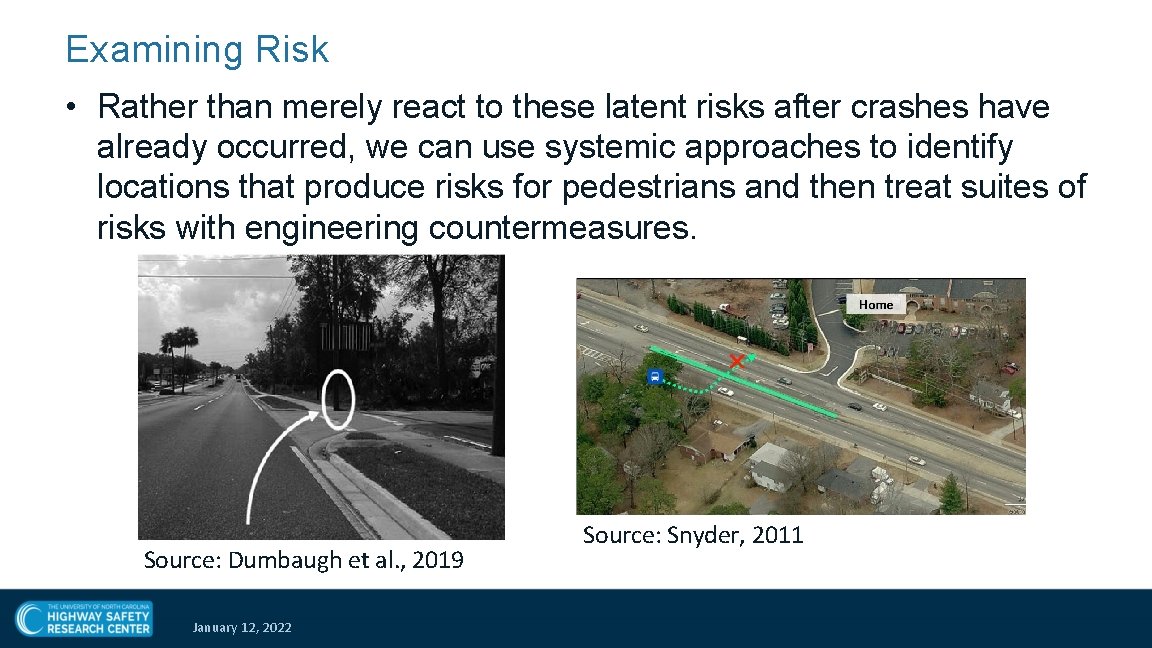
Examining Risk • Systemic approaches can help us better understand where latent risks exist in our transportation network. • If we only focus on hot spots, we might fall into the temptation of only attempting to address driver error. • The roadway environment, however, is full of dormant risks that produce and exacerbate driver errors to cause crashes. Source: Dumbaugh et al. , 2019 January 12, 2022
Examining Risk • Rather than merely react to these latent risks after crashes have already occurred, we can use systemic approaches to identify locations that produce risks for pedestrians and then treat suites of risks with engineering countermeasures. Source: Dumbaugh et al. , 2019 January 12, 2022 Source: Snyder, 2011
How is a systemic approach different? January 12, 2022
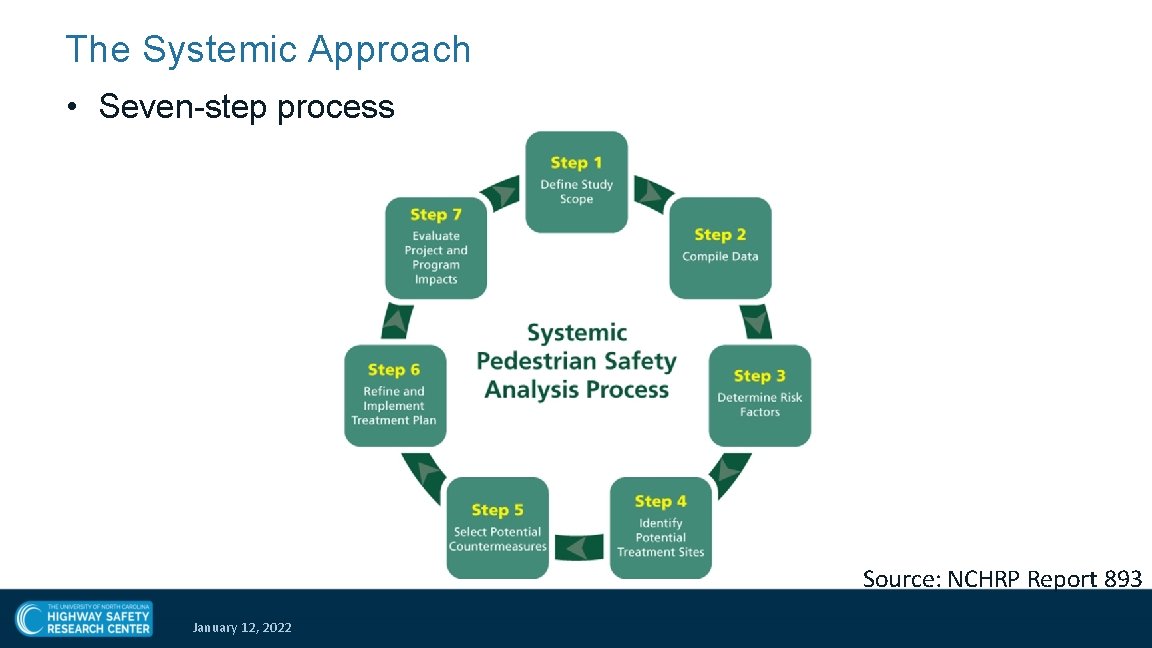
The Systemic Approach • Seven-step process Source: NCHRP Report 893 January 12, 2022
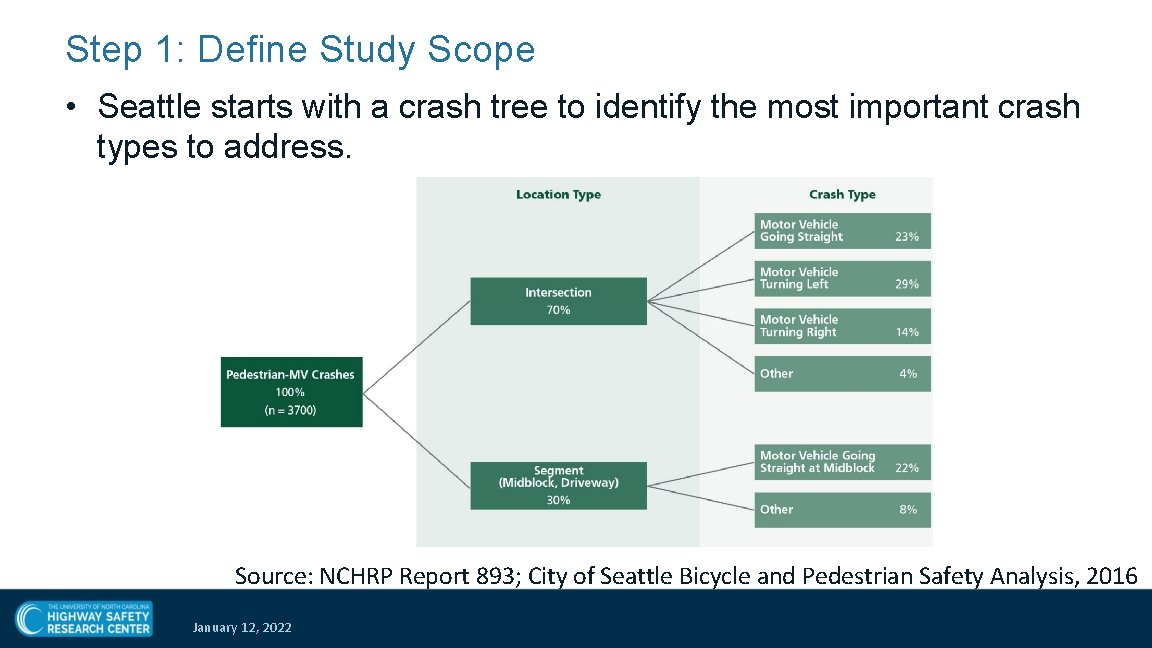
Step 1: Define Study Scope • For NCHRP Report 893, we looked at: • Two types of crashes modeled on 23, 636 segments in City of Seattle – Crashes between vehicles traveling straight and pedestrians crossing at street segments – 802 crashes in data – All crashes between vehicles and pedestrians at street segments at night – 404 crashes in data • Crash data from 2007 -2014 • Variables to capture risks inherent to roadway design, traffic volumes, population characteristics, and development types/density January 12, 2022
Step 1: Define Study Scope • Seattle starts with a crash tree to identify the most important crash types to address. Source: NCHRP Report 893; City of Seattle Bicycle and Pedestrian Safety Analysis, 2016 January 12, 2022
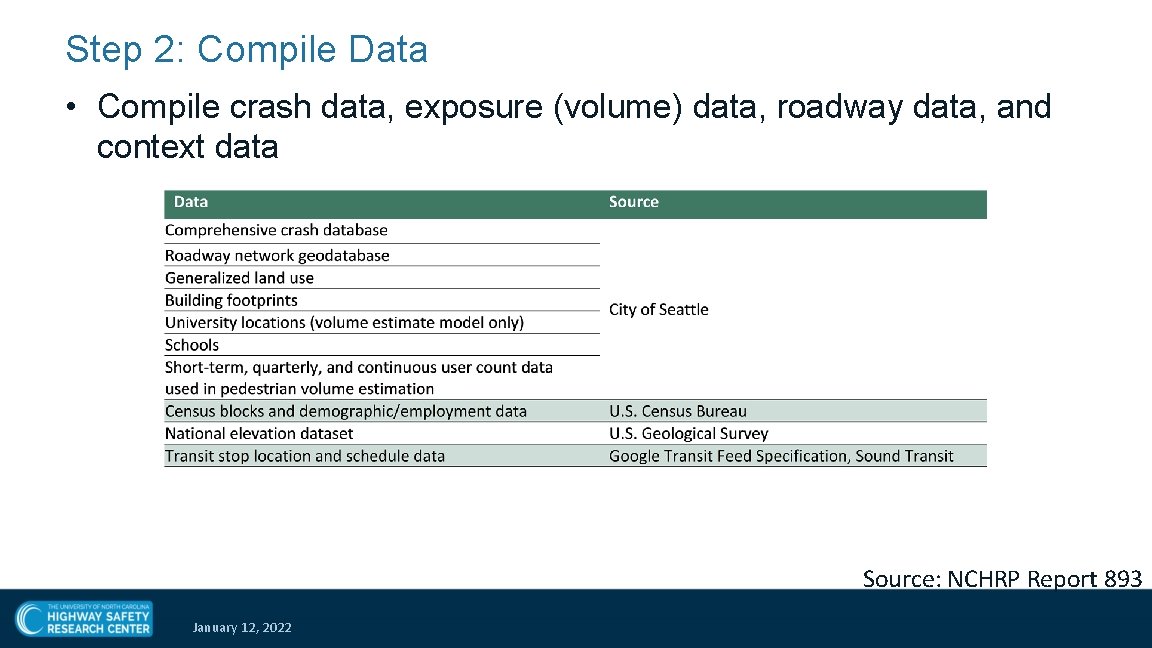
Step 2: Compile Data • Compile crash data, exposure (volume) data, roadway data, and context data Source: NCHRP Report 893 January 12, 2022
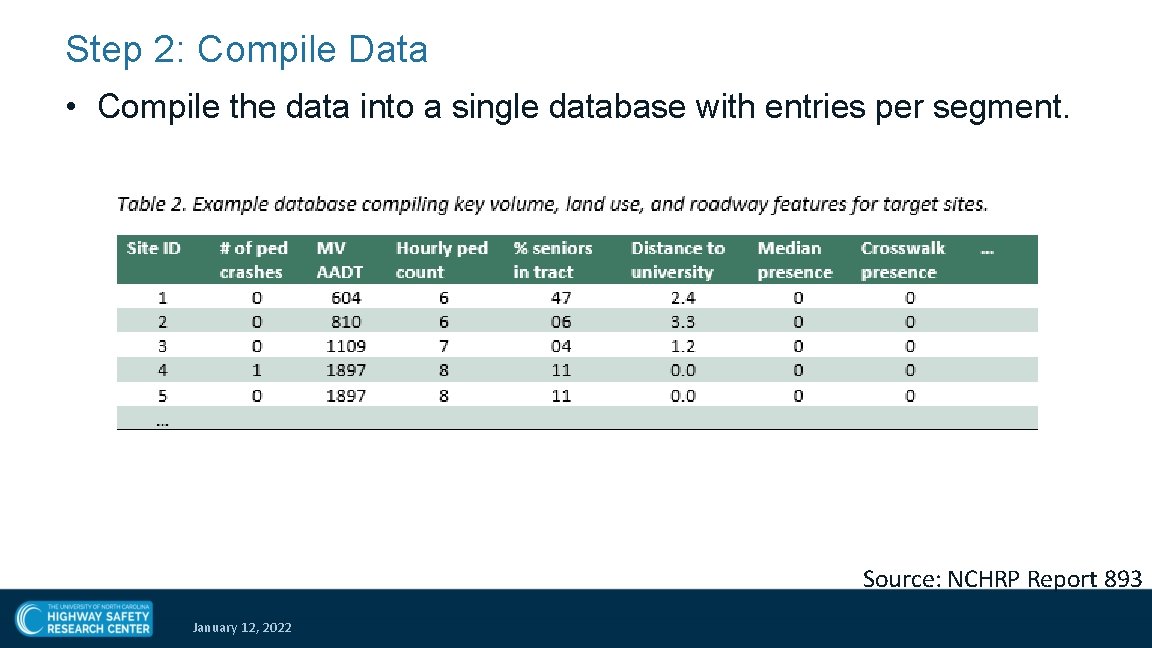
Step 2: Compile Data • Compile the data into a single database with entries per segment. Source: NCHRP Report 893 January 12, 2022
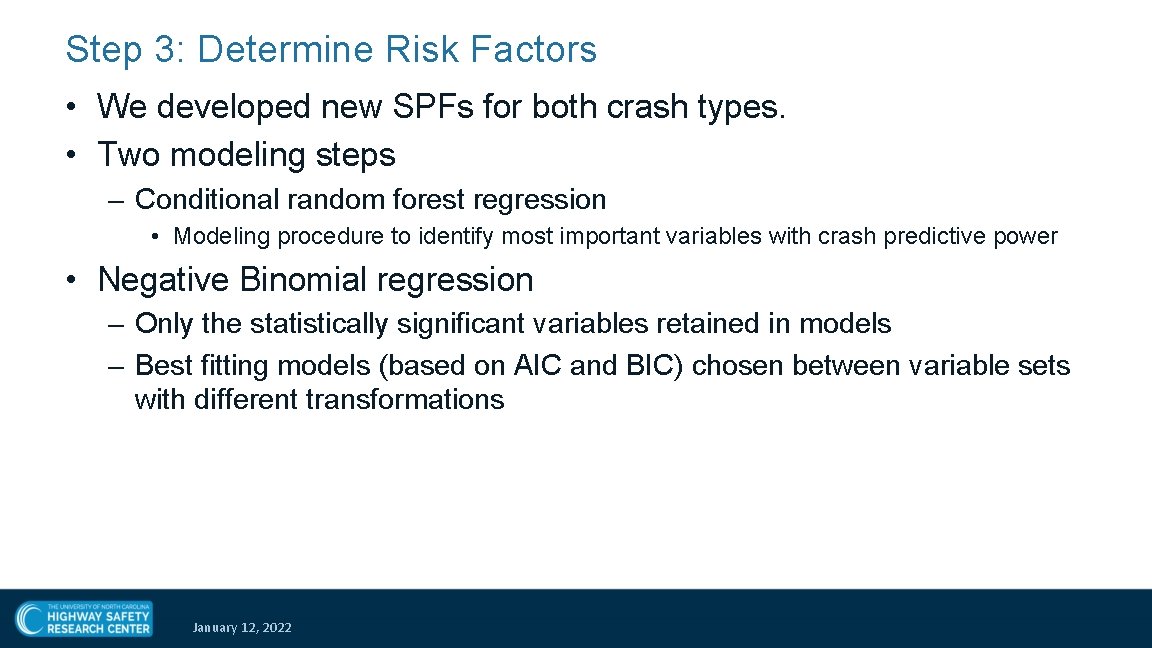
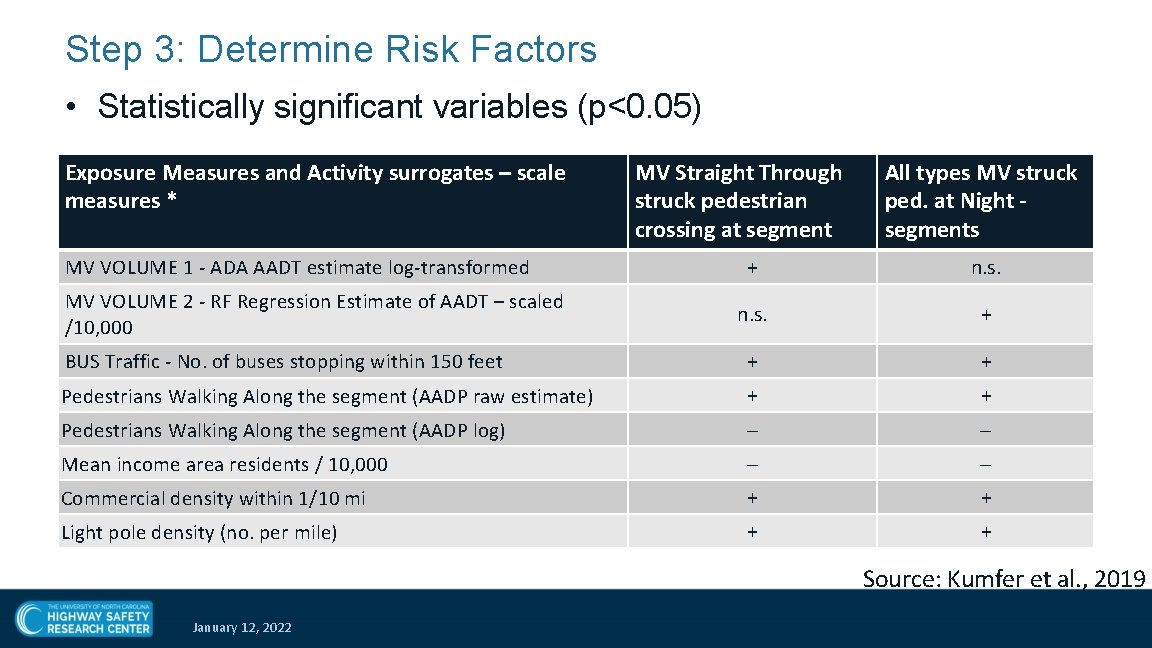
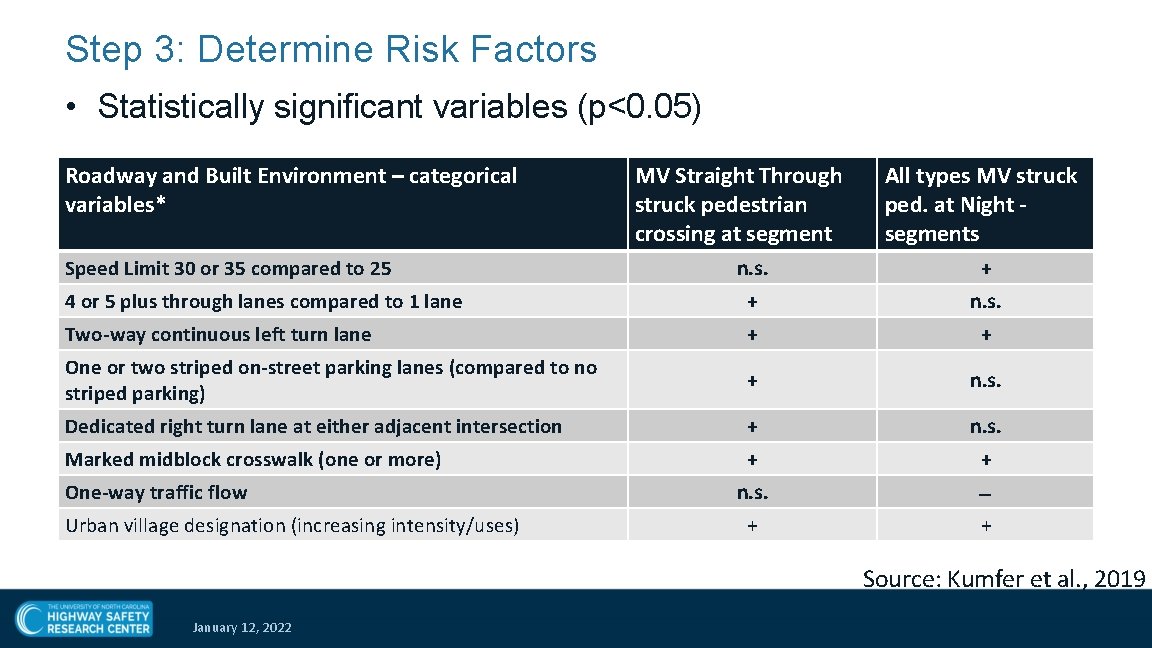
Step 3: Determine Risk Factors • We developed new SPFs for both crash types. • Two modeling steps – Conditional random forest regression • Modeling procedure to identify most important variables with crash predictive power • Negative Binomial regression – Only the statistically significant variables retained in models – Best fitting models (based on AIC and BIC) chosen between variable sets with different transformations January 12, 2022
Step 3: Determine Risk Factors • Statistically significant variables (p<0. 05) Exposure Measures and Activity surrogates – scale measures * MV Straight Through struck pedestrian crossing at segment All types MV struck ped. at Night segments + n. s. + BUS Traffic - No. of buses stopping within 150 feet + + Pedestrians Walking Along the segment (AADP raw estimate) + + Pedestrians Walking Along the segment (AADP log) Mean income area residents / 10, 000 Commercial density within 1/10 mi + + Light pole density (no. per mile) + + MV VOLUME 1 - ADA AADT estimate log-transformed MV VOLUME 2 - RF Regression Estimate of AADT – scaled /10, 000 Source: Kumfer et al. , 2019 January 12, 2022
Step 3: Determine Risk Factors • Statistically significant variables (p<0. 05) Roadway and Built Environment – categorical variables* MV Straight Through struck pedestrian crossing at segment All types MV struck ped. at Night segments n. s. + 4 or 5 plus through lanes compared to 1 lane + n. s. Two-way continuous left turn lane + + One or two striped on-street parking lanes (compared to no striped parking) + n. s. Dedicated right turn lane at either adjacent intersection + n. s. Marked midblock crosswalk (one or more) + + n. s. + Speed Limit 30 or 35 compared to 25 One-way traffic flow Urban village designation (increasing intensity/uses) + Source: Kumfer et al. , 2019 January 12, 2022
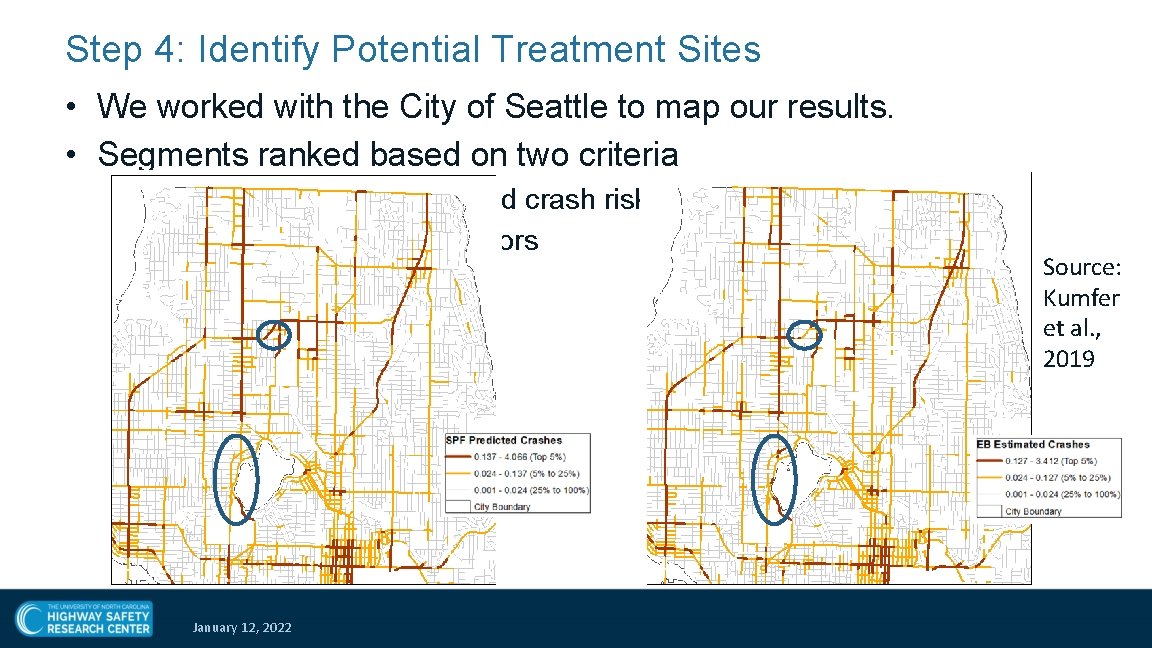
Step 4: Identify Potential Treatment Sites • We worked with the City of Seattle to map our results. • Segments ranked based on two criteria – Screening based on predicted crash risk (SPF-predicted crashes) – Screening based on risk factors January 12, 2022 Source: Kumfer et al. , 2019
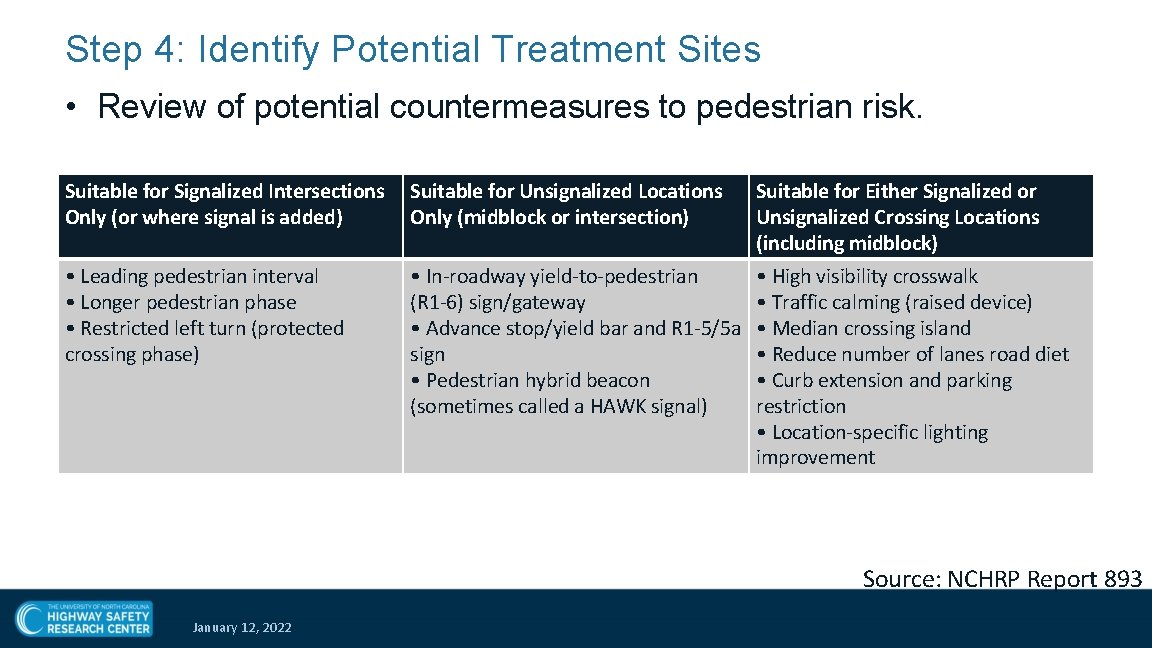
Step 4: Identify Potential Treatment Sites • Review of potential countermeasures to pedestrian risk. Suitable for Signalized Intersections Only (or where signal is added) Suitable for Unsignalized Locations Only (midblock or intersection) Suitable for Either Signalized or Unsignalized Crossing Locations (including midblock) • Leading pedestrian interval • Longer pedestrian phase • Restricted left turn (protected crossing phase) • In-roadway yield-to-pedestrian (R 1 -6) sign/gateway • Advance stop/yield bar and R 1 -5/5 a sign • Pedestrian hybrid beacon (sometimes called a HAWK signal) • High visibility crosswalk • Traffic calming (raised device) • Median crossing island • Reduce number of lanes road diet • Curb extension and parking restriction • Location-specific lighting improvement Source: NCHRP Report 893 January 12, 2022
What countermeasures can we use? January 12, 2022
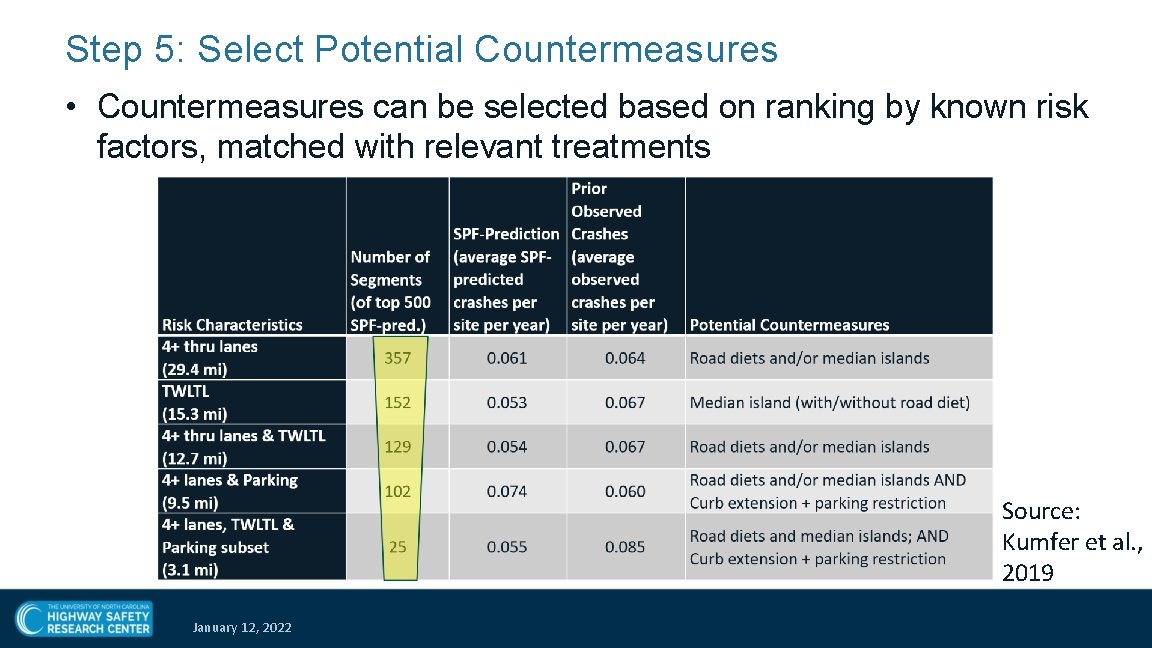
Step 5: Select Potential Countermeasures • Countermeasures can be selected based on ranking by known risk factors, matched with relevant treatments Source: Kumfer et al. , 2019 January 12, 2022
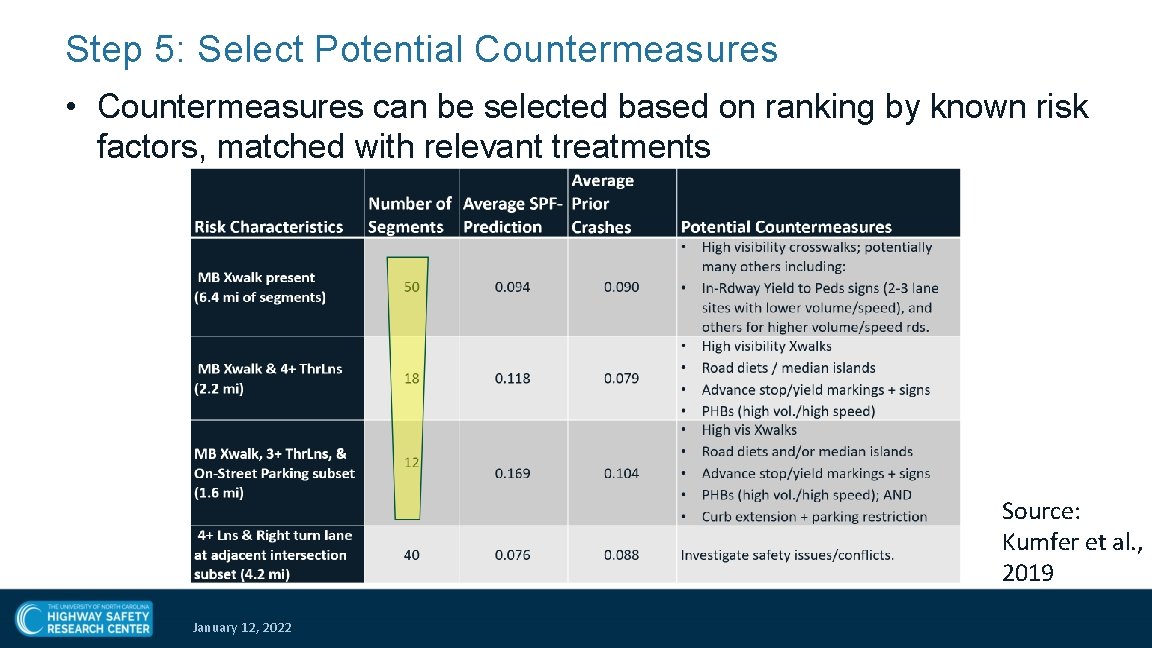
Step 5: Select Potential Countermeasures • Countermeasures can be selected based on ranking by known risk factors, matched with relevant treatments Source: Kumfer et al. , 2019 January 12, 2022
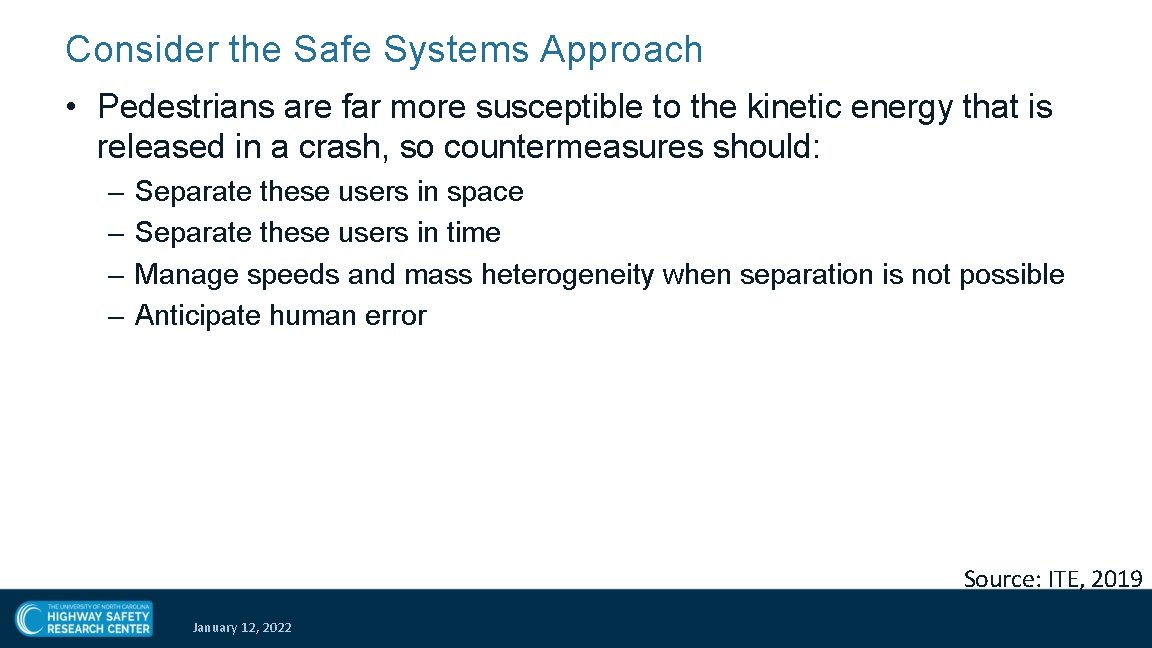
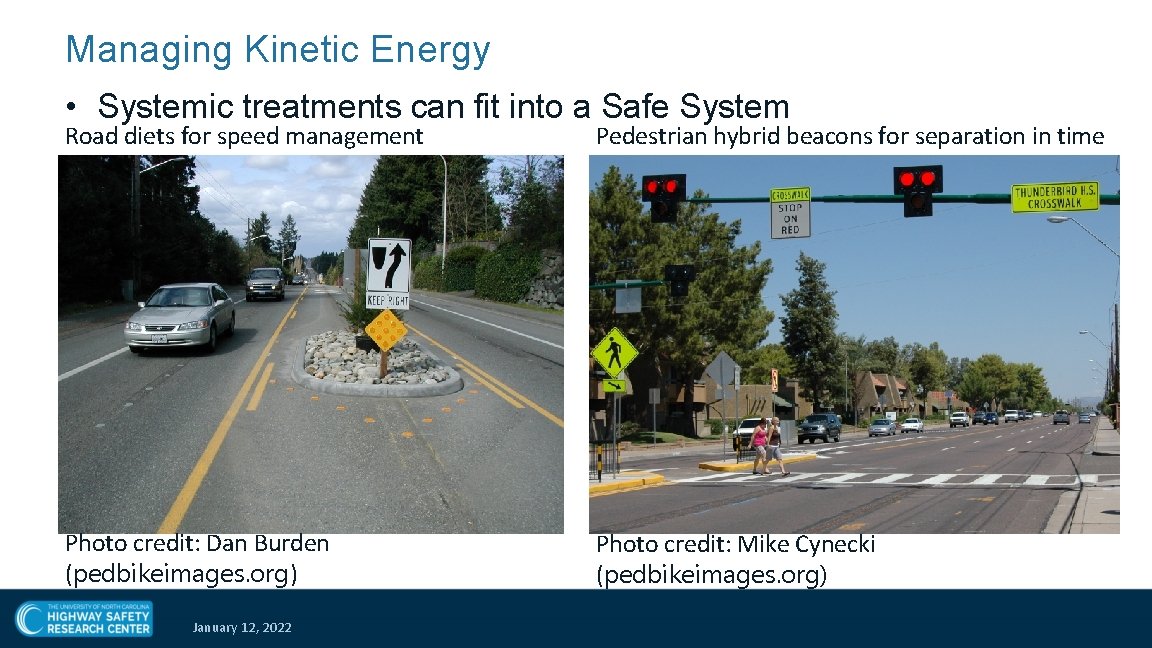
Consider the Safe Systems Approach • Pedestrians are far more susceptible to the kinetic energy that is released in a crash, so countermeasures should: – – Separate these users in space Separate these users in time Manage speeds and mass heterogeneity when separation is not possible Anticipate human error Source: ITE, 2019 January 12, 2022
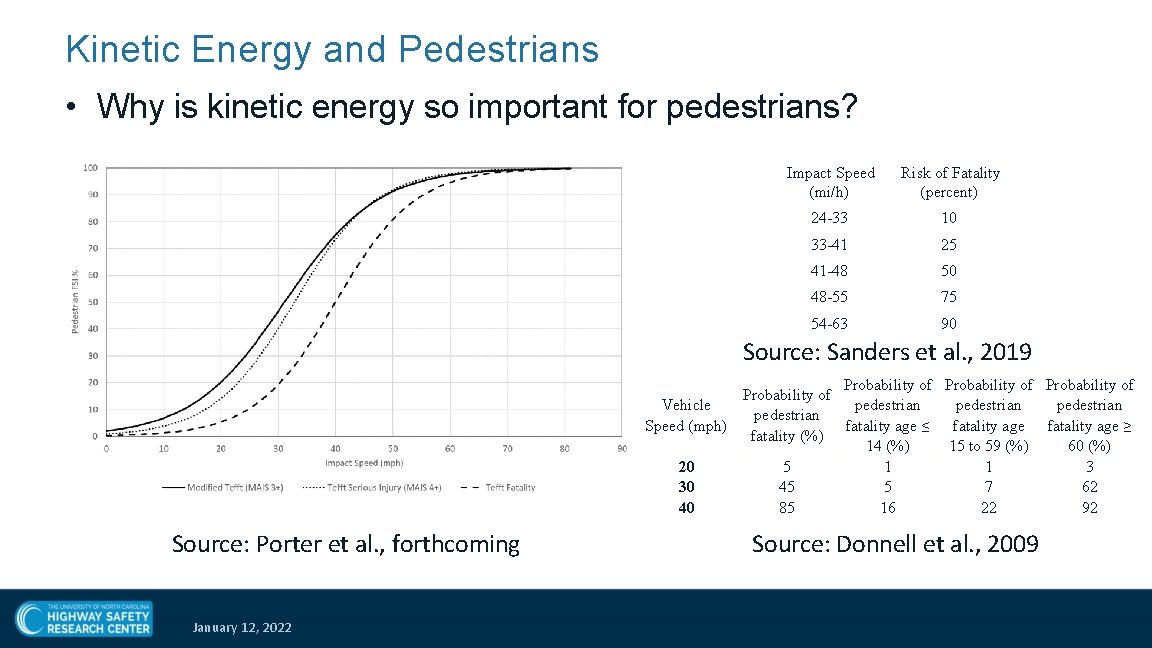
Kinetic Energy and Pedestrians • Why is kinetic energy so important for pedestrians? Impact Speed (mi/h) Risk of Fatality (percent) 24 -33 10 33 -41 25 41 -48 50 48 -55 75 54 -63 90 Source: Sanders et al. , 2019 Probability of Vehicle pedestrian Speed (mph) fatality age ≤ fatality age ≥ fatality (%) 14 (%) 15 to 59 (%) 60 (%) 20 5 1 1 3 30 45 5 7 62 40 85 16 22 92 Source: Porter et al. , forthcoming January 12, 2022 Source: Donnell et al. , 2009
Managing Kinetic Energy • Systemic treatments can fit into a Safe System Road diets for speed management Pedestrian hybrid beacons for separation in time Photo credit: Dan Burden (pedbikeimages. org) Photo credit: Mike Cynecki (pedbikeimages. org) January 12, 2022
Steps 6 and 7: Refine and Evaluate • Steps 6 (Refine and Implement Treatment Plan) and 7 (Evaluate Project and Program Impacts) were beyond our research project but are critical steps. • Step 6 might be where agencies use a benefit/cost ratio or some other measure to determine which sites to treat. • Step 7 is critical to ensure that risks have been properly addressed. You should still collect data after the treatment has been installed. • Step 7 is also important to evaluate the equitable distribution of safety interventions. You can make the biggest gains in safety in locations that have been traditionally underserved. January 12, 2022
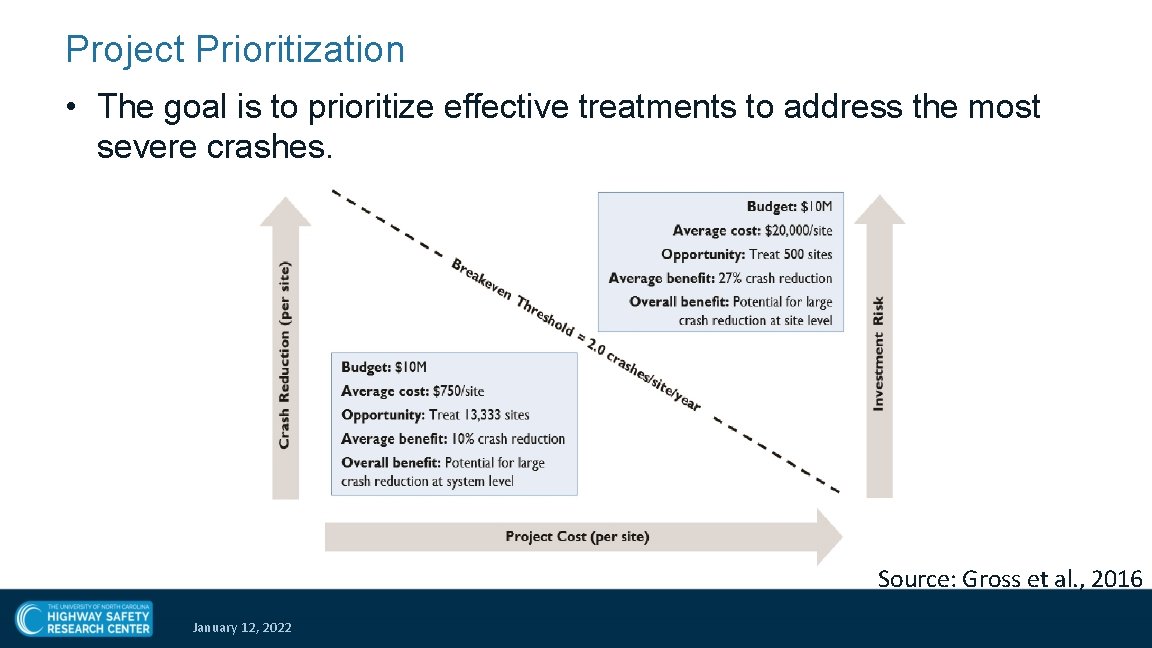
Project Prioritization • The goal is to prioritize effective treatments to address the most severe crashes. Source: Gross et al. , 2016 January 12, 2022
How have State DOTs used systemic safety approaches? January 12, 2022
Numerous Examples • NCHRP Report 893 lists several case studies based on different levels of data collection and statistical proficiency. • Since its publication, more states have adopted various systemic safety approaches, often as part of Vision Zero or Toward Zero Death initiatives. – FHWA has hosted a series of webinars on doing systemic cost analysis as part of the Focus on Reducing Rural Roadway Departures series. • Systemic safety approaches fit into Strategic Highway Safety Plans and can be used to justify the creation of new warrants. January 12, 2022
Oregon DOT • ODOT’s All Roads Transportation Safety program splits available funding (primarily Highway Safety Improvement Program funds) evenly between two project prioritization types: – Hotspot treatments – Systemic analyses further disseminated into three emphasis areas • Roadway departure • Intersection • Pedestrian/bicycle safety improvement projects – Together, these three emphasis areas account for approximately 90 percent of the fatal and injury crashes in Oregon. January 12, 2022
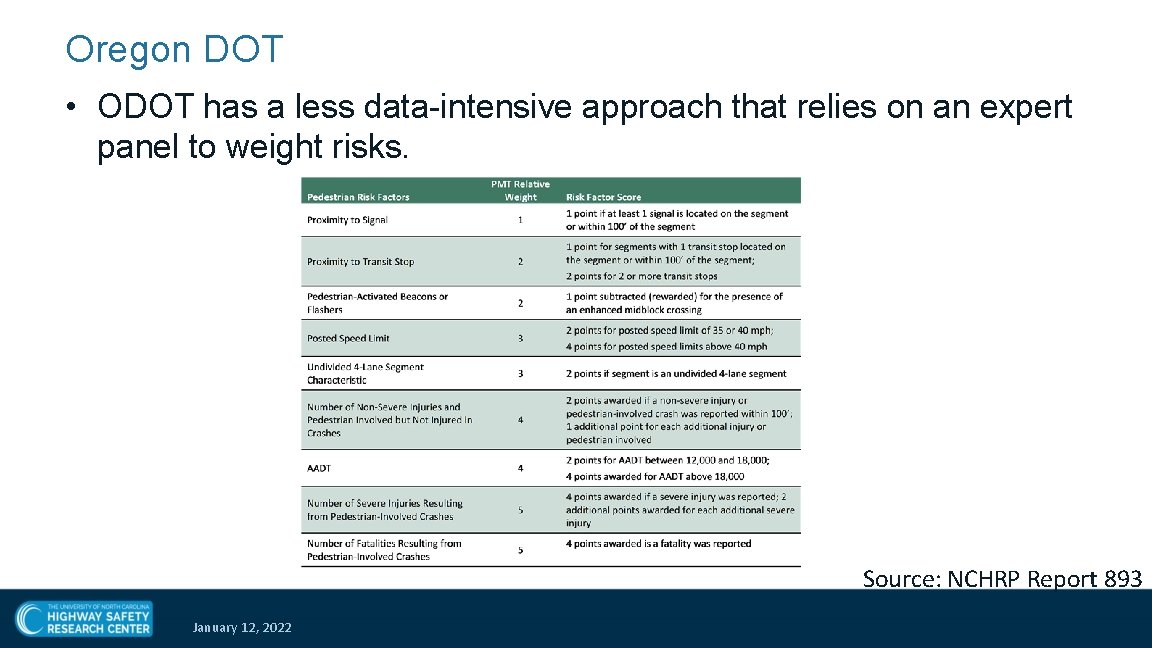
Oregon DOT • ODOT has a less data-intensive approach that relies on an expert panel to weight risks. Source: NCHRP Report 893 January 12, 2022
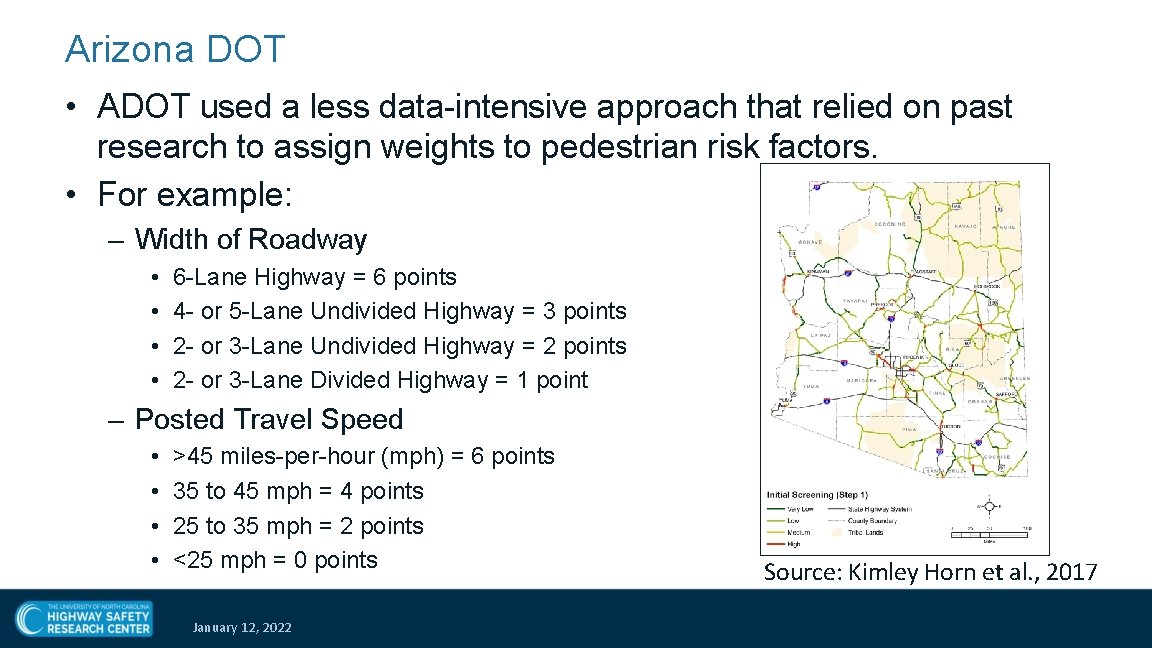
Arizona DOT • ADOT used a less data-intensive approach that relied on past research to assign weights to pedestrian risk factors. • For example: – Width of Roadway • • 6 -Lane Highway = 6 points 4 - or 5 -Lane Undivided Highway = 3 points 2 - or 3 -Lane Undivided Highway = 2 points 2 - or 3 -Lane Divided Highway = 1 point – Posted Travel Speed • • >45 miles-per-hour (mph) = 6 points 35 to 45 mph = 4 points 25 to 35 mph = 2 points <25 mph = 0 points January 12, 2022 Source: Kimley Horn et al. , 2017
Conclusions • Our roadway environments contain many risks for pedestrians. • Pedestrian crashes are widely dispersed, so identifying treatment locations can be difficult. • A systemic, risk-based approach can be useful for leveraging crash, exposure, and context data to uncover sites for treatment. • Achieving a safe system requires us to be proactive in addressing risks. January 12, 2022
Acknowledgments • I’d like to thank my colleagues and the co-authors of our TRB paper on Report 893 – Libby Thomas – Laura Sandt – Bo Lan • Also thanks to Chad and Brian for the invitation! January 12, 2022
Questions? Feel free to contact me at: Kumfer@hsrc. unc. edu January 12, 2022