
Identifying Opportunities and Challenges ITN Continuous Distribution Systems
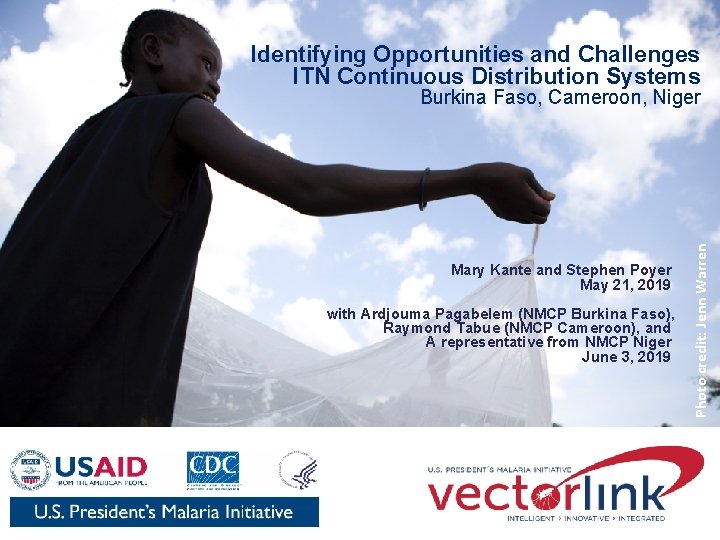
Identifying Opportunities and Challenges ITN Continuous Distribution Systems Mary Kante and Stephen Poyer May 21, 2019 with Ardjouma Pagabelem (NMCP Burkina Faso), Raymond Tabue (NMCP Cameroon), and A representative from NMCP Niger June 3, 2019 Photo credit: Jenn Warren Burkina Faso, Cameroon, Niger
Webinar Notes • Participants will be muted throughout the presentation. • To submit a question, please use the chat box. • We will answer questions and facilitate discussion at the end of the presentation. • We are recording the webinar and will share the recording with all registered participants. • If you have any problem connecting to the webinar or hearing the discussion, please notify the host, Cheyenne Cook, via the chat box. 2
INTRODUCTION 3

The PMI Vector. Link Project The U. S. President’s Malaria Initiative (PMI) Vector. Link Project builds the capacity of country governments to use epidemiological, entomological, and coverage data to support the optimal deployment of vector control tools, including IRS and ITNs within each country. 4

The PMI Vector. Link Project Partners • Abt Associates (Prime) • Population Services International (ITN Lead) and PATH; • With support from Liverpool School of Tropical Medicine, Malaria Consortium, Innovative Vector Control Consortium, Mc. Kinsey & Company, Inc. , En. Compass LLC, 5 BAO Systems LLC, and Dimagi, Inc.

Context: Universal Coverage • Achieving and maintaining Universal Coverage (UC) of ITNs (Pillar 1, WHO Global Technical Strategy) requires a combination of mass free distribution through campaigns and continuous distribution (CD) through multiple channels [Ref 1]: – Antenatal care (ANC) clinics and expanded program on immunization (EPI) - High priority – Other channels: schools, faith- and community-based networks, agriculture and food-security initiatives – Occupation-related (Asia) – Private or commercial sector to supplement free distribution [1] WHO/GMP, Achieving and maintaining universal coverage with LLINs for malaria control, December 2017 6

Context: Why Continuous Distribution? Evidence Shows • ITN coverage gaps emerge post-campaign (i. e. , due to deterioration, population growth) [Ref 1] • ITN coverage before the next campaign can diminish to 40%, potentially reducing the ‘community effect’ [Ref 2] • Continuous distribution can maintain coverage and save lives for about the same cost as mass campaigns [Ref 3] • ANC and EPI distribution are more cost effective than any type of distribution however 45% of women attending ANC and 66% of infants attending EPI do not receive a net [Ref 3] [1] WHO/GMP Recommendations 2017 [2] Kilian et al. Malar J (2017) 16: 363 Evaluation of a continuous community-based ITN distribution pilot in Lainya County, South Sudan 2012 -2013 [3] Vector. Works Insight Series, Issue #2: Is switching to continuous distribution worth it? April 2019 7

Assessment Design Purpose Identify, describe, and prioritize improvements for strengthening continuous distribution systems. Photo credit: Jenn Warren Scope Existing ANC and EPI routine ITN distribution systems Niger, Cameroon and Burkina Faso in 2018 Potential, new channels also reviewed 8

Assessment Design Evaluation Questions • To what extent is continuous ITN distribution implemented according to existing international best practice and national guidelines? • What improvements could deliver immediate, mid-term and long-term efficiencies? Methods • Desk review to inform development of discussion guide • Country document review • Teamwork approach for data collection and analysis • Key informant interviews across functions and levels 9

Analysis Framework ITN Continuous Distribution Assessment Framework Central Region / District Health facility Exploration of all potential continuous distribution channels Planning and coordination Beneficiary identification … and health system level Quantification and ITN supply Storage, transport and stock management ITN Distribution Personnel and capacity strengthening Supervision Data management Communication Learnings organized according to distribution function… 10

Cameroon Teamwork Approach Sites Teams Interviews Central Yaoundé North and Extreme North Regions Lagdo et Yagoua Health Districts North: Salomon Patchoke/NMCP, Mary Kante/PMI Vector. Link, Laure Moukam, ACMS Extreme North: Raymond Tabue/NMCP, Eloi Oboussou, PMI Vector. Link (and AMP) Consultant, Albertine Lele/ACMS Interviews with: NMCP, DSF, PLMI, WHO, UNICEF, PSM, Malaria No More Interviews with: - Governor, Regional Technical Coordinator, and FPSP in Garoua ; Representative of the Governor, Regional Health Region / Director and Regional Technical Coordinator in Maroua District - District health team, Sous-Préfet and Mayor in Lagdo - District health team, Malaria Focal Point, Surveillant Général, ANC lead in Yagoua Health facilities Interviews with Health center directors and CHWs in 11 Djippordé, Mayo Bocki, and Badankali (Lagdo) and in Dana,
Observations Recommendations All three countries Results Template In some cases Innovative ideas, Key themes In one region of one country 12

Observations Planning and Coordination All three countries • Coordination mechanisms are in place, with high-level MOH support In some cases • Some coordination gaps exist across MOH departments (e. g. , NMCP, EPI, Reproductive Health) • ITNs and other free commodities are generally managed separately to other health commodities In one region of one country • Due to disagreement on ITN stock management, one regional team has stopped ITN resupply to health centers Recommendations Innovative idea Leverage regional and district health coordination meetings to identify ITN stock-outs or overages Develop or finalize ITN distribution guidelines, instructions Reinforce coordination across MOH departments 13
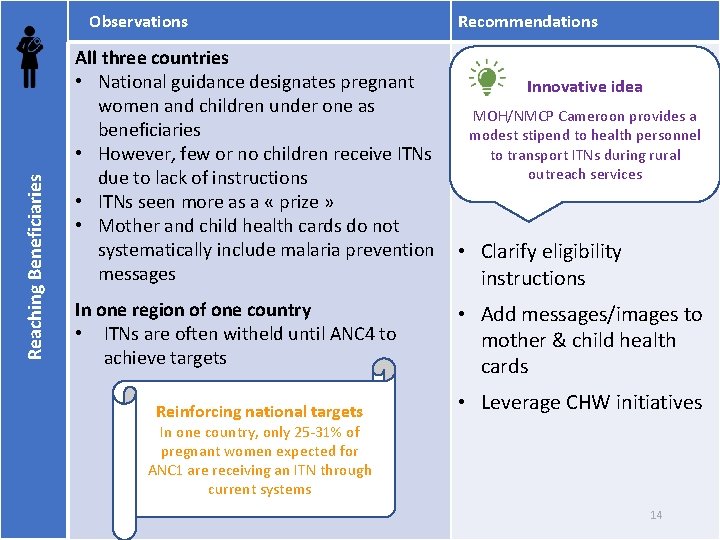
Reaching Beneficiaries Observations Recommendations All three countries • National guidance designates pregnant women and children under one as beneficiaries • However, few or no children receive ITNs due to lack of instructions • ITNs seen more as a « prize » • Mother and child health cards do not systematically include malaria prevention messages • Clarify eligibility instructions In one region of one country • ITNs are often witheld until ANC 4 to achieve targets • Add messages/images to mother & child health cards Reinforcing national targets Innovative idea MOH/NMCP Cameroon provides a modest stipend to health personnel to transport ITNs during rural outreach services • Leverage CHW initiatives In one country, only 25 -31% of pregnant women expected for ANC 1 are receiving an ITN through current systems 14

Storage, Transport, and Stock Management Observations All three countries • Lack of ITN transport from district to health facilities identified as leading cause of stock-outs • Stock management tools are used inconsistently Container storage In one district, more than 24 months of stocks are in containers under the sun In some cases: ITNs are delivered directly to districts, without notification at regional the level. With limited storage capacity, some districts dispatch immediately to health facilities (even at night). Recommendations Innovative idea In Burkina Faso, the MOH has developed a national integrated health commodity information management system and is moving to a « pull » system for all public health commodities. • Recognize that pull systems require significant investments • Ensure last-mile ITN transport • Establish stock alert systems, minimum stock level indicators • Where municipalities ensure ITN storage and transport, provide recognition and support 15
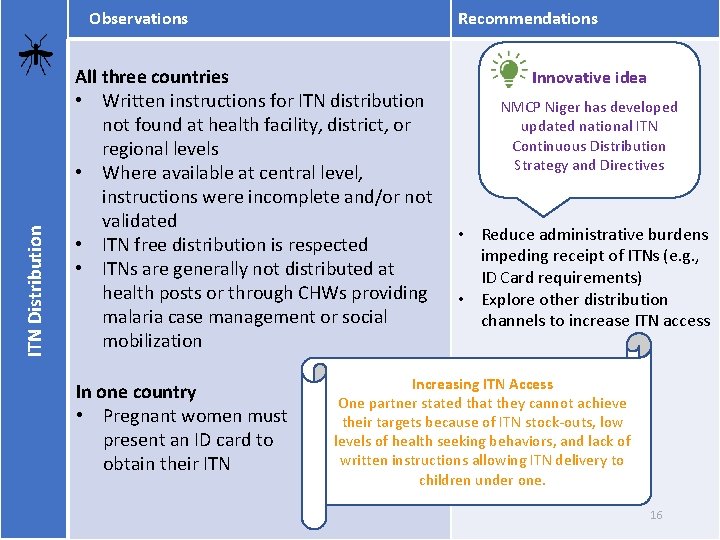
ITN Distribution Observations Recommendations All three countries • Written instructions for ITN distribution not found at health facility, district, or regional levels • Where available at central level, instructions were incomplete and/or not validated • ITN free distribution is respected • ITNs are generally not distributed at health posts or through CHWs providing malaria case management or social mobilization In one country • Pregnant women must present an ID card to obtain their ITN Innovative idea NMCP Niger has developed updated national ITN Continuous Distribution Strategy and Directives • Reduce administrative burdens impeding receipt of ITNs (e. g. , ID Card requirements) • Explore other distribution channels to increase ITN access Increasing ITN Access One partner stated that they cannot achieve their targets because of ITN stock-outs, low levels of health seeking behaviors, and lack of written instructions allowing ITN delivery to children under one. 16
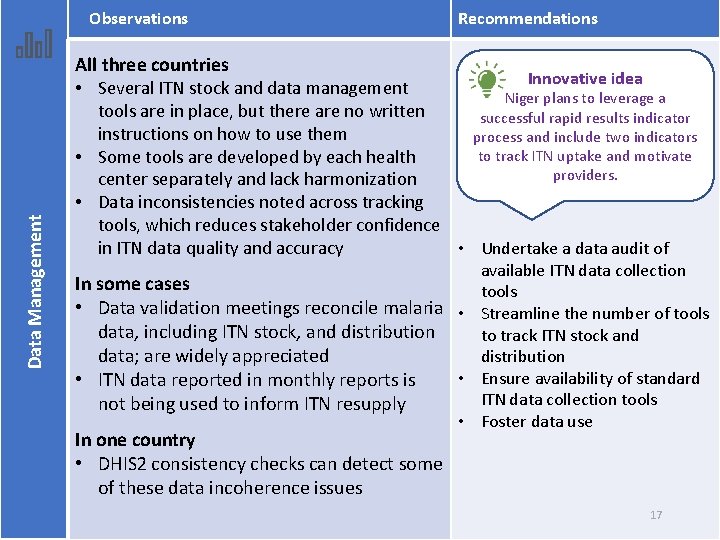
Observations Data Management All three countries • Several ITN stock and data management Recommendations Innovative idea Niger plans to leverage a successful rapid results indicator process and include two indicators to track ITN uptake and motivate providers. tools are in place, but there are no written instructions on how to use them • Some tools are developed by each health center separately and lack harmonization • Data inconsistencies noted across tracking tools, which reduces stakeholder confidence in ITN data quality and accuracy • Undertake a data audit of available ITN data collection In some cases tools • Data validation meetings reconcile malaria • Streamline the number of tools data, including ITN stock, and distribution to track ITN stock and data; are widely appreciated distribution • Ensure availability of standard • ITN data reported in monthly reports is ITN data collection tools not being used to inform ITN resupply • Foster data use In one country • DHIS 2 consistency checks can detect some of these data incoherence issues 17
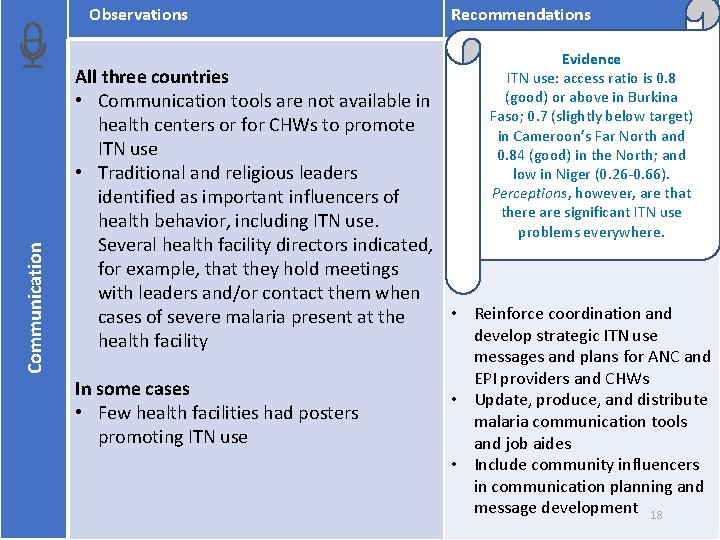
Observations Recommendations Communication Evidence ITN use: access ratio is 0. 8 (good) or above in Burkina Faso; 0. 7 (slightly below target) in Cameroon’s Far North and 0. 84 (good) in the North; and low in Niger (0. 26 -0. 66). Perceptions, however, are that there are significant ITN use problems everywhere. All three countries • Communication tools are not available in health centers or for CHWs to promote ITN use • Traditional and religious leaders identified as important influencers of health behavior, including ITN use. Several health facility directors indicated, for example, that they hold meetings with leaders and/or contact them when • Reinforce coordination and cases of severe malaria present at the develop strategic ITN use health facility In some cases • Few health facilities had posters promoting ITN use messages and plans for ANC and EPI providers and CHWs • Update, produce, and distribute malaria communication tools and job aides • Include community influencers in communication planning and message development 18
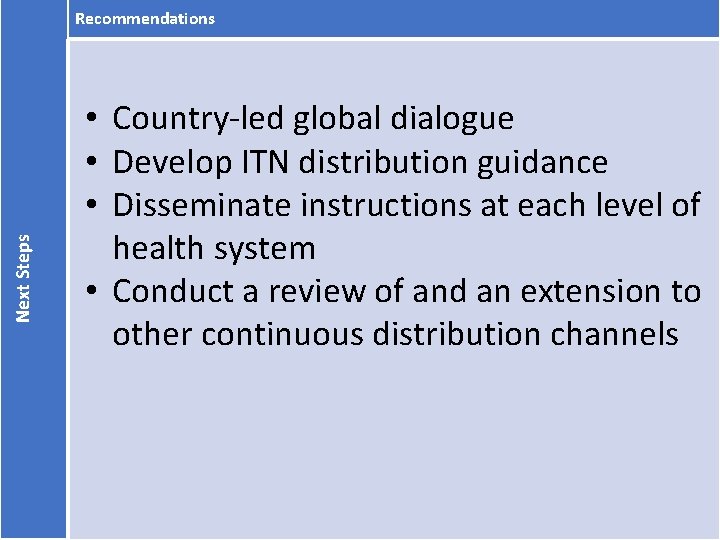
Next Steps Recommendations • Country-led global dialogue • Develop ITN distribution guidance • Disseminate instructions at each level of health system • Conduct a review of and an extension to other continuous distribution channels 19
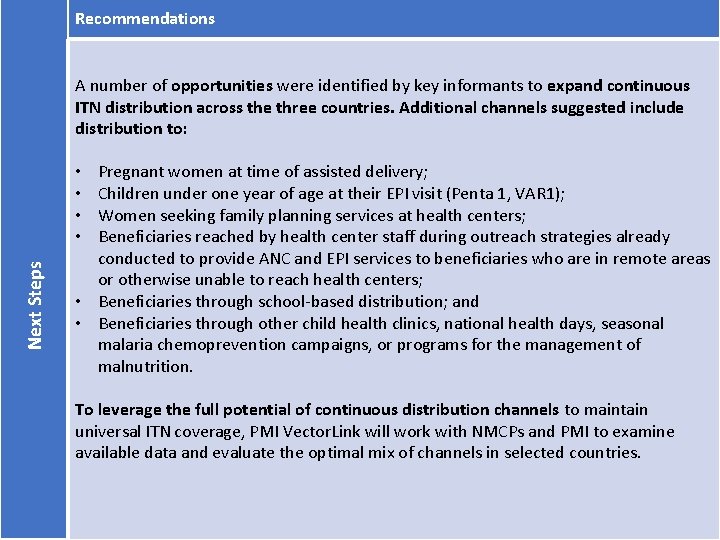
Recommendations A number of opportunities were identified by key informants to expand continuous ITN distribution across the three countries. Additional channels suggested include distribution to: Pregnant women at time of assisted delivery; Children under one year of age at their EPI visit (Penta 1, VAR 1); Women seeking family planning services at health centers; Beneficiaries reached by health center staff during outreach strategies already conducted to provide ANC and EPI services to beneficiaries who are in remote areas or otherwise unable to reach health centers; • Beneficiaries through school-based distribution; and • Beneficiaries through other child health clinics, national health days, seasonal malaria chemoprevention campaigns, or programs for the management of malnutrition. Next Steps • • To leverage the full potential of continuous distribution channels to maintain universal ITN coverage, PMI Vector. Link will work with NMCPs and PMI to examine available data and evaluate the optimal mix of channels in selected countries. 20
Acknowledgements We would like to thank the following groups for their input and support of these activities: • NMCP staff at national, regional, and local level in Burkina Faso, Cameroon, and Niger • PMI Vector. Link COR, headquarters, and country mission staff • All fieldwork colleagues from PMI Vector. Link, PSI, community health, and malaria partners • And all respondents who opened their office and clinic doors to the team and shared their experience and insights for strengthening vector control in their countries 21
THANK YOU 22
- Slides: 22