
Identifying Needs of NonMinority Students Presented By Joshua
Identifying Needs of Non-Minority Students Presented By: Joshua Moore, Stephanie Keene, Franeisha Jones, and Tim Gray 11/6/08 CNS 572 - The College Student Experience
White Identity Development Model • Created by Janet Helms – Model based on the process of moving toward a nonracist white identity – Identified 3 types of racism • Individual • Institutional • Cultural
White Identity Development Model • Features two phases – Abandonment of racism – Defining a nonracist white identity
White Identity Development Model • Phase 1: Abandonment of Racism – Status 1: Contact – Status 2: Disintegration – Status 3: Reintegration

White Identity Development Model • Phase 2: Defining a Nonracist White Identity – Status 4: Psuedo-Independence – Status 5: Immersion-Emersion – Status 6: Autonomy
Chickering's Theory on Student Development • 7 vectors – Achieving competence • Developing intellectual, physical, manual, a social competencies that lead to achievement – Managing emotions • Seeing the origin of emotion and being able to control those emotions.
Chickering’s Theory on Student Development – Developing Autonomy • Emotional and Instrumental Autonomy – Being held accountable and interdependent – Establishing Identity • Constructing your image, meeting physical needs, clarifying sexual identity, establishing a sense of self

Chickering’s Theory on Student Development – Freeing of Interpersonal Relationships • Developing tolerance, intimacy, trust, and creating rules for parenting, dating, marriage, and friendships – Developing a Purpose • Creating goals for career, recreation, leisure, etc. – Developing Integrity • Constructing a belief system regarding social responsibility, ethics, and political activity.
Creating an Identity • Social and service organizations help non-minority students have a sense of belonging • Though they create an identity for nonminority and non-minority students alike, statistics have shown that non-minority students take more advantage of joining organizations
Going Greek • Greek organizations are one the biggest ways non-minorities students can create a sense of identity • Provides them a group of people with whom they are similar to, while having activities to get them out interacting with others and being involved on campus
Famous Greeks • Blanche Lamber, Chi Omega Sorority, member of the U. S. House of Representatives • Joan Ganz Cooney, Kappa Alpha Theta Sorority, Creator of Sesame Street • Colonel Sanders, Pi Kappa Alpha Fraternity, Founder of KFC • Tom Johnson, Sigma Nu Fraternity, CEO of CNN
Perceptions of Greek Life • • Negative Paying for friends Promiscuity Alcohol Peer Pressures • • • Positive Community service Learning to work with others Campus Involvement Responsibility Networking
Postives • • • Community service Learning to work with others Campus Involvement Responsibility Networking
Service Organizations • Similar to Greek life • Service Organizations create an identity for non-minority students while bringing them around people whom they are similar to
Examples of WKU Service Organizations • • Student Volunteer Bureau Green Toppers Student Alumni Association Unite for Site
Negative & Positive Stereotypes Negative • Time constraints • Selected to only that identity • Stereotypes • • Positive Similar to Greek organizations Campus and community involvement Sense of accomplishment Networking
University Organizations • Various other activities exist at all universities that non-minority students can get involved with that gives then a sense of belonging • University organizations are usually more targeted towards a students’ particular area of interest • Examples: College democrats, College Republicans, Student Government, & Student Newspaper
Positives & Negatives • Networking • More enjoyable(usually their passion) • Often within their major, providing work experience • Time constraints • Sometimes exclusive
Stereotypes • Fixed impressions, exaggerated or preconceived ideas about particular social groups, usually based solely on physical appearance. Franeisha
Commonly Known Stereotypes • • • Assertive Dishonest Evil Greedy Lacking athleticism Lusting for power • • • Racist Untrustworthy Smart Unclean Lacking Rhythm Franeisha
Impact of Stereotypes • Eliminate the challenges of understanding people who are different from ourselves • Create a general overview for whole groups of people, dictating how me must act and what to expect • Generally inaccurate and used as a method of avoiding certain issues or situations Franeisha
Impact Cont… • Used to separate “their” behavior from ‘my” behavior • As humans we tend to feel like other cultures are different and therefore we observe them as being wrong, therefore developing stereotypes • Prevent us from identifying our true feelings Franeisha
Media Affect Stereotypes • Stereotypes act as quick references for common understanding of a person or group of people, usually relating to their class, ethnicity, or race, gender, sexual orientation, social role, or occupation Franeisha
We must not allow other peoples’ limited perceptions to define us. Virginia Satire Franeisha
WHAT IS WHITE PRIVILEGE? “White privilege” is a name for the unearned advantages and benefits that accrue to “white” (or lighter skinned) people by virtue of a system that establishes the experiences, values, and perceptions of their group as the norm and what is most desired or esteemed. White privilege Ø (1) automatically confers dominance to one group, while subordinating groups of color in a descending relational hierarchy, Ø (2) owes its existence to the history and ideology of White supremacy, both as an idea and a set of legal and social practices Ø (3) is premised on the mistaken notion of individual meritocracy and deservingness (hard work, family values, etc. ) rather than favoritism, Ø (4) is deeply embedded in the structural, systemic and cultural workings of U. S. society and Ø (5) operates within an invisible veil of unspoken and protected secrecy. Ø (6) means not having to think about race all the time--the privilege to enjoy the benefits of whiteness without acknowledging those advantages and while denying that “race matters”
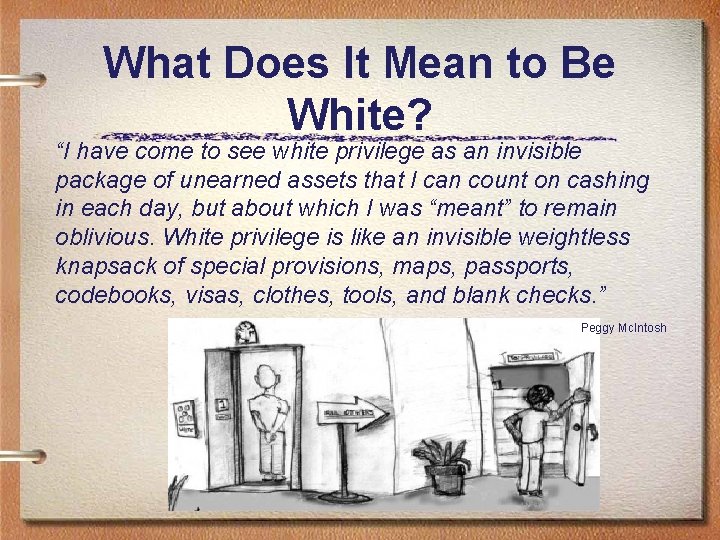
What Does It Mean to Be White? “I have come to see white privilege as an invisible package of unearned assets that I can count on cashing in each day, but about which I was “meant” to remain oblivious. White privilege is like an invisible weightless knapsack of special provisions, maps, passports, codebooks, visas, clothes, tools, and blank checks. ” Peggy Mc. Intosh
WHAT DOES IT MEAN TO BE WHITE? Ø 42 -year old White businessman Ø A: Frankly, I don’t know what you’re talking about! Ø Q: Aren’t you White? Ø A: Yes, but I come from Italian heritage. I’m Italian, not White. Ø Q: Well then, what does it mean to be Italian? Ø A: Pasta, good food, love of wine (obviously agitated). This is getting ridiculous!
WHAT DOES IT MEAN TO BE WHITE? Ø 26 -year-old White female college student Ø A: Is this a trick question? . . . I’ve never thought about it. . . Well, I know that lots of Black people see us as being prejudiced and all that stuff. I wish people would just forget about race differences and see one another as human beings. People are people and we should all be proud to be Americans.
WHAT DOES IT MEAN TO BE WHITE? Ø 34 -year-old White female stockbroker Ø A: I don’t know (laughing), I’ve never thought about it. Ø Q: Are you White? Ø A: Yes, I suppose so (seems very amused). Ø Q: Why haven’t you thought about it? Ø A: Because it’s not important to me. Ø Q: Why not? Ø A: It doesn’t enter into my mind because it doesn’t affect my life. Besides, we are all individuals. Color isn’t important.
WHITE REACTIONS TO WHITENESS Ø White people: Ø (1) Often find the question perplexing, Ø (2) Would rather not think about their whiteness, Ø (3) Are uncomfortable or react negatively to being labeled “White” Ø (4) Deny its importance in affecting their lives Ø (5) Seem to believe that they are unjustifiably accused of being bigoted or racist by virtue of being White.
Whiteness and Color Blindness Ø The pretense by White Americans that they do not see color is motivated by the need to appear free of bias and prejudice, fears that what they say or do may appear racist or as an attempt to cover up hidden biases. Ø To be color blind not only denies the central importance of racial differences in the psychological experience of minorities (racism and discrimination), but also allows the White person to deny how his or her whiteness intrudes upon the person of color.
Diversity Means… • For minority high school students, "diversity" is a code word in recruiting materials reassuring them that they will enjoy some ethnic homogeneity on campus, that there will be others just like themselves to hang out with. • For white teens, however, "diversity" promises the prestige of the exotic, an escape from the vast white middle class suburbs where they grew up to a more exciting and elite world.
7 Student Affairs Core Competencies • • Theory & Translation Administrative & Management Skills Helping & Interpersonal Skills Assessment & Evaluation Teaching & Training Ethical & Legal Experience Multicultural Awareness, knowledge, & skills Pope, R. L. , and Reynolds, A. L. “Student Affairs Core Competencies: Integrating Multicultural Awareness, Knowledge, and Skills. ” Journal of College Student Development, 1997, 38, 266 -275
Best Administration Practices • Create a mechanism whereby entry-level professionals and paraprofessionals are made aware of the unique relationship they have with students • Design and implement student affairs educational programs that promote interpersonal understanding, cooperation, conflict resolution, and crisis intervention
Promoting Diversity: Practice & Applications • Training programs to address multicultural issues and prepare culturally sensitive and skilled student affairs practitioners • Teach from a more relevant and inclusive curricula
Promoting Diversity: Practice & Applications • Be aware of equity issues. Understand that “treating everyone the same may not lead to equity • Design and implement student affairs educational programs that promote interpersonal understanding, cooperation, conflict resolution, and crisis intervention
Promoting Diversity: Practice & Applications • Evaluate the mission statement and policies of the institution to determine whether they are inclusive of issues related to diversity and to students from diverse backgrounds. • Clarify the meaning and scope of diversity as it relates to your campus and its student population • Be familiar with the recruitment policies of the institution
Conclusion “Walk the Line”
- Slides: 38