
Identifying managing Fear of Falling Presentation by Associate
Identifying & managing Fear of Falling Presentation by Associate Professor Kim Delbaere NSW Falls Prevention Network Rural Forum - Northern NSW LHD (Ballina) Friday 1 November 2019
1. Understanding fear of falling 2. Managing fear of falling

Fear of falling • Important psychological factor associated with falls in older people (since 1982) – Fear of falling is a persistent feeling related to the risk of falling during one or more activities of daily living • Prevalence – – 29 -92% in older people who have already fallen 12 -65% in older people who have NOT fallen Women > men Increases with age • Many associated factors
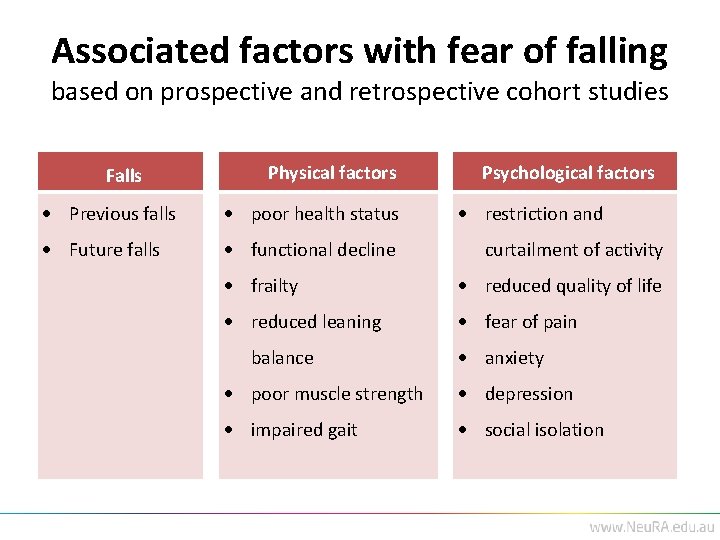
Associated factors with fear of falling based on prospective and retrospective cohort studies Falls Physical factors Previous falls poor health status Future falls functional decline Psychological factors restriction and curtailment of activity frailty reduced quality of life reduced leaning fear of pain balance anxiety poor muscle strength depression impaired gait social isolation

Mechanisms in relation to falls Reduced level of activity Fear of falling Falls Social isolation Reduced physical function Difficulties in daily life
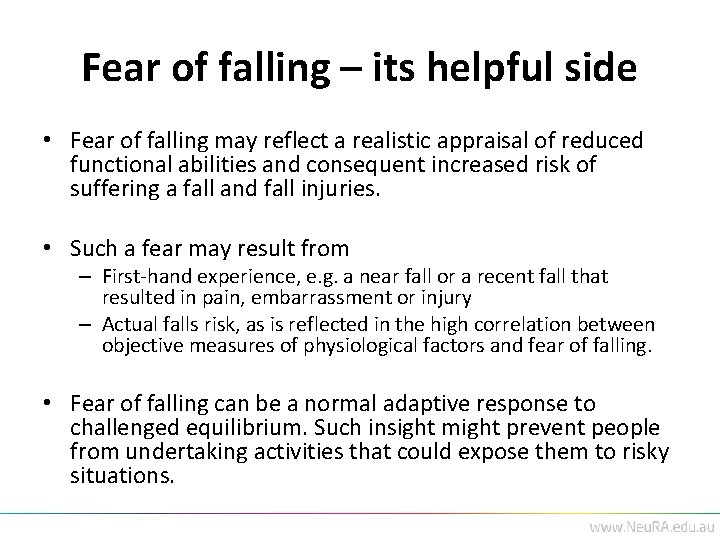
Fear of falling – its helpful side • Fear of falling may reflect a realistic appraisal of reduced functional abilities and consequent increased risk of suffering a fall and fall injuries. • Such a fear may result from – First-hand experience, e. g. a near fall or a recent fall that resulted in pain, embarrassment or injury – Actual falls risk, as is reflected in the high correlation between objective measures of physiological factors and fear of falling. • Fear of falling can be a normal adaptive response to challenged equilibrium. Such insight might prevent people from undertaking activities that could expose them to risky situations.
Fear of falling – its unhelpful side • Fear of falling can be irrational, excessive or phobic which then results in a persistent and dysfunctional disruption of attention and behaviour. • Such a fear may result from – Catastrophizing or thinking the worst of events • Fear of falling may then have a detrimental effect upon several domains of life, including the needless restriction of activities of daily living and enjoyable pastimes, which may, then, lead to physical inactivity and social isolation.
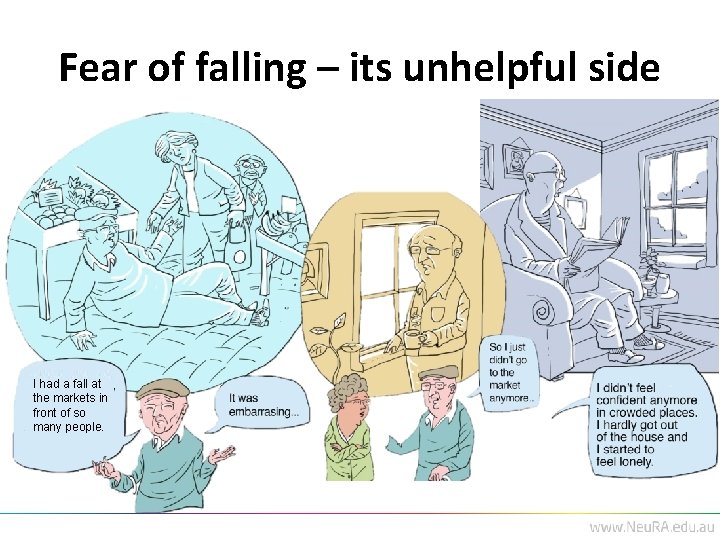
Fear of falling – its unhelpful side I had a fall at the markets in front of so many people.
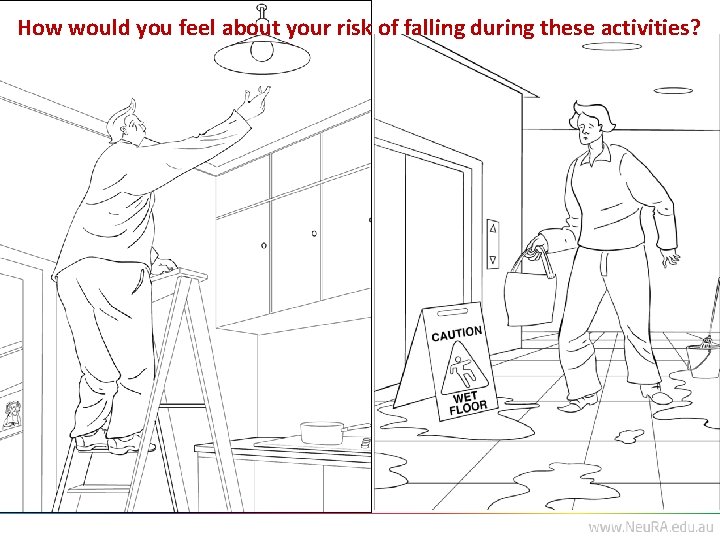
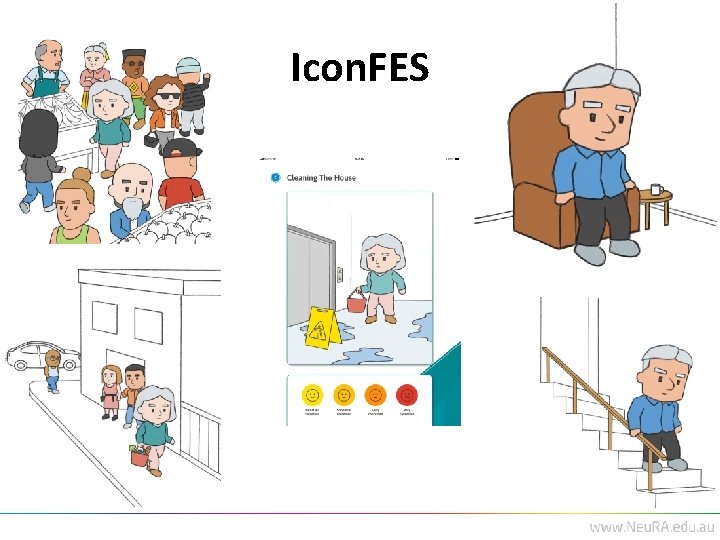
How would you feel about your risk of falling during these activities?

Perceived fall risk Fear of falling: helpful vs unhelpful? Anxious Frail Vigorous Stoics Actual fall risk DELBAERE K, Close JCT, Brodaty H, Sachdev P, Lord SR. Determinants of disparities between perceived and physiological risk of falling among elderly people: Cohort study. BMJ. 2010; 341(c 4165): 1 -8
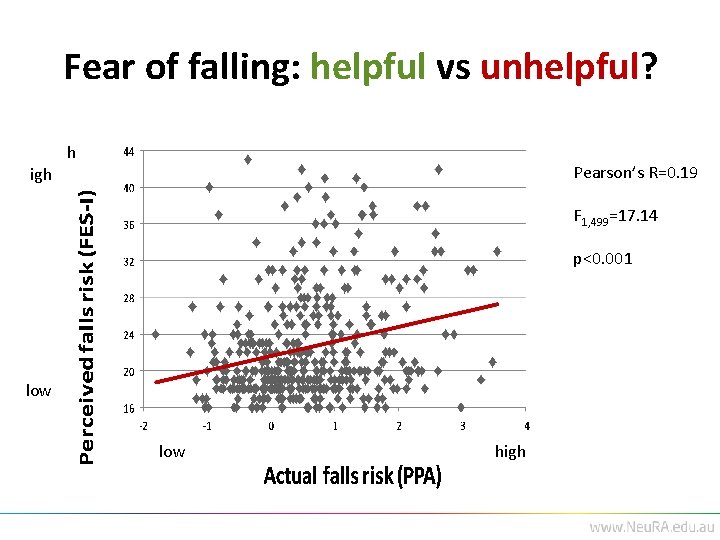
Fear of falling: helpful vs unhelpful? igh h Pearson’s R=0. 19 F 1, 499=17. 14 p<0. 001 low high

Perceived fall risk HIGH Fear of falling: helpful vs unhelpful? Anxious worriers (10%) 40% falls Frail aware (40%) 40% falls LOW Stoics (20%) Vigorous (30%) 20% falls aka Aussie Battlers 30% falls LOW HIGH Actual fall risk Delbaere et al, BMJ 2010
Summary findings • Many older people under or over estimate their risk of falling • Disparities between perceived and physiological fall risk influence the probability of falling – Worriers have a higher falls rate despite low actual risk – Battlers have a low perceived risk despite high actual risk + slightly lower falls rate • Fear of falling leads to falls, independent of physiological fall risk factors
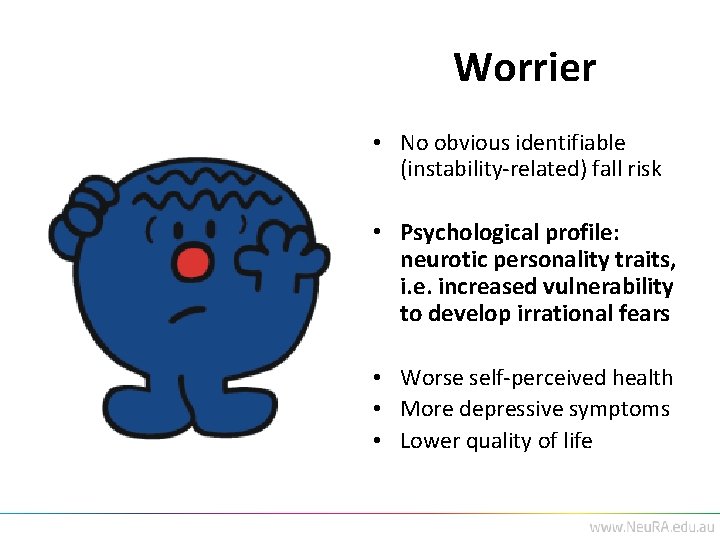
Worrier • No obvious identifiable (instability-related) fall risk • Psychological profile: neurotic personality traits, i. e. increased vulnerability to develop irrational fears • Worse self-perceived health • More depressive symptoms • Lower quality of life
Age-related physical decline is normal • Age-related physical decline requires continuous adjustments of the perception of how well people are able to do certain activities. • Based on their perception, they will have to select an appropriate behaviour as well as motor strategy to be able to conduct the activity without falling. • How do people achieve this?

Fear of falling induces gait adaptations Cautious gait: % appropriate excessive Gait speed Decreases Step length walking Single Support time stability and could therefore Not fearful increase fall Fearful risk rather than protect against it
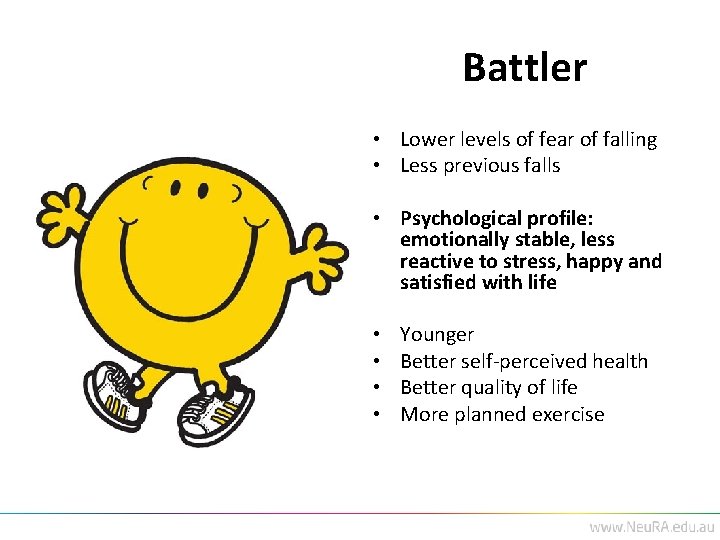
Battler • Lower levels of fear of falling • Less previous falls • Psychological profile: emotionally stable, less reactive to stress, happy and satisfied with life • • Younger Better self-perceived health Better quality of life More planned exercise
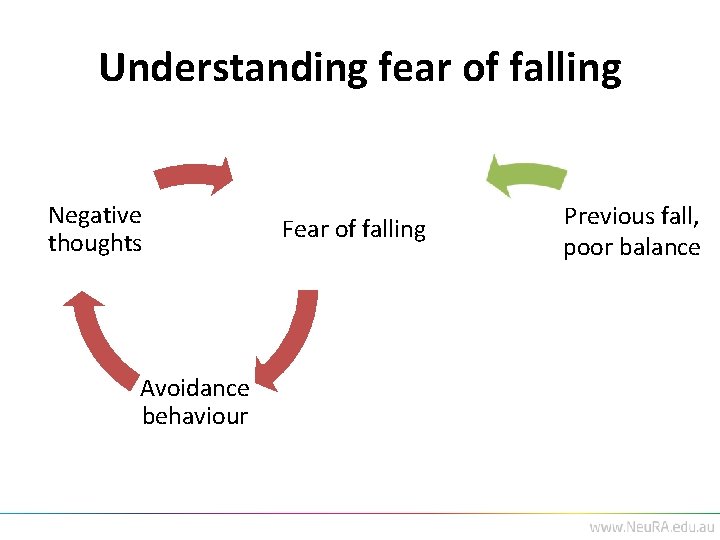
Understanding fear of falling Negative thoughts Avoidance behaviour . of falling Fear Previous fall, poor balance Adaptive behaviour

www. neura. edu. au /apps/iconfes/ 30 -item: <53 10 -item: <19 30 -item: • low (30 -40) • medium (41 -58) • high (59 -120)
Icon. FES
1. Understanding fear of falling 2. Managing fear of falling
What does fear of falling tell us? • The presence of fear of falling is likely to be a sign that something is wrong: – The person has an accurate perception of falls risk – The person is spiralling into a vicious circle of general frailty through depression or other psychological factors • Lower levels of fear of falling are likely to be protective of falls: – The person has an low actual falls risk – The person has a positive attitude to life and has engaged him/herself in falls preventative activities
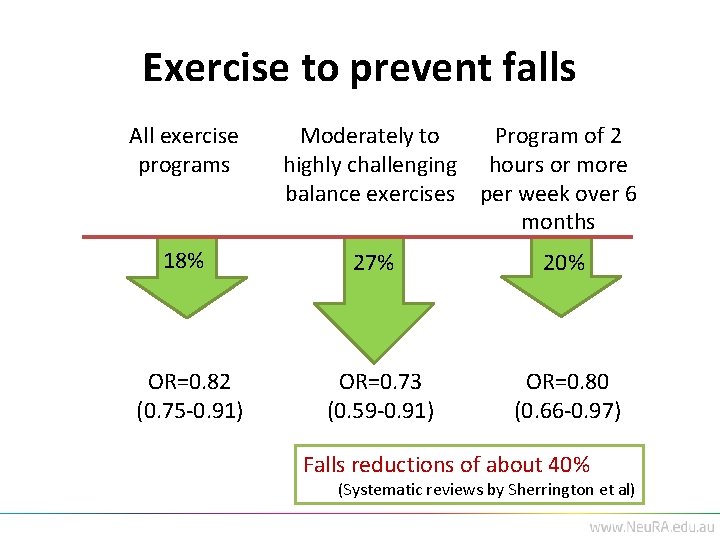
Exercise to prevent falls All exercise programs Moderately to Program of 2 highly challenging hours or more balance exercises per week over 6 months 18% 27% 20% OR=0. 82 (0. 75 -0. 91) OR=0. 73 (0. 59 -0. 91) OR=0. 80 (0. 66 -0. 97) Falls reductions of about 40% (Systematic reviews by Sherrington et al)
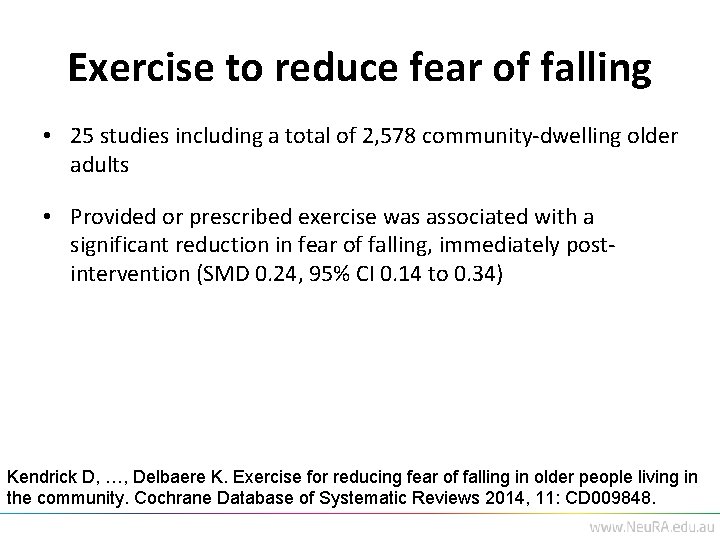
Exercise to reduce fear of falling • 25 studies including a total of 2, 578 community-dwelling older adults • Provided or prescribed exercise was associated with a significant reduction in fear of falling, immediately postintervention (SMD 0. 24, 95% CI 0. 14 to 0. 34) Kendrick D, …, Delbaere K. Exercise for reducing fear of falling in older people living in the community. Cochrane Database of Systematic Reviews 2014, 11: CD 009848.
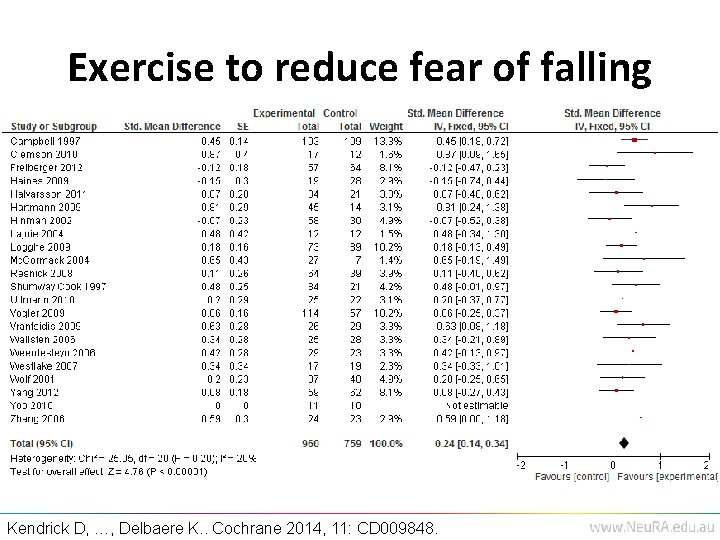
Exercise to reduce fear of falling Kendrick D, …, Delbaere K. . Cochrane 2014, 11: CD 009848.
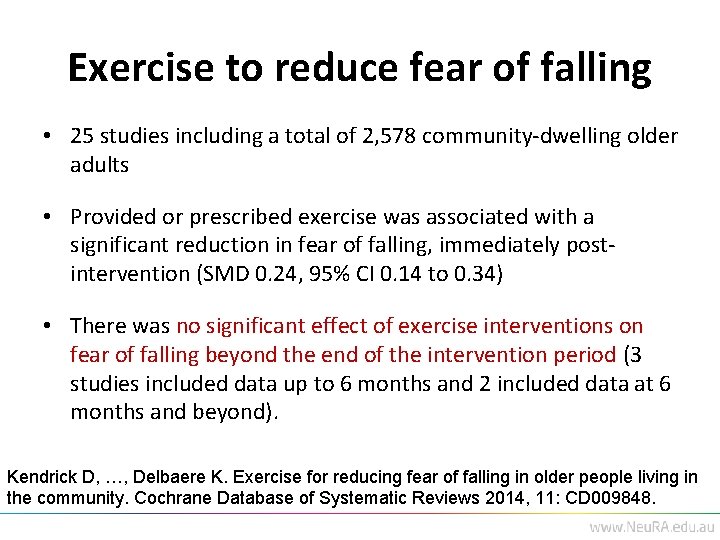
Exercise to reduce fear of falling • 25 studies including a total of 2, 578 community-dwelling older adults • Provided or prescribed exercise was associated with a significant reduction in fear of falling, immediately postintervention (SMD 0. 24, 95% CI 0. 14 to 0. 34) • There was no significant effect of exercise interventions on fear of falling beyond the end of the intervention period (3 studies included data up to 6 months and 2 included data at 6 months and beyond). Kendrick D, …, Delbaere K. Exercise for reducing fear of falling in older people living in the community. Cochrane Database of Systematic Reviews 2014, 11: CD 009848.
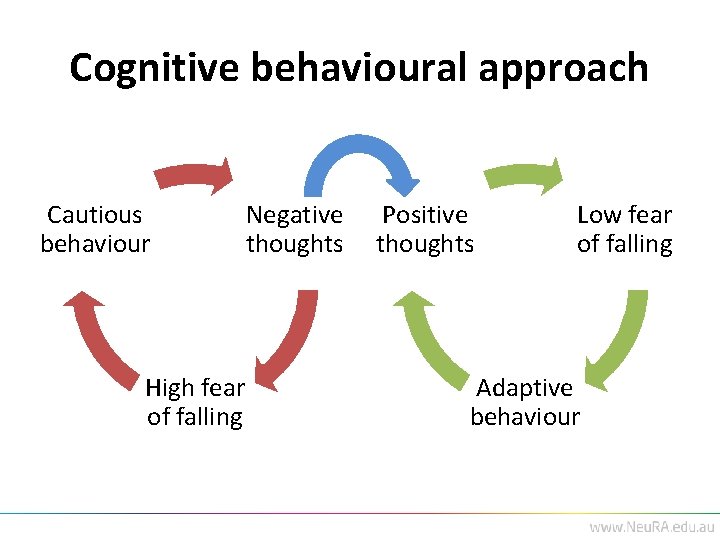
Cognitive behavioural approach Cautious behaviour High fear of falling Negative thoughts Positive thoughts Low fear of falling Adaptive behaviour
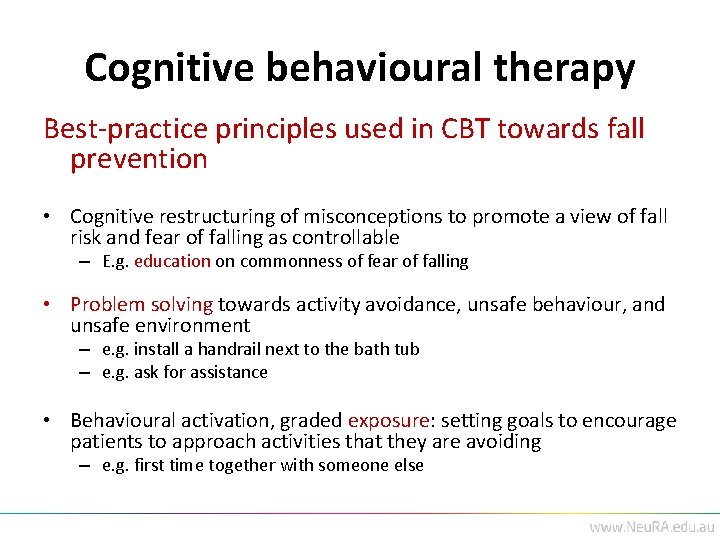
Cognitive behavioural therapy Best-practice principles used in CBT towards fall prevention • Cognitive restructuring of misconceptions to promote a view of fall risk and fear of falling as controllable – E. g. education on commonness of fear of falling • Problem solving towards activity avoidance, unsafe behaviour, and unsafe environment – e. g. install a handrail next to the bath tub – e. g. ask for assistance • Behavioural activation, graded exposure: setting goals to encourage patients to approach activities that they are avoiding – e. g. first time together with someone else
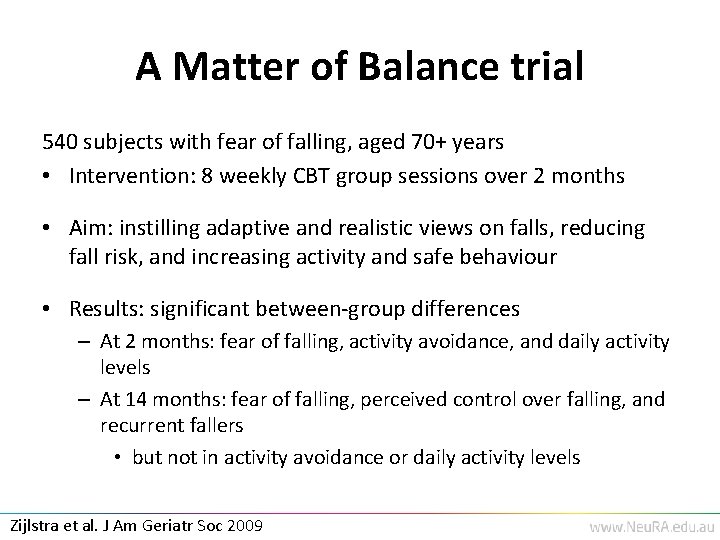
A Matter of Balance trial 540 subjects with fear of falling, aged 70+ years • Intervention: 8 weekly CBT group sessions over 2 months • Aim: instilling adaptive and realistic views on falls, reducing fall risk, and increasing activity and safe behaviour • Results: significant between-group differences – At 2 months: fear of falling, activity avoidance, and daily activity levels – At 14 months: fear of falling, perceived control over falling, and recurrent fallers • but not in activity avoidance or daily activity levels Zijlstra et al. J Am Geriatr Soc 2009
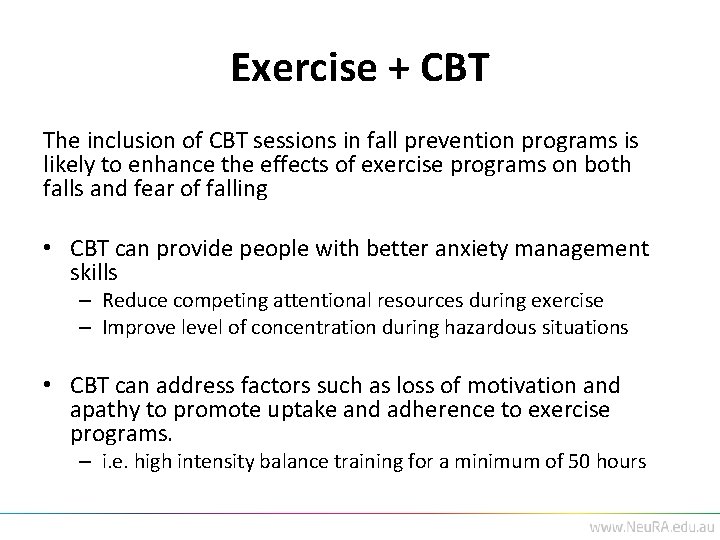
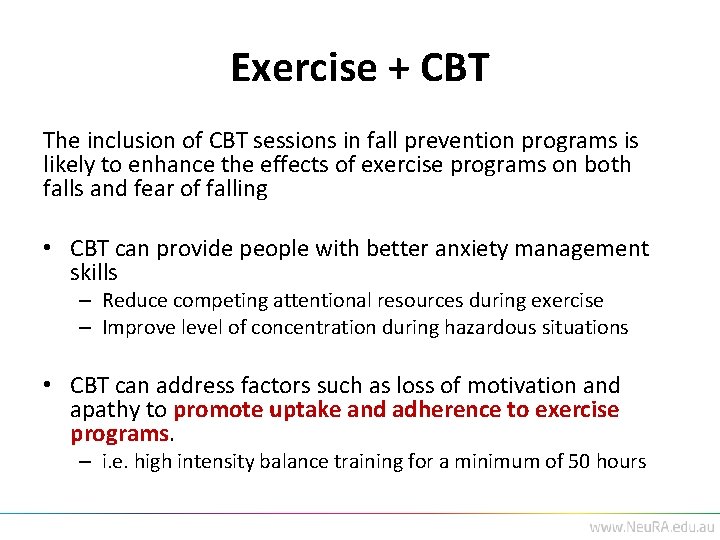
Exercise + CBT The inclusion of CBT sessions in fall prevention programs is likely to enhance the effects of exercise programs on both falls and fear of falling • CBT can provide people with better anxiety management skills – Reduce competing attentional resources during exercise – Improve level of concentration during hazardous situations • CBT can address factors such as loss of motivation and apathy to promote uptake and adherence to exercise programs. – i. e. high intensity balance training for a minimum of 50 hours
Exercise + CBT The inclusion of CBT sessions in fall prevention programs is likely to enhance the effects of exercise programs on both falls and fear of falling • CBT can provide people with better anxiety management skills – Reduce competing attentional resources during exercise – Improve level of concentration during hazardous situations • CBT can address factors such as loss of motivation and apathy to promote uptake and adherence to exercise programs. – i. e. high intensity balance training for a minimum of 50 hours
CONCLUSION Summary
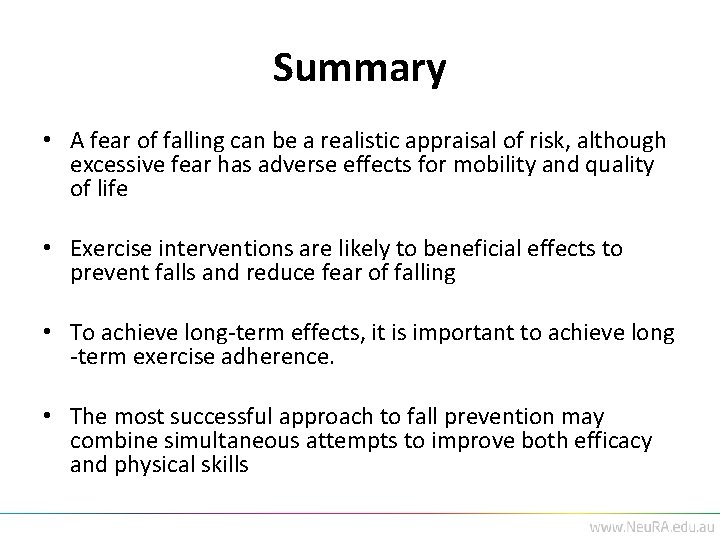
Summary • A fear of falling can be a realistic appraisal of risk, although excessive fear has adverse effects for mobility and quality of life • Exercise interventions are likely to beneficial effects to prevent falls and reduce fear of falling • To achieve long-term effects, it is important to achieve long -term exercise adherence. • The most successful approach to fall prevention may combine simultaneous attempts to improve both efficacy and physical skills

Thank you! For further questions Contact: Kim Delbaere k. delbaere@neura. edu. au
- Slides: 34