
IDENTIFYING GRAPHING SEQUENCES Algebra 1 Sequence a list
IDENTIFYING & GRAPHING SEQUENCES Algebra 1
Sequence a list of numbers in a specific order. Each element in a sequence is called a term.
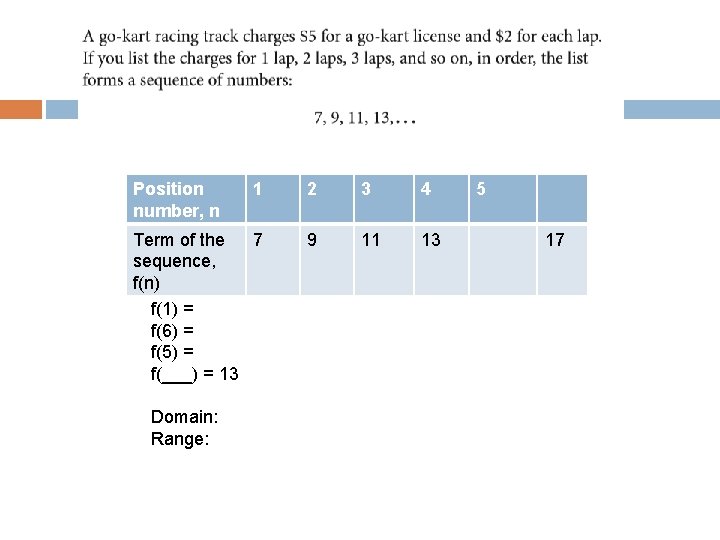
Position number, n 1 2 3 4 Term of the 7 sequence, f(n) f(1) = f(6) = f(5) = f(___) = 13 9 11 13 Domain: Range: 5 17
Explicit rule defines the nth term as a function of n for any whole number n greater than 0. Explicit rules can be used to find any specific term in a sequence without finding any of the previous terms.
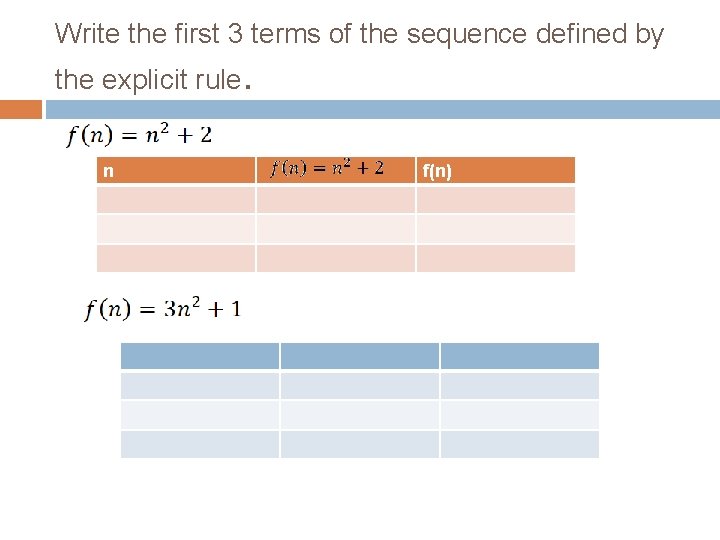
Write the first 3 terms of the sequence defined by the explicit rule. n f(n)

Recursive rule A sequence defines the nth term by relating it to one or more previous terms.
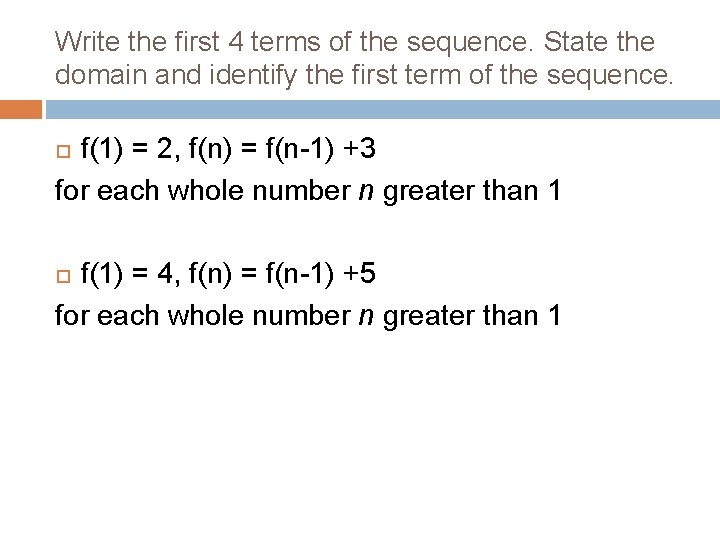
Write the first 4 terms of the sequence. State the domain and identify the first term of the sequence. f(1) = 2, f(n) = f(n-1) +3 for each whole number n greater than 1 f(1) = 4, f(n) = f(n-1) +5 for each whole number n greater than 1
Constructing and Graphing Sequences You can graph a sequence on a coordinate plane by plotting the points (n, f(n)) indicated in a table that you use to generate the terms
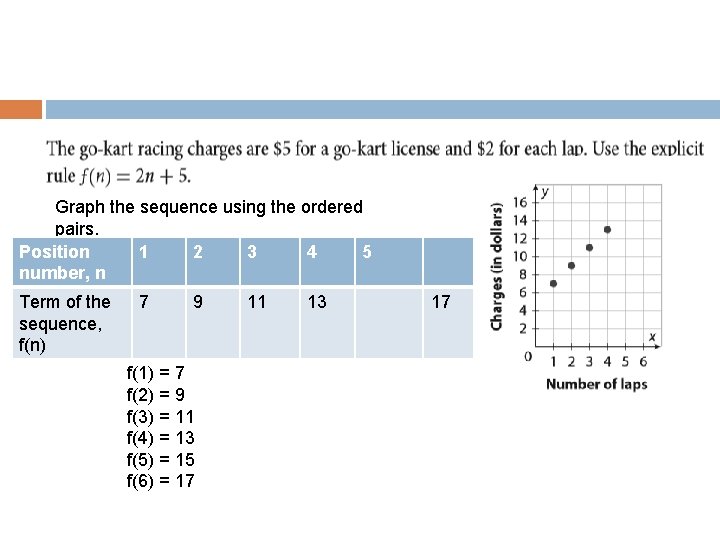
Graph the sequence using the ordered pairs. Position 1 2 3 4 5 number, n Term of the sequence, f(n) 7 9 f(1) = 7 f(2) = 9 f(3) = 11 f(4) = 13 f(5) = 15 f(6) = 17 11 13 17

Construct and graph the sequence described. A pizza place is having a special. If you order a large pizza for a regular price $17, you can order any number of additional pizzas for $8. 50 each. Use the recursive rule ƒ (1) = 17 and ƒ (n) = ƒ (n - 1) + 8. 5 for each whole number n greater than 1 ( up to 4 slices)
- Slides: 10