
Identifying Export Opportunities of China in One Belt
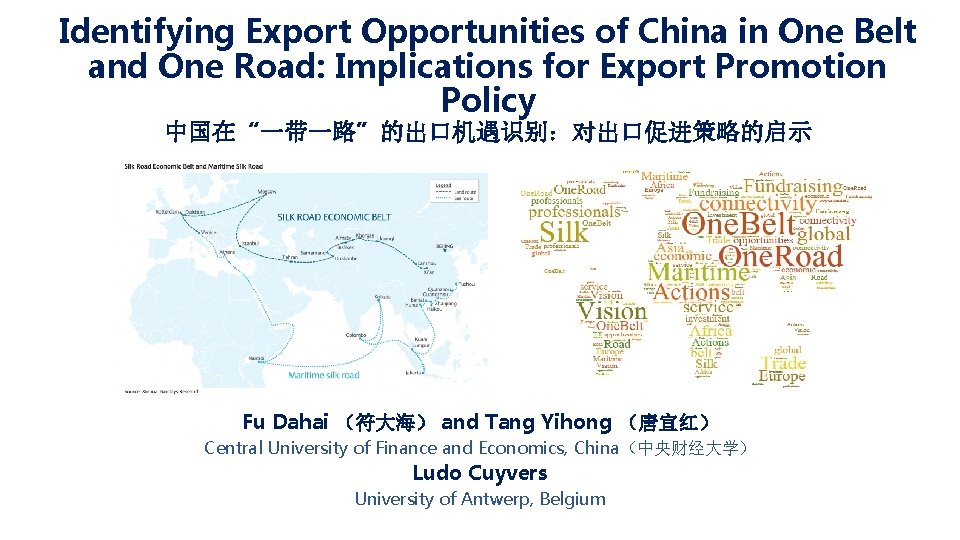
Identifying Export Opportunities of China in One Belt and One Road: Implications for Export Promotion Policy 中国在“一带一路”的出口机遇识别:对出口促进策略的启示 Fu Dahai (符大海) and Tang Yihong (唐宜红) Central University of Finance and Economics, China(中央财经大学) Ludo Cuyvers University of Antwerp, Belgium
Research Background China’s one belt and one road (OBOR) initiative unveiled by President Xi Jinping in 2013, aims to restore the country’s old land sea trade routes and to boost economic connectivity between Asia, Europe and Africa. Unimpeded trade is one of the five priorities for the OBOR initiative. China wants to reduce trade barriers, increase efficiency and promote regional economic integration. To date, it has signed 14 free trade agreements involving over 20 countries. The volume between China and OBOR countries has increased by 13. 4 percent year-on-year - 5. 9 percent higher than China’s overall foreign trade growth rate in 2017.
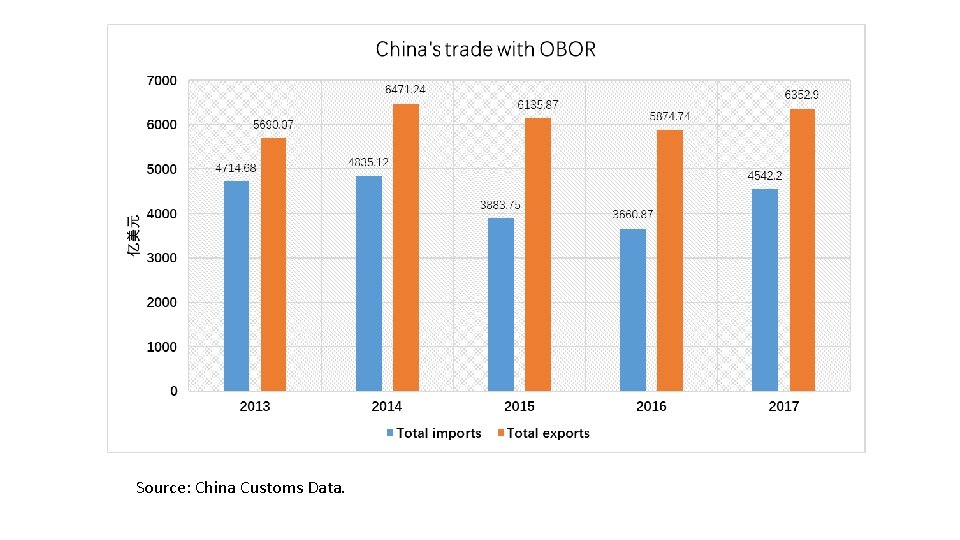
Source: China Customs Data.

Source: China Customs Data.
Research Background The OBOR will bring a great export opportunities for Chinese firms. However, China’s business will face different opportunities in different countries due to a great diversity among countries in terms of development stage, market size, consumption features, and transport infrastructure. Export promotion officials are under increasing pressure to allocate their scarce resources in a way that strengthens their countries’ existing exports while also focusing on new opportunity area. A key component of a successful export promotion drive is the ability to identify the right foreign markets.
Research Purpose We aims to identify China’s realistic export opportunities along the One Belt and One Road, which together constitutes an economicallydynamic region and a strategic export destination for China. Furthermore, this paper seeks to determine the extent to which China already has a share in the OBOR countries and where new opportunities lie. Finally, we forms an important basis for the formulation of appropriate export promotion strategies for China.
Related Studies A small but growing body of literature addresses the question of how to identify opportunities for exporters. Papadopoulos and Denis (1988, IMR) provided the first summary and categorization of the literature on international market selection. Steenkamp, Viviers and Cuyvers (2012) provided a detailed discussion and comparison of the specific firm- and country-level studies. The Decision Support Model (DSM) can be classified as a country-level international market selection model, which considers all possible worldwide product-country combinations as a starting point, while other methods base their analyses on the exporting country’s existing export products and/or destinations. The DSM has been applied to identify export opportunities for many countries including Belgium (Cuyvers and Dumount, 2008), South Africa (Viviers and Cuyers, 2013), Netherlands (Viviers et al. , 2014), Czech Republic (Urban et al. , 2014), Greece (Kanellopoulos and Skintzi, 2014) and Thailand (Cuyvers, 1997; Cuyvers et al. , 2016).
Contributions This is the first paper to apply decision support model (DSM) approach to identify China’s export opportunities. This is the first paper to identify China’s export potential and opportunities at the country-product level in the OBOR. The findings are of great implications for export promotion agencies, industry associations and business.
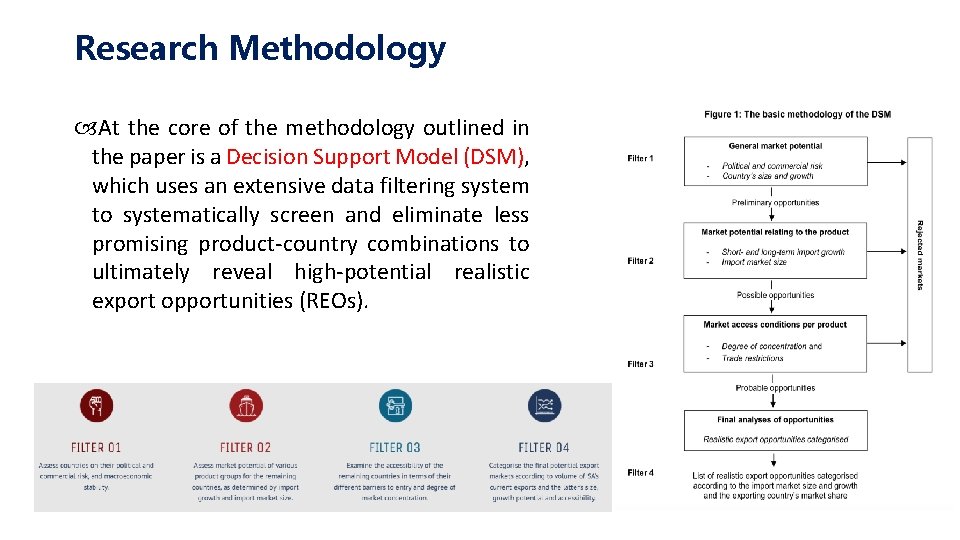
Research Methodology At the core of the methodology outlined in the paper is a Decision Support Model (DSM), which uses an extensive data filtering system to systematically screen and eliminate less promising product-country combinations to ultimately reveal high-potential realistic export opportunities (REOs).
Filter 1 In Filter 1, countries are eliminated that pose too high a political and/or commercial risk to the exporting country, and do not show adequate macroeconomic size or growth. Step 1: The ONDD rates countries on a scale of 1 to 7 for political risk and rates “A”, “B” and “C” for commercial risk. A country is considered to be too risky as a target for public export promotion efforts if its ONDD rating is 6 C, 7 A, 7 B or 7 C. Step 2: A country is selected based on its macroeconomic size when its GDP and GDP per capita values are higher than the cut-off values (20 th percentile) for at least two of the three years 2013, 2014, 2015. Alternative selection: For macroeconomic growth, the average GDP growth and GDP per capita growth values are used as cut-off values for all three years. After Filter 1, we retained 53 in 65 OBOR countries that enter into Filter 2.
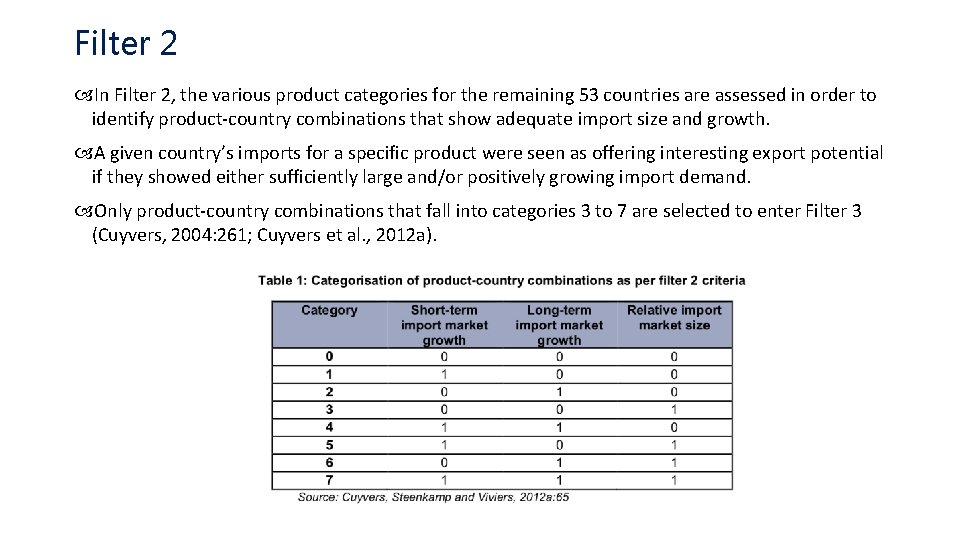
Filter 2 In Filter 2, the various product categories for the remaining 53 countries are assessed in order to identify product-country combinations that show adequate import size and growth. A given country’s imports for a specific product were seen as offering interesting export potential if they showed either sufficiently large and/or positively growing import demand. Only product-country combinations that fall into categories 3 to 7 are selected to enter Filter 3 (Cuyvers, 2004: 261; Cuyvers et al. , 2012 a).
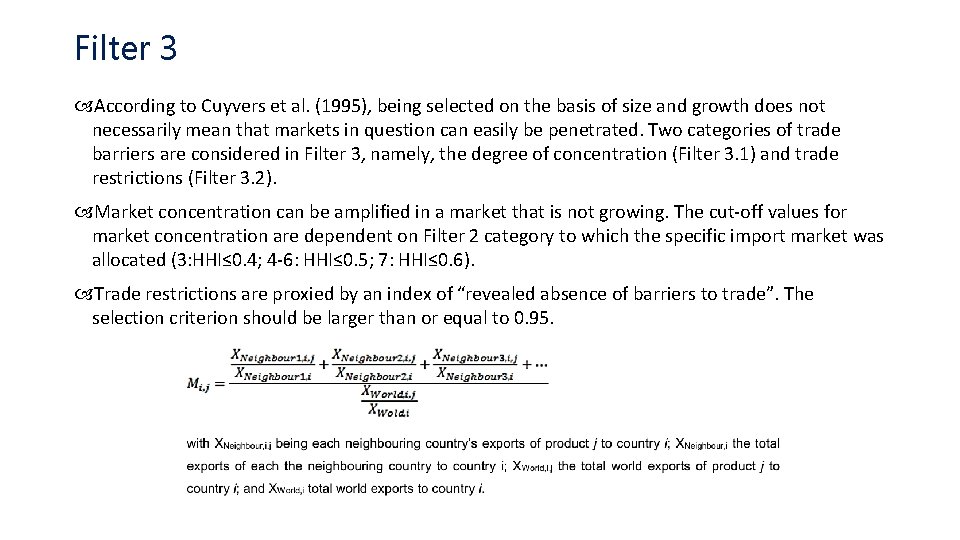
Filter 3 According to Cuyvers et al. (1995), being selected on the basis of size and growth does not necessarily mean that markets in question can easily be penetrated. Two categories of trade barriers are considered in Filter 3, namely, the degree of concentration (Filter 3. 1) and trade restrictions (Filter 3. 2). Market concentration can be amplified in a market that is not growing. The cut-off values for market concentration are dependent on Filter 2 category to which the specific import market was allocated (3: HHI≤ 0. 4; 4 -6: HHI≤ 0. 5; 7: HHI≤ 0. 6). Trade restrictions are proxied by an index of “revealed absence of barriers to trade”. The selection criterion should be larger than or equal to 0. 95.
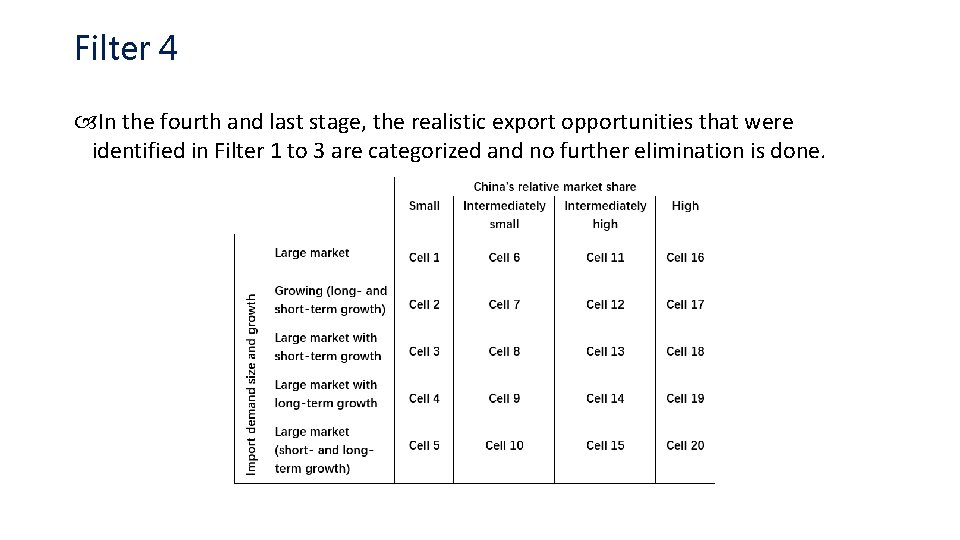
Filter 4 In the fourth and last stage, the realistic export opportunities that were identified in Filter 1 to 3 are categorized and no further elimination is done.
Data For filter 1, country-level data on political and commercial risk are sourced from the Office National du Ducroire (ONDD), as well as macro-economic data (GDP, GDP per capita –levels and -growth) from the World Bank Development Indicators are used. In filters 2, 3 and 4 bilateral trade values from CEPII-BACI during the period from 2013 to 2015.

Findings
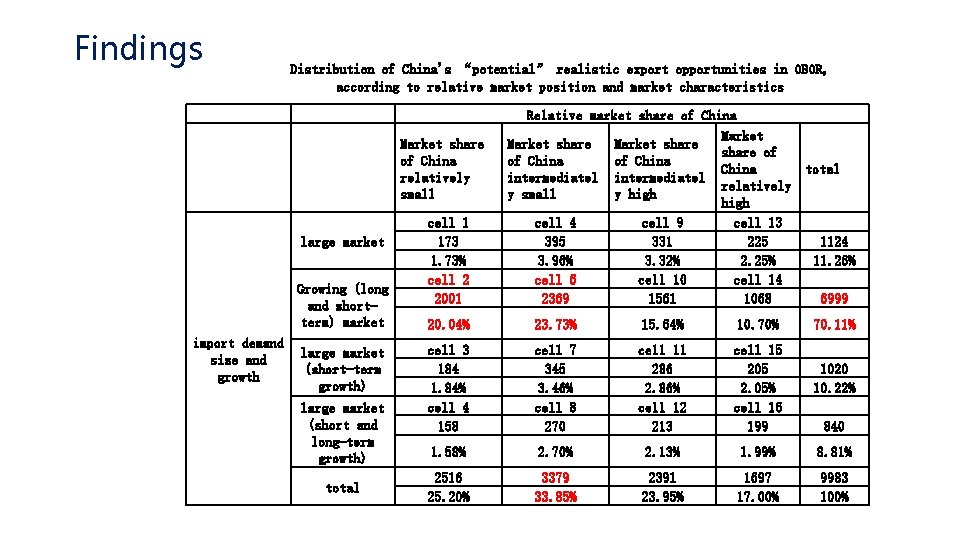
Findings Distribution of China's “potential” realistic export opportunities in OBOR, according to relative market position and market characteristics Market share of China relatively small large market Growing (long and shortterm) market import demand size and growth large market (short-term growth) large market (short and long-term growth) total cell 1 173 1. 73% cell 2 2001 Relative market share of China Market share of of China total intermediatel relatively y small y high cell 4 cell 9 cell 13 395 331 225 1124 3. 96% 3. 32% 2. 25% 11. 26% cell 6 cell 10 cell 14 2369 1561 1068 6999 20. 04% 23. 73% 15. 64% 10. 70% 70. 11% cell 3 184 1. 84% cell 4 158 cell 7 345 3. 46% cell 8 270 cell 11 286 2. 86% cell 12 213 cell 15 205 2. 05% cell 16 199 1. 58% 2. 70% 2. 13% 1. 99% 8. 81% 2516 25. 20% 3379 33. 85% 2391 23. 95% 1697 17. 00% 9983 100% 1020 10. 22% 840
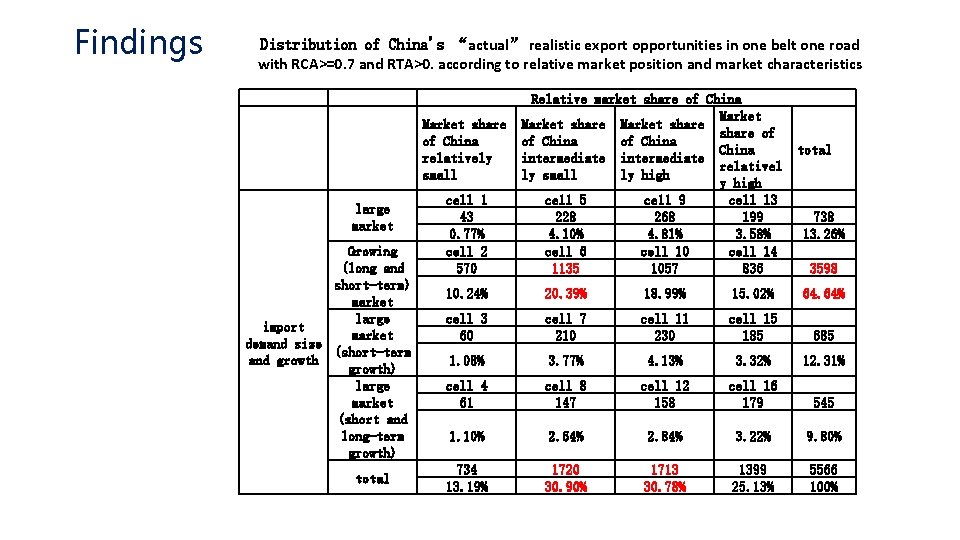
Findings Distribution of China's “actual” realistic export opportunities in one belt one road with RCA>=0. 7 and RTA>0. according to relative market position and market characteristics Market share of China relatively small large market Growing (long and short-term) market large import market demand size (short-term and growth) large market (short and long-term growth) total cell 1 43 0. 77% cell 2 570 Relative market share of China Market share of of China intermediate relativel ly small ly high cell 5 cell 9 cell 13 228 268 199 4. 10% 4. 81% 3. 58% cell 6 cell 10 cell 14 1135 1057 836 total 738 13. 26% 3598 10. 24% 20. 39% 18. 99% 15. 02% 64. 64% cell 3 60 cell 7 210 cell 11 230 cell 15 185 685 1. 08% 3. 77% 4. 13% 3. 32% 12. 31% cell 4 61 cell 8 147 cell 12 158 cell 16 179 545 1. 10% 2. 64% 2. 84% 3. 22% 9. 80% 734 13. 19% 1720 30. 90% 1713 30. 78% 1399 25. 13% 5566 100%
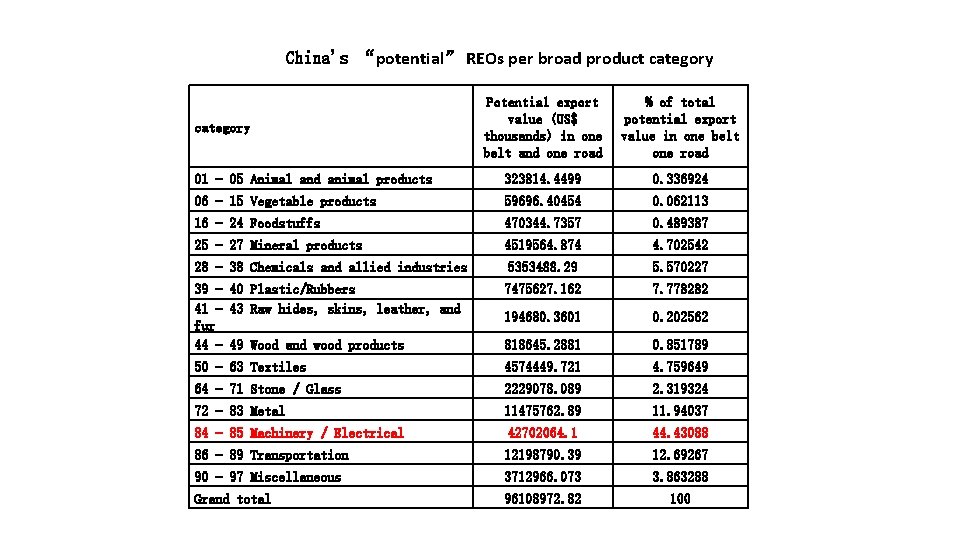
China's “potential” REOs per broad product category Potential export value (US$ thousands) in one belt and one road % of total potential export value in one belt one road 01 - 05 Animal and animal products 323814. 4499 0. 336924 06 - 15 Vegetable products 59696. 40454 0. 062113 16 - 24 Foodstuffs 470344. 7357 0. 489387 25 - 27 Mineral products 4519564. 874 4. 702542 28 - 38 Chemicals and allied industries 5353488. 29 5. 570227 39 - 40 Plastic/Rubbers 41 - 43 Raw hides, skins, leather, and fur 44 - 49 Wood and wood products 7475627. 162 7. 778282 194680. 3601 0. 202562 818645. 2881 0. 851789 50 - 63 Textiles 4574449. 721 4. 759649 64 - 71 Stone / Glass 2229078. 089 2. 319324 72 - 83 Metal 11475762. 89 11. 94037 84 - 85 Machinery / Electrical 42702064. 1 44. 43088 86 - 89 Transportation 12198790. 39 12. 69267 90 - 97 Miscellaneous 3712966. 073 3. 863288 Grand total 96108972. 82 100 category
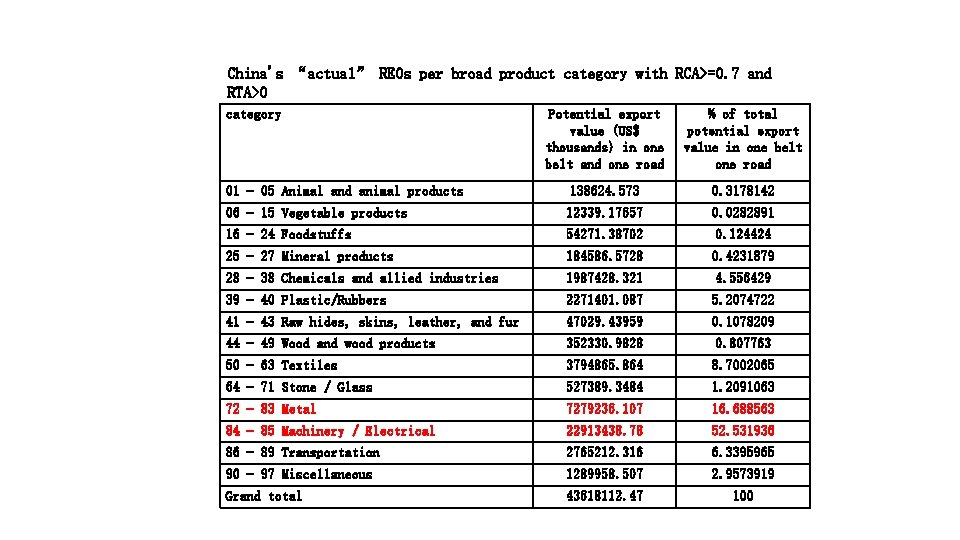
China's “actual” REOs per broad product category with RCA>=0. 7 and RTA>0 category Potential export value (US$ thousands) in one belt and one road % of total potential export value in one belt one road 01 - 05 Animal and animal products 138624. 573 0. 3178142 06 - 15 Vegetable products 12339. 17657 0. 0282891 16 - 24 Foodstuffs 54271. 38702 0. 124424 25 - 27 Mineral products 184586. 5728 0. 4231879 28 - 38 Chemicals and allied industries 1987428. 321 4. 556429 39 - 40 Plastic/Rubbers 2271401. 087 5. 2074722 41 - 43 Raw hides, skins, leather, and fur 47029. 43959 0. 1078209 44 - 49 Wood and wood products 352330. 9828 0. 807763 50 - 63 Textiles 3794865. 864 8. 7002065 64 - 71 Stone / Glass 527389. 3484 1. 2091063 72 - 83 Metal 7279236. 107 16. 688563 84 - 85 Machinery / Electrical 22913438. 78 52. 531936 86 - 89 Transportation 2765212. 316 6. 3395965 90 - 97 Miscellaneous 1289958. 507 2. 9573919 Grand total 43618112. 47 100
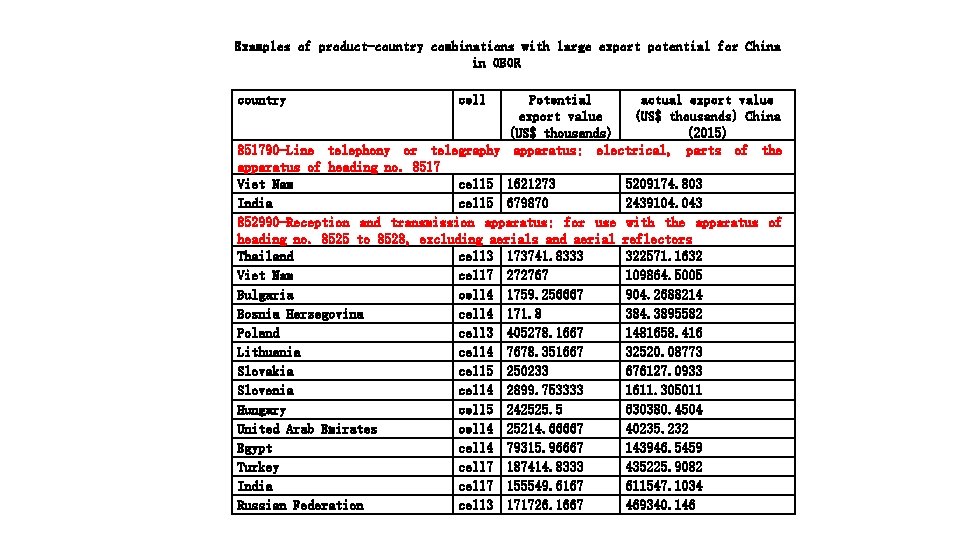
Examples of product-country combinations with large export potential for China in OBOR country cell Potential actual export value (US$ thousands) China (US$ thousands) (2015) 851790 -Line telephony or telegraphy apparatus; electrical, parts of the apparatus of heading no. 8517 Viet Nam cell 5 1621273 5209174. 803 India cell 5 679870 2439104. 043 852990 -Reception and transmission apparatus; for use with the apparatus of heading no. 8525 to 8528, excluding aerials and aerial reflectors Thailand cell 3 173741. 8333 322571. 1632 Viet Nam cell 7 272767 109864. 5005 Bulgaria cell 4 1759. 256667 904. 2688214 Bosnia Herzegovina cell 4 171. 8 384. 3895582 Poland cell 3 405278. 1667 1481658. 416 Lithuania cell 4 7678. 351667 32520. 08773 Slovakia cell 5 250233 676127. 0933 Slovenia cell 4 2899. 753333 1611. 305011 Hungary cell 5 242525. 5 630380. 4504 United Arab Emirates cell 4 25214. 66667 40235. 232 Egypt cell 4 79315. 96667 143946. 5459 Turkey cell 7 187414. 8333 435225. 9082 India cell 7 155549. 6167 611547. 1034 Russian Federation cell 3 171726. 1667 469340. 146
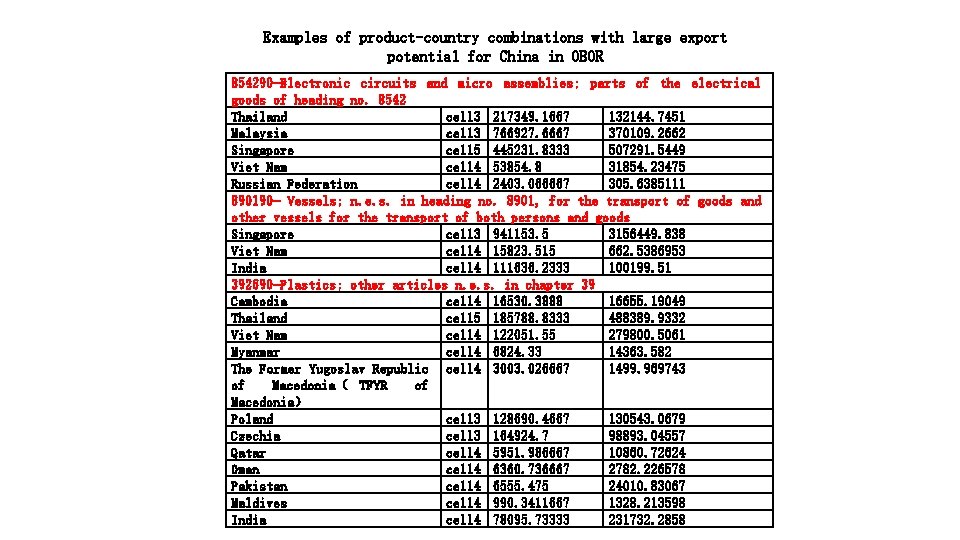
Examples of product-country combinations with large export potential for China in OBOR 854290 -Electronic circuits and micro assemblies; parts of the electrical goods of heading no. 8542 Thailand cell 3 217349. 1667 132144. 7451 Malaysia cell 3 766927. 6667 370109. 2662 Singapore cell 5 445231. 8333 507291. 5449 Viet Nam cell 4 53854. 8 31854. 23475 Russian Federation cell 4 2403. 066667 305. 6385111 890190 - Vessels; n. e. s. in heading no. 8901, for the transport of goods and other vessels for the transport of both persons and goods Singapore cell 3 941153. 5 3156449. 838 Viet Nam cell 4 15823. 515 662. 5386953 India cell 4 111636. 2333 100199. 51 392690 -Plastics; other articles n. e. s. in chapter 39 Cambodia cell 4 16530. 3888 16655. 19049 Thailand cell 5 185788. 8333 488389. 9332 Viet Nam cell 4 122051. 55 279800. 5061 Myanmar cell 4 6824. 33 14363. 582 The Former Yugoslav Republic cell 4 3003. 026667 1499. 969743 of Macedonia( TFYR of Macedonia) Poland cell 3 128690. 4667 130543. 0679 Czechia cell 3 164924. 7 98893. 04557 Qatar cell 4 5951. 986667 10860. 72624 Oman cell 4 6360. 736667 2782. 226578 Pakistan cell 4 6555. 475 24010. 83067 Maldives cell 4 990. 3411667 1328. 213598 India cell 4 78095. 73333 231732. 2858
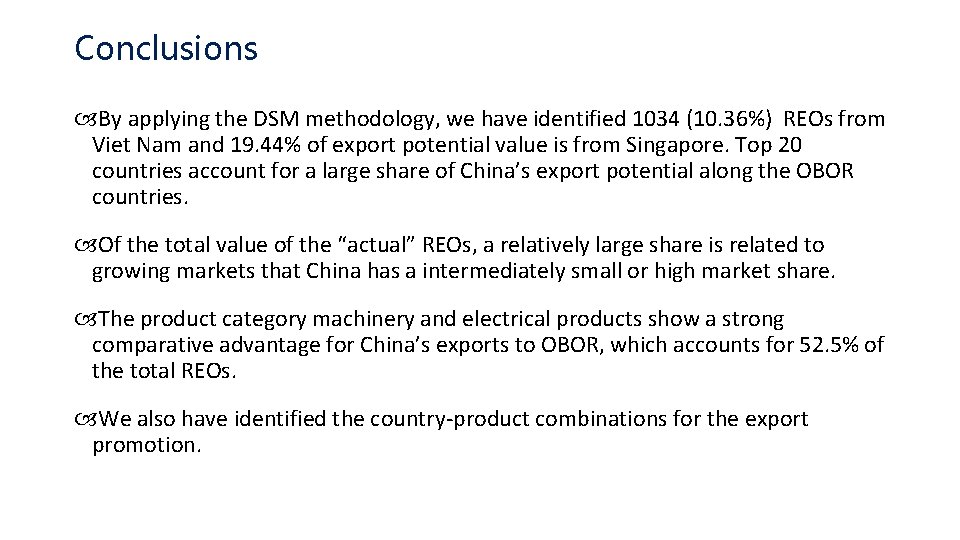
Conclusions By applying the DSM methodology, we have identified 1034 (10. 36%) REOs from Viet Nam and 19. 44% of export potential value is from Singapore. Top 20 countries account for a large share of China’s export potential along the OBOR countries. Of the total value of the “actual” REOs, a relatively large share is related to growing markets that China has a intermediately small or high market share. The product category machinery and electrical products show a strong comparative advantage for China’s exports to OBOR, which accounts for 52. 5% of the total REOs. We also have identified the country-product combinations for the export promotion.
Implications for China’s Export Promotion Policy The findings from this study builds a strong base for China to introduce a strong regional and product focus in its export promotion efforts. It points to the fact that relatively more of the country’s scarce public export promotion resources should be directed at ASEAN and West Asia as well as North Africa at least in the short-run. More efforts should be targeted at the promotion of the exports of machinery and electrical products in particular countries with strong REOS.

Thanks and Comments Welcome! Dr. FU Dahai Email: fudahai@cufe. edu. cn
- Slides: 24