
Identifying depleted areas using overburden 4 D time
Identifying depleted areas using overburden 4 D time shifts Thomas Røste (Statoil) ROSE meeting 23. -24. April 2018
Outline • Why monitor overburden? • Time shifts and geomechanics • Field examples • Summary

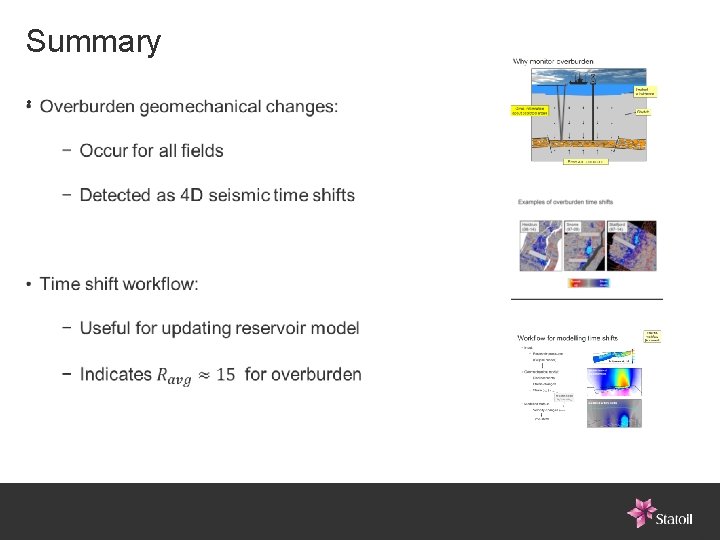
Why monitor overburden Seabed subsidence - 4 D seismic time shifts in overburden give information about depleted areas Independent of reservoir fluid changes Hydrocarbon production Reservoir compaction Pore-pressure decrease Overburden Stress Stretch displacements changes
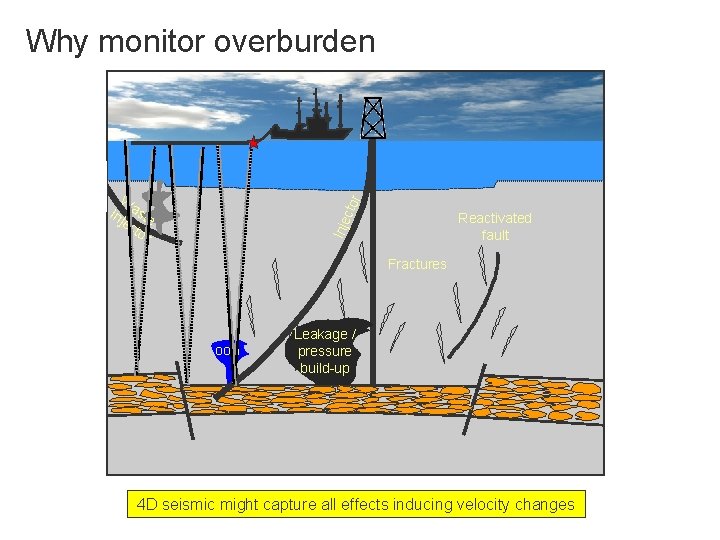
Why monitor overburden cto r W Inj aste ec tor Inje Reactivated fault Fractures oozi Leakage / pressure build-up 4 D seismic might capture all effects inducing velocity changes
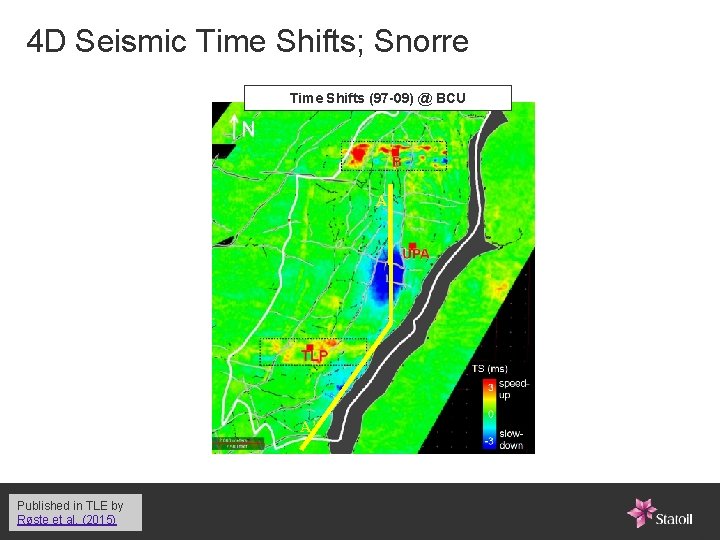
4 D Seismic Time Shifts; Snorre Time Shifts (97 -09) @ BCU A A’ Published in TLE by Røste et al. (2015)
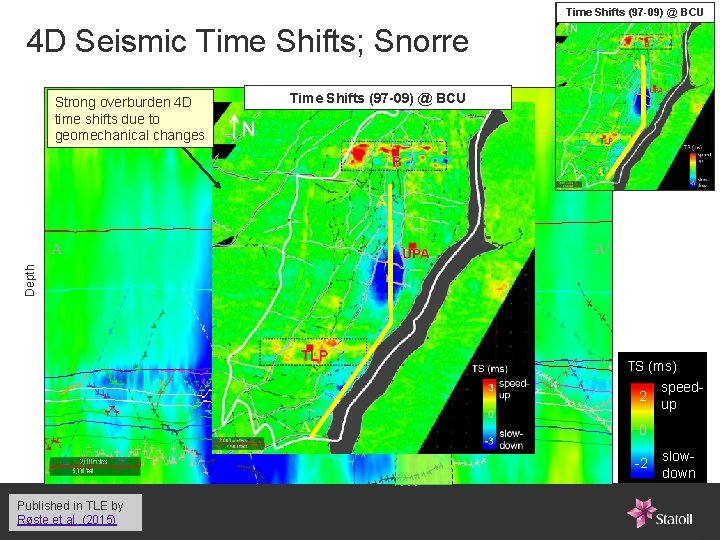
Time Shifts (97 -09) @ BCU 4 D Seismic Time Shifts; Snorre Strong overburden 4 D time shifts due to geomechanical changes A (Poor@4 D Time Shifts (97 -09) BCU due to TLP) Nordland (Seabed) A’ A Hordaland A’ Depth A Balder BCU TS (ms) 2 A’ SN LL 0 -2 Published in TLE by Røste et al. (2015) speedup slowdown

Examples of overburden time shifts Speedup Published in TLE by Røste et al. (2017) Slowdown
Outline • Why monitor overburden? • Time shifts and geomechanics • Field examples • Summary
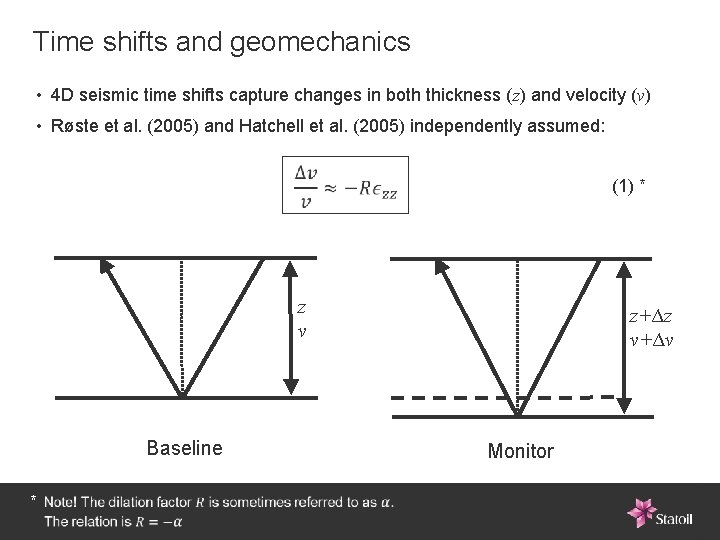
Time shifts and geomechanics • 4 D seismic time shifts capture changes in both thickness (z) and velocity (v) • Røste et al. (2005) and Hatchell et al. (2005) independently assumed: (1) * z v Baseline * z+Δz v+Δv Monitor
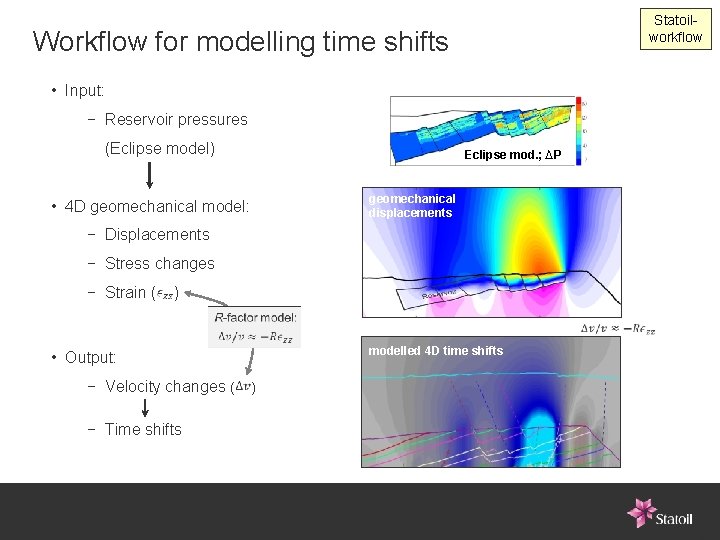
Statoilworkflow Workflow for modelling time shifts • Input: − Reservoir pressures (Eclipse model) • 4 D geomechanical model: Eclipse mod. ; ∆P geomechanical displacements − Displacements − Stress changes − Strain ( ) • Output: − Velocity changes ( ) − Time shifts modelled 4 D time shifts
Outline • Why monitor overburden? • Time shifts and geomechanics • Field examples • Summary
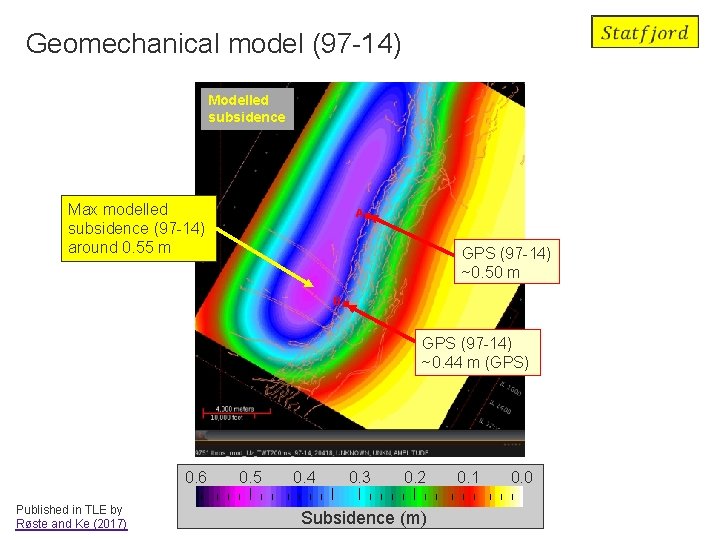
Geomechanical model (97 -14) Modelled subsidence Max modelled subsidence (97 -14) around 0. 55 m A GPS (97 -14) ~0. 50 m B GPS (97 -14) ~0. 44 m (GPS) 0. 6 Published in TLE by Røste and Ke (2017) 0. 5 0. 4 0. 3 0. 2 Subsidence (m) 0. 1 0. 0
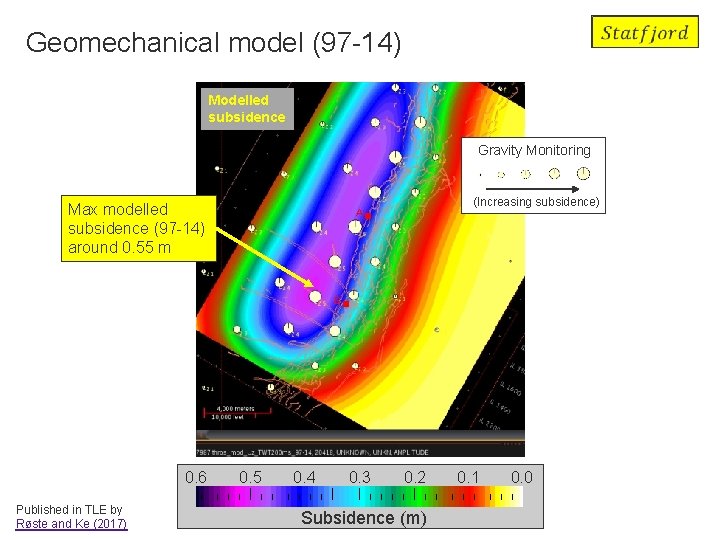
Geomechanical model (97 -14) Modelled subsidence Gravity Monitoring Max modelled subsidence (97 -14) around 0. 55 m (Increasing subsidence) A B 0. 6 Published in TLE by Røste and Ke (2017) 0. 5 0. 4 0. 3 0. 2 Subsidence (m) 0. 1 0. 0
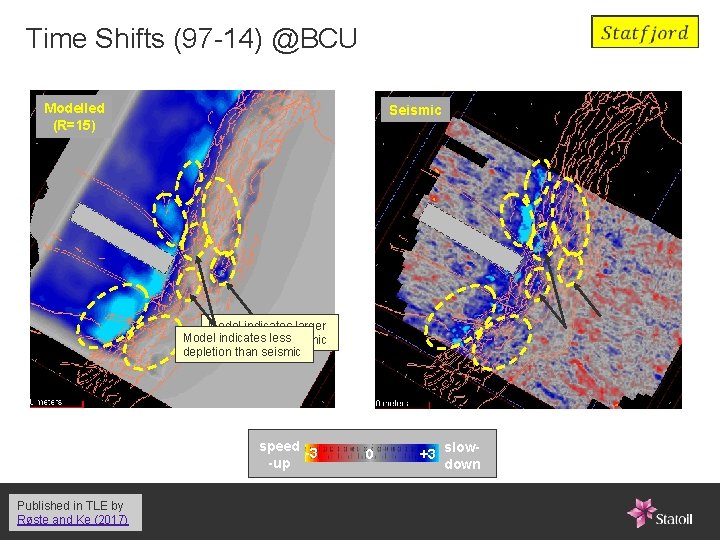
Time Shifts (97 -14) @BCU Modelled (R=15) Seismic Model indicates larger Model indicatesthan lessseismic depletion than seismic speed -3 -up Published in TLE by Røste and Ke (2017) 0 +3 slowdown
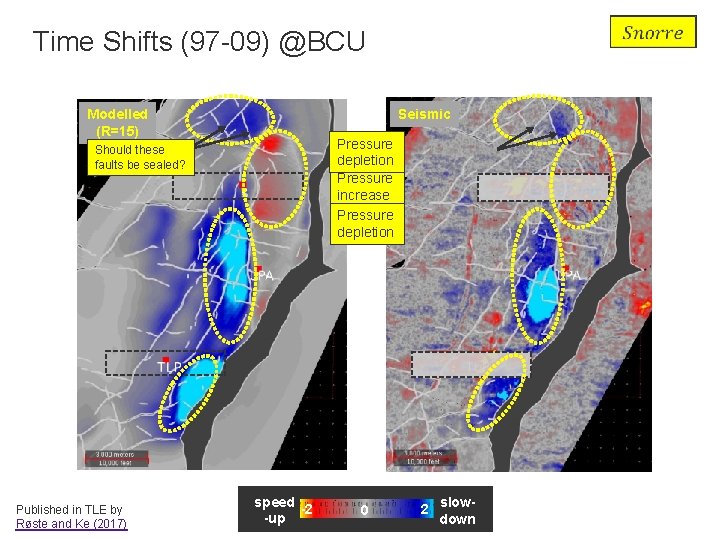
Time Shifts (97 -09) @BCU Seismic Modelled (R=15) Pressure depletion Pressure increase Pressure depletion Should these faults be sealed? Published in TLE by Røste and Ke (2017) speed -2 -up 0 2 slowdown
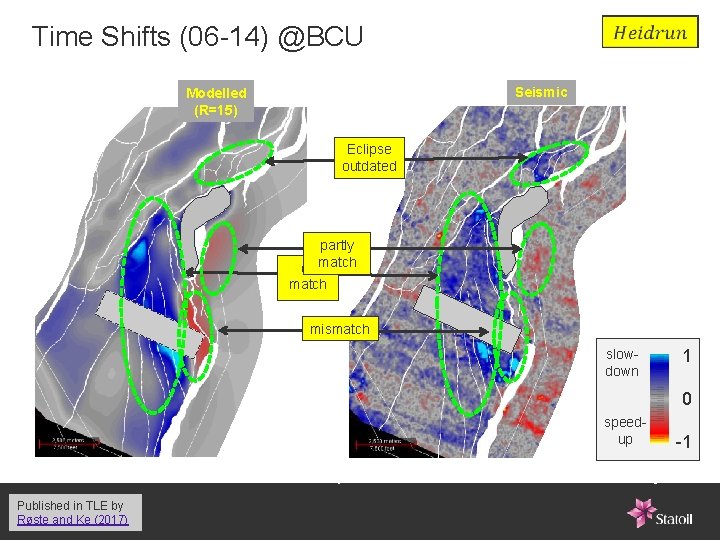
Time Shifts (06 -14) @BCU Seismic Modelled (R=15) Eclipse outdated partly ok match mismatch slowdown 1 0 speedup Published in TLE by Røste and Ke (2017) -1
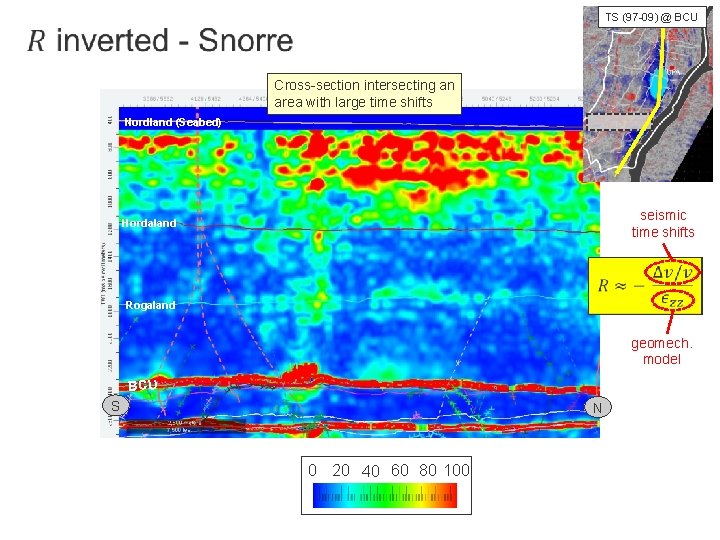
TS (97 -09) @ BCU Cross-section intersecting an area with large time shifts Nordland (Seabed) seismic time shifts Hordaland Rogaland geomech. model BCU S N 0 20 40 60 80 100
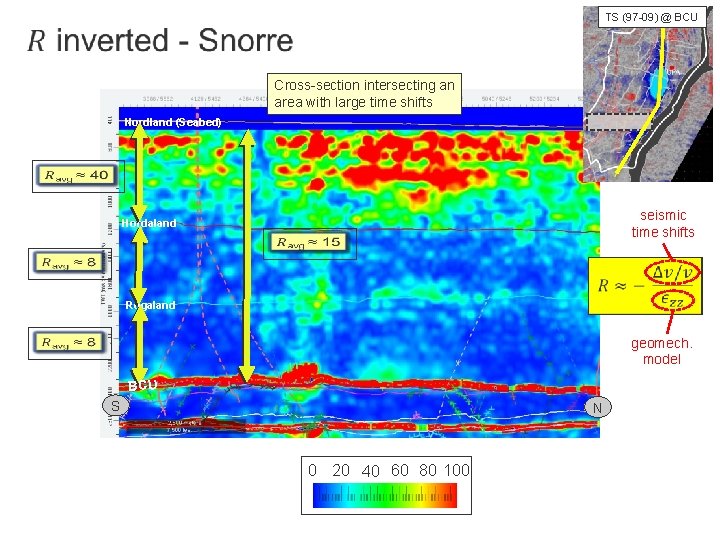
TS (97 -09) @ BCU Cross-section intersecting an area with large time shifts Nordland (Seabed) seismic time shifts Hordaland Rogaland geomech. model BCU S N 0 20 40 60 80 100
Outline • Why monitor overburden? • Time shifts and geomechanics • Field examples • Summary
Summary •
Acknowledgments • Ganpan Ke for fruitful discussions and input to geomechanical models • Colleagues in Statoil and NTNU for discussions, especially: − Sascha Bussat, Lasse Renli, Martin Landrø, Kenneth Duffaut, Bård Bostrøm, Ola -Petter Munkvold, Øyvind Kvam, Ole K. Søreide, Svend Østmo, Odd Arve Solheim, Jon Lippard, Frank Aanvik, Torill Andersen, Marianne Houbiers, and Vibeke Haugen • The Snorre, Statfjord, and Heidrun partnerships for permission to present this data
References • Røste, T. and G. Ke, 2017, Overburden 4 D time shifts — Indicating undrained areas and fault transmissibility in the reservoir: The Leading Edge. • Røste, T. , O. P. Dybvik, and O. K. Søreide, 2015, Overburden 4 D time shifts induced by reservoir compaction at Snorre field: The Leading Edge. • Røste, T. , A. Stovas, and M. Landrø, 2005, Estimation of layer thickness and velocity changes using 4 D prestack seismic data: 67 th EAGE, Extended Abstracts, C 010. • Hatchell, P. J. , R. S. Kawar, and A. A. Savitski, 2005, Integrating 4 D seismic, geomechanics and reservoir simulation in the Valhall Oil Field: 67 th EAGE, Extended Abstracts, C 012. 22 -
- Slides: 22