
Identifying Cloud Glaciation with Single Particle Light Depolarization

- Slides: 21
Identifying Cloud Glaciation with Single Particle Light Depolarization Bruce Gandrud Droplet Measurement Technologies Boulder, Colorado Darrel Baumgardner Centro de Ciencias de la Atmósfera Universidad Nacional Autónoma de México Mexico City, Mexico Martina Krämer Jűlich Institute Germany
Problem Statement The transition of water to ice is a fundamentally important process in clouds, since it is an efficient mechanism for the formation of precipitation. This process is poorly understood, largely due to the lack of instruments that can distinguish liquid water from ice in the early stages of glaciation, i. e. when the droplets and crystals are less than ~50 μm. The effectiveness of cloud seeding depends on the number of natural ice nuclei (IN), the concentration of supercooled liquid water content (SLWC) and the ability to measure both. Until recently there were few instruments to measure IN (none commercially available)** and no sensor that could make size resolved, unambiguous measurements separating water droplets from ice crystals. ** Droplet Measurement Technologies will have an IN counter available for marketing at the end of 2011.
Introducing The Cloud Particle Spectrometer with Depolarization (CPSD) and The Backscatter Cloud Probe with Depolarization (BCPD)
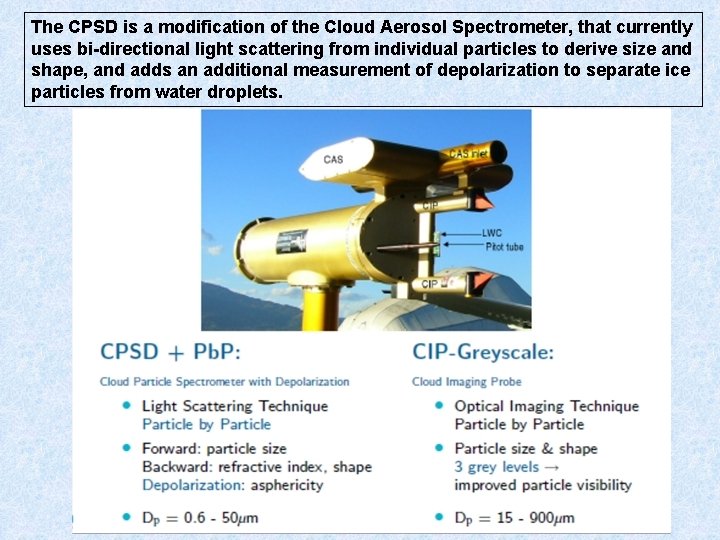
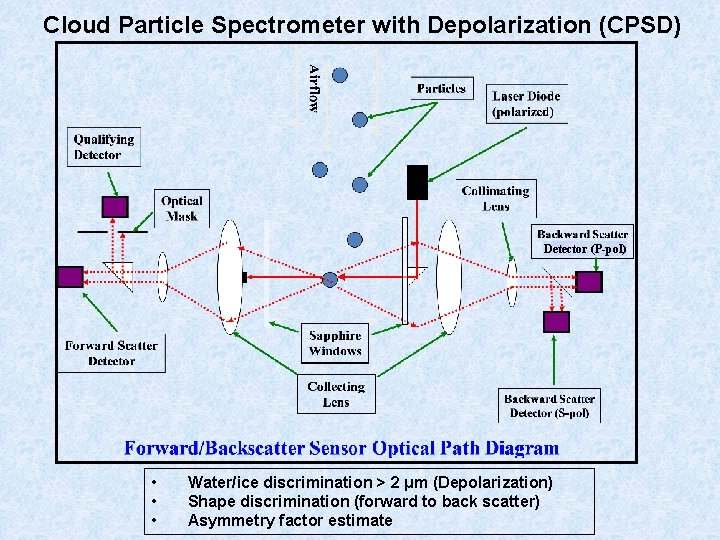
The CPSD is a modification of the Cloud Aerosol Spectrometer, that currently uses bi-directional light scattering from individual particles to derive size and shape, and adds an additional measurement of depolarization to separate ice particles from water droplets.
Cloud Particle Spectrometer with Depolarization (CPSD) Detector (P-pol) • • • Water/ice discrimination > 2 μm (Depolarization) Shape discrimination (forward to back scatter) Asymmetry factor estimate
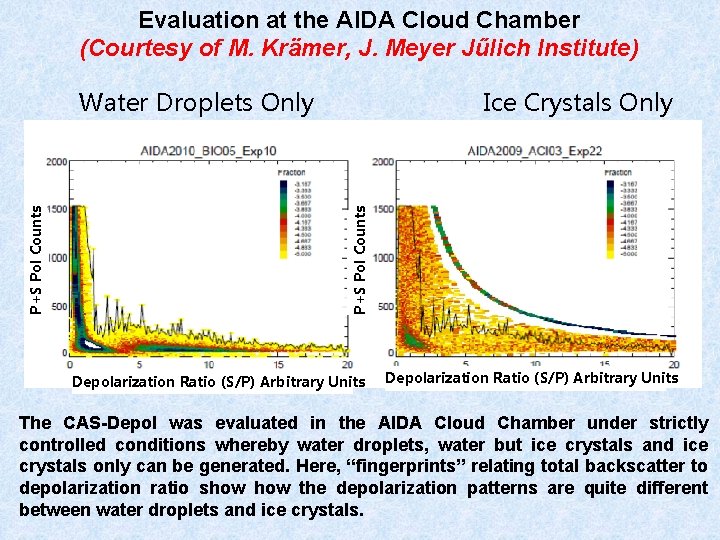
Evaluation at the AIDA Cloud Chamber (Courtesy of M. Krämer, J. Meyer Jűlich Institute) Ice Crystals Only P+S Pol Counts Water Droplets Only Depolarization Ratio (S/P) Arbitrary Units The CAS-Depol was evaluated in the AIDA Cloud Chamber under strictly controlled conditions whereby water droplets, water but ice crystals and ice crystals only can be generated. Here, “fingerprints” relating total backscatter to depolarization ratio show the depolarization patterns are quite different between water droplets and ice crystals.
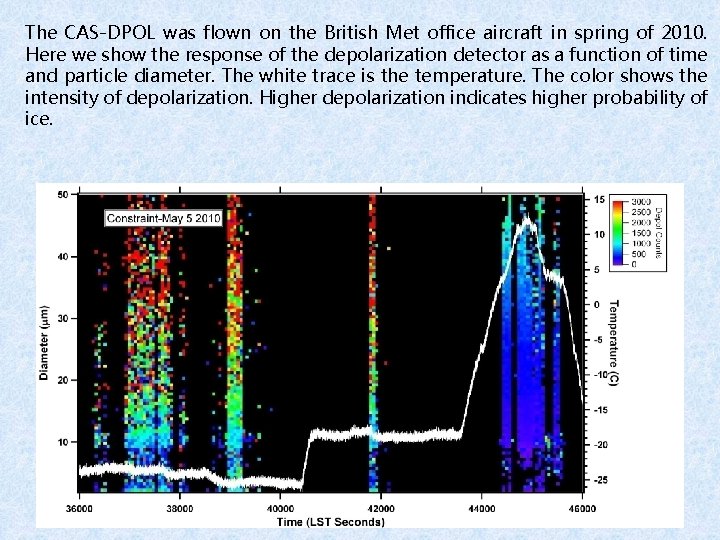
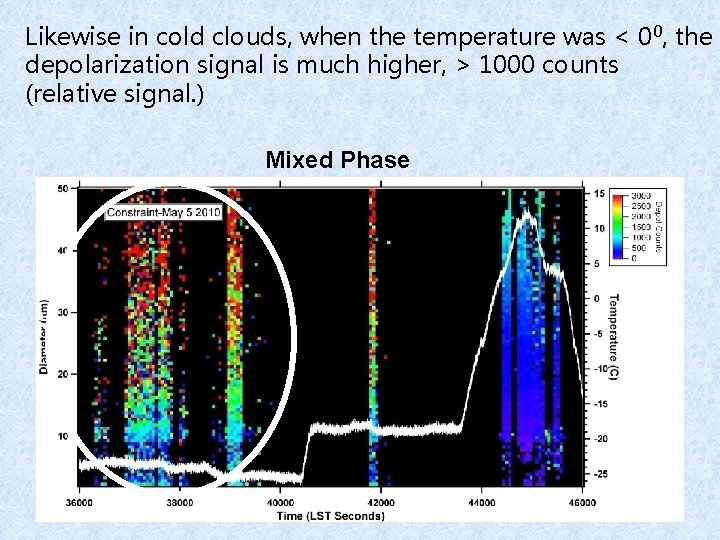
The CAS-DPOL was flown on the British Met office aircraft in spring of 2010. Here we show the response of the depolarization detector as a function of time and particle diameter. The white trace is the temperature. The color shows the intensity of depolarization. Higher depolarization indicates higher probability of ice.
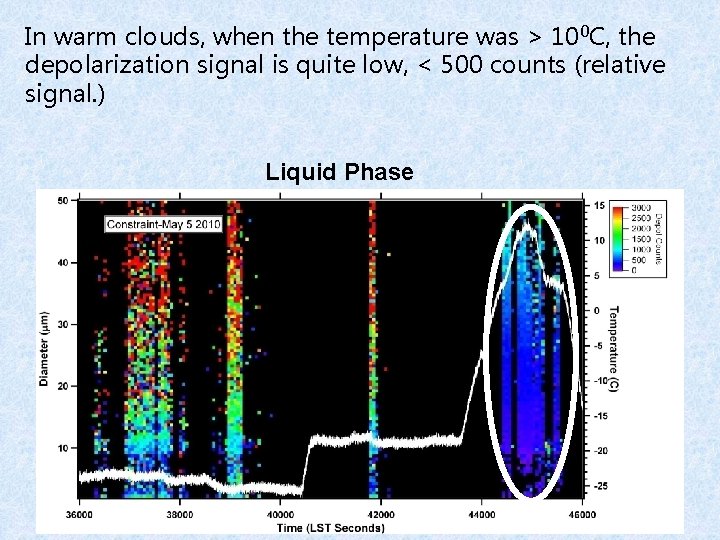
In warm clouds, when the temperature was > 100 C, the depolarization signal is quite low, < 500 counts (relative signal. ) Liquid Phase
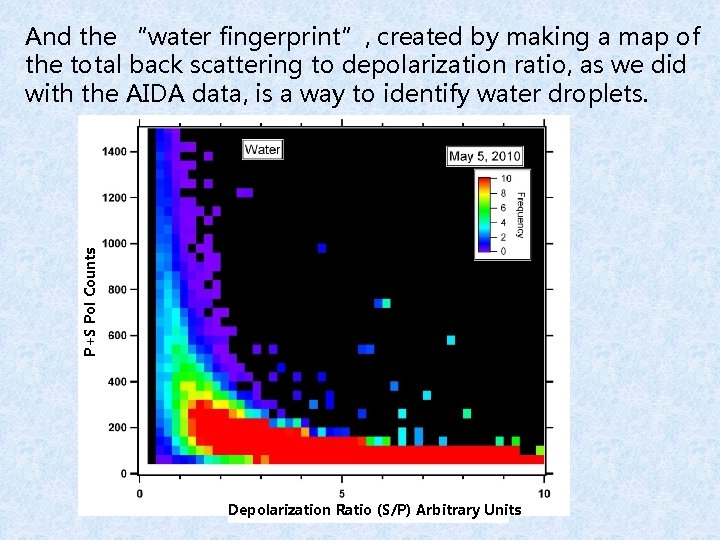
P+S Pol Counts And the “water fingerprint”, created by making a map of the total back scattering to depolarization ratio, as we did with the AIDA data, is a way to identify water droplets. Depolarization Ratio (S/P) Arbitrary Units
Likewise in cold clouds, when the temperature was < 00, the depolarization signal is much higher, > 1000 counts (relative signal. ) Mixed Phase
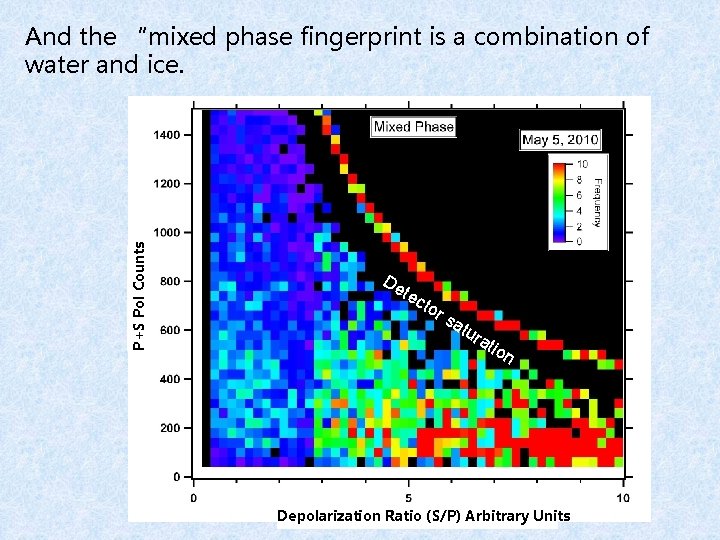
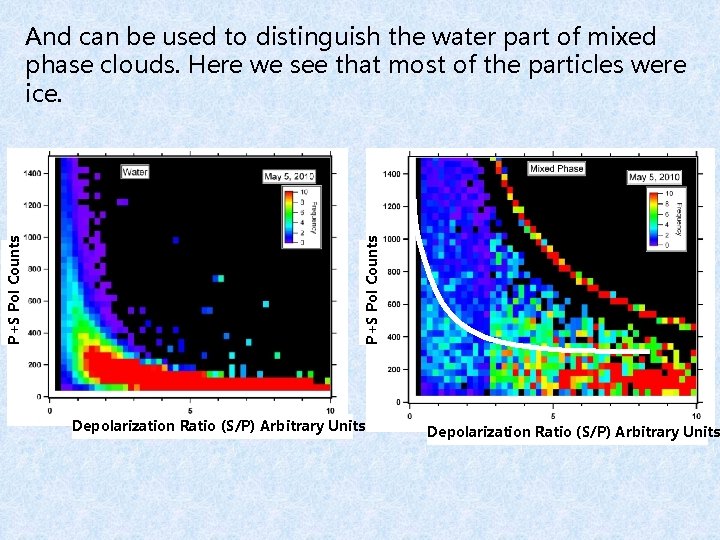
P+S Pol Counts And the “mixed phase fingerprint is a combination of water and ice. De tec tor sa tur ati on Depolarization Ratio (S/P) Arbitrary Units
P+S Pol Counts The white line shows the approximate threshold for water. Depolarization Ratio (S/P) Arbitrary Units
P+S Pol Counts And can be used to distinguish the water part of mixed phase clouds. Here we see that most of the particles were ice. Depolarization Ratio (S/P) Arbitrary Units
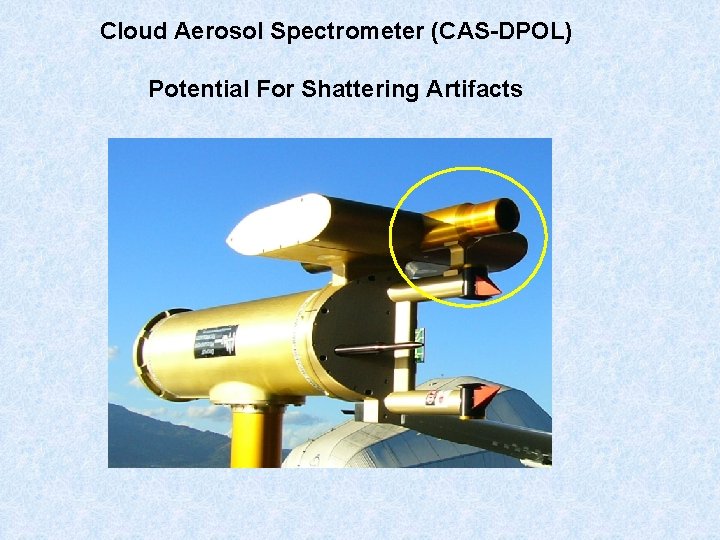
Cloud Aerosol Spectrometer (CAS-DPOL) Potential For Shattering Artifacts
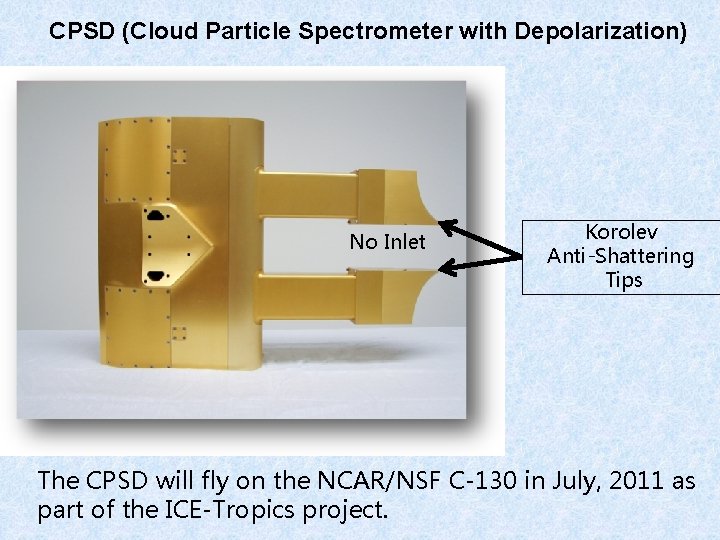
CPSD (Cloud Particle Spectrometer with Depolarization) No Inlet Korolev Anti-Shattering Tips The CPSD will fly on the NCAR/NSF C-130 in July, 2011 as part of the ICE-Tropics project.
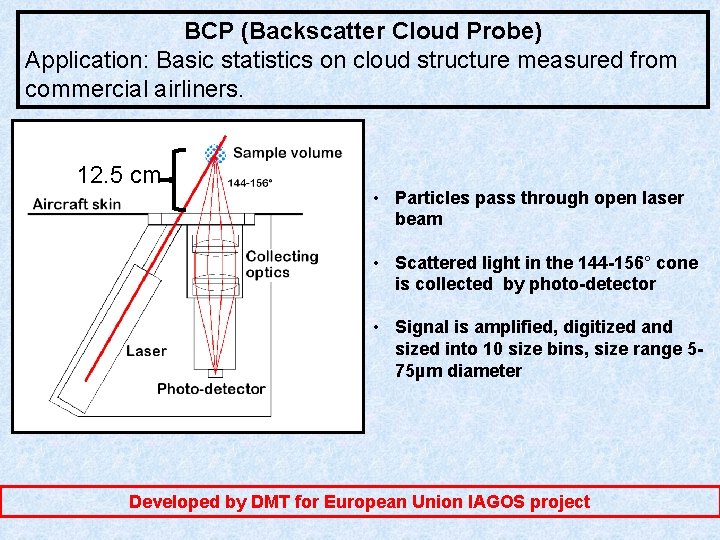
BCP (Backscatter Cloud Probe) Application: Basic statistics on cloud structure measured from commercial airliners. 12. 5 cm • Particles pass through open laser beam • Scattered light in the 144 -156° cone is collected by photo-detector • Signal is amplified, digitized and sized into 10 size bins, size range 575µm diameter Developed by DMT for European Union IAGOS project
Implications for Detecting Cloud Seeding Signatures The magnitude of the depolarization signal for individual ice crystals is a function of crystal habit. Ice crystals formed from artificial nuclei will likely have habits that are initially quite different from the natural crystals. The CPSD can provide information of glaciation rates, i. e. the fraction of cloud particles that are ice. The CPSD could be useful in detecting ice multiplication signatures since ice particles formed by the Hallett Mossop process are distinctly different in shape than pristine ice crystals.
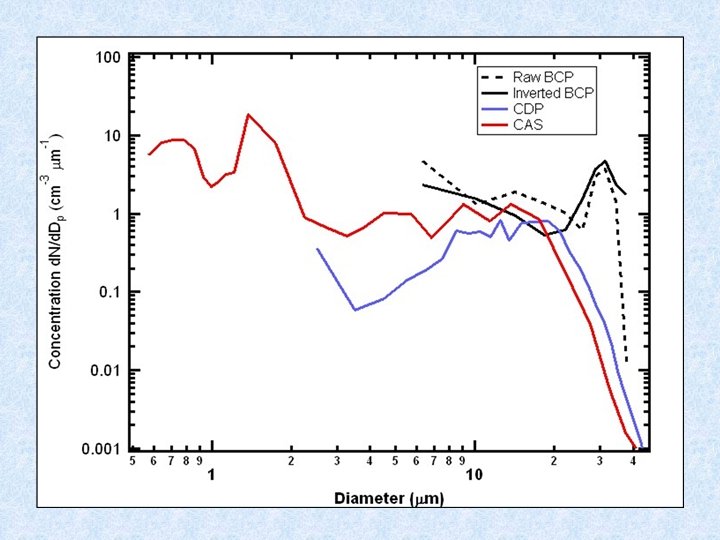
The BCP has been flown successfully on the BAE-146. Contrary to expectations, measurements were comparable to CDP and CAS, even though the sample volume is in the aircraft boundary layer.
Summary • The use of single particle light scattering with measurement of depolarization is cutting edge technology that will provide unprecedented measurements of cloud droplet and ice crystal distributions from 2 – 50 μm. • The CPSD will allow investigations of glaciation rates and evaluation of supercooled ice water fraction in mixed phase clouds. • Identification of the fraction of supercooled LWC prior to seeding, and measurements of small ice crystal concentrations after seeding will allow more precise evaluation of seeding efficiency. • The BCP is currently being upgraded to the BCPD and will be available by early 2012. Although not as precise or accurate of an instrument as the CPSD, its easy mounting makes it an economic alternative to the CPSD.